H.I.S.-toryby Vince Ciotti
Episode #82:          NextGenPart 4
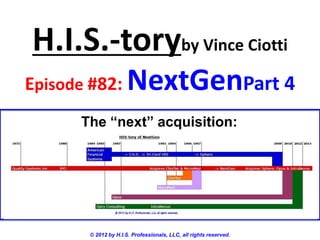
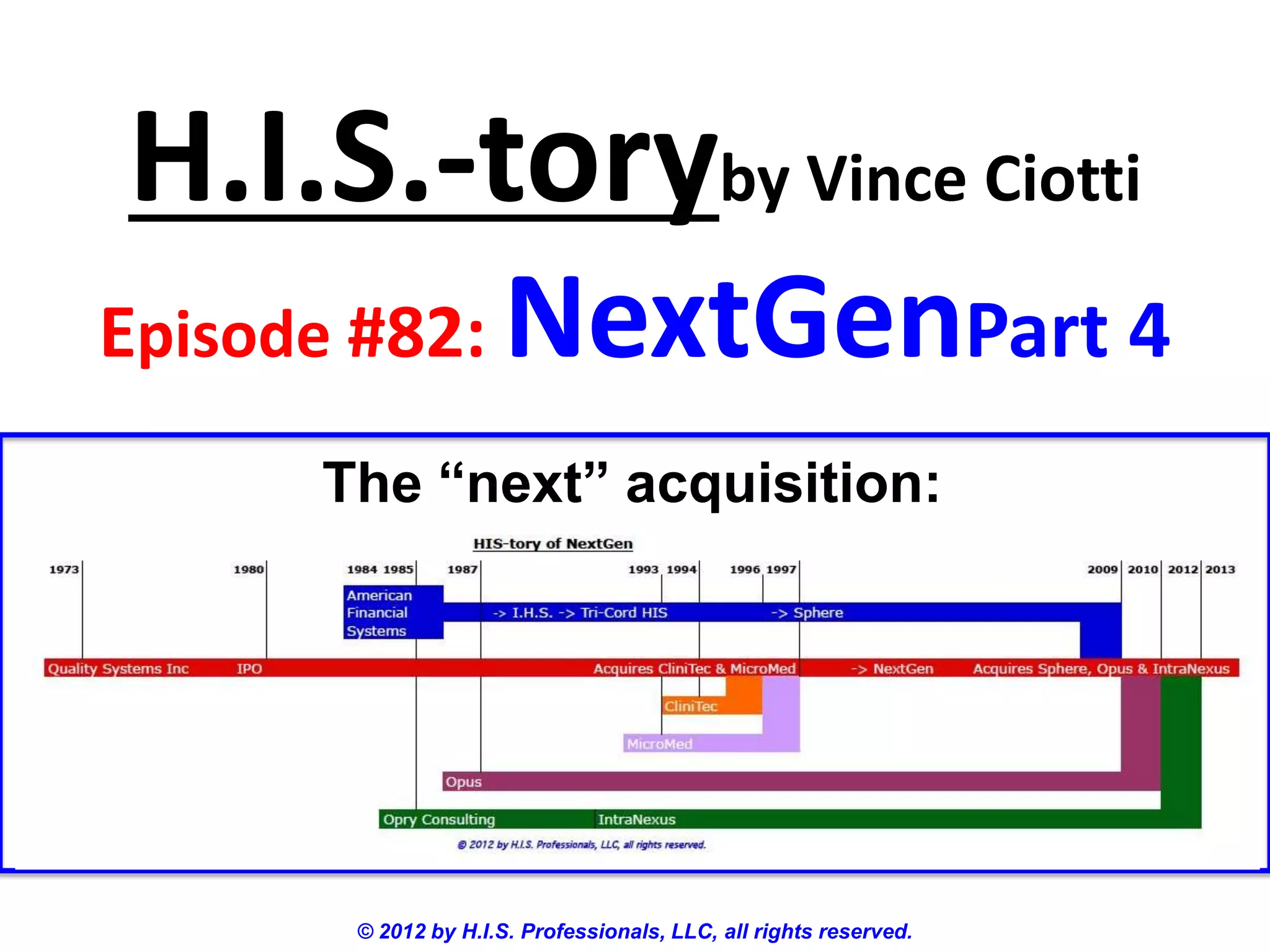
      The “next” acquisition:


       © 2012 by H.I.S. Professionals, LLC, all rights reserved.
Final Episode of NextGen
• Probably not the end of their acquisitions, but the last part in our
  saga of where their present-day HIS product offerings came from.
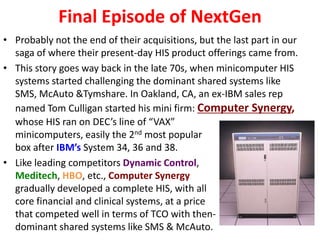
• This story goes way back in the late 70s, when minicomputer HIS
  systems started challenging the dominant shared systems like
  SMS, McAuto &Tymshare. In Oakland, CA, an ex-IBM sales rep
  named Tom Culligan started his mini firm: Computer Synergy,
  whose HIS ran on DEC’s line of “VAX”
  minicomputers, easily the 2nd most popular
  box after IBM’s System 34, 36 and 38.
• Like leading competitors Dynamic Control,
  Meditech, HBO, etc., Computer Synergy
  gradually developed a complete HIS, with all
  core financial and clinical systems, at a price
  that competed well in terms of TCO with then-
  dominant shared systems like SMS & McAuto.
If you can’t
 beat ‘em…
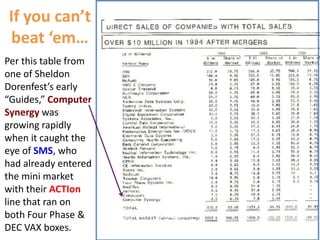
Per this table from
one of Sheldon
Dorenfest’s early
“Guides,” Computer
Synergy was
growing rapidly
when it caught the
eye of SMS, who
had already entered
the mini market
with their ACTIon
line that ran on
both Four Phase &
DEC VAX boxes.
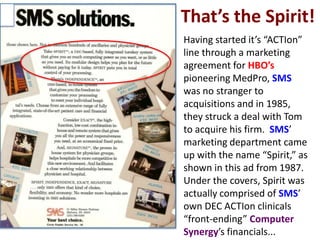
That’s the Spirit!
• Having started it’s “ACTIon”
  line through a marketing
  agreement for HBO’s
  pioneering MedPro, SMS
  was no stranger to
  acquisitions and in 1985,
  they struck a deal with Tom
  to acquire his firm. SMS’
  marketing department came
  up with the name “Spirit,” as
  shown in this ad from 1987.
  Under the covers, Spirit was
  actually comprised of SMS’
  own DEC ACTIon clinicals
  “front-ending” Computer
  Synergy’s financials...
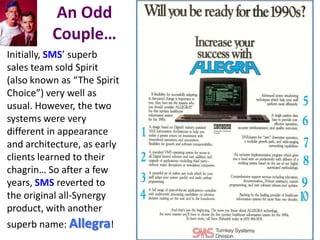
An Odd
          Couple…
Initially, SMS’ superb
sales team sold Spirit
(also known as “The Spirit
Choice”) very well as
usual. However, the two
systems were very
different in appearance
and architecture, as early
clients learned to their
chagrin… So after a few
years, SMS reverted to
the original all-Synergy
product, with another
superb name: Allegra!
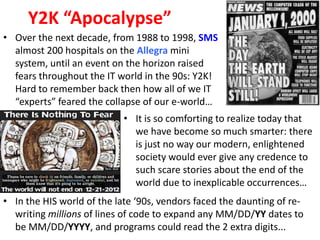
Y2K “Apocalypse”
• Over the next decade, from 1988 to 1998, SMS
  almost 200 hospitals on the Allegra mini
  system, until an event on the horizon raised
  fears throughout the IT world in the 90s: Y2K!
  Hard to remember back then how all of we IT
  “experts” feared the collapse of our e-world…
                            • It is so comforting to realize today that
                              we have become so much smarter: there
                              is just no way our modern, enlightened
                              society would ever give any credence to
                              such scare stories about the end of the
                              world due to inexplicable occurrences…
• In the HIS world of the late ‘90s, vendors faced the daunting of re-
  writing millions of lines of code to expand any MM/DD/YY dates to
  be MM/DD/YYYY, and programs could read the 2 extra digits...
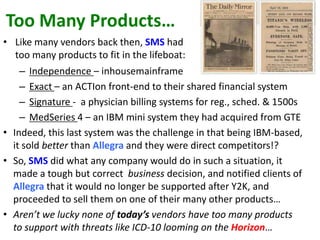
Too Many Products…
• Like many vendors back then, SMS had
  too many products to fit in the lifeboat:
    – Independence – inhousemainframe
    – Exact – an ACTIon front-end to their shared financial system
    – Signature - a physician billing systems for reg., sched. & 1500s
    – MedSeries 4 – an IBM mini system they had acquired from GTE
• Indeed, this last system was the challenge in that being IBM-based,
  it sold better than Allegra and they were direct competitors!?
• So, SMS did what any company would do in such a situation, it
  made a tough but correct business decision, and notified clients of
  Allegra that it would no longer be supported after Y2K, and
  proceeded to sell them on one of their many other products…
• Aren’t we lucky none of today’s vendors have too many products
  to support with threats like ICD-10 looming on the Horizon…
To The Rescue!
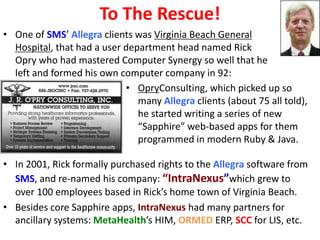
• One of SMS’ Allegra clients was Virginia Beach General
  Hospital, that had a user department head named Rick
  Opry who had mastered Computer Synergy so well that he
  left and formed his own computer company in 92:
                            • OpryConsulting, which picked up so
                               many Allegra clients (about 75 all told),
                               he started writing a series of new
                               “Sapphire” web-based apps for them
                               programmed in modern Ruby & Java.

• In 2001, Rick formally purchased rights to the Allegra software from
  SMS, and re-named his company: “IntraNexus”which grew to
  over 100 employees based in Rick’s home town of Virginia Beach.
• Besides core Sapphire apps, IntraNexus had many partners for
  ancillary systems: MetaHealth’s HIM, ORMED ERP, SCC for LIS, etc.
The Next Acquisition
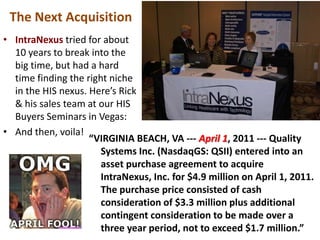
• IntraNexus tried for about
  10 years to break into the
  big time, but had a hard
  time finding the right niche
  in the HIS nexus. Here’s Rick
  & his sales team at our HIS
  Buyers Seminars in Vegas:
• And then, voila!
                    “VIRGINIA BEACH, VA --- April 1, 2011 --- Quality
                       Systems Inc. (NasdaqGS: QSII) entered into an
                       asset purchase agreement to acquire
                       IntraNexus, Inc. for $4.9 million on April 1, 2011.
                       The purchase price consisted of cash
                       consideration of $3.3 million plus additional
                       contingent consideration to be made over a
                       three year period, not to exceed $1.7 million.”
The “LastGen!?”
• So there you have it, the full HIS-tory of where NextGen got their
  complete product line, acquisition by acquisition by acquisition…
• The next episode promises to be a breath of fresh air as we delve
  into the origins of today’s leading vendor in terms of longevity
  (both of the firm & leadership) and market share: Meditech!,
  that never acquired a single total HIS competitor in its 40+ years!
• With over 2,000 hospital clients world-wide, this will be a
  fascinating story, delving into the HIS-tory of all 3 core products:
  Magic, Client/Server, and Release 6:
• Indeed, Meditech’s story is so deep &
  fascinating, I’m askingany old Boston
  vets out there to share their inside
  stories/pics at: vciotti@hispros.com
• And if you’re a really old HIS veteran who prefers a live human
  voice to a keyboard, feel free to call me any time at:505/466-4958

82. next gen part 4

  • 1.
    H.I.S.-toryby Vince Ciotti Episode#82: NextGenPart 4 The “next” acquisition: © 2012 by H.I.S. Professionals, LLC, all rights reserved.
  • 2.
    Final Episode ofNextGen • Probably not the end of their acquisitions, but the last part in our saga of where their present-day HIS product offerings came from. • This story goes way back in the late 70s, when minicomputer HIS systems started challenging the dominant shared systems like SMS, McAuto &Tymshare. In Oakland, CA, an ex-IBM sales rep named Tom Culligan started his mini firm: Computer Synergy, whose HIS ran on DEC’s line of “VAX” minicomputers, easily the 2nd most popular box after IBM’s System 34, 36 and 38. • Like leading competitors Dynamic Control, Meditech, HBO, etc., Computer Synergy gradually developed a complete HIS, with all core financial and clinical systems, at a price that competed well in terms of TCO with then- dominant shared systems like SMS & McAuto.
  • 3.
    If you can’t beat ‘em… Per this table from one of Sheldon Dorenfest’s early “Guides,” Computer Synergy was growing rapidly when it caught the eye of SMS, who had already entered the mini market with their ACTIon line that ran on both Four Phase & DEC VAX boxes.
  • 4.
    That’s the Spirit! •Having started it’s “ACTIon” line through a marketing agreement for HBO’s pioneering MedPro, SMS was no stranger to acquisitions and in 1985, they struck a deal with Tom to acquire his firm. SMS’ marketing department came up with the name “Spirit,” as shown in this ad from 1987. Under the covers, Spirit was actually comprised of SMS’ own DEC ACTIon clinicals “front-ending” Computer Synergy’s financials...
  • 5.
    An Odd Couple… Initially, SMS’ superb sales team sold Spirit (also known as “The Spirit Choice”) very well as usual. However, the two systems were very different in appearance and architecture, as early clients learned to their chagrin… So after a few years, SMS reverted to the original all-Synergy product, with another superb name: Allegra!
  • 6.
    Y2K “Apocalypse” • Overthe next decade, from 1988 to 1998, SMS almost 200 hospitals on the Allegra mini system, until an event on the horizon raised fears throughout the IT world in the 90s: Y2K! Hard to remember back then how all of we IT “experts” feared the collapse of our e-world… • It is so comforting to realize today that we have become so much smarter: there is just no way our modern, enlightened society would ever give any credence to such scare stories about the end of the world due to inexplicable occurrences… • In the HIS world of the late ‘90s, vendors faced the daunting of re- writing millions of lines of code to expand any MM/DD/YY dates to be MM/DD/YYYY, and programs could read the 2 extra digits...
  • 7.
    Too Many Products… •Like many vendors back then, SMS had too many products to fit in the lifeboat: – Independence – inhousemainframe – Exact – an ACTIon front-end to their shared financial system – Signature - a physician billing systems for reg., sched. & 1500s – MedSeries 4 – an IBM mini system they had acquired from GTE • Indeed, this last system was the challenge in that being IBM-based, it sold better than Allegra and they were direct competitors!? • So, SMS did what any company would do in such a situation, it made a tough but correct business decision, and notified clients of Allegra that it would no longer be supported after Y2K, and proceeded to sell them on one of their many other products… • Aren’t we lucky none of today’s vendors have too many products to support with threats like ICD-10 looming on the Horizon…
  • 8.
    To The Rescue! •One of SMS’ Allegra clients was Virginia Beach General Hospital, that had a user department head named Rick Opry who had mastered Computer Synergy so well that he left and formed his own computer company in 92: • OpryConsulting, which picked up so many Allegra clients (about 75 all told), he started writing a series of new “Sapphire” web-based apps for them programmed in modern Ruby & Java. • In 2001, Rick formally purchased rights to the Allegra software from SMS, and re-named his company: “IntraNexus”which grew to over 100 employees based in Rick’s home town of Virginia Beach. • Besides core Sapphire apps, IntraNexus had many partners for ancillary systems: MetaHealth’s HIM, ORMED ERP, SCC for LIS, etc.
  • 9.
    The Next Acquisition •IntraNexus tried for about 10 years to break into the big time, but had a hard time finding the right niche in the HIS nexus. Here’s Rick & his sales team at our HIS Buyers Seminars in Vegas: • And then, voila! “VIRGINIA BEACH, VA --- April 1, 2011 --- Quality Systems Inc. (NasdaqGS: QSII) entered into an asset purchase agreement to acquire IntraNexus, Inc. for $4.9 million on April 1, 2011. The purchase price consisted of cash consideration of $3.3 million plus additional contingent consideration to be made over a three year period, not to exceed $1.7 million.”
  • 10.
    The “LastGen!?” • Sothere you have it, the full HIS-tory of where NextGen got their complete product line, acquisition by acquisition by acquisition… • The next episode promises to be a breath of fresh air as we delve into the origins of today’s leading vendor in terms of longevity (both of the firm & leadership) and market share: Meditech!, that never acquired a single total HIS competitor in its 40+ years! • With over 2,000 hospital clients world-wide, this will be a fascinating story, delving into the HIS-tory of all 3 core products: Magic, Client/Server, and Release 6: • Indeed, Meditech’s story is so deep & fascinating, I’m askingany old Boston vets out there to share their inside stories/pics at: vciotti@hispros.com • And if you’re a really old HIS veteran who prefers a live human voice to a keyboard, feel free to call me any time at:505/466-4958