H.I.S.-tory
          by Vince Ciotti


         Episode #78:
                CPSI
                   Part 3
© 2012 by H.I.S. Professionals, LLC, all rights reserved.
Per Modern Healthcare…
• In case you wonder why we’re
  dwelling so long on such a small
  vendor as CPSI, check this out:
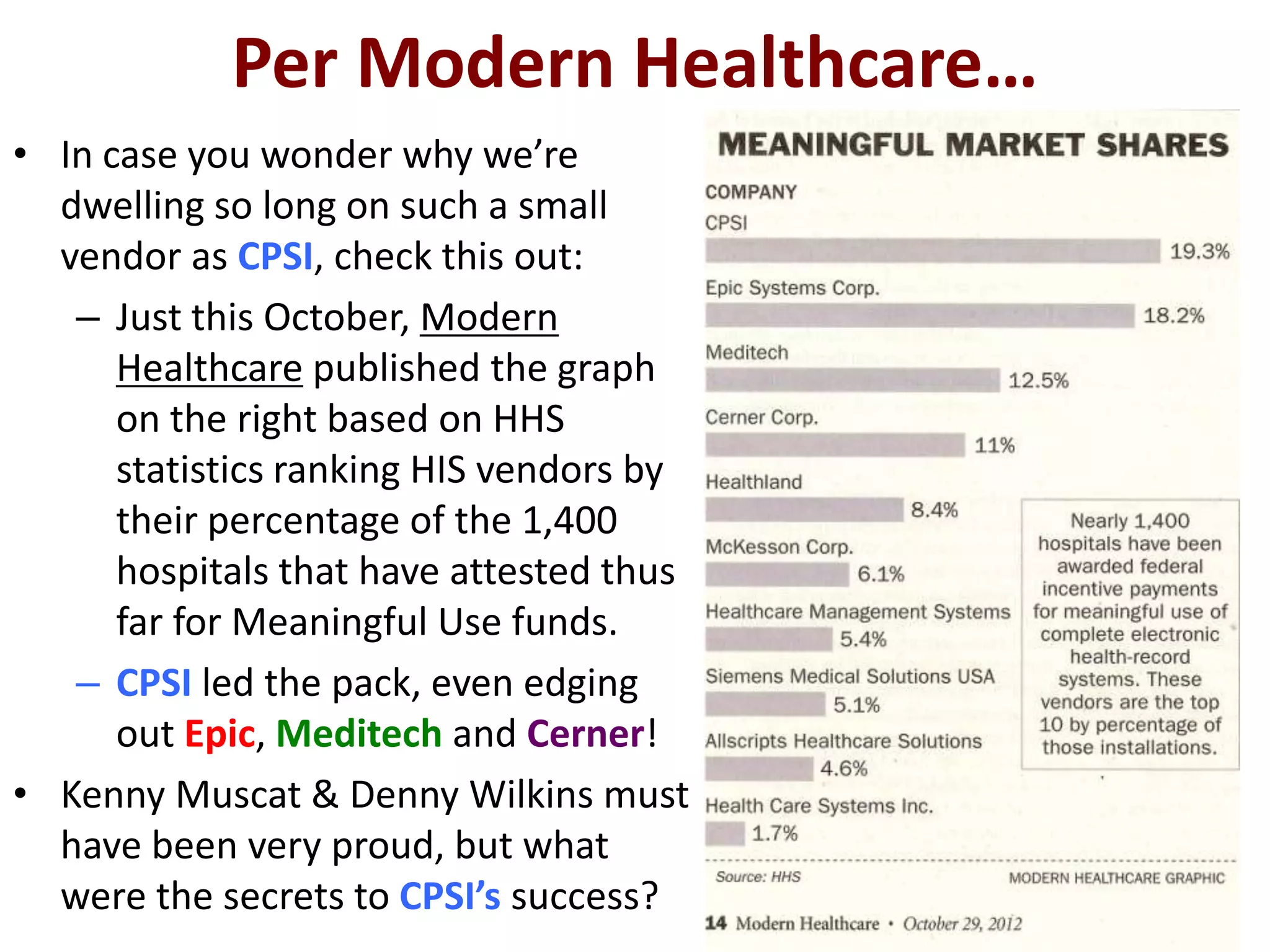
   – Just this October, Modern
      Healthcare published the graph
      on the right based on HHS
      statistics ranking HIS vendors by
      their percentage of the 1,400
      hospitals that have attested thus
      far for Meaningful Use funds.
   – CPSI led the pack, even edging
      out Epic, Meditech and Cerner!
• Kenny Muscat & Denny Wilkins must
  have been very proud, but what
  were the secrets to CPSI’s success?
Keys to Success?
• This leads us into an area I promised in the intro: what CPSI has in
   common with Meditech and Epic, which will make a fun lead-up
   to their two HIS-tories that will come up in a few months.
• There are several things these three leaders in the small, mid-size
   and large hospital markets (in that order) share:
    1. Rookies – for most of their staff, they hire college graduates
        right out of school, with little or no prior HIS experience…
    2. Corporate HQ – all of their employees live in or very near
        their corporate HQ city: Mobile, Boston and Verona.
    3. Acquisition-Free – two of these vendors roll their own HIS,
        acquiring no vendors and/or products; one has done a few…
    4. Integration – the hallmark marketing slogan for all three,
        although in truth two have gaps: one big, the other small.
 • We’ll next look at each of these four areas in turnin detail:
Rookies
• I can’t discuss this subject without remembering my first job in
  HIS in 1969: I was an English Major at Temple U. in Phila. And was
  hired by SMS to install IBM’s SHAS system. After a few months of
  reading IBM manuals and attending an (excellent) class taught by
  some of the best & Brightest IBM ever had (and SMS ever stole),
  they sent me up the NJ turnpike to St. Vincent’s Hospital in Staten
  Island. There I pulled out the SHAS OPS manual and my class
  notes, and proceeded to convert their AR from posting cards.
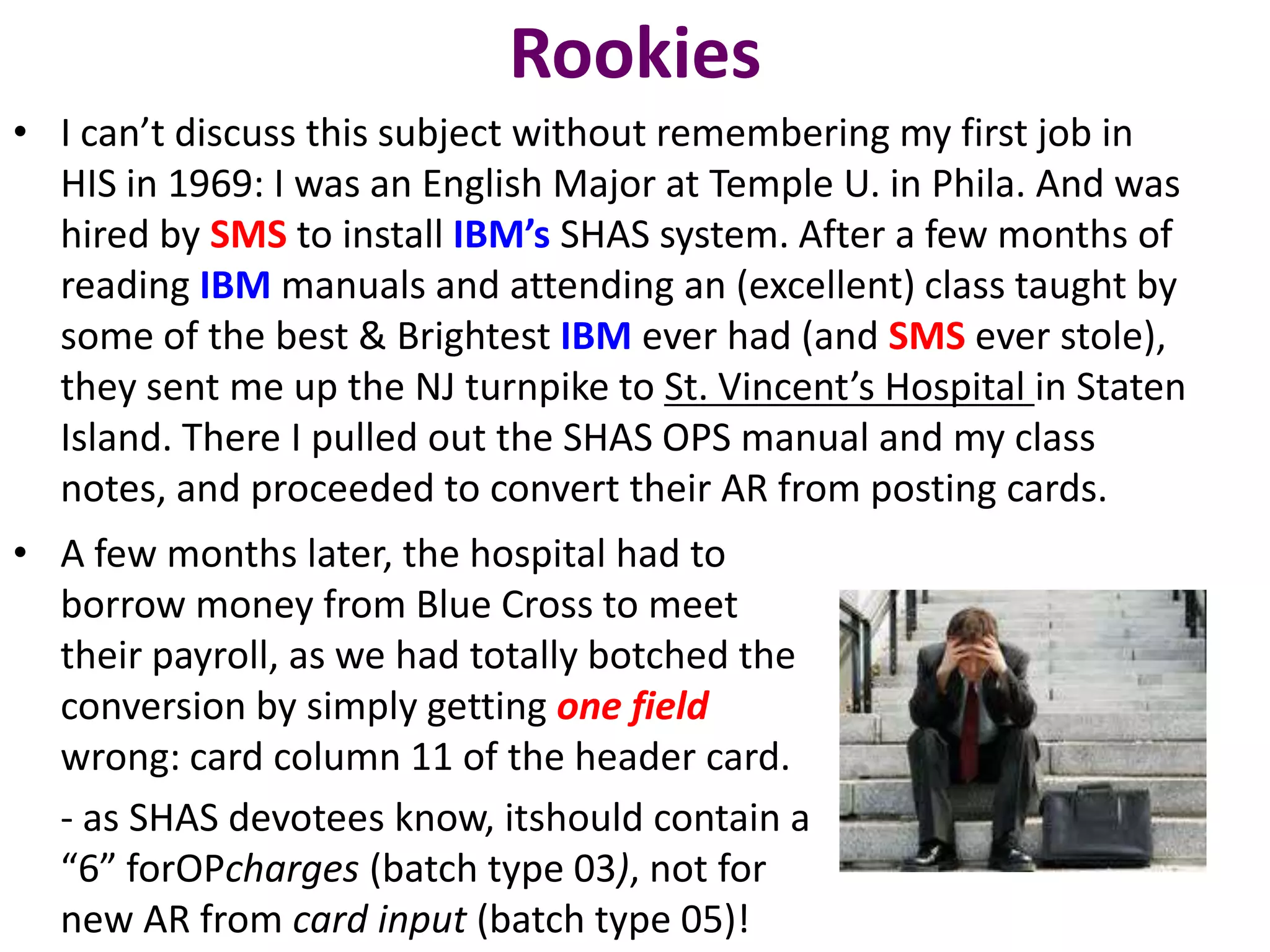
• A few months later, the hospital had to
  borrow money from Blue Cross to meet
  their payroll, as we had totally botched the
  conversion by simply getting one field
  wrong: card column 11 of the header card.
  - as SHAS devotees know, itshould contain a
  “6” forOPcharges (batch type 03), not for
  new AR from card input (batch type 05)!
So Why Rookies?
• So why in the world do the three leading vendors today still hire
  college graduates who can’t spell RN or MD? Several reasons:
   1. Cost – Forget all this “partner” crap,
       vendors are in it for the money and
       college graduates are the cheapest FTEs
       one can find, hence the lowest Payroll
       costs and highest profit margin. SMS
       paid me $7,500 in 1969, while savvy
       veterans like Karl Sydor, who SMS hired
       in 1970 to bail things out at St. V’s,
       probably earned twice as much…
    2. Malleability – Once these kids go through your training class
       and work under the few experienced managers, they learn
       the “CPSI (or Epic or Meditech) Way,” reflecting the company
       culture and values, making sure clients do things just the way
       corporate wants them to, whether good or bad for the client.
The Other Side of Rookies
• There are some up-sides to recent college graduates too, namely:
                     1. Work Ethic – SHAS became my life back in the
                         early 70s as I dog-eared the OPS and PDM
                         manuals, and memorized every ID memo
                         Mike Mulhallsent out on new modules and
                         features. Usually on Saturdays. We travelled
                         on personal time to be at the client 9AM no
                         matter how far they were from SMS, and
                         stayed until 6PM most nights. Truth is, the
                         clubs didn’t fill up with hot chicks until 10PM
                         anyway, and most were closed on Sundays..
   2. Promote-ability– The natural weeding out process caused any
      “losers” to either leave or get canned, and led to a rash of
      promotions of those who earned it. For example, David Dye
      joined CPSI right out of school as an economics major, and
      worked his way up the ranks to become CEO in only 9 years!
Corporate HQ vs Field Offices
• The Internet age has changed things a bunch since the 70s and
  80s when these three companies started, but they can’t shake
  their tradition of having all employees live in or near their HQ.
                          • And it must hurt sales as
                            those Boston accents from
                            Meditech reps and “good old
                            boy phrases” of CPSI reps
                            from Mobile grate on ears
                            from California or Iowa!?
• Which might also explain why Meditech dominates the New England
  market and CPSI owns the deep south: those CIOs understand ‘em!
• Once again, however, the main motivation is monetary: clients pay
  for all trips to clients during implementation/service, leaving the firm
  to pay only for relatively fewer sales & marketing trips by reps.
• Of course, Epic faces no such problem as Judy merely sits in Verona
  and waits for large AMCs and IDNs to “apply” for a proposal…
Little/No “Acquisition-itis”
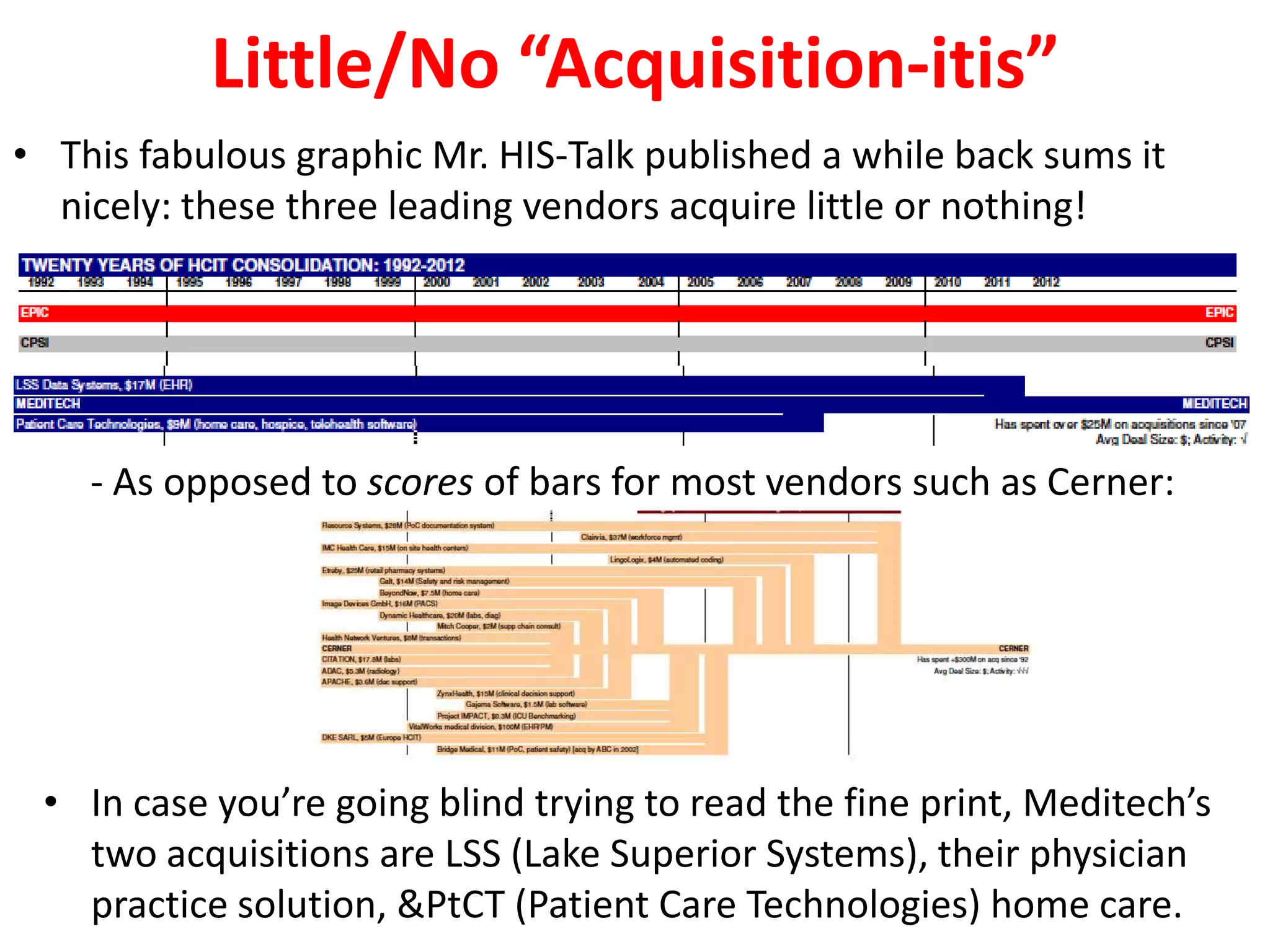
• This fabulous graphic Mr. HIS-Talk published a while back sums it
  nicely: these three leading vendors acquire little or nothing!


    - As opposed to scores of bars for most vendors such as Cerner:


 • In case you’re going blind trying to read the fine print, Meditech’s
   two acquisitions are LSS (Lake Superior Systems), their physician
   practice solution, &PtCT (Patient Care Technologies) home care.
Integration
• The “Holy Grail” of so many CIOs tired of being
  ripped off by vendors who over-charge for
  interfaces, then the inevitable finger-pointing
  between them whenever things go wrong...
• Our three excel in this regard, with few caveats:
   – EPIC makes most of its sales from physicians who insist on
     seeing the same EMR in their practices as in the hospital. Of
     course, they don’t know how to spell “ERP” up in Verona…
   – Meditech was one of the first vendors to offer a “Total HIS”
     way back in the mid-80s when they added a full set of
     financials to their robust clinicals. Only LSS’s physician EMR
     and PtCT’s Home Care are interfaced “under the covers…”
   – CPSI– is the absolute king of integration, not only offering a full
     set of clinicals and financials (including ERP), but even
     including their own Time & Attendance and PACS systems!
Next Week…
• So there you have it, how CPSI started
  with Kenny & Denny and rose to the
  top of the small-hospital market by
  following these four principles.
• After completing this 30-year HIS-tory
  of CPSI, we’ll next delve into a relative
  newcomer in HIS ranks, but one that is
  making quite a splash: NextGen
• They’re so new, I don’t know much
  about the physician practice parent,
  Quality Systems Inc., mainly their
  Opus &Sphere HIS components, and
  acquisitions of Rick Opry’sIntraNexus.
  VP of Sales Christie Guthrie has
  promised to help, so stay tuned next
  week to see what she delivers...

78. cpsi part 3

  • 1.
    H.I.S.-tory by Vince Ciotti Episode #78: CPSI Part 3 © 2012 by H.I.S. Professionals, LLC, all rights reserved.
  • 2.
    Per Modern Healthcare… •In case you wonder why we’re dwelling so long on such a small vendor as CPSI, check this out: – Just this October, Modern Healthcare published the graph on the right based on HHS statistics ranking HIS vendors by their percentage of the 1,400 hospitals that have attested thus far for Meaningful Use funds. – CPSI led the pack, even edging out Epic, Meditech and Cerner! • Kenny Muscat & Denny Wilkins must have been very proud, but what were the secrets to CPSI’s success?
  • 3.
    Keys to Success? •This leads us into an area I promised in the intro: what CPSI has in common with Meditech and Epic, which will make a fun lead-up to their two HIS-tories that will come up in a few months. • There are several things these three leaders in the small, mid-size and large hospital markets (in that order) share: 1. Rookies – for most of their staff, they hire college graduates right out of school, with little or no prior HIS experience… 2. Corporate HQ – all of their employees live in or very near their corporate HQ city: Mobile, Boston and Verona. 3. Acquisition-Free – two of these vendors roll their own HIS, acquiring no vendors and/or products; one has done a few… 4. Integration – the hallmark marketing slogan for all three, although in truth two have gaps: one big, the other small. • We’ll next look at each of these four areas in turnin detail:
  • 4.
    Rookies • I can’tdiscuss this subject without remembering my first job in HIS in 1969: I was an English Major at Temple U. in Phila. And was hired by SMS to install IBM’s SHAS system. After a few months of reading IBM manuals and attending an (excellent) class taught by some of the best & Brightest IBM ever had (and SMS ever stole), they sent me up the NJ turnpike to St. Vincent’s Hospital in Staten Island. There I pulled out the SHAS OPS manual and my class notes, and proceeded to convert their AR from posting cards. • A few months later, the hospital had to borrow money from Blue Cross to meet their payroll, as we had totally botched the conversion by simply getting one field wrong: card column 11 of the header card. - as SHAS devotees know, itshould contain a “6” forOPcharges (batch type 03), not for new AR from card input (batch type 05)!
  • 5.
    So Why Rookies? •So why in the world do the three leading vendors today still hire college graduates who can’t spell RN or MD? Several reasons: 1. Cost – Forget all this “partner” crap, vendors are in it for the money and college graduates are the cheapest FTEs one can find, hence the lowest Payroll costs and highest profit margin. SMS paid me $7,500 in 1969, while savvy veterans like Karl Sydor, who SMS hired in 1970 to bail things out at St. V’s, probably earned twice as much… 2. Malleability – Once these kids go through your training class and work under the few experienced managers, they learn the “CPSI (or Epic or Meditech) Way,” reflecting the company culture and values, making sure clients do things just the way corporate wants them to, whether good or bad for the client.
  • 6.
    The Other Sideof Rookies • There are some up-sides to recent college graduates too, namely: 1. Work Ethic – SHAS became my life back in the early 70s as I dog-eared the OPS and PDM manuals, and memorized every ID memo Mike Mulhallsent out on new modules and features. Usually on Saturdays. We travelled on personal time to be at the client 9AM no matter how far they were from SMS, and stayed until 6PM most nights. Truth is, the clubs didn’t fill up with hot chicks until 10PM anyway, and most were closed on Sundays.. 2. Promote-ability– The natural weeding out process caused any “losers” to either leave or get canned, and led to a rash of promotions of those who earned it. For example, David Dye joined CPSI right out of school as an economics major, and worked his way up the ranks to become CEO in only 9 years!
  • 7.
    Corporate HQ vsField Offices • The Internet age has changed things a bunch since the 70s and 80s when these three companies started, but they can’t shake their tradition of having all employees live in or near their HQ. • And it must hurt sales as those Boston accents from Meditech reps and “good old boy phrases” of CPSI reps from Mobile grate on ears from California or Iowa!? • Which might also explain why Meditech dominates the New England market and CPSI owns the deep south: those CIOs understand ‘em! • Once again, however, the main motivation is monetary: clients pay for all trips to clients during implementation/service, leaving the firm to pay only for relatively fewer sales & marketing trips by reps. • Of course, Epic faces no such problem as Judy merely sits in Verona and waits for large AMCs and IDNs to “apply” for a proposal…
  • 8.
    Little/No “Acquisition-itis” • Thisfabulous graphic Mr. HIS-Talk published a while back sums it nicely: these three leading vendors acquire little or nothing! - As opposed to scores of bars for most vendors such as Cerner: • In case you’re going blind trying to read the fine print, Meditech’s two acquisitions are LSS (Lake Superior Systems), their physician practice solution, &PtCT (Patient Care Technologies) home care.
  • 9.
    Integration • The “HolyGrail” of so many CIOs tired of being ripped off by vendors who over-charge for interfaces, then the inevitable finger-pointing between them whenever things go wrong... • Our three excel in this regard, with few caveats: – EPIC makes most of its sales from physicians who insist on seeing the same EMR in their practices as in the hospital. Of course, they don’t know how to spell “ERP” up in Verona… – Meditech was one of the first vendors to offer a “Total HIS” way back in the mid-80s when they added a full set of financials to their robust clinicals. Only LSS’s physician EMR and PtCT’s Home Care are interfaced “under the covers…” – CPSI– is the absolute king of integration, not only offering a full set of clinicals and financials (including ERP), but even including their own Time & Attendance and PACS systems!
  • 10.
    Next Week… • Sothere you have it, how CPSI started with Kenny & Denny and rose to the top of the small-hospital market by following these four principles. • After completing this 30-year HIS-tory of CPSI, we’ll next delve into a relative newcomer in HIS ranks, but one that is making quite a splash: NextGen • They’re so new, I don’t know much about the physician practice parent, Quality Systems Inc., mainly their Opus &Sphere HIS components, and acquisitions of Rick Opry’sIntraNexus. VP of Sales Christie Guthrie has promised to help, so stay tuned next week to see what she delivers...