Classification of Fingerprints 
Sarat C. Dass 
Department of Statistics & Probability
Fingerprint ClassificationFingerprint ClassificationFingerprint classification is a coarse level partitioning of a fingerprint database into smaller subsets. Fingerprint classification reduces the search space of a large database: Determine the class of the query fingerprint. Then, only search templates with the same class as the query. Illustration: Inputs are the fingerprint impressions from 10 fingers of an individual. If size of the database is N and D is the number of classes, 
Search space without classification: N10 
Search space with classification: (N/D)10
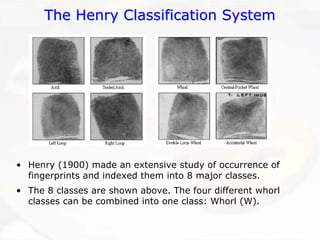
The Henry Classification SystemThe System•Henry (1900) made an extensive study of occurrence of fingerprints and indexed them into 8 major classes. •The 8 classes are shown above. The four different whorl classes can be combined into one class: Whorl (W).
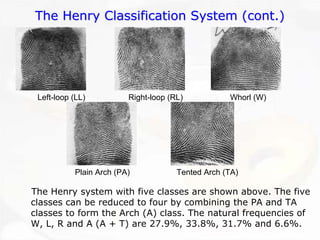
The Henry Classification System (cont.)Left-loop (LL)Right-loop (RL)Whorl (W) 
Tented Arch (TA) 
Plain Arch (PA) 
The Henry system with five classes are shown above. The fiveclasses can be reduced to four by combining the PA and TA classes to form the Arch (A) class. The natural frequencies of W, L, R and A (A + T) are 27.9%, 33.8%, 31.7% and 6.6%.
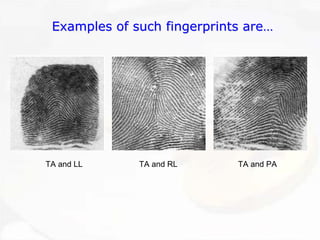
The Henry Classification System (cont.)•The five main classes differ in terms of the global flow patterns of the ridge curves. •They also differ in terms of the number and locations of singular points in the fingerprint image. For example, ¾LL –exactly one core and one delta; the core is to the left of the delta, ¾RL –exactly one core and one delta; the core is to the right of thedelta, ¾W –two cores and two deltas, ¾PA –no singular points, and ¾TA –one core and one delta; the delta is approximately directly below the core. Problems with the Henry classification system: (i) non- uniform classification proportions, and (ii) experts classify 
some fingerprint images into different Henry classes.
Examples of such fingerprints are…
TA and LL 
TA and RL 
TA and PA
Approaches for Fingerprint ClassificationApproaches ClassificationApproaches based on singular points: Hong and Jain (1999), Karu and Jain (1996). Structure-basedapproaches such as using the orientation field and geometry of ridges: Cappelli et. al (2002), Chang & Fan (2002), and Chong et. al (1997). Frequency-basedapproaches using Fourier spectrum: Jain et. al (1999). Syntactic or grammar-based: Moayer & Fu (1975,1976). Mathematical models: Silviu & Jain (2002), Dass & Jain (2004). Hybrid methods: Combination of at least two of the above approaches (Chang & Fan (2002) and Chong et. al (1997))
Singular point based approaches 
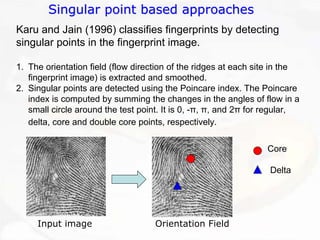
Input imageOrientation FieldKaruand Jain (1996) classifies fingerprints by detectingsingular points in the fingerprint image. 1.The orientation field (flow direction of the ridges at each sitein the fingerprint image) is extracted and smoothed. 2.Singular points are detected using the Poincareindex. The Poincareindex is computed by summing the changes in the angles of flow in a small circle around the test point. It is 0, -π, π, and 2πfor regular, delta, core and double core points, respectively. CoreDelta
Karu and Jain (1996), cont. 
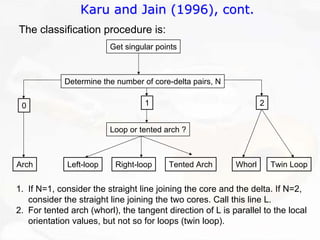
The classification procedure is: 
Get singular pointsDetermine the number of core-delta pairs, NArchLoop or tented arch ? 012Left-loopRight-loopTented ArchWhorlTwin Loop1.If N=1, consider the straight line joining the core and the delta. If N=2, consider the straight line joining the two cores. Call this lineL. 2.For tented arch (whorl), the tangent direction of L is parallel to the local orientation values, but not so for loops (twin loop).
Structure based approaches 
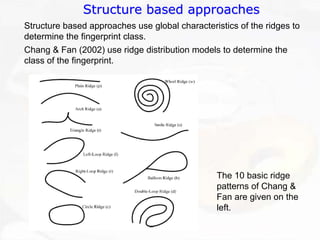
Structure based approaches use global characteristics of the ridges to determine the fingerprint class. 
Chang & Fan (2002) use ridge distribution models to determine the class of the fingerprint. 
The 10 basic ridge patterns of Chang & Fan are given on the left.
Chang & Fan (2002) 
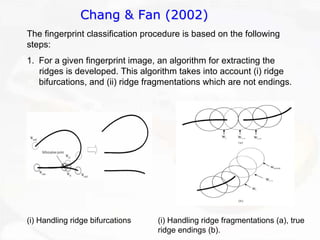
The fingerprint classification procedure is based on the following steps: 
1.For a given fingerprint image, an algorithm for extracting theridges is developed. This algorithm takes into account (i) ridge bifurcations, and (ii) ridge fragmentations which are not endings. 
(i) Handling ridge bifurcations 
(i) Handling ridge fragmentations (a), true ridge endings (b).
Chang & Fan (2002), cont. 
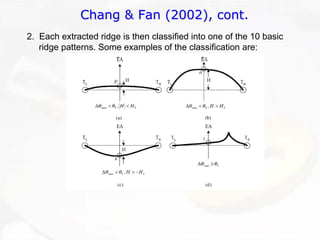
2. Each extracted ridge is then classified into one of the 10 basic ridge patterns. Some examples of the classification are:
Chang & Fan (2002), cont. 
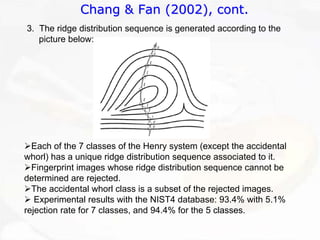
3. The ridge distribution sequence is generated according to the picture below: ¾Each of the 7 classes of the Henry system (except the accidentalwhorl) has a unique ridge distribution sequence associated to it. ¾Fingerprint images whose ridge distribution sequence cannot be determined are rejected. ¾The accidental whorl class is a subset of the rejected images. ¾Experimental results with the NIST4 database: 93.4% with 5.1% rejection rate for 7 classes, and 94.4% for the 5 classes.
Structural based approach - Chong & Ngee (1997) 
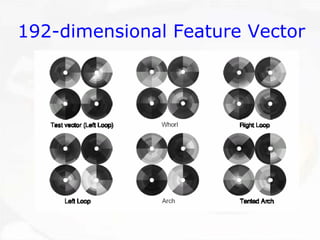
1.The fingerprint classification procedure is based on determiningthe global geometric structure of the extracted ridges using B- splines. 2.The B-splinesprovide a compact representation of the ridges and contain enough information to determine their geometric structure. 3.The main drawback of this method is that it was not tested on a large number of fingerprints. Frequency based method ––Jain et. al (1999)1.Frequency based approached covert the fingerprint image into thefrequency space and perform the classification in that space. 2.In Jain et. al (1999), Gaborfilters at 16 different orientation values are applied to different sectors of the fingerprint image. The Gaborcoefficients form the feature for classification.
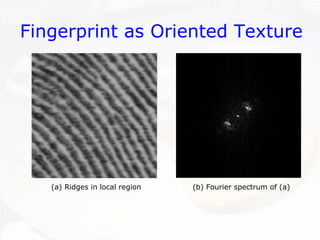
Fingerprint as Oriented Texture 
(a) Ridges in local region 
(b) Fourier spectrum of (a)
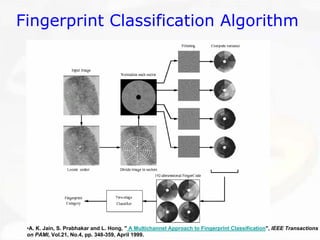
Fingerprint Classification Algorithm•A. K. Jain, S. Prabhakarand L. Hong, "A MultichannelApproach to Fingerprint Classification",IEEE Transactions on PAMI, Vol.21, No.4, pp. 348-359, April 1999.
192-dimensional Feature Vector
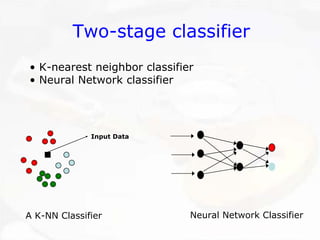
Two-stage classifier•K-nearest neighbor classifier•Neural Network classifier 
Input Data 
A K-NN Classifier 
Neural Network Classifier
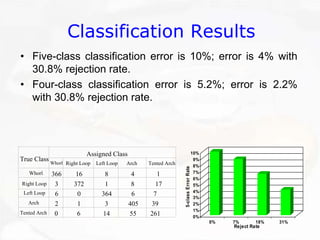
•Five-class classification error is 10%; error is 4% with 30.8% rejection rate. •Four-class classification error is 5.2%; error is 2.2% with 30.8% rejection rate. WhorlRight LoopLeft LoopArchTented ArchWhorl36616841Right Loop33721817Left Loop6036467Arch21340539Tented Arch061455261Assigned ClassTrue Class0% 1% 2% 3% 4% 5% 6% 7% 8% 9% 10% 5-class Error Rate 0%7%18%31% Reject RateClassification Results
Approaches based on mathematical models –– 
Silviu & Jain, 2002 
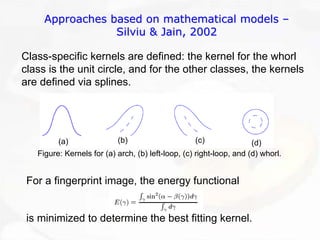
Class-specific kernels are defined: the kernel for the whorl class is the unit circle, and for the other classes, the kernelsare defined via splines. Figure: Kernels for (a) arch, (b) left-loop, (c) right-loop, and (d) whorl. (a)(b)(c)(d) 
For a fingerprint image, the energy functionalis minimized to determine the best fitting kernel.
Silviu & Jain (cont.) 
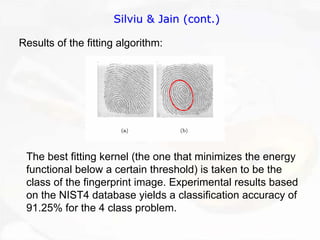
Results of the fitting algorithm: The best fitting kernel (the one that minimizes the energy functional below a certain threshold) is taken to be the class of the fingerprint image. Experimental results based on the NIST4 database yields a classification accuracy of 91.25% for the 4 class problem.
Why Another Fingerprint Classifier ?Dass & Jain (2004)Limitations of the existing approaches:Ridges are subject to breaks and discontinuities due to noise Singular points may be missed in some fingerprint imagesMathematical models are too rigid to represent all possible ridge variationsRequirements of a fingerprint classifier:Requirements Robust detection of global ridge characteristicsRobust characteristicsClassification Classification invariance under affine transformationsinvariance transformationsand and mild nonmild non--linear deformations of the fingerprintlinear fingerprint
Orientation Field Flow Curves 
Fingerprint Image 
Orientation Field 
Flow Curves 
•Orientation field: local flow directions of the ridges and valleys •Opposite flow directions are equivalent, angle ε[-π/2, π/2] •Orientation field flow curve(OFFC) is a curve whose tangent direction at each point is parallel to the orientation field direction•This is not ridge tracing; OFFCsare pseudoridges
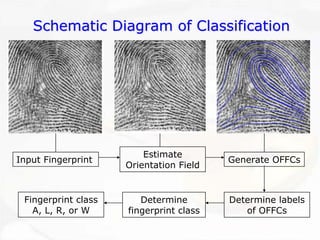
Schematic Diagram of ClassificationSchematic ClassificationInput FingerprintFingerprint class A, L, R, or WDetermine fingerprint classEstimate Orientation FieldGenerate OFFCsDetermine labels of OFFCs
Estimation of Orientation Field Field* 
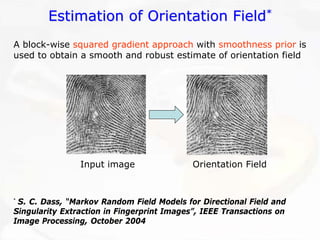
Input imageOrientation FieldA block-wise squared gradient approachwith smoothness prioris used to obtain a smooth and robust estimate of orientation field*S. C. Dass, “Markov Random Field Models for Directional Field and Singularity Extraction in Fingerprint Images”, IEEE Transactionson Image Processing, October 2004
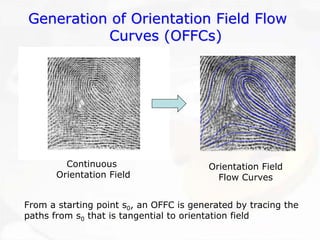
Generation of Orientation Field Flow 
Curves ( OFFCs OFFCs) 
Continuous Orientation Field 
From a starting point s0, an OFFC is generated by tracing the paths from s0that is tangential to orientation fieldOrientation FieldFlow Curves
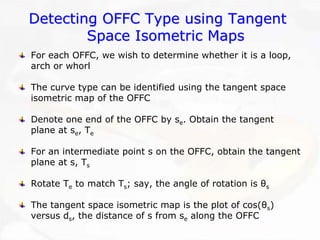
Detecting OFFC Type using Tangent 
Space Isometric Maps 
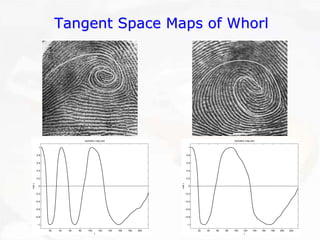
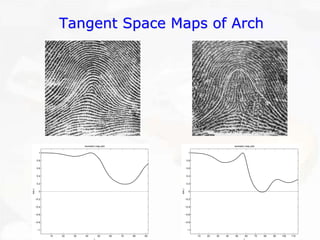
For each OFFC, we wish to determine whether it is a loop, arch or whorlThe curve type can be identified using the tangent space isometric map of the OFFCDenote one end of the OFFC by se. Obtain the tangent plane at se, TeFor an intermediate point s on the OFFC, obtain the tangent plane at s, TsRotate Teto match Ts; say, the angle of rotation is θsThe tangent space isometric map is the plot of cos(θs) versus ds, the distance of s from sealong the OFFC
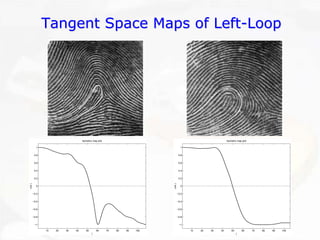
Tangent Space Maps of LeftTangent Left--LoopLoop102030405060708090100−1−0.8−0.6−0.4−0.200.20.40.60.81Isometric map plotj cos γ 102030405060708090100−1−0.8−0.6−0.4−0.200.20.40.60.81Isometric map plotj cos γ
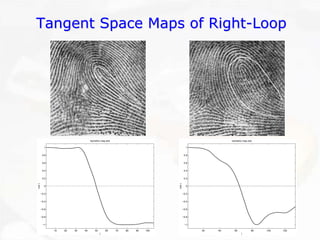
102030405060708090100−1−0.8−0.6−0.4−0.200.20.40.60.81Isometric map plotj cos γ 20406080100120−1−0.8−0.6−0.4−0.200.20.40.60.81Isometric map plotj cos γ Tangent Space Maps of RightTangent Right--LoopLoop
20406080100120140160180200−1−0.8−0.6−0.4−0.200.20.40.60.81Isometric map plotj cos γ 20406080100120140160180200220−1−0.8−0.6−0.4−0.200.20.40.60.81Isometric map plotj cos γ Tangent Space Maps of WhorlTangent Whorl
102030405060708090−1−0.8−0.6−0.4−0.200.20.40.60.81Isometric map plotj cos γ 102030405060708090100110−1−0.8−0.6−0.4−0.200.20.40.60.81Isometric map plotj cos γ Tangent Space Maps of ArchTangent Arch
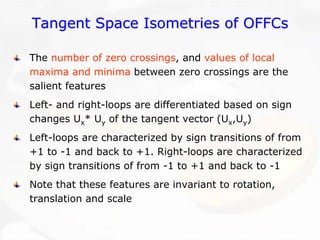
Tangent Space Isometries of OFFCsTangent OFFCsThe number of zero crossings, and values of local maxima and minimabetween zero crossings are the salient featuresLeft-and right-loops are differentiated based on sign changes Ux* Uyof the tangent vector (Ux,Uy) Left-loops are characterized by sign transitions of from +1 to -1 and back to +1. Right-loops are characterized by sign transitions of from -1 to +1 and back to -1Note that these features are invariant to rotation, translation and scale
Fingerprint Classification Rules 
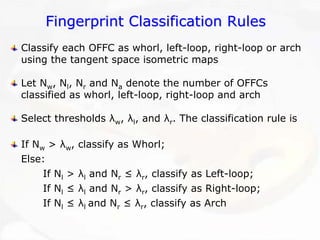
Classify each OFFC as whorl, left-loop, right-loop or arch using the tangent space isometric mapsLet Nw, Nl, Nrand Nadenote the number of OFFCsclassified as whorl, left-loop, right-loop and archSelect thresholds λw, λl, and λr. The classification rule isIf Nw> λw, classify as Whorl; Else: If Nl> λland Nr≤ λr, classify as Left-loop; If Nl≤ λland Nr> λr, classify as Right-loop; If Nl≤ λl and Nr≤ λr, classify as Arch
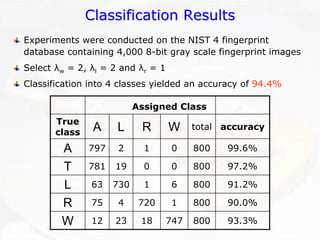
Classification ResultsClassification ResultsExperiments were conducted on the NIST 4 fingerprint database containing 4,000 8-bit gray scale fingerprint images Select λw= 2, λl= 2 and λr= 1Classification into 4 classes yielded an accuracy of 94.4% Assigned ClassTrue classALRW100 
L 63 7301680091.2% 
R 75 4720180090.0% 
W 12 231874780093.3% 0219797781ATtotalaccuracy80099.6% 80097.2%
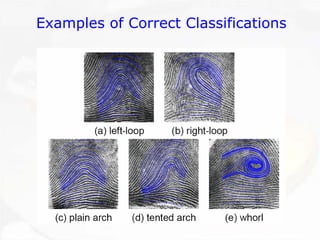
Examples of Correct Classifications
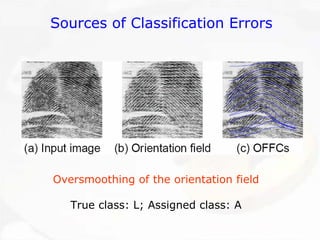
Sources of Classification Errors 
Oversmoothingof the orientation field 
True class: L; Assigned class: A
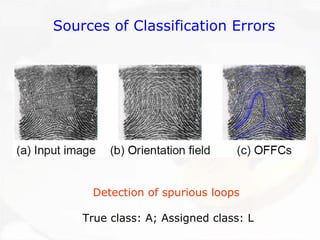
Detection of spurious loopsTrue class: A; Assigned class: L 
Sources of Classification Errors
Summary and Future WorkSummary WorkWe have proposed a fingerprint classification scheme based on the flow curves derived from the orientation fieldPerformance of the proposed approach is comparable with the other state-of-the-art methodsWe plan to extend the 4-class classification to the 5-and 7- class problems by including other features of OFFCs into our classification procedureOther indexing techniques, besides the Henry system, will be investigated based on relevant features of the OFFCs

802 fp classification

  • 1.
    Classification of Fingerprints Sarat C. Dass Department of Statistics & Probability
  • 2.
    Fingerprint ClassificationFingerprint ClassificationFingerprintclassification is a coarse level partitioning of a fingerprint database into smaller subsets. Fingerprint classification reduces the search space of a large database: Determine the class of the query fingerprint. Then, only search templates with the same class as the query. Illustration: Inputs are the fingerprint impressions from 10 fingers of an individual. If size of the database is N and D is the number of classes, Search space without classification: N10 Search space with classification: (N/D)10
  • 3.
    The Henry ClassificationSystemThe System•Henry (1900) made an extensive study of occurrence of fingerprints and indexed them into 8 major classes. •The 8 classes are shown above. The four different whorl classes can be combined into one class: Whorl (W).
  • 4.
    The Henry ClassificationSystem (cont.)Left-loop (LL)Right-loop (RL)Whorl (W) Tented Arch (TA) Plain Arch (PA) The Henry system with five classes are shown above. The fiveclasses can be reduced to four by combining the PA and TA classes to form the Arch (A) class. The natural frequencies of W, L, R and A (A + T) are 27.9%, 33.8%, 31.7% and 6.6%.
  • 5.
    The Henry ClassificationSystem (cont.)•The five main classes differ in terms of the global flow patterns of the ridge curves. •They also differ in terms of the number and locations of singular points in the fingerprint image. For example, ¾LL –exactly one core and one delta; the core is to the left of the delta, ¾RL –exactly one core and one delta; the core is to the right of thedelta, ¾W –two cores and two deltas, ¾PA –no singular points, and ¾TA –one core and one delta; the delta is approximately directly below the core. Problems with the Henry classification system: (i) non- uniform classification proportions, and (ii) experts classify some fingerprint images into different Henry classes.
  • 6.
    Examples of suchfingerprints are… TA and LL TA and RL TA and PA
  • 7.
    Approaches for FingerprintClassificationApproaches ClassificationApproaches based on singular points: Hong and Jain (1999), Karu and Jain (1996). Structure-basedapproaches such as using the orientation field and geometry of ridges: Cappelli et. al (2002), Chang & Fan (2002), and Chong et. al (1997). Frequency-basedapproaches using Fourier spectrum: Jain et. al (1999). Syntactic or grammar-based: Moayer & Fu (1975,1976). Mathematical models: Silviu & Jain (2002), Dass & Jain (2004). Hybrid methods: Combination of at least two of the above approaches (Chang & Fan (2002) and Chong et. al (1997))
  • 8.
    Singular point basedapproaches Input imageOrientation FieldKaruand Jain (1996) classifies fingerprints by detectingsingular points in the fingerprint image. 1.The orientation field (flow direction of the ridges at each sitein the fingerprint image) is extracted and smoothed. 2.Singular points are detected using the Poincareindex. The Poincareindex is computed by summing the changes in the angles of flow in a small circle around the test point. It is 0, -π, π, and 2πfor regular, delta, core and double core points, respectively. CoreDelta
  • 9.
    Karu and Jain(1996), cont. The classification procedure is: Get singular pointsDetermine the number of core-delta pairs, NArchLoop or tented arch ? 012Left-loopRight-loopTented ArchWhorlTwin Loop1.If N=1, consider the straight line joining the core and the delta. If N=2, consider the straight line joining the two cores. Call this lineL. 2.For tented arch (whorl), the tangent direction of L is parallel to the local orientation values, but not so for loops (twin loop).
  • 10.
    Structure based approaches Structure based approaches use global characteristics of the ridges to determine the fingerprint class. Chang & Fan (2002) use ridge distribution models to determine the class of the fingerprint. The 10 basic ridge patterns of Chang & Fan are given on the left.
  • 11.
    Chang & Fan(2002) The fingerprint classification procedure is based on the following steps: 1.For a given fingerprint image, an algorithm for extracting theridges is developed. This algorithm takes into account (i) ridge bifurcations, and (ii) ridge fragmentations which are not endings. (i) Handling ridge bifurcations (i) Handling ridge fragmentations (a), true ridge endings (b).
  • 12.
    Chang & Fan(2002), cont. 2. Each extracted ridge is then classified into one of the 10 basic ridge patterns. Some examples of the classification are:
  • 13.
    Chang & Fan(2002), cont. 3. The ridge distribution sequence is generated according to the picture below: ¾Each of the 7 classes of the Henry system (except the accidentalwhorl) has a unique ridge distribution sequence associated to it. ¾Fingerprint images whose ridge distribution sequence cannot be determined are rejected. ¾The accidental whorl class is a subset of the rejected images. ¾Experimental results with the NIST4 database: 93.4% with 5.1% rejection rate for 7 classes, and 94.4% for the 5 classes.
  • 14.
    Structural based approach- Chong & Ngee (1997) 1.The fingerprint classification procedure is based on determiningthe global geometric structure of the extracted ridges using B- splines. 2.The B-splinesprovide a compact representation of the ridges and contain enough information to determine their geometric structure. 3.The main drawback of this method is that it was not tested on a large number of fingerprints. Frequency based method ––Jain et. al (1999)1.Frequency based approached covert the fingerprint image into thefrequency space and perform the classification in that space. 2.In Jain et. al (1999), Gaborfilters at 16 different orientation values are applied to different sectors of the fingerprint image. The Gaborcoefficients form the feature for classification.
  • 15.
    Fingerprint as OrientedTexture (a) Ridges in local region (b) Fourier spectrum of (a)
  • 16.
    Fingerprint Classification Algorithm•A.K. Jain, S. Prabhakarand L. Hong, "A MultichannelApproach to Fingerprint Classification",IEEE Transactions on PAMI, Vol.21, No.4, pp. 348-359, April 1999.
  • 17.
  • 18.
    Two-stage classifier•K-nearest neighborclassifier•Neural Network classifier Input Data A K-NN Classifier Neural Network Classifier
  • 19.
    •Five-class classification erroris 10%; error is 4% with 30.8% rejection rate. •Four-class classification error is 5.2%; error is 2.2% with 30.8% rejection rate. WhorlRight LoopLeft LoopArchTented ArchWhorl36616841Right Loop33721817Left Loop6036467Arch21340539Tented Arch061455261Assigned ClassTrue Class0% 1% 2% 3% 4% 5% 6% 7% 8% 9% 10% 5-class Error Rate 0%7%18%31% Reject RateClassification Results
  • 20.
    Approaches based onmathematical models –– Silviu & Jain, 2002 Class-specific kernels are defined: the kernel for the whorl class is the unit circle, and for the other classes, the kernelsare defined via splines. Figure: Kernels for (a) arch, (b) left-loop, (c) right-loop, and (d) whorl. (a)(b)(c)(d) For a fingerprint image, the energy functionalis minimized to determine the best fitting kernel.
  • 21.
    Silviu & Jain(cont.) Results of the fitting algorithm: The best fitting kernel (the one that minimizes the energy functional below a certain threshold) is taken to be the class of the fingerprint image. Experimental results based on the NIST4 database yields a classification accuracy of 91.25% for the 4 class problem.
  • 22.
    Why Another FingerprintClassifier ?Dass & Jain (2004)Limitations of the existing approaches:Ridges are subject to breaks and discontinuities due to noise Singular points may be missed in some fingerprint imagesMathematical models are too rigid to represent all possible ridge variationsRequirements of a fingerprint classifier:Requirements Robust detection of global ridge characteristicsRobust characteristicsClassification Classification invariance under affine transformationsinvariance transformationsand and mild nonmild non--linear deformations of the fingerprintlinear fingerprint
  • 23.
    Orientation Field FlowCurves Fingerprint Image Orientation Field Flow Curves •Orientation field: local flow directions of the ridges and valleys •Opposite flow directions are equivalent, angle ε[-π/2, π/2] •Orientation field flow curve(OFFC) is a curve whose tangent direction at each point is parallel to the orientation field direction•This is not ridge tracing; OFFCsare pseudoridges
  • 24.
    Schematic Diagram ofClassificationSchematic ClassificationInput FingerprintFingerprint class A, L, R, or WDetermine fingerprint classEstimate Orientation FieldGenerate OFFCsDetermine labels of OFFCs
  • 25.
    Estimation of OrientationField Field* Input imageOrientation FieldA block-wise squared gradient approachwith smoothness prioris used to obtain a smooth and robust estimate of orientation field*S. C. Dass, “Markov Random Field Models for Directional Field and Singularity Extraction in Fingerprint Images”, IEEE Transactionson Image Processing, October 2004
  • 26.
    Generation of OrientationField Flow Curves ( OFFCs OFFCs) Continuous Orientation Field From a starting point s0, an OFFC is generated by tracing the paths from s0that is tangential to orientation fieldOrientation FieldFlow Curves
  • 27.
    Detecting OFFC Typeusing Tangent Space Isometric Maps For each OFFC, we wish to determine whether it is a loop, arch or whorlThe curve type can be identified using the tangent space isometric map of the OFFCDenote one end of the OFFC by se. Obtain the tangent plane at se, TeFor an intermediate point s on the OFFC, obtain the tangent plane at s, TsRotate Teto match Ts; say, the angle of rotation is θsThe tangent space isometric map is the plot of cos(θs) versus ds, the distance of s from sealong the OFFC
  • 28.
    Tangent Space Mapsof LeftTangent Left--LoopLoop102030405060708090100−1−0.8−0.6−0.4−0.200.20.40.60.81Isometric map plotj cos γ 102030405060708090100−1−0.8−0.6−0.4−0.200.20.40.60.81Isometric map plotj cos γ
  • 29.
    102030405060708090100−1−0.8−0.6−0.4−0.200.20.40.60.81Isometric map plotjcos γ 20406080100120−1−0.8−0.6−0.4−0.200.20.40.60.81Isometric map plotj cos γ Tangent Space Maps of RightTangent Right--LoopLoop
  • 30.
    20406080100120140160180200−1−0.8−0.6−0.4−0.200.20.40.60.81Isometric map plotjcos γ 20406080100120140160180200220−1−0.8−0.6−0.4−0.200.20.40.60.81Isometric map plotj cos γ Tangent Space Maps of WhorlTangent Whorl
  • 31.
    102030405060708090−1−0.8−0.6−0.4−0.200.20.40.60.81Isometric map plotjcos γ 102030405060708090100110−1−0.8−0.6−0.4−0.200.20.40.60.81Isometric map plotj cos γ Tangent Space Maps of ArchTangent Arch
  • 32.
    Tangent Space Isometriesof OFFCsTangent OFFCsThe number of zero crossings, and values of local maxima and minimabetween zero crossings are the salient featuresLeft-and right-loops are differentiated based on sign changes Ux* Uyof the tangent vector (Ux,Uy) Left-loops are characterized by sign transitions of from +1 to -1 and back to +1. Right-loops are characterized by sign transitions of from -1 to +1 and back to -1Note that these features are invariant to rotation, translation and scale
  • 33.
    Fingerprint Classification Rules Classify each OFFC as whorl, left-loop, right-loop or arch using the tangent space isometric mapsLet Nw, Nl, Nrand Nadenote the number of OFFCsclassified as whorl, left-loop, right-loop and archSelect thresholds λw, λl, and λr. The classification rule isIf Nw> λw, classify as Whorl; Else: If Nl> λland Nr≤ λr, classify as Left-loop; If Nl≤ λland Nr> λr, classify as Right-loop; If Nl≤ λl and Nr≤ λr, classify as Arch
  • 34.
    Classification ResultsClassification ResultsExperimentswere conducted on the NIST 4 fingerprint database containing 4,000 8-bit gray scale fingerprint images Select λw= 2, λl= 2 and λr= 1Classification into 4 classes yielded an accuracy of 94.4% Assigned ClassTrue classALRW100 L 63 7301680091.2% R 75 4720180090.0% W 12 231874780093.3% 0219797781ATtotalaccuracy80099.6% 80097.2%
  • 35.
    Examples of CorrectClassifications
  • 36.
    Sources of ClassificationErrors Oversmoothingof the orientation field True class: L; Assigned class: A
  • 37.
    Detection of spuriousloopsTrue class: A; Assigned class: L Sources of Classification Errors
  • 38.
    Summary and FutureWorkSummary WorkWe have proposed a fingerprint classification scheme based on the flow curves derived from the orientation fieldPerformance of the proposed approach is comparable with the other state-of-the-art methodsWe plan to extend the 4-class classification to the 5-and 7- class problems by including other features of OFFCs into our classification procedureOther indexing techniques, besides the Henry system, will be investigated based on relevant features of the OFFCs