Fingerprint Technology
Biometrics:
Fingerprint Biometrics
An extremely useful biometrics technology
since fingerprints have long been recognized
as a primary and accurate identification
method.
Benefits of Fingerprint Biometrics
 Fingerprints are unique, with no two fingers
having the exact same dermal ridge
characteristics
 Easy to use
 Cheap
 Small size
 Low power
 Non-intrusive
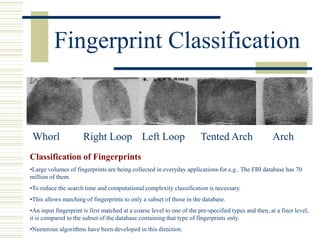
Whorl Right Loop Left Loop Tented Arch Arch
Classification of Fingerprints
•Large volumes of fingerprints are being collected in everyday applications-for e.g.. The FBI database has 70
million of them.
•To reduce the search time and computational complexity classification is necessary.
•This allows matching of fingerprints to only a subset of those in the database.
•An input fingerprint is first matched at a coarse level to one of the pre-specified types and then, at a finer level,
it is compared to the subset of the database containing that type of fingerprints only.
•Numerous algorithms have been developed in this direction.
Fingerprint Classification
Types of Prints
 FINGERPRINTS HAVE GENERAL RIDGE PATTERNS FOR
CLASSIFICATION:
 Divided into three classes:
 LOOP
 WHORL
 ARCH
 60-65% OF POPULATION HAS LOOPS
 30-35% WHORLS
 AND 5% ARCHES.
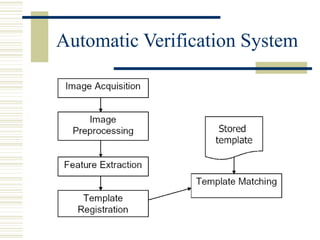
Automatic Verification System
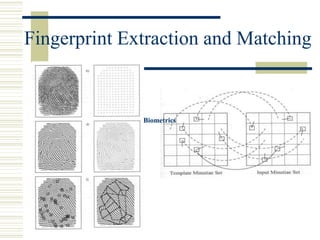
Fingerprint Extraction and Matching
Biometrics
Biometrics
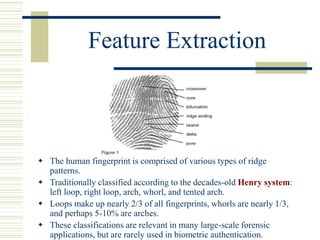
 The human fingerprint is comprised of various types of ridge
patterns.
 Traditionally classified according to the decades-old Henry system:
left loop, right loop, arch, whorl, and tented arch.
 Loops make up nearly 2/3 of all fingerprints, whorls are nearly 1/3,
and perhaps 5-10% are arches.
 These classifications are relevant in many large-scale forensic
applications, but are rarely used in biometric authentication.
Feature Extraction
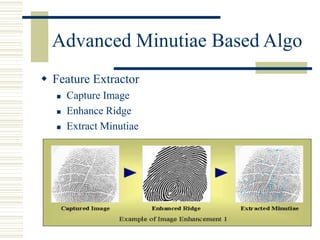
Advanced Minutiae Based Algo
 Feature Extractor
 Capture Image
 Enhance Ridge
 Extract Minutiae
Advanced Minutiae Based Algo
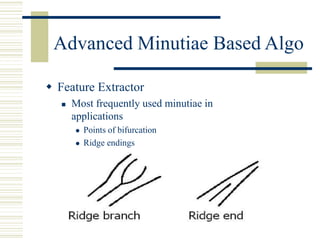
 Feature Extractor
 Most frequently used minutiae in
applications
 Points of bifurcation
 Ridge endings
Advanced Minutiae Based Algo
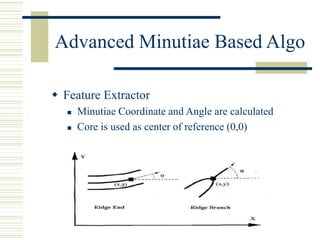
 Feature Extractor
 Minutiae Coordinate and Angle are calculated
 Core is used as center of reference (0,0)
Advanced Minutiae Based Algo
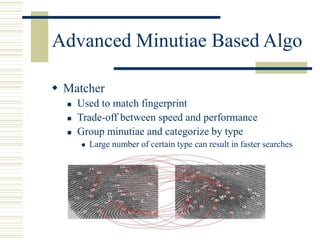
 Matcher
 Used to match fingerprint
 Trade-off between speed and performance
 Group minutiae and categorize by type
 Large number of certain type can result in faster searches
Identification vs. Authentication
 Identification – Who are you?
 1 : N comparison
 Slower
 Scan all templates in database
 Authentication – Are you John
Smith?
 1 : 1 comparison
 Faster
 Scan one template
Security
 Several sensors to detect fake fingerprints
 Cannot steal from previous user
 Latent print residue (will be ignored)
 Cannot use cut off finger
 Temperature
 Pulse
 Heartbeat sensors
 Blood flow
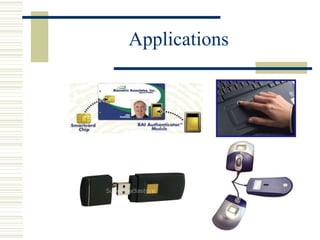
Applications
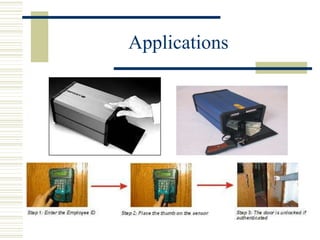
Applications
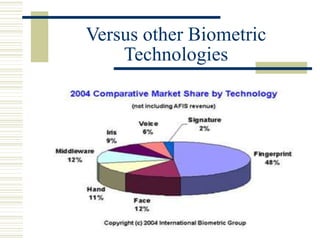
Versus other Biometric
Technologies

fingerprint_ information _technology.ppt

  • 1.
  • 2.
    Fingerprint Biometrics An extremelyuseful biometrics technology since fingerprints have long been recognized as a primary and accurate identification method.
  • 3.
    Benefits of FingerprintBiometrics  Fingerprints are unique, with no two fingers having the exact same dermal ridge characteristics  Easy to use  Cheap  Small size  Low power  Non-intrusive
  • 4.
    Whorl Right LoopLeft Loop Tented Arch Arch Classification of Fingerprints •Large volumes of fingerprints are being collected in everyday applications-for e.g.. The FBI database has 70 million of them. •To reduce the search time and computational complexity classification is necessary. •This allows matching of fingerprints to only a subset of those in the database. •An input fingerprint is first matched at a coarse level to one of the pre-specified types and then, at a finer level, it is compared to the subset of the database containing that type of fingerprints only. •Numerous algorithms have been developed in this direction. Fingerprint Classification
  • 5.
    Types of Prints FINGERPRINTS HAVE GENERAL RIDGE PATTERNS FOR CLASSIFICATION:  Divided into three classes:  LOOP  WHORL  ARCH  60-65% OF POPULATION HAS LOOPS  30-35% WHORLS  AND 5% ARCHES.
  • 6.
  • 7.
    Fingerprint Extraction andMatching Biometrics Biometrics
  • 8.
     The humanfingerprint is comprised of various types of ridge patterns.  Traditionally classified according to the decades-old Henry system: left loop, right loop, arch, whorl, and tented arch.  Loops make up nearly 2/3 of all fingerprints, whorls are nearly 1/3, and perhaps 5-10% are arches.  These classifications are relevant in many large-scale forensic applications, but are rarely used in biometric authentication. Feature Extraction
  • 9.
    Advanced Minutiae BasedAlgo  Feature Extractor  Capture Image  Enhance Ridge  Extract Minutiae
  • 10.
    Advanced Minutiae BasedAlgo  Feature Extractor  Most frequently used minutiae in applications  Points of bifurcation  Ridge endings
  • 11.
    Advanced Minutiae BasedAlgo  Feature Extractor  Minutiae Coordinate and Angle are calculated  Core is used as center of reference (0,0)
  • 12.
    Advanced Minutiae BasedAlgo  Matcher  Used to match fingerprint  Trade-off between speed and performance  Group minutiae and categorize by type  Large number of certain type can result in faster searches
  • 13.
    Identification vs. Authentication Identification – Who are you?  1 : N comparison  Slower  Scan all templates in database  Authentication – Are you John Smith?  1 : 1 comparison  Faster  Scan one template
  • 14.
    Security  Several sensorsto detect fake fingerprints  Cannot steal from previous user  Latent print residue (will be ignored)  Cannot use cut off finger  Temperature  Pulse  Heartbeat sensors  Blood flow
  • 15.
  • 16.
  • 17.