FAST AND LS TTL DATA 
5-544 
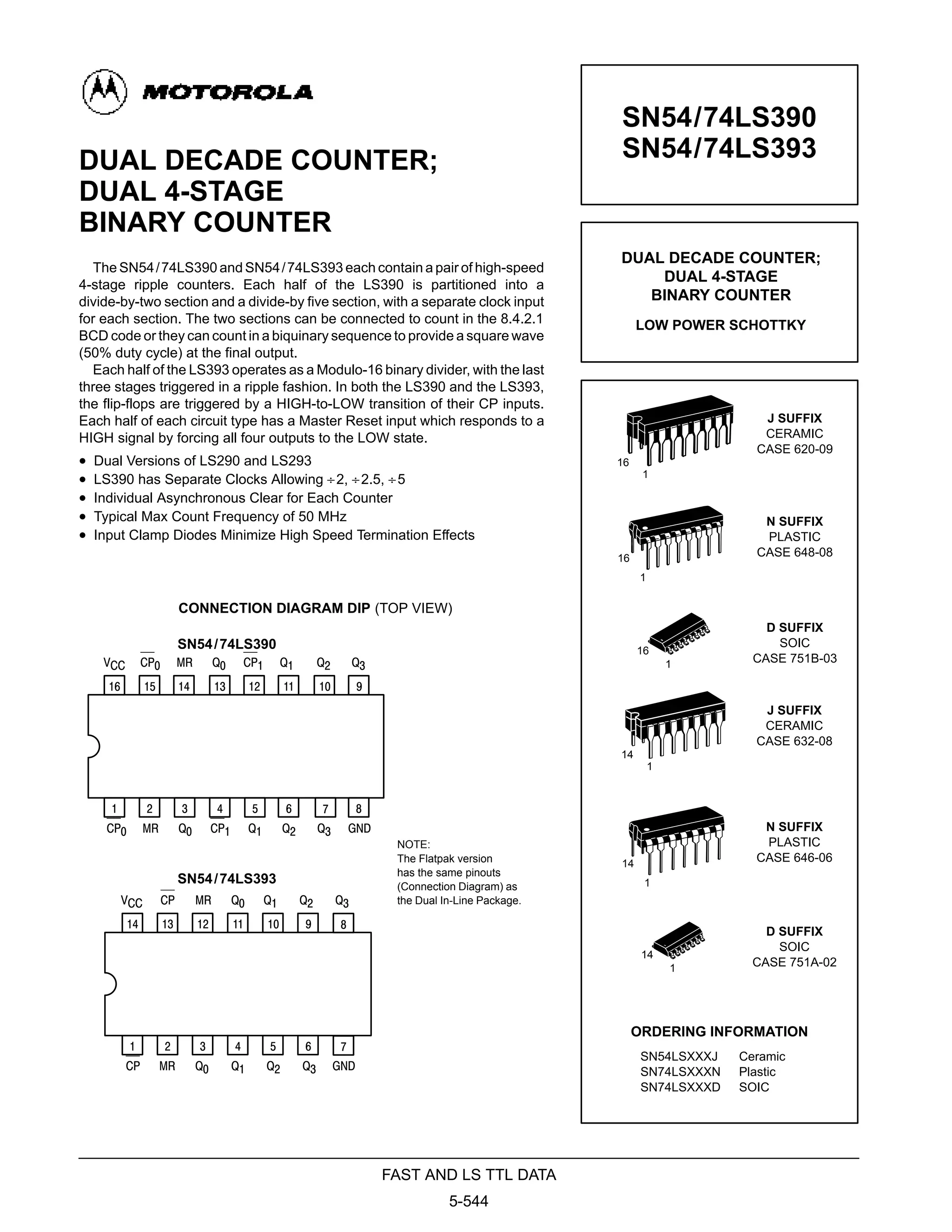
DUAL DECADE COUNTER; 
DUAL 4-STAGE 
BINARY COUNTER 
The SN54/74LS390 and SN54/ 74LS393 each contain a pair of high-speed 
4-stage ripple counters. Each half of the LS390 is partitioned into a 
divide-by-two section and a divide-by five section, with a separate clock input 
for each section. The two sections can be connected to count in the 8.4.2.1 
BCD code or they can count in a biquinary sequence to provide a square wave 
(50% duty cycle) at the final output. 
Each half of the LS393 operates as a Modulo-16 binary divider, with the last 
three stages triggered in a ripple fashion. In both the LS390 and the LS393, 
the flip-flops are triggered by a HIGH-to-LOW transition of their CP inputs. 
Each half of each circuit type has a Master Reset input which responds to a 
HIGH signal by forcing all four outputs to the LOW state. 
• Dual Versions of LS290 and LS293 
• LS390 has Separate Clocks Allowing ÷2, ÷2.5, ÷5 
• Individual Asynchronous Clear for Each Counter 
• Typical Max Count Frequency of 50 MHz 
• Input Clamp Diodes Minimize High Speed Termination Effects 
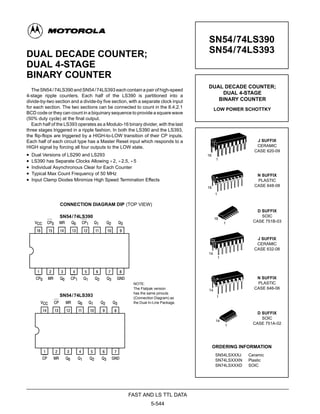
CONNECTION DIAGRAM DIP (TOP VIEW) 
SN54/74LS390 


SN54/74LS393 
NOTE: 
The Flatpak version 
has the same pinouts 
(Connection Diagram) as 
the Dual In-Line Package.
SN54/74LS390 
SN54/74LS393 
DUAL DECADE COUNTER; 
DUAL 4-STAGE 
BINARY COUNTER 
LOW POWER SCHOTTKY 
J SUFFIX 
CERAMIC 
CASE 620-09 
N SUFFIX 
PLASTIC 
CASE 648-08 
ORDERING INFORMATION 
SN54LSXXXJ Ceramic 
SN74LSXXXN Plastic 
SN74LSXXXD SOIC 
16 
1 
16 
1 
16 
1 
D SUFFIX 
SOIC 
CASE 751B-03 
J SUFFIX 
CERAMIC 
CASE 632-08 
N SUFFIX 
PLASTIC 
CASE 646-06 
14 
1 
14 
1 
14 
1 
D SUFFIX 
SOIC 
CASE 751A-02
SN54/74LS390 • SN54/74LS393 
PIN NAMES LOADING (Note a) 
FAST AND LS TTL DATA 
5-545 
HIGH LOW 
CP Clock (Active LOW going edge) 
Input to +16 (LS393) 0.5 U.L. 1.0 U.L. 
CP0 Clock (Active LOW going edge) 
Input to ÷2 (LS390) 0.5 U.L. 1.0 U.L. 
CP1 Clock (Active LOW going edge) 
Input to ÷5 (LS390) 0.5 U.L. 1.5 U.L. 
MR Master Reset (Active HIGH) Input 0.5 U.L. 0.25 U.L. 
Q0–Q3 Flip-Flop outputs (Note b) 10 U.L. 5 (2.5) U.L. 
NOTES: 
a) 1 TTL Unit Load (U.L.) = 40 mA HIGH/1.6 mA LOW. 
b) The Output LOW drive factor is 2.5 U.L. for Military (54) and 5 U.L. for Commercial (74) 
b) Temperature Ranges. 
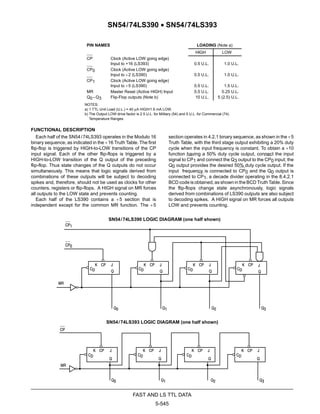
FUNCTIONAL DESCRIPTION 
Each half of the SN54 /74LS393 operates in the Modulo 16 
binary sequence, as indicated in the ÷16 Truth Table. The first 
flip-flop is triggered by HIGH-to-LOW transitions of the CP 
input signal. Each of the other flip-flops is triggered by a 
HIGH-to-LOW transition of the Q output of the preceding 
flip-flop. Thus state changes of the Q outputs do not occur 
simultaneously. This means that logic signals derived from 
combinations of these outputs will be subject to decoding 
spikes and, therefore, should not be used as clocks for other 
counters, registers or flip-flops. A HIGH signal on MR forces 
all outputs to the LOW state and prevents counting. 
Each half of the LS390 contains a ÷5 section that is 
independent except for the common MR function. The ÷5 
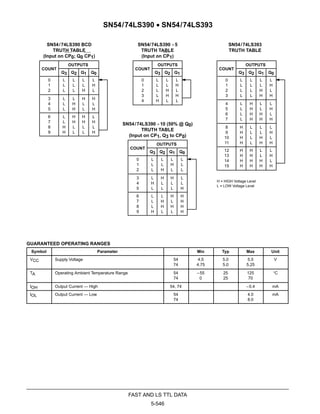
section operates in 4.2.1 binary sequence, as shown in the ÷5 
Truth Table, with the third stage output exhibiting a 20% duty 
cycle when the input frequency is constant. To obtain a ÷10 
function having a 50% duty cycle output, connect the input 
signal to CP1 and connect the Q3 output to the CP0 input; the 
Q0 output provides the desired 50% duty cycle output. If the 
input frequency is connected to CP0 and the Q0 output is 
connected to CP1, a decade divider operating in the 8.4.2.1 
BCD code is obtained, as shown in the BCD Truth Table. Since 
the flip-flops change state asynchronously, logic signals 
derived from combinations of LS390 outputs are also subject 
to decoding spikes. A HIGH signal on MR forces all outputs 
LOW and prevents counting. 
SN54/74LS390 LOGIC DIAGRAM (one half shown) 
SN54/74LS393 LOGIC DIAGRAM (one half shown)
SN54/74LS390 • SN54/74LS393 
FAST AND LS TTL DATA 
5-546 
SN54/74LS390 BCD 
TRUTH TABLE 
(Input on CP0; Q0 CP1) 
SN54/74LS390 ÷5 
TRUTH TABLE 
(Input on CP1) 
SN54/74LS393 
TRUTH TABLE 
COUNT 
OUTPUTS 
Q3 Q2 Q1 Q0 
0 
1 
2 
3 
4 
5 
6 
7 
8 
9 
L 
L 
L 
L 
L 
L 
L 
L 
H 
H 
L 
L 
H 
H 
L 
L 
H 
H 
L 
L 
L 
H 
L 
H 
L 
H 
L 
H 
L 
H 
L 
L 
L 
L 
H 
H 
H 
H 
L 
L 
COUNT 
OUTPUTS 
Q3 Q2 Q1 
0 
1 
2 
3 
4 
L 
L 
L 
L 
H 
L 
H 
L 
H 
L 
L 
L 
H 
H 
L 
COUNT 
OUTPUTS 
Q3 Q2 Q1 Q0 
0 
1 
2 
3 
4 
5 
6 
7 
8 
9 
10 
11 
L 
L 
L 
L 
H 
H 
H 
H 
H 
H 
H 
H 
L 
L 
H 
H 
L 
L 
H 
H 
L 
L 
H 
H 
L 
H 
L 
H 
L 
H 
L 
H 
L 
H 
L 
H 
L 
L 
L 
L 
L 
L 
L 
L 
H 
H 
H 
H 
12 
13 
14 
15 
L 
L 
L 
L 
L 
L 
H 
H 
L 
H 
L 
H 
H 
H 
H 
H 
SN54/74LS390 ÷10 (50% @ Q0) 
TRUTH TABLE 
(Input on CP1, Q3 to CP0) 
COUNT 
OUTPUTS 
Q3 Q2 Q1 Q0 
0 
1 
2 
3 
4 
5 
6 
7 
8 
9 
L 
L 
L 
L 
H 
L 
L 
L 
L 
H 
L 
H 
L 
H 
L 
L 
H 
L 
H 
L 
L 
L 
L 
L 
L 
H 
H 
H 
H 
H 
L 
L 
H 
H 
L 
L 
L 
H 
H 
L 
H = HIGH Voltage Level 
L = LOW Voltage Level 
GUARANTEED OPERATING RANGES 
Symbol Parameter Min Typ Max Unit 
VCC Supply Voltage 54 
74 
4.5 
4.75 
5.0 
5.0 
5.5 
5.25 
V 
TA Operating Ambient Temperature Range 54 
74 
–55 
0 
25 
25 
125 
70 
°C 
IOH Output Current — High 54, 74 –0.4 mA 
IOL Output Current — Low 54 
74 
4.0 
8.0 
mA
SN54/74LS390 • SN54/74LS393 
DC CHARACTERISTICS OVER OPERATING TEMPERATURE RANGE (unless otherwise specified) 
FAST AND LS TTL DATA 
5-547 
Symbol Parameter 
Limits 
Min Typ Max Unit Test Conditions 
VIH Input HIGH Voltage 2.0 V 
Guaranteed Input HIGH Voltage for 
All Inputs 
VIL Input LOW Voltage 
54 0.7 
V 
Guaranteed Input LOW Voltage for 
All Inputs 
74 0.8 
VIK Input Clamp Diode Voltage –0.65 –1.5 V VCC = MIN, IIN = –18 mA 
VOH Output HIGH Voltage 
54 2.5 3.5 V VCC 74 2.7 3.5 V 
= MIN, IOH = MAX, VIN = VIH 
or VIL per Truth Table 
VOL Output LOW Voltage 
54, 74 0.25 0.4 V IOL = 4.0 mA VCC = VCC MIN, 
VIN = VIL or VIH 
per Truth Table 
74 0.35 0.5 V IOL = 8.0 mA 
IIH Input HIGH Current 
20 mA VCC = MAX, VIN = 2.7 V 
0.1 mA VCC = MAX, VIN = 7.0 V 
IIL Input LOW Current 
MR –0.4 mA 
CP, CP0 –1.6 mA VCC CC = MAX, VIN = 0.4 V 
CP1 –2.4 mA 
IOS Short Circuit Current (Note 1) –20 –100 mA VCC = MAX 
ICC Power Supply Current 26 mA VCC = MAX 
Note 1: Not more than one output should be shorted at a time, nor for more than 1 second. 
AC CHARACTERISTICS (TA = 25°C, VCC = 5.0 V) 
Symbol Parameter 
Limits 
Min Typ Max Unit Test Conditions 
fMAX 
Maximum Clock Frequency 
CP0 to Q0 
25 35 MHz 
CL = 15 pF 
fMAX 
Maximum Clock Frequency 
CP1 to Q1 
20 MHz 
tPLH 
tPHL 
Propagation Delay, 
CP to Q0 LS393 
12 
13 
20 
20 ns 
tPLH 
tPHL 
CP0 to Q0 LS390 
12 
13 
20 
20 ns 
tPLH 
tPHL 
CP to Q3 LS393 
40 
40 
60 
60 ns 
tPLH 
tPHL 
CP0 to Q2 LS390 
37 
39 
60 
60 ns 
tPLH 
tPHL 
CP1 to Q1 LS390 
13 
14 
21 
21 ns 
tPLH 
tPHL 
CP1 to Q2 LS390 
24 
26 
39 
39 ns 
tPLH 
tPHL 
CP1 to Q3 LS390 
13 
14 
21 
21 ns 
tPHL MR to Any Output LS390/393 24 39 ns
SN54/74LS390 • SN54/74LS393 
  
	 
Figure 1 


Figure 2 
FAST AND LS TTL DATA 
5-548 
AC SETUP REQUIREMENTS (TA = 25°C, VCC = 5.0 V) 
Symbol Parameter 
Limits 
Min Typ Max Unit Test Conditions 
tW Clock Pulse Width LS393 20 ns 
VCC = 5.0 V 
tW CP0 Pulse Width LS390 20 ns 
tW CP1 Pulse Width LS390 40 ns tW MR Pulse Width LS390/393 20 ns 
CC trec Recovery Time LS390/393 25 ns 
AC WAVEFORMS
*The number of Clock Pulses required between tPHL and tPLH measurements can be determined from the appropriate Truth Table.
L 
N M 
FAST AND LS TTL DATA 
5-549

74ls390

  • 1.
    FAST AND LSTTL DATA 5-544 DUAL DECADE COUNTER; DUAL 4-STAGE BINARY COUNTER The SN54/74LS390 and SN54/ 74LS393 each contain a pair of high-speed 4-stage ripple counters. Each half of the LS390 is partitioned into a divide-by-two section and a divide-by five section, with a separate clock input for each section. The two sections can be connected to count in the 8.4.2.1 BCD code or they can count in a biquinary sequence to provide a square wave (50% duty cycle) at the final output. Each half of the LS393 operates as a Modulo-16 binary divider, with the last three stages triggered in a ripple fashion. In both the LS390 and the LS393, the flip-flops are triggered by a HIGH-to-LOW transition of their CP inputs. Each half of each circuit type has a Master Reset input which responds to a HIGH signal by forcing all four outputs to the LOW state. • Dual Versions of LS290 and LS293 • LS390 has Separate Clocks Allowing ÷2, ÷2.5, ÷5 • Individual Asynchronous Clear for Each Counter • Typical Max Count Frequency of 50 MHz • Input Clamp Diodes Minimize High Speed Termination Effects CONNECTION DIAGRAM DIP (TOP VIEW) SN54/74LS390 SN54/74LS393 NOTE: The Flatpak version has the same pinouts (Connection Diagram) as the Dual In-Line Package.
  • 2.
    SN54/74LS390 SN54/74LS393 DUALDECADE COUNTER; DUAL 4-STAGE BINARY COUNTER LOW POWER SCHOTTKY J SUFFIX CERAMIC CASE 620-09 N SUFFIX PLASTIC CASE 648-08 ORDERING INFORMATION SN54LSXXXJ Ceramic SN74LSXXXN Plastic SN74LSXXXD SOIC 16 1 16 1 16 1 D SUFFIX SOIC CASE 751B-03 J SUFFIX CERAMIC CASE 632-08 N SUFFIX PLASTIC CASE 646-06 14 1 14 1 14 1 D SUFFIX SOIC CASE 751A-02
  • 3.
    SN54/74LS390 • SN54/74LS393 PIN NAMES LOADING (Note a) FAST AND LS TTL DATA 5-545 HIGH LOW CP Clock (Active LOW going edge) Input to +16 (LS393) 0.5 U.L. 1.0 U.L. CP0 Clock (Active LOW going edge) Input to ÷2 (LS390) 0.5 U.L. 1.0 U.L. CP1 Clock (Active LOW going edge) Input to ÷5 (LS390) 0.5 U.L. 1.5 U.L. MR Master Reset (Active HIGH) Input 0.5 U.L. 0.25 U.L. Q0–Q3 Flip-Flop outputs (Note b) 10 U.L. 5 (2.5) U.L. NOTES: a) 1 TTL Unit Load (U.L.) = 40 mA HIGH/1.6 mA LOW. b) The Output LOW drive factor is 2.5 U.L. for Military (54) and 5 U.L. for Commercial (74) b) Temperature Ranges. FUNCTIONAL DESCRIPTION Each half of the SN54 /74LS393 operates in the Modulo 16 binary sequence, as indicated in the ÷16 Truth Table. The first flip-flop is triggered by HIGH-to-LOW transitions of the CP input signal. Each of the other flip-flops is triggered by a HIGH-to-LOW transition of the Q output of the preceding flip-flop. Thus state changes of the Q outputs do not occur simultaneously. This means that logic signals derived from combinations of these outputs will be subject to decoding spikes and, therefore, should not be used as clocks for other counters, registers or flip-flops. A HIGH signal on MR forces all outputs to the LOW state and prevents counting. Each half of the LS390 contains a ÷5 section that is independent except for the common MR function. The ÷5 section operates in 4.2.1 binary sequence, as shown in the ÷5 Truth Table, with the third stage output exhibiting a 20% duty cycle when the input frequency is constant. To obtain a ÷10 function having a 50% duty cycle output, connect the input signal to CP1 and connect the Q3 output to the CP0 input; the Q0 output provides the desired 50% duty cycle output. If the input frequency is connected to CP0 and the Q0 output is connected to CP1, a decade divider operating in the 8.4.2.1 BCD code is obtained, as shown in the BCD Truth Table. Since the flip-flops change state asynchronously, logic signals derived from combinations of LS390 outputs are also subject to decoding spikes. A HIGH signal on MR forces all outputs LOW and prevents counting. SN54/74LS390 LOGIC DIAGRAM (one half shown) SN54/74LS393 LOGIC DIAGRAM (one half shown)
  • 4.
    SN54/74LS390 • SN54/74LS393 FAST AND LS TTL DATA 5-546 SN54/74LS390 BCD TRUTH TABLE (Input on CP0; Q0 CP1) SN54/74LS390 ÷5 TRUTH TABLE (Input on CP1) SN54/74LS393 TRUTH TABLE COUNT OUTPUTS Q3 Q2 Q1 Q0 0 1 2 3 4 5 6 7 8 9 L L L L L L L L H H L L H H L L H H L L L H L H L H L H L H L L L L H H H H L L COUNT OUTPUTS Q3 Q2 Q1 0 1 2 3 4 L L L L H L H L H L L L H H L COUNT OUTPUTS Q3 Q2 Q1 Q0 0 1 2 3 4 5 6 7 8 9 10 11 L L L L H H H H H H H H L L H H L L H H L L H H L H L H L H L H L H L H L L L L L L L L H H H H 12 13 14 15 L L L L L L H H L H L H H H H H SN54/74LS390 ÷10 (50% @ Q0) TRUTH TABLE (Input on CP1, Q3 to CP0) COUNT OUTPUTS Q3 Q2 Q1 Q0 0 1 2 3 4 5 6 7 8 9 L L L L H L L L L H L H L H L L H L H L L L L L L H H H H H L L H H L L L H H L H = HIGH Voltage Level L = LOW Voltage Level GUARANTEED OPERATING RANGES Symbol Parameter Min Typ Max Unit VCC Supply Voltage 54 74 4.5 4.75 5.0 5.0 5.5 5.25 V TA Operating Ambient Temperature Range 54 74 –55 0 25 25 125 70 °C IOH Output Current — High 54, 74 –0.4 mA IOL Output Current — Low 54 74 4.0 8.0 mA
  • 5.
    SN54/74LS390 • SN54/74LS393 DC CHARACTERISTICS OVER OPERATING TEMPERATURE RANGE (unless otherwise specified) FAST AND LS TTL DATA 5-547 Symbol Parameter Limits Min Typ Max Unit Test Conditions VIH Input HIGH Voltage 2.0 V Guaranteed Input HIGH Voltage for All Inputs VIL Input LOW Voltage 54 0.7 V Guaranteed Input LOW Voltage for All Inputs 74 0.8 VIK Input Clamp Diode Voltage –0.65 –1.5 V VCC = MIN, IIN = –18 mA VOH Output HIGH Voltage 54 2.5 3.5 V VCC 74 2.7 3.5 V = MIN, IOH = MAX, VIN = VIH or VIL per Truth Table VOL Output LOW Voltage 54, 74 0.25 0.4 V IOL = 4.0 mA VCC = VCC MIN, VIN = VIL or VIH per Truth Table 74 0.35 0.5 V IOL = 8.0 mA IIH Input HIGH Current 20 mA VCC = MAX, VIN = 2.7 V 0.1 mA VCC = MAX, VIN = 7.0 V IIL Input LOW Current MR –0.4 mA CP, CP0 –1.6 mA VCC CC = MAX, VIN = 0.4 V CP1 –2.4 mA IOS Short Circuit Current (Note 1) –20 –100 mA VCC = MAX ICC Power Supply Current 26 mA VCC = MAX Note 1: Not more than one output should be shorted at a time, nor for more than 1 second. AC CHARACTERISTICS (TA = 25°C, VCC = 5.0 V) Symbol Parameter Limits Min Typ Max Unit Test Conditions fMAX Maximum Clock Frequency CP0 to Q0 25 35 MHz CL = 15 pF fMAX Maximum Clock Frequency CP1 to Q1 20 MHz tPLH tPHL Propagation Delay, CP to Q0 LS393 12 13 20 20 ns tPLH tPHL CP0 to Q0 LS390 12 13 20 20 ns tPLH tPHL CP to Q3 LS393 40 40 60 60 ns tPLH tPHL CP0 to Q2 LS390 37 39 60 60 ns tPLH tPHL CP1 to Q1 LS390 13 14 21 21 ns tPLH tPHL CP1 to Q2 LS390 24 26 39 39 ns tPLH tPHL CP1 to Q3 LS390 13 14 21 21 ns tPHL MR to Any Output LS390/393 24 39 ns
  • 6.
    SN54/74LS390 • SN54/74LS393 Figure 1 Figure 2 FAST AND LS TTL DATA 5-548 AC SETUP REQUIREMENTS (TA = 25°C, VCC = 5.0 V) Symbol Parameter Limits Min Typ Max Unit Test Conditions tW Clock Pulse Width LS393 20 ns VCC = 5.0 V tW CP0 Pulse Width LS390 20 ns tW CP1 Pulse Width LS390 40 ns tW MR Pulse Width LS390/393 20 ns CC trec Recovery Time LS390/393 25 ns AC WAVEFORMS
  • 7.
    *The number ofClock Pulses required between tPHL and tPLH measurements can be determined from the appropriate Truth Table.
  • 8.
    L N M FAST AND LS TTL DATA 5-549