Course 2, Lesson 3-4
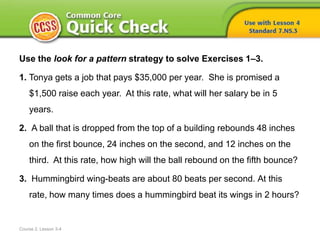
Use the look for a pattern strategy to solve Exercises 1–3.
1. Tonya gets a job that pays $35,000 per year. She is promised a
$1,500 raise each year. At this rate, what will her salary be in 5
years.
2. A ball that is dropped from the top of a building rebounds 48 inches
on the first bounce, 24 inches on the second, and 12 inches on the
third. At this rate, how high will the ball rebound on the fifth bounce?
3. Hummingbird wing-beats are about 80 beats per second. At this
rate, how many times does a hummingbird beat its wings in 2 hours?
Course 2, Lesson 3-4
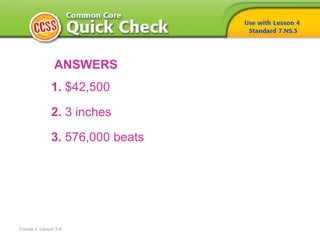
ANSWERS
1. $42,500
2. 3 inches
3. 576,000 beats
WHAT happens when you add,
subtract, multiply, and divide integers?
The Number System
Course 2, Lesson 3-4
The Number System
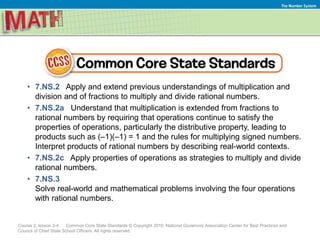
• 7.NS.2 Apply and extend previous understandings of multiplication and
division and of fractions to multiply and divide rational numbers.
• 7.NS.2a Understand that multiplication is extended from fractions to
rational numbers by requiring that operations continue to satisfy the
properties of operations, particularly the distributive property, leading to
products such as (–1)(–1) = 1 and the rules for multiplying signed numbers.
Interpret products of rational numbers by describing real-world contexts.
• 7.NS.2c Apply properties of operations as strategies to multiply and divide
rational numbers.
• 7.NS.3
Solve real-world and mathematical problems involving the four operations
with rational numbers.
Course 2, lesson 3-4 Common Core State Standards © Copyright 2010. National Governors Association Center for Best Practices and
Council of Chief State School Officers. All rights reserved.
The Number System
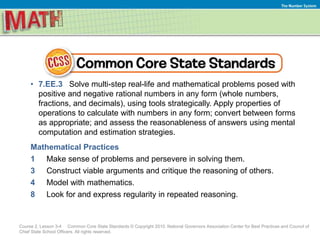
• 7.EE.3 Solve multi-step real-life and mathematical problems posed with
positive and negative rational numbers in any form (whole numbers,
fractions, and decimals), using tools strategically. Apply properties of
operations to calculate with numbers in any form; convert between forms
as appropriate; and assess the reasonableness of answers using mental
computation and estimation strategies.
Mathematical Practices
1 Make sense of problems and persevere in solving them.
3 Construct viable arguments and critique the reasoning of others.
4 Model with mathematics.
8 Look for and express regularity in repeated reasoning.
Course 2, Lesson 3-4 Common Core State Standards © Copyright 2010. National Governors Association Center for Best Practices and Council of
Chief State School Officers. All rights reserved.
•To multiply integers with different
signs
•To multiply integers with the same
sign
Course 2, Lesson 3-4
The Number System
Course 2, Lesson 3-4
The Number System
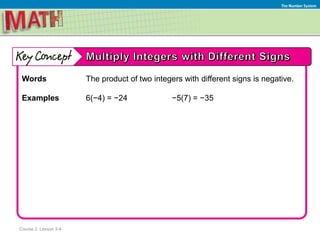
Words The product of two integers with different signs is negative.
Examples 6(−4) = −24 −5(7) = −35
1
Need Another Example?
Step-by-Step Example
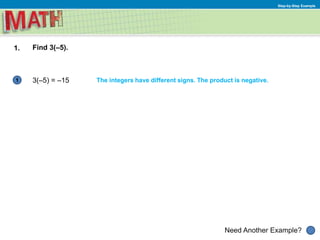
1. Find 3(–5).
3(–5) = –15 The integers have different signs. The product is negative.
Answer
Need Another Example?
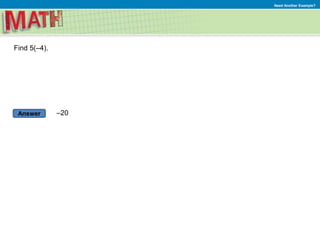
Find 5(–4).
–20
Need Another Example?
Step-by-Step Example
1
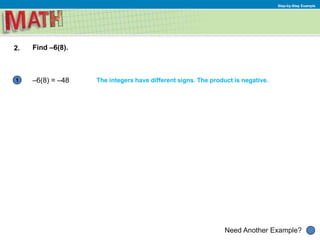
2. Find –6(8).
–6(8) = –48 The integers have different signs. The product is negative.
Answer
Need Another Example?
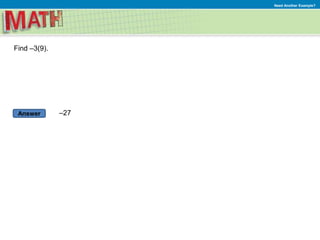
Find –3(9).
–27
Course 2, Lesson 3-4
The Number System
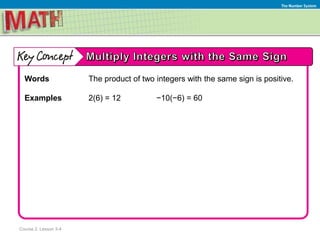
Words The product of two integers with the same sign is positive.
Examples 2(6) = 12 −10(−6) = 60
Need Another Example?
Step-by-Step Example
1
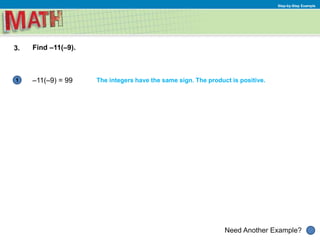
3. Find –11(–9).
–11(–9) = 99 The integers have the same sign. The product is positive.
Answer
Need Another Example?
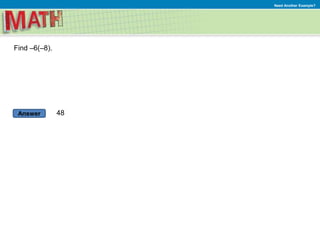
Find –6(–8).
48
1
Need Another Example?
2
Step-by-Step Example
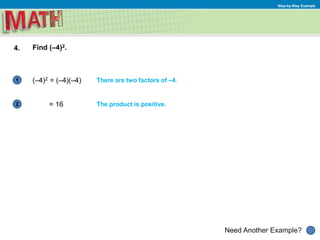
4. Find (–4)2.
(–4)2 = (–4)(–4) There are two factors of –4.
= 16 The product is positive.
Answer
Need Another Example?
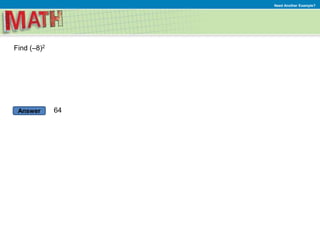
Find (–8)2
64
1
Need Another Example?
2
3
Step-by-Step Example
5. Find –3(–4)(–2).
–3(–4)(–2) = [–3(–4)](–2) Associative Property
= 12(–2) –3(–4) = 12
= –24 12(–2) = –24
Answer
Need Another Example?
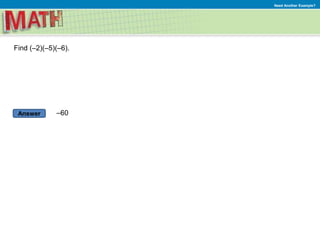
Find (–2)(–5)(–6).
–60
Need Another Example?
Step-by-Step Example
1
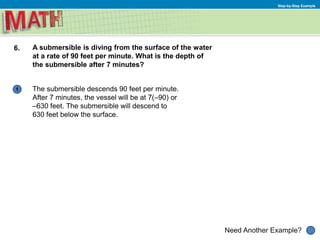
6. A submersible is diving from the surface of the water
at a rate of 90 feet per minute. What is the depth of
the submersible after 7 minutes?
The submersible descends 90 feet per minute.
After 7 minutes, the vessel will be at 7(–90) or
–630 feet. The submersible will descend to
630 feet below the surface.
Answer
Need Another Example?
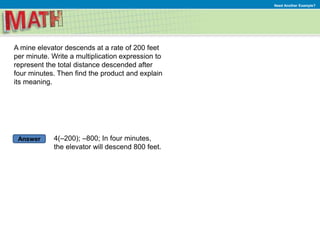
A mine elevator descends at a rate of 200 feet
per minute. Write a multiplication expression to
represent the total distance descended after
four minutes. Then find the product and explain
its meaning.
4(–200); –800; In four minutes,
the elevator will descend 800 feet.
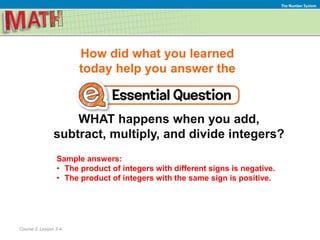
How did what you learned
today help you answer the
WHAT happens when you add,
subtract, multiply, and divide integers?
Course 2, Lesson 3-4
The Number System
How did what you learned
today help you answer the
WHAT happens when you add,
subtract, multiply, and divide integers?
Course 2, Lesson 3-4
The Number System
Sample answers:
• The product of integers with different signs is negative.
• The product of integers with the same sign is positive.
In a previous lesson, you
learned about adding
integers. Write about how
that lesson’s concepts
helped you with this lesson.
Ratios and Proportional RelationshipsThe Number System
Course 2, Lesson 3-4

(7) Lesson 3.4 - Multiply Integers

  • 1.
    Course 2, Lesson3-4 Use the look for a pattern strategy to solve Exercises 1–3. 1. Tonya gets a job that pays $35,000 per year. She is promised a $1,500 raise each year. At this rate, what will her salary be in 5 years. 2. A ball that is dropped from the top of a building rebounds 48 inches on the first bounce, 24 inches on the second, and 12 inches on the third. At this rate, how high will the ball rebound on the fifth bounce? 3. Hummingbird wing-beats are about 80 beats per second. At this rate, how many times does a hummingbird beat its wings in 2 hours?
  • 2.
    Course 2, Lesson3-4 ANSWERS 1. $42,500 2. 3 inches 3. 576,000 beats
  • 3.
    WHAT happens whenyou add, subtract, multiply, and divide integers? The Number System Course 2, Lesson 3-4
  • 4.
    The Number System •7.NS.2 Apply and extend previous understandings of multiplication and division and of fractions to multiply and divide rational numbers. • 7.NS.2a Understand that multiplication is extended from fractions to rational numbers by requiring that operations continue to satisfy the properties of operations, particularly the distributive property, leading to products such as (–1)(–1) = 1 and the rules for multiplying signed numbers. Interpret products of rational numbers by describing real-world contexts. • 7.NS.2c Apply properties of operations as strategies to multiply and divide rational numbers. • 7.NS.3 Solve real-world and mathematical problems involving the four operations with rational numbers. Course 2, lesson 3-4 Common Core State Standards © Copyright 2010. National Governors Association Center for Best Practices and Council of Chief State School Officers. All rights reserved.
  • 5.
    The Number System •7.EE.3 Solve multi-step real-life and mathematical problems posed with positive and negative rational numbers in any form (whole numbers, fractions, and decimals), using tools strategically. Apply properties of operations to calculate with numbers in any form; convert between forms as appropriate; and assess the reasonableness of answers using mental computation and estimation strategies. Mathematical Practices 1 Make sense of problems and persevere in solving them. 3 Construct viable arguments and critique the reasoning of others. 4 Model with mathematics. 8 Look for and express regularity in repeated reasoning. Course 2, Lesson 3-4 Common Core State Standards © Copyright 2010. National Governors Association Center for Best Practices and Council of Chief State School Officers. All rights reserved.
  • 6.
    •To multiply integerswith different signs •To multiply integers with the same sign Course 2, Lesson 3-4 The Number System
  • 7.
    Course 2, Lesson3-4 The Number System Words The product of two integers with different signs is negative. Examples 6(−4) = −24 −5(7) = −35
  • 8.
    1 Need Another Example? Step-by-StepExample 1. Find 3(–5). 3(–5) = –15 The integers have different signs. The product is negative.
  • 9.
  • 10.
    Need Another Example? Step-by-StepExample 1 2. Find –6(8). –6(8) = –48 The integers have different signs. The product is negative.
  • 11.
  • 12.
    Course 2, Lesson3-4 The Number System Words The product of two integers with the same sign is positive. Examples 2(6) = 12 −10(−6) = 60
  • 13.
    Need Another Example? Step-by-StepExample 1 3. Find –11(–9). –11(–9) = 99 The integers have the same sign. The product is positive.
  • 14.
  • 15.
    1 Need Another Example? 2 Step-by-StepExample 4. Find (–4)2. (–4)2 = (–4)(–4) There are two factors of –4. = 16 The product is positive.
  • 16.
  • 17.
    1 Need Another Example? 2 3 Step-by-StepExample 5. Find –3(–4)(–2). –3(–4)(–2) = [–3(–4)](–2) Associative Property = 12(–2) –3(–4) = 12 = –24 12(–2) = –24
  • 18.
    Answer Need Another Example? Find(–2)(–5)(–6). –60
  • 19.
    Need Another Example? Step-by-StepExample 1 6. A submersible is diving from the surface of the water at a rate of 90 feet per minute. What is the depth of the submersible after 7 minutes? The submersible descends 90 feet per minute. After 7 minutes, the vessel will be at 7(–90) or –630 feet. The submersible will descend to 630 feet below the surface.
  • 20.
    Answer Need Another Example? Amine elevator descends at a rate of 200 feet per minute. Write a multiplication expression to represent the total distance descended after four minutes. Then find the product and explain its meaning. 4(–200); –800; In four minutes, the elevator will descend 800 feet.
  • 21.
    How did whatyou learned today help you answer the WHAT happens when you add, subtract, multiply, and divide integers? Course 2, Lesson 3-4 The Number System
  • 22.
    How did whatyou learned today help you answer the WHAT happens when you add, subtract, multiply, and divide integers? Course 2, Lesson 3-4 The Number System Sample answers: • The product of integers with different signs is negative. • The product of integers with the same sign is positive.
  • 23.
    In a previouslesson, you learned about adding integers. Write about how that lesson’s concepts helped you with this lesson. Ratios and Proportional RelationshipsThe Number System Course 2, Lesson 3-4