Read Anytime AnywhereEasy Ebook Downloads at ebookmeta.com
Math Power 7th Grade 1st Edition Anita Rajput
https://ebookmeta.com/product/math-power-7th-grade-1st-
edition-anita-rajput/
OR CLICK HERE
DOWLOAD EBOOK
Visit and Get More Ebook Downloads Instantly at https://ebookmeta.com
Contents
1. Integers... ...1
2.Fractions ...25
e * a o a e e e e e oonoa oe*** *eaocea eneoe* eo
3. Decimals. 47
4. Rational Numbers .71
5. Exponents and Powers 9 3
o e * * o e
6. Algebraic Expressions 1 0 3
7. Linear Equations .121
8. Percentage and its Applications. .135
9. Lines and Angles... .163
10. Triangleand its Properties ...189
11. Congruence ofTriangles . . ...219
4.
12. Visualising 3-DShapes ..237
13. Symmetry ...249
14. Constructions... 263
15. Perimeter and Area of
Rectilinear Figures.. ...273
16. Circumference and Area of Circlees ...295
17. Data Handling. .311
AnswerS, .331
5.
Svllabus
Prescribed by NCERT
NumberSystem (50 hours)
() Knowing our Numbers:
Integers
Multiplication and division of integers (through patterns). Division by zero is
meaningless
Properties of integers (including identities for addition &multiplication, commutative,
associative, distributive) (through patterns). These would include examples from
whole numbers as well. Involve expressing commutative and associative properties
in a general form. Construction of counter-examples, including some by children.
Counter examples like subtraction is not commutative.
Word problems including integers (all operations)
(i) Fractions and Rational Numbers:
Multiplication offractions
Fractionasanoperator
Reciprocal of a fraction
Division offractions
Word problems involving mixed fractions
Introduction to rational numbers (with representation on number line)
Operations on rational numbers (all operations)
Representation of rational number as a decimal
Word problems on rational numbers (all operations)
Multiplication and division of decimal fractions
Conversion of units (lengths &mass)
Word problems (including all operations)
i) Powers:
Exponents only natural numbers.
Laws of exponents (through observing patterns to arrive at generalization.)
(1) a". a" = a"*
() (a" )" = a""
(ii) =am-n where m-nEN
(IV) a".b" = (ab)m"
6.
(20 hours)
Algebra
Algebraic Expressions
eneratealgebraicexpressions (simple) involving one or two variables
ldentifying constants, coeficient, powers
LIRE and unlike terms, degree of expressions e.g. xy etc. (exponent s 3 number of
variables s2)
Addition, subtraction of algebraic expressions (coefficients should be integers).
Simple linear equations in one variable (in contextual problems) with two operations
(avoid complicated coeficients)
Ratio and Proportion (20 hours)
Ratio and proportion (revision)
Unitary method continued consolidation, general expression
Percentage- an introduction
Understanding percentage as a fraction with denominator 100
Converting fractions and decimals into percentage and viceversa
Application to profit &loss (single transaction only)
Application to simple interest (time period in complete years)
Geometry (60 hours)
) Understanding Shapes:
Pairs of angles (linear, supplementary, complementary, adjacent, verticlly opposite)
(verificationand simple proof ofverticall opposite angles)
Properties of paralle! lines with transversal (alternate, corresponding, interior, exterior
angles)
(i) Properties of Triangles:
Angle sum property (with notions of proof &verification through paper folding, proofs
using property of parallelines, diference between proof andverification.)
Exterior angle property
Sum of two sides of aA> it's third side
Pythagoras Theorem (Verification only)
(ii) Symmetry
Recalling reflection symmetry.
Idea of rotational symmetry, observations of rotational symmetry of 2-D objects. (90°.
120, 180)
Operation of rotation through 90"and 180°of simple figures
Examples offigures with both rotation and reflection symmetry (both operations)
Examples of figures that have reflection and rotation symmetry and viceversa
7.
() Representing 3-Din 2-D:
Drawing 3-Dfigures in 2-D showing hiddenfaces.
ldentification & counting of vertices edges, faces, nets (for cubes cuboids, &
cylinders,cones).
Matching pictures with objects (ldentitying names)
Mapping the space around approximately through visual estimation
(V) Congruence
Congruence through superposition (examples-blades, stamps, etc.)
Extend congruence to simple geometrical shapes e.g., triangles, circles
Criteria ofcongruence (byverification) SSS, SAS, ASA, RHS
(vi) Construction (Using scale, protractor, compass):
Construction of a line parallel to a given line from a point outside it. (Simple proof as
remark with the reasoning of alternate angles)
Construction of simple triangles. Like given three sides, given a side and two angles
on it, given two sides and the angle between them
Mensuration (15 hours)
Revision of perimeter, ldea of t, Circumference of Circle
Area
Concept of measurement using a basic unit area of a square, rectangle, triangle,
parallelogram and circle, area between two rectangles and two concentric circles.
Data Handling (15 hours)
(9 Collection and organisation of data - choosing the data to collect for a hypothesis
testing.
i) Mean, median and mode of ungrouped data-understanding what they represent.
(m) Constructing bargraphs
iv) Feel of probability using data through experiments. Notion of chance in events like
tossing coins, dice etc. Tabulating and counting occurrences of 1 through 6 in a
number of throws. Comparing the observation with that for a coin. Observing strings
of throws, notion of randomness.
8.
INTEGERS 1
Introduction
In theprevious class we have learnt about integers, their addition and subtraction.
Here we shall study the properties of integers (including identities and inverse for
addition, closure, commutative, associative, and distributive laws). Also we shall study the
multiplication and division of integers. At last we solve some word problems on integers.
Let us recall the integers and their addition and subtraction. We know that the
integers are signed whole numbers i.e., whole numbers with + or
-signs.
Positive Integers:
The numbers 1, 2, 3, 4, 5, . .
i.e., the natural numbers are called positive integers.
Positive integers are also written as + 1, + 2, + 3, + 4, + 5, .., however, the
plus (+) sign is usually omitted and understood to be there with the number.
Negative Integers:
The numbers -1, -2, -3, -4, -5,.. are called negative integers.
Zero Integer:
The number 0 is simply an
inleger. It is neither positive nor
negative. D i d
Y o
Thesymbolto
denote negative
integers and the
same symbol is
used to indicate the
subtraction. But, in
the context it will be
clearly mentioned
whether we mean
ou
Know
DO YOURSELF
1. Complete the following table:
S. No. Predecessor Number Successor
() 3 5
i) 0
(i) negative integer or
subtraction.
(iv)
() 6
vi) b
2. Write the opposite of the following:
S. No. Statement Opposite Statement
Profit of T 300 Loss of 300
(ii) 500 m upward 500 m downward
(ii) 100 m below sea level
(i) Loss of 800
(u) 500 BC ----------o-
(vi) 11:00 am
9.
2
FK Mathematics Class- VII
Integers on a Number Line
We know that an integer can be represented on a line as a point. We take a point
representing the number zero.
-7654-3-210 124 6 7
We represet positive numbers on right sideofzero and negative numbers on the left side.
From the number line, we can easily order the integers. We say that an integer 'a is
greater than the other integer b if'a' lies to the right of 'b' on the number line.
Forexample:
Similarly an integer 'a' is said to be smaller than other integer 'b'if'a'lies to the left of
bon the number line.
Forexample:
Here some integers are represented on the number line given below:
Example 1: With the help of the given number line, answer the following questions:
5> 2, -3>-4, etc.
-4< -1, -2<2, etc.
-
8 -7 -6 -5 4 -3 -2 -1 0 1 2 3 4 5 6 7
)Write the integersin ascending order.
ii) Write the smallest integer slhown on the number Iline.
(u) Write the greatest integer shown on the number line.
) Ascencding order of the integers on the number line is:
8,-7. -6. - 5, - 4, - 3. -2. - 1, 0, 1, 2, 3, 4, 5, 6. 7
() Smallest integer shown on the number line is -8.
Solution
(u) Cireatest integer shown on the number line is 7.
Example 2: Some integersaremarkedon the following number line. Write these integers
in descending order.
-7 -6 -3 0 2 89
Solution: The descending order ol these integers is
9, 8,6,4, 2. 0, -3. -6. -7
Example 3: Identify the smaller number in each of the following pairs:
)8, 8 () 0. - I12 (ii) - 15, - 5 (iv) 318. - 356.
Solution: i12 (ii) -15 (iu) 356
arc smaller, iecausc sa'i r nuinbi ies on the lelt oi the larger u o
the numher ne
Example 4: Write all the integers between:
() - 5 ad 2
(u) 0 anl 4 (ii) A and 4 (u) - 7 and 0.
Solution: ()-1,3, -2. -1,9
i)3, -2, - 1. 0, 1. 2,3
i) 1,2.3
(a) - 6, - 5,-4, 3, - 2, - 1.
Example 5:
Replacein each ofthefollowing by < or > so that the statement is true:
) o7
(r)-
815
From a number ine, ve ran shey which ol the tO numbers are greater o
smaller because greater number always lhes on the right side of the smalle.
number on the number line So.
()-7 - 15
()-150 15
(ii)-4 0
(7) -25:3 420
Solution:
(i)0< 7
()-81 < 5
(i) -7> - 15
() - 15 <15
(ii) -4<0
() 253 >
-420
10.
Integers 3
Addition ofIntegers
In order to add two integers on a number line, we lollow the following steps:
Step 1. On the number line, mark one
ofthegiven integers.
Step 2. Move as many umls as the second number to the:
(i) right of the first, if the second integer is positive.
(i) left of the first, if the second integer is negalrve.
7he point thus we reach represents the sum
of two given integers.
Step 3.
Example 1: Add the following integers:
(i) 6 and -9 ()- 3 and -4 (i) - 4 and 5
Solution: ) First we draw a number line and mark the integer 6 on it.
Adding 9
5 67
-6-5 4 3) -2 -1 0
To add-9 we move 9 steps to the left from 6. Thus, we reach at a point
representing - 3. Hence the sum of6 and -9 is-3. That is, 6 + (-9) = -3.
Note that ifwerepresent the number -9 on the number line then to find
6+(-9) we shall move 6 units to the right of-9.Obviously, we reach at -3.
1 2 3 4 8
Adding 6
-11 10 -9) -8 -7-6 -54 3 2 -1
(i) Draw a number line and mark the integer-3on it.
Adding-4
11 -10 -9 -8- -6 -5-4 3-2 -1 0
To add- 1 10 - 3 we have ti move 4 steps to the left of-3. Thus, we arrive
at -7. Hence, the required sum is - 7. That is, (-3) +(-4) = - 7.
(ii) Draw a number line and represent the integer- 4 on it.
Adding 5
-5 4 -3 2 -1 0 2 3 4 5
To add 5 w - 4 we have to move 5 steps to the right of- 4, in this way we
aTiVC a point representing I which represents the sum oftwointegers.
Therefore, (-4) +5 =l.
Thus, e conclude that;
To add a positive integer we move to right as many steps as the second integer is to be added,
while to odd o negative integer we move to left as many steps as the negative integer is to be
added
should also be noticed that no matter which number you choose as first and
the other as second number, because in both the conditions you will get the
s121 aiIswer.
Example 2: Draw a number line and represent each ofthe following on it
() - 1 + (- 8) + 6
(i)-2 + 8 +(-9) (ii) - 2 + (-3) + (- 5).
- 1 + (-8) + 6 =-3
Adding 8
Solution:
-10-9-8 -7 -6 -5 43-2 1 0 1 2 3 4 5 6 7 8 9 10
Adding 6
11.
4 FK MathematicsClass - VIl
() -2 + 8 +(-9) =-3
Adding 9
-10-9-s -7 -6 -543 2-1 0 1 2 3 4 5 6 7 8 9 10
Adding8
(ii) -2 +(-3) + (-5) = - 10.
Adding-5 Adding-3
-10-9 8 -7 -6 -)4 3 2 -1 0 1 2 3 4
o12 3 45 67 8 9 10
Subtraction of Integers
We know that in the subraction fact 9 5 = 4, 9 is the minuend, 5 is the
subtrahend and 4 is the dillerence.
In order to subtract an integer from another integer, we follow the following steps:
Step 1. First we draw a number line and mark (label) the mimuend on it.
(i) To subtract a positive integer, we move to the leftfrom the minuend as many steps
as the second integer is.
(i) To sublract a negative integer, we move to lhe vight (not lefl) as many steps as the
second integer s.
The point thus we reach represents the difference of two integers.
Step 2.
Step 3.
Example 3: Subtract the following integers:
0) 4-8 () -54 (i) - 3- (-4)
(i)0-(-6)
Solution: () First we draw a number line and mark the number 4 on it.
Subtracting 8
45 6
-6-5 -4-3
To suburact 8, we move 8 steps to the left of 4, thus we reach at the point
representing - 4
Hence, 4 - 8 = -4.
(2) Mark the integer - 5 on a number line.
-2-1 0 2 3
Subtracting 4
-10-9 8-7-6 6) 4-3-2 -1 0
To subtract 4, we move 4 steps to the lelt of -
5, thus we reach at the point
representing - 9.
Hence, -5 -4 =-9.
(i) First we draw a number line and mark the integer -3 on it.
Subtracting (-4)
6-543-2 -1 0 (1) 2 3 4 5 67
To subtract a negative integer-4, we will move 4 steps to the right of- 3,
thus we reach at the point representing 1.
Hence, (-3) -(-4) -3 +4 =1
(iv) For 0-(-6), firstly we draw a numberlineand mark the numberO on it.
Subtracting (-6)
-6-5 4-3 -2 1 (01 2 3 4 5 67
To subiract-6 from 0, we move 6 steps to the right of0, thus we reach at
the point representing 6.
Hence, 0 -(-6) =0 +6 =6.
Thus, we conclude that;
12.
Integers 5
Tosubtrocta positiveinteger,move lefhwards as many steps as the positive integer is to be subtracted.
Tosubtractanegative integer, move rightwards (from the position of minuend) as many steps as
the negative integer is to be subtracted.
From the above examples (iü) and (iv).
We observe that -3-(-4) = l which is same as -3+4. Also 0-(-6) = 6 which is same
as 0 +6 = 6.
lt is clear that subtracting a number means adding the additive inverse of the
number. This rule cannot be understood without a proper mathematical explanation. But
with the help of following analogy, we can have an idea of it:
Imagine that you are cooking some kind of dish, but not on a stove. You control the
temperature of the stove with magic cubes. These cubes come in two types: hot cubes and
cold cubes.
Letting hot cubes as positive numbers and cold cubes as negative numbers.
Therefore,
If you add a hot cube (add a positive number), the temperature goes up. If you add a
cold cube (add a negative number), the temperature goes down. If you remove a hot cube
(subtract a positive number), the temperature goes down and if you remove a cold cube
(subiract a negative number), the temperature goes up.
That is subtracting a negative is the same as adding a positive and subtracting a positive is the
same as adding a negative.
Limitations of the Number Line
Of course, addition and subtraction of integers on a number line would not work so
well if you are dealing with large numbers.
For example, think about 465 - 739 or 465 +(-739). We certainly do not want to use
a number line for this. Now we can say that the answer to 465 - 739 has to be negative
number (because minus 739 will take you somewhere to the left of the number zero on the
number line) but how do you figure out which negative number is the answer?
For solving the above difficulty look "5 - 9". You know that the answer will be
negative, because you are suburacting a bigger number (9 is bigger than 5). The easiest way
of dealing with this is to do the subtraction. "Normally, smaller number is subtracted from
the larger number and then put, a 'minus' sign before thhe difference soobtained. Like:
9-5 4 so 5-9 = -4. This works the same way (and simpler) for bigger numbers:
739- 465 =274.
Therefore,
465 739 = - (739 - 465) = -274
Similarly,
100 425 = - (425 -100) = -325
500 915=- (915-500) =- 415, etc.
Thus, we say that:
To subtract a larger natural number from a smaller natural number we subtract smaller number
from the larger number and we put a negative sign before the difference so obtained. That is
Smaller naturad number -Larger natural number - [Larger natural number - Smaller natural number)
To add two negative numbers, we add the numbers without sign and then we put the negative sign
(common sign) before the sum so obtained.
Summary on Addition and Subtraction of Integers
)While adding integers with like signs(both positive or both negative), we add the
numbers(by dropping their negative sign if any), and the common sign is put up
before the sum.
i) While adding integers of unlike signs, we suburact the smaller number from the
larger (obained after dropping the negative sign) and give the sign of the larger
number before the diflerence so obtained.
13.
6
FK Mathematics Class- VII
(i) When the addition and subtraction signs are placed side by side without any
number in between, the two opposite signs give a negative sign.
For example: -5+(-9) = - 5-9 =- 14
- 7- (+8) = - 7- 8 = - 15.
u) When there are two negative signs placed side by side with no numeral n
between, the two like signs give a positive sign.
4 -(-9) = - 4 +9 = 5.
Exacise 1.1
1. Represent the following numbers as integers with
appropriatesigns:
Statement Signs
S.No.
() 500 m abovesealevel
35 C below 0°Ctemperature
(i)
5°C below 0°Ctemperature
(i)
(iv) Heightof300m
Depth of500m
(u)
(u) A
depositofrupees thirtythousand
(vu) Withdrawal of rupees seven hundred
2. Compare the following pairs of numbers using > or <.
)0 5
(iv) -1 B7
3. Represent the following numbers on a number line:
ii) 5 - 5
(u)ii 15
9
(vi) -20 -18
) +9
4. The number line given below shows the temperature of different cities on a
particular day:
Patnitop-
() -8 (1)+8 )-5
Srinagar Shimla
Bhubaneswar Chennai
HH++H++H+++|++H++|+++H+H+|+HH+++H
-10 5 20 25 30 35 40 45 50
Nainital varanasi
i) Observe the number line and write the temperature of the cities markcd on it.
(ii) What is the difference of temperature between the hollest and the coldest
places anong the above?
(i) Can we say temperature ol Bhubaneswar is more than the temperature ol
Nainital and Srinagar together?
5. Draw a number line and represent each of the following:
)-3 +-7) +6
6. Add the following integers:
(i) 2 +6 +(-7) (iü) -6 +8
) 7 and -11
7. Find the difference between the following pairs of integers:
(i)-20and 40
8. Drawa number line and answer the following:
) Which number will we reach if we move 8 steps to the right of- 15: Write this
number with appropriate sign.
(i) 6 and -5 (ii)-4 and -7
() - 19 and 30 (ri) 45 and 36
(i) Which number will we reach if we move 12 steps to the left of 3?
(ai) Ifweare at -7 on a number line, in which direction should we move to reach- 15
and how many steps?
(iu) 12?
If we are at -7 on a number line, in which direction should we move to reach
14.
Integers
9. Write allthe integers between the given pairs in ascending and descending orders:
S. No. Integers Ascending Order Descending Order
) 0 and 5
-3 and 3
-
8 and -15
)|-40 and-32
10. Write the following integers in ascending and descending orders:
S. No. Integers Ascending Order| Descending Order
) -51, 320, 0, -215, 27
(ü)-200,154, 4, 315
11. Complete the following table:
3-4 0 12 4
- 3
4
7
- 19 - 19
-27
7
12. Write true (T) or false (F) for the following statements. Also correct those which
are false
(i) Sum of two positive integers is always positive.
(i) Sum of two negative integers is always positive.
() When a positive integer and a negative integer are added, the result is always a
negative integer.
(iv) The sum of an integer and its additive inverse is always zero.
()When a positive integer and a negative integer are added. we1ake tlheir
difference and place the sign of bigger integer, ignoring the sign of both.
(a) We know that in a magic square, each row, column and diagonal have the equal
13.
sum. Check which of the following is a magic square.
(i)
- -
-5-2
o33
-10
-4-3-2
-7
6
(b) Magic squares are given below, fill in the empty cells with appropriate integers:
() 4 5
-2
-6
15.
FK Mathematics Class- VIl
14. Observe the pattern for each of the following and find the next three numbers:
()1,3,5,7,9,
(ii) 2, 4, 6, 8, 10,
(i) 25, 20, 15, 10,
(i) -27,- 18, -9,
() -1, - 10, - 100, - 1000,
(oi) 11,9, 7, 5,
(viü) 1,3, 6, 10,
15. In a quiz competition, one positive mark is allotted for each correct answer and one
negative mark is allotted for each wrong answer. If Tom's score in five successive
rounds were 19,-10, 18, 21, and -17 respectively, then what was his total at the end?
16. At midnight the temperature was 21°C. Two hours later, it was 3° colder. What was
the temperature then?
17. At mid-day the temperature was 18°C. Two hours later, it was 2° warmer. What was
the temperature then?
18. A rock climber started at + 200 m and came a distance of 50 m down the rock face.
How far above sea level was he then?
19. At midnight the temperature was - 5°C. One hour later, it was 2" warmer. What was
the temperature then?
20. Neeta has a loan of R 1,200 to repay. Her father gave 2,500. Describe Neeta's
financial position.
21. A plane is flying at 6,000 m above the sea level. At a particular point, it is exactly
above a submarine floating 1,000 m below the sea level. What is the vertical distance
between them?
Rajesh deposits 5,000 in his bank accountand withdraws 4,650 from it. If the
withdrawal of amount in the account is represented by a negative integer, then how
will you represent the amount deposited? Find the balance in Rajesh's account after
the withdrawal.
22.
23. Find whether the given statements are true (T) or false (F):
) The smallest integer is 0.
(i) The opposite of zero on a number line is zero.
(ii) Zero is not a positive integer.
(iv) O is larger than every negative integer but less than every positive number.
() A positive integer is greater than its opposite.
(vi) Every integer is less than every natural number.
(v) -1 is the greatest negative integer.
(vii) 0 is the smallest positive integer.
(ix) The sum of greatest negative integer and sinaller positive number is zero.
(x) The negative of a positive integer is a negatüve integer.
(xi) The negative of a negative integer is positive.
(xii) Ifa and b are two integers such that a <b then (b -a) is always a positive integer.
24. Find the solution of the following:
(i') -12 (-14) + (-3) + (+29)
-9)+(+7) + (-11) +(+29)
i)-380 +(-247) + (+376) - (+384) (iv)-(-9) +(-17) (-37)+ (+ 47)
(7)-484 - (-317) -
317 484 (i) 565 354 +125 - 324 + 18
16.
Integers 9
25. Usethe signs>, < or = in the following:
) 80 +69 319
(i) 19 +(-40) -(37) 32 +(-66) -(-39)
(i) 53 54 - 55
(iv) (-13)+(-12) -36)-(-6)
26. Subtract the sum of873 and -3002 from the sum of-904 and 7093.
27. Sum of two integers is 308. If one of the integers is -78, find the other integer.
28. Simplify:
)(708-(-2351)+(3477)-(4051)]
(i) 7924 +(7092) -(843) +(-6670)+7000
-219-
100+ 70 +79
-
79 30- 35
(ii) 54357 +(-90873) -(231001) +(-405)
Properties of Addition
We have obtained integers by extending the system ofwhole numbers to integers. We
now state the properties of addition of integers as follows:
1. Closure Property
Let us add two integers:
6+3 9;
6+(-3)=3; -6 +(-3) = -9
-6 +3 = -3;
In all the above four cases, when an integer is added to another integer, we always get an
integer. Therefore, we say integers are closed under addition.
2. Commutative Property
Let us add two integers in different order:
8 +(-5)=8-5=3 (-5) +(-3) = - 5-3 = -8
-3 +(-5)= -3-5 = -8
and
and -5+(8) = -5 +8 = 3
Therefore, +(-5)=
=-5
5+(8). Therefore, (-5) +(-3) =-3+(-5)
A change in the order of addition of two integers does not change the sum of the integers. This is
known as commutative property of addition of integers.
3. Associative Property
Let us add three integers in any order:
-3+(+5)] +(-6) and -3 +[(+5) +(-6)]
= (+2) +(-6)
= (-4)
(-3)+(-1)
= (-4)
Thus, [-3+(+5)] +(-6) = -
3 +[(+5) +
(-6)].Thus, we conclude that:
In addition of integers, when the grouping is changed, the result does not change. This property
is called associative property of addition of integers.
4. Additive Identity
Let us add 0 to an integer:
- 5 +0 = - 5
- 6 +0 = -
6
0+(-6) =-6
What do you observe?
When O is added to any integer the result is the integer itself. Zero is the additive identity for
integers.
17.
10 FK MathematicsClass - VII
5. Additive Inverse
Complete the following table and write your observation:
S.No. Integer Another Integer Sum oftheIntegers
6+-6)= 0
) 6 6
3 3 -3 +3 == 0
15+(-15) =
0
0+0 0
(ii) 15 15
(iv) 0
() 7
(vi) - 8
(vii) - 100
(uii) 21
What do you observe?
We observe that,
)Sum of the given two integers in each of the given pairs is zero i.e. the additive
identity for integers.
( ) To find the additive inverse, we change the + sign into - sign (except in case of )
of the gven integer and vIce-versa.
(i) Each of the integer in such a pair is called the additive inverse of the other e.g. -6
is the additive inverse of 6.
Properties of Subtraction
1. Closure Property
Observe the following subtractions:
(-6)-(-6)= - 6 + 6 =0; [As subtracting the negative of a number is same as adding
its additive inverse.]
5-3=2 5-5 0
5--5)=10; (-7)-(+3) =- 10, etc.
In all cases we observe that,
When an integer is subtracted from another integer the result is always an integer.
Therefore, we say integers are closed under subtraction.
2. Commutative Property
Let us subtract:
3-(-2) = -3+2 =--1
-2-(-3) =-2 +3 =lI
-3-(-2)* -2 -(-3)
and
So
Hence
Subtraction of integers is not commutative.
3. Associative Property
Let us subtract:
5-(-3)]-4 = [5 +3]-4 =8 -4 =4
5-(-3)-4] =5-(-3-4) = 5--7) =5 +7 =12
and
Therefore, [5-(-3)]-4 5-[(-3)-4]
Hence,
Subtraction of integers does not follow the associative property.
18.
11
Integers
4. Subtraction ofZero
Let us subtract zero from an
integer:
14 0 14. 0-0 =(0, -5 -0 = - 5, 2-0 =2
We observed that:
When zero is subtracted from an integer, we get the same integer.
But, if an integer is subtracted from zero, we obtain the opposite of the integer.
For example, - 14 -0 = - 14, 0-(-14) = 14,
5. Subtraction of1
Let us subract I from an
integer
4-1 =3. 10-1 =9
- 7 -l = -8, 0 - 1 = - 1, etc.
We observed that;
When 1 is subtracted from an integer, we get its predecessor
Example 1: Write a
pair of integers whose (i) sum is -
7 and (ii) difference is -
9.
) -9 +2 = -4 + (-3) =-7
(i) 1 - 10 = 2- 11 = -9
Solution:
Example 2: Write a pair of integers whose difference is
() a negative number.
(i) an integer greater than only one of the integers.
) - 14 - (-5) = - 9 (Negative integer)
(i)(-11)- (-3) =
-8 (lt is greater than -
11 and less than -
3)
Solution:
EXCNGSA 1.2
1. Write a pair of integers whose
) difference is - 12
2. Write a pair of integers whose difference gives:
() an integer greater than both the integers.
1) an integer greater than only one of the integers.
(ii) zero.
(i) difference is5 (ii) sum is 0
3. Fill in the blanks:
(i)-7)+()= (-9) +(_
_)= -88
(ii) - 29 + (_)= 0
(iv) 0 + ( )= (-18) - (
(ii) - 88 + (_
()[11 +-19)] +
( )=( )+[-19) +(-5]
4. Calculate the sum:
2+(-2) +2 +(-2) +2 +(-2) +.
) if the number of terms is 160 (i) if the number of terms is 127
5. Find:
(1) a pair of negative integers whose difference gives 6.
(u0) a pair of negative integers whose diference gives -
9.
(i) a negative integer and a positive integer whose difference is -
15.
(i) a negative integer and a positive integer whose difference is 16.
19.
12 FK MathematicsClass - VII
6. Verify a -(-b) =a+b for the following:
0) a =10, b =12 (i) a = 88, b = 77 (ii) a = 119, b = 144
(iv) a = - 65, b = 15
7. Verify: [-a-(-6)] -c* -a-[-b-(-c)]}
) a = 3, b= 7, c=-9
() a =117, b = -112 (vi) a = 4 l5, b = 502
(2) a =10, b =11, c=-14
(ii) a = 18, b = -32, c =17 (iv) a = -31, b = 40, c= -43
Multiplication of Integers
We know that the multiplication is a simpler form of repeated addition.
CaseI: Multiplication ofTwo Positive Integers
Observe the pattern and complete the table:
3 times 4 4 +4 + 4 3x4 12
7x9 63
7 times 9
9+9+9+9+9+9
5 times 4
8 times 2
Case II: Multiplication of a Positive Integer by a Negative Integer
Let us observe the following epeated addition.
S.No. Statement Repeated Addition Product Form Result
() 3 times 2(-2) + (-2) + (-2) 3x(-2) 6
(i) 4 imes-3 (-3)+(-3)+ (-3)+ (-3) 4x - 3 12
(ii) 2times -7 (-7) + (-7) 2x(-7) -14
Alternative Method:
Let us find 4 x-3 and 3 x
-6byother pattern.
() (i)
4x 4 16 3x3 9
Product
4x 3 12 is decreasing by 4 3 x22
4x 2 8 3x1 Product
is decreasing by 3
4x 1 3x0
4x 0 0 3 x -1 = 3
4x-1 3x -2 =-6
-4
4x-2 3x-3 = -
3x 4 = - 12
4x-3 =-12
4x4 = - 16 3x-5 =-15
3x6=-18
Second factor is
decreasing by 1
Second factor is
decreasing by |
What do you observe from the above patterns?
To get the multiplication of a
positive integer by a
negative integer, we
multiply the numbers
without sign and place a negative sign before the product so obtained.
Can you write - 2 x 3 as repeated addition?
No, how we can find - 2 x 3?
20.
Integers 13
Case III:Multiplicationof aNegative Integer with a PositiveInteger
Let us find,
() (i) Product
3x 3 is decreasing
4x5 = 20
3x 5
9
=
2 x 3 6 Product 15 by 5
1x 3 is decreasing by 3
2x 5
1x5
10
0x 3 0
x 3
-2 x 3
=-3 0x
5
= - 6
l x 5 = -5
3 = -9 2x 5 - 10
x
First factor is -3 x 5 = - 15
decreasing by 1 First factor is
-4x 5 = - 20
decreasing by 1
What do you observe?
To get the product of two integers with unlike signs, we multiply the numbers without their sign
and give a minus sign to the product.
CaseIV:MultiplicationofTwoNegative Integers
Let us find -3 x - 4.
We know that Product
3 x 4 = - 12 is increasing
by 4
2x -4 = - 8
1x -4 4
First factor is 0 x -4 = 0
decreasing by 1 -1 x -4
-2x -4 =
-3x 4 =
8
12
What do you observe?
To find the product of two integers with same sign, we find the product of their values regardless
of their signs and give plus sign to the product.
Thus from above, we conclude that
(x (+)=+
(x(+)=
(+) x (==
Ox(9= +_
Positive xPositive =Positive
Negative x Positive= Negative
Positive xNegative= Negative
Negative x Negative =Positive
Rules for multiplication of integers:
(i) The product of two integers ofsame (like) sigms is a positive integer.
(i) The product of two integers ofdifferent (unlike) signs is a negative integer.
Let us observe the patterns of signs in the product of integers:
()-2x-3x- 4 =
(-2x-3)x-4 =6x- 4 =
-24
()-4x-5x- 6x-7 =(-4x-5)x(-6x- 7) =
20x42 840
i-1x-lx-
1x-1x-1 ={-1)x(-1)} {-1)x(-1)}>x-1
=lxlx(-1) = 1x(-1) =(-1)
(iv) -
5x-4x-2x -3 =(- 5x- 4)x(-2x-3) =20 x6 120
What do we observe?
We observe that:
If negative integers are multiplied even times, product is always a positive integer.
If negative integers are multiplied odd times, product is always a negative integer.
21.
FK Mathematics Class- VII
DO YOURSELF
F'ind the sign in the following products:
SignoftheProduct
S.No.
)-2x-3x-4x-Ix-
i)-3x-5x-6x-2
(i)-4x-3x-Ix-5x-2x-7
Product
Properties of Multiplication of Integers
1. Closure Property
Let us multiply two integers.
S.No. First Number Second Number Is the product an
integer?
Product
-3x-2=6
-4x0 0
Ix-1=1
-3x5 =-15
Yes
Yes
)
(iii)
4
Yes
(iv) 5 Yes
What do you observe?
The product of two integers is also an integer. This means that integers are closed under
multiplication. This property is called the closure property of multiplication of integers.
2. Commutative Property
Let us multiply two integers in different order.
S. No. a xb b xa a xb=b xa
) 2x-3=-6 -3x 2 - 6 Yes
- 3x-4=12
()
(i)
-4x-3 =12 Yes
0x 6=0 6x0 0 Yes
What do vou observe?
A change in order of multiplication of two integers does not change the product.
This property is known as the commutative property of multiplication of integers.
3. Associative Property
Let us muliply three integeTS -2, 3 and 4,
-2x 4=(-2x-3)1- i
2 2x-2x(-3)- 2)
{in) 1-x-3-4<-2,
IWhat do you observe?
A change in grouping of three integers while ultiy hn do not choge he pr a of
those three integers. This property is known as
associutivity of muitiplication of integers.
4. Distributive Property
et ns observe the followng pT.luct
) 7>(2 5) and 7
19
Thus, 7x (2 +5) = 7x2 +7x5
22.
Integers 15
(i)-2(-3+1) and
=-2-2)
-2x-3+(-2)x(1)
= (-2)x(-3) +(-2)x1
= -2 x -2 = 6-2
4 = 4
=
Thus-2x(-3 + 1)= -2x(-3)+(-2) x(1)
This property of integers is known as the Distributive property of multiplication over addition.
(ii) 7x(5-7) and 7x5-7x7
=
7 x (-2) 35-49
= -14 -14
Thus, 7x (5-7) = 7x5-7x7
This property of integers is known as the Distributive property of multiplication over subtraction.
DO YOURSELF
) Is 5x[7+(-2)] =5x7+5x-2?
() Is (-23) x[(-21) +(-9)] = -23 x-21 +(-23) x(-9) ?
(m) Is[-11+(-11)]x11 =11x(-11)+11x(-11)?
5. Multiplicationby1
Let us multiply integers by 1:
0 x 1 = 1 x 0 = 0
7 x 1 =1 x7 =7
-2x 1 =l x-2 =-2
6x1 =l x 6 =6
What do you observe?
The product of ary integer and 1 is the integer itsef. 1 is called the multiplicative identity of integers.
6. Multiplication by 0
-7 x 0 = 0 x-7 =0
6x 0 = 0 x 6 =0
-1 x 0 = 0 x-1 = 0
The product of any integer and O is always zero.
Example: In a class test containing 20 questions, 3 marks are given for every correct
answer and -
I mark is given for every incorrect answer.
(i) Renu attempt all questions but only 11 ofheranswers are correct. What
is her total score?
(ii) One of her friends attempt 8 questions but only one answer is incorrect.
What is her friend's total score?
Marks given for one correct answer =
3
Marks given for l correct answers =3 x 11 33
Marks given for one incorrect answer = -
1
Marks given for 9 incorrectanswers =
-1 x9 =
-9
Solution:
So,
So,
Therefore,
Renu's total score = 33 - 9 24
Marks given for one correct answer
Marks given for 7 correct answers =
3 x 7 =21
Marks given foroneincorrect answer =
1x-1 =-
1
3
So
her friend's total score = 21 - 1 = 20
Therefore,
23.
FK Mathematics Class-VIl
EXercisa 1.3
1. Simplify:
) (-7)x(-9) i) (-8)x(11) (ii) (10) x(-12)
(iv) (-8)x (-4) x (-7)
2. Complete the following multiplication:
() (-12) x(-6)x (14) (vi) (0) x (-14) x (-4)
X - 6 4
36
20
-6 - S
0
3. State true (T) or false (F):
) The product oftwo integers with same sign is always positive.
(i) The product of two integers with opposite sign is always negative
(ii) The product of three negative integers is negative.
(iv) The product of odd number of negative integers is negative. 7
() The product of a negaive and a positive integers may be zero. f
4. Compare:
(i) (7 +9) x 10 and 7+9x10
(i) [(-4 -(6)] x(-2) and (-4) - 6x-7
5. An integer 'a' is muitip!lied by - I1. Classify the integer 'a' if the product is
negative
6. Give the opposite of:
(i) - (-5)
By what integer should a given number n be muliplied to get the opposite of n?
(1) positive (i) neither positive nor negative
(i) (+6) (in) (-1)x20
7. Verify the following:
() 19x[7+(-3)] = 19x7+19x-3 i)-24 x [(-6) +(19)]= -24 x-6 +(-24) x 19
8. Ifax-1) = -25, is the integer a positive or negative?
9. Verify:
) 16x [7 + (-8)] = [16x 7] + [16x(- 8)]
(i) 14 x [-2) +(-4)] = [14 x (-2)] + [(14) x (-4)]
10. Determine the integer whose product with I is:
(i) 14
11. What will be the sign of the product if we multiply together
) 9 negative integers and 2 positive integers?
(i) 5 negative integers and 4 positive integers?
(ii) 0 (in) - 100
12. Match the following:
()-7) +9 = 9 +-7)(b)
ii) 6 + [3+(-2)] = [(6 +3)] +(-2Xei(b) Commutative property of addition
(ii) (-8)(-5) = (-5)-8))
(iv) 4 [5 x (- 5)] = (4x 5) (- 5Xdy
() 7 x0 =0(c)
(7i) 13xl = 13(a
(a) property of muliplicative identity
(c) Multiplicative property of zero
(d) Associative property of multiplication
() Associative property of addition
) Commutative property of multiplication
24.
Integers 17
13. Theproduct of two jntegers is -120. If one number is - 30, what is the other,
14. Find the product using suitable properties:
-15) x(-37)
(ii) 10 x (-35) x (-5)x (-20)
i) 6x 63 x (- 135)
(v)(-31)x
202
() 720 x (- 68) +(-720) x 30
15. Fill in the blanks with suitable integers:
)-3)x(-12)= 6
(ii) (-9)x -9= 81
()-8x3=-24
(vi) 4 x
=-32
16. In a class test containing 18 questions, 4 marks are awarded for every correct
answer and -1 mark is awarded for every incorrect answer and 0 for questions not
attempted.
() Vishal gets 5 correct and 7 incorrect answers. What is his score?
vi') 9 (70-3)
(i) 7xj= -49
u)-12x(-13) = 156
(vi) x-7 =49
(vii) -13x-13 = 169
n) Nidhi gets five corect answers and five incorrect answers, what is her score?
() Neetagets two correct and 7 incorrect answers out of 9 questions she attempts.
What is her score?
17. A certain freezing process requires that room temperature be lowered from 43°C at
the rate of 8C every hour. What will be the room temperature 6 hours after the
process begins?
18. A cement company earns a profit of 1l per bag of whitecement sold and a loss of
6 per bag of grey cement sold.
(i) The company sells 4,000 bags of white cement and 8,000 bags of grey cement in
a month. What is its profit or loss?
(i) Whatisthenumber of white cement bags it must sell to have neither profit nor
loss, if the number of grey bags sold is 1,100 bags.
Division of Integers
We know that division is the reverse process of multiplication. For example, to
divide 24 by -8 means to find a number by which -8 should be multiplied suchthat it
gives the product 24. The answer is - 3.
Observe the pattern and fill up the boxes:
) 6x 4 = 24 24 4 = 6
i) 8 x-5 =-40 -40 5 = 8
3 - 8
35 =7
-24 L=4
=-8
(12)-8 x 3 =-24
(iv) 7 x 5 = 35
(U)-6 x4 =- 24
(ur) -8x =-48
It is clear from above that:
The quotient of two integers involving two like signs is positive.
or(+)+(+)=+ and
(-)+(-)= +
The quotient of two itegers having opposite signs is negative.
or (+)+(-)= -
and (-)+(+) = -
25.
18
FK Mathematics Class- VII
Properties of Division of Integers
1. Closure Property
Let us divide two integers:
Remainder Isthequotientaninteger?]|
Yes
Yes
Divisor Quotient
Dividend
35
24 8 3
-25 6 No
17 2 8 No
What do 1ou observer
We observe that:
When an integer is divided by another non-zero integer, the quotient is not always an integer.
Hence, we say integers do not satisfy closure propertyfor division.
2. Comnmutative Property
Let us divide two integers in different order.
357
48
735 is not aninteger.
48+8 =68+48isnotaninteger. 488 8+48
21 7 21+7 =3 7+21is notan integer. 21+7 +7+21 |
35+7 5 35+77+35
8
Hence, we say integers do not possess the commutative property of division.
3. Associative Property
Let us divide integers:
) (32 4)4 32(4 4)
32 1
and
84
2 32
Hence, (32 4) +4 32 -(4 4).
() (248) 2 and 24 (8+2)
= 3 2 244
6
Hence, (24 8) +2 and 24 (8+2) are not equal.
Thus, we say that ntegers do Hol possess the asaocalive property.
Division by One
Let us observe the followingdivisions:
)-31=-3 (i) 0 +l =0 (i) 4 l = 4 (iv) 173 +1 = 173
What do We obseIVe:
We observe that:
When an integer is divided by 1, the quotient is always the integer itself.
Property of Zero
Let us divide the 1nteger O by any non-zero integer.
) 015=(0
i) 015is the integer which when mulüplied by 15 gives the product zero.
Obviouslv, the integer is zero. Thus, 0 +15= 0.
() Also0+ -9 is the number which when multiplied by -9 gives zero. We know that
-9 x0 =
0, so 0 -9 =
0
So, we say that:
(u)0 -9 =0
When the integer zero is divided by any non-zero integer, the result is always zero
26.
Integers 19
Division byZero
Just as the multiplication operation is repeated addition, so the division operation is
repeated subtraction. Look at the following examples:
() Let us divide -12 by -3.
- 12
-3) (First time siubtraction of- 3)
-9
--3) (Second time subtraction of-3)
-6
-3) (Third ine subtraction of - 3)
-3)
Hence. -12+-3 =
4, which is an integer.
(i) Let us divide 13+4.
13
-4 (First tinme subtraction of 4)
9
(Second time subtraction of 4)
(Third time suburaction of 4)
Hence. 13+4 gives quotient as 3 and remainder as 1.
From above, we observed that
In division we keep subtracting till we get zero or a number less than the number being
subtracted repeatedly.
Let us now try to divide à non-zero number by zero.
Let us divide -15 by 0. Now if we repeatedly subtract 0 from a non-zero number, we
keep on getting same non-zero number. We could never get 0 or a number less than the
divisor. For example -13+0, we could have
-15
-0 (First ime sub1raction of 0)
- 15
-0 (Second time suburaction of 0)
-15
-0 (Third úme suburaction ol 0)
-15
Thus, we say -15 -0, is a meaningless operation.
Also -15 +0 should be the number which when multiplied by 0 gives 15. But there is
no such number. Hence, -15+0 is an undefined operation.
Thus, division of any non-zero integer by zero is an undefined operation.
27.
FK Mathematics Class- VIl
20
Example 1. In a test +4 marks are given for every correct answer and -
2 marks are
given for every incorrect answer.
(i) Neeta answered all the questions and scored 40 marks though she got
15 correct answers.
(ii) Radhey also answered all the questions and scored - 16 marks though
he got 5 correct answers.
How many incorrect answers had they attempted?
() Marks given for one correct answer =4
Solution
So, Marks given for 15 correct answers = 4 x 15 = 60
Neeta's score = 40
Marks obtained for incorrect answers 40- 60 =- 20
Marks given for one incorrect answer = - 2
Therefore, number ofincorrect answers =- 20 * - 2= 10
Marks given for 5 correct answers = 5 x 4 = 20
Radhey's score = -
16
(2i) So,
Marks obtained for incorrect answers= -
16-20 = -
36
Marks given for one incorrect answer = -2
Therefore, number of incorrect answers = - 36 + -2 18
Example 2. A shopkeeperearns a profit of 2 by selling one pen and incurs a loss of50
paise per pencil while selling pencils of her old stock.
) In a particular monthsheincursa loss of R 10. In this period, she sold
45 pens. How many pencils did she sell in this period?
ii) In the next month, she earns neither profit nor loss. If she sold 80 pens,
how many pencils did she sell?
) Profit earned by selling one pen = R 2
Profit earned by selling 45 pens = 2 x 45 = R 90
Solution:
Total loss given =
l0,which we denote by 10
Profit earned + Loss incurred = Total loss
Therefore, Loss incurred =
Total loss -
Profit earned
=
7 (-10-90) = -
100
= -
10000 paise
SO Number of pencils sold = -
10000 + -
50
= 200 pencils
(i) In the next month, there is neither prolit nor loss.
So, Profit +Loss incurred = 0
Tt means
profit earned = -
Loss incurred
Now, profit earned by selling 80 pens =
2x80 = 160
Hence, loss incurred by selling pencils =7 160
which we indicate by -
160 or -
16000 paise
Total numberof pencils sold =(-16000) 50 320 pencils
EXNCs 1.4
1. Find:
) 96 +(-12)
(i) (-48) +(-6)
(ii) (-24) +8
(iu) (-2248) +(281)+(-8)
(u) 43960 +(-1)
(vi) 50000 +(2500)
28.
Integers 21
2. Fillin the blanks:
) 448 448 (i) 999 +999=- 1
(i) 6 28 = 2 (iv) 0 + 384 = 0
()(-200) 100 = 2 (ui) (-55)+-L=55
uii) -9_ 7 = - 7
3. Write true (T) or false (F) for the following statements:
(vi) 60 + -R0 = -3
)0+(-8) =0 T
4. Simplify:
(i) -
6+0 =0F (n) - 18 +(-6) =3 T
) [81+(-9)] +[(-27)+3]
5. Find 3 pairs of integers (a, b), such that a +b = - 2, For example, - 18 +9 = - 2.
6. Write five pairs of integers (a, b), such that a + b = -
5. One such pair is (10, -
2)
because 10 (-2) =
-5.
i) [-144 +(-14 +2)]+[72 +(4 +8)]
7. An elevator descends into a mineshaft at the rate of 7m/min. If the descent starts
from 15 m above the ground level, how long will it take to reach 475 m?
8. The temperature at l2 noon was 15°C above zero. If it decreases at the rate of 3C
per hour until midnight, at what time would the temperature be 9°C below zero?
In a class test +2 marks are given for every correct answer and - 1 mark is given for
every incorrect answer and 0 for not attempting any question.
() Shruti scored 26 marks. If she has got 14 correct answers, how many questions
has she attempted incorrectly?
9.
(2) Rekha scores - 6 marks in this test, though she has got 8 correct answers. How
many questions has she attempted incomectly?
10. A certain freezing process requires that room temperature be lowered from 40°C at
the rate of 5°C every hour. What will be the room temperature 10 hours after the
process begins?
Use of Brackets
We have learntthe fundamental operations of addition, subtraction, multiplication and
division. In simplifying mathematical expressions, consisting one operation at many
places, we perform one operation at a time, starting from the left, moving towards right.
For example, 2 + 3 +5 +7, etc.
ltan expression has more than one operation, as given in the example,
2 x2 + 4 +2- 1, then they cannot beperformed the way they are given.
These operations have to be performed in a set order i.e.
(1) Division > (2) Multiplication> (3) Addition > (4) Subtraction.
Let us understand this in the following exan1ple.
Example :
Simplify: 36-8 +4+4x2
We have, 36 -8 +4 +4 x2
Solution:
36 +4 x2
= 36 -2 +4 x2 (lst division operation)
= 36 -2 +8 (21nd muliplication operation)
= 36 +6 (3rd addition operation)
42.
29.
22 FK MathematicsClass - VIl
However, in some specific expressions, we are required to perform some operations
prior to the others.
For example, what is the number obtained by dividing 48 by the product of 2 and 4?
Here writing 48 +2x4 =24x4 =96 is not correct, because we have tofirstmultiply 2 and
4 and then to perform the operation of division.
Here, we have to perlorm muliplication before division and in such cases we need to
usc brackets i.e., we write 48 +(2x 4) = 48 +8 =6.
Thus,
A bracket indicates that the operation within it is to be performed before the operation outside
the bracket.
In some complex expressions, it is necessary to have brackets within brackets. For
example, divide 75 by the sum of 10 and the product of 5 and 7.
Clearly here we have to first muliply 5 and 7 and to add 10 to this product. Finally we
have to divide 75 by the above resulting number.
Therefore, there is a need for two or more types of brackets to avoid confusion. We
wrie 75+{(5 x7)+10}
The most commonly used brackets are
Round brackets or parenthesis
Curly brackets hraces
Square brackets
bar or vinculu
Vinculum or baris used as the innermost brackets and then (). then { }, and finally [.
Example: In the expression (8 + 2 +2), it means 8 + 4.
Brackets are simplified in the following order:
(i)) (i')
Example: 48 (2 x 4)
i)-
Use of one bracket
Use of two brackets Example: 5x {48+(2 x 4)}
Use of three brackets Example: 10+[5x {48 +(2 x 4)}
A bar, when placed over the innermost lerm gets preference over all other operations
and brackets.
The Operation 'Of
Sometimes we use expressions like thrice of, 'one-fourth of'. In these expressions,
the meaning of 'of is 'multiplication with'.
For example, 'twice of eleven' or 'two times eleven' is written as 2 of 11' and its
meaning is 2 x 11. Similarly, 'one-fourth ofeightecn' is written asof 18 and its meaning
4
-x 18. The operation 'of" is performed before division and multiplication are carried
out.
Example: Find the value of:
) 4 of(9 +7) i) 8 of (8 of 3) (i2i) 72 4 of6
Solution: G) We have, 4 of (9 + 7)
or 4 of (16) Simplifying the brackets first]
or 4x 16 = 64
30.
Integers 23
(ii) Wehave.
8 of (8 of 3) =
8 of (8 x 3)
= 8 of 24
=
8 x 24 =192
(ii) 72 +4 of 6 72+ 4 x 6
7224 =3 Applying 'of' first)
BODMAS Rule
In the chain ofletters 'BODMAS', B stands for brackets, O for the operation 'Of°
D for division, M for multiplication, A for addition and S for subtraction. It denotes the
order or
sequence in which combined operations are done in the simplification process.
We ftirst remove brackets, next we perform the 'of' operation. It is followed by the division
operation and then the multiplication operation. We then perform addition followed by
the suburaction operation. Having determined the order of various operations, we apply
the rules of these operations to complete the simplification process.
Example I: Simplify: 40-6 x 3 of6 + (25 - 5) + 10
Solution: 40-6 x 3 of6 + (25- 5) + 10
40-6 x 3 of 6 + 20 10 [Removing the brackets]
or
40 6 x 18 + 20 10
[Operation'of
or
40-
6 x 18 2 Operation D]
or
40 108 + 2 [Operation M]
or
40 106 Operation A]
Or
66 [Operation S]
Example 2: Simplify: 57 -[28 - 16 +(5-3-D}
Solution: 57-[28-{16 +(5 -3 -1)}]
=
57-[28-{16 +(5-2)}] [Removal of bar]
=
57-[28 -
{16 + 3}] [Innermost brackets removed]
=
57-[28 -
19] [Next innermost brackets removed]
= 57 -9 = 48.
Example3: Simplify:
(0) (-40) of (- 1) +28+ 7 (i) 7- 13-2 (4 of-4)}
(ii) 81 of l59 - {7 x 8 + (13-2 of5)}.
(i)(-40)of(-1)+28 7 =
(-40) x (-1) + 28 7
Solution:
= (40 X 1) + 28 7 = 40 +4 = 44
i) 7- {13- 2 (4 of -4)} = 7 -{13 - 2 ( 4 x - 4)}
= 7- {13-2 x (- 16)} =
7- {13-(-32)}
7-{ 13 + 32} = 7-45 = - 38
31.
24
FK Mathematics Class-VII
(i') 81 of[59- {7 x 8+ (13- 2 of5)}]
81 x [59-{7 x 8 + (13 - 2 x 5)}]
= 81 x [59- {7 x 8 + (13 - 10)}]
= 81 x [59- {56 +3}]
= 81x [59- 59]
= 81x0 = 81 x 0 = 0.
Example4: Simplify: 63 -(-3){-2- 8-3} 3 {5 +(-2) (-1)}
Solution: 63--3)-2-8-3} +3 {5+(-2)(-1)}
=
63-(-3){-2-5) +3 {5 +(-2)(-1)} [Removal of bar]
I-2 (-1) =
2
[Removal ofcurlybrackets]
= 63--3) -2-5} +3 {5 +2}
= 63-(-3) {-7} 3 x7
63+3x|x7= 63-49 =14
ExGcisa 1.5
Simplify the following:
) 27-15+{28 (29-7)})
i) 48[18 - {16 -(5 -4 -1)}
(ii) (60 x (-3)} +45 +(-3)
(iv) 39 - [23 - {29 (17-9-3)}]
(u) 22-3{-5of3-(-48) +(-16)}
(vi) 29 -(-2) (6 -(7-3)}] +3 x {5 +(-3) x
(-2)}
(ui) 72-[3 +{18 -19-4)] {1 +2 of 3 - (3 -2)}
121 +[17-(15-3(7-4)})
(ix) 32+[32 + {32 - (32 +32 - 32)}]
x) 15-(-3)114 -7-3} +3 15+(-3) x(-6)}
ImporlantPoints to Remember
All whole numbers and their negatives are jointly called integers
Sum, product and difference oftwointegers is also an integer.
The quotient of two integers is not always an integer.
Integers are commutativeand associative for the operations of addition and
multiplication but not for the operations of suburaction and division.
-
32.
FRACTIONS
2
Introduction
In our previousclass we have studied about the fractions and their addition and
subtraction. In this chapter, we shall discuss the multiplication and division of fractions.
Let us have a quick recall of what we have already studied.
Fraction
A fraction is a number which can be written inthe form, where both a and b are
natural numbers and the number 'a' is called numerator and b' is called the denominator of
thefraction
a
b
0 7
5'315
For example, are fractions.
A fraction represents a part of a whole, where the denominator of the fraction represents the
number in which equal parts the whole
parts taken.
divided and the numerator shows the number of equal
3
For example, the shaded partofthefigure represents the fraction 8
Proper Fraction 8
A properfraction is a fraction in which the numerator is smaller than the denominator.
2 3 12
For example,
' 9a,
etc. are proper fractions.
29
Improper Fraction
An improperfraction is a fraction in which the numerator is greater than the denominator.
29 17
17'13.,etc.areimproper fractions.
For example,
LikeFractions
Thefractions with the same denominator are called likefractions.
11
For example,
12' 12' 19*,
etc. are like fractions.
Unlike Fractions
Thefractions with different denominators are called unlike fractions.
For example,
3'5 13
., etc. are unlike fractions.
Unit Fractions
The fractions with numerator 1 are called unitfractions.
For example, ., etc. are unit fractions
33.
26 FK MathematicsClass - VIl
Mixed Numerals
Mixed numerals are combination ofa whole number and a proper fraction.
For example, fractions3, 5, 8,etc. are mixed numerals or mixed fractions.
Simplest Form of Fractions
Ifnumerator and denominator ofa fraction have no commonfactor other than 1, then
thefraction is said to be in its simplestform.
For example,
7 , are the fractions in simplest form.
Equivalent Fractions
f
Cm xKa then the fractionsandare called equivalent fractions because they
d mxb b d
represent the same portion of the whole.
5x3
Forexample,
6 3x2 48 16x3
For example, the shaded parts of each of the following figures are same but they are
represented by different fractional numbers.
They are called equivalent fractions.
So we write. , etc.
Addition and Subtraction of Fractions
) Addition and Subiraction of Like Fractions
Let us observe the followingfigures:
and
. ..
.
From the above figural presentation, it is clear that
9 9 9 9
Thus, to add like fractions. addthe numerator and to the sum write the same
denominator as that of the given like fractions.
Let us now take up the following figures.
2 is taken
away
Thus,
Thus,to subtract a fraction from another smaller like fraction, we subtract the numerator
and to the difterence we write the same denominator as that of the given like fractions.
34.
Fractions 27
(ii) Additionand Subtraction of Unlike Fractions
To finc we writeand such that they have the same denominator (i.e., they
become ike fraction). For this purpose we write the equivalent fractions ofandwith
same denominator.
2 2x3-6 2 2x4 8,
3 3x2 6 '3 3x3 93 3x4 12
33x2-6 33x39
4 x2 8 4 4x3 12
and
Thus, we have
12212
Similarly, for subtraction of two unlike fractions, we find the equivalent fractions so
that they have same denominator. Then, we find the difference as we do for like fractions.
For example, . W e
, we have
etc., and
6 6x212 6 5
etc.
Therefore,
4 12 12 12
To shorten the above process we take the LCM of the denominators of the given
fraction and perform addition and/or subtraction.
, LCM of6 and 9 =3 x2 x3 =18
3 6,9
2 23
3 1,3
4x3 +2 x 2 12+4 16
Therefore, - and
9
18 18 18
4x3-2x2-24-8
18 18 18 1,1
Let us solve some more examples.
Example 1: Simplify :) 7 - (i)8
Solution: (i) Clearly, 7 is a mixed numeral. So we can write
27x9+2
9 9
2 65 1 65 -3 62
Therefore,7 3 9
Hence, 7--52-68
8x 4 +35x6+535 35
(i)8-5 6
35x3 105and35 x2
35
x2 70
Now, LCM of4 and 6 =
2 x 2 x3 =
12
4x3 12 12
35.
FK Mathematics Class- VIl
28
105 70 105-70
12
So,
46 12 12
Hence,
2
Example 2: Mukta studies for 2hours at home and watches T.V. foran hour. How
3
2
much time does he spend on studies and watching T.V. ?
Solution. Time spent on studies =2 hours =hours.
2
Time spent on watching T.V. = an hour
Therefore, total time spent on studies and watching T.V. =|+ hours
5x3 +2x2 15+4 19 3 hours.
6 63,
6
ExerCise 2.1
1. Write the fraction for each of the following figures:
(i) (i) (ii)
2. Shade/colour on the basis of fractions given below:
A A
A A A
AAA A
AAA AA
Part
6 (i)Part G)Part
3. Simplify the
following:
) 3+ (i) 7+
9 (ii)+ 7 Gi)5-
n 4-s (ci) 547ovn) 9+8
4. Arrange the following fractions in
ascending order:
() 10
20
5. Use signs >, <, =
in the following boxes:
6. Arvind wrote 12
pages of his story on
Saturday and
16pages on
Sunday. How
12
many more pages did he write on
Sunday than Saturday
36.
29
Fractions
7. Nidhi paintedof a wall. Ankita painted anotherofit. What fraction ofthe wall
9 3
was painted by them?
8. Which firaction is
greateror
9. Anup was
given 1 hours to solve a test paper. But he finished the paper inl.
hours. How much earlier did he finish his test paper?
10. A square field is 120 m
long. What is its perimeter?
2
11. Find the perimeter ofthe given triangle.
3 cm
om
B
4cm
12. A cyclistcovered 8km in three hours. He covered3km in first two hours. What
12
distance did he cover in the third hour?
13. Find the perimeter of the rectangle whose:
) Length = 4m, breadth = 2m.
3
(n) Length =5 m, breadth = 4 m.
14. Complete the magic square given below:
[Note that the sum of numbers in each row, or in each column or in each diagonal of
a magic square is same]
8
15
15
2
15
15. Check whether the following is a magic square?
10 5
10
2
3
10
37.
FK Mathematics Class- VIl
30
Multiplication of Fractions
(i) Multiplication ofa whole number by a fraction
We know that repeated addition is also expressed as multiplication. So, let us find.
Combining the shaded parts we obtain 3 whole parts. So,6x =3.
2
06x-6
times-11,I11-I+|+1+1+1+l-° =3
2
Or 6x
(i)
8x 8 times +++++++
3
_1+1 +1+1+1 +1+l+l_8_92
8x8x*I_
3
Or
2
(Gii) 7x 7 times-22,2,2.2,2,2-2+2+2+2+2+2+2
2--1
3
7x _14-42
OT
Thus, we observed that
To multiply a whole number by a fraction, we simply multiply the numerator of the fraction by the
whole number, keeping the denominator same.
DO YOURSELF
Find the following products:
6) 8x= D ()12x
ii)15x= v) 7x
(ii) Fraction as an Operator 'OP
Let us now try to understand the meaning ola fraction. Let us consider .
Wha in represents half of a whole.
2 So,ifthe whole is a circle, then itswill be one
part from the two equal parts obtained by
drawing a diameter of the circle as shown in figure.
Similarly, in case of a
group of 6
things, the of the group will be another group
containingx6 =3 things.
38.
Fractions 31
So,as afraction gives a physical sense when the quantify or shape, etc. is attached to it as
2
of acircle,ofasquare, of6,etc.
2 2
Thus, hereis an
operator.
Similarly, all fractions work as an
operator.
When a fraction operates on a
group of objects it means multiplication.
Soof16 =
x16 =
12.
4 4
Similarlyof18-x18 15.
DO YOURSELF
Find the following:
0 of 25 = D
(ii)MultiplicationofaFractionbyaWhole Number
Gi)of6 (Gin) of 15 =D
3
Shreya bought 16 eggs. She usedofthem to bake a cake. How many eggs did she use?
We have to findof16.
4
o oo o o o o o
Let us divide 16 eggs into 4 equal groups.
o
oo oo oo o
Three groups are to be shaded.
The shaded part showsof 16 which is 12.
x16-3x16-13
Thus, we write
4
What do you observe ?
We observe that to multiply a fraction by a whole number, we multiply the numerator of the
fraction by the whole number, keeping the denominator same.
Example : Find the following products:
3
()x15 (ti)x72
9
(iii)x18
()x15=x3 = 9.
Solution:
1
(G)x72 7x8 =56.
9
(Gi)x18 13
DO YOURSELF
Find the following products:
2824-U ()x81=
18
(i)x18=
15
28
7
Giv)x24-D (v)x48 =
12 (vi)of56-
39.
FK Mathematics Class- Vil
32
(uri)of30 =
15
(vii) Find the product ofand 24.
18
(ix) Find the product of 16 and >
Let usobserve the following products
()x16 =12and 16x =4x3 =
12
So,x1616x
i)x6-2x2=4and6x=2x2=4.
3
So,x6 =6x.
3
What do you observe ?
We observe that when a fraction anda whole number is multiplied in any order, the
result is the same.
(iv) Multiplication of a Whole Number by a Mixed Fraction
Let us
find8x5
= 8x(Converting the mixed fraction into an improper fraction).
248
(Multiplying the numerator by the whole number).
6
124 (Simplifying into lowest term).
3
41 (Converting the improper fraction into a mixed numeral).
To multiply a whole number by a mixed fraction, we follow the following steps:
Step 1. Convert the mixedfraction into an improfperfraction.
Multiply the mumerator by the whole number keeping the denominator same.
After multiplication, the fraction shouid be converted in is lowest form.
Comvert the improperfraction (product so obtained) into a mixed nmumeral.
Step 2.
Step 3.
Step 4.
Example l: Find6x3.
Solution Step 1. 3
Step 2. 6x3=6x=X-42
Step 3. =21;
2
Hence,6x3 =21
Example 2: Find 5x4
Solution: 5x4=5x5*13 _65
4
3
Hence, 65
40.
Fractions 33
Example 3:Find 7of36.
Solution7of36 -7x36
5136 (Converting the mixed fraction into an improper fraction)
57 x36 (Multiplying numerator by the whole number)
8
57x9
(Writing the fraction into lowest term)
513
(Multiplying 57 by 9)
2
=256
2
(Converting the improper fraction into a mixed numeral)
Example 4: The weight of one packet of tea iskg. What is the weight of 20 such
packets ?
Solution: Weight of one packet of tea :
Therefore, weight of 15 packets of tea =x 20 = 5 kg.
4
Example 5: In a Cinema hall's parking, 90 cars can be parked at a time. During a night
show,oftheparking lot was full. How many cars were there at that time?
Solution: Total capacity of Parking place = 90 cars
Number ofcars during night show =90x
90x10 x5=50 cars.
9
XCl3e 2.2
1. Multiply and write the following in simplest form:
5
)9x Gi) 3x
2. Match thefollowing:
Git) 5x ) 4x ()x6 (ui)14x
4 2 2
() 3x (a)
2* (6)
(di)4x
(io) 2x (d)
3. Multiply and give the answer in the lowest term.
) 7x4 Gi) 14 x3 (in) x35 G)of 21
41.
34
K Mathematics Class- VII
4. Find:
of 24 ( ) o f 36 =
9
(ii)of96
8
5. Ankita organised a picnic and invitedofall her classmates. Ifoftheclassmates
6
invited were girls, find how nmany boys were there at Ankita's picnic, if there were
60 students in her class.
3
6. Ofthe 175 passengers travelling in a double decker bus, are sitting on the lower
deck and the rest are on the upper deck. How many passengers are travellingg on the
upper deck ofthe bus?
7. A 500 m length of road is to be repaired. After one day, the workers had repaired
of the road. What length of the road is left unrepaired?
8. Afruitsellerbuys712 fruits,ofwhichare apples. Ofall the apples that he bought,
were found to be rotten. If he sold all the good apples at 7 5^ each. How much
4
ples.
money did he receive on selling all the good
(u) Multiplication of a Fraction by a Fraction
Let us lindofor x
3 5 5
To find the above product let us do thhe following activity:
Activity :
Take a rcctangular paper srip of length 10 cm and bread1h 4 cm.
xFold the paper such that it is livided into 5 equal parts (equal to the
denominator of -). Each part represenisof thewhole. Now shade one part.
xSince theother fraction isso lolkd the paperalong breadth into 3 equal parts
(cqual to denominator of ). Then shade 2 parts in different way.
We lind that the double shaded part is of
We also observe that
15
The product of any two simple fractions (like or unlike) is a simple fraction with its numerator
equal to the product of the numerators of the two simple fractions and its denominator equal to
the product of the denominators of the two simple fractions.
school of AlexandrianPhilosophy arose. (See p. 60, under heading
“The Spiritual City.”)
(E) SCIENCE.
The Ptolemies were more successful over Science than over
Literature. They preferred it, for it could not criticise their divine
right. Its endowment was the greatest achievement of the dynasty
and makes Alexandria famous until the end of time. Science had
been studied in Ancient Greece, but sporadically: there had been no
co-ordination, no laboratories, and though important truths might be
discovered or surmised, they were in danger of oblivion because
they could not be popularised. The foundation of the Mouseion
changed all this. Working under royal patronage and with every
facility, science leapt to new heights, and gave valuable gifts to
mankind. The third century B.C. is (from this point of view) the
greatest period that civilisation has ever known—greater even than
the nineteenth century A.D. It did not bring happiness or wisdom:
science never does. But it explored the physical universe and
harnessed many powers for our use. Mathematics, Geography,
Astronomy, Medicine, all grew to maturity in the little space of the
land between the present Rue Rosette and the sea, and if we had
any sense of the fitting, some memorial to them would arise on the
spot to-day.
(i). Mathematics.
Mathematics begin with the tremendous but obscure career of
Euclid. Nothing is known about Euclid: indeed one thinks of him to-
day more as a branch of knowledge than as a man. But Euclid was
once alive, landing here in the reign of Ptolemy Philadelphus, and
informing that superficial monarch that there is “no royal road to
geometry.” Here he composed, among other works, his “Elements” in
which he incorporated all previous knowledge, and which have
remained the world’s text book for Geometry almost down to the
44.
present day. Herehe founded a mathematical school that lasted 700
years, and acknowledged his leadership to the last. Apollonius of
Perga, who inaugurated the study of Conic Sections, was his
immediate pupil: Hyspicles added to the thirteen books of his
“Elements” two books more: and Theon—father to the martyred
Hypatia—edited the “Elements” and gave them their present form,
so that from first to last the mathematicians of Alexandria were
preoccupied with him. An insignificant man, according to tradition,
and very shy; his snub to Philadelphus seems to have been
exceptional.
(ii). Geography.
In Geography there are two leading figures—Eratosthenes and
Claudius Ptolemy. Eratosthenes is the greater. He seems to have
been an all round genius, eminent in literature as well as science. He
was born at Cyrene in B.C. 276 and, on the death of Callimachus,
was invited to Alexandria to become librarian. It was in the Mouseion
observatory that he measured the Earth—perhaps not the greatest
achievement of Alexandrian science, but certainly the most thrilling.
His method was as follows. He knew that the earth is round, and he
was told that the midsummer sun at Assouan in Upper Egypt cast no
shadow at midday. At Alexandria, at the same moment, it did cast a
shadow, Alexandria being further to the north on the same
longitude. On measuring the Alexandria shadow he found that it was
7⅕ degrees—i.e. 1/50th of a complete circle—so that the distance
from Alexandria to Assouan must be 1/50th the circumference of the
Earth. He estimated the distance at 500 miles, and consequently
arrived at 250,000 miles for the complete circumference, and 7,850
for the diameter; in the latter calculation he is only 50 miles out. It is
strange that when science had once gained such triumphs mankind
should ever have slipped back again into fairy tales and barbarism.
45.
The World accordingto Eratosthenes B.C. 250
The World according To Claudius Ptolemy A.D. 100
46.
The other greatwork of Eratosthenes was his “Geographies,”
including all previous knowledge on the subject, just as the
“Elements” of Euclid had included all previous mathematical
knowledge. The “Geographies” were in three books, and to them
was attached a map of the known world. (See p. 37). It is, of
course, full of inaccuracies—e g. Great Britain is too large, India fails
to be a peninsula and the Caspian Sea connects with the Arctic
Ocean. But it is conceived in the scientific spirit. It represents the
world as Eratosthenes thought it was, not as he thought it ought to
be. When he knows nothing, he inserts nothing; he is not ashamed
to leave blank spaces. He bases it on such facts as he knew, and
had he known more facts he would have altered it.
The other great geographer, Claudius Ptolemy, belongs to a later
period (A.D. 100) but it is convenient to notice him here. Possibly he
was a connection of the late royal family, but nothing is known of his
life. His fame has outshone Eratosthenes’, and no doubt he was
more learned, for more facts were at his disposal. Yet we can trace
in him the decline of the scientific spirit. Observe his Map of the
World (p. 39). At first sight it is superior to the Eratosthenes Map.
The Caspian Sea is corrected, new countries—e.g. China—are
inserted, and there are (in the original) many more names. But there
is one significant mistake. He has prolonged Africa into an imaginary
continent and joined it up to China. It was a mere flight of his fancy:
he even scattered this continent with towns and rivers. No one
corrected the mistake and for hundreds of years it was believed that
the Indian Ocean was land bound. The age of enquiry was over, and
the age of authority had begun, and it is worth noting that the
decline of science at Alexandria exactly coincides with the rise of
Christianity.
(iii). Astronomy and the Calendar.
Astronomy develops on the same lines as Geography. There is an
early period of scientific research under Eratosthenes, and there is a
later period in which Claudius Ptolemy codifies the results and
dictates his opinions to posterity. He announced, for example, that
47.
the Universe revolvesround the Earth, and this “Ptolemaic” Theory
was adopted by all subsequent astronomers until Galileo, and
supported by all the thunders of the Church. Yet another view had
been put forward, though Ptolemy ignores it. Aristarchus of Samos,
working at Alexandria with Eratosthenes, had suggested that the
earth might revolve round the sun, and it is only a chance that this
view was not stamped as official and imposed as orthodox all
through the Middle Ages. We do not know what Aristarchus’
arguments were, for his writings have perished, but we may be sure
that, working in the 3rd century B.C., he had arguments and did not
take refuge in authority. Astronomy under the Ptolemies was a
serious affair—lightened only by the episode of Berenice’s Hair.
As to the Calendar. The Calendar we now use was worked out in
Alexandria. The Ancient Egyptians had calculated the year at 365
days. It is actually 365 ¼, so before long they were hopelessly out;
the official Harvest Festival, for instance, only coincided with the
actual harvest once in 1,500 years. They were aware of the
discrepancy, but were too conservative to alter it: that was left to
Alexandria. In B.C. 239 the little daughter of Ptolemy Euergetes
died, and the priests of Serapis at Canopus passed a decree making
her a goddess. A reformer even in his grief, the King induced them
to rectify the Calendar at the same time by decreeing the existence
of a Leap Year, to occur every four years, as at present; he
attempted to harmonise the traditions of Egypt with the science of
Greece. The attempt—so typical of Alexandria—failed, for though the
priests passed the decree they kept to their old chronology. It was
not until Julius Caesar came to Egypt that the cause of reform
prevailed. He established the “Alexandrian Year” as official, and
modelled on it the “Julian,” which we use in Europe to-day; the two
years were of the same length, but the “Alexandrian” retained the
old Egyptian arrangement of twelve equal months.
(iv). Medicine.
Erasistratus (3rd. cent. B.C.) is the chief glory of the Alexandrian
medical school. In his earlier life he had been a great practitioner,
48.
and had realisedthe connection between sexual troubles and
nervous breakdowns. In his old age he settled in the Mouseion, and
devoted himself to research. He practised vivisection on animals, and
possibly on criminals, and he seems to have come near to
discovering the circulation of the blood. Less severely scientific were
the healing cults that sprang up in the great temples of Serapis, both
at Alexandria and at Canopus;—cults that were continued into
Christian times under other auspices.
Site of Mouseion: p. 105.
Map of Eratosthenes: p. 37.
Map of Claudius Ptolemy: p. 39.
Temple of Serapis at Canopus: p. 180.
“ ” Alexandria: p. 144.
50.
SECTION II.
CHRISTIAN PERIOD.
THERULE OF ROME (B.C. 30—A.D. 313).
Octavian (Augustus) the founder of the Roman Empire, so disliked
Alexandria that after his triumph over Cleopatra he founded a town
near modern Ramleh—Nicopolis, the “City of Victory.” He also
forbade any Roman of the governing classes to enter Egypt without
his permission, on the ground that the religious orgies there would
corrupt their morals. The true reason was economic. He wanted to
keep the Egyptian corn supply in his own hands, and thus control
the hungry populace of Rome. Egypt, unlike the other Roman
provinces, became a private appanage of the Emperor, who himself
appointed the Prefect who governed it, and Alexandria turned into a
vast imperial granary where the tribute, collected in kind from the
cultivators, was stored for transhipment. It was an age of
exploitation. Octavian posed locally as the divine successor of the
Ptolemies, and appears among hieroglyphs at Dendyra and Philae.
But he had no local interest at heart.
After his death things improved. The harsh ungenerous Republic
that he had typified passed into Imperial Rome, who, despite her
moments of madness, brought happiness to the Mediterranean
world for two hundred years. Alexandria had her share of this
happiness. Her new problem—riots between Greeks and Jews—was
solved at the expense of the latter; she gained fresh trade by the
improved connections with India (Trajan A.D. 115, recut the Red Sea
51.
Canal); she wasvisited by a series of appreciative Emperors on their
way to the antiquities of Upper Egypt.
In about A.D. 250 she, with the rest of the Empire, reentered
trouble. The human race, as if not designed to enjoy happiness, had
slipped into a mood of envy and discontent. Barbarians attacked the
frontiers of the Empire, while within were revolts and mutinies. The
difficulties of the Emperors were complicated by a religious problem.
They had, for political reasons, been emphasising their own divinity
—a divinity that Egypt herself had taught them: it seemed to them
that it would be a binding force against savagery and schism. They
therefore directed that everyone should worship them. Who could
have expected a protest, and a protest from Alexandria?
Ramleh (Nicopolis): p. 165.
Statue of Emperor (Marcus Aurelius): Museum, Room 12.
Imperial Coins: Museum, Room 2.
Certificates to Roman Soldiers: Museum, Room 6.
THE CHRISTIAN COMMUNITY.
According to the tradition of the Egyptian Church, Christianity was
introduced into Alexandria by St. Mark, who in A.D. 45 converted a
Jewish shoemaker named Annianus, and who in 62 was martyred for
protesting against the worship of Serapis. There is no means of
checking this tradition; the origins of the movement were
unfashionable and obscure, and the authorities took little notice of it
until it disobeyed their regulations. Its doctrines were confounded
partly with the Judaism from which they had sprung, partly with the
other creeds of the city. A letter ascribed to the emperor Hadrian (in
Alexandria 134) says “Those who worship Serapis are Christians, and
those who call themselves bishops of Christ are devoted to Serapis,”
52.
showing how indistinctwas the impression that the successors of St.
Mark had made. The letter continues “As a race of men they are
seditious, vain, and spiteful; as a body, wealthy and prosperous, of
whom nobody lives in idleness. Some blow glass, some make paper,
and others linen. Their one God is nothing peculiar; Christians, Jews,
and all nations worship him. I wish this body of men was better
behaved.”
The community was organised under its “overseer” or bishop, who
soon took the title of patriarch, and appointed bishops elsewhere in
Egypt. The earliest centres were (i) the oratory of St. Mark which
stood by the sea shore—probably to the east of Silsileh—and was
afterwards enlarged into a Cathedral; (ii) a later cathedral church
dedicated (285) by the Patriarch Theonas to the Virgin Mary; it was
on the site of the present Franciscan Church by the Docks. (iii) a
Theological College—the “Catechetical School,” founded about 200,
where Clement of Alexandria and Origen taught—site unknown.
It was its “bad behaviour,” to use Hadrian’s term, that brought the
community into notice—that is to say, its refusal to worship the
Emperors. To the absurd spiritual claims of the state, Christianity
opposed the claims of the individual conscience, and the conflict was
only allayed by the state itself becoming Christian. The conflict came
to its height in Alexandria, which, more than any other city in the
Empire, may claim to have won the battle for the new religion.
Persecution, at first desultory, grew under Decius, and culminated in
the desperate measures of Diocletian (303)—demolition of churches,
all Christian officials degraded, all Christian non-officials enslaved.
Diocletian, an able ruler—the great column miscalled Pompey’s is his
memorial—did not persecute from personal spite, but the results
were no less appalling and definitely discredited the pagan state.
While we need not accept the Egyptian Church’s estimate of 144,000
martyrs in nine years, there is no doubt that numbers perished in all
ranks of society. Among the victims was St. Menas, a young Egyptian
soldier who became patron of the desert west of Lake Mariout,
where a great church was built over his grave. St. Catherine of
Alexandria is also said to have died under Diocletian, but it is
53.
improbable that sheever lived; she and her wheel were creations of
Western Catholicism, and the land of her supposed sufferings has
only recognised her out of politeness to the French. The persecution
was vain, the state was defeated, and the Egyptian Church, justly
triumphant, dates its chronology, not from the birth of Christ, but
from the “Era of Martyrs” (A.D. 284). A few years later the Emperor
Constantine made Christianity official, and the menace from without
came to an end.
Coin of Hadrian at Alexandria: Museum, Room 2.
Site of St. Mark’s: p. 163.
Capital from St. Mark’s: Museum, Room 1.
Site of St. Theonas: p. 170.
Column from St. Theonas: p. 163.
Statue of Diocletian: Museum, Room 17.
Coins of Diocletian: Museum, Room 4.
Pompey’s (Diocletian’s) Pillar: p. 144.
Church of St. Menas: p. 195.
Remains from St. Menas: Museum, Rooms 1, 2, 5.
Modern Church of St. Catherine: p. 142.
Pillar of St. Catherine: p. 106.
Certificate of having worshipped the Gods: Museum, Room 6.
ARIUS AND ATHANASIUS.
(4th Cent. A.D.)
It was natural that Alexandria, who had suffered so much for
Christianity, should share in its triumph, and as soon as universal
toleration was proclaimed her star reemerged. Rome, as the
stronghold of Paganism, was discredited, and it seemed that the city
by the Nile might again become Imperial, as in the days of Antony.
That hoped was dashed, for Constantine, a very cautious man,
54.
thought it saferto found a new capital on the Bosphorus, where no
memories from the past could intrude. But Alexandria was the
capital spiritually, and at least it seemed that she, who had helped to
free imprisoned Christendom, would lead it in harmony and peace to
its home at the feet of God. That hope was dashed too. An age of
hatred and misery was approaching. The Christians, as soon as they
had captured the machinery of the pagan state, turned it against
one another, and the century resounds to a dispute between two
dictatorial clergymen.
Both were natives of Alexandria. Arius, the older, took duty at St.
Mark’s—the vanished church by the sea at Chatby where the
Evangelist was said to have been martyred. Learned and sincere,
tall, simple in his dress, persuasive in his speech, he was accused by
his enemies of looking like a snake, and of seducing, in the
theological sense, 700 virgins. Athanasius, his opponent, first
appears as a merry little boy, playing with other children on the
beach below St. Theonas’—on the shore of the present western
harbour, that is to say. He was playing at Baptism, which not being
in orders he had no right to do, and the Patriarch, who happened to
be looking out of the palace window, tried to stop him. No one ever
succeeded in stopping St. Athanasius. He baptised his playmates,
and the Patriarch, struck by his precocity, recognised the sacrament
as valid and engaged the active young theologian as his secretary.
Physically Athanasius was blackish and small, but strong and
extremely graceful—one recognises a modern street type. His
character can scarcely be discerned through the dust of the century,
but he was certainly not loveable, though he lived to be a popular
hero. His powers were remarkable. As a theologian he knew what is
true, and as a politician he knew how truth can be enforced, and his
career blends subtlety with vigour and self-abnegation with craft in
the most remarkable way.
The dispute—Arius started it—concerned the nature of Christ. Its
doctrinal import is discussed below (p. 75); here we are only dealing
with the outward results. Constantine who was no theologian and
dubiously Christian, was appalled by the schism which rapidly
55.
divided his empire.He wrote, counselling charity, and when he was
ignored summoned the disputants to Nicaea on the Black Sea (325).
Two hundred and fifty bishops and many priests attended, and amid
great violence the Nicene Creed was passed, and Arius condemned.
Athanasius who was still only a deacon, returned in triumph to
Alexandria, and soon afterwards became Patriarch here. But his
troubles were only beginning. Constantine, still obsessed with hopes
of toleration, asked him to receive Arius back. He refused, and was
banished himself.
He was banished five times in all—once by the orthodox
Constantine (335), twice by the Arian Constantius (338 and 356),
once by the pagan Julian (362), and once, shortly before his death,
by the Arian Valens. Sometimes he hid in the Lybian desert,
sometimes he escaped to Rome or Palestine and made Christendom
ring with his grievances. Twice he came near to death in church—
once in the Caesareum where he marched processionally out of one
door as the enemy came in at the other, and once in St. Theonas at
night, where he escaped from the altar just before the Arian soldiers
murdered him there. He always returned, and he had the supreme
joy of outliving Arius, who fell down dead one evening, while walking
through Alexandria with a friend. To us, living in a secular age, such
triumphs appear remote, and it seems better to die young, like
Alexander the Great, than to drag out this arid theological Odyssey.
But Athanasius has the immortality that he would have desired.
Owing to his efforts the Church has accepted as final his opinion on
the nature of Christ, and, duly grateful, has recognised him as a
doctor and canonised him as a saint. In Alexandria a large church
was built to commemorate his name. It stood on the north side of
the Canopic Street; the Attarine Mosque occupies part of its site to-
day.
56.
St. Mark’s: p.163.
St. Theonas’: p. 170.
Council of Nicaea, picture of: p. 106.
Nicene Creed: original text containing Clause against Arius:
Appendix p. 218.
Caesareum: p. 161.
Attarine Mosque (Church of St. Athanasius): p. 143.
THE RULE OF THE MONKS.
(4th and 5th Cents.)
Theophilus.
Cyril.
Dioscurus.
After the exploits of Athanasius the Patriarchate of Alexandria
became very powerful. In theory Egypt belonged to the Emperor,
who sent a Prefect and a garrison from Constantinople; in practise it
was ruled by the Patriarch and his army of monks. The monks had
not been important so long as each lived alone, but by the 4th cent.,
they had gathered into formidable communities, whence they would
occasionally make raids on civilisation like the Bedouins to-day. One
of these communities was only nine miles from Alexandria (the
“Ennaton”), others lay further west, in the Mariout desert; of those
in the Wady Natrun, remnants still survive. The monks had some
knowledge of theology and of decorative craft, but they were averse
to culture and incapable of thought. Their heroes were St. Ammon
who deserted his wife on their wedding eve, or St. Antony, who
thought bathing sinful and was consequently carried across the
canals of the delta by an angel. From the ranks of such men the
Patriarchs were recruited.
57.
Christianity, which hadbeen made official at the beginning of the
4th century, was made compulsory towards its close, and this gave
the monks the opportunity of attacking the worship of Serapis. Much
had now taken refuge in that ancient Ptolemaic shrine—philosophy,
magic, learning, licentiousness. The Patriarch Theophilus led the
attack. The Serapis temple at Canopus (Aboukir) fell in 389, the
parent temple at Alexandria two years later; great was the fall of the
latter, for it involved the destruction of the Library whose books had
been stored in the cloisters surrounding the buildings; a monastery
was installed on the site. The persecution of the pagans continued,
and culminated in the murder of Hypatia (415). The achievements of
Hypatia, like her youthfulness, have been exaggerated; she was a
middle-aged lady who taught mathematics at the Mouseion and
though she was a philosopher too we have no record of her
doctrines. The monks were now supreme, and one of them had
murdered the Imperial Prefect, and had been canonised for the deed
by the Patriarch Cyril. Cyril’s wild black army filled the streets,
“human only in their faces,” and anxious to perform some crowning
piety before they retired to their monasteries. In this mood they
encountered Hypatia who was driving from a lecture (probably along
the course of the present Rue Nebi Daniel), dragged her from the
carriage to the Caesareum, and there tore her to pieces with tiles.
She is not a great figure. But with her the Greece that is a spirit
expired—the Greece that tried to discover truth and create beauty
and that had created Alexandria.
The monks however, have another aspect. They were the nucleus
of a national movement. Nationality did not exist in the modern
sense—it was a religious not a patriotic age. But under the cloak of
religion racial passions could shelter, and the monks killed Hypatia
not only because they knew she was sinful but also because they
thought she was foreign. They were anti-Greek, and later on they
and their lay adherents were given the name of Copts. “Copt” means
“Egyptian.” The language of the Copts was derived from the ancient
Egyptian, their script was Greek, with the addition of six letters
adapted from the hieroglyphs. The new movement permeated the
58.
whole country, evencosmopolitan Alexandria, and as soon as it
found a theological formula in which to express itself, a revolt
against Constantinople broke out.
That formula is known as “Monophysism.” Its theological import—
it concerns the Nature of Christ—is discussed below (p. 76); here we
are concerned with its outward effects. The Patriarch Dioscurus,
successor and nephew to Cyril, is the first Monophysite hero and the
real founder of the Coptic Church. The Emperor took up a high and
mighty line, and at the Council of Chalcedon near Constantinople
Dioscurus was exiled and his doctrines condemned (451). From that
moment no Greek was safe in Egypt. The racial trouble, which had
been averted by the Ptolemies, broke out at last and has not even
died down to-day. Before long Alexandria was saddled with two
Patriarchs. There was (i) The Orthodox or “Royal” Patriarch, who
upheld the decrees of Chalcedon. He was appointed by the Emperor
and had most of the Church revenues. But he had no spiritual
authority over the Egyptians; to them he was an odious Greek
official, disguised as a priest. (ii) The Monophysite or Coptic
Patriarch, who opposed Chalcedon—a regular Egyptian monk, poor,
bigoted and popular. Each of these Patriarchs claimed to represent
St. Mark and the only true church; each of them is represented by a
Patriarch in Alexandria to-day. Now and then an Emperor tried to
heal the schism, and made concessions to the Egyptian faith. But
the schism was racial, the concessions theological, so nothing was
effected. Egypt was only held for the Empire by Greek garrisons, and
consequently when the Arabs came they conquered her at once.
Tombstones from the Ennaton: Museum, Room 1.
Wady Natrun: p. 200.
Temple of Serapis at Canopus: p. 180.
Temple of Serapis at Alexandria: p. 144.
Caesareum: p. 161.
Orthodox and Coptic Patriarchates: p. 211, 212.
Portrait of Dioscurus: p. 207.
59.
THE ARAB CONQUEST(641).
We are now approaching the catastrophe. Its details though
dramatic are confusing. It took place during the reign of the
Emperor Heraclius, and we must begin by glancing at his curious
career.
Heraclius was an able and sensitive man—very sensitive, very
much in the grip of his own moods. Sometimes he appears as a
hero, a great administrator; sometimes as an apathetic recluse. He
won his empire (610) by the sword; then the reaction came and he
allowed the Persians to occupy Syria and Egypt almost without
striking a blow. Alexandria fell by treachery. She was safe on the
seaward side, for the Persians had no fleet, and her immense walls
made her impregnable by land; their army (which was encamped
near Mex) could burn monasteries but do nothing more. But a
foreign student—Peter was his name—got into touch with them and
revealed the secrets of her topography. A canal ran through her from
the Western Harbour, rather to the north of the present
(Mahmoudieh) canal, and it passed, by a bridge, under the Canopic
Way (present Rue Sidi Metwalli). The harbour end of the Canal was
unguarded, and a few Persians, at Peter’s advice, disguised
themselves as fishermen and rowed in; then walked westward down
the Canopic Way and unbarred the Gate of the Moon to the main
army (617). Their rule was not cruel; though sun-worshippers, they
persecuted neither orthodox Christians nor Copts. For five years
Heraclius did nothing; then shook off his torpor and performed
miracles. Marching against the armies of the Persians in Asia, he
defeated them and recovered the relic of the True Cross, which they
had taken from Jerusalem. Alexandria and Egypt were freed, and at
the festival of the Exaltation of the Cross—his coins commemorate it
—the Emperor appeared as the champion of Christendom and the
greatest ruler in the world. It is unlikely that in the hour of his
triumph he paid any attention to the envoys of an obscure Arab
Sheikh named Mohammed, who came to congratulate him on his
60.
victory and tosuggest that he should adopt a new religion called
“Peace” or “Islam.” But he is said to have dismissed them politely.
The same Sheikh also sent envoys to the Imperial viceroy at
Alexandria. He too was polite and sent back a present that included
an ass, a mule, a bag of money, some butter and honey, and two
Coptic maidens. One of the latter, Mary, became the Sheikh’s
favourite concubine. Amidst such amenities did our intercourse with
Mohammedanism begin.
Heraclius, now at the height of his power and with a mind now
vigorous, turned next to the religious problem. He desired that his
empire should be spiritually as it was physically one, and in
particular that the feud in Egypt should cease. He was not a bigot.
He believed in tolerance, and sought a formula that should satisfy
both orthodox and Copts—both the supporters and the opponents of
the Council of Chalcedon. A disastrous search. He had better have
let well alone. The formula that he found—Monothelism—was so
obscure that no one could understand it, and the man whom he
chose as its exponent was a cynical bully, who did not even wish
that it should be understood. This man was Cyrus, sometimes called
the Mukaukas, the evil genius of Egypt and of Alexandria. Cyrus was
made both Patriarch and Imperial Viceroy. He landed in 631, made
no attempt to conciliate or even to explain, persecuted the Copts,
tried to kill the Coptic Patriarch and at the end of ten year’s rule had
ripened Egypt for its fall. There was a Greek garrison in Alexandria
and another to the south of the present Cairo in a fort called
“Babylon.” And there were some other forces in the Delta and the
fleet held the sea. But the mass of the people were hostile. Heraclius
ruled by violence, though he did not realise it; the reports that Cyrus
sent him never told the truth. Indeed, he paid little attention to
them; he was paralysed by a new terror: Mohammedanism. His
nerve failed him again, as at the Persian invasion. Syria and the Holy
Places were again lost to the Empire, this time for ever. Broken in
health and spirits, the Emperor slunk back to Constantinople, and
there, shortly before he died, Cyrus arrived with the news that Egypt
had been lost too.
61.
What happened wasthis. The Arab general Amr had invaded
Egypt with an army of 4000 horse. Amr was not only a great
general. He was an administrator, a delightful companion, and a poet
—one of the ablest and most charming men that Islam ever
produced. He would have been remarkable in any age; he is all the
more remarkable in an age that was petrified by theology. Riding
into Egypt by the coast where Port Said stands now, he struck
swiftly up the Nile, defeated an Imperial army at Heliopolis and
invested the fort of Babylon. Cyrus was inside it. His character, like
the Emperor’s, had collapsed. He knew that no native Egyptian
would resist the Arabs, and he may have felt, like many of his
contemporaries, that Christianity was doomed, that its complexities
were destined to perish before the simplicity of Islam. He negotiated
a peace, which the Emperor was to ratify. Heraclius was furious and
recalled him to Constantinople. But the mischief had been done; all
Egypt, with the exception of Alexandria, had been abandoned to the
heathen.
Alexandria was surely safe. In the first place the Arabs had no
ships, and Amr, for all his courage, was not the man to build one. “If
a ship lies still,” he writes, “it rends the heart; if it moves it terrifies
the imagination. Upon it a man’s power ever diminishes and calamity
increases. Those within it are like worms in a log, and if it rolls over
they are drowned.” Alexandria had nothing to fear on the seaward
side from such a foe and on the landward what could he do against
her superb walls, defended by all the appliances of military science?
Amr, though powerful, had no artillery. His was purely a cavalry
force. And there was no great alarm when, from the south east, the
force was seen approaching and encamping somewhere beyond the
present Nouzha Gardens. Moreover the Patriarch Cyrus was back,
and had held a great service in the Caesareum and exhorted the
Christians to arms. Indeed it is not easy to see why Alexandria did
fall. There was no physical reason for it. One is almost driven to say
that she fell because she had no soul. Cyrus, for the second time,
betrayed his trust. He negotiated again with the Arabs, as at
Babylon, and signed (Nov. 8th, 641) an armistice with them, during
62.
which the Imperialgarrison evacuated the town. Amr did not make
hard terms; cruelty was neither congenial to him nor politic. Those
inhabitants who wished to leave might do so; the rest might worship
as they wished on payment of tribute.
The following year Amr entered in triumph through the Gate of
the Sun that closed the eastern end of the Canopic Way. Little had
been ruined so far. Colonnades of marble stretched before him, the
Tomb of Alexander rose to his left, the Pharos to his right. His
sensitive and generous soul may have been moved, but the message
he sent to the Caliph in Arabia is sufficiently prosaic. “I have taken,”
he writes, “a city of which I can only say that it contains 4,000
palaces, 4,000 baths, 400 theatres, 1,200 greengrocers and 40,000
Jews.” And the Caliph received the news with equal calm, merely
rewarding the messenger with a meal of bread and oil and a few
dates. There was nothing studied in this indifference. The Arabs
could not realise the value of their prize. They knew that Allah had
given them a large and strong city. They could not know that there
was no other like it in the world, that the science of Greece had
planned it, that it had been the intellectual birthplace of Christianity.
Legends of a dim Alexander, a dimmer Cleopatra, might move in
their minds, but they had not the historical sense, they could never
realise what had happened on this spot nor how inevitably the city
of the double harbour should have arisen between the lake and the
sea. And so though they had no intention of destroying her, they
destroyed her, as a child might a watch. She never functioned again
for over 1,000 years.
One or two details are necessary, to complete this sketch of the
conquest. It had been a humane affair, and no damage had been
done to property; the library which the Arabs are usually accused of
destroying had already been destroyed by the Christians. A few
years later, however, some damage was done. Supported by an
Imperial fleet, the city revolted, and Amr was obliged to re-enter it
by force. There was a massacre, which he stayed by sheathing his
sword; the Mosque of Amr or of Mercy was built upon the site. As
governor of Egypt, he administered it well, but his interests lay
63.
inland not onthe odious sea shore, and he founded a city close to
the fort of Babylon—Fostat, the germ of the modern Cairo. Here all
the life of the future was to centre. Here Amr himself was to die. As
he lay on his couch a friend said to him: “You have often remarked
that you would like to find an intelligent man at the point of death,
and to ask him what his feelings were. Now I ask you that question.”
Amr replied, “I feel as if the heaven lay close upon the earth and I
between the two, breathing through the eye of a needle.” There is
something in this dialogue that transports us into a new world; it
could never have taken place between two Alexandrians.
Coin of Heraclius, showing Cross: Museum, Room 4.
Rosetta Gate (Gate of the Sun): p. 121.
Mosque of Amr: p. 144.
Such were the chief physical events in the city during the Christian
Period. We must now turn back to consider another and more
important aspect: the spiritual.



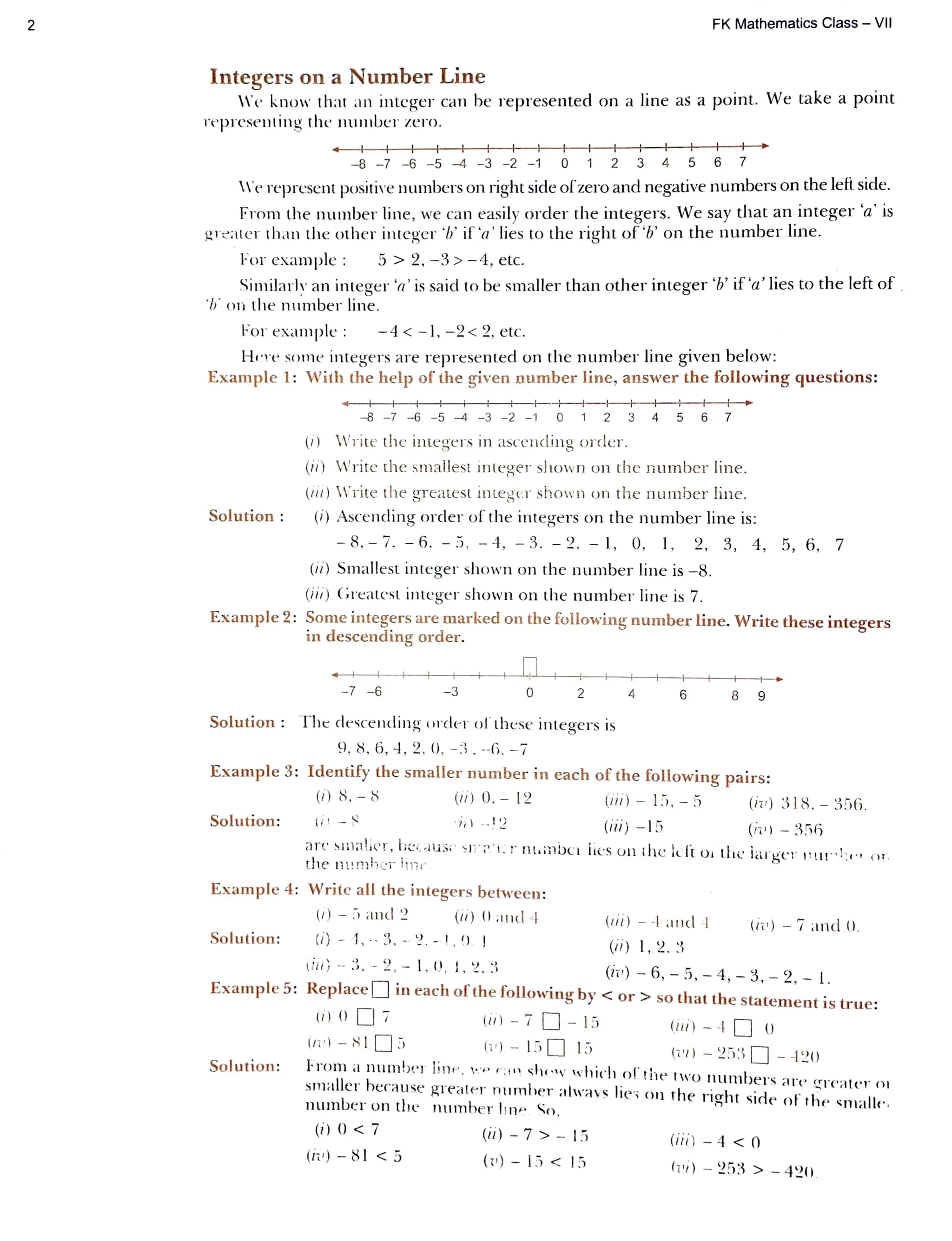


![Integers 9
25. Use the signs>, < or = in the following:
) 80 +69 319
(i) 19 +(-40) -(37) 32 +(-66) -(-39)
(i) 53 54 - 55
(iv) (-13)+(-12) -36)-(-6)
26. Subtract the sum of873 and -3002 from the sum of-904 and 7093.
27. Sum of two integers is 308. If one of the integers is -78, find the other integer.
28. Simplify:
)(708-(-2351)+(3477)-(4051)]
(i) 7924 +(7092) -(843) +(-6670)+7000
-219-
100+ 70 +79
-
79 30- 35
(ii) 54357 +(-90873) -(231001) +(-405)
Properties of Addition
We have obtained integers by extending the system ofwhole numbers to integers. We
now state the properties of addition of integers as follows:
1. Closure Property
Let us add two integers:
6+3 9;
6+(-3)=3; -6 +(-3) = -9
-6 +3 = -3;
In all the above four cases, when an integer is added to another integer, we always get an
integer. Therefore, we say integers are closed under addition.
2. Commutative Property
Let us add two integers in different order:
8 +(-5)=8-5=3 (-5) +(-3) = - 5-3 = -8
-3 +(-5)= -3-5 = -8
and
and -5+(8) = -5 +8 = 3
Therefore, +(-5)=
=-5
5+(8). Therefore, (-5) +(-3) =-3+(-5)
A change in the order of addition of two integers does not change the sum of the integers. This is
known as commutative property of addition of integers.
3. Associative Property
Let us add three integers in any order:
-3+(+5)] +(-6) and -3 +[(+5) +(-6)]
= (+2) +(-6)
= (-4)
(-3)+(-1)
= (-4)
Thus, [-3+(+5)] +(-6) = -
3 +[(+5) +
(-6)].Thus, we conclude that:
In addition of integers, when the grouping is changed, the result does not change. This property
is called associative property of addition of integers.
4. Additive Identity
Let us add 0 to an integer:
- 5 +0 = - 5
- 6 +0 = -
6
0+(-6) =-6
What do you observe?
When O is added to any integer the result is the integer itself. Zero is the additive identity for
integers.](https://image.slidesharecdn.com/68513-250322162031-6c8807f6/75/Math-Power-7th-Grade-1st-Edition-Anita-Rajput-16-2048.jpg)
![10 FK Mathematics Class - VII
5. Additive Inverse
Complete the following table and write your observation:
S.No. Integer Another Integer Sum oftheIntegers
6+-6)= 0
) 6 6
3 3 -3 +3 == 0
15+(-15) =
0
0+0 0
(ii) 15 15
(iv) 0
() 7
(vi) - 8
(vii) - 100
(uii) 21
What do you observe?
We observe that,
)Sum of the given two integers in each of the given pairs is zero i.e. the additive
identity for integers.
( ) To find the additive inverse, we change the + sign into - sign (except in case of )
of the gven integer and vIce-versa.
(i) Each of the integer in such a pair is called the additive inverse of the other e.g. -6
is the additive inverse of 6.
Properties of Subtraction
1. Closure Property
Observe the following subtractions:
(-6)-(-6)= - 6 + 6 =0; [As subtracting the negative of a number is same as adding
its additive inverse.]
5-3=2 5-5 0
5--5)=10; (-7)-(+3) =- 10, etc.
In all cases we observe that,
When an integer is subtracted from another integer the result is always an integer.
Therefore, we say integers are closed under subtraction.
2. Commutative Property
Let us subtract:
3-(-2) = -3+2 =--1
-2-(-3) =-2 +3 =lI
-3-(-2)* -2 -(-3)
and
So
Hence
Subtraction of integers is not commutative.
3. Associative Property
Let us subtract:
5-(-3)]-4 = [5 +3]-4 =8 -4 =4
5-(-3)-4] =5-(-3-4) = 5--7) =5 +7 =12
and
Therefore, [5-(-3)]-4 5-[(-3)-4]
Hence,
Subtraction of integers does not follow the associative property.](https://image.slidesharecdn.com/68513-250322162031-6c8807f6/75/Math-Power-7th-Grade-1st-Edition-Anita-Rajput-17-2048.jpg)
![11
Integers
4. Subtraction of Zero
Let us subtract zero from an
integer:
14 0 14. 0-0 =(0, -5 -0 = - 5, 2-0 =2
We observed that:
When zero is subtracted from an integer, we get the same integer.
But, if an integer is subtracted from zero, we obtain the opposite of the integer.
For example, - 14 -0 = - 14, 0-(-14) = 14,
5. Subtraction of1
Let us subract I from an
integer
4-1 =3. 10-1 =9
- 7 -l = -8, 0 - 1 = - 1, etc.
We observed that;
When 1 is subtracted from an integer, we get its predecessor
Example 1: Write a
pair of integers whose (i) sum is -
7 and (ii) difference is -
9.
) -9 +2 = -4 + (-3) =-7
(i) 1 - 10 = 2- 11 = -9
Solution:
Example 2: Write a pair of integers whose difference is
() a negative number.
(i) an integer greater than only one of the integers.
) - 14 - (-5) = - 9 (Negative integer)
(i)(-11)- (-3) =
-8 (lt is greater than -
11 and less than -
3)
Solution:
EXCNGSA 1.2
1. Write a pair of integers whose
) difference is - 12
2. Write a pair of integers whose difference gives:
() an integer greater than both the integers.
1) an integer greater than only one of the integers.
(ii) zero.
(i) difference is5 (ii) sum is 0
3. Fill in the blanks:
(i)-7)+()= (-9) +(_
_)= -88
(ii) - 29 + (_)= 0
(iv) 0 + ( )= (-18) - (
(ii) - 88 + (_
()[11 +-19)] +
( )=( )+[-19) +(-5]
4. Calculate the sum:
2+(-2) +2 +(-2) +2 +(-2) +.
) if the number of terms is 160 (i) if the number of terms is 127
5. Find:
(1) a pair of negative integers whose difference gives 6.
(u0) a pair of negative integers whose diference gives -
9.
(i) a negative integer and a positive integer whose difference is -
15.
(i) a negative integer and a positive integer whose difference is 16.](https://image.slidesharecdn.com/68513-250322162031-6c8807f6/75/Math-Power-7th-Grade-1st-Edition-Anita-Rajput-18-2048.jpg)
![12 FK Mathematics Class - VII
6. Verify a -(-b) =a+b for the following:
0) a =10, b =12 (i) a = 88, b = 77 (ii) a = 119, b = 144
(iv) a = - 65, b = 15
7. Verify: [-a-(-6)] -c* -a-[-b-(-c)]}
) a = 3, b= 7, c=-9
() a =117, b = -112 (vi) a = 4 l5, b = 502
(2) a =10, b =11, c=-14
(ii) a = 18, b = -32, c =17 (iv) a = -31, b = 40, c= -43
Multiplication of Integers
We know that the multiplication is a simpler form of repeated addition.
CaseI: Multiplication ofTwo Positive Integers
Observe the pattern and complete the table:
3 times 4 4 +4 + 4 3x4 12
7x9 63
7 times 9
9+9+9+9+9+9
5 times 4
8 times 2
Case II: Multiplication of a Positive Integer by a Negative Integer
Let us observe the following epeated addition.
S.No. Statement Repeated Addition Product Form Result
() 3 times 2(-2) + (-2) + (-2) 3x(-2) 6
(i) 4 imes-3 (-3)+(-3)+ (-3)+ (-3) 4x - 3 12
(ii) 2times -7 (-7) + (-7) 2x(-7) -14
Alternative Method:
Let us find 4 x-3 and 3 x
-6byother pattern.
() (i)
4x 4 16 3x3 9
Product
4x 3 12 is decreasing by 4 3 x22
4x 2 8 3x1 Product
is decreasing by 3
4x 1 3x0
4x 0 0 3 x -1 = 3
4x-1 3x -2 =-6
-4
4x-2 3x-3 = -
3x 4 = - 12
4x-3 =-12
4x4 = - 16 3x-5 =-15
3x6=-18
Second factor is
decreasing by 1
Second factor is
decreasing by |
What do you observe from the above patterns?
To get the multiplication of a
positive integer by a
negative integer, we
multiply the numbers
without sign and place a negative sign before the product so obtained.
Can you write - 2 x 3 as repeated addition?
No, how we can find - 2 x 3?](https://image.slidesharecdn.com/68513-250322162031-6c8807f6/75/Math-Power-7th-Grade-1st-Edition-Anita-Rajput-19-2048.jpg)


![Integers 15
(i)-2(-3+1) and
= -2-2)
-2x-3+(-2)x(1)
= (-2)x(-3) +(-2)x1
= -2 x -2 = 6-2
4 = 4
=
Thus-2x(-3 + 1)= -2x(-3)+(-2) x(1)
This property of integers is known as the Distributive property of multiplication over addition.
(ii) 7x(5-7) and 7x5-7x7
=
7 x (-2) 35-49
= -14 -14
Thus, 7x (5-7) = 7x5-7x7
This property of integers is known as the Distributive property of multiplication over subtraction.
DO YOURSELF
) Is 5x[7+(-2)] =5x7+5x-2?
() Is (-23) x[(-21) +(-9)] = -23 x-21 +(-23) x(-9) ?
(m) Is[-11+(-11)]x11 =11x(-11)+11x(-11)?
5. Multiplicationby1
Let us multiply integers by 1:
0 x 1 = 1 x 0 = 0
7 x 1 =1 x7 =7
-2x 1 =l x-2 =-2
6x1 =l x 6 =6
What do you observe?
The product of ary integer and 1 is the integer itsef. 1 is called the multiplicative identity of integers.
6. Multiplication by 0
-7 x 0 = 0 x-7 =0
6x 0 = 0 x 6 =0
-1 x 0 = 0 x-1 = 0
The product of any integer and O is always zero.
Example: In a class test containing 20 questions, 3 marks are given for every correct
answer and -
I mark is given for every incorrect answer.
(i) Renu attempt all questions but only 11 ofheranswers are correct. What
is her total score?
(ii) One of her friends attempt 8 questions but only one answer is incorrect.
What is her friend's total score?
Marks given for one correct answer =
3
Marks given for l correct answers =3 x 11 33
Marks given for one incorrect answer = -
1
Marks given for 9 incorrectanswers =
-1 x9 =
-9
Solution:
So,
So,
Therefore,
Renu's total score = 33 - 9 24
Marks given for one correct answer
Marks given for 7 correct answers =
3 x 7 =21
Marks given foroneincorrect answer =
1x-1 =-
1
3
So
her friend's total score = 21 - 1 = 20
Therefore,](https://image.slidesharecdn.com/68513-250322162031-6c8807f6/75/Math-Power-7th-Grade-1st-Edition-Anita-Rajput-22-2048.jpg)
![FK Mathematics Class- VIl
EXercisa 1.3
1. Simplify:
) (-7)x(-9) i) (-8)x(11) (ii) (10) x(-12)
(iv) (-8)x (-4) x (-7)
2. Complete the following multiplication:
() (-12) x(-6)x (14) (vi) (0) x (-14) x (-4)
X - 6 4
36
20
-6 - S
0
3. State true (T) or false (F):
) The product oftwo integers with same sign is always positive.
(i) The product of two integers with opposite sign is always negative
(ii) The product of three negative integers is negative.
(iv) The product of odd number of negative integers is negative. 7
() The product of a negaive and a positive integers may be zero. f
4. Compare:
(i) (7 +9) x 10 and 7+9x10
(i) [(-4 -(6)] x(-2) and (-4) - 6x-7
5. An integer 'a' is muitip!lied by - I1. Classify the integer 'a' if the product is
negative
6. Give the opposite of:
(i) - (-5)
By what integer should a given number n be muliplied to get the opposite of n?
(1) positive (i) neither positive nor negative
(i) (+6) (in) (-1)x20
7. Verify the following:
() 19x[7+(-3)] = 19x7+19x-3 i)-24 x [(-6) +(19)]= -24 x-6 +(-24) x 19
8. Ifax-1) = -25, is the integer a positive or negative?
9. Verify:
) 16x [7 + (-8)] = [16x 7] + [16x(- 8)]
(i) 14 x [-2) +(-4)] = [14 x (-2)] + [(14) x (-4)]
10. Determine the integer whose product with I is:
(i) 14
11. What will be the sign of the product if we multiply together
) 9 negative integers and 2 positive integers?
(i) 5 negative integers and 4 positive integers?
(ii) 0 (in) - 100
12. Match the following:
()-7) +9 = 9 +-7)(b)
ii) 6 + [3+(-2)] = [(6 +3)] +(-2Xei(b) Commutative property of addition
(ii) (-8)(-5) = (-5)-8))
(iv) 4 [5 x (- 5)] = (4x 5) (- 5Xdy
() 7 x0 =0(c)
(7i) 13xl = 13(a
(a) property of muliplicative identity
(c) Multiplicative property of zero
(d) Associative property of multiplication
() Associative property of addition
) Commutative property of multiplication](https://image.slidesharecdn.com/68513-250322162031-6c8807f6/75/Math-Power-7th-Grade-1st-Edition-Anita-Rajput-23-2048.jpg)

![18
FK Mathematics Class - VII
Properties of Division of Integers
1. Closure Property
Let us divide two integers:
Remainder Isthequotientaninteger?]|
Yes
Yes
Divisor Quotient
Dividend
35
24 8 3
-25 6 No
17 2 8 No
What do 1ou observer
We observe that:
When an integer is divided by another non-zero integer, the quotient is not always an integer.
Hence, we say integers do not satisfy closure propertyfor division.
2. Comnmutative Property
Let us divide two integers in different order.
357
48
735 is not aninteger.
48+8 =68+48isnotaninteger. 488 8+48
21 7 21+7 =3 7+21is notan integer. 21+7 +7+21 |
35+7 5 35+77+35
8
Hence, we say integers do not possess the commutative property of division.
3. Associative Property
Let us divide integers:
) (32 4)4 32(4 4)
32 1
and
84
2 32
Hence, (32 4) +4 32 -(4 4).
() (248) 2 and 24 (8+2)
= 3 2 244
6
Hence, (24 8) +2 and 24 (8+2) are not equal.
Thus, we say that ntegers do Hol possess the asaocalive property.
Division by One
Let us observe the followingdivisions:
)-31=-3 (i) 0 +l =0 (i) 4 l = 4 (iv) 173 +1 = 173
What do We obseIVe:
We observe that:
When an integer is divided by 1, the quotient is always the integer itself.
Property of Zero
Let us divide the 1nteger O by any non-zero integer.
) 015=(0
i) 015is the integer which when mulüplied by 15 gives the product zero.
Obviouslv, the integer is zero. Thus, 0 +15= 0.
() Also0+ -9 is the number which when multiplied by -9 gives zero. We know that
-9 x0 =
0, so 0 -9 =
0
So, we say that:
(u)0 -9 =0
When the integer zero is divided by any non-zero integer, the result is always zero](https://image.slidesharecdn.com/68513-250322162031-6c8807f6/75/Math-Power-7th-Grade-1st-Edition-Anita-Rajput-25-2048.jpg)


![Integers 21
2. Fill in the blanks:
) 448 448 (i) 999 +999=- 1
(i) 6 28 = 2 (iv) 0 + 384 = 0
()(-200) 100 = 2 (ui) (-55)+-L=55
uii) -9_ 7 = - 7
3. Write true (T) or false (F) for the following statements:
(vi) 60 + -R0 = -3
)0+(-8) =0 T
4. Simplify:
(i) -
6+0 =0F (n) - 18 +(-6) =3 T
) [81+(-9)] +[(-27)+3]
5. Find 3 pairs of integers (a, b), such that a +b = - 2, For example, - 18 +9 = - 2.
6. Write five pairs of integers (a, b), such that a + b = -
5. One such pair is (10, -
2)
because 10 (-2) =
-5.
i) [-144 +(-14 +2)]+[72 +(4 +8)]
7. An elevator descends into a mineshaft at the rate of 7m/min. If the descent starts
from 15 m above the ground level, how long will it take to reach 475 m?
8. The temperature at l2 noon was 15°C above zero. If it decreases at the rate of 3C
per hour until midnight, at what time would the temperature be 9°C below zero?
In a class test +2 marks are given for every correct answer and - 1 mark is given for
every incorrect answer and 0 for not attempting any question.
() Shruti scored 26 marks. If she has got 14 correct answers, how many questions
has she attempted incorrectly?
9.
(2) Rekha scores - 6 marks in this test, though she has got 8 correct answers. How
many questions has she attempted incomectly?
10. A certain freezing process requires that room temperature be lowered from 40°C at
the rate of 5°C every hour. What will be the room temperature 10 hours after the
process begins?
Use of Brackets
We have learntthe fundamental operations of addition, subtraction, multiplication and
division. In simplifying mathematical expressions, consisting one operation at many
places, we perform one operation at a time, starting from the left, moving towards right.
For example, 2 + 3 +5 +7, etc.
ltan expression has more than one operation, as given in the example,
2 x2 + 4 +2- 1, then they cannot beperformed the way they are given.
These operations have to be performed in a set order i.e.
(1) Division > (2) Multiplication> (3) Addition > (4) Subtraction.
Let us understand this in the following exan1ple.
Example :
Simplify: 36-8 +4+4x2
We have, 36 -8 +4 +4 x2
Solution:
36 +4 x2
= 36 -2 +4 x2 (lst division operation)
= 36 -2 +8 (21nd muliplication operation)
= 36 +6 (3rd addition operation)
42.](https://image.slidesharecdn.com/68513-250322162031-6c8807f6/75/Math-Power-7th-Grade-1st-Edition-Anita-Rajput-28-2048.jpg)
![22 FK Mathematics Class - VIl
However, in some specific expressions, we are required to perform some operations
prior to the others.
For example, what is the number obtained by dividing 48 by the product of 2 and 4?
Here writing 48 +2x4 =24x4 =96 is not correct, because we have tofirstmultiply 2 and
4 and then to perform the operation of division.
Here, we have to perlorm muliplication before division and in such cases we need to
usc brackets i.e., we write 48 +(2x 4) = 48 +8 =6.
Thus,
A bracket indicates that the operation within it is to be performed before the operation outside
the bracket.
In some complex expressions, it is necessary to have brackets within brackets. For
example, divide 75 by the sum of 10 and the product of 5 and 7.
Clearly here we have to first muliply 5 and 7 and to add 10 to this product. Finally we
have to divide 75 by the above resulting number.
Therefore, there is a need for two or more types of brackets to avoid confusion. We
wrie 75+{(5 x7)+10}
The most commonly used brackets are
Round brackets or parenthesis
Curly brackets hraces
Square brackets
bar or vinculu
Vinculum or baris used as the innermost brackets and then (). then { }, and finally [.
Example: In the expression (8 + 2 +2), it means 8 + 4.
Brackets are simplified in the following order:
(i)) (i')
Example: 48 (2 x 4)
i)-
Use of one bracket
Use of two brackets Example: 5x {48+(2 x 4)}
Use of three brackets Example: 10+[5x {48 +(2 x 4)}
A bar, when placed over the innermost lerm gets preference over all other operations
and brackets.
The Operation 'Of
Sometimes we use expressions like thrice of, 'one-fourth of'. In these expressions,
the meaning of 'of is 'multiplication with'.
For example, 'twice of eleven' or 'two times eleven' is written as 2 of 11' and its
meaning is 2 x 11. Similarly, 'one-fourth ofeightecn' is written asof 18 and its meaning
4
-x 18. The operation 'of" is performed before division and multiplication are carried
out.
Example: Find the value of:
) 4 of(9 +7) i) 8 of (8 of 3) (i2i) 72 4 of6
Solution: G) We have, 4 of (9 + 7)
or 4 of (16) Simplifying the brackets first]
or 4x 16 = 64](https://image.slidesharecdn.com/68513-250322162031-6c8807f6/75/Math-Power-7th-Grade-1st-Edition-Anita-Rajput-29-2048.jpg)
![Integers 23
(ii) We have.
8 of (8 of 3) =
8 of (8 x 3)
= 8 of 24
=
8 x 24 =192
(ii) 72 +4 of 6 72+ 4 x 6
7224 =3 Applying 'of' first)
BODMAS Rule
In the chain ofletters 'BODMAS', B stands for brackets, O for the operation 'Of°
D for division, M for multiplication, A for addition and S for subtraction. It denotes the
order or
sequence in which combined operations are done in the simplification process.
We ftirst remove brackets, next we perform the 'of' operation. It is followed by the division
operation and then the multiplication operation. We then perform addition followed by
the suburaction operation. Having determined the order of various operations, we apply
the rules of these operations to complete the simplification process.
Example I: Simplify: 40-6 x 3 of6 + (25 - 5) + 10
Solution: 40-6 x 3 of6 + (25- 5) + 10
40-6 x 3 of 6 + 20 10 [Removing the brackets]
or
40 6 x 18 + 20 10
[Operation'of
or
40-
6 x 18 2 Operation D]
or
40 108 + 2 [Operation M]
or
40 106 Operation A]
Or
66 [Operation S]
Example 2: Simplify: 57 -[28 - 16 +(5-3-D}
Solution: 57-[28-{16 +(5 -3 -1)}]
=
57-[28-{16 +(5-2)}] [Removal of bar]
=
57-[28 -
{16 + 3}] [Innermost brackets removed]
=
57-[28 -
19] [Next innermost brackets removed]
= 57 -9 = 48.
Example3: Simplify:
(0) (-40) of (- 1) +28+ 7 (i) 7- 13-2 (4 of-4)}
(ii) 81 of l59 - {7 x 8 + (13-2 of5)}.
(i)(-40)of(-1)+28 7 =
(-40) x (-1) + 28 7
Solution:
= (40 X 1) + 28 7 = 40 +4 = 44
i) 7- {13- 2 (4 of -4)} = 7 -{13 - 2 ( 4 x - 4)}
= 7- {13-2 x (- 16)} =
7- {13-(-32)}
7-{ 13 + 32} = 7-45 = - 38](https://image.slidesharecdn.com/68513-250322162031-6c8807f6/75/Math-Power-7th-Grade-1st-Edition-Anita-Rajput-30-2048.jpg)
![24
FK Mathematics Class- VII
(i') 81 of[59- {7 x 8+ (13- 2 of5)}]
81 x [59-{7 x 8 + (13 - 2 x 5)}]
= 81 x [59- {7 x 8 + (13 - 10)}]
= 81 x [59- {56 +3}]
= 81x [59- 59]
= 81x0 = 81 x 0 = 0.
Example4: Simplify: 63 -(-3){-2- 8-3} 3 {5 +(-2) (-1)}
Solution: 63--3)-2-8-3} +3 {5+(-2)(-1)}
=
63-(-3){-2-5) +3 {5 +(-2)(-1)} [Removal of bar]
I-2 (-1) =
2
[Removal ofcurlybrackets]
= 63--3) -2-5} +3 {5 +2}
= 63-(-3) {-7} 3 x7
63+3x|x7= 63-49 =14
ExGcisa 1.5
Simplify the following:
) 27-15+{28 (29-7)})
i) 48[18 - {16 -(5 -4 -1)}
(ii) (60 x (-3)} +45 +(-3)
(iv) 39 - [23 - {29 (17-9-3)}]
(u) 22-3{-5of3-(-48) +(-16)}
(vi) 29 -(-2) (6 -(7-3)}] +3 x {5 +(-3) x
(-2)}
(ui) 72-[3 +{18 -19-4)] {1 +2 of 3 - (3 -2)}
121 +[17-(15-3(7-4)})
(ix) 32+[32 + {32 - (32 +32 - 32)}]
x) 15-(-3)114 -7-3} +3 15+(-3) x(-6)}
ImporlantPoints to Remember
All whole numbers and their negatives are jointly called integers
Sum, product and difference oftwointegers is also an integer.
The quotient of two integers is not always an integer.
Integers are commutativeand associative for the operations of addition and
multiplication but not for the operations of suburaction and division.
-](https://image.slidesharecdn.com/68513-250322162031-6c8807f6/75/Math-Power-7th-Grade-1st-Edition-Anita-Rajput-31-2048.jpg)


![29
Fractions
7. Nidhi painted of a wall. Ankita painted anotherofit. What fraction ofthe wall
9 3
was painted by them?
8. Which firaction is
greateror
9. Anup was
given 1 hours to solve a test paper. But he finished the paper inl.
hours. How much earlier did he finish his test paper?
10. A square field is 120 m
long. What is its perimeter?
2
11. Find the perimeter ofthe given triangle.
3 cm
om
B
4cm
12. A cyclistcovered 8km in three hours. He covered3km in first two hours. What
12
distance did he cover in the third hour?
13. Find the perimeter of the rectangle whose:
) Length = 4m, breadth = 2m.
3
(n) Length =5 m, breadth = 4 m.
14. Complete the magic square given below:
[Note that the sum of numbers in each row, or in each column or in each diagonal of
a magic square is same]
8
15
15
2
15
15. Check whether the following is a magic square?
10 5
10
2
3
10](https://image.slidesharecdn.com/68513-250322162031-6c8807f6/75/Math-Power-7th-Grade-1st-Edition-Anita-Rajput-36-2048.jpg)


