Inland Navigation
Logistics
Challenges & Opportunities
Maritime Days – Odessa - Ukraine (29th May 2015)
InduStreams
1
2. Inland Navigation in Ukraine
•Modal Split &Volumes – Evolution 2004 – 2014
•Inland Navigation Fleet – Evolution 1990 - 2013
•Inland Navigation – Challenges & Opportunities
2
3
UKRAINE - MODAL SPLIT - EVOLUTION
2013 (Source 2)
4
UKRAINE - MODAL SPLIT - EVOLUTION
2004 – 20014 (Source 1)
2014 Shift
Transport mln.t/km Share mln.t Share
railway trains 209 634,30 82,91% 387,00 67,73% 541,69
motor vehicles 37 764,20 14,93% 178,40 31,22% 211,68
water 5 462,30 2,16% 6,00 1,05% 910,38
252 860,80 571,40 1 663,76
2004 Shift
Transport Mln.t/km Share Mln.t Share
railway 460 900,00 76,07% 233,60 88,55% 1 973,03
motor vehicles 124 400,00 20,53% 15,30 5,80% 8 130,72
water 20 600,00 3,40% 14,90 5,65% 1 382,55
605 900,00 263,80 11 486,30
2004/2014 Freight turnover Freight shipped Shift
Transport mln.t/km Share mln.t Share
railway trains -251 265,70 -55% 153,40 66% -1 431,34
motor vehicles -86 635,80 -70% 163,10 1066% -7 919,04
water -15 137,70 -73% -8,90 -60% -472,17
-353 039,20 -58% 307,60 117% -1 147,72
Freight turnover Freight shipped
Freight ShippedFreight Turnover
5
EU Project - ENPI 2011 / 264 459
Commodities eligible
for
Inland NavigationTransportation
Cargo 2008 2010 2011 2012 2013 2014 2015 2008/2015
Sand 9,500 8,000 8,250 9,250 9,500 10,500 12,000 2,500
Iron ore raw materials 2,356 7,500 8,800 9,900 11,500 11,500 11,500 9,144
Manganese ore, coke and ferroalloys 0,695 0,700 0,700 0,750 0,800 0,900 0,950 0,255
Ferrous metals 1,236 5,000 5,500 6,000 6,900 7,880 7,880 6,644
Grain 0,172 3,850 5,000 6,200 6,900 7,050 7,150 6,978
Coal 0,187 1,100 1,100 1,100 1,100 1,600 1,600 1,413
Total 14,146 26,150 29,350 33,200 36,700 39,430 41,080 26,934
Actual 6,300
Containers – Potential 400,000TEU @ 14,5 Mts/TEU
Est. 5,8 Milj Mts
Inland Navigation in Ukraine
•Modal Split &Volumes – Evolution 2004 – 2014
•Inland Navigation Fleet – Evolution 1990 - 2013
•Inland Navigation – Challenges & Opportunities
6
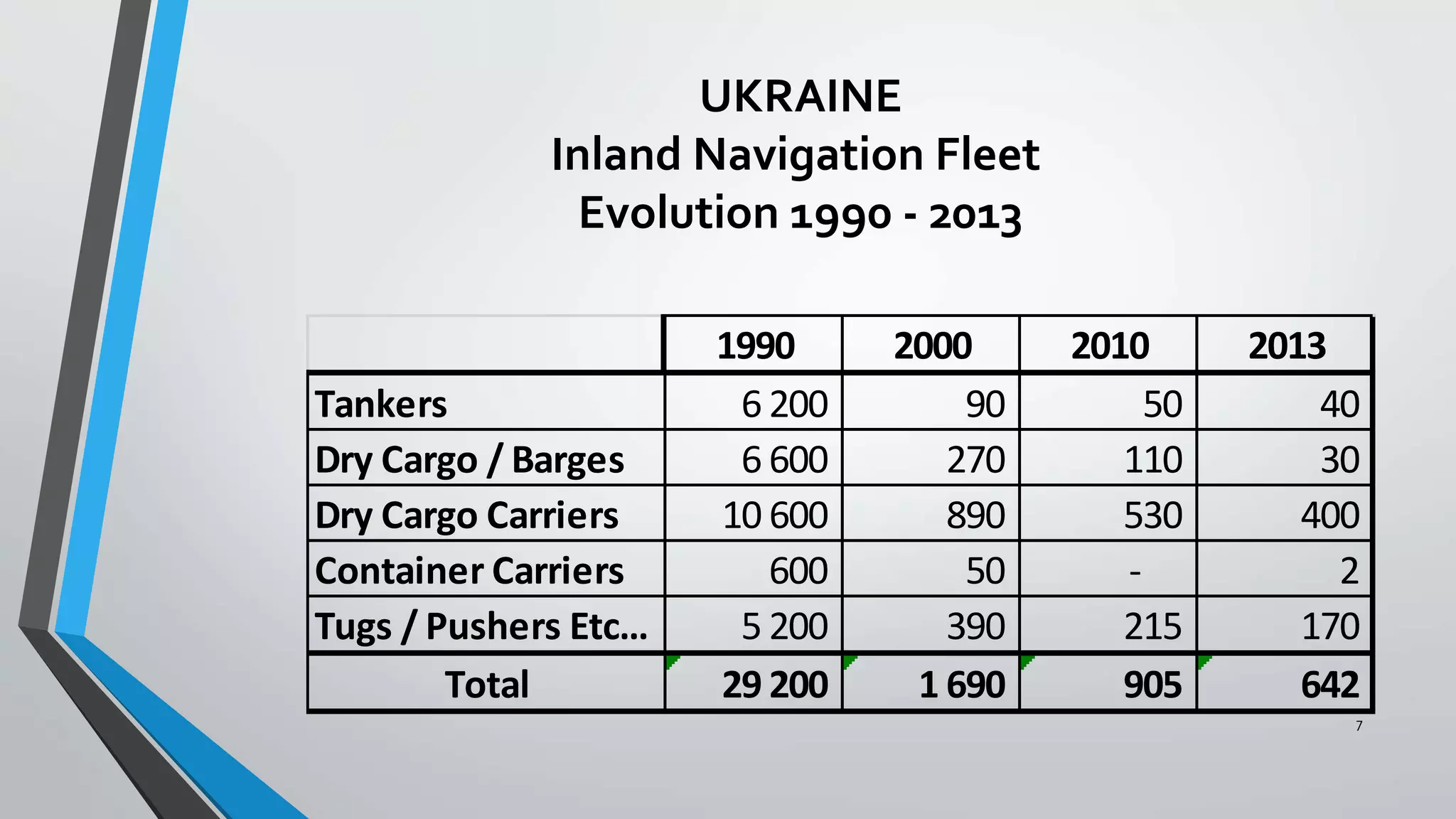
7
1990 2000 2010 2013
Tankers 6 200 90 50 40
Dry Cargo / Barges 6 600 270 110 30
Dry Cargo Carriers 10 600 890 530 400
Container Carriers 600 50 - 2
Tugs / Pushers Etc… 5 200 390 215 170
Total 29 200 1 690 905 642
UKRAINE
Inland Navigation Fleet
Evolution 1990 - 2013
8
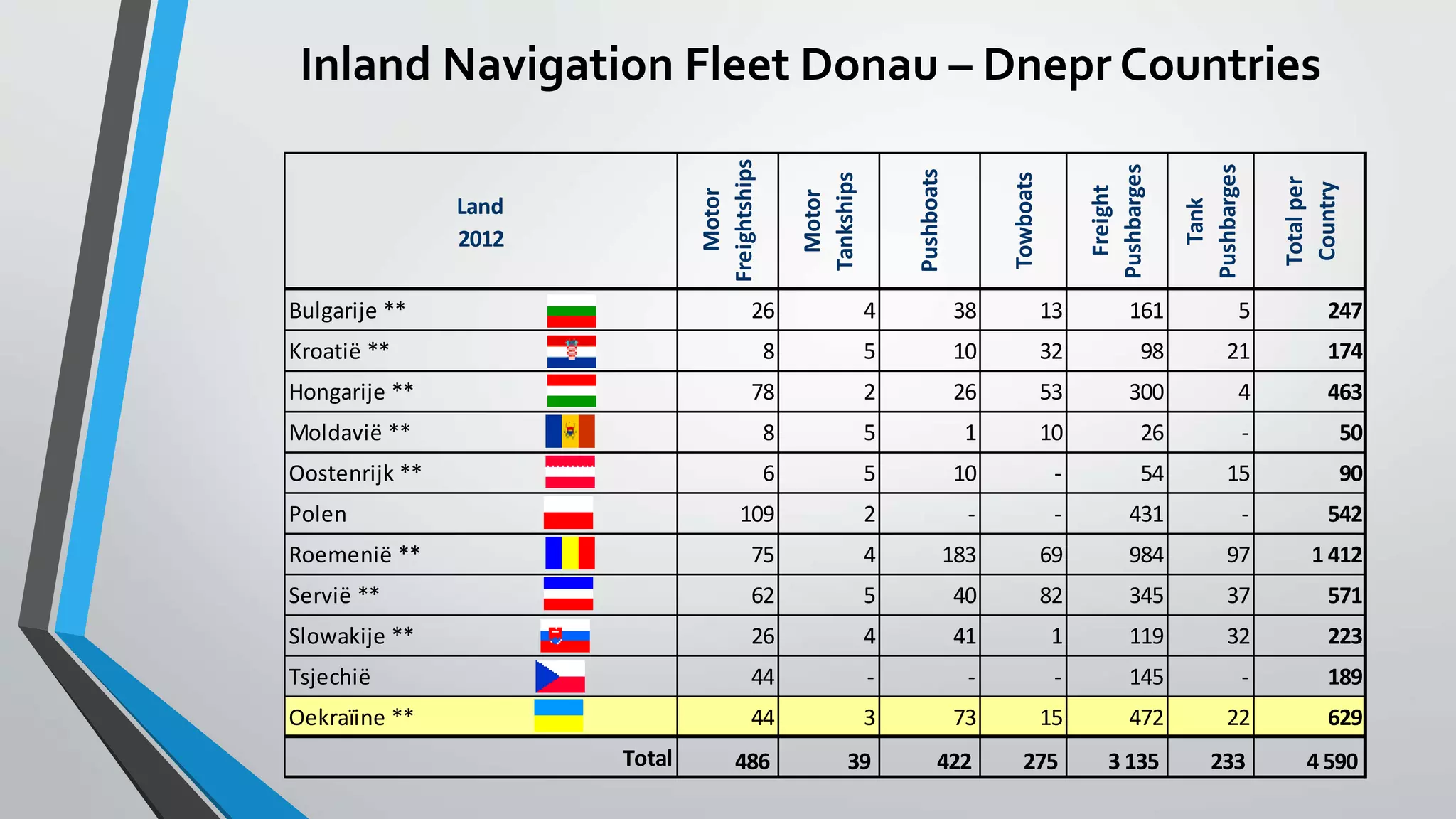
Land
2012
Motor
Freightships
Motor
Tankships
Pushboats
Towboats
Freight
Pushbarges
Tank
Pushbarges
Totalper
Country
Bulgarije ** 26 4 38 13 161 5 247
Kroatië ** 8 5 10 32 98 21 174
Hongarije ** 78 2 26 53 300 4 463
Moldavië ** 8 5 1 10 26 - 50
Oostenrijk ** 6 5 10 - 54 15 90
Polen 109 2 - - 431 - 542
Roemenië ** 75 4 183 69 984 97 1 412
Servië ** 62 5 40 82 345 37 571
Slowakije ** 26 4 41 1 119 32 223
Tsjechië 44 - - - 145 - 189
Oekraïine ** 44 3 73 15 472 22 629
Total 486 39 422 275 3 135 233 4 590
Inland Navigation Fleet Donau – Dnepr Countries
9
Land
2012
Motor
Freightships
Motor
Tankships
Pushboats
Towboats
Freight
Pushbarges
Tank
Pushbarges
Totalper
Country
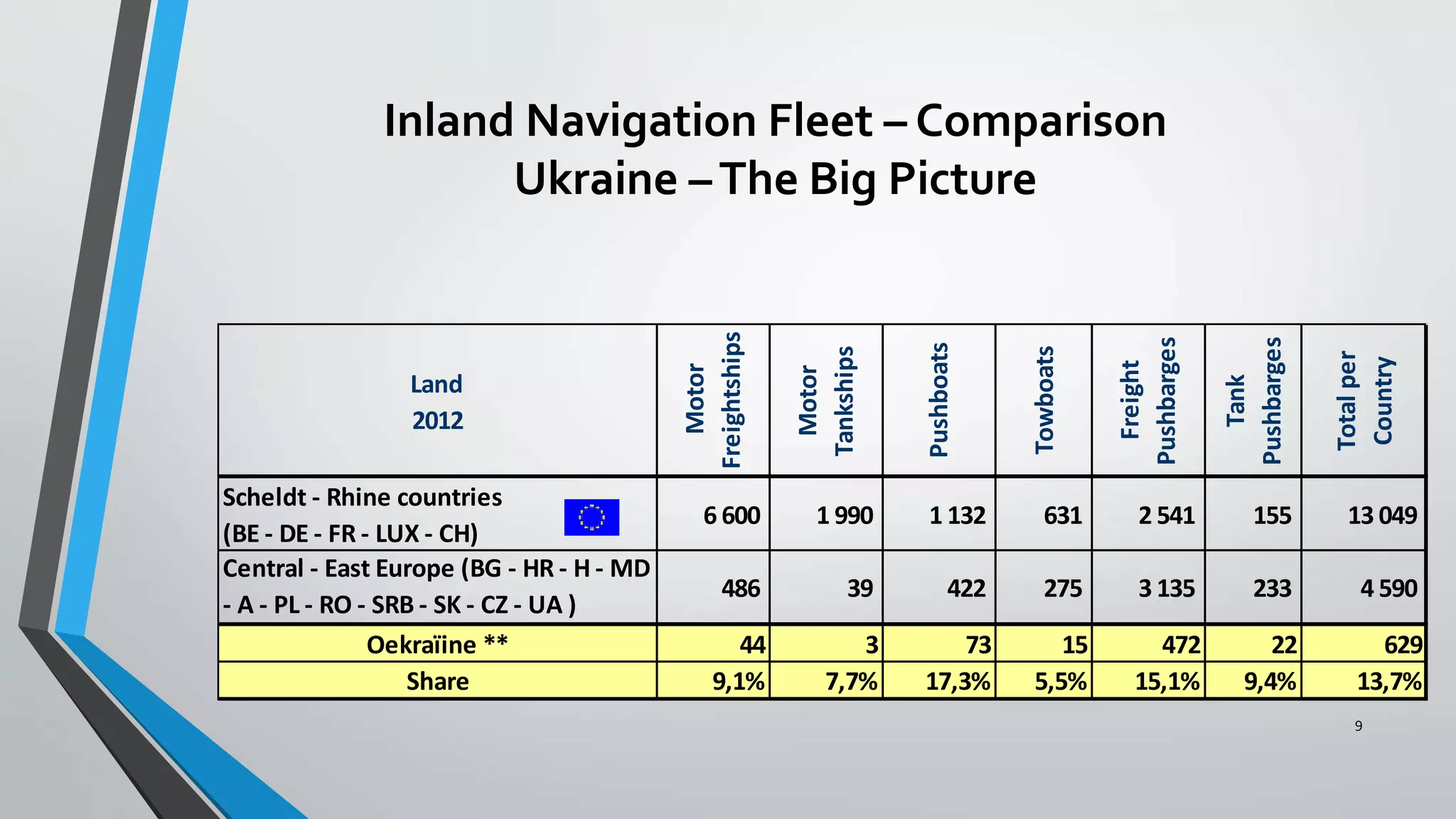
Scheldt - Rhine countries
(BE - DE - FR - LUX - CH)
6 600 1 990 1 132 631 2 541 155 13 049
Central - East Europe (BG - HR - H - MD
- A - PL - RO - SRB - SK - CZ - UA )
486 39 422 275 3 135 233 4 590
Oekraïine ** 44 3 73 15 472 22 629
Share 9,1% 7,7% 17,3% 5,5% 15,1% 9,4% 13,7%
Inland Navigation Fleet – Comparison
Ukraine –The Big Picture
Inland Navigation in Ukraine
•Modal Split &Volumes – Evolution 2004 – 2014
•Inland Navigation Fleet – Evolution 1990 - 2013
•Inland Navigation – Challenges & Opportunities
10
TRACECA InlandWaterways – Dnepr Case Study
ENPI 2011 / 264 459
• State of Affairs & clear Analysis on Dnepr and Inland
Waterways – Markets and Opportunities
• Addressing the problems with regard to Ownership and
Regulatory constrains
• Providing concrete examples of action which can improve the
Inland Waterways Logistics relatively fast
• Concrete recommendations and extend where the EU can
assist 11
12
The path of the Dnepr between Kherson to Kiev (850 Km) is in
competition with the 510km long Odessa-Kiev road (510 Km) and
the 713 km (tariff) railway link Odessa-Kiev.
The Dnepr freezes in winter closing down navigation for 2 – 3
monts/year. Ice-breakers can – at a cost - extend the ice-free
period.
The Dnepr estuary is about 100 Km away from Ukraine’s closest
deepsea ports of Ilyichevsk, Odessa or Yuzhni. Pure river-going
barges are prohibited hence coastal barges are to be deployed.
Natural Challenges
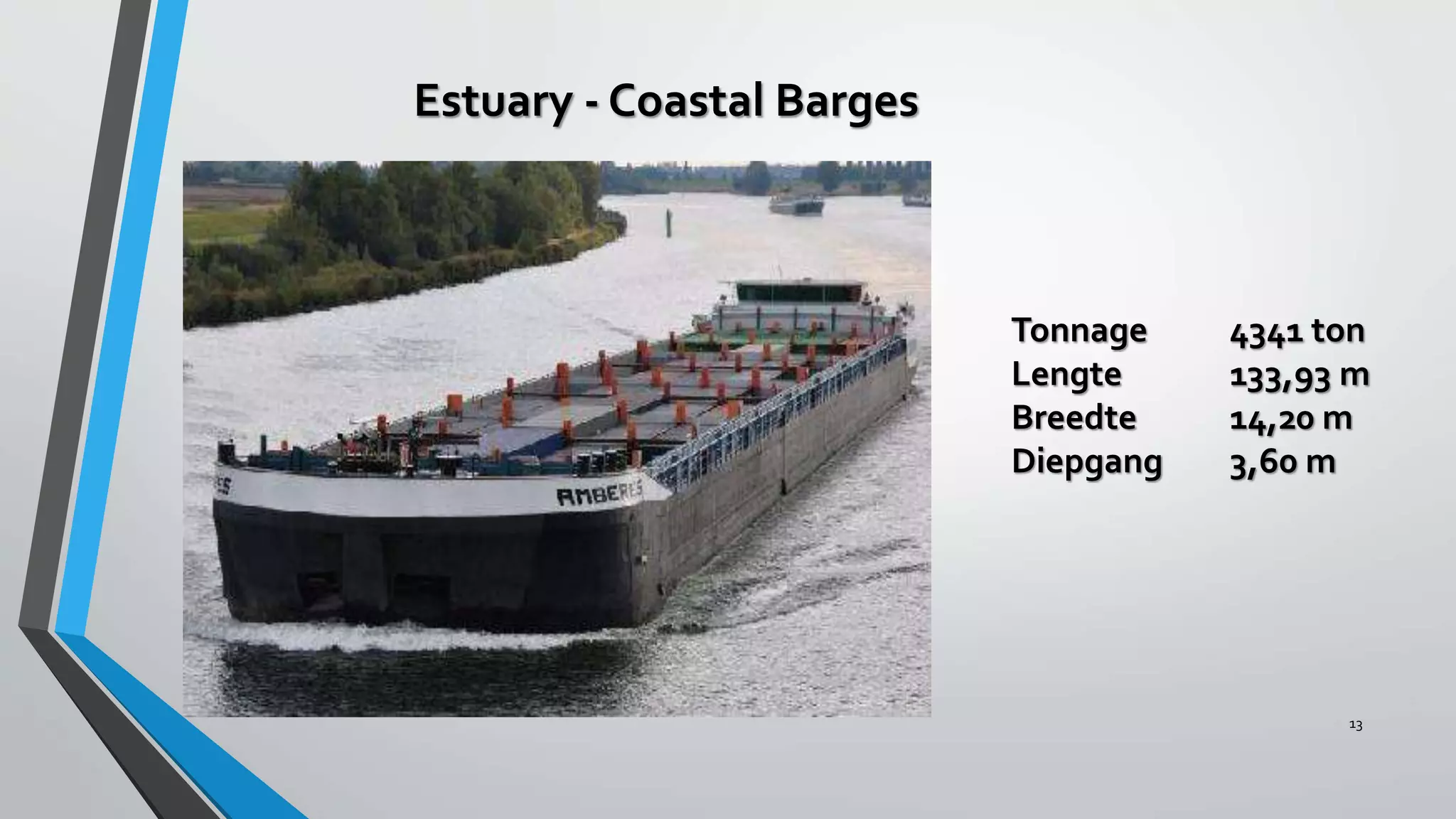
13
Tonnage 4341 ton
Lengte 133,93 m
Breedte 14,20 m
Diepgang 3,60 m
Estuary - Coastal Barges
14
Tonnage 5524 ton
L.O.A. 109,88 cm
Beam 17,05 m
Draft 4,50 m
Estuary - Coastal Barges
15
Structural – Technical constrains
 Lack of suitable transhipment bases for exchanging cargo between river units
and sea-going vessels – result: reduced market
 River ports lack suitable handling equipment for containers – result: slow
cargo processing
 The lack of fleet replacement is contributing to increase in its technical
obsolescence. The average age of vessels exceeds 25 years.
 Lack of bunkering facilities
 Dredging programs lacking behind maintenance to navigation equipment
such as buoys, lights, landmarks etc... is creating safety and security
exposures
16
Economical Constrains
 The efficiency and the utilisation of the available facilities is generally low –
result: increased cost
 Main usage of river transportation and river infrastructure is for low-value
bulk cargo, such as sand, scrap metal, ore, metal, etc. allowing for slow
inefficient transportation
 Inland Navigation suffers from lack of integration with the Ukrainian
intermodal transportation network mainly attributed to its substantial
inefficiency in transit cargo transportation and the inadequate
infrastructure.
17
Regulatory Constrains
 Market distortion through Government Intervention in Product Tariff
setting and Fiscal facilitation or manipulation
 Discrimination to respective Transport Modes through Government
intervention in usage tariffs (Port Dues, Locks, Pilotage etc…)
 Lack of liberalised economical operating environment preventing market
forces and players to compete
 Insufficient activity with respect to Infrastructure maintenance and
development and PPP policy
Some conclusions
• Persuade Government to limit their intervention to strictly creating and
maintaining reliable infrastructure and a stable regulatory operating
environment and let entrepreneurs do what they do best – developing
business.
• Don’t try to re-invent the wheel – all you need in support to efficient
inland navigation logistics is already existing somewhere… somehow….
and do not be afraid to call in expertise and experience.
• Make a solid Business Plan and go shopping for Investors and experience
in the European Intermodal Scene.
• Attitude – Don’t walk alone but be careful with whom you walk the way.
18
19
InduStreams
Gunther R M Ginckels
gunther.ginckels@industreams.com

Panel discussion

  • 1.
    Inland Navigation Logistics Challenges &Opportunities Maritime Days – Odessa - Ukraine (29th May 2015) InduStreams 1
  • 2.
    2. Inland Navigationin Ukraine •Modal Split &Volumes – Evolution 2004 – 2014 •Inland Navigation Fleet – Evolution 1990 - 2013 •Inland Navigation – Challenges & Opportunities 2
  • 3.
    3 UKRAINE - MODALSPLIT - EVOLUTION 2013 (Source 2)
  • 4.
    4 UKRAINE - MODALSPLIT - EVOLUTION 2004 – 20014 (Source 1) 2014 Shift Transport mln.t/km Share mln.t Share railway trains 209 634,30 82,91% 387,00 67,73% 541,69 motor vehicles 37 764,20 14,93% 178,40 31,22% 211,68 water 5 462,30 2,16% 6,00 1,05% 910,38 252 860,80 571,40 1 663,76 2004 Shift Transport Mln.t/km Share Mln.t Share railway 460 900,00 76,07% 233,60 88,55% 1 973,03 motor vehicles 124 400,00 20,53% 15,30 5,80% 8 130,72 water 20 600,00 3,40% 14,90 5,65% 1 382,55 605 900,00 263,80 11 486,30 2004/2014 Freight turnover Freight shipped Shift Transport mln.t/km Share mln.t Share railway trains -251 265,70 -55% 153,40 66% -1 431,34 motor vehicles -86 635,80 -70% 163,10 1066% -7 919,04 water -15 137,70 -73% -8,90 -60% -472,17 -353 039,20 -58% 307,60 117% -1 147,72 Freight turnover Freight shipped Freight ShippedFreight Turnover
  • 5.
    5 EU Project -ENPI 2011 / 264 459 Commodities eligible for Inland NavigationTransportation Cargo 2008 2010 2011 2012 2013 2014 2015 2008/2015 Sand 9,500 8,000 8,250 9,250 9,500 10,500 12,000 2,500 Iron ore raw materials 2,356 7,500 8,800 9,900 11,500 11,500 11,500 9,144 Manganese ore, coke and ferroalloys 0,695 0,700 0,700 0,750 0,800 0,900 0,950 0,255 Ferrous metals 1,236 5,000 5,500 6,000 6,900 7,880 7,880 6,644 Grain 0,172 3,850 5,000 6,200 6,900 7,050 7,150 6,978 Coal 0,187 1,100 1,100 1,100 1,100 1,600 1,600 1,413 Total 14,146 26,150 29,350 33,200 36,700 39,430 41,080 26,934 Actual 6,300 Containers – Potential 400,000TEU @ 14,5 Mts/TEU Est. 5,8 Milj Mts
  • 6.
    Inland Navigation inUkraine •Modal Split &Volumes – Evolution 2004 – 2014 •Inland Navigation Fleet – Evolution 1990 - 2013 •Inland Navigation – Challenges & Opportunities 6
  • 7.
    7 1990 2000 20102013 Tankers 6 200 90 50 40 Dry Cargo / Barges 6 600 270 110 30 Dry Cargo Carriers 10 600 890 530 400 Container Carriers 600 50 - 2 Tugs / Pushers Etc… 5 200 390 215 170 Total 29 200 1 690 905 642 UKRAINE Inland Navigation Fleet Evolution 1990 - 2013
  • 8.
    8 Land 2012 Motor Freightships Motor Tankships Pushboats Towboats Freight Pushbarges Tank Pushbarges Totalper Country Bulgarije ** 264 38 13 161 5 247 Kroatië ** 8 5 10 32 98 21 174 Hongarije ** 78 2 26 53 300 4 463 Moldavië ** 8 5 1 10 26 - 50 Oostenrijk ** 6 5 10 - 54 15 90 Polen 109 2 - - 431 - 542 Roemenië ** 75 4 183 69 984 97 1 412 Servië ** 62 5 40 82 345 37 571 Slowakije ** 26 4 41 1 119 32 223 Tsjechië 44 - - - 145 - 189 Oekraïine ** 44 3 73 15 472 22 629 Total 486 39 422 275 3 135 233 4 590 Inland Navigation Fleet Donau – Dnepr Countries
  • 9.
    9 Land 2012 Motor Freightships Motor Tankships Pushboats Towboats Freight Pushbarges Tank Pushbarges Totalper Country Scheldt - Rhinecountries (BE - DE - FR - LUX - CH) 6 600 1 990 1 132 631 2 541 155 13 049 Central - East Europe (BG - HR - H - MD - A - PL - RO - SRB - SK - CZ - UA ) 486 39 422 275 3 135 233 4 590 Oekraïine ** 44 3 73 15 472 22 629 Share 9,1% 7,7% 17,3% 5,5% 15,1% 9,4% 13,7% Inland Navigation Fleet – Comparison Ukraine –The Big Picture
  • 10.
    Inland Navigation inUkraine •Modal Split &Volumes – Evolution 2004 – 2014 •Inland Navigation Fleet – Evolution 1990 - 2013 •Inland Navigation – Challenges & Opportunities 10
  • 11.
    TRACECA InlandWaterways –Dnepr Case Study ENPI 2011 / 264 459 • State of Affairs & clear Analysis on Dnepr and Inland Waterways – Markets and Opportunities • Addressing the problems with regard to Ownership and Regulatory constrains • Providing concrete examples of action which can improve the Inland Waterways Logistics relatively fast • Concrete recommendations and extend where the EU can assist 11
  • 12.
    12 The path ofthe Dnepr between Kherson to Kiev (850 Km) is in competition with the 510km long Odessa-Kiev road (510 Km) and the 713 km (tariff) railway link Odessa-Kiev. The Dnepr freezes in winter closing down navigation for 2 – 3 monts/year. Ice-breakers can – at a cost - extend the ice-free period. The Dnepr estuary is about 100 Km away from Ukraine’s closest deepsea ports of Ilyichevsk, Odessa or Yuzhni. Pure river-going barges are prohibited hence coastal barges are to be deployed. Natural Challenges
  • 13.
    13 Tonnage 4341 ton Lengte133,93 m Breedte 14,20 m Diepgang 3,60 m Estuary - Coastal Barges
  • 14.
    14 Tonnage 5524 ton L.O.A.109,88 cm Beam 17,05 m Draft 4,50 m Estuary - Coastal Barges
  • 15.
    15 Structural – Technicalconstrains  Lack of suitable transhipment bases for exchanging cargo between river units and sea-going vessels – result: reduced market  River ports lack suitable handling equipment for containers – result: slow cargo processing  The lack of fleet replacement is contributing to increase in its technical obsolescence. The average age of vessels exceeds 25 years.  Lack of bunkering facilities  Dredging programs lacking behind maintenance to navigation equipment such as buoys, lights, landmarks etc... is creating safety and security exposures
  • 16.
    16 Economical Constrains  Theefficiency and the utilisation of the available facilities is generally low – result: increased cost  Main usage of river transportation and river infrastructure is for low-value bulk cargo, such as sand, scrap metal, ore, metal, etc. allowing for slow inefficient transportation  Inland Navigation suffers from lack of integration with the Ukrainian intermodal transportation network mainly attributed to its substantial inefficiency in transit cargo transportation and the inadequate infrastructure.
  • 17.
    17 Regulatory Constrains  Marketdistortion through Government Intervention in Product Tariff setting and Fiscal facilitation or manipulation  Discrimination to respective Transport Modes through Government intervention in usage tariffs (Port Dues, Locks, Pilotage etc…)  Lack of liberalised economical operating environment preventing market forces and players to compete  Insufficient activity with respect to Infrastructure maintenance and development and PPP policy
  • 18.
    Some conclusions • PersuadeGovernment to limit their intervention to strictly creating and maintaining reliable infrastructure and a stable regulatory operating environment and let entrepreneurs do what they do best – developing business. • Don’t try to re-invent the wheel – all you need in support to efficient inland navigation logistics is already existing somewhere… somehow…. and do not be afraid to call in expertise and experience. • Make a solid Business Plan and go shopping for Investors and experience in the European Intermodal Scene. • Attitude – Don’t walk alone but be careful with whom you walk the way. 18
  • 19.
    19 InduStreams Gunther R MGinckels gunther.ginckels@industreams.com

Editor's Notes

  • #4 It is not as bad as it looks. When we take-out Pipeline moved goods the share of Inland Navigation is not 0,83% but goes up to 0,997%. I apologise for becoming cynical. And its getting better.
  • #5 The previous table showed 2013 data. Here the evolution 2004/ 2014. Te bad news is that the increased volumes in freighttons are not the result of more cargo moving over inland waterways – on the contrary. While freight moved by Rail and Truck increased considerably, freight transported over water dropped from 15 to 6 Milj Mts. What is difficult to understand is that while the total tonnage increased more than double from 263 Milj Mts to 571 Milj Mts the relative Ton-Kilometer freight dropped indirectly proportional from 606 Milj Ton Km to 253 Milj Ton Km. So much for sustainable logistics and environmental friendly mobility. I apologise again for being cynical.
  • #6 Lets look at which commodities Ukraine has and are Inland Navigation Transportation eligible. Today less that 20% of inland navigation eligible freight is moving over inland waterways. That is compared to 2013 and not taking into account containers which can add another 5,8 Milj Mts.
  • #8 We have seen Inland Navigation Fleet figures before and these where not a source of joy. When we see the evolution over the past decade we can see the potential of Inland Navigation.
  • #9 No comments – Remarkable is the relative large fleet of Freight Push barges in all countries. Assuming these pushbarges have an average capacity of 1500 Mts and can do 26 trips / year there is a capacity out there of 18 milj Mts.
  • #10 When looking at Ukraine fleet figures compared to the total Central – East Europe fleet it is not too bad. Specifically in Push concept we see Ukraine accounts for 15-17% of the fleet.
  • #12 The Dnepr was for me – and still is –unknown territory from which on basis of recent history I can suspect the causes for the current situation and will not look too much back. In my efforts to attempt to better understand I found the TRACECA (Transport Corridor Europe Caucasus Asia) report sponsored by the EU in 2011. Here some – and only few of the many – eye catching analysis and recommendations I found.
  • #13 Some Natural Challenges. Although natural they obviously have an economic impact. 950 Km by barge @ average speed of 10 Km/Hr will require a minimum of 95 hrs or 4 days. This is for certain commodities not an issue. For high value goods such as electronics or perishables it can be an issue although the Rhine-Ruhr area is also served by Barges where the transittime is also 2-4 days – see also the Duisburg concept. Odessa – Kiev by rail will require less than 24 Hrs. A possible solution for the transit between Kherson and Odessa could be Estuary Barges.
  • #16 We addressed these challenges earlier today. It is a combination of Infrastructure and efficiency through using the right tools and equipment for the specific commodities.