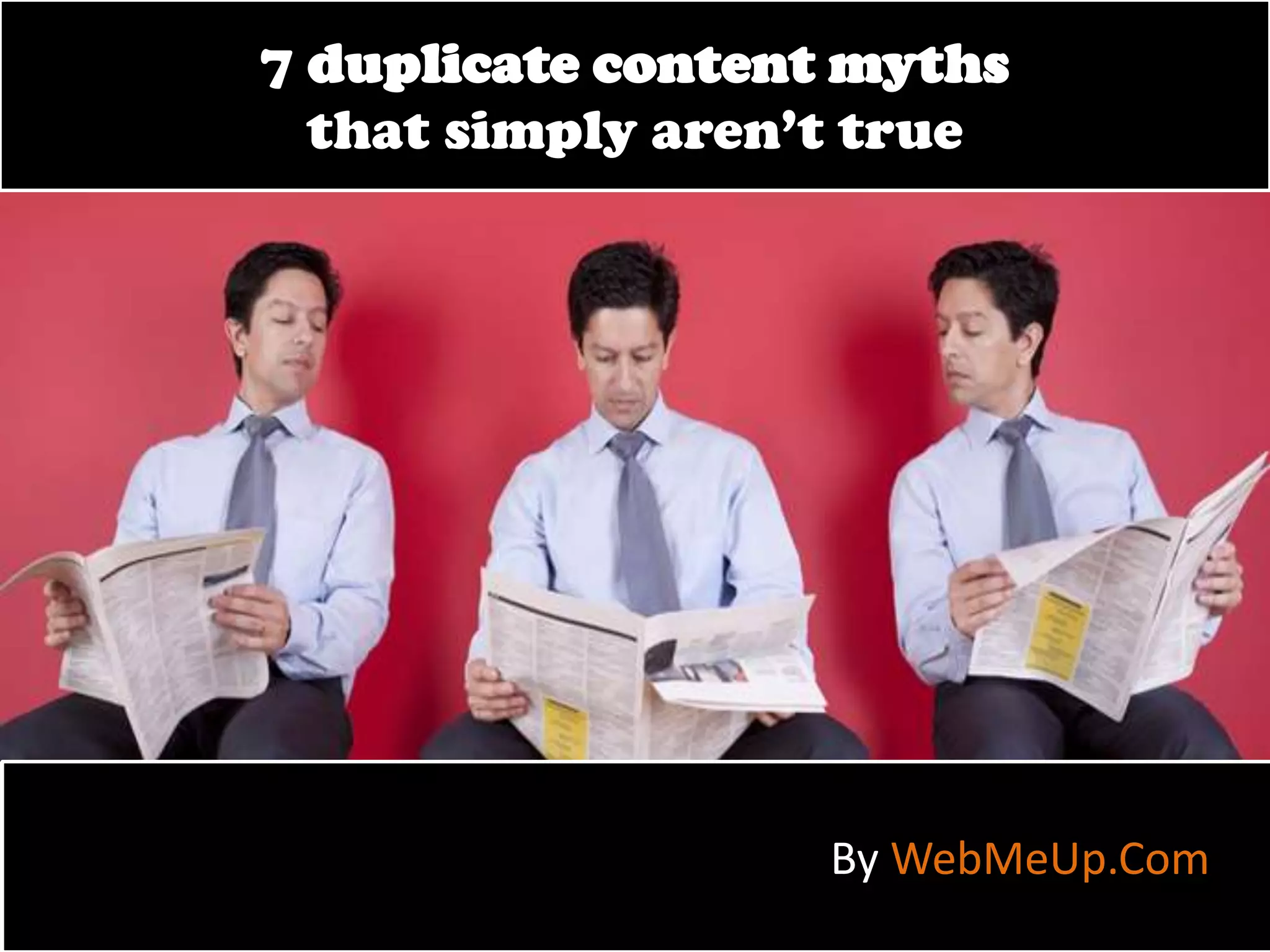
7 duplicate content myths
that simply aren’t true

By WebMeUp.Com
There are quite a few duplicate content myths
circulating in the SEO community.
Let’s bust them!
Myth 1.
Duplicate content is ‘same text on multiple pages‘
Website owners who are not so good at web
design think that the only way to produce
duplicate content is to purposefully replicate a
piece of text on multiple pages.

http://webmeup.com/blog/duplicate-content-myths.html
What they don't realize is that some of their
site's pages may be accessible via multiple ULRs
(which
may
happen
for
various
reasons), which, in turn, would automatically
lead to content duplication.

http://webmeup.com/blog/duplicate-content-myths.html
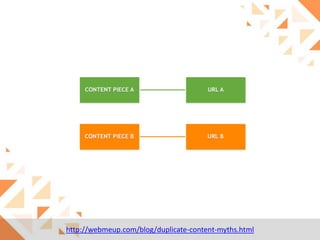
Ideally, each piece of content should have only
one URL associated with it:
http://webmeup.com/blog/duplicate-content-myths.html
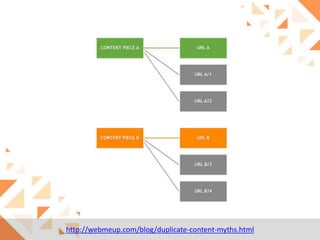
In reality, though, it happens quite often that a
page has multiple URLs associated with it:

http://webmeup.com/blog/duplicate-content-myths.html
Hence, if there are pages on your site that have
multiple URLs pointing to them, you need to
take care of that!

http://webmeup.com/blog/duplicate-content-myths.html
To solve that, one should use canonical tags, an
XML sitemap, a robots.txt file or other means
that aid the canonicalization process.

http://webmeup.com/blog/duplicate-content-myths.html
Also, more information on how to tackle these
structure issues are given in this guide to SEOfriendly URL architecture.

http://webmeup.com/blog/duplicate-content-myths.html
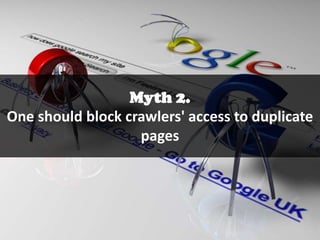
Myth 2.
One should block crawlers' access to duplicate
pages
In case you have duplicate URLs on a site,
closing duplicates from getting indexed with a
robots.txt is a bad idea.

http://webmeup.com/blog/duplicate-content-myths.html
A better solution is to allow search engines to
crawl these URLs, but mark them as duplicates.

http://webmeup.com/blog/duplicate-content-myths.html
That can be done by using
the rel="canonical" link element, the URL
parameter handling tool, or 301 redirects.

http://webmeup.com/blog/duplicate-content-myths.html
Myth 3.
Legal info/disclaimer across multiple pages
isn't allowed
Some SEOs truly believe that having even a small
amount of duplicate content on your site can
lead to a penalty.

In an overwhelming number of cases, however,
it can't.

http://webmeup.com/blog/duplicate-content-myths.html
According to Matt Cutts, having a Terms and
Conditions template or a Disclaimer message
across all pages of your site won't get you
penalized.

http://webmeup.com/blog/duplicate-content-myths.html
Check out this video to learn more:
http://www.youtube.com/watch?v=ViwkEeOKxM

http://webmeup.com/blog/duplicate-content-myths.html
NB!
At the same time, Google still advises one to
keep the amount of text in that repeated
message to a minimum.

http://webmeup.com/blog/duplicate-content-myths.html
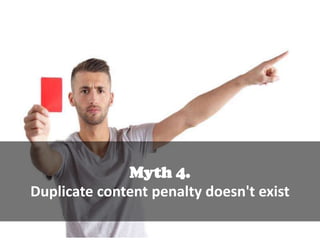
Myth 4.
Duplicate content penalty doesn't exist
Although Google penalizes sites for duplicate
content quire seldom (usually such sites are pure
spam), it could easily dish out a penalty to a site
that:

http://webmeup.com/blog/duplicate-content-myths.html
Has nothing but scraped content
Scrapes images, auto-translates pages, or uses
automated apps/software to spin
content prior to publication
Purposefully creates pages with nearly
identical content to rank them for various
locations/keywords

http://webmeup.com/blog/duplicate-content-myths.html
In all other cases, your site is unlikely to get
penalized for duplicate content.
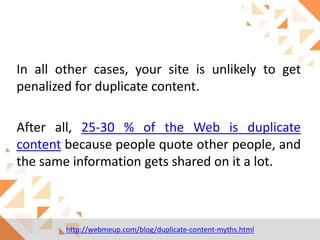
After all, 25-30 % of the Web is duplicate
content because people quote other people, and
the same information gets shared on it a lot.

http://webmeup.com/blog/duplicate-content-myths.html
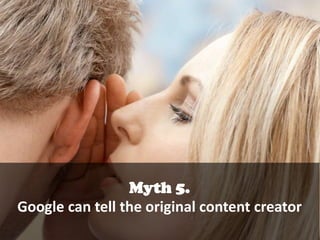
Myth 5.
Google can tell the original content creator
There's been a lot of discussion on the Web
about Google being or not being able to tell the
original creator of a content piece.

http://webmeup.com/blog/duplicate-content-myths.html
Some people would say Google replies on
publication date to track the authentic author
BUT
multiple instances of hijacked search results (a
scraper site outranking the original) disprove
that.

http://webmeup.com/blog/duplicate-content-myths.html
Thus, according to Dan Petrovic, there are
certain signals you can send Google to let it
know you're the original author.

http://webmeup.com/blog/duplicate-content-myths.html
These are:
Claiming your Google Authorship
Specifying canonical URLs
Sharing a newly published piece on Google+,
etc.

http://webmeup.com/blog/duplicate-content-myths.html
Myth 6.
Syndicated content is duplicate content
Type 1.
That is legitimate news sites/information hubs
that sometimes feature previously published
content.

They often provide original commentary and
analysis of the piece they cover. Such sites
always credit the original content creator.

http://webmeup.com/blog/duplicate-content-myths.html
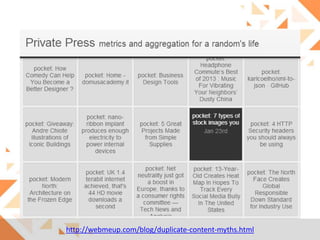
Type 2.
Content syndication sites that produce no
content of their own.
They scrape content off multiple websites
(often it is imagery) and give no credit to the
original content creators whatsoever.

http://webmeup.com/blog/duplicate-content-myths.html
So, if your site belongs to the 1st type and you
have syndicated content on it, you have nothing
to worry about.

If you are type 2, getting a penalty is just a
matter of time!

http://webmeup.com/blog/duplicate-content-myths.html
Myth 7.
Translated copy on regional site isn't duplicate
content
You may think that translating the copy from
your English-language site and publishing it on a
regional domain/subdomain is never a problem.

http://webmeup.com/blog/duplicate-content-myths.html
Well, sometimes it is.

http://webmeup.com/blog/duplicate-content-myths.html
These are the cases when Google can classify a
translated copy as duplicate content:

http://webmeup.com/blog/duplicate-content-myths.html
You translated it with an automatic tool and
just dumped it on your site;
* (in which case it would qualify as automatically
generated content)
You copied your English-language content
without change to the regional site.

http://webmeup.com/blog/duplicate-content-myths.html
So, when creating a foreign site for your biz,
tailor its content for the segment of users you
are
trying
to
reach
with
it.

Most likely, they would want a slightly different
message than the one you have for Englishspeaking audiences.

http://webmeup.com/blog/duplicate-content-myths.html
This is it!

http://webmeup.com/blog/duplicate-content-myths.html
For more info check WebMeUp blog:
http://webmeup.com/blog/duplicate-contentmyths.html

7 duplicate content myths that simply aren't true

  • 1.
    7 duplicate contentmyths that simply aren’t true By WebMeUp.Com
  • 2.
    There are quitea few duplicate content myths circulating in the SEO community.
  • 3.
  • 4.
    Myth 1. Duplicate contentis ‘same text on multiple pages‘
  • 5.
    Website owners whoare not so good at web design think that the only way to produce duplicate content is to purposefully replicate a piece of text on multiple pages. http://webmeup.com/blog/duplicate-content-myths.html
  • 6.
    What they don'trealize is that some of their site's pages may be accessible via multiple ULRs (which may happen for various reasons), which, in turn, would automatically lead to content duplication. http://webmeup.com/blog/duplicate-content-myths.html
  • 7.
    Ideally, each pieceof content should have only one URL associated with it: http://webmeup.com/blog/duplicate-content-myths.html
  • 8.
  • 9.
    In reality, though,it happens quite often that a page has multiple URLs associated with it: http://webmeup.com/blog/duplicate-content-myths.html
  • 10.
  • 11.
    Hence, if thereare pages on your site that have multiple URLs pointing to them, you need to take care of that! http://webmeup.com/blog/duplicate-content-myths.html
  • 12.
    To solve that,one should use canonical tags, an XML sitemap, a robots.txt file or other means that aid the canonicalization process. http://webmeup.com/blog/duplicate-content-myths.html
  • 13.
    Also, more informationon how to tackle these structure issues are given in this guide to SEOfriendly URL architecture. http://webmeup.com/blog/duplicate-content-myths.html
  • 14.
    Myth 2. One shouldblock crawlers' access to duplicate pages
  • 15.
    In case youhave duplicate URLs on a site, closing duplicates from getting indexed with a robots.txt is a bad idea. http://webmeup.com/blog/duplicate-content-myths.html
  • 16.
    A better solutionis to allow search engines to crawl these URLs, but mark them as duplicates. http://webmeup.com/blog/duplicate-content-myths.html
  • 17.
    That can bedone by using the rel="canonical" link element, the URL parameter handling tool, or 301 redirects. http://webmeup.com/blog/duplicate-content-myths.html
  • 18.
    Myth 3. Legal info/disclaimeracross multiple pages isn't allowed
  • 19.
    Some SEOs trulybelieve that having even a small amount of duplicate content on your site can lead to a penalty. In an overwhelming number of cases, however, it can't. http://webmeup.com/blog/duplicate-content-myths.html
  • 20.
    According to MattCutts, having a Terms and Conditions template or a Disclaimer message across all pages of your site won't get you penalized. http://webmeup.com/blog/duplicate-content-myths.html
  • 21.
    Check out thisvideo to learn more: http://www.youtube.com/watch?v=ViwkEeOKxM http://webmeup.com/blog/duplicate-content-myths.html
  • 22.
    NB! At the sametime, Google still advises one to keep the amount of text in that repeated message to a minimum. http://webmeup.com/blog/duplicate-content-myths.html
  • 23.
    Myth 4. Duplicate contentpenalty doesn't exist
  • 24.
    Although Google penalizessites for duplicate content quire seldom (usually such sites are pure spam), it could easily dish out a penalty to a site that: http://webmeup.com/blog/duplicate-content-myths.html
  • 25.
    Has nothing butscraped content Scrapes images, auto-translates pages, or uses automated apps/software to spin content prior to publication Purposefully creates pages with nearly identical content to rank them for various locations/keywords http://webmeup.com/blog/duplicate-content-myths.html
  • 26.
    In all othercases, your site is unlikely to get penalized for duplicate content. After all, 25-30 % of the Web is duplicate content because people quote other people, and the same information gets shared on it a lot. http://webmeup.com/blog/duplicate-content-myths.html
  • 27.
    Myth 5. Google cantell the original content creator
  • 28.
    There's been alot of discussion on the Web about Google being or not being able to tell the original creator of a content piece. http://webmeup.com/blog/duplicate-content-myths.html
  • 29.
    Some people wouldsay Google replies on publication date to track the authentic author BUT multiple instances of hijacked search results (a scraper site outranking the original) disprove that. http://webmeup.com/blog/duplicate-content-myths.html
  • 30.
    Thus, according toDan Petrovic, there are certain signals you can send Google to let it know you're the original author. http://webmeup.com/blog/duplicate-content-myths.html
  • 31.
    These are: Claiming yourGoogle Authorship Specifying canonical URLs Sharing a newly published piece on Google+, etc. http://webmeup.com/blog/duplicate-content-myths.html
  • 32.
    Myth 6. Syndicated contentis duplicate content
  • 33.
    Type 1. That islegitimate news sites/information hubs that sometimes feature previously published content. They often provide original commentary and analysis of the piece they cover. Such sites always credit the original content creator. http://webmeup.com/blog/duplicate-content-myths.html
  • 34.
    Type 2. Content syndicationsites that produce no content of their own. They scrape content off multiple websites (often it is imagery) and give no credit to the original content creators whatsoever. http://webmeup.com/blog/duplicate-content-myths.html
  • 35.
  • 36.
    So, if yoursite belongs to the 1st type and you have syndicated content on it, you have nothing to worry about. If you are type 2, getting a penalty is just a matter of time! http://webmeup.com/blog/duplicate-content-myths.html
  • 37.
    Myth 7. Translated copyon regional site isn't duplicate content
  • 38.
    You may thinkthat translating the copy from your English-language site and publishing it on a regional domain/subdomain is never a problem. http://webmeup.com/blog/duplicate-content-myths.html
  • 39.
    Well, sometimes itis. http://webmeup.com/blog/duplicate-content-myths.html
  • 40.
    These are thecases when Google can classify a translated copy as duplicate content: http://webmeup.com/blog/duplicate-content-myths.html
  • 41.
    You translated itwith an automatic tool and just dumped it on your site; * (in which case it would qualify as automatically generated content) You copied your English-language content without change to the regional site. http://webmeup.com/blog/duplicate-content-myths.html
  • 42.
    So, when creatinga foreign site for your biz, tailor its content for the segment of users you are trying to reach with it. Most likely, they would want a slightly different message than the one you have for Englishspeaking audiences. http://webmeup.com/blog/duplicate-content-myths.html
  • 43.
  • 44.
    For more infocheck WebMeUp blog: http://webmeup.com/blog/duplicate-contentmyths.html