10 Countries ProjectBy: Andrew Freer
Liechtenstein
Country Description LocationCentral Europe, between Austria and SwitzerlandSize160 sq kmPopulation34,761Climate continental; cold, cloudy winters with frequent snow or rain; cool to moderately warm, cloudy, humid summers
Geographic DescriptionLand Regionmostly mountainousRivers, lakes, oceansNoneFauna and Flora1600 plant species, about 800 species are mountain flora, the rest are valley and slope flora55 mammal 17 species of bats10 species of amphibians 24 species of fish   Vacation Tour
HistoryEarly The Principality of Liechtenstein was established within the Holy Roman Empire in 1719. Occupied by both French and Russian troops during the Napoleonic wars, it became a sovereign state in 1806 and joined the Germanic Confederation in 1815Liechtenstein became fully independent in 1866 when the Confederation dissolvedWWIINeutralMajor EventsBlacklisted for money laundering in 2000.
PoliticalGovernment type constitutional monarchyGovernment LeaderExecutive Chief of state: Prince Hans Adam II Head of government: Head of Government KlausCabinetLegislative Parliament or Landtag Judicial Supreme Court or Oberster Gerichtshof
Economy Industryelectronics, metal manufacturing, dental products, ceramics, pharmaceuticals, food products, precision instruments, tourism, optical instrumentsExportssmall specialty machinery, connectors for audio and video, parts for motor vehicles, dental products, hardware, prepared foodstuffs, electronic equipment, optical products$3.92 billionImports$2.59 billionagricultural products, raw materials, energy products, machinery, metal goods, textiles, foodstuffs, motor vehiclesEconomic StatusDebt = $0Major Trade PartnersSwissAustriaFranceUSGermanTrade AssociationsEuropean Economic Area (EEA) WTO  World Trade Organization
Daily LifeWealthy individualsHigh cost of livingExpensive ClothingTotal literacy- 100%Internet usage65.2%
CulturalTraditionsMixed traditions of Swiss and Austrian cultureReligionsRoman Catholic 76.2%, Protestant 7%, unknown 10.6%, other 6.2% FoodsCoffee and bread with jam are commonly eaten for breakfastZmittag, a meal that includes main dish, soup, salad, and dessertMusic and DanceLiechtenstein Musical Company, the annual Guitar Days and the International Josef Gabriel Rheinberger Society(Musical societies)ArtPrivate Art Collection of the Prince of Liechtenstein, one of the world's leading private art collections, is shown at the Liechtenstein Museum in ViennaFootball teams play in Swiss football leagues
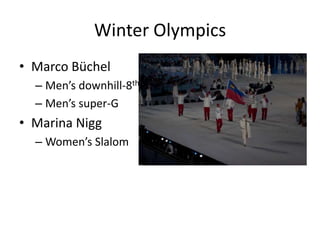
Winter OlympicsMarco BüchelMen’s downhill-8thMen’s super-GMarina NiggWomen’s Slalom
Ethiopia
Country DescriptionSize1,104,300 sq kmLocationEastern Africa, west of SomaliaPopulation85,237,338Climatetropical monsoon with wide topographic-induced variation
Geographic DescriptionLand Regionhigh plateau with central mountain range divided by Great Rift Valley Rivers, Lakes, OceansLake Tana, Lake Turkana, Blue RiverIndigenous Fauna and FloraGelada Baboon, Nyala, HartebeestEnsete, Eragrostis abyssinica
HistoryEarly HistoryIn 1974 archaeologists excavating sites in the Awash River valley discovered 3.5-million-year- old fossil skeletons, is the oldest hominid to be uncoveredMuslims invade their lands in 1527They become independent in 1543, defeating the Muslims1682, Iyasus I, or the Great, is crowned and modernizes Ethiopia. After death in 1706, Iyasus’s country is divided into separate regions.  1936-41Italians invade EthiopiaFought against the Axis during WWII and allied with Britain1974, Emperor Selassie establishes a socialistic ruleHis rule ended after the Ethiopian People's Revolutionary Democratic Front (EPRDF) had rebelled against him from his bloody uprisings and wide spread droughtsModernA constitution was made in 1994, following Ethiopia’s first multiparty elections in 1995A border war with Eritrea ended with a peace treaty in 2000
PoliticalType of Governmentfederal republicGovernment LeadersExecutiveChief of State President GirmaWoldegiorgisHead of Government Prime Minister Meles ZenawiCabinet Council of MinistersLegislativeHouse of FederationJudicialFederal Supreme Court
EconomyIndustryfood processing, beverages, textiles, leather, chemicals, metals processing, cementExports$1.608 billioncoffee, qat, gold, leather products, live animals, oilseedsImports$7.315 billionfood and live animals, petroleum and petroleum products, chemicals, machinery, motor vehicles, cereals, textilesEconomic StatusDebt:  $4.229 billionMajor Trade PartnersUS, Germany, Swiss, Italy, China, Sudan, Saudi Arabia, IndiaTrade AssociationsConfederation of Ethiopian Trade Unions (CETU)
Daily LifeNot wealthy individualsLow cost of Living LiteracyTotal population: 42.7%Male: 50.3%Female: 35.1%ClothingGabi-ShawlCoffee DressesGown/OvercoatShirtsInternet Usage .446%
Cultural LanguagesAmarigna 32.7%, Oromigna 31.6%, Tigrigna 6.1%, Somaligna 6%, Guaragigna 3.5%, Sidamigna 3.5%, Hadiyigna 1.7%, other 14.8%ReligionsChristian 60.8% (Orthodox 50.6%, Protestant 10.2%), Muslim 32.8%, Traditional 4.6%, other 1.8%FoodsWat- thick stewInjera- sourdough flatbreadNo pork or shellfishMusic and DanceExtremely Diverse80 ethnic groupsChristian elementsMuslimFolklore
Winter OlympicsRobel Teklemariam15 kilometer freestyleRanked 93
ConclusionEthiopia has only 1 medical doctor per 100,000 people980,000 with HIV/AIDS67,0000 Died with HIV/AIDS
Djibouti
Country DescriptionSize23,200 sq kmClimatedesert; torrid, dryLocationEastern Africa, bordering the Gulf of Aden and the Red Sea, between Eritrea and SomaliaPopulation724,622
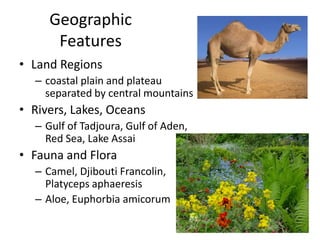
Geographic FeaturesLand Regionscoastal plain and plateau separated by central mountainsRivers, Lakes, OceansGulf of Tadjoura, Gulf of Aden, Red Sea, Lake AssaiFauna and FloraCamel, Djibouti Francolin, Platyceps aphaeresis Aloe, Euphorbia amicorum
HistoryEarlyRecorded in poetry, songs, and folkloreTrade with China, Egypt, and IndiaAdopted IslamFrench ruled by the sultan of Raheita, until independence in 1977ModernUnrest among the Afars in the 1990s lead to civil war that ended in 2001 with peace between Afars and government
PoliticalType of GovernmentRepublicGovernment LeadersExecutiveChief of State: President Ismail Omar GuellehHead of Government: Prime Minister Mohamed Dileita DileitaCabinet: Council of MinistersLegislativeChamber of DeputiesJudicialSupreme Court
EconomyIndustryconstruction, agricultural processingExports$340 million Re exports, hides and skins, coffeeImports$1.555 billion foods, beverages, transport equipment, chemicals, petroleum productsEconomic StatusDebt:$428 million Unemployment rate: 59%Major Trade PartnersSomalia, Yemen, Saudi Arabia, India, China, US, MalaysiaTrade AssociationsNone
Daily LifeStandard of LivingVery poorUnemployment at 59%42% of population below the poverty liveLiteracyTotal population: 67.9%Male: 78%Female: 58.4%ClothingAfrican dresses and clothingMacawiis -sarong-like garment worn around the waistDirac- a long, light, sheer dressInternet Usage1.34 %
CulturalReligionsMuslim 94%Christian 6%LanguagesFrench, Arabic, Somali, AfarFoodsMany foods have influence with Arab and French culinary artsFresh seafood, lamb, and meatsMusicHorn of AfricaAfar and Arab MusicMuch of its countries history is written in poetryLake AsalGreat attraction for tourism
Winter OlympicsDid not participate in Winter Olympics
Falkland Islands
Country DescriptionSize 12,173 sq kmClimatecold marine; strong westerly winds, cloudy, humid; rain occurs on more than half of days in yearLocation Southern South America, islands in the South Atlantic Ocean, east of southern ArgentinaPopulation3,140
Geographic FeaturesLand regionsrocky, hilly, mountainous with some boggy, undulating plainsRivers, Lakes, OceansAtlantic Ocean, Scotia Sea, Falkland Sound, Fauna and FloraFalkland Flightless Steamer Duck, Falkland Islands Wolf Hairy Daisy Erigeron incertus, Moore's Plantain Plantago moorei Vacation tourFlaklands Islands Quest
HistoryEarlyFirst sighted by a English navigator, John Davis, in 1592First landings occurred in 1690First settlement was French, not British, until 1764Turned over to Spain, but was disputed between Spain and British, later Argentina and BritishModernApril2, 1982- Argentina invade the islands. British sent in expeditionary forces that landed several weeks later and after fighting for a few months, Argentina surrendered on June 14, 1982
PoliticalType of GovernmentBritish Dependent TerritoryGovernment LeadersExecutiveChief of State: Queen Elizabeth IIHead of Government: Governor Alan HuckleCabinet: Executive Council LegislativeLegislative Council JudicialSupreme Court
EconomyIndustryfish and wool processing; tourismExports$125 millionwool, hides, meat, fish, squid Imports$90 millionfuel, food and drink, building materials, clothingEconomic StatusDebt-NAMajor Trade PartnersUKTrade AssociationsNone
Daily LifeStandard of LivingSimple lifeStable life and no unemploymentLiteracyNAClothingJeans, T’s, Modern Westernized clothingInternet Usage100%
CulturalReligionsChristianity CustomsMilitary Based IslandsRAF(Royal Air Force)Foodstea with home made cakelamb, mutton, beef, trout and also garden vegetablesMusic and DanceModern Music and Dances from British and American culturePlacesStanley
Winter OlympicsDid not participate in Winter Olympics
Falklands WarApril 2, 1982, Argentina invaded Falkland Islands British send expeditionary forces to retake the islands, which started the warAllied forces landed at San Carlos Water on 21 MayLed to 655 Argentine and 255 British deaths
Sao Tome And Principe
Country DescriptionSize964 sq kmClimatetropical; hot, humid; one rainy seasonLocationWestern Africa, islands in the Gulf of Guinea, straddling the Equator, west of GabonPopulation212,679
Geographic FeaturesLand Regionvolcanic, mountainousRivers, Lakes, OceansGulf of GuineaAtlantic OceanFauna and FloraDwarf Olive IbisMaroon PigeonSao Tome Fiscal Shrike Begonia amplaPandanusthomensisBegonia subalpestrisVacation ToursPestana Sao Tome Ocean Resort
HistoryEarlyDiscovered and claimed by Portugal in the late 15th centurythe islands' sugar-based economy gave way to coffee and cocoa in the 19th centuryindependence was achieved in 1975Modern Held its first election in 1991, but had many waging of power within the government and resulted in two failed coup attempts in 1995 and 2003Recent discovery of oil within the Gulf of Guinea
PoliticalDemocratic Republic of Sao Tome and Principe Government TypeRepublicGovernment LeadersExecutiveChief of State: President FradiqueBandieraMelo De MenezesHead of Government: Prime Minister Joachim Rafael BrancoCabinet: Council of MinistersLegislativeNational AssemblyJudicial Supreme Court
EconomyIndustry light construction, textiles, soap, beer, fish processing, timberExports$8 million Cocoa,  copra, coffee, palm oilImports$91 millionmachinery and electrical equipment, food products, petroleum productsEconomic StatusDebt: $318 million Unemployment: NA%Major Trade PartnersJapan, Belgium, Netherlands, PortugalTrade AssociationsEuropean Union (EU)
Daily LifeStandard of Living54% under the Poverty LineLow cost of living Third world countryLiteracyTotal Population: 84.9%Male: 92.2%Female: 77.9%ClothingLightweight Portuguese and African clothingInternet Usage15.4%
CulturalTraditionsBoth Portuguese and AfricanReligionsCatholic 70.3%, Evangelical 3.4%, New Apostolic 2%, Adventist 1.8%, other 3.1%, none 19.4%FoodsGrilled fish and chickenFried fish Cooked bananasBuzios(large land snails) Tropical fruitMusic and DanceTchiloli is a musical dance performance that tells a dramatic story. Danço-congo is similarly a combination of music, dance and theatreUnique FactsArtsPascoalViegasVilheteAlmadaNegreirosViannadaMota representing rural life and forms in modern art
Winter OlympicsDid not participate in Winter Olympics
ConclusionCurrency DobraLanguagesPortuguese ForroAngolarPrincipense
Cyprus
Country DescriptionSize9,251 sq kmClimatetemperate; Mediterranean with hot, dry summers and cool wintersLocationMiddle East, island in the Mediterranean Sea, south of TurkeyPopulation1,084,748
Geographic FeaturesLand RegionsCentral plain with mountains to north and south; scattered but significant plains along southern coastRivers, Lakes, OceansMediterranean SeaFauna Sea TurtlesMountain RamGolden OrioleFloraGolden OakCyclamenPink oleanderAkamas Peninsula Many Turtles lay eggs and rest for summer
HistoryEarlyEarliest recorded time of human activity in 10,000 BC as hunter-gatherers395, Became part of Eat Roman EmpireIn 1570, became under siege with an assault of 60,000 troops, which was brought under control by Ottoman empireBecame under control by British in 1878ModernBecame Independent on August 16, 1960Tension between Greek Cypriot majority and Turkish Cypriot minority  in 1963, brought uprisings, despite UN peacekeepers1983, The Turkish Cypriot Area declared itself the Turkish Republic of Northern Cyprus2008, have held peace negotiations into reuniting the island
PoliticalRepublic of CyprusGovernment TypeRepublicGovernment LeadersExecutiveChief of State and Head of Government President DemetrisChristofiasCabinet: Council of MinistersLegislativeHouse of RepresentativesJudicialSupreme Court
EconomyIndustrytourism, food and beverage processing, cement and gypsum production, ship repair and refurbishment, textiles, light chemicals, metal products, wood, paper, stone, and clay productsExports$1.135 billioncitrus, potatoes, pharmaceuticals, cement, and clothingImports$6.676 billion consumer goods, petroleum and lubricants, intermediate goods, machinery, transport equipmentEconomic StatusDebt: $32.86 billionUnemployment: 4.8%Major Trade PartnersGreeceUKGermanyItalyIsraelTrade AssociationsIMF or International Monetary Fund
Daily LifeWealthy Standard of LivingWell Built homes and buildingsLiteracyTotal Population: 97.6%Male: 98.9%Female: 96.3%Clothingvrakas -a long black trouser worn with vests on topSarkas- the local made skirt and blouse.Internet Usage38%
CulturalCustomsCelebrationReligious FestivalsMidnight Mass on ChristmasCarnivals and ParadesLife of Foods and wineReligionsGreek Orthodox 78%, Muslim 18%, other (includes Maronite and Armenian Apostolic) 4%FoodsHellim cheese originated in CyprusSeafood and fish dishesmeat marinated in dried coriander seeds and winelountza (smoked pork loin), charcoal-grilled lambMusic and DanceFolk music from Greece and TurkeyHip HopHardcore/EmoReggaeArtsCarved figures to be about 10,000 years old
Winter OlympicsChristopher Papamichalopoulos -Men's slalomDisqualifiedSophia Papamichalopoulos Women's slalomRanked 53
ConclusionCurrencyEuroLanguagesGreek Turkish
Nepal
Country DescriptionSize147,181 sq kmClimateVaries from cool summers and severe winters in north to subtropical summers and mild winters in southLocationSouthern Asia, between China and IndiaPopulation28,563,377
Geographic FeaturesLand RegionsTarai or flat river plain of the Ganges in south, central hill region, rugged Himalayas in northRivers, Lakes, OceansKosi RiverNarayani RiverKail RiverKarnali RiverFaunaBuffaloesTigersLeopardsCrocodilesFloraSalAsnaElephant grass Special Points of InterestMt. EverestHimalayaVacation TourNaturally Nepal
HistoryEarlyPeople have found bones from 9,000 years ago1951, Ended a century old monarch and formed cabinet system governmentModern1990, established a multiparty democracy within the framework of a constitutional monarchy.Extremist brake out of Maoists in 1996Ten-year civil war between insurgents and the governmentMass protests in 2006Peace treaties and negotiations In August 2008, Maoist formed its first coalition governmentLater overruled by president to fire the chief of the army staff
Political Federal Democratic Republic of NepalGovernment TypeFederal Democratic RepublicGovernment LeadersExecutiveCabinet: Communist Party of Nepal-United Marxist-Leninist, Nepali CongressChief of State: President Ram BaranYadavHead of Government: Prime Minister Madhav Kumar NepalLegislativeConstituent AssemblyJudicialSupreme Court
EconomyIndustryTourism, carpets, textiles; small rice, jute, sugar, and oilseed mills; cigarettes, cement and brick productionExports$907 millionclothing, pulses, carpets, textiles, juice, pashima, jute goodsImports$3.626 billionpetroleum products, machinery and equipment, gold, electrical goods, medicineEconomic Status115th largest economyDebt: $4.5 billionUnemployment rate46%Major Trade PartnersIndiaUSBangladeshGermanyChinaTrade AssociationsSouth Asian Association for Regional Cooperation (SAARC)
Daily LifeStandard of Living24.7% Low rate of living Poor areasLiteracyTotal Population: 48.6%Male: 62.7%Female: 34.9%ClothingJacketsCotton shirtsTrousersWoolen jacketsSkirtsInternet usage1.41%
CulturalCustomsTaking off your shoes before entering a temple or homePointing is considered badReligionsHindu 80.6%, Buddhist 10.7%, Muslim 4.2%, Kirant 3.6%FoodsDal is a spicy lentil soup, served over bhat (boiled rice)ChileMusic and DanceThe Newari Music orchestra consists mainly of percussion instruments such as flutesLakhey dance- a drunken dance Done at least once a year
Winter OlympicsDid not participate in Winter Olympics
Conclusion Mount EverestWorld Highest Mountain29,029 ft. above sea levelMay 29, 1953, On the ninth expedition to the top, Edmund Hillary and Tenzing Norgay had reached the top of the summit at 11:30 a.m.
England
Country DescriptionSize50,346 sq mi ClimateDamp relatively frequently and is subject to changeLocationWestern Europe, northwest of FrancePopulation51,446,000
Geographic FeaturesLand Regionsmostly rugged hills and low mountains; level to rolling plains in east and southeastRivers, Lakes, OceansEnglish ChannelNorth SeaIrish SeaCeltic SeaFaunagulls, oystercatchers, buntingsgrey sealssquirrels, badgers, stags, deer, blue titsFlorabeech treesshrub-hedged farmlands sea lavender
HistoryEarlyIn 55 BC, England is conquered by the Romans.9th century  raids of Vikings in the century.In 1066, Guillaume the Conqueror is victorious in the Battle of HastingsFrom 1337 to 1453 the Hundred Years war takes place.In 1563, Anglicanism is instituted by a confession of faith. In 1666, a fire destroys most of London’s buildingsJuly4, 1776 America  declared independence and won independence on 1783 after signing the Treaty of ParisIn 1876, Queen Victoria is proclaimed empress of India.ModernIn 1914 and 1939, the British government allies with France in the war against Germany in WWI1939, Britain declares war on Germany along with FranceIn 1947, England declares the independence of India and Pakistan.In 1994, the Channel tunnel is openedIn 1997, The Labour Party led by Tony Blair wins elections.In 1997, Princess Diana Spencer dies in a car accident.
PoliticalParliament of the United KingdomType of Governmentconstitutional monarchy and parliamentary democracy  Leaders of GovernmentQueen: Elizabeth IIPrime Minister of the United Kingdom: Gordon Brown
EconomyIndustrymachine tools, electric power equipment, automation equipment, railroad equipment, shipbuilding, aircraft, motor vehicles and parts, electronics and communications equipment, metals, chemicals, coal, petroleum, paper and paper products, food processing, textiles, clothing, other consumer goodsExports$351.3 billionmanufactured goods, fuels, chemicals; food, beverages, tobaccoImports$473.6 billionmanufactured goods, machinery, fuels; foodstuffsEconomic StatusDebt: $9.088 trillionUnemployment: 8%Major Trade PartnersUS Germany Netherlands France Ireland Belgium SpainTrade AssociationsCCTA Consumer Credit Trade Association
Daily LifeHouses are expensiveFirst-World CountryLiteracyTotal population: 99%ClothingSuitsDressesModern ClothingInternet Usage79.4%
CulturalCustomsDrinking TeaBowler hatsSoccerReligionsChristian 71.6%Muslim 2.7%Hindu 1%FoodsFish and ChipsPieSandwishTeaWine and CoffeeMusic and DanceRock Hip HopR&BPopMorris Dances- folklore dancingDouble Decker buses1,000 buses Custom Red colored
Winter OlympicsAmy WilliamsWomen’s Skeleton1st Place Gold
SportsCricketPlayed in the 16th CenturyBat-and-ball team sport 11 PlayersEquipmentCricket ball, cricket bat,wicket: stumps, bails
ConclusionCapital LondonLanguageEnglish	 Rock N’ RollThe BeatlesRolling StonesLed Zeppelin
Egypt
Country DescriptionSize1,001,450 sq kmClimatedesert; hot, dry summers with moderate wintersLocationNorthern Africa, bordering the Mediterranean Sea, between Libya and the Gaza Strip, and the Red Sea north of Sudan, and includes the Asian Sinai PeninsulaPopulation78,866,635
Geographic FeaturesLand Regionsvast desert plateau interrupted by Nile valley and deltaRivers, Lakes, OceansMediterranean Sea, Lake Nasser, Nile River, Suez Canal, Red SeaFaunaCamelDonkeyOxSheepPigFloraSycamoreAcacia niloticaTamariskPlaces of InterestSuez CanalAlexandria Cairo
HistoryEarlyMany people flooded to the area of water from the Nile and of its richesFirst time this country was unified is about 3200 B.C.Ruled by many Dynasties for three thousand yearsHad war and fell to the Persian Dynastyin 341 B.C.In the 7th Century Islam was first introduced and had ruled the people for the next six centuriesOttoman Empire had controlled the land in 1517Suez Canal was completed on 1869Britain gained control in 1882ModernHad gained partial independence in 1922On WWII begin they had allied with Americans and British forces to stop Nazis Germany from controlling all of North AfricaIn 1952, Egypt had finally gotten full sovereignty as they overthrew the monarchy setup thereNow, is the largest population in the Arab world
PoliticalArab Republic of Egypt Type of GovernmentRepublicGovernment LeadersExecutiveChief of State: President Mohamed Hosni Mubarak Head of Government: Prime Minister Ahmed Mohamed NazifCabinet: Cabinet LegislativeAdvisory Council JudicialSupreme Constitutional Court
EconomyIndustrytextiles, food processing, tourism, chemicals, pharmaceuticals, hydrocarbons, construction, cement, metals, light manufacturesExports$22.91 billioncrude oil and petroleum products, cotton, textiles, metal products, chemicals, processed foodImports$43.98 billionmachinery and equipment, foodstuffs, chemicals, wood products, fuelsEconomic StatusDebt: $28.45 billion Unemployment rate9.7%Major Trade PartnersItaly, Germany, US, Spain, India, Syria, ChinaTrade AssociationsOrascomgroup
Daily LifeStandard of Living20% Below Poverty LineWell-balanced CountryMost parts aren’t habitualLiteracyTotal Population: 71.4%Male: 83%Female: 59.4%ClothingGalabya- cotton robesFez HatVestInternet Usage15.4%
CultureCustomsHeavily influenced by Egyptian literature, music, Film and televisionModern Western cultureReligionsMuslim 90%, Coptic 9%, Christian 1%FoodsKebabFulmedamesKushariMusic and DanceMamba-most popular in CairoHarps and Flutes played in 4000 BCPop MusicBelly Dance-or RaqsSharqi
Winter OlympicsDid not participate in Winter Olympics
ConclusionPyramids of GizaPart as the Seven wonders of the WorldPyramid of KhufuLargest of the Three Pyramids in the Giza RegionBuilt for the fourth dynasty Egyptian Pharaoh KhufuConstructed over a 20-year periodPyramid of KhafreBuilt by Khafre’s, father KhufuSecond Largest pyramidPyramid of MenkaureServe as the tomb of the Pharaoh MenkaureCompleted 26th Century BC
Austria
Country DescriptionSize83,871 sq kmClimatetemperate; continental, cloudy; cold winters with frequent rain and some snow in lowlands and snow in mountains; moderate summers with occasional showersLocationCentral Europe, north of Italy and SloveniaPopulation8,210,281
Geographic FeaturesLand Regionswest and south mostly mountains (Alps); along the eastern and northern margins mostly flat or gently slopingRivers, Lakes, OceansGulf of ViennaDanube RiverFaunaGeeseHarrowsFalconsEagleFloraBeech TreeConifersSpecial PlacesAlps
HistoryEarlyHad been controlled by Celtics before pre-Roman timesAfter the fall of the Romans they were invaded by Bavarians, Slavs, and AvarsRuled by the HabsburgsBattle of Vienna broke Ottoman Empire’s advance toward Europein 1683Archduke Ferdinand of Austria had been assassinated in 1914This led to war with Serbia and allied troopsOne million Austro-Hungarian soldiers died in WWIAs a result they had their country split into Austria and HungaryModernAustria had than joined Hitler and the Nazi party for WWII against Allied forces once againThey had lost and had their lands split againAustria had than split form any control of Germany by the State Treaty in 1955Had joined the European Union in 1995Now has a seat on the UN security Council
PoliticalRepublic of Austria Type of GovernmentFederal RepublicGovernment LeadersExecutiveChief of State President Heinz FischerHead of Government: Chancellor Werner FaymannCabinet: Council of Ministers LegislativeFederal AssemblyJudicialSupreme Judicial Court
EconomyIndustryConstruction, machinery, vehicles and parts, food, metals, chemicals, lumber and wood processing, paper and paperboard, communications equipment, tourismExports$129 billion Machinery and equipment, motor vehicles and parts, paper and paperboard, metal goods, chemicals, iron and steel, textiles, foodstuffsImports$136 billionMachinery and equipment, motor vehicles, chemicals, metal goods, oil and oil products; foodstuffsEconomic StatusDebt: $808.9 billionUnemployment rate: 4.7%Major Trade PartnersGermany, US, Italy, Swiss, NetherlandsTrade AssociationsAustrian Federal Economic Chamber
Daily LifeStandard of Living12th richest country in the worldHigh living cost LiteracyTotal Population: 98%ClothingTrousers made of leatherJacketsFormal dressesInternet Usage59.3%
CulturalCustomsFamous music composersEnvironmental forms of Art ReligionsRoman Catholic 73.6%, Protestant 4.7%, Muslim 4.2%, other 3.5%, unspecified 2%FoodsInfluenced by Czech, Italian, Balkan, French and HungarianWiener SchnitzelKaiserschmarrnMusic and DanceFamous composersWolfgang Amadeus MozartMichael HaydnClassical musicUnique PlacesViennaSalzburg
Winter OlympicsTotal Medal Count 16Snowboard Men's Parallel Giant Slalom Benjamin Karl Bronze Snowboard Women's Parallel Giant Slalom Marion KreinerSilver Alpine Skiing Women's Slalom MarliesSchildSilver Biathlon Men's 4x7.5 km Relay Simon Eder, Daniel Mesotitsch, DominikLandertinger, ChristophSumannBronze Nordic Combined Individual Large Hill/10 km CC Bernhard GruberBronze Alpine Skiing Women's Giant Slalom Elisabeth GoerglGold Nordic Combined Team/4x5 km CC Bernhard Gruber, David Kreiner, Felix Gottwald, Mario StecherGold Ski Jumping Team Andreas Kofler, Wolfgang Loitzl, Thomas Morgenstern, GregorSchlierenzauerSilver Freestyle Skiing Men's Ski Cross Andreas Matt Bronze Ski Jumping LH Individual GregorSchlierenzauerGold Alpine Skiing Women's Super-G Andrea FischbacherGold Luge Doubles Wolfgang Linger, Andreas LingerBronze Alpine Skiing Women's Downhill Elisabeth GoerglSilver Luge Women's Singles Nina ReithmayerSilver Biathlon Men's 12.5 km Pursuit ChristophSumannBronze Ski Jumping NH Individual GregorSchlierenzauer 
ConclusionWolfgang Amadeus Mozart600 works composedBorn January 27, 1756Spent his childhood in SalzburgLearned his art of music from othersFamous MusicRequiem Mass

Freer10 Countries Project

  • 1.
  • 2.
  • 3.
    Country Description LocationCentralEurope, between Austria and SwitzerlandSize160 sq kmPopulation34,761Climate continental; cold, cloudy winters with frequent snow or rain; cool to moderately warm, cloudy, humid summers
  • 4.
    Geographic DescriptionLand RegionmostlymountainousRivers, lakes, oceansNoneFauna and Flora1600 plant species, about 800 species are mountain flora, the rest are valley and slope flora55 mammal 17 species of bats10 species of amphibians 24 species of fish Vacation Tour
  • 5.
    HistoryEarly The Principalityof Liechtenstein was established within the Holy Roman Empire in 1719. Occupied by both French and Russian troops during the Napoleonic wars, it became a sovereign state in 1806 and joined the Germanic Confederation in 1815Liechtenstein became fully independent in 1866 when the Confederation dissolvedWWIINeutralMajor EventsBlacklisted for money laundering in 2000.
  • 6.
    PoliticalGovernment type constitutionalmonarchyGovernment LeaderExecutive Chief of state: Prince Hans Adam II Head of government: Head of Government KlausCabinetLegislative Parliament or Landtag Judicial Supreme Court or Oberster Gerichtshof
  • 7.
    Economy Industryelectronics, metalmanufacturing, dental products, ceramics, pharmaceuticals, food products, precision instruments, tourism, optical instrumentsExportssmall specialty machinery, connectors for audio and video, parts for motor vehicles, dental products, hardware, prepared foodstuffs, electronic equipment, optical products$3.92 billionImports$2.59 billionagricultural products, raw materials, energy products, machinery, metal goods, textiles, foodstuffs, motor vehiclesEconomic StatusDebt = $0Major Trade PartnersSwissAustriaFranceUSGermanTrade AssociationsEuropean Economic Area (EEA) WTO  World Trade Organization
  • 8.
    Daily LifeWealthy individualsHighcost of livingExpensive ClothingTotal literacy- 100%Internet usage65.2%
  • 9.
    CulturalTraditionsMixed traditions ofSwiss and Austrian cultureReligionsRoman Catholic 76.2%, Protestant 7%, unknown 10.6%, other 6.2% FoodsCoffee and bread with jam are commonly eaten for breakfastZmittag, a meal that includes main dish, soup, salad, and dessertMusic and DanceLiechtenstein Musical Company, the annual Guitar Days and the International Josef Gabriel Rheinberger Society(Musical societies)ArtPrivate Art Collection of the Prince of Liechtenstein, one of the world's leading private art collections, is shown at the Liechtenstein Museum in ViennaFootball teams play in Swiss football leagues
  • 10.
    Winter OlympicsMarco BüchelMen’sdownhill-8thMen’s super-GMarina NiggWomen’s Slalom
  • 11.
  • 12.
    Country DescriptionSize1,104,300 sqkmLocationEastern Africa, west of SomaliaPopulation85,237,338Climatetropical monsoon with wide topographic-induced variation
  • 13.
    Geographic DescriptionLand Regionhighplateau with central mountain range divided by Great Rift Valley Rivers, Lakes, OceansLake Tana, Lake Turkana, Blue RiverIndigenous Fauna and FloraGelada Baboon, Nyala, HartebeestEnsete, Eragrostis abyssinica
  • 14.
    HistoryEarly HistoryIn 1974archaeologists excavating sites in the Awash River valley discovered 3.5-million-year- old fossil skeletons, is the oldest hominid to be uncoveredMuslims invade their lands in 1527They become independent in 1543, defeating the Muslims1682, Iyasus I, or the Great, is crowned and modernizes Ethiopia. After death in 1706, Iyasus’s country is divided into separate regions. 1936-41Italians invade EthiopiaFought against the Axis during WWII and allied with Britain1974, Emperor Selassie establishes a socialistic ruleHis rule ended after the Ethiopian People's Revolutionary Democratic Front (EPRDF) had rebelled against him from his bloody uprisings and wide spread droughtsModernA constitution was made in 1994, following Ethiopia’s first multiparty elections in 1995A border war with Eritrea ended with a peace treaty in 2000
  • 15.
    PoliticalType of GovernmentfederalrepublicGovernment LeadersExecutiveChief of State President GirmaWoldegiorgisHead of Government Prime Minister Meles ZenawiCabinet Council of MinistersLegislativeHouse of FederationJudicialFederal Supreme Court
  • 16.
    EconomyIndustryfood processing, beverages,textiles, leather, chemicals, metals processing, cementExports$1.608 billioncoffee, qat, gold, leather products, live animals, oilseedsImports$7.315 billionfood and live animals, petroleum and petroleum products, chemicals, machinery, motor vehicles, cereals, textilesEconomic StatusDebt: $4.229 billionMajor Trade PartnersUS, Germany, Swiss, Italy, China, Sudan, Saudi Arabia, IndiaTrade AssociationsConfederation of Ethiopian Trade Unions (CETU)
  • 17.
    Daily LifeNot wealthyindividualsLow cost of Living LiteracyTotal population: 42.7%Male: 50.3%Female: 35.1%ClothingGabi-ShawlCoffee DressesGown/OvercoatShirtsInternet Usage .446%
  • 18.
    Cultural LanguagesAmarigna 32.7%,Oromigna 31.6%, Tigrigna 6.1%, Somaligna 6%, Guaragigna 3.5%, Sidamigna 3.5%, Hadiyigna 1.7%, other 14.8%ReligionsChristian 60.8% (Orthodox 50.6%, Protestant 10.2%), Muslim 32.8%, Traditional 4.6%, other 1.8%FoodsWat- thick stewInjera- sourdough flatbreadNo pork or shellfishMusic and DanceExtremely Diverse80 ethnic groupsChristian elementsMuslimFolklore
  • 19.
    Winter OlympicsRobel Teklemariam15kilometer freestyleRanked 93
  • 20.
    ConclusionEthiopia has only1 medical doctor per 100,000 people980,000 with HIV/AIDS67,0000 Died with HIV/AIDS
  • 21.
  • 22.
    Country DescriptionSize23,200 sqkmClimatedesert; torrid, dryLocationEastern Africa, bordering the Gulf of Aden and the Red Sea, between Eritrea and SomaliaPopulation724,622
  • 23.
    Geographic FeaturesLand Regionscoastalplain and plateau separated by central mountainsRivers, Lakes, OceansGulf of Tadjoura, Gulf of Aden, Red Sea, Lake AssaiFauna and FloraCamel, Djibouti Francolin, Platyceps aphaeresis Aloe, Euphorbia amicorum
  • 24.
    HistoryEarlyRecorded in poetry,songs, and folkloreTrade with China, Egypt, and IndiaAdopted IslamFrench ruled by the sultan of Raheita, until independence in 1977ModernUnrest among the Afars in the 1990s lead to civil war that ended in 2001 with peace between Afars and government
  • 25.
    PoliticalType of GovernmentRepublicGovernmentLeadersExecutiveChief of State: President Ismail Omar GuellehHead of Government: Prime Minister Mohamed Dileita DileitaCabinet: Council of MinistersLegislativeChamber of DeputiesJudicialSupreme Court
  • 26.
    EconomyIndustryconstruction, agricultural processingExports$340million Re exports, hides and skins, coffeeImports$1.555 billion foods, beverages, transport equipment, chemicals, petroleum productsEconomic StatusDebt:$428 million Unemployment rate: 59%Major Trade PartnersSomalia, Yemen, Saudi Arabia, India, China, US, MalaysiaTrade AssociationsNone
  • 27.
    Daily LifeStandard ofLivingVery poorUnemployment at 59%42% of population below the poverty liveLiteracyTotal population: 67.9%Male: 78%Female: 58.4%ClothingAfrican dresses and clothingMacawiis -sarong-like garment worn around the waistDirac- a long, light, sheer dressInternet Usage1.34 %
  • 28.
    CulturalReligionsMuslim 94%Christian 6%LanguagesFrench,Arabic, Somali, AfarFoodsMany foods have influence with Arab and French culinary artsFresh seafood, lamb, and meatsMusicHorn of AfricaAfar and Arab MusicMuch of its countries history is written in poetryLake AsalGreat attraction for tourism
  • 29.
    Winter OlympicsDid notparticipate in Winter Olympics
  • 30.
  • 31.
    Country DescriptionSize 12,173sq kmClimatecold marine; strong westerly winds, cloudy, humid; rain occurs on more than half of days in yearLocation Southern South America, islands in the South Atlantic Ocean, east of southern ArgentinaPopulation3,140
  • 32.
    Geographic FeaturesLand regionsrocky,hilly, mountainous with some boggy, undulating plainsRivers, Lakes, OceansAtlantic Ocean, Scotia Sea, Falkland Sound, Fauna and FloraFalkland Flightless Steamer Duck, Falkland Islands Wolf Hairy Daisy Erigeron incertus, Moore's Plantain Plantago moorei Vacation tourFlaklands Islands Quest
  • 33.
    HistoryEarlyFirst sighted bya English navigator, John Davis, in 1592First landings occurred in 1690First settlement was French, not British, until 1764Turned over to Spain, but was disputed between Spain and British, later Argentina and BritishModernApril2, 1982- Argentina invade the islands. British sent in expeditionary forces that landed several weeks later and after fighting for a few months, Argentina surrendered on June 14, 1982
  • 34.
    PoliticalType of GovernmentBritishDependent TerritoryGovernment LeadersExecutiveChief of State: Queen Elizabeth IIHead of Government: Governor Alan HuckleCabinet: Executive Council LegislativeLegislative Council JudicialSupreme Court
  • 35.
    EconomyIndustryfish and woolprocessing; tourismExports$125 millionwool, hides, meat, fish, squid Imports$90 millionfuel, food and drink, building materials, clothingEconomic StatusDebt-NAMajor Trade PartnersUKTrade AssociationsNone
  • 36.
    Daily LifeStandard ofLivingSimple lifeStable life and no unemploymentLiteracyNAClothingJeans, T’s, Modern Westernized clothingInternet Usage100%
  • 37.
    CulturalReligionsChristianity CustomsMilitary BasedIslandsRAF(Royal Air Force)Foodstea with home made cakelamb, mutton, beef, trout and also garden vegetablesMusic and DanceModern Music and Dances from British and American culturePlacesStanley
  • 38.
    Winter OlympicsDid notparticipate in Winter Olympics
  • 39.
    Falklands WarApril 2,1982, Argentina invaded Falkland Islands British send expeditionary forces to retake the islands, which started the warAllied forces landed at San Carlos Water on 21 MayLed to 655 Argentine and 255 British deaths
  • 40.
    Sao Tome AndPrincipe
  • 41.
    Country DescriptionSize964 sqkmClimatetropical; hot, humid; one rainy seasonLocationWestern Africa, islands in the Gulf of Guinea, straddling the Equator, west of GabonPopulation212,679
  • 42.
    Geographic FeaturesLand Regionvolcanic,mountainousRivers, Lakes, OceansGulf of GuineaAtlantic OceanFauna and FloraDwarf Olive IbisMaroon PigeonSao Tome Fiscal Shrike Begonia amplaPandanusthomensisBegonia subalpestrisVacation ToursPestana Sao Tome Ocean Resort
  • 43.
    HistoryEarlyDiscovered and claimedby Portugal in the late 15th centurythe islands' sugar-based economy gave way to coffee and cocoa in the 19th centuryindependence was achieved in 1975Modern Held its first election in 1991, but had many waging of power within the government and resulted in two failed coup attempts in 1995 and 2003Recent discovery of oil within the Gulf of Guinea
  • 44.
    PoliticalDemocratic Republic ofSao Tome and Principe Government TypeRepublicGovernment LeadersExecutiveChief of State: President FradiqueBandieraMelo De MenezesHead of Government: Prime Minister Joachim Rafael BrancoCabinet: Council of MinistersLegislativeNational AssemblyJudicial Supreme Court
  • 45.
    EconomyIndustry light construction,textiles, soap, beer, fish processing, timberExports$8 million Cocoa, copra, coffee, palm oilImports$91 millionmachinery and electrical equipment, food products, petroleum productsEconomic StatusDebt: $318 million Unemployment: NA%Major Trade PartnersJapan, Belgium, Netherlands, PortugalTrade AssociationsEuropean Union (EU)
  • 46.
    Daily LifeStandard ofLiving54% under the Poverty LineLow cost of living Third world countryLiteracyTotal Population: 84.9%Male: 92.2%Female: 77.9%ClothingLightweight Portuguese and African clothingInternet Usage15.4%
  • 47.
    CulturalTraditionsBoth Portuguese andAfricanReligionsCatholic 70.3%, Evangelical 3.4%, New Apostolic 2%, Adventist 1.8%, other 3.1%, none 19.4%FoodsGrilled fish and chickenFried fish Cooked bananasBuzios(large land snails) Tropical fruitMusic and DanceTchiloli is a musical dance performance that tells a dramatic story. Danço-congo is similarly a combination of music, dance and theatreUnique FactsArtsPascoalViegasVilheteAlmadaNegreirosViannadaMota representing rural life and forms in modern art
  • 48.
    Winter OlympicsDid notparticipate in Winter Olympics
  • 49.
  • 50.
  • 51.
    Country DescriptionSize9,251 sqkmClimatetemperate; Mediterranean with hot, dry summers and cool wintersLocationMiddle East, island in the Mediterranean Sea, south of TurkeyPopulation1,084,748
  • 52.
    Geographic FeaturesLand RegionsCentralplain with mountains to north and south; scattered but significant plains along southern coastRivers, Lakes, OceansMediterranean SeaFauna Sea TurtlesMountain RamGolden OrioleFloraGolden OakCyclamenPink oleanderAkamas Peninsula Many Turtles lay eggs and rest for summer
  • 53.
    HistoryEarlyEarliest recorded timeof human activity in 10,000 BC as hunter-gatherers395, Became part of Eat Roman EmpireIn 1570, became under siege with an assault of 60,000 troops, which was brought under control by Ottoman empireBecame under control by British in 1878ModernBecame Independent on August 16, 1960Tension between Greek Cypriot majority and Turkish Cypriot minority in 1963, brought uprisings, despite UN peacekeepers1983, The Turkish Cypriot Area declared itself the Turkish Republic of Northern Cyprus2008, have held peace negotiations into reuniting the island
  • 54.
    PoliticalRepublic of CyprusGovernmentTypeRepublicGovernment LeadersExecutiveChief of State and Head of Government President DemetrisChristofiasCabinet: Council of MinistersLegislativeHouse of RepresentativesJudicialSupreme Court
  • 55.
    EconomyIndustrytourism, food andbeverage processing, cement and gypsum production, ship repair and refurbishment, textiles, light chemicals, metal products, wood, paper, stone, and clay productsExports$1.135 billioncitrus, potatoes, pharmaceuticals, cement, and clothingImports$6.676 billion consumer goods, petroleum and lubricants, intermediate goods, machinery, transport equipmentEconomic StatusDebt: $32.86 billionUnemployment: 4.8%Major Trade PartnersGreeceUKGermanyItalyIsraelTrade AssociationsIMF or International Monetary Fund
  • 56.
    Daily LifeWealthy Standardof LivingWell Built homes and buildingsLiteracyTotal Population: 97.6%Male: 98.9%Female: 96.3%Clothingvrakas -a long black trouser worn with vests on topSarkas- the local made skirt and blouse.Internet Usage38%
  • 57.
    CulturalCustomsCelebrationReligious FestivalsMidnight Masson ChristmasCarnivals and ParadesLife of Foods and wineReligionsGreek Orthodox 78%, Muslim 18%, other (includes Maronite and Armenian Apostolic) 4%FoodsHellim cheese originated in CyprusSeafood and fish dishesmeat marinated in dried coriander seeds and winelountza (smoked pork loin), charcoal-grilled lambMusic and DanceFolk music from Greece and TurkeyHip HopHardcore/EmoReggaeArtsCarved figures to be about 10,000 years old
  • 58.
    Winter OlympicsChristopher Papamichalopoulos-Men's slalomDisqualifiedSophia Papamichalopoulos Women's slalomRanked 53
  • 59.
  • 60.
  • 61.
    Country DescriptionSize147,181 sqkmClimateVaries from cool summers and severe winters in north to subtropical summers and mild winters in southLocationSouthern Asia, between China and IndiaPopulation28,563,377
  • 62.
    Geographic FeaturesLand RegionsTaraior flat river plain of the Ganges in south, central hill region, rugged Himalayas in northRivers, Lakes, OceansKosi RiverNarayani RiverKail RiverKarnali RiverFaunaBuffaloesTigersLeopardsCrocodilesFloraSalAsnaElephant grass Special Points of InterestMt. EverestHimalayaVacation TourNaturally Nepal
  • 63.
    HistoryEarlyPeople have foundbones from 9,000 years ago1951, Ended a century old monarch and formed cabinet system governmentModern1990, established a multiparty democracy within the framework of a constitutional monarchy.Extremist brake out of Maoists in 1996Ten-year civil war between insurgents and the governmentMass protests in 2006Peace treaties and negotiations In August 2008, Maoist formed its first coalition governmentLater overruled by president to fire the chief of the army staff
  • 64.
    Political Federal DemocraticRepublic of NepalGovernment TypeFederal Democratic RepublicGovernment LeadersExecutiveCabinet: Communist Party of Nepal-United Marxist-Leninist, Nepali CongressChief of State: President Ram BaranYadavHead of Government: Prime Minister Madhav Kumar NepalLegislativeConstituent AssemblyJudicialSupreme Court
  • 65.
    EconomyIndustryTourism, carpets, textiles;small rice, jute, sugar, and oilseed mills; cigarettes, cement and brick productionExports$907 millionclothing, pulses, carpets, textiles, juice, pashima, jute goodsImports$3.626 billionpetroleum products, machinery and equipment, gold, electrical goods, medicineEconomic Status115th largest economyDebt: $4.5 billionUnemployment rate46%Major Trade PartnersIndiaUSBangladeshGermanyChinaTrade AssociationsSouth Asian Association for Regional Cooperation (SAARC)
  • 66.
    Daily LifeStandard ofLiving24.7% Low rate of living Poor areasLiteracyTotal Population: 48.6%Male: 62.7%Female: 34.9%ClothingJacketsCotton shirtsTrousersWoolen jacketsSkirtsInternet usage1.41%
  • 67.
    CulturalCustomsTaking off yourshoes before entering a temple or homePointing is considered badReligionsHindu 80.6%, Buddhist 10.7%, Muslim 4.2%, Kirant 3.6%FoodsDal is a spicy lentil soup, served over bhat (boiled rice)ChileMusic and DanceThe Newari Music orchestra consists mainly of percussion instruments such as flutesLakhey dance- a drunken dance Done at least once a year
  • 68.
    Winter OlympicsDid notparticipate in Winter Olympics
  • 69.
    Conclusion Mount EverestWorldHighest Mountain29,029 ft. above sea levelMay 29, 1953, On the ninth expedition to the top, Edmund Hillary and Tenzing Norgay had reached the top of the summit at 11:30 a.m.
  • 70.
  • 71.
    Country DescriptionSize50,346 sq mi ClimateDamp relativelyfrequently and is subject to changeLocationWestern Europe, northwest of FrancePopulation51,446,000
  • 72.
    Geographic FeaturesLand Regionsmostlyrugged hills and low mountains; level to rolling plains in east and southeastRivers, Lakes, OceansEnglish ChannelNorth SeaIrish SeaCeltic SeaFaunagulls, oystercatchers, buntingsgrey sealssquirrels, badgers, stags, deer, blue titsFlorabeech treesshrub-hedged farmlands sea lavender
  • 73.
    HistoryEarlyIn 55 BC,England is conquered by the Romans.9th century raids of Vikings in the century.In 1066, Guillaume the Conqueror is victorious in the Battle of HastingsFrom 1337 to 1453 the Hundred Years war takes place.In 1563, Anglicanism is instituted by a confession of faith. In 1666, a fire destroys most of London’s buildingsJuly4, 1776 America declared independence and won independence on 1783 after signing the Treaty of ParisIn 1876, Queen Victoria is proclaimed empress of India.ModernIn 1914 and 1939, the British government allies with France in the war against Germany in WWI1939, Britain declares war on Germany along with FranceIn 1947, England declares the independence of India and Pakistan.In 1994, the Channel tunnel is openedIn 1997, The Labour Party led by Tony Blair wins elections.In 1997, Princess Diana Spencer dies in a car accident.
  • 74.
    PoliticalParliament of theUnited KingdomType of Governmentconstitutional monarchy and parliamentary democracy Leaders of GovernmentQueen: Elizabeth IIPrime Minister of the United Kingdom: Gordon Brown
  • 75.
    EconomyIndustrymachine tools, electricpower equipment, automation equipment, railroad equipment, shipbuilding, aircraft, motor vehicles and parts, electronics and communications equipment, metals, chemicals, coal, petroleum, paper and paper products, food processing, textiles, clothing, other consumer goodsExports$351.3 billionmanufactured goods, fuels, chemicals; food, beverages, tobaccoImports$473.6 billionmanufactured goods, machinery, fuels; foodstuffsEconomic StatusDebt: $9.088 trillionUnemployment: 8%Major Trade PartnersUS Germany Netherlands France Ireland Belgium SpainTrade AssociationsCCTA Consumer Credit Trade Association
  • 76.
    Daily LifeHouses areexpensiveFirst-World CountryLiteracyTotal population: 99%ClothingSuitsDressesModern ClothingInternet Usage79.4%
  • 77.
    CulturalCustomsDrinking TeaBowler hatsSoccerReligionsChristian71.6%Muslim 2.7%Hindu 1%FoodsFish and ChipsPieSandwishTeaWine and CoffeeMusic and DanceRock Hip HopR&BPopMorris Dances- folklore dancingDouble Decker buses1,000 buses Custom Red colored
  • 78.
  • 79.
    SportsCricketPlayed in the16th CenturyBat-and-ball team sport 11 PlayersEquipmentCricket ball, cricket bat,wicket: stumps, bails
  • 80.
    ConclusionCapital LondonLanguageEnglish RockN’ RollThe BeatlesRolling StonesLed Zeppelin
  • 81.
  • 82.
    Country DescriptionSize1,001,450 sqkmClimatedesert; hot, dry summers with moderate wintersLocationNorthern Africa, bordering the Mediterranean Sea, between Libya and the Gaza Strip, and the Red Sea north of Sudan, and includes the Asian Sinai PeninsulaPopulation78,866,635
  • 83.
    Geographic FeaturesLand Regionsvastdesert plateau interrupted by Nile valley and deltaRivers, Lakes, OceansMediterranean Sea, Lake Nasser, Nile River, Suez Canal, Red SeaFaunaCamelDonkeyOxSheepPigFloraSycamoreAcacia niloticaTamariskPlaces of InterestSuez CanalAlexandria Cairo
  • 84.
    HistoryEarlyMany people floodedto the area of water from the Nile and of its richesFirst time this country was unified is about 3200 B.C.Ruled by many Dynasties for three thousand yearsHad war and fell to the Persian Dynastyin 341 B.C.In the 7th Century Islam was first introduced and had ruled the people for the next six centuriesOttoman Empire had controlled the land in 1517Suez Canal was completed on 1869Britain gained control in 1882ModernHad gained partial independence in 1922On WWII begin they had allied with Americans and British forces to stop Nazis Germany from controlling all of North AfricaIn 1952, Egypt had finally gotten full sovereignty as they overthrew the monarchy setup thereNow, is the largest population in the Arab world
  • 85.
    PoliticalArab Republic ofEgypt Type of GovernmentRepublicGovernment LeadersExecutiveChief of State: President Mohamed Hosni Mubarak Head of Government: Prime Minister Ahmed Mohamed NazifCabinet: Cabinet LegislativeAdvisory Council JudicialSupreme Constitutional Court
  • 86.
    EconomyIndustrytextiles, food processing,tourism, chemicals, pharmaceuticals, hydrocarbons, construction, cement, metals, light manufacturesExports$22.91 billioncrude oil and petroleum products, cotton, textiles, metal products, chemicals, processed foodImports$43.98 billionmachinery and equipment, foodstuffs, chemicals, wood products, fuelsEconomic StatusDebt: $28.45 billion Unemployment rate9.7%Major Trade PartnersItaly, Germany, US, Spain, India, Syria, ChinaTrade AssociationsOrascomgroup
  • 87.
    Daily LifeStandard ofLiving20% Below Poverty LineWell-balanced CountryMost parts aren’t habitualLiteracyTotal Population: 71.4%Male: 83%Female: 59.4%ClothingGalabya- cotton robesFez HatVestInternet Usage15.4%
  • 88.
    CultureCustomsHeavily influenced byEgyptian literature, music, Film and televisionModern Western cultureReligionsMuslim 90%, Coptic 9%, Christian 1%FoodsKebabFulmedamesKushariMusic and DanceMamba-most popular in CairoHarps and Flutes played in 4000 BCPop MusicBelly Dance-or RaqsSharqi
  • 89.
    Winter OlympicsDid notparticipate in Winter Olympics
  • 90.
    ConclusionPyramids of GizaPartas the Seven wonders of the WorldPyramid of KhufuLargest of the Three Pyramids in the Giza RegionBuilt for the fourth dynasty Egyptian Pharaoh KhufuConstructed over a 20-year periodPyramid of KhafreBuilt by Khafre’s, father KhufuSecond Largest pyramidPyramid of MenkaureServe as the tomb of the Pharaoh MenkaureCompleted 26th Century BC
  • 91.
  • 92.
    Country DescriptionSize83,871 sqkmClimatetemperate; continental, cloudy; cold winters with frequent rain and some snow in lowlands and snow in mountains; moderate summers with occasional showersLocationCentral Europe, north of Italy and SloveniaPopulation8,210,281
  • 93.
    Geographic FeaturesLand Regionswestand south mostly mountains (Alps); along the eastern and northern margins mostly flat or gently slopingRivers, Lakes, OceansGulf of ViennaDanube RiverFaunaGeeseHarrowsFalconsEagleFloraBeech TreeConifersSpecial PlacesAlps
  • 94.
    HistoryEarlyHad been controlledby Celtics before pre-Roman timesAfter the fall of the Romans they were invaded by Bavarians, Slavs, and AvarsRuled by the HabsburgsBattle of Vienna broke Ottoman Empire’s advance toward Europein 1683Archduke Ferdinand of Austria had been assassinated in 1914This led to war with Serbia and allied troopsOne million Austro-Hungarian soldiers died in WWIAs a result they had their country split into Austria and HungaryModernAustria had than joined Hitler and the Nazi party for WWII against Allied forces once againThey had lost and had their lands split againAustria had than split form any control of Germany by the State Treaty in 1955Had joined the European Union in 1995Now has a seat on the UN security Council
  • 95.
    PoliticalRepublic of AustriaType of GovernmentFederal RepublicGovernment LeadersExecutiveChief of State President Heinz FischerHead of Government: Chancellor Werner FaymannCabinet: Council of Ministers LegislativeFederal AssemblyJudicialSupreme Judicial Court
  • 96.
    EconomyIndustryConstruction, machinery, vehiclesand parts, food, metals, chemicals, lumber and wood processing, paper and paperboard, communications equipment, tourismExports$129 billion Machinery and equipment, motor vehicles and parts, paper and paperboard, metal goods, chemicals, iron and steel, textiles, foodstuffsImports$136 billionMachinery and equipment, motor vehicles, chemicals, metal goods, oil and oil products; foodstuffsEconomic StatusDebt: $808.9 billionUnemployment rate: 4.7%Major Trade PartnersGermany, US, Italy, Swiss, NetherlandsTrade AssociationsAustrian Federal Economic Chamber
  • 97.
    Daily LifeStandard ofLiving12th richest country in the worldHigh living cost LiteracyTotal Population: 98%ClothingTrousers made of leatherJacketsFormal dressesInternet Usage59.3%
  • 98.
    CulturalCustomsFamous music composersEnvironmentalforms of Art ReligionsRoman Catholic 73.6%, Protestant 4.7%, Muslim 4.2%, other 3.5%, unspecified 2%FoodsInfluenced by Czech, Italian, Balkan, French and HungarianWiener SchnitzelKaiserschmarrnMusic and DanceFamous composersWolfgang Amadeus MozartMichael HaydnClassical musicUnique PlacesViennaSalzburg
  • 99.
    Winter OlympicsTotal MedalCount 16Snowboard Men's Parallel Giant Slalom Benjamin Karl Bronze Snowboard Women's Parallel Giant Slalom Marion KreinerSilver Alpine Skiing Women's Slalom MarliesSchildSilver Biathlon Men's 4x7.5 km Relay Simon Eder, Daniel Mesotitsch, DominikLandertinger, ChristophSumannBronze Nordic Combined Individual Large Hill/10 km CC Bernhard GruberBronze Alpine Skiing Women's Giant Slalom Elisabeth GoerglGold Nordic Combined Team/4x5 km CC Bernhard Gruber, David Kreiner, Felix Gottwald, Mario StecherGold Ski Jumping Team Andreas Kofler, Wolfgang Loitzl, Thomas Morgenstern, GregorSchlierenzauerSilver Freestyle Skiing Men's Ski Cross Andreas Matt Bronze Ski Jumping LH Individual GregorSchlierenzauerGold Alpine Skiing Women's Super-G Andrea FischbacherGold Luge Doubles Wolfgang Linger, Andreas LingerBronze Alpine Skiing Women's Downhill Elisabeth GoerglSilver Luge Women's Singles Nina ReithmayerSilver Biathlon Men's 12.5 km Pursuit ChristophSumannBronze Ski Jumping NH Individual GregorSchlierenzauer 
  • 100.
    ConclusionWolfgang Amadeus Mozart600works composedBorn January 27, 1756Spent his childhood in SalzburgLearned his art of music from othersFamous MusicRequiem Mass