AMPLIFYING Community
Collaborating to Achieve Health Equity &
Community Capacity
Panelists:
Victoria Breckwich Vásquez, Assistant Professor, University of Washington-Bothell
Sophia Beltrán, Family Support Program Manager, Lutheran Community Services NW
Maria Peña, Chief Diversity and Equity Officer, Everett Community College
Diane Douglas, Executive Director, Seattle City Club
Moderated by:
Jody Early, Associate Professor, University of Washington- Bothell
Introducing the Panelists
Guiding Questions
• What are we, as a community, doing to amplify the voices
of residents of Snohomish County—especially those often
“not at the table”?
• What are we currently doing to improve:
• Health Equity ?
• Community Capacity?
• What /where are the gaps and how do we address them?
Amplify YOUR Voice!
• Tweet your comments, thoughts,
or examples to #AMPVOICES2015
OR write them down on the
comment card provided. Submit
your card to Jody or Vicky at the
end of the session.
What does it mean to “Amplify Community
Voice”?
• Strengthening
community impact
through representation
and engagement
• Begin with the community’s
perceived needs—listen!
• Use an asset-based
approach vs. deficit
approach
*”Start where the people are.”
(Nyswander, 1956)
• Research shows that
community participation can be
significant in improving:
• Health behaviors and
health status
• Perceived control
• Empowerment
• Individual coping
• Building community
capacity
• Lasting change
Sources: Marmot, 2009; Kegler et al, 2009;
Wallerstein, 2006
A Starting Point : Amplifying Community Voice
Efforts
• PIHC efforts: community conversations with Sno.Co residents across the county
(119 people; and 11 groups thus far)
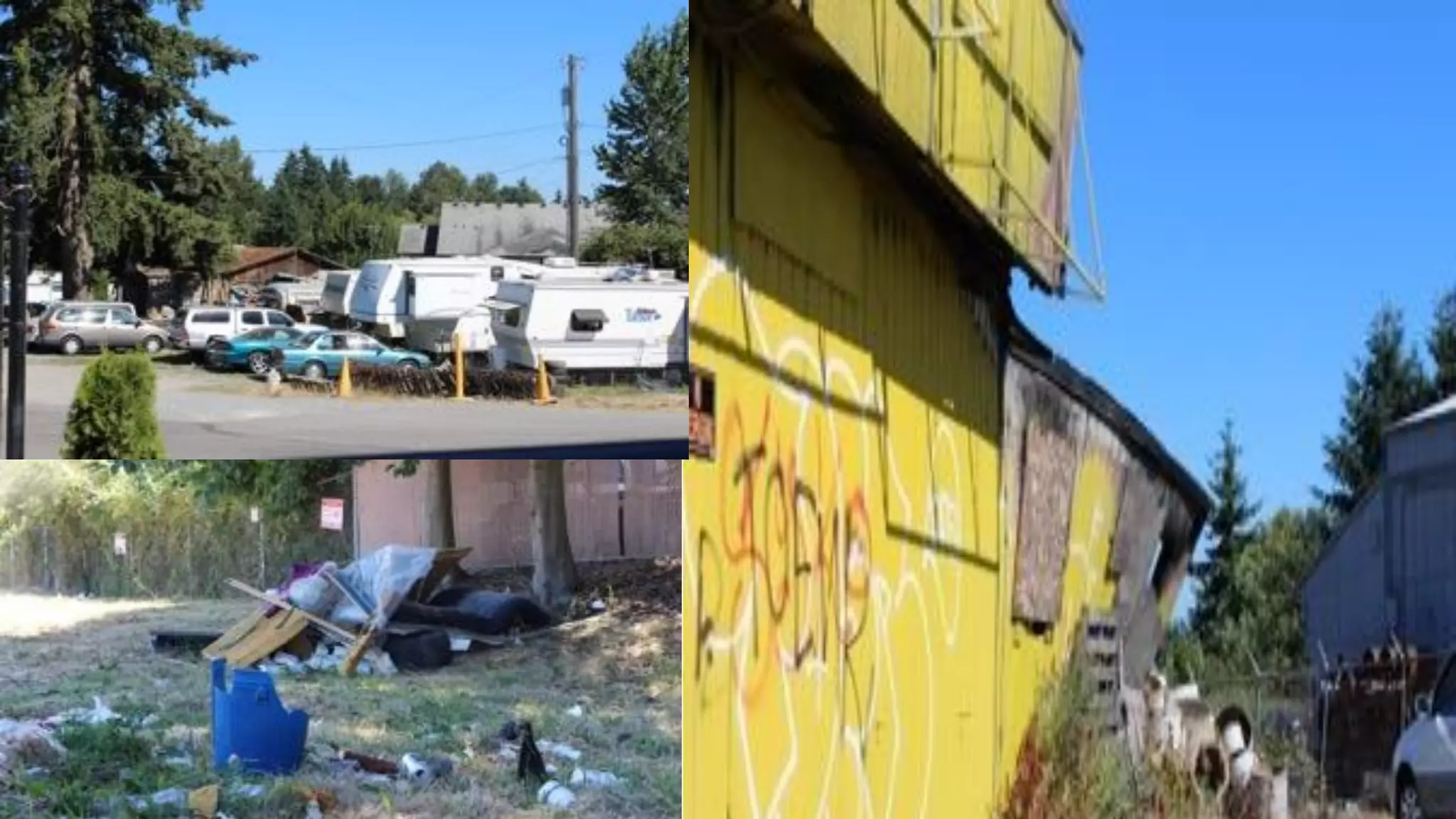
• Additional Efforts: *”Picture Health” -community photo contest *Interviews
*Quantitative surveys *Synthesis of existing data
• Intent is to let people discuss these issues from their vantage points
• Hear voices often excluded
• Deepen our understanding of health through the eyes of residents
• Ground models of understanding in here and now
• Determine ways in which to address gaps and leverage community resources
Amplifying Community Voice to Achieve
Health & Well-Being in Snohomish County:
Health Equity in Snohomish County
Victoria Breckwich Vásquez, DrPH, MPH, MA
Assistant Professor/Director, Community Engagement & Education
University of Washington Bothell/ Seattle
vbreck@uw.edu
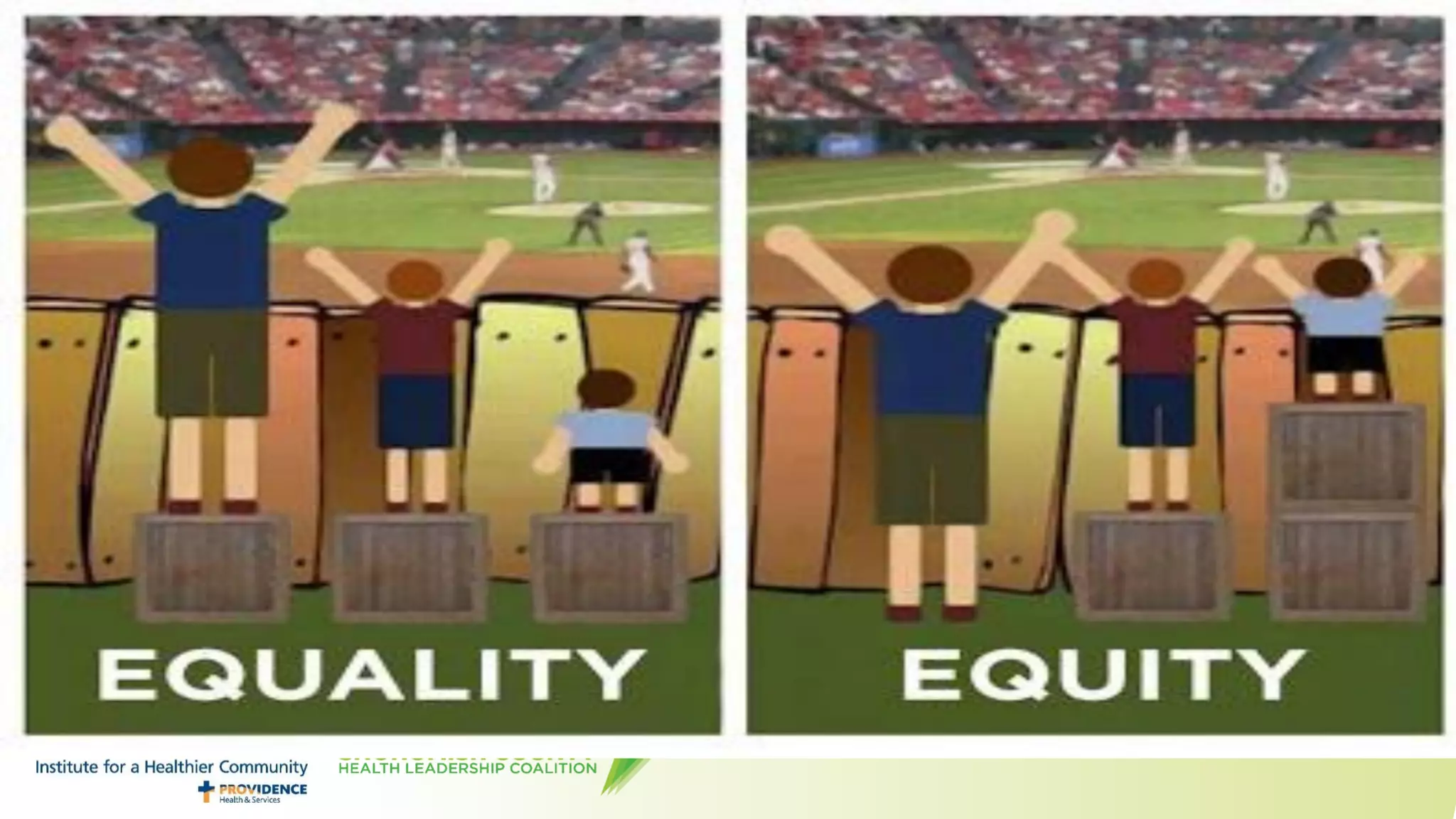
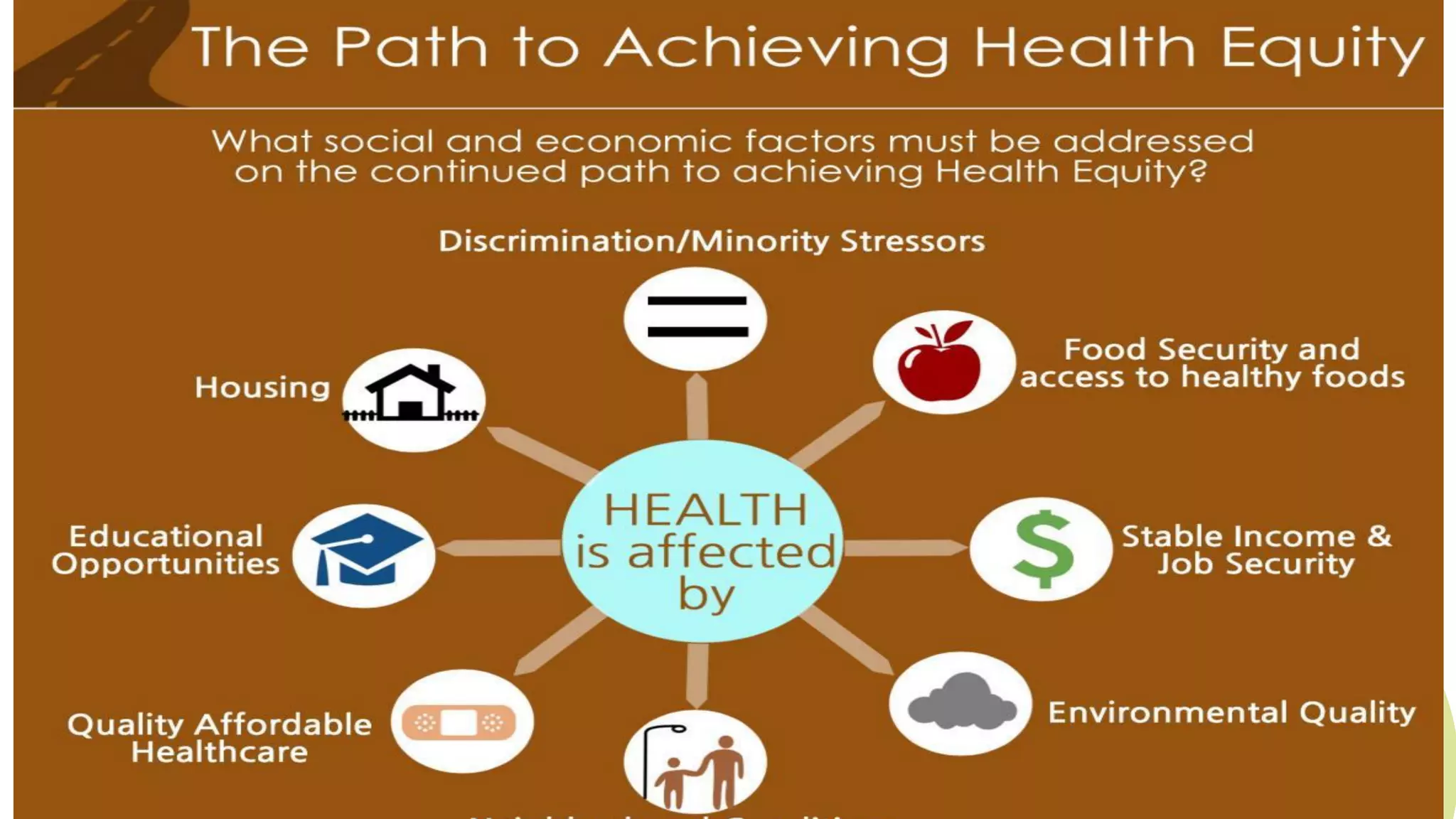
How does EQUITY
affect HEALTH?
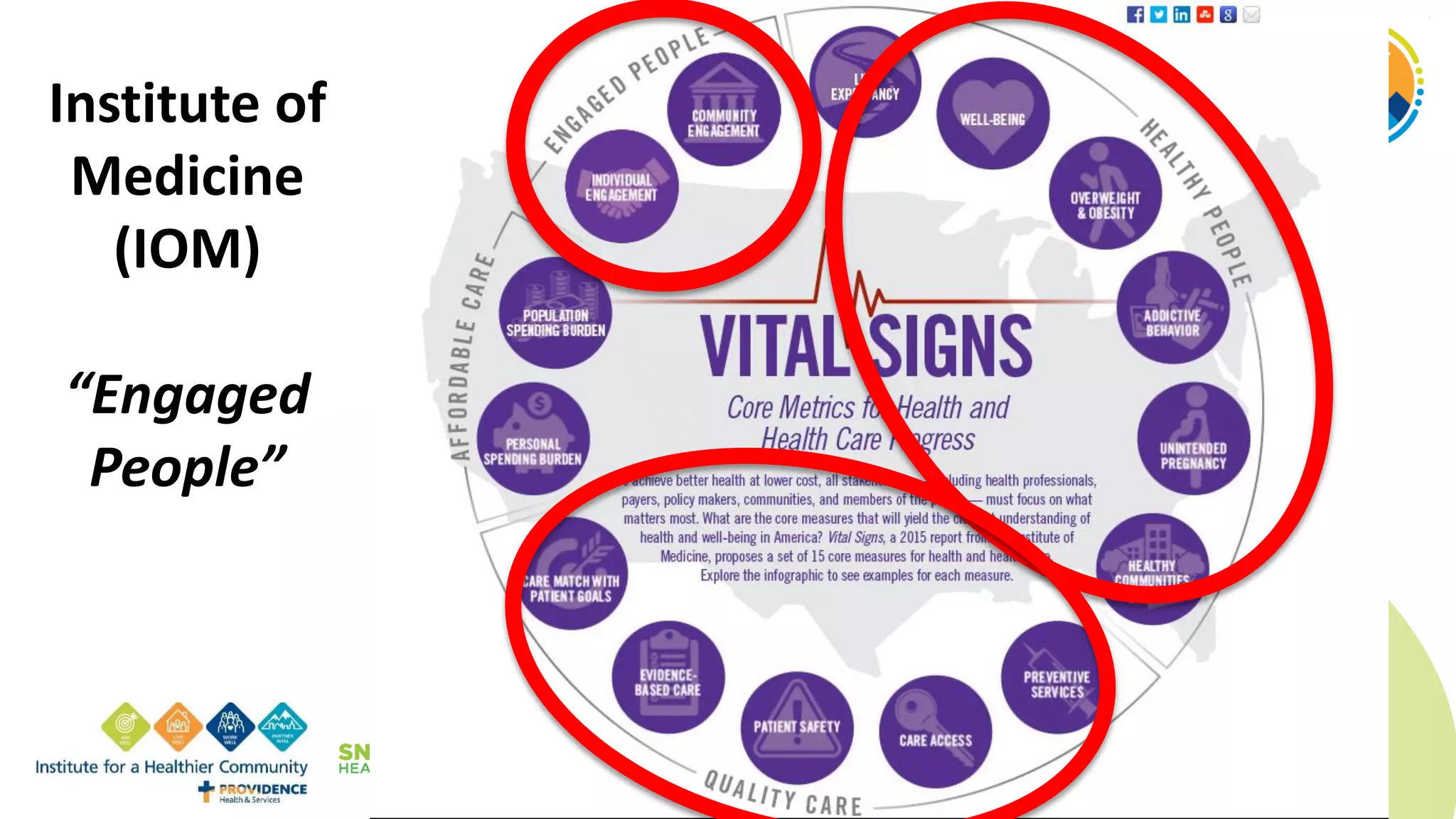
Institute of
Medicine
(IOM)
“Engaged
People”
Using an Asset-Based Approach
to Community Transformation
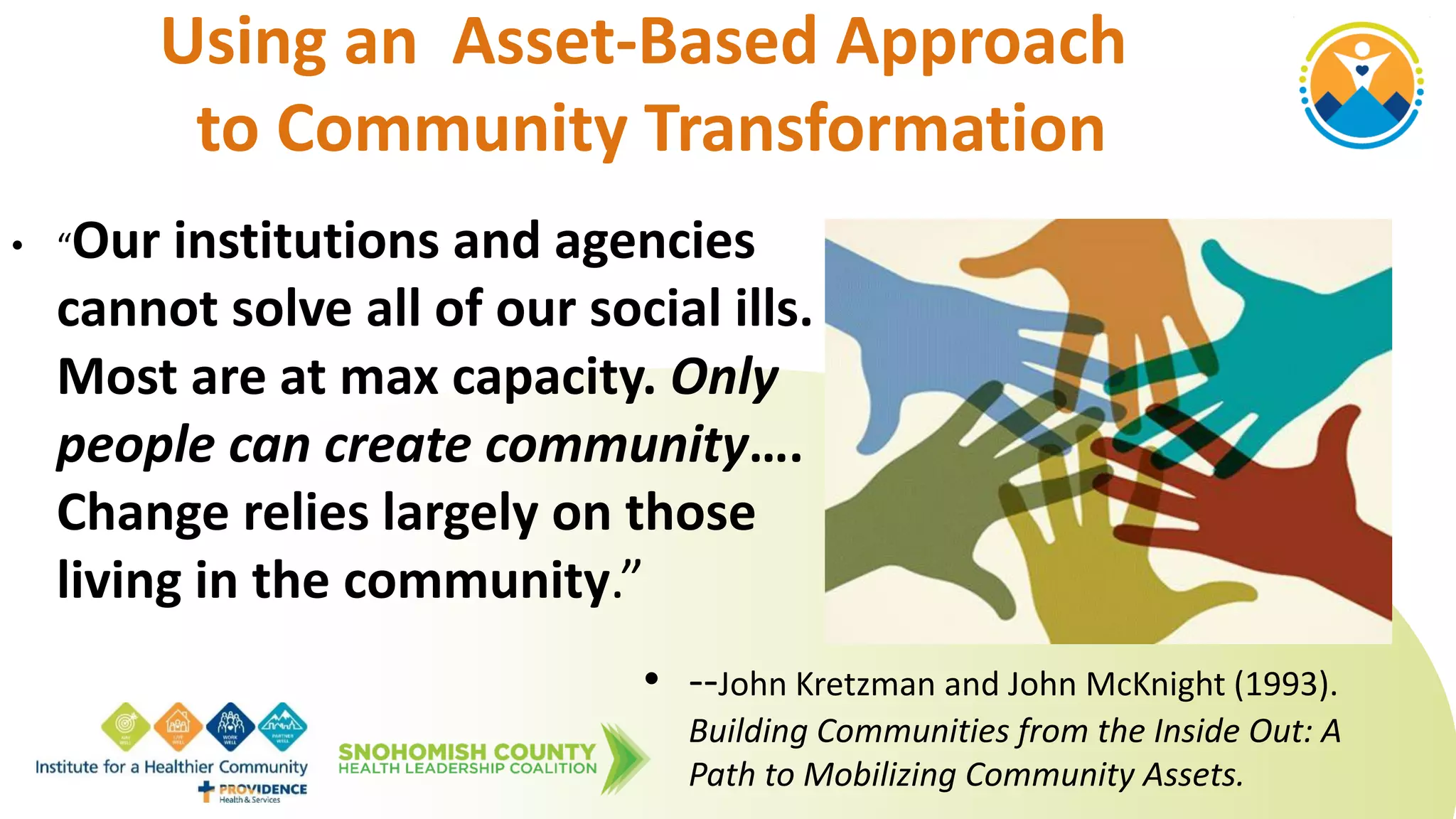
• “Our institutions and agencies
cannot solve all of our social ills.
Most are at max capacity. Only
people can create community….
Change relies largely on those
living in the community.”
• --John Kretzman and John McKnight (1993).
Building Communities from the Inside Out: A
Path to Mobilizing Community Assets.
ABCD Approach to
Healthy Community Building
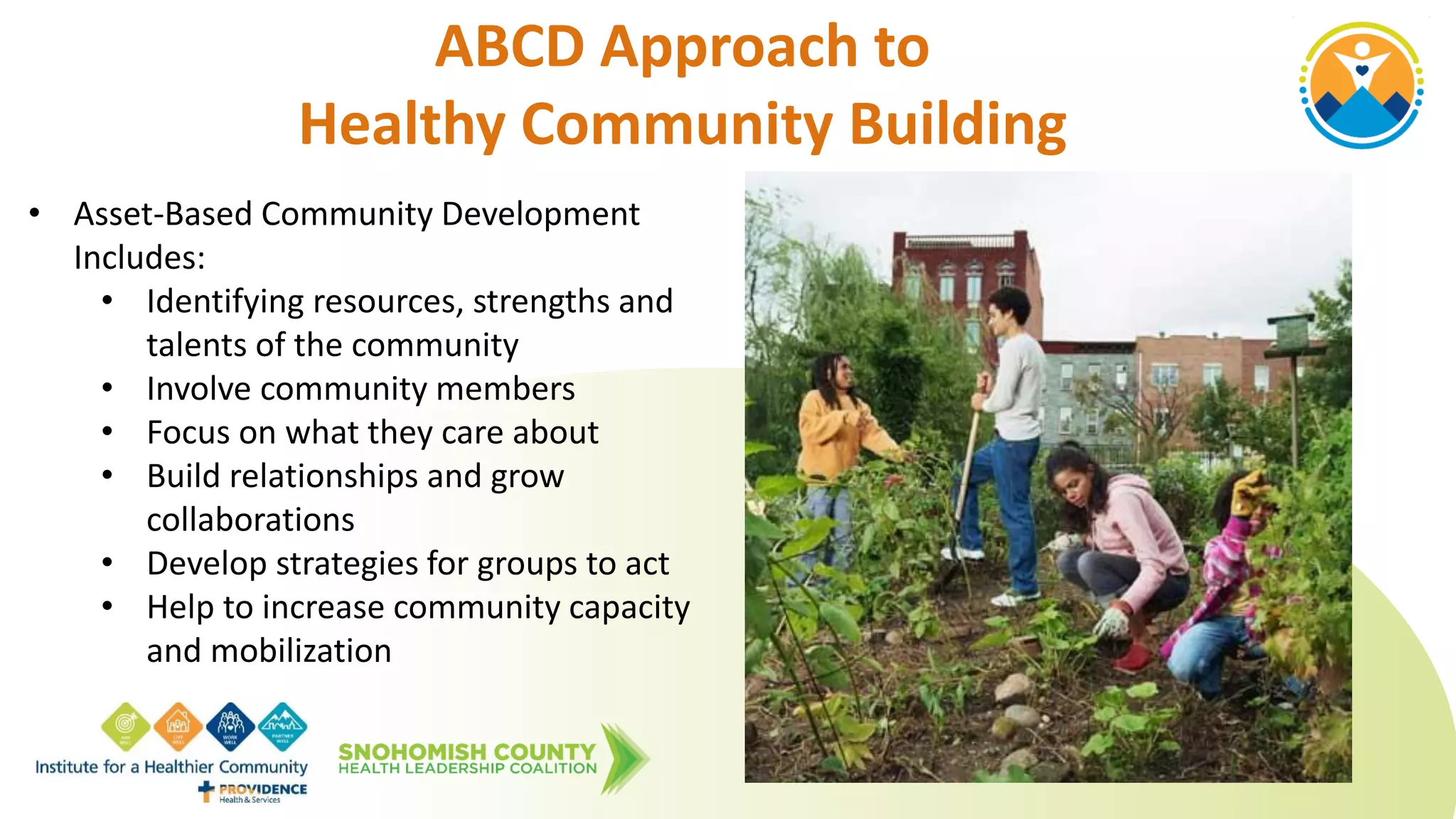
• Asset-Based Community Development
Includes:
• Identifying resources, strengths and
talents of the community
• Involve community members
• Focus on what they care about
• Build relationships and grow
collaborations
• Develop strategies for groups to act
• Help to increase community capacity
and mobilization
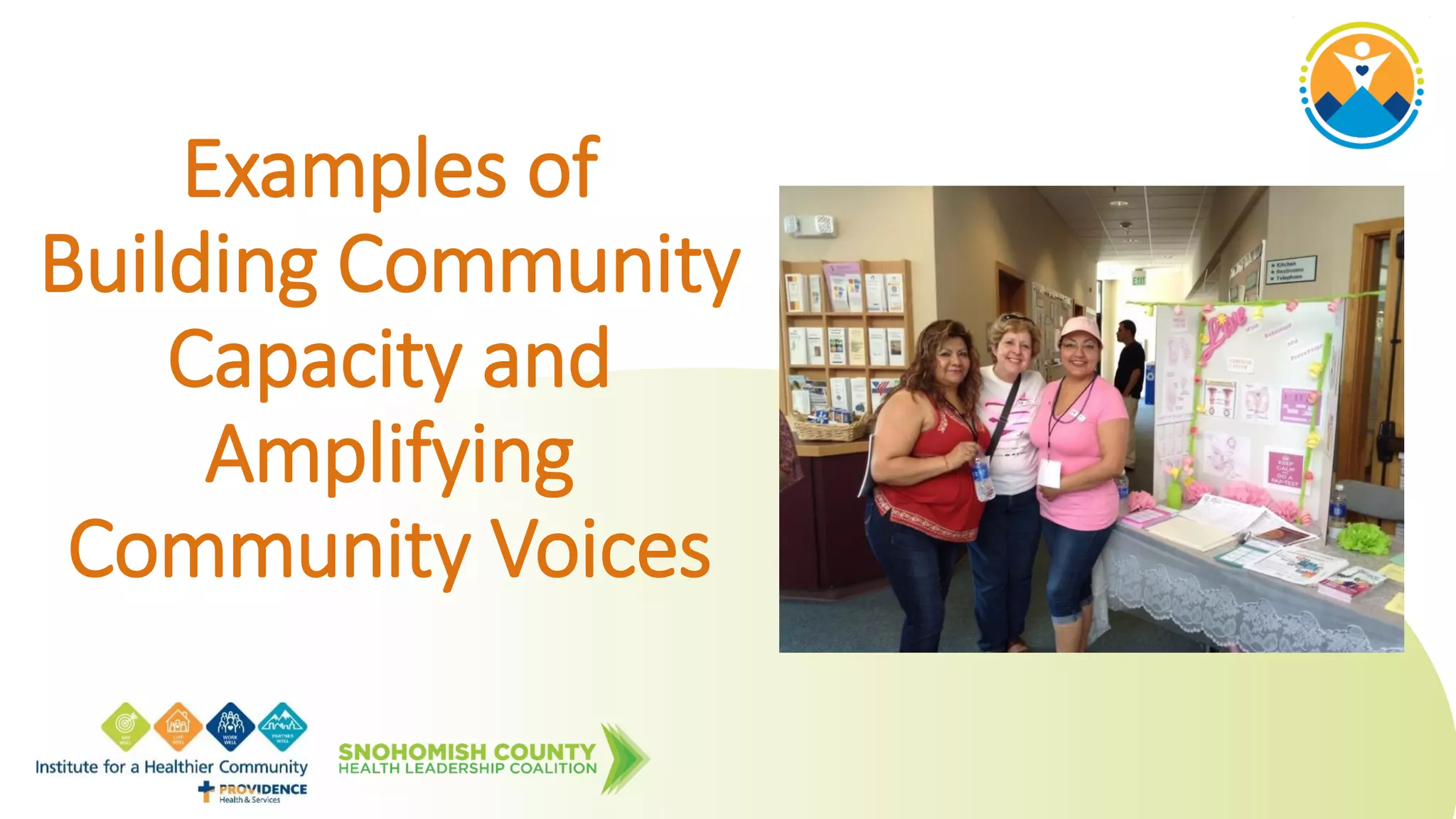
Examples of
Building Community
Capacity and
Amplifying
Community Voices
Presented by Sophia Beltrán, Family Support
Program Manager, Everett & South Snohomish
”I’m going to
introduce you to..”
Malcolm Gladwell explains:
Connectors are people who
link us up with the world.
People with a special gift for
bringing the world together.
Social capital works through multiple channels:
Information flows (e.g. learning about jobs, learning about candidates
running for office, exchanging ideas at college, etc.) depend on social
capital.
Norms of reciprocity (mutual aid) rely on social networks. Bonding
networks that connect folks who are similar sustain particularized (in-
group) reciprocity. Bridging networks that connect individuals who are
diverse sustain generalized reciprocity.
Collective action depends upon social networks (e.g., the role that the
black church played in the Civil Rights movement), although collective
action also can foster new networks.
Broader identities and solidarity are encouraged by social networks that
help translate an "I" mentality into a "we" mentality.
http://www.escapefromcubiclenation.com/2010/08/23/connectors-mavens-and-salesmen-the-secret-to-your-success/
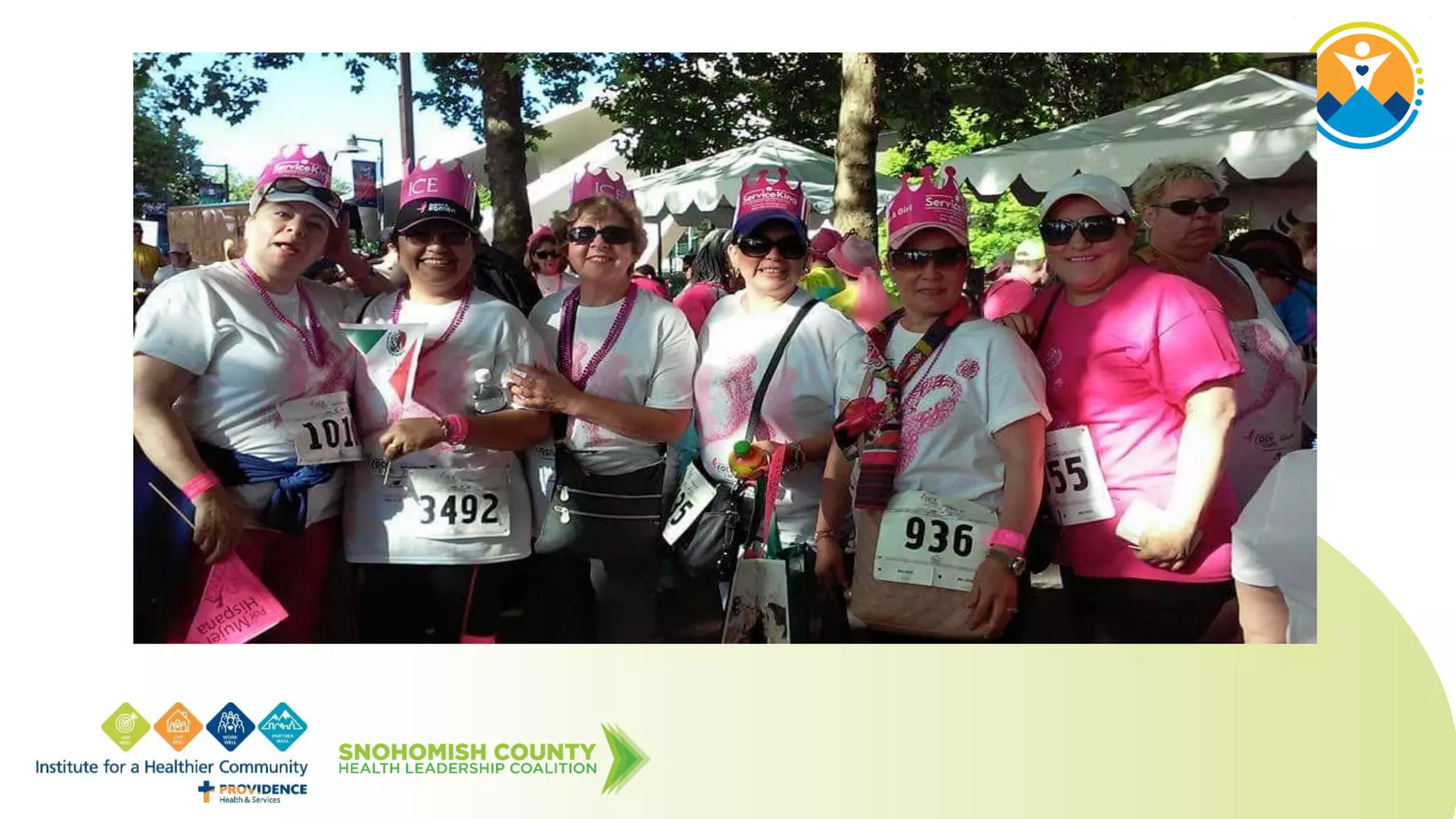
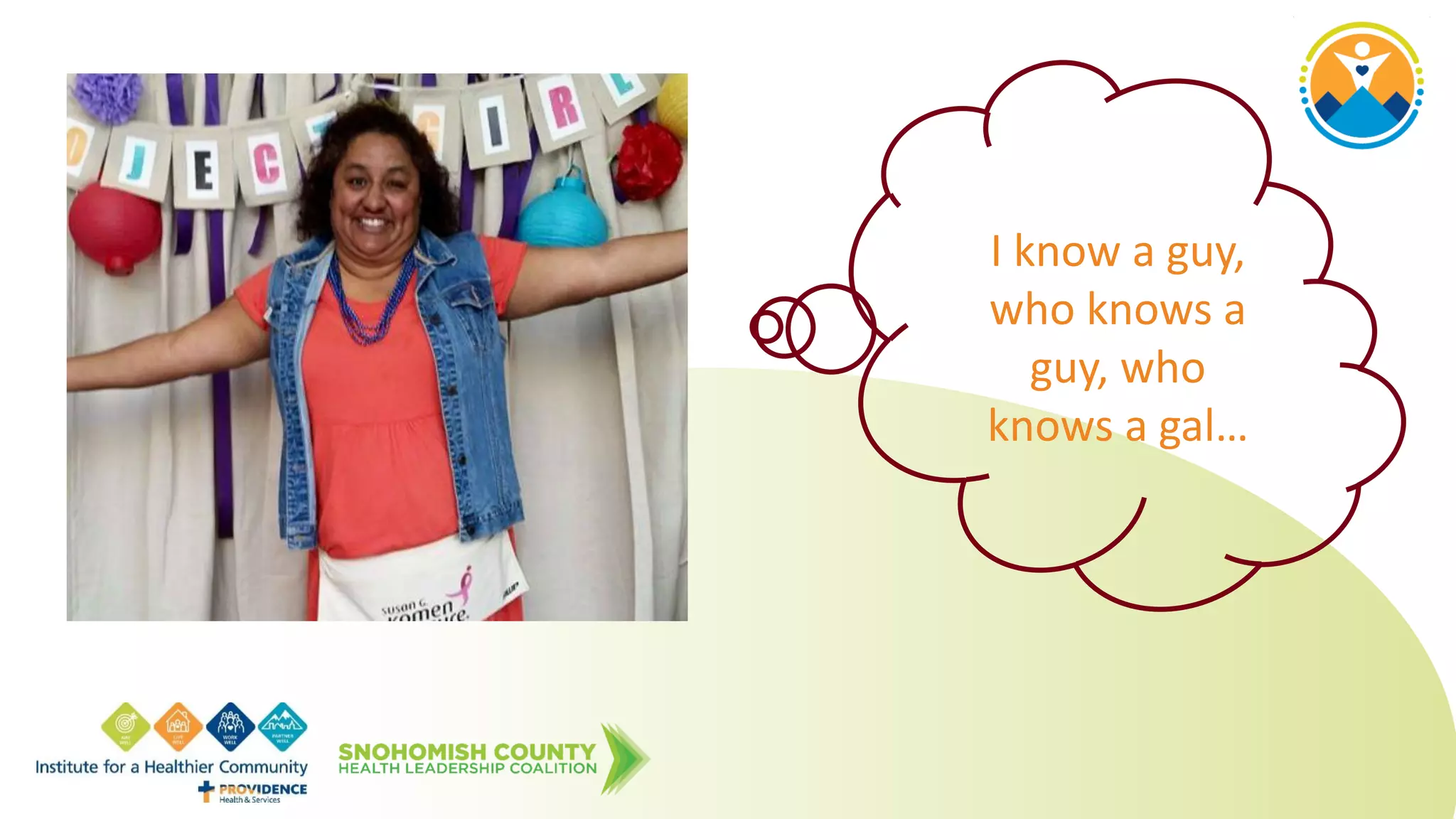
I know a guy,
who knows a
guy, who
knows a gal…
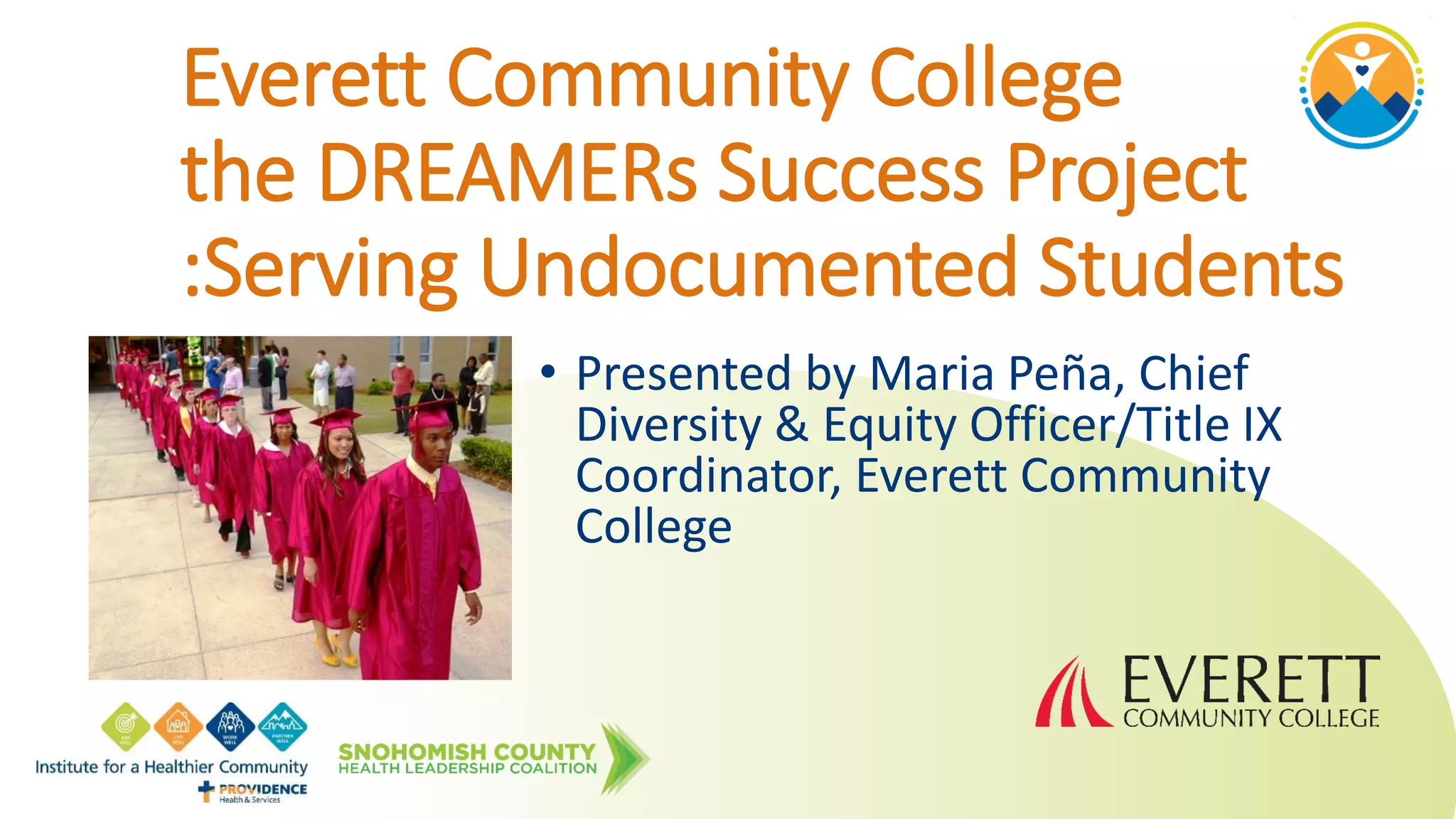
Everett Community College
the DREAMERs Success Project
:Serving Undocumented Students
• Presented by Maria Peña, Chief
Diversity & Equity Officer/Title IX
Coordinator, Everett Community
College
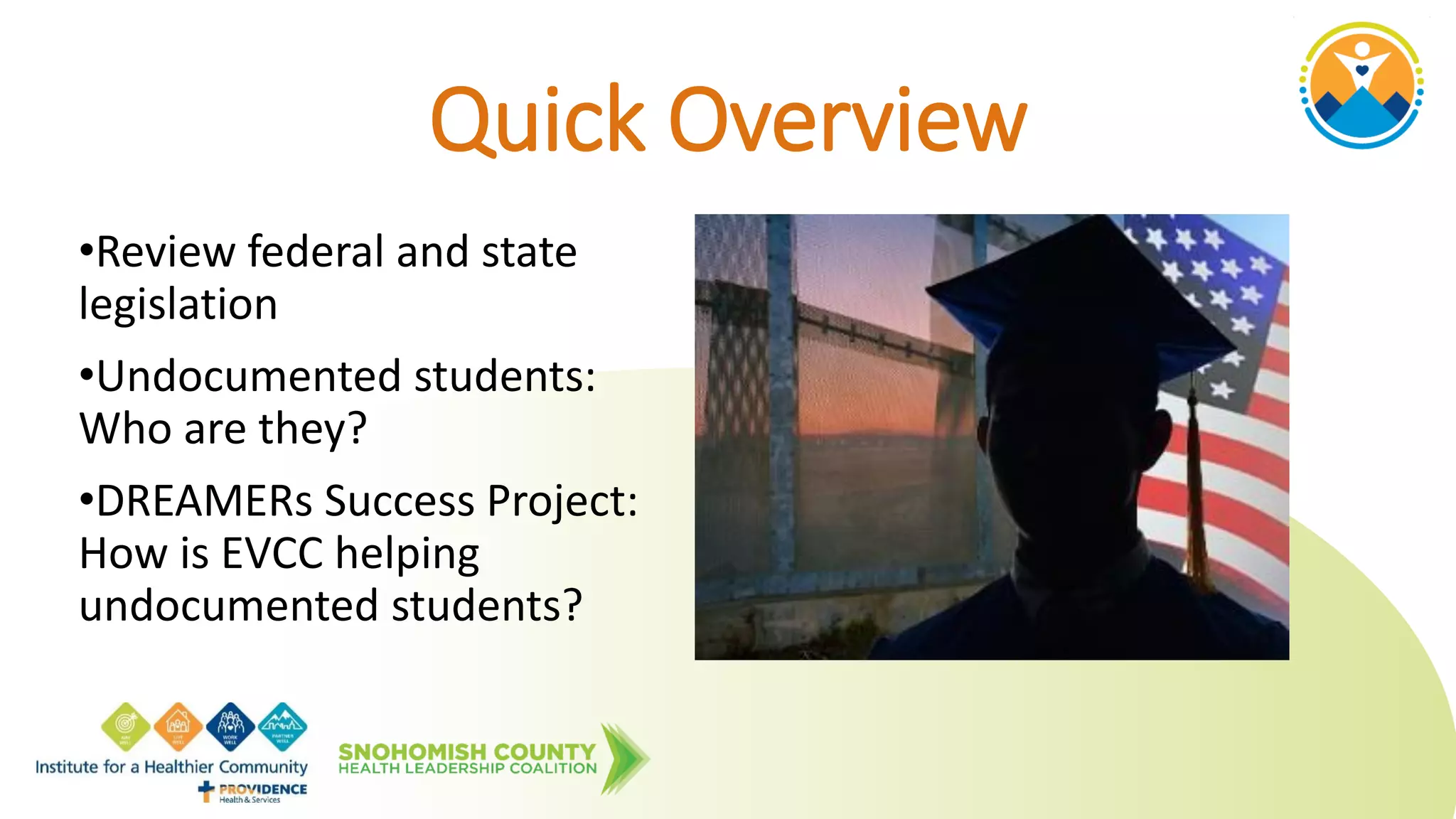
Quick Overview
•Review federal and state
legislation
•Undocumented students:
Who are they?
•DREAMERs Success Project:
How is EVCC helping
undocumented students?
Federal Policy:
Undocumented Students
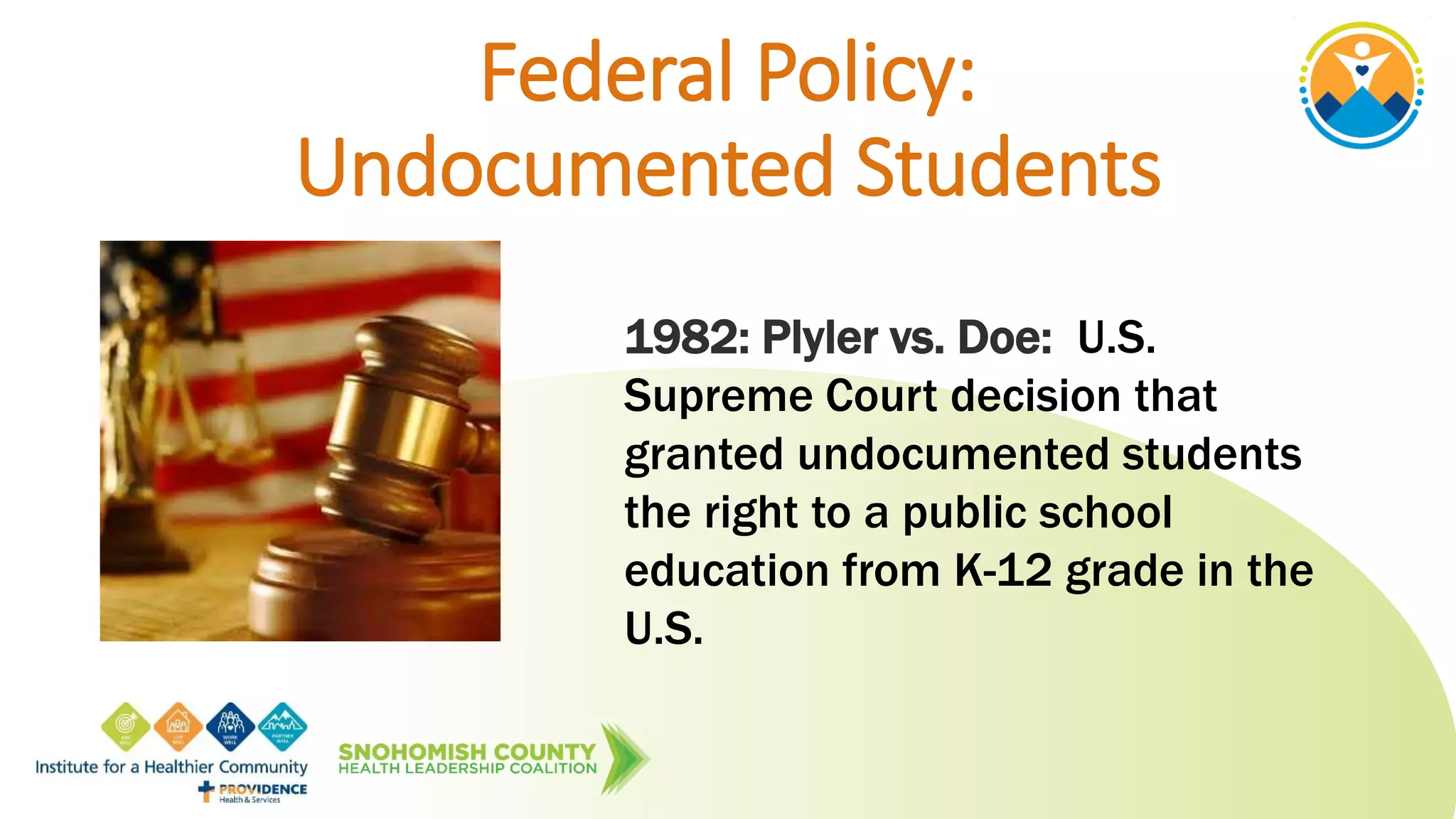
1982: Plyler vs. Doe: U.S.
Supreme Court decision that
granted undocumented students
the right to a public school
education from K-12 grade in the
U.S.
Federal Initiatives
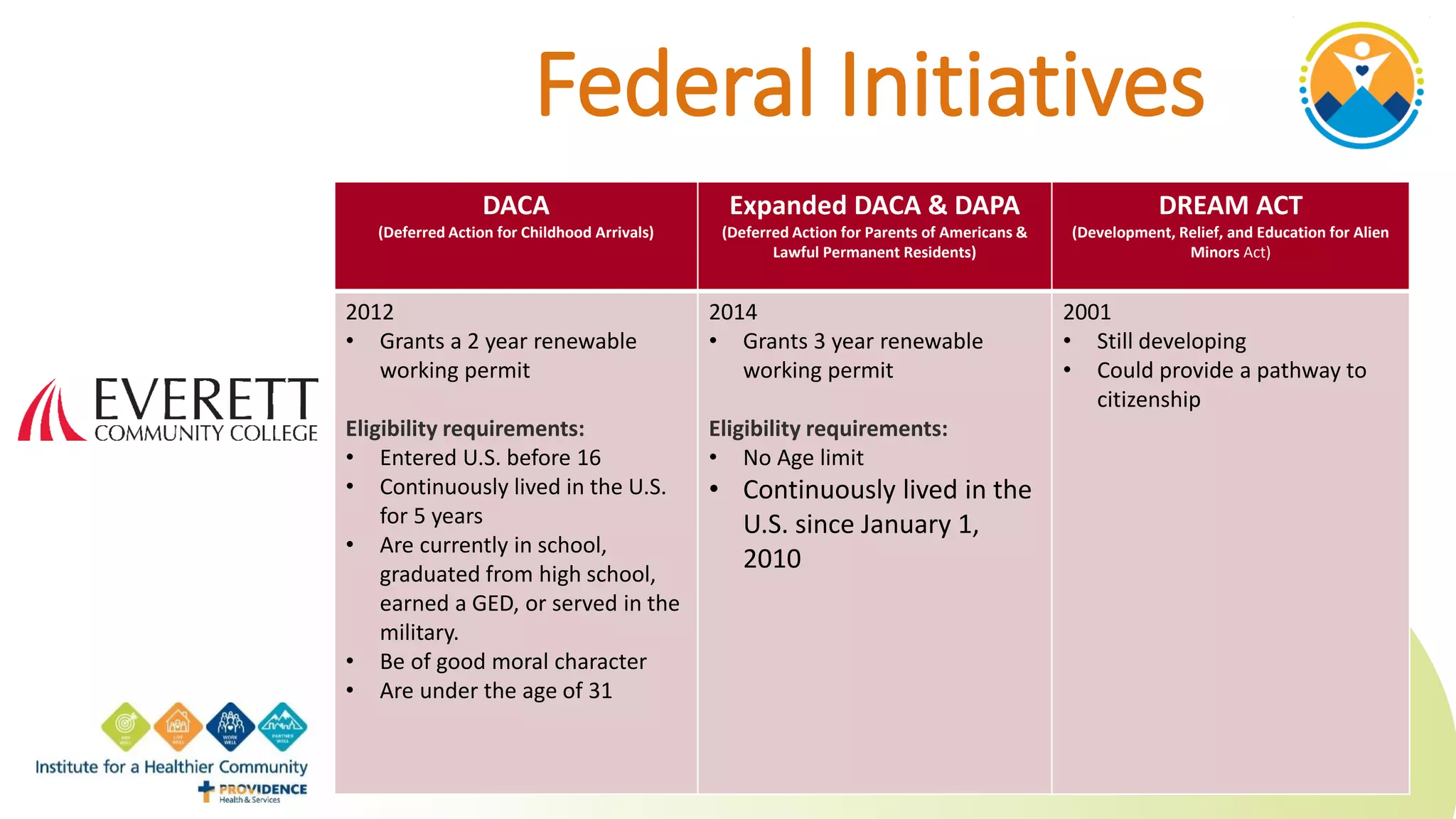
DACA
(Deferred Action for Childhood Arrivals)
Expanded DACA & DAPA
(Deferred Action for Parents of Americans &
Lawful Permanent Residents)
DREAM ACT
(Development, Relief, and Education for Alien
Minors Act)
2012
• Grants a 2 year renewable
working permit
Eligibility requirements:
• Entered U.S. before 16
• Continuously lived in the U.S.
for 5 years
• Are currently in school,
graduated from high school,
earned a GED, or served in the
military.
• Be of good moral character
• Are under the age of 31
2014
• Grants 3 year renewable
working permit
Eligibility requirements:
• No Age limit
• Continuously lived in the
U.S. since January 1,
2010
2001
• Still developing
• Could provide a pathway to
citizenship
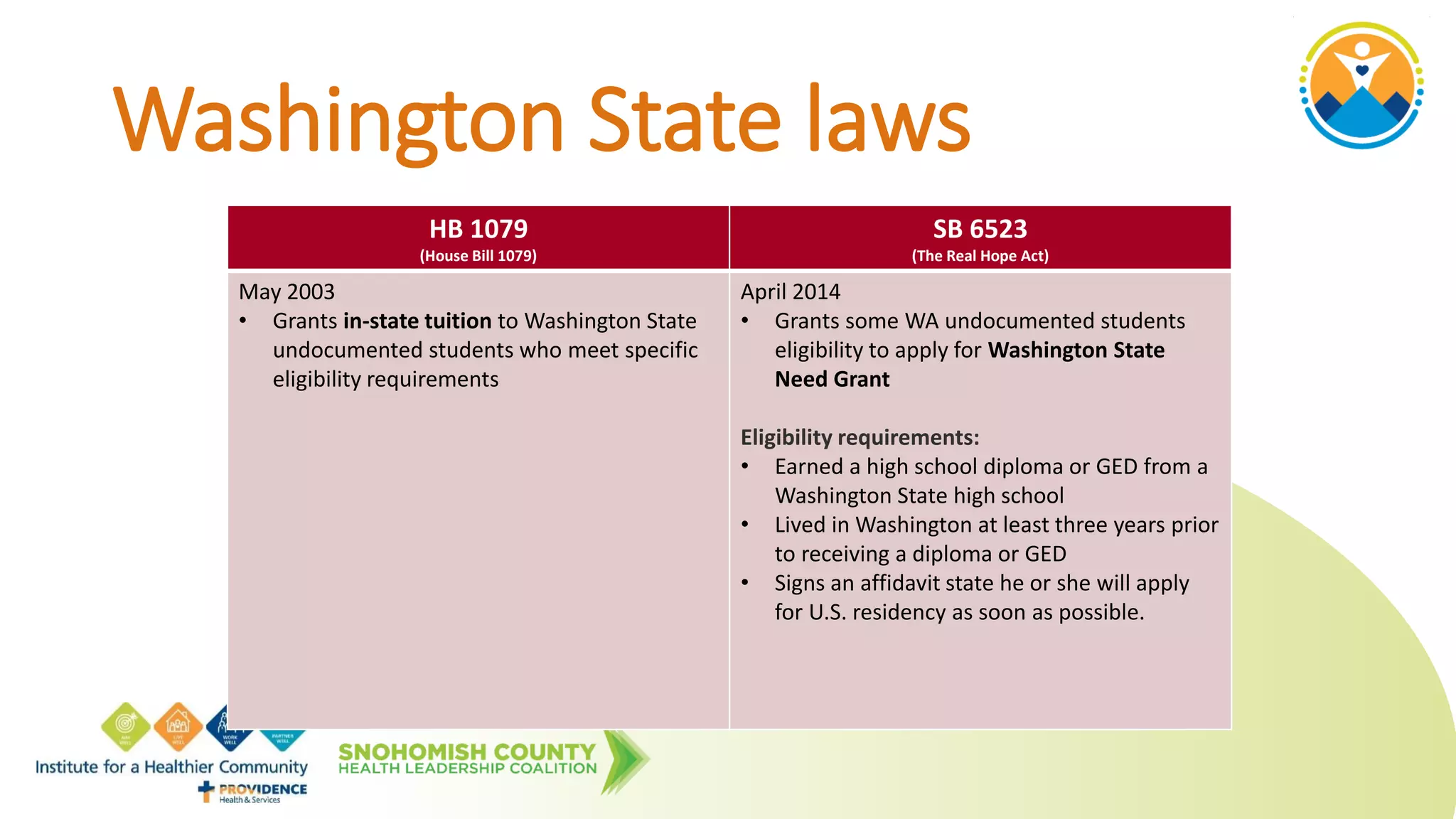
HB 1079
(House Bill 1079)
SB 6523
(The Real Hope Act)
May 2003
• Grants in-state tuition to Washington State
undocumented students who meet specific
eligibility requirements
April 2014
• Grants some WA undocumented students
eligibility to apply for Washington State
Need Grant
Eligibility requirements:
• Earned a high school diploma or GED from a
Washington State high school
• Lived in Washington at least three years prior
to receiving a diploma or GED
• Signs an affidavit state he or she will apply
for U.S. residency as soon as possible.
Washington State laws
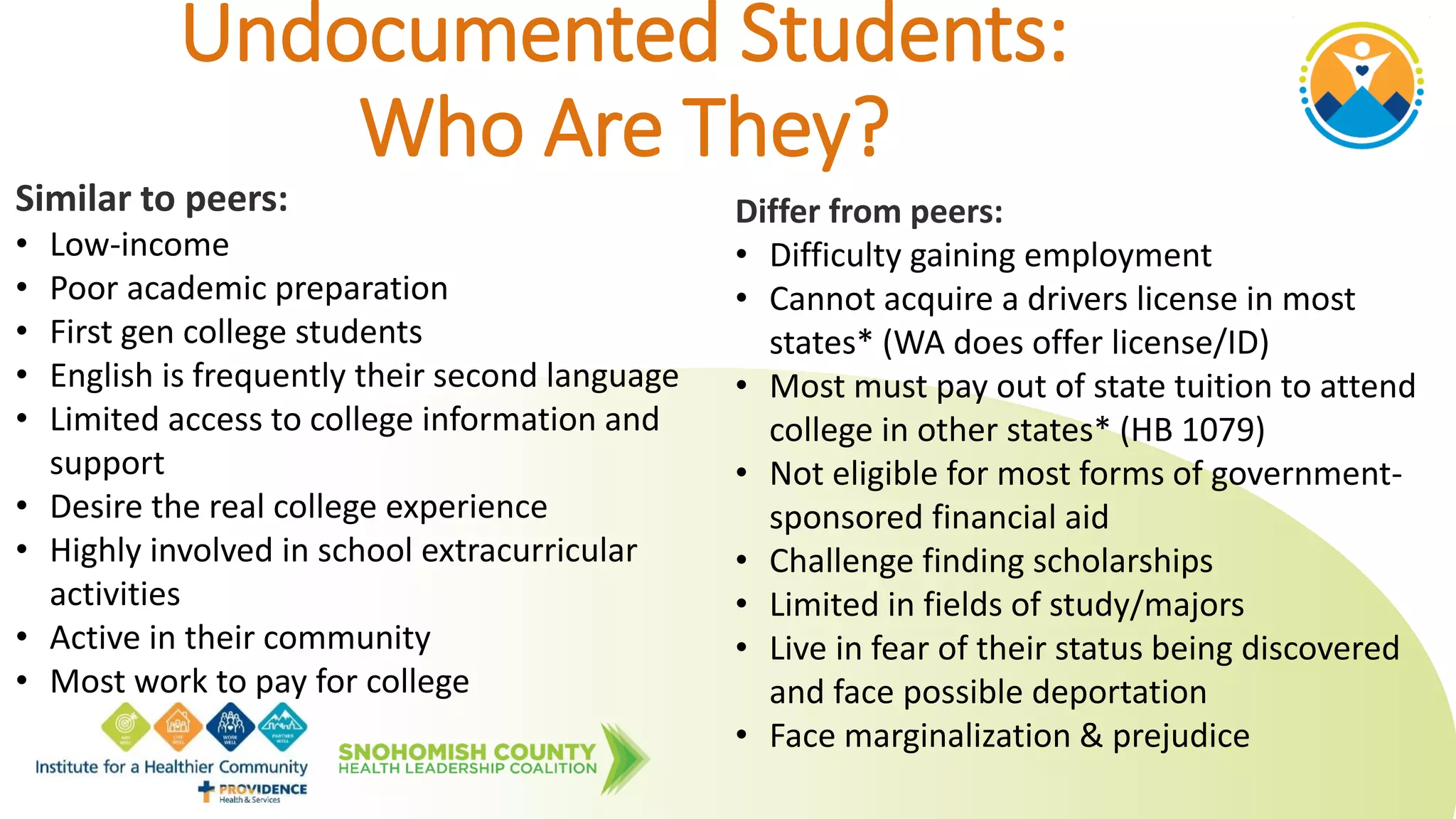
Undocumented Students:
Who Are They?
Similar to peers:
• Low-income
• Poor academic preparation
• First gen college students
• English is frequently their second language
• Limited access to college information and
support
• Desire the real college experience
• Highly involved in school extracurricular
activities
• Active in their community
• Most work to pay for college
Differ from peers:
• Difficulty gaining employment
• Cannot acquire a drivers license in most
states* (WA does offer license/ID)
• Most must pay out of state tuition to attend
college in other states* (HB 1079)
• Not eligible for most forms of government-
sponsored financial aid
• Challenge finding scholarships
• Limited in fields of study/majors
• Live in fear of their status being discovered
and face possible deportation
• Face marginalization & prejudice
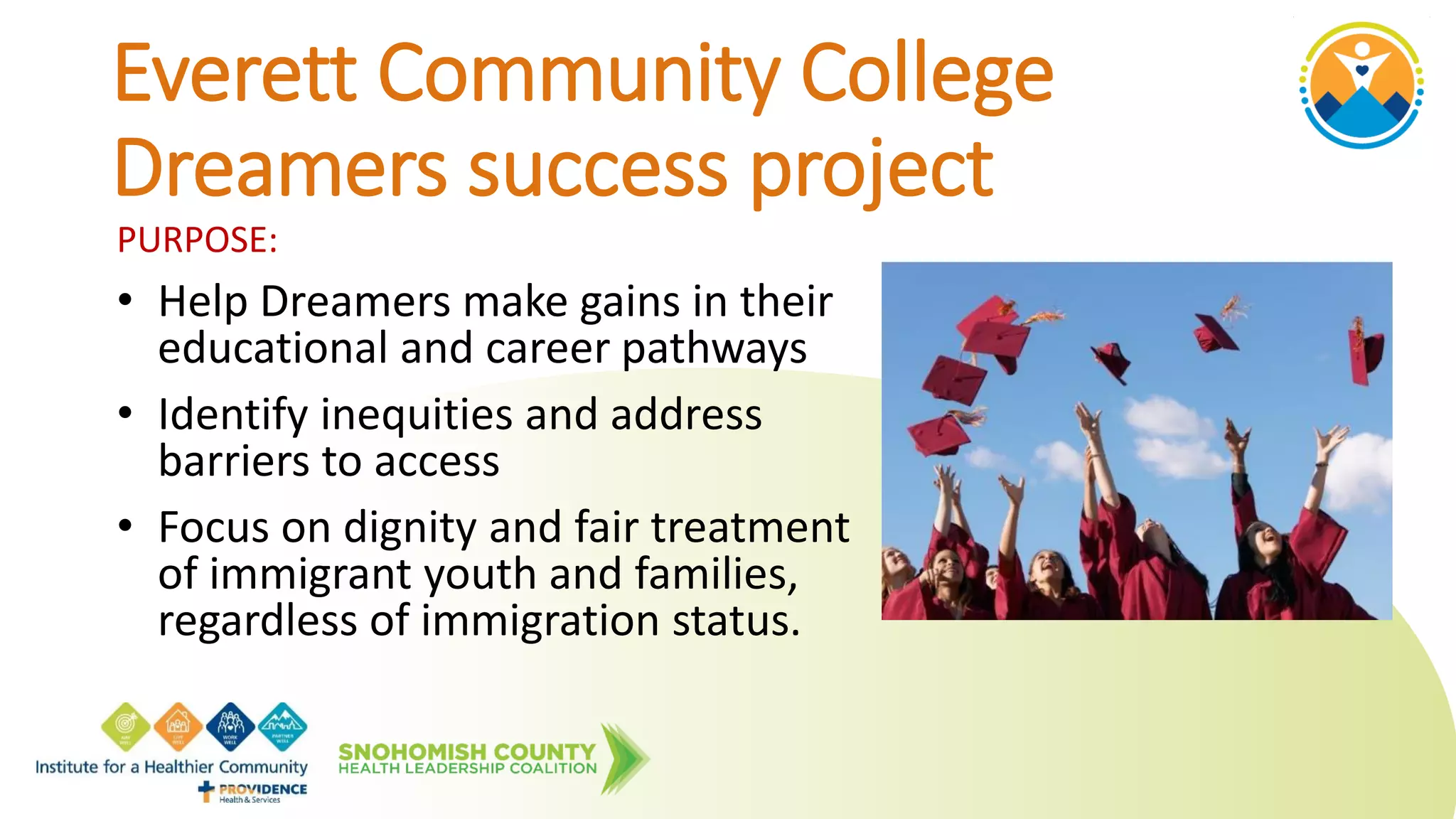
PURPOSE:
• Help Dreamers make gains in their
educational and career pathways
• Identify inequities and address
barriers to access
• Focus on dignity and fair treatment
of immigrant youth and families,
regardless of immigration status.
Everett Community College
Dreamers success project
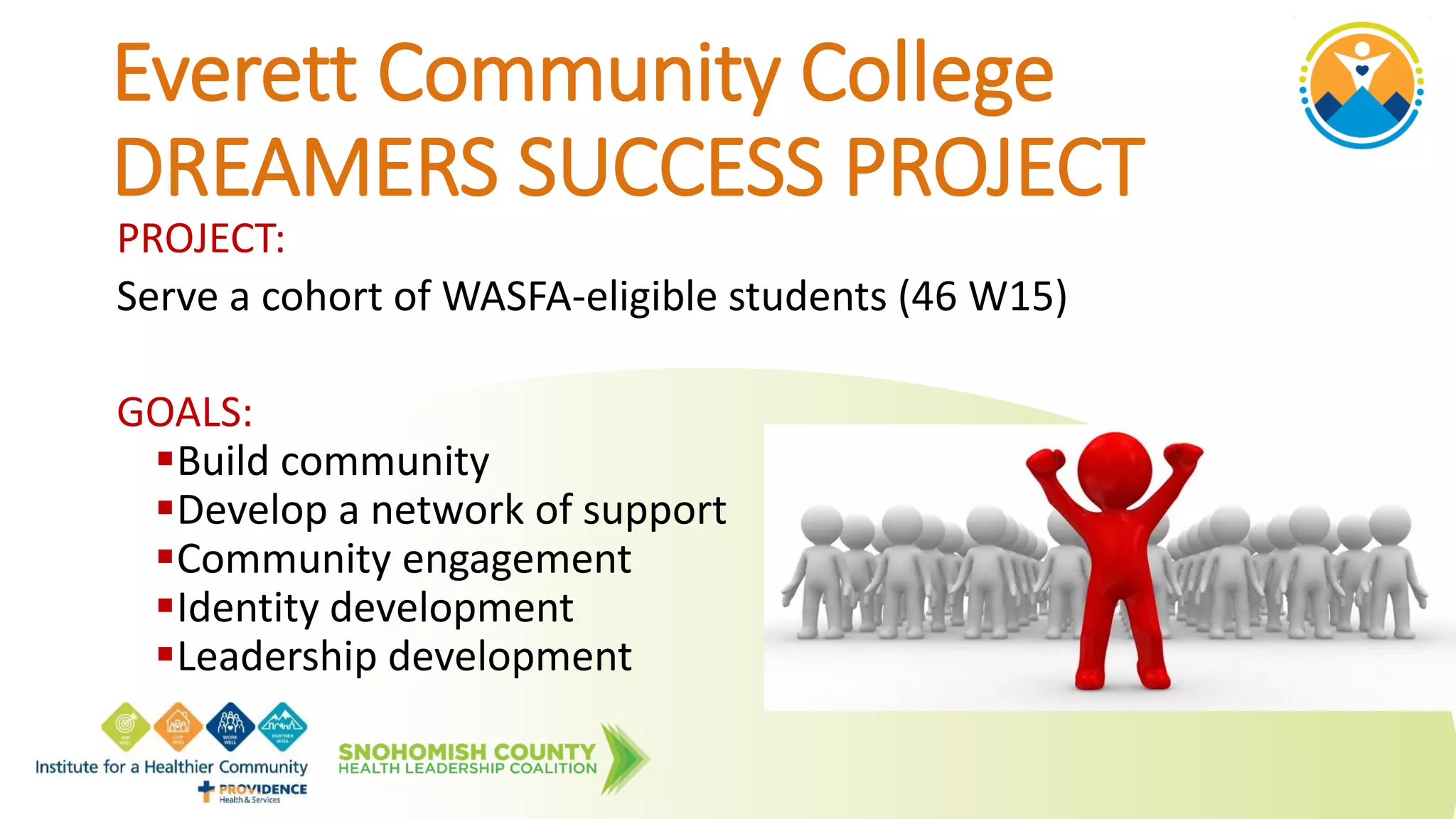
PROJECT:
Serve a cohort of WASFA-eligible students (46 W15)
GOALS:
Build community
Develop a network of support
Community engagement
Identity development
Leadership development
Everett Community College
DREAMERS SUCCESS PROJECT
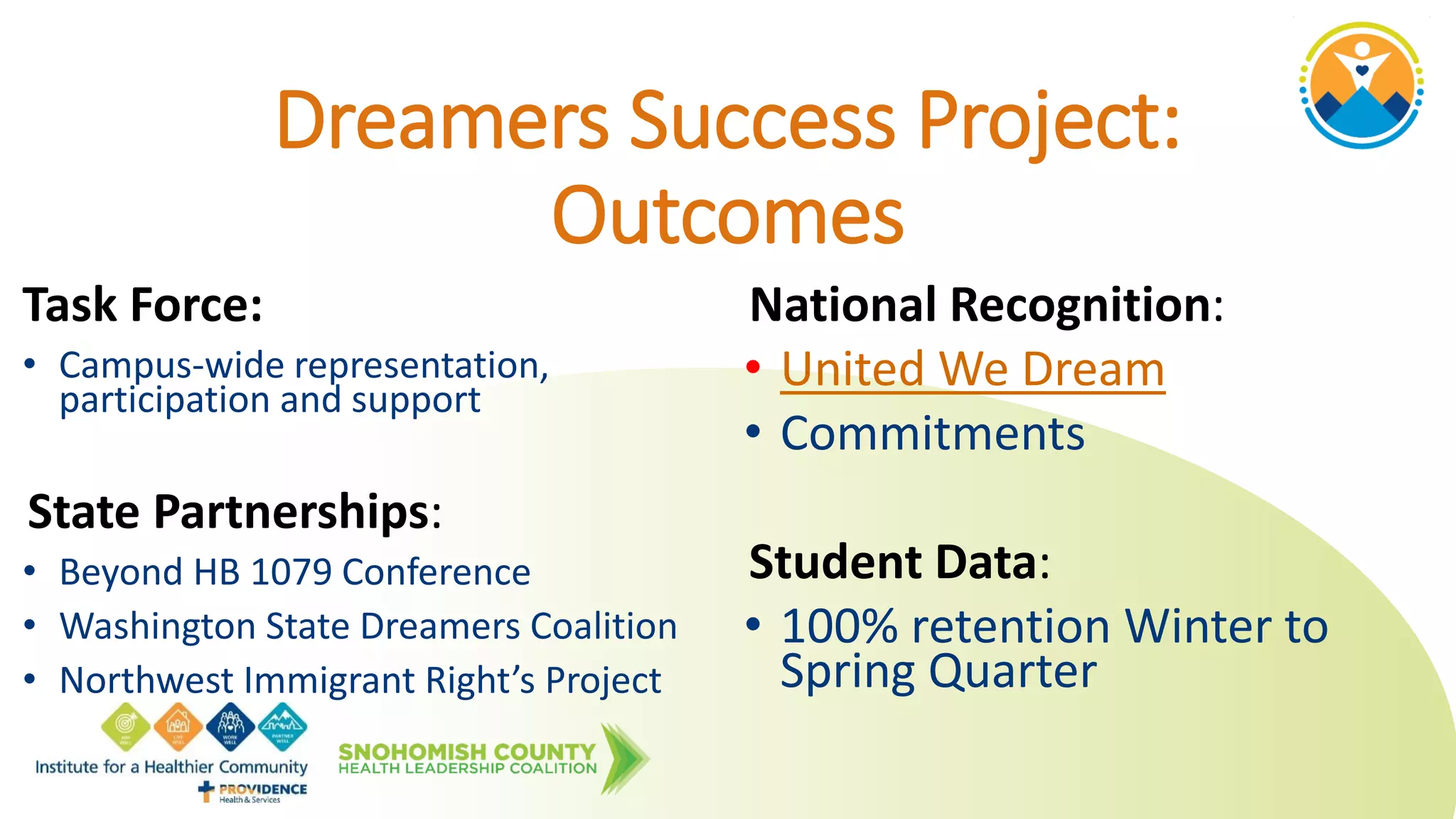
Task Force:
• Campus-wide representation,
participation and support
State Partnerships:
• Beyond HB 1079 Conference
• Washington State Dreamers Coalition
• Northwest Immigrant Right’s Project
National Recognition:
• United We Dream
• Commitments
Student Data:
• 100% retention Winter to
Spring Quarter
Dreamers Success Project:
Outcomes
Presented by:
Diane Douglas, Executive Director
Seattle City Club’s
mission is
to inform, connect and
engage the public
to strengthen the civic
health of our region.
Organizational
Mission
In school,
they don’t tell us
we can
change the world.
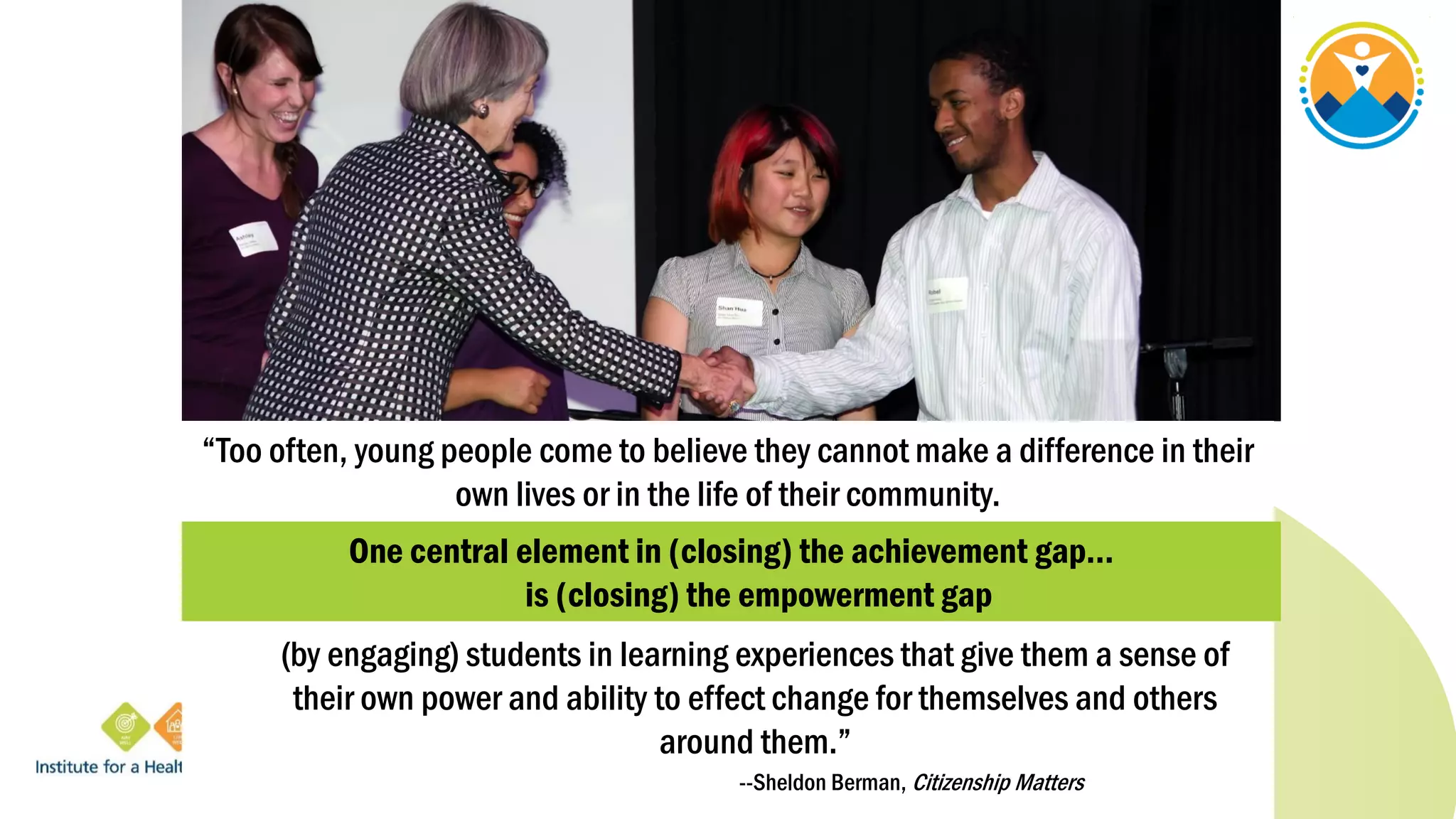
“Too often, young people come to believe they cannot make a difference in their
own lives or in the life of their community.
(by engaging) students in learning experiences that give them a sense of
their own power and ability to effect change for themselves and others
around them.”
--Sheldon Berman, Citizenship Matters
One central element in (closing) the achievement gap…
is (closing) the empowerment gap
Skills Values Attitudes
for
Active Citizenship
Educational attainment is the single most important
predictor
of strong civic agency.
Make education our most important
civic health investment.
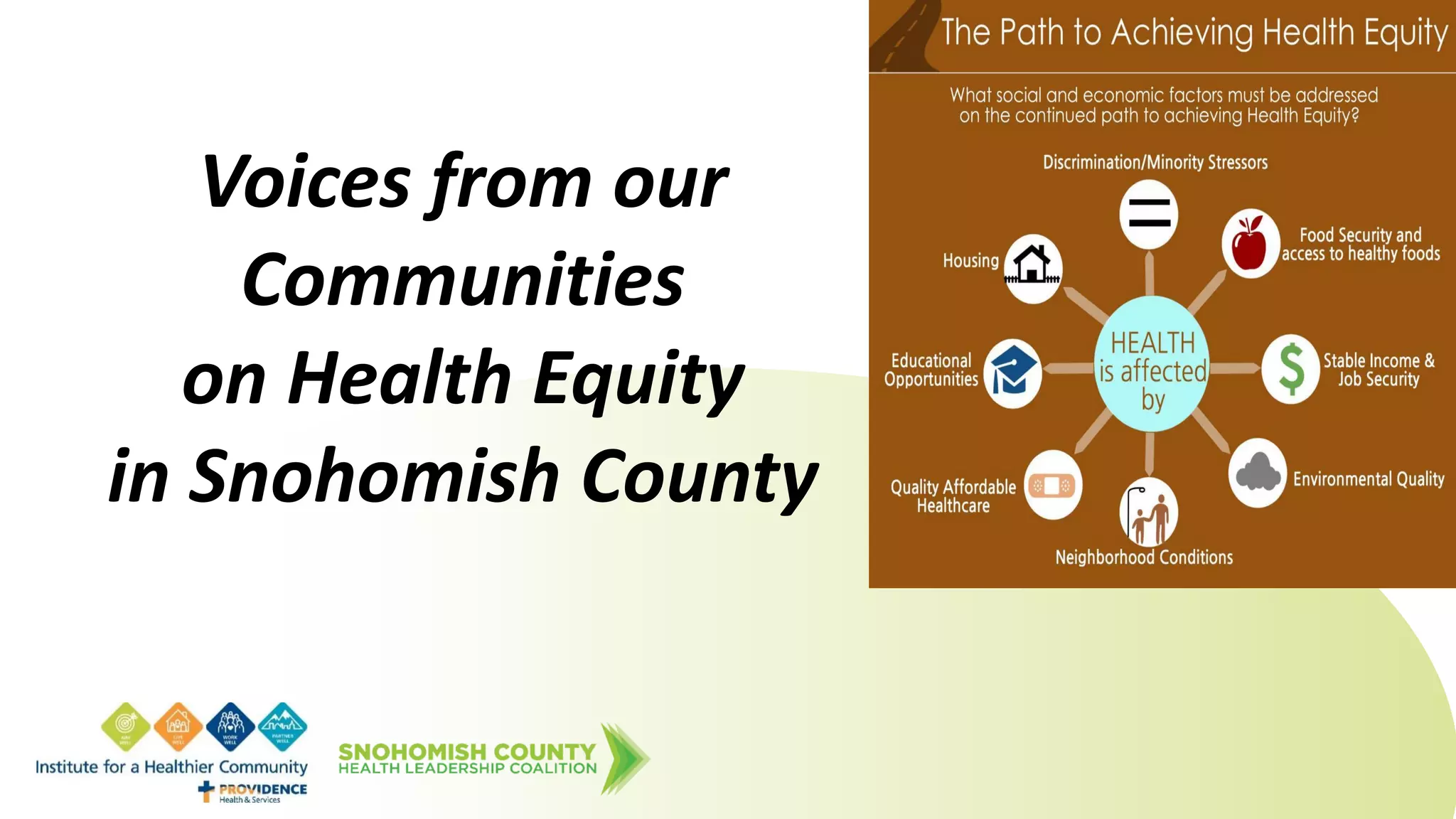
Voices from our
Communities
on Health Equity
in Snohomish County
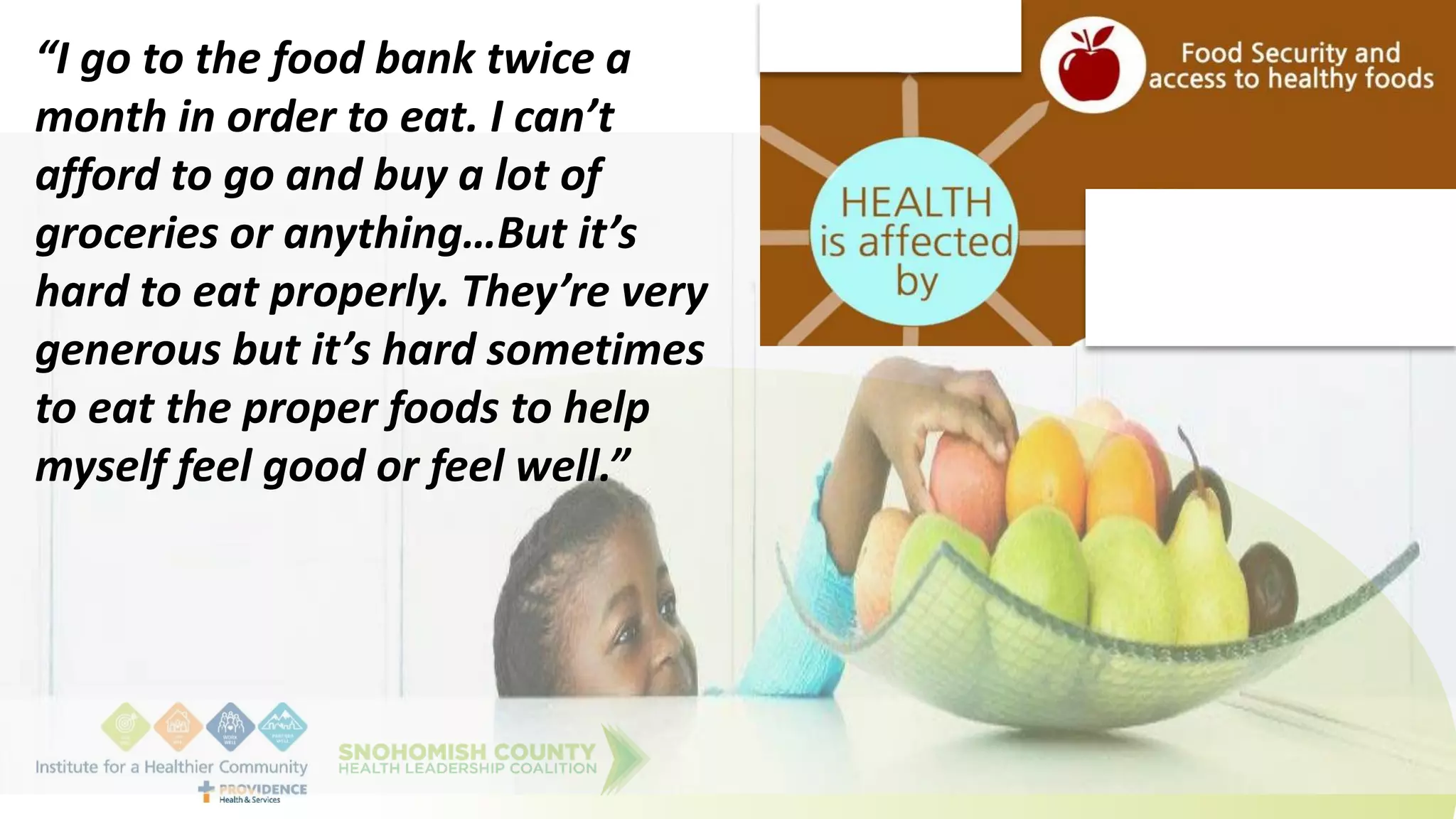
“I go to the food bank twice a
month in order to eat. I can’t
afford to go and buy a lot of
groceries or anything…But it’s
hard to eat properly. They’re very
generous but it’s hard sometimes
to eat the proper foods to help
myself feel good or feel well.”
“…If you have a community
that has a very high
unemployment rate, that’s
an unhealthy environment.
You have a higher crime rate,
and people with lower self-
worth.”
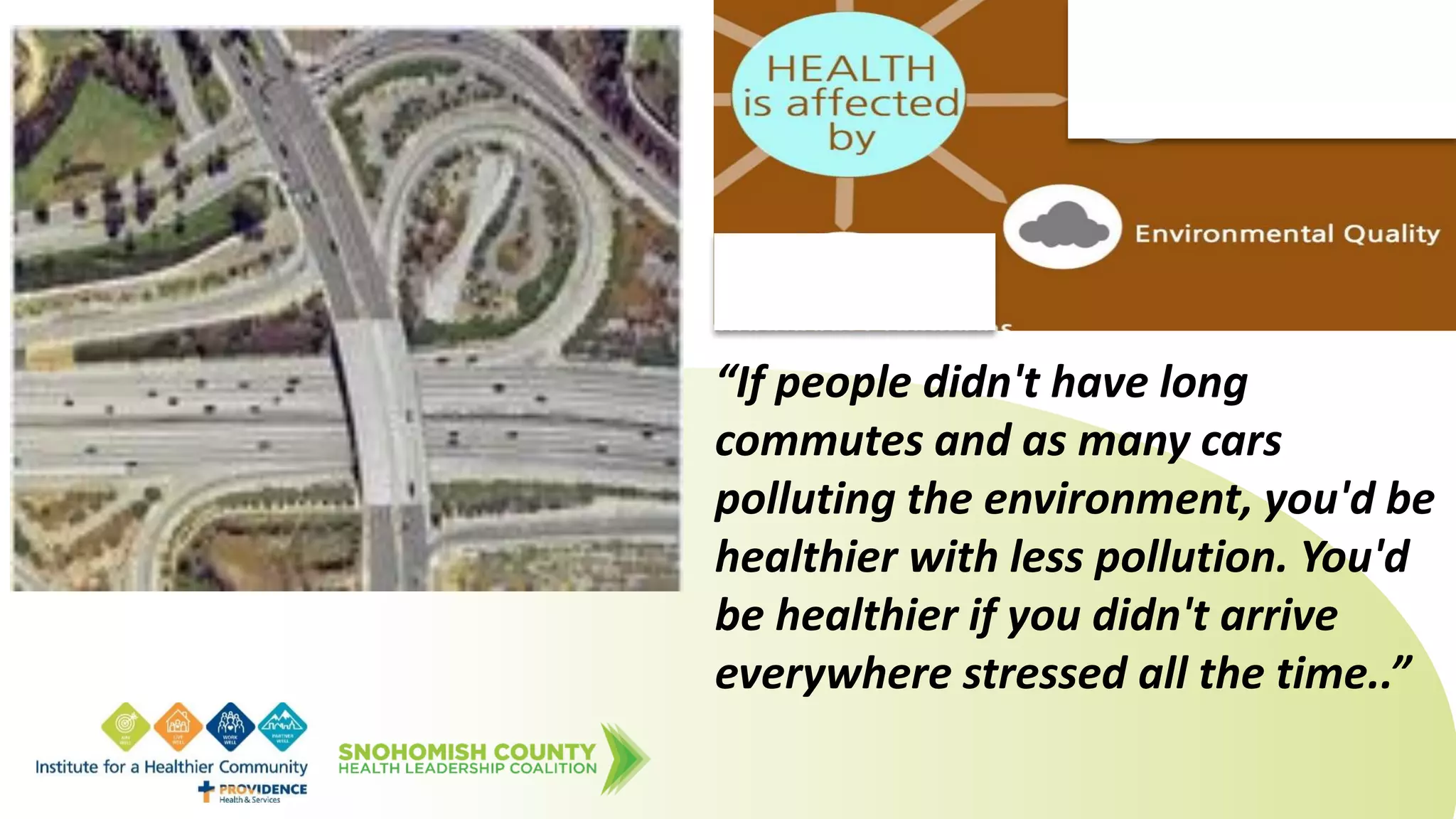
“If people didn't have long
commutes and as many cars
polluting the environment, you'd be
healthier with less pollution. You'd
be healthier if you didn't arrive
everywhere stressed all the time..”
“This county has a severe heroine problem.
4 youth this year alone have died from
heroine overdoses.”
“There are a large number of homeless
with drug and alcohol problems. They are
not getting the help they need.”
“Well, I feel like doctors should
probably be one of our first resorts,
but since they are not as accessible
as we wish they would be, Google,
Facebook [and] friends become our
first resorts...”
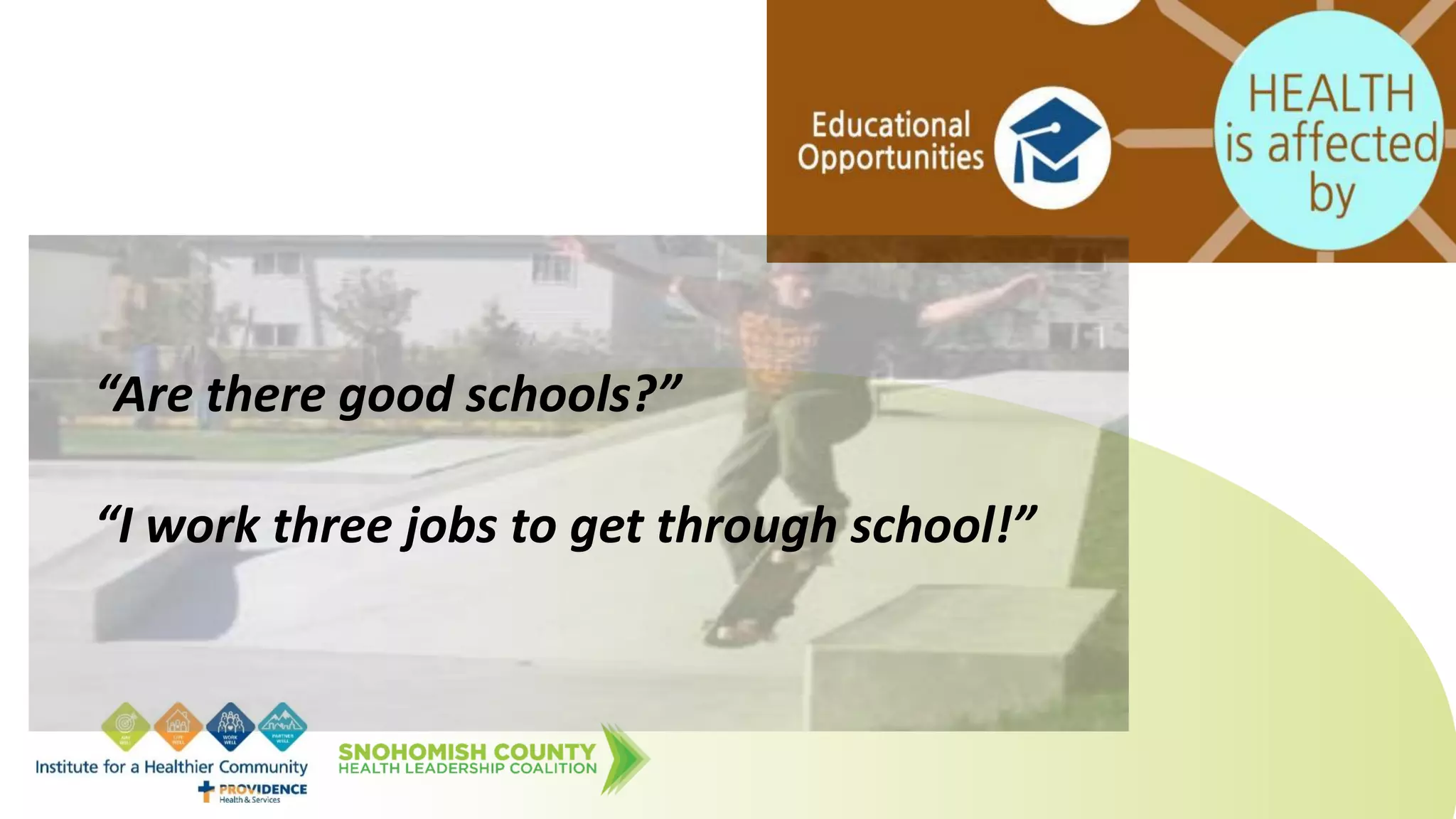
“Are there good schools?”
“I work three jobs to get through school!”
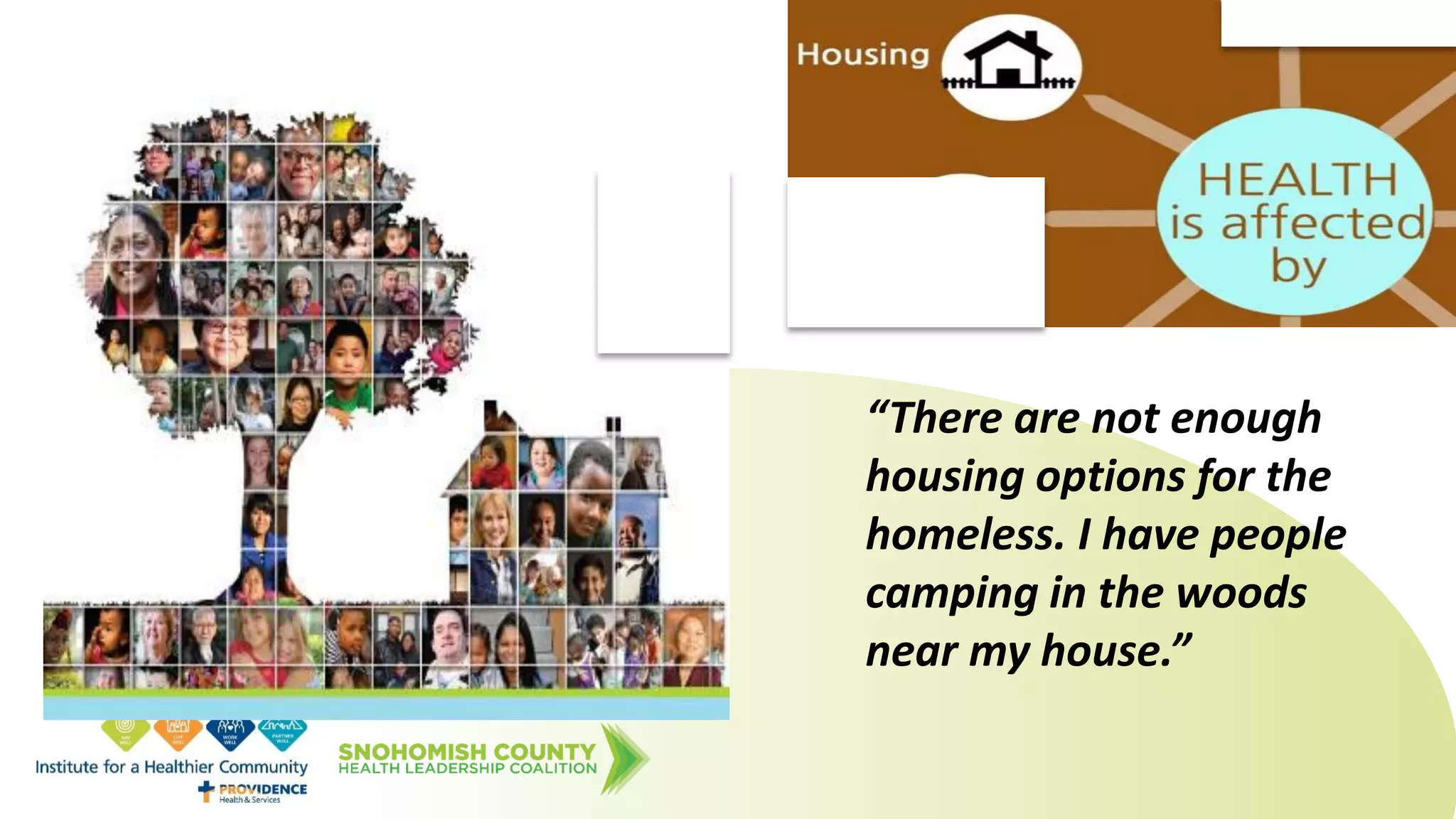
“There are not enough
housing options for the
homeless. I have people
camping in the woods
near my house.”
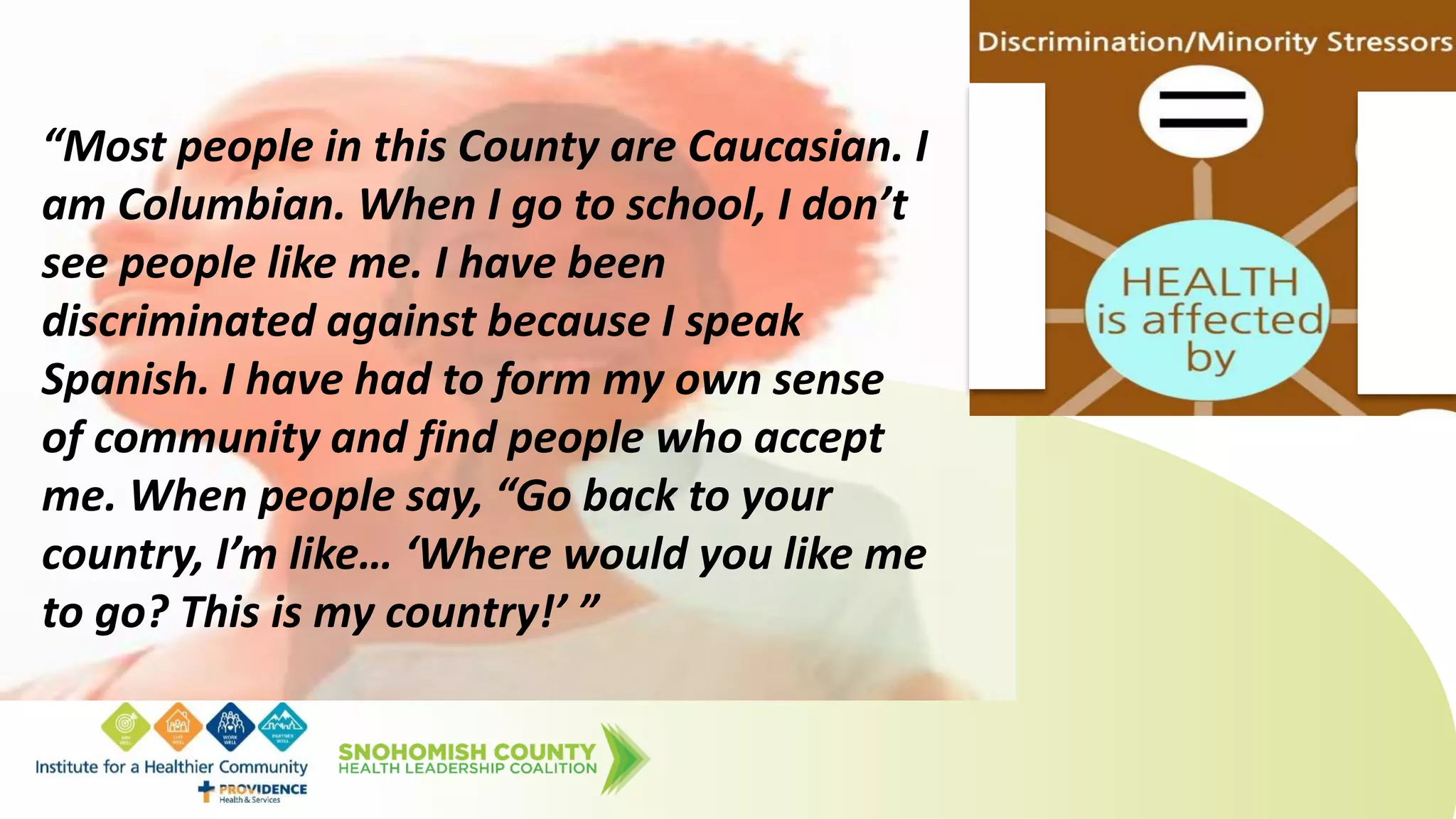
“Most people in this County are Caucasian. I
am Columbian. When I go to school, I don’t
see people like me. I have been
discriminated against because I speak
Spanish. I have had to form my own sense
of community and find people who accept
me. When people say, “Go back to your
country, I’m like… ‘Where would you like me
to go? This is my country!’ ”
Achieving Health Equity:
Promising Practices
From Around the Nation
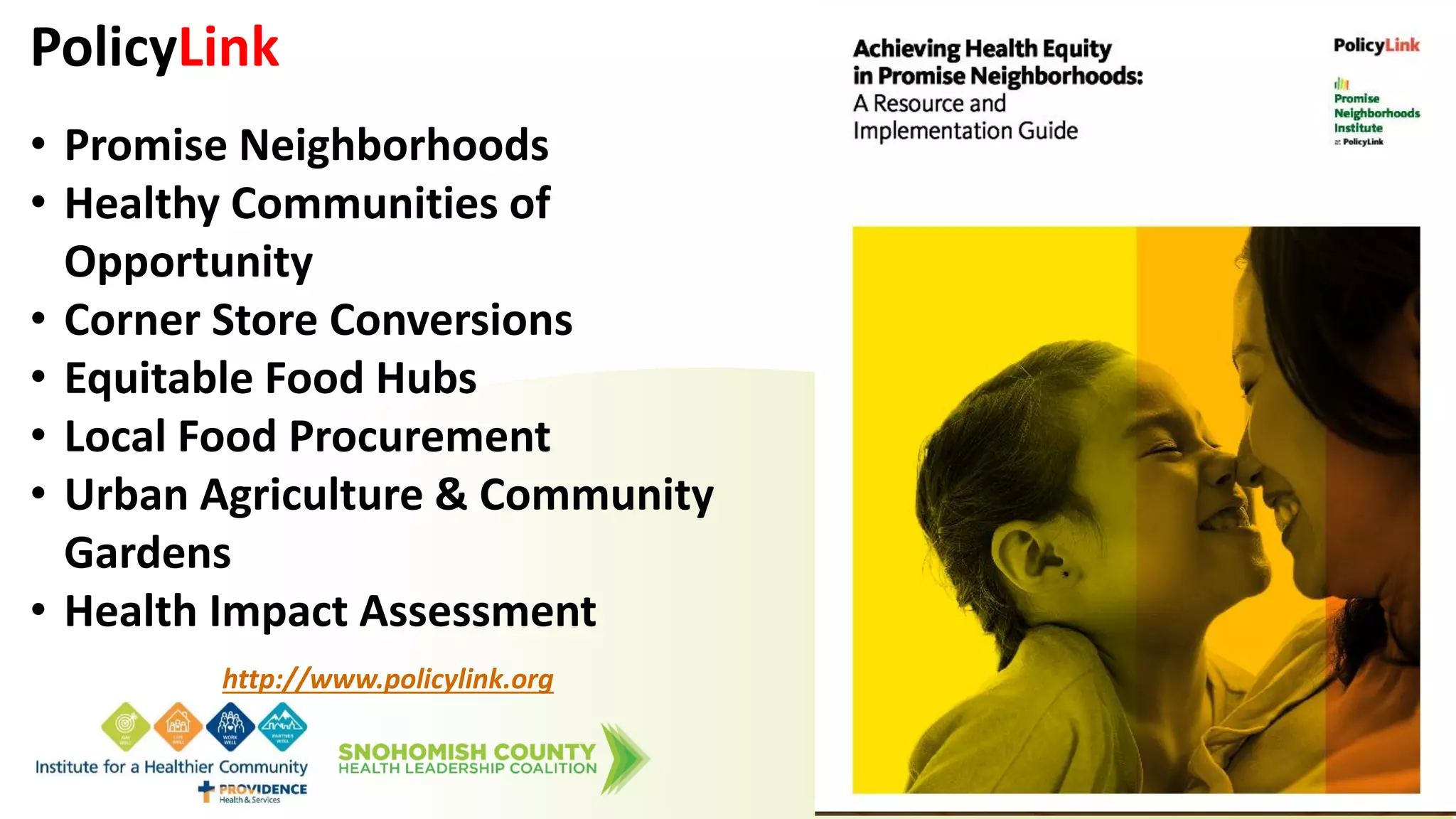
PolicyLink
• Promise Neighborhoods
• Healthy Communities of
Opportunity
• Corner Store Conversions
• Equitable Food Hubs
• Local Food Procurement
• Urban Agriculture & Community
Gardens
• Health Impact Assessment
http://www.policylink.org
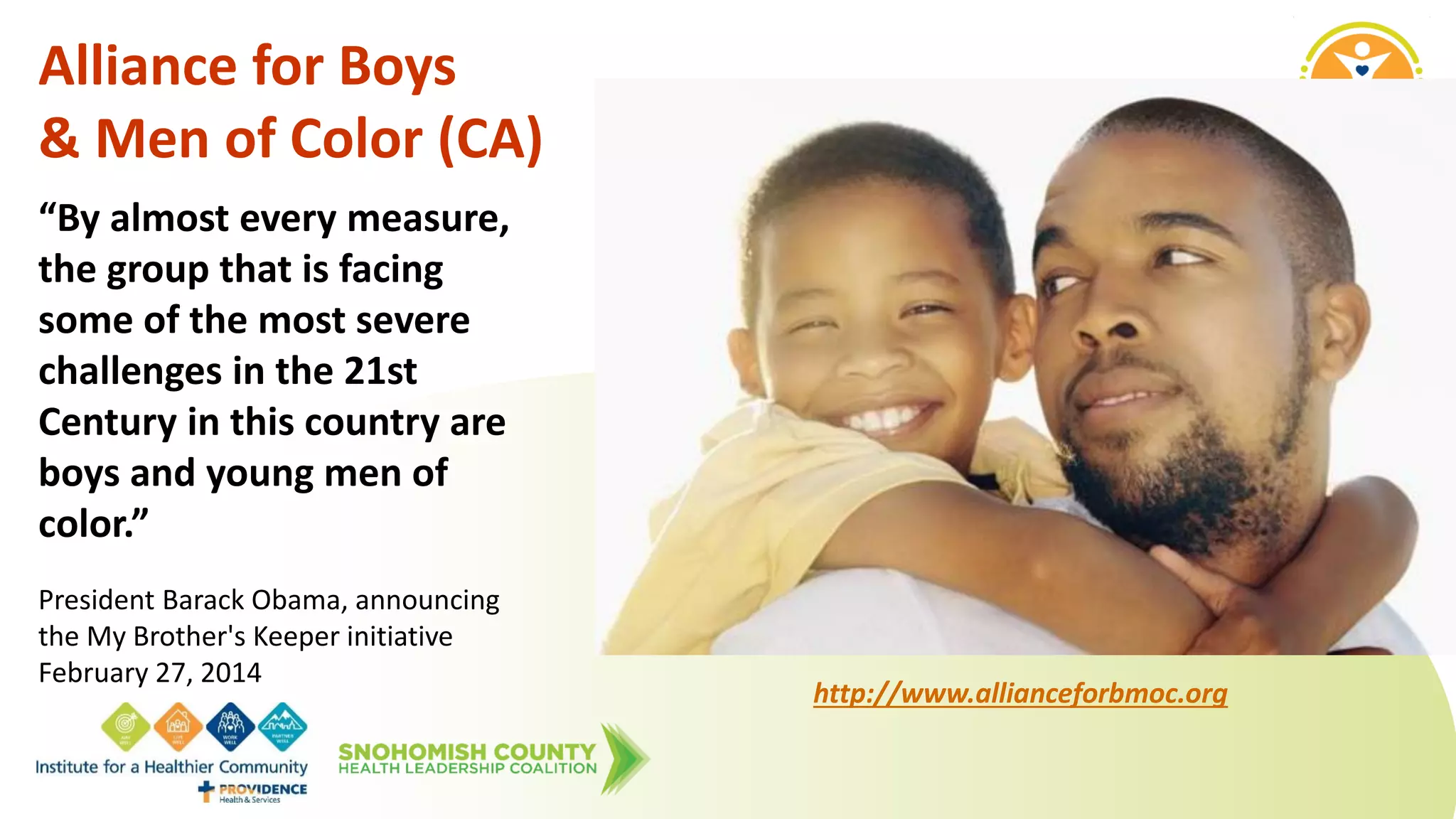
Alliance for Boys
& Men of Color (CA)
“By almost every measure,
the group that is facing
some of the most severe
challenges in the 21st
Century in this country are
boys and young men of
color.”
President Barack Obama, announcing
the My Brother's Keeper initiative
February 27, 2014
http://www.allianceforbmoc.org
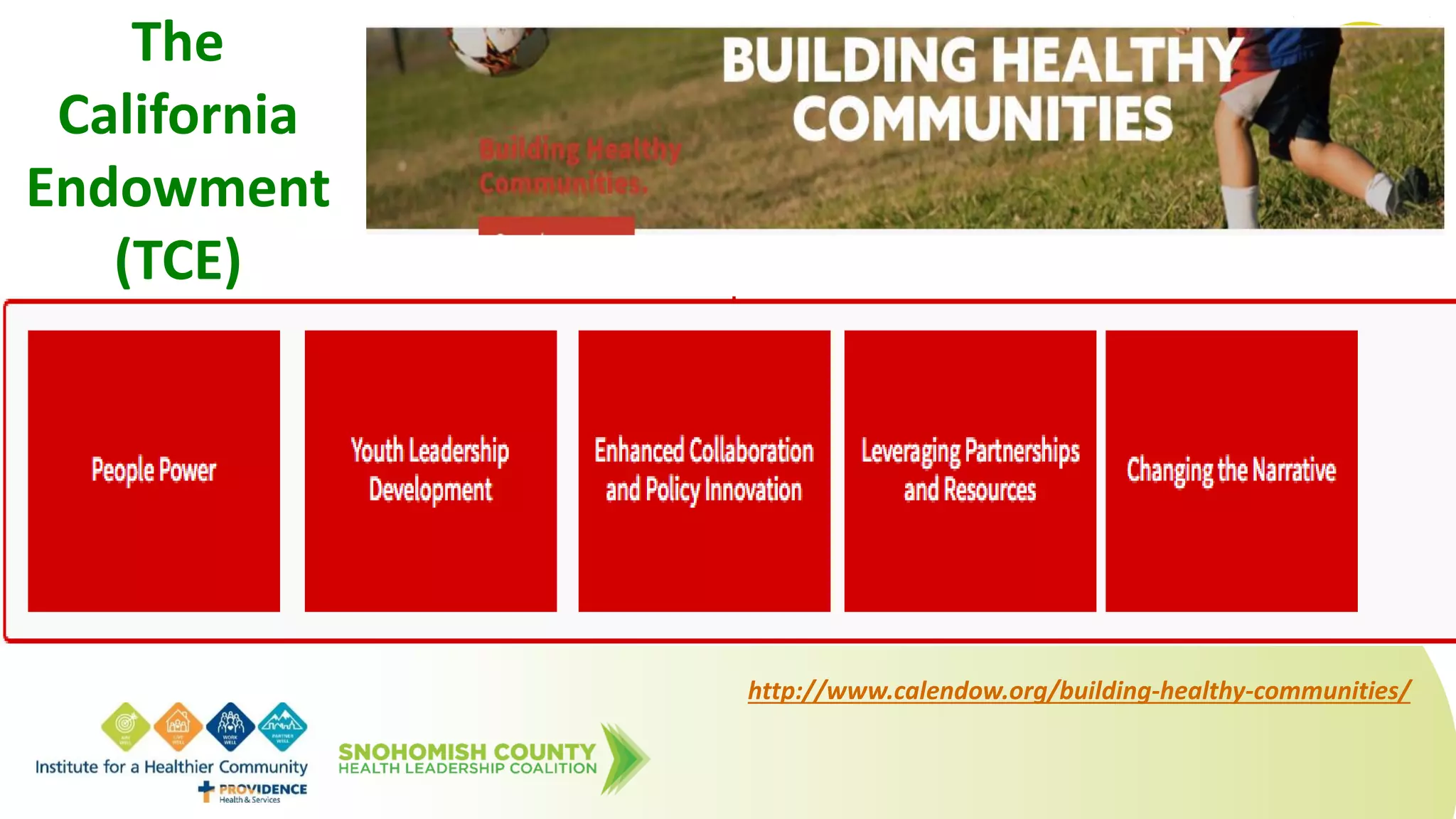
The
California
Endowment
(TCE)
http://www.calendow.org/building-healthy-communities/
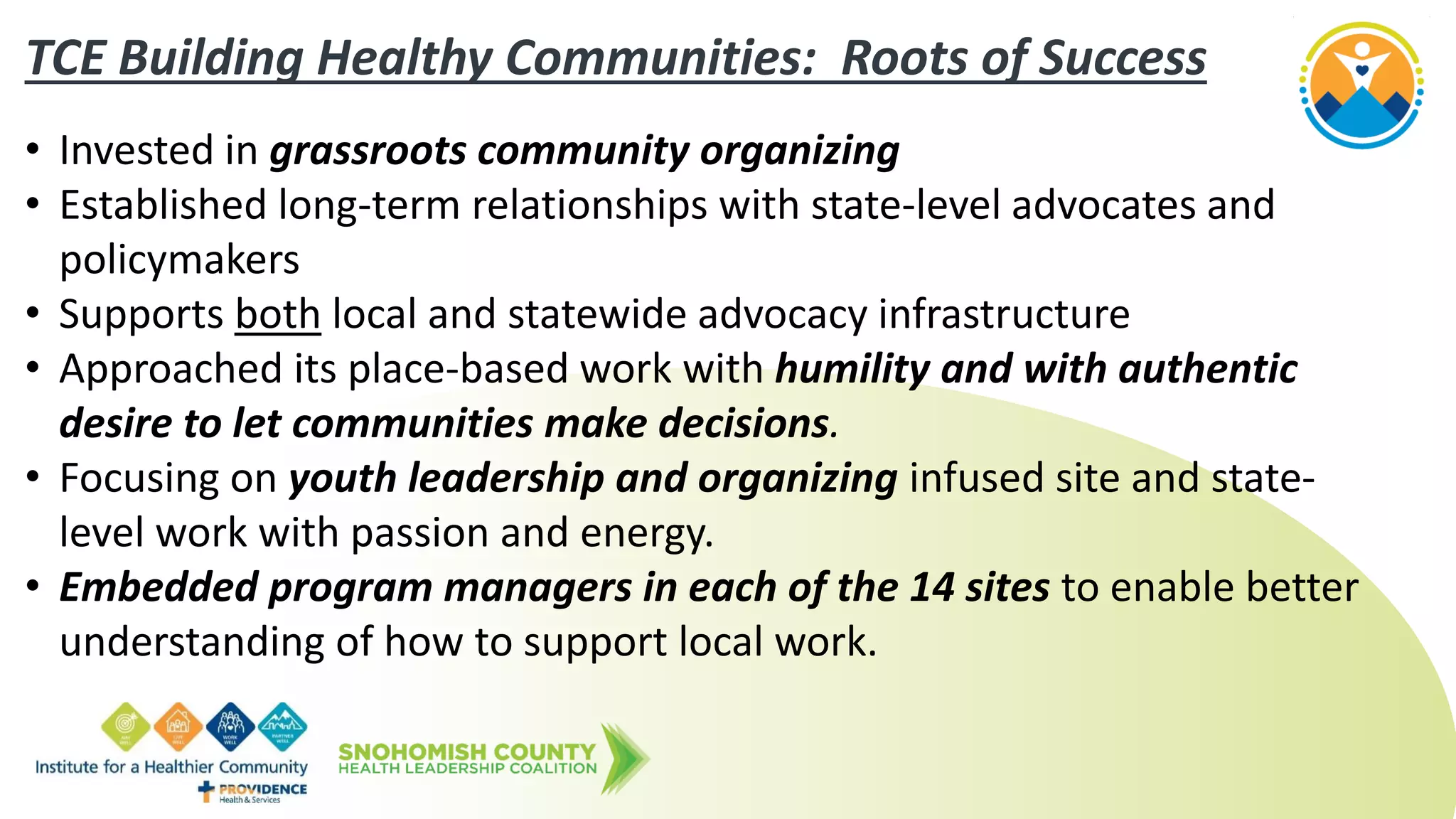
TCE Building Healthy Communities: Roots of Success
• Invested in grassroots community organizing
• Established long-term relationships with state-level advocates and
policymakers
• Supports both local and statewide advocacy infrastructure
• Approached its place-based work with humility and with authentic
desire to let communities make decisions.
• Focusing on youth leadership and organizing infused site and state-
level work with passion and energy.
• Embedded program managers in each of the 14 sites to enable better
understanding of how to support local work.
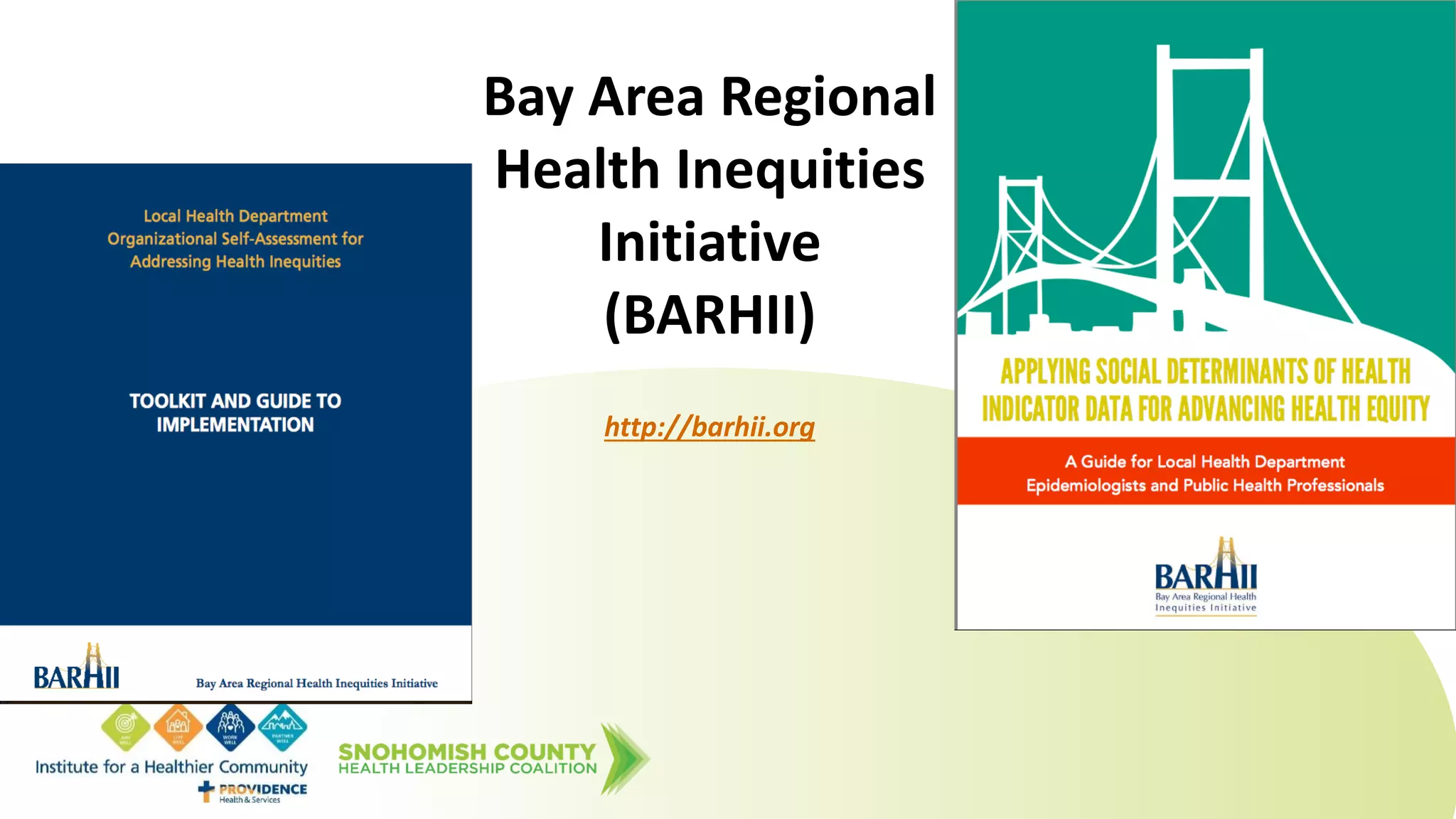
Bay Area Regional
Health Inequities
Initiative
(BARHII)
http://barhii.org
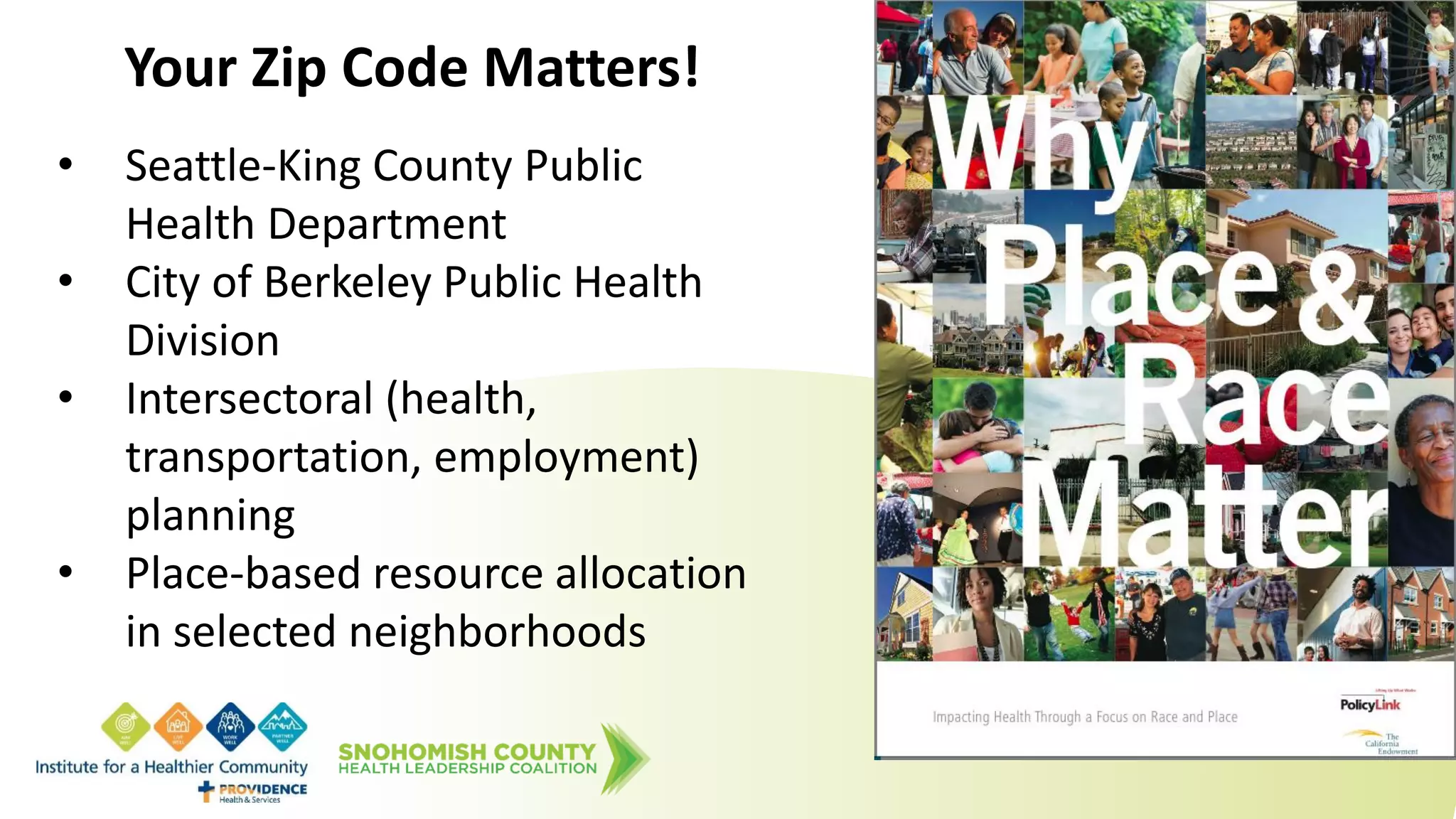
Your Zip Code Matters!
• Seattle-King County Public
Health Department
• City of Berkeley Public Health
Division
• Intersectoral (health,
transportation, employment)
planning
• Place-based resource allocation
in selected neighborhoods
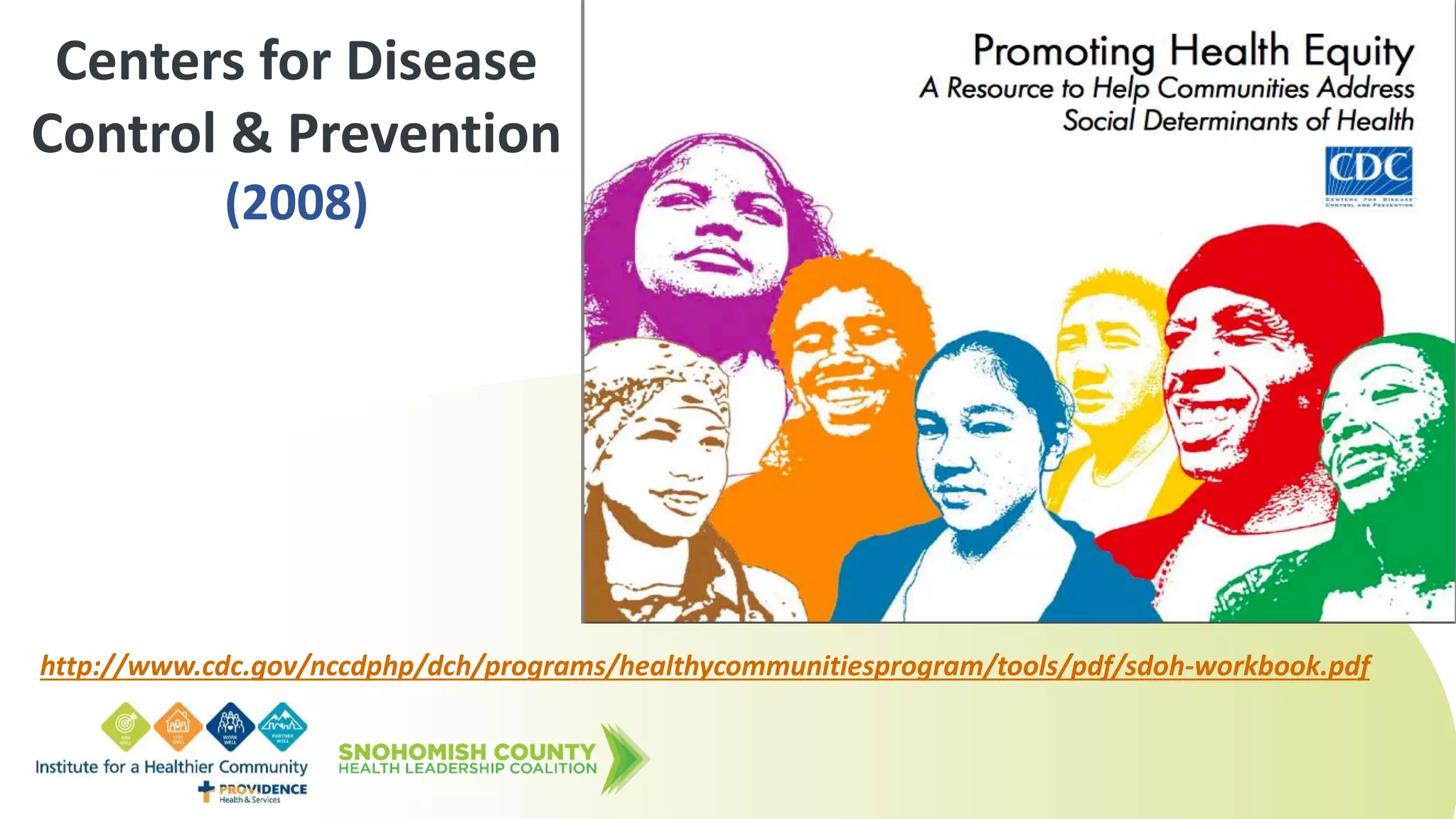
Centers for Disease
Control & Prevention
(2008)
http://www.cdc.gov/nccdphp/dch/programs/healthycommunitiesprogram/tools/pdf/sdoh-workbook.pdf
Key Take-Aways
In the context of the discussion
we just had, what are 2-3 key
priorities as we look to improve
the health of our community?
• PIHC can serve as a conduit for collaboration
• Continue this conversation: How can we leverage
Sno.Co resources and community assets?
• Who else needs to be heard?
• Tweet your thoughts to #AMPVOICES2015 or
submit comment card to Jody or Vicky as you leave.
Extend the Conversation!
AMPLIFYING Community
THANK YOU FOR COMING!
Panelists:
Victoria Breckwich Vásquez: Vbreck@uw.edu
Sophia Beltrán: Sbeltran@lcsnw.org
Maria Peña: mpena@everettcc.edu
Diane Douglas: ddouglas@seattlecityclub.org

EOA2015: Amplifying the Community Voice

  • 1.
    AMPLIFYING Community Collaborating toAchieve Health Equity & Community Capacity Panelists: Victoria Breckwich Vásquez, Assistant Professor, University of Washington-Bothell Sophia Beltrán, Family Support Program Manager, Lutheran Community Services NW Maria Peña, Chief Diversity and Equity Officer, Everett Community College Diane Douglas, Executive Director, Seattle City Club Moderated by: Jody Early, Associate Professor, University of Washington- Bothell
  • 2.
  • 3.
    Guiding Questions • Whatare we, as a community, doing to amplify the voices of residents of Snohomish County—especially those often “not at the table”? • What are we currently doing to improve: • Health Equity ? • Community Capacity? • What /where are the gaps and how do we address them?
  • 4.
    Amplify YOUR Voice! •Tweet your comments, thoughts, or examples to #AMPVOICES2015 OR write them down on the comment card provided. Submit your card to Jody or Vicky at the end of the session.
  • 5.
    What does itmean to “Amplify Community Voice”? • Strengthening community impact through representation and engagement • Begin with the community’s perceived needs—listen! • Use an asset-based approach vs. deficit approach *”Start where the people are.” (Nyswander, 1956) • Research shows that community participation can be significant in improving: • Health behaviors and health status • Perceived control • Empowerment • Individual coping • Building community capacity • Lasting change Sources: Marmot, 2009; Kegler et al, 2009; Wallerstein, 2006
  • 6.
    A Starting Point: Amplifying Community Voice Efforts • PIHC efforts: community conversations with Sno.Co residents across the county (119 people; and 11 groups thus far) • Additional Efforts: *”Picture Health” -community photo contest *Interviews *Quantitative surveys *Synthesis of existing data • Intent is to let people discuss these issues from their vantage points • Hear voices often excluded • Deepen our understanding of health through the eyes of residents • Ground models of understanding in here and now • Determine ways in which to address gaps and leverage community resources
  • 7.
    Amplifying Community Voiceto Achieve Health & Well-Being in Snohomish County: Health Equity in Snohomish County Victoria Breckwich Vásquez, DrPH, MPH, MA Assistant Professor/Director, Community Engagement & Education University of Washington Bothell/ Seattle vbreck@uw.edu
  • 11.
  • 13.
  • 14.
    Using an Asset-BasedApproach to Community Transformation • “Our institutions and agencies cannot solve all of our social ills. Most are at max capacity. Only people can create community…. Change relies largely on those living in the community.” • --John Kretzman and John McKnight (1993). Building Communities from the Inside Out: A Path to Mobilizing Community Assets.
  • 15.
    ABCD Approach to HealthyCommunity Building • Asset-Based Community Development Includes: • Identifying resources, strengths and talents of the community • Involve community members • Focus on what they care about • Build relationships and grow collaborations • Develop strategies for groups to act • Help to increase community capacity and mobilization
  • 16.
    Examples of Building Community Capacityand Amplifying Community Voices
  • 17.
    Presented by SophiaBeltrán, Family Support Program Manager, Everett & South Snohomish
  • 18.
  • 19.
    Malcolm Gladwell explains: Connectorsare people who link us up with the world. People with a special gift for bringing the world together.
  • 21.
    Social capital worksthrough multiple channels: Information flows (e.g. learning about jobs, learning about candidates running for office, exchanging ideas at college, etc.) depend on social capital. Norms of reciprocity (mutual aid) rely on social networks. Bonding networks that connect folks who are similar sustain particularized (in- group) reciprocity. Bridging networks that connect individuals who are diverse sustain generalized reciprocity. Collective action depends upon social networks (e.g., the role that the black church played in the Civil Rights movement), although collective action also can foster new networks. Broader identities and solidarity are encouraged by social networks that help translate an "I" mentality into a "we" mentality. http://www.escapefromcubiclenation.com/2010/08/23/connectors-mavens-and-salesmen-the-secret-to-your-success/
  • 24.
    I know aguy, who knows a guy, who knows a gal…
  • 32.
    Everett Community College theDREAMERs Success Project :Serving Undocumented Students • Presented by Maria Peña, Chief Diversity & Equity Officer/Title IX Coordinator, Everett Community College
  • 33.
    Quick Overview •Review federaland state legislation •Undocumented students: Who are they? •DREAMERs Success Project: How is EVCC helping undocumented students?
  • 34.
    Federal Policy: Undocumented Students 1982:Plyler vs. Doe: U.S. Supreme Court decision that granted undocumented students the right to a public school education from K-12 grade in the U.S.
  • 35.
    Federal Initiatives DACA (Deferred Actionfor Childhood Arrivals) Expanded DACA & DAPA (Deferred Action for Parents of Americans & Lawful Permanent Residents) DREAM ACT (Development, Relief, and Education for Alien Minors Act) 2012 • Grants a 2 year renewable working permit Eligibility requirements: • Entered U.S. before 16 • Continuously lived in the U.S. for 5 years • Are currently in school, graduated from high school, earned a GED, or served in the military. • Be of good moral character • Are under the age of 31 2014 • Grants 3 year renewable working permit Eligibility requirements: • No Age limit • Continuously lived in the U.S. since January 1, 2010 2001 • Still developing • Could provide a pathway to citizenship
  • 36.
    HB 1079 (House Bill1079) SB 6523 (The Real Hope Act) May 2003 • Grants in-state tuition to Washington State undocumented students who meet specific eligibility requirements April 2014 • Grants some WA undocumented students eligibility to apply for Washington State Need Grant Eligibility requirements: • Earned a high school diploma or GED from a Washington State high school • Lived in Washington at least three years prior to receiving a diploma or GED • Signs an affidavit state he or she will apply for U.S. residency as soon as possible. Washington State laws
  • 37.
    Undocumented Students: Who AreThey? Similar to peers: • Low-income • Poor academic preparation • First gen college students • English is frequently their second language • Limited access to college information and support • Desire the real college experience • Highly involved in school extracurricular activities • Active in their community • Most work to pay for college Differ from peers: • Difficulty gaining employment • Cannot acquire a drivers license in most states* (WA does offer license/ID) • Most must pay out of state tuition to attend college in other states* (HB 1079) • Not eligible for most forms of government- sponsored financial aid • Challenge finding scholarships • Limited in fields of study/majors • Live in fear of their status being discovered and face possible deportation • Face marginalization & prejudice
  • 38.
    PURPOSE: • Help Dreamersmake gains in their educational and career pathways • Identify inequities and address barriers to access • Focus on dignity and fair treatment of immigrant youth and families, regardless of immigration status. Everett Community College Dreamers success project
  • 39.
    PROJECT: Serve a cohortof WASFA-eligible students (46 W15) GOALS: Build community Develop a network of support Community engagement Identity development Leadership development Everett Community College DREAMERS SUCCESS PROJECT
  • 40.
    Task Force: • Campus-widerepresentation, participation and support State Partnerships: • Beyond HB 1079 Conference • Washington State Dreamers Coalition • Northwest Immigrant Right’s Project National Recognition: • United We Dream • Commitments Student Data: • 100% retention Winter to Spring Quarter Dreamers Success Project: Outcomes
  • 41.
    Presented by: Diane Douglas,Executive Director
  • 42.
    Seattle City Club’s missionis to inform, connect and engage the public to strengthen the civic health of our region. Organizational Mission
  • 43.
    In school, they don’ttell us we can change the world.
  • 44.
    “Too often, youngpeople come to believe they cannot make a difference in their own lives or in the life of their community. (by engaging) students in learning experiences that give them a sense of their own power and ability to effect change for themselves and others around them.” --Sheldon Berman, Citizenship Matters One central element in (closing) the achievement gap… is (closing) the empowerment gap
  • 45.
  • 46.
    Educational attainment isthe single most important predictor of strong civic agency. Make education our most important civic health investment.
  • 47.
    Voices from our Communities onHealth Equity in Snohomish County
  • 48.
    “I go tothe food bank twice a month in order to eat. I can’t afford to go and buy a lot of groceries or anything…But it’s hard to eat properly. They’re very generous but it’s hard sometimes to eat the proper foods to help myself feel good or feel well.”
  • 49.
    “…If you havea community that has a very high unemployment rate, that’s an unhealthy environment. You have a higher crime rate, and people with lower self- worth.”
  • 50.
    “If people didn'thave long commutes and as many cars polluting the environment, you'd be healthier with less pollution. You'd be healthier if you didn't arrive everywhere stressed all the time..”
  • 51.
    “This county hasa severe heroine problem. 4 youth this year alone have died from heroine overdoses.” “There are a large number of homeless with drug and alcohol problems. They are not getting the help they need.”
  • 52.
    “Well, I feellike doctors should probably be one of our first resorts, but since they are not as accessible as we wish they would be, Google, Facebook [and] friends become our first resorts...”
  • 53.
    “Are there goodschools?” “I work three jobs to get through school!”
  • 54.
    “There are notenough housing options for the homeless. I have people camping in the woods near my house.”
  • 55.
    “Most people inthis County are Caucasian. I am Columbian. When I go to school, I don’t see people like me. I have been discriminated against because I speak Spanish. I have had to form my own sense of community and find people who accept me. When people say, “Go back to your country, I’m like… ‘Where would you like me to go? This is my country!’ ”
  • 56.
    Achieving Health Equity: PromisingPractices From Around the Nation
  • 57.
    PolicyLink • Promise Neighborhoods •Healthy Communities of Opportunity • Corner Store Conversions • Equitable Food Hubs • Local Food Procurement • Urban Agriculture & Community Gardens • Health Impact Assessment http://www.policylink.org
  • 58.
    Alliance for Boys &Men of Color (CA) “By almost every measure, the group that is facing some of the most severe challenges in the 21st Century in this country are boys and young men of color.” President Barack Obama, announcing the My Brother's Keeper initiative February 27, 2014 http://www.allianceforbmoc.org
  • 59.
  • 62.
    TCE Building HealthyCommunities: Roots of Success • Invested in grassroots community organizing • Established long-term relationships with state-level advocates and policymakers • Supports both local and statewide advocacy infrastructure • Approached its place-based work with humility and with authentic desire to let communities make decisions. • Focusing on youth leadership and organizing infused site and state- level work with passion and energy. • Embedded program managers in each of the 14 sites to enable better understanding of how to support local work.
  • 63.
    Bay Area Regional HealthInequities Initiative (BARHII) http://barhii.org
  • 64.
    Your Zip CodeMatters! • Seattle-King County Public Health Department • City of Berkeley Public Health Division • Intersectoral (health, transportation, employment) planning • Place-based resource allocation in selected neighborhoods
  • 65.
    Centers for Disease Control& Prevention (2008) http://www.cdc.gov/nccdphp/dch/programs/healthycommunitiesprogram/tools/pdf/sdoh-workbook.pdf
  • 66.
    Key Take-Aways In thecontext of the discussion we just had, what are 2-3 key priorities as we look to improve the health of our community?
  • 67.
    • PIHC canserve as a conduit for collaboration • Continue this conversation: How can we leverage Sno.Co resources and community assets? • Who else needs to be heard? • Tweet your thoughts to #AMPVOICES2015 or submit comment card to Jody or Vicky as you leave. Extend the Conversation!
  • 68.
    AMPLIFYING Community THANK YOUFOR COMING! Panelists: Victoria Breckwich Vásquez: Vbreck@uw.edu Sophia Beltrán: Sbeltran@lcsnw.org Maria Peña: mpena@everettcc.edu Diane Douglas: ddouglas@seattlecityclub.org