EDU 642-1202 A – 01
 UNIT 1 PPT
THE MILLENNIALS
  Estella Saloma
  AIU Online
Introduction

   This presentation will introduce the different
    generations.

   This presentation will present you with a brief
    description of today’s learners also known as
    “The Millennials”.

   This presentation will also introduce a few
    characteristics of Millennials
Generation Learners

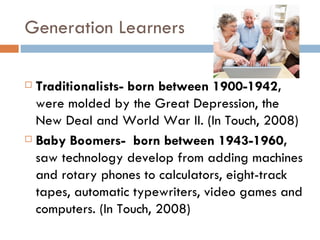
 Traditionalists- born between 1900-1942,
  were molded by the Great Depression, the
  New Deal and World War II. (In Touch, 2008)
 Baby Boomers- born between 1943-1960,

  saw technology develop from adding machines
  and rotary phones to calculators, eight-track
  tapes, automatic typewriters, video games and
  computers. (In Touch, 2008)
Cont. Generation Learners
 Generation X- born between 1961-1981,
  cutting edge technology for them include video
  games, VCRs, cable TV, personal computers,
  microwave ovens, ATM machines and cell
  phones. (In Touch, 2008)
 Millennials – born after 1981, cutting edge

  technology for them includes iPods/MP3s,
  camera phones, PDAs, digital cameras,
  personal DVD players and virtual reality. (In
  Touch, 2008)
Facts about the Millennial Learner
     According to In Touch (2008) children born after 1981
     are considered “Millennials”.
    They are also known as “Generation Y,” “The Me
     Generation,” and “The Least Great Generation. (Klauss,
     2012)
    63% of teens internet users go online everyday.
    Nearly six out of ten 18-29 year-olds have more than one
     social networking profile more than one site. A number
     that is increasing year over year.
    Texting has increased 566% with 12-17
      year-old over the last 3 years.
      (Petrusa, 2010)
Characteristics of a Millennial
Special
     Have   always been treated as special and important.
     This generation of children has been the most wanted.

     It’s been instilled in them that they are vital to the
      nation and to their parents’ sense of purpose.
     They feel they are here to solve world problems that
      older generations have failed to solve.
     They may claim they want privacy, but they crave
      attention. (Howe & Strauss, 2003)
Characteristics of a Millennial
    Sheltered
      Highly  protected as children.
      Grew up in a time of increasing safety measures (car
       seats, baby on board signs, school lockdowns).
      They were rarely left unsupervised.

      They were sheltered from having to take care of their
       own conflicts as parents advocated on their behalf, and
       “spared” them from unpleasant experiences.
      As college students, they may expect faculty and staff
       to shelter, protect, and nurture them – and resolve their
       conflicts for them. (Howe & Strauss, 2003)
Characteristics of a Millennial

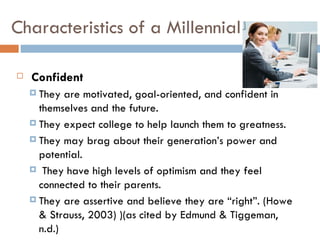
   Confident
     They  are motivated, goal-oriented, and confident in
      themselves and the future.
     They expect college to help launch them to greatness.

     They may brag about their generation’s power and
      potential.
     They have high levels of optimism and they feel
      connected to their parents.
     They are assertive and believe they are “right”. (Howe
      & Strauss, 2003) )(as cited by Edmund & Tiggeman,
      n.d.)
Characteristics of a Millennial

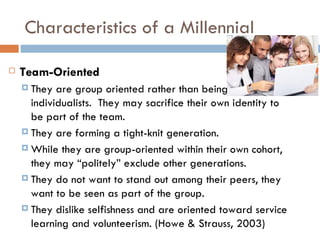
   Team-Oriented
     They  are group oriented rather than being
      individualists. They may sacrifice their own identity to
      be part of the team.
     They are forming a tight-knit generation.

     While they are group-oriented within their own cohort,
      they may “politely” exclude other generations.
     They do not want to stand out among their peers, they
      want to be seen as part of the group.
     They dislike selfishness and are oriented toward service
      learning and volunteerism. (Howe & Strauss, 2003)
Characteristics of a Millennial

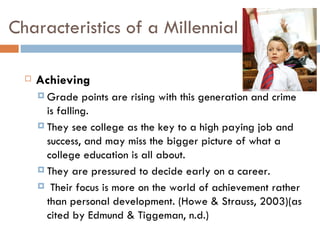
     Achieving
       Grade    points are rising with this generation and crime
        is falling.
       They see college as the key to a high paying job and
        success, and may miss the bigger picture of what a
        college education is all about.
       They are pressured to decide early on a career.

       Their focus is more on the world of achievement rather
        than personal development. (Howe & Strauss, 2003)(as
        cited by Edmund & Tiggeman, n.d.)
Characteristics of a Millennial

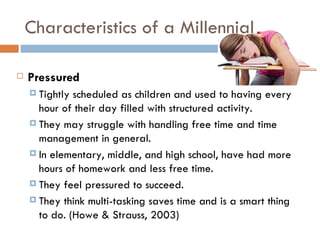
   Pressured
     Tightly scheduled as children and used to having every
      hour of their day filled with structured activity.
     They may struggle with handling free time and time
      management in general.
     In elementary, middle, and high school, have had more
      hours of homework and less free time.
     They feel pressured to succeed.

     They think multi-tasking saves time and is a smart thing
      to do. (Howe & Strauss, 2003)
Characteristics of a Millennial
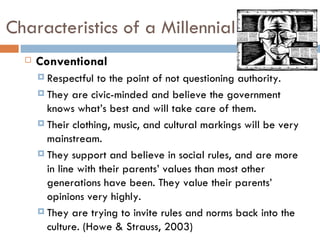
     Conventional
       Respectful  to the point of not questioning authority.
       They are civic-minded and believe the government
        knows what’s best and will take care of them.
       Their clothing, music, and cultural markings will be very
        mainstream.
       They support and believe in social rules, and are more
        in line with their parents’ values than most other
        generations have been. They value their parents’
        opinions very highly.
       They are trying to invite rules and norms back into the
        culture. (Howe & Strauss, 2003)
Characteristics of a Millennial
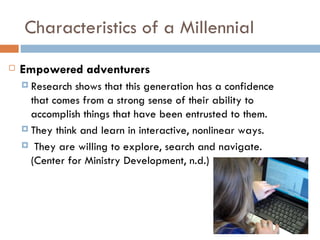
   Empowered adventurers
     Research  shows that this generation has a confidence
      that comes from a strong sense of their ability to
      accomplish things that have been entrusted to them.
     They think and learn in interactive, nonlinear ways.

     They are willing to explore, search and navigate.
      (Center for Ministry Development, n.d.)
Characteristics of a Millennial
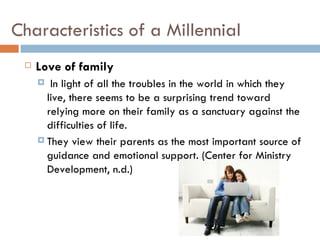
    Love of family
       In light of all the troubles in the world in which they
       live, there seems to be a surprising trend toward
       relying more on their family as a sanctuary against the
       difficulties of life.
      They view their parents as the most important source of
       guidance and emotional support. (Center for Ministry
       Development, n.d.)
Characteristics of a Millennial

   Self-reliance
      They believe that becoming successful is up to them,
      and they are not depending on others for help.
     Finding a good job is a priority.

     They are the young navigators. They must chart their
      own course.
     They value personal experience and are prone to seek
      out critical thinkers.
     They strongly value individual rights. (Center for
      Ministry Development, n.d.)
Characteristics of a Millennial
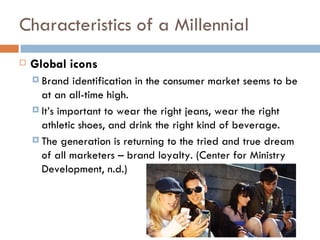
   Global icons
     Brand   identification in the consumer market seems to be
      at an all-time high.
     It’s important to wear the right jeans, wear the right
      athletic shoes, and drink the right kind of beverage.
     The generation is returning to the tried and true dream
      of all marketers – brand loyalty. (Center for Ministry
      Development, n.d.)
Characteristics of a Millennial


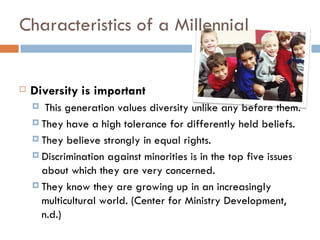
   Diversity is important
      This generation values diversity unlike any before them.
     They have a high tolerance for differently held beliefs.

     They believe strongly in equal rights.

     Discrimination against minorities is in the top five issues
      about which they are very concerned.
     They know they are growing up in an increasingly
      multicultural world. (Center for Ministry Development,
      n.d.)
Characteristics of a Millennial

   Hungry for the transcendent
     They  are spiritually hungry. While more than 80% of
      young people today will identify themselves as
      believers, the question that should be raised is what do
      they believe in?
     They are hungry not just for answers, but more
      importantly the knowledge of how to find them for
      themselves.
     They are seeking a practical, pragmatic, everyday
      faith they can grasp that will help them to make sense
      of the world around them. (Center for Ministry
      Development, n.d.)
Characteristics of a Millennial

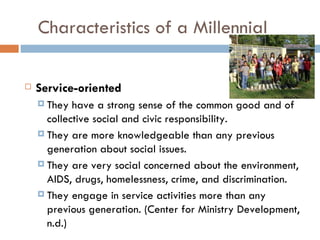
   Service-oriented
     They  have a strong sense of the common good and of
      collective social and civic responsibility.
     They are more knowledgeable than any previous
      generation about social issues.
     They are very social concerned about the environment,
      AIDS, drugs, homelessness, crime, and discrimination.
     They engage in service activities more than any
      previous generation. (Center for Ministry Development,
      n.d.)
Characteristics of a Millennial
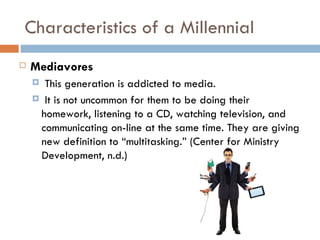
   Mediavores
     This generation is addicted to media.
     It is not uncommon for them to be doing their
     homework, listening to a CD, watching television, and
     communicating on-line at the same time. They are giving
     new definition to “multitasking.” (Center for Ministry
     Development, n.d.)
Characteristics of a Millennial
   Mobility equals freedom
     This generations promises to be one of the most mobile
      ever.
     They don’t intend to stay at home. They have
      aspirations to travel, not only around this country, but
      also around the world. They already travel on the
      Internet to many places and now they want to go there
      in person. (Center for Ministry Development, n.d.)
Conclusion

    Millennials require hands on experiential
     learning if possible with technology involvement.
    The bad news is that they need continual praise
     and criticism to feel “special.”
    The good news is that they are well behaved
     and respect rules more which makes them easier
     to teach. (Edmond & Tiggeman, n.d.)
References
   Center for Ministry Development (n.d.). Key Characteristics of Today’s
    Adolescents: The Millennial Generation (1980/83 – present). Retrieved
    from
    http://catholicyouthministryofdallas.org/documents/Handbook%202006%20-%
   Edmond, T. & Tiggeman, T. (n.d.). Effectively Reaching the Millennial
    Generation through Experiential Learning Techniques. Retrieved from
    http://www.abe.sju.edu/tiggeman.pdf
   Howe, N. & Strauss, W. (2003). Characteristics of The Millennial
    Generation. Retrieved from
    https://students.rice.edu/images/students/AADV/OWeek2008AADVResources/
   In Touch (2008). Meeting The Needs of Millennial Students. Retrieved from
    http://www.csulb.edu/divisions/students2/intouch/archives/2007-08/vol16_no1
References
   Klauss, L. (2012). Facts About Millennials. Retrieved from
    http://lucasklauss.com/post/4183686254/facts-about-millennials
   McGlynn, A. (2005). Teaching Millennials, Our Newest Cultural Cohort.
    Education Digest: Essential Readings Condensed For Quick Review, 71(4),
    12-16Aviles, C. B. (2000). Teaching and Testing for Critical Thinking with
    Bloom's Taxonomy of Educational Objectives. Retrieved from ERIC.
   MUSE (2012). Technology: Informal and Formal Learning. Retrieved from
    http://coursebuildercontent.careeredonline.com/Assets/50000/40912.pdf
   Petrusa, J. (2010). 26 Facts About Millennials Online, Social and Mobile
    Behaviors. Retrieved from
    http://itsjosipnotjoseph.com/2010/08/26-facts-about-millennials-online-social-and-mobil

The Millenials

  • 1.
    EDU 642-1202 A– 01 UNIT 1 PPT THE MILLENNIALS Estella Saloma AIU Online
  • 2.
    Introduction  This presentation will introduce the different generations.  This presentation will present you with a brief description of today’s learners also known as “The Millennials”.  This presentation will also introduce a few characteristics of Millennials
  • 3.
    Generation Learners  Traditionalists-born between 1900-1942, were molded by the Great Depression, the New Deal and World War II. (In Touch, 2008)  Baby Boomers- born between 1943-1960, saw technology develop from adding machines and rotary phones to calculators, eight-track tapes, automatic typewriters, video games and computers. (In Touch, 2008)
  • 4.
    Cont. Generation Learners Generation X- born between 1961-1981, cutting edge technology for them include video games, VCRs, cable TV, personal computers, microwave ovens, ATM machines and cell phones. (In Touch, 2008)  Millennials – born after 1981, cutting edge technology for them includes iPods/MP3s, camera phones, PDAs, digital cameras, personal DVD players and virtual reality. (In Touch, 2008)
  • 5.
    Facts about theMillennial Learner  According to In Touch (2008) children born after 1981 are considered “Millennials”.  They are also known as “Generation Y,” “The Me Generation,” and “The Least Great Generation. (Klauss, 2012)  63% of teens internet users go online everyday.  Nearly six out of ten 18-29 year-olds have more than one social networking profile more than one site. A number that is increasing year over year.  Texting has increased 566% with 12-17 year-old over the last 3 years. (Petrusa, 2010)
  • 6.
    Characteristics of aMillennial Special  Have always been treated as special and important.  This generation of children has been the most wanted.  It’s been instilled in them that they are vital to the nation and to their parents’ sense of purpose.  They feel they are here to solve world problems that older generations have failed to solve.  They may claim they want privacy, but they crave attention. (Howe & Strauss, 2003)
  • 7.
    Characteristics of aMillennial  Sheltered  Highly protected as children.  Grew up in a time of increasing safety measures (car seats, baby on board signs, school lockdowns).  They were rarely left unsupervised.  They were sheltered from having to take care of their own conflicts as parents advocated on their behalf, and “spared” them from unpleasant experiences.  As college students, they may expect faculty and staff to shelter, protect, and nurture them – and resolve their conflicts for them. (Howe & Strauss, 2003)
  • 8.
    Characteristics of aMillennial  Confident  They are motivated, goal-oriented, and confident in themselves and the future.  They expect college to help launch them to greatness.  They may brag about their generation’s power and potential.  They have high levels of optimism and they feel connected to their parents.  They are assertive and believe they are “right”. (Howe & Strauss, 2003) )(as cited by Edmund & Tiggeman, n.d.)
  • 9.
    Characteristics of aMillennial  Team-Oriented  They are group oriented rather than being individualists. They may sacrifice their own identity to be part of the team.  They are forming a tight-knit generation.  While they are group-oriented within their own cohort, they may “politely” exclude other generations.  They do not want to stand out among their peers, they want to be seen as part of the group.  They dislike selfishness and are oriented toward service learning and volunteerism. (Howe & Strauss, 2003)
  • 10.
    Characteristics of aMillennial  Achieving  Grade points are rising with this generation and crime is falling.  They see college as the key to a high paying job and success, and may miss the bigger picture of what a college education is all about.  They are pressured to decide early on a career.  Their focus is more on the world of achievement rather than personal development. (Howe & Strauss, 2003)(as cited by Edmund & Tiggeman, n.d.)
  • 11.
    Characteristics of aMillennial  Pressured  Tightly scheduled as children and used to having every hour of their day filled with structured activity.  They may struggle with handling free time and time management in general.  In elementary, middle, and high school, have had more hours of homework and less free time.  They feel pressured to succeed.  They think multi-tasking saves time and is a smart thing to do. (Howe & Strauss, 2003)
  • 12.
    Characteristics of aMillennial  Conventional  Respectful to the point of not questioning authority.  They are civic-minded and believe the government knows what’s best and will take care of them.  Their clothing, music, and cultural markings will be very mainstream.  They support and believe in social rules, and are more in line with their parents’ values than most other generations have been. They value their parents’ opinions very highly.  They are trying to invite rules and norms back into the culture. (Howe & Strauss, 2003)
  • 13.
    Characteristics of aMillennial  Empowered adventurers  Research shows that this generation has a confidence that comes from a strong sense of their ability to accomplish things that have been entrusted to them.  They think and learn in interactive, nonlinear ways.  They are willing to explore, search and navigate. (Center for Ministry Development, n.d.)
  • 14.
    Characteristics of aMillennial  Love of family  In light of all the troubles in the world in which they live, there seems to be a surprising trend toward relying more on their family as a sanctuary against the difficulties of life.  They view their parents as the most important source of guidance and emotional support. (Center for Ministry Development, n.d.)
  • 15.
    Characteristics of aMillennial  Self-reliance  They believe that becoming successful is up to them, and they are not depending on others for help.  Finding a good job is a priority.  They are the young navigators. They must chart their own course.  They value personal experience and are prone to seek out critical thinkers.  They strongly value individual rights. (Center for Ministry Development, n.d.)
  • 16.
    Characteristics of aMillennial  Global icons  Brand identification in the consumer market seems to be at an all-time high.  It’s important to wear the right jeans, wear the right athletic shoes, and drink the right kind of beverage.  The generation is returning to the tried and true dream of all marketers – brand loyalty. (Center for Ministry Development, n.d.)
  • 17.
    Characteristics of aMillennial  Diversity is important  This generation values diversity unlike any before them.  They have a high tolerance for differently held beliefs.  They believe strongly in equal rights.  Discrimination against minorities is in the top five issues about which they are very concerned.  They know they are growing up in an increasingly multicultural world. (Center for Ministry Development, n.d.)
  • 18.
    Characteristics of aMillennial  Hungry for the transcendent  They are spiritually hungry. While more than 80% of young people today will identify themselves as believers, the question that should be raised is what do they believe in?  They are hungry not just for answers, but more importantly the knowledge of how to find them for themselves.  They are seeking a practical, pragmatic, everyday faith they can grasp that will help them to make sense of the world around them. (Center for Ministry Development, n.d.)
  • 19.
    Characteristics of aMillennial  Service-oriented  They have a strong sense of the common good and of collective social and civic responsibility.  They are more knowledgeable than any previous generation about social issues.  They are very social concerned about the environment, AIDS, drugs, homelessness, crime, and discrimination.  They engage in service activities more than any previous generation. (Center for Ministry Development, n.d.)
  • 20.
    Characteristics of aMillennial  Mediavores  This generation is addicted to media.  It is not uncommon for them to be doing their homework, listening to a CD, watching television, and communicating on-line at the same time. They are giving new definition to “multitasking.” (Center for Ministry Development, n.d.)
  • 21.
    Characteristics of aMillennial  Mobility equals freedom  This generations promises to be one of the most mobile ever.  They don’t intend to stay at home. They have aspirations to travel, not only around this country, but also around the world. They already travel on the Internet to many places and now they want to go there in person. (Center for Ministry Development, n.d.)
  • 22.
    Conclusion  Millennials require hands on experiential learning if possible with technology involvement.  The bad news is that they need continual praise and criticism to feel “special.”  The good news is that they are well behaved and respect rules more which makes them easier to teach. (Edmond & Tiggeman, n.d.)
  • 23.
    References  Center for Ministry Development (n.d.). Key Characteristics of Today’s Adolescents: The Millennial Generation (1980/83 – present). Retrieved from http://catholicyouthministryofdallas.org/documents/Handbook%202006%20-%  Edmond, T. & Tiggeman, T. (n.d.). Effectively Reaching the Millennial Generation through Experiential Learning Techniques. Retrieved from http://www.abe.sju.edu/tiggeman.pdf  Howe, N. & Strauss, W. (2003). Characteristics of The Millennial Generation. Retrieved from https://students.rice.edu/images/students/AADV/OWeek2008AADVResources/  In Touch (2008). Meeting The Needs of Millennial Students. Retrieved from http://www.csulb.edu/divisions/students2/intouch/archives/2007-08/vol16_no1
  • 24.
    References  Klauss, L. (2012). Facts About Millennials. Retrieved from http://lucasklauss.com/post/4183686254/facts-about-millennials  McGlynn, A. (2005). Teaching Millennials, Our Newest Cultural Cohort. Education Digest: Essential Readings Condensed For Quick Review, 71(4), 12-16Aviles, C. B. (2000). Teaching and Testing for Critical Thinking with Bloom's Taxonomy of Educational Objectives. Retrieved from ERIC.  MUSE (2012). Technology: Informal and Formal Learning. Retrieved from http://coursebuildercontent.careeredonline.com/Assets/50000/40912.pdf  Petrusa, J. (2010). 26 Facts About Millennials Online, Social and Mobile Behaviors. Retrieved from http://itsjosipnotjoseph.com/2010/08/26-facts-about-millennials-online-social-and-mobil

Editor's Notes

  • #2 Please do not put any content in the notes part (put all your content on the slides with sources, etc.) Think all your information on the slides since you can’t talk to me in person for this assignments 
  • #3 Please do not put any content in the notes part (put all your content on the slides with sources, etc.) Think all your information on the slides since you can’t talk to me in person for this assignments 
  • #6 Please do not put any content in the notes part (put all your content on the slides with sources, etc.) Think all your information on the slides since you can’t talk to me in person for this assignments 
  • #7 Please do not put any content in the notes part (put all your content on the slides with sources, etc.) Think all your information on the slides since you can’t talk to me in person for this assignments 
  • #14 Please do not put any content in the notes part (put all your content on the slides with sources, etc.) Think all your information on the slides since you can’t talk to me in person for this assignments 
  • #15 Please do not put any content in the notes part (put all your content on the slides with sources, etc.) Think all your information on the slides since you can’t talk to me in person for this assignments 
  • #16 Please do not put any content in the notes part (put all your content on the slides with sources, etc.) Think all your information on the slides since you can’t talk to me in person for this assignments 
  • #17 Please do not put any content in the notes part (put all your content on the slides with sources, etc.) Think all your information on the slides since you can’t talk to me in person for this assignments 
  • #19 Please do not put any content in the notes part (put all your content on the slides with sources, etc.) Think all your information on the slides since you can’t talk to me in person for this assignments 
  • #20 Please do not put any content in the notes part (put all your content on the slides with sources, etc.) Think all your information on the slides since you can’t talk to me in person for this assignments 
  • #21 Please do not put any content in the notes part (put all your content on the slides with sources, etc.) Think all your information on the slides since you can’t talk to me in person for this assignments 
  • #24 Please do not put any content in the notes part (put all your content on the slides with sources, etc.) Think all your information on the slides since you can’t talk to me in person for this assignments 