DR SUHAIL KISHAWI
PREGNANCY & THE PERIODONTIUM
OUTLINE
 INTRODUCTION.
 PREGNANCY & ITS FEATURES
 THE PERIODONTIUM
 PATHOGENESIS OF PERIODONTAL DISEASE IN PREGNANCY.
 EFFECTS OF PERIODONTAL DISEASE ON PREGNANCY.
 TREATMENTS
 CONCLUSION
 SUMMARY
INTRODUCTION
Females experience a series of changes in their body
which affect the periodontium. These changes could
be physiological or non-physiological:
 Physiological
 Puberty
 Menstrual cycle
 Pregnancy
 Menopause
 Non-physiological
 Oral contraceptives
PREGNANCY & ITS FEATURES
Pregnancy is a physiological condition of having a
developing embryo/fetus in the body, after fertilization.
Normal pregnancy term, from conception to birth is 37-
42 wks & can be divided into three trimesters:
T1: 0-12 wks
T2: 12-28 wks
T3: 28-40 wks.
Delivery at < 37wks is regarded as Preterm .
Average birth weight is taken to be about 3.5kg.
Birth weight < 2.5 kg is taken as a low birth weight
(LBW).
PREGNANCY & ITS FEATURES
PREGNANCY FEATURES
The numerous physical and physiological changes that occur
during pregnancy affect every major body system resulting in
localized physical alterations in many parts of the body, including
the oral cavity.
These alterations include:
Cardiovascular System
↑CO, ↑ HR, ↑BV
↓ BP due to ↓ P.R
↑ risk of hypotension due to ↓venous return
↑ Varicose veins, ↑hemorrhoid & ↑leg edema.
Hematologic system
↓Hb & hematocrit count due to hemodilution.
↑ Leucocyte count but impaired function.
PREGNANCY FEATURES
Gastrointestinal System
↑Gastroesophageal reflux
↓G.I motility & constipation
Respiratory System
↑O consumption₂
Endocrine System
↑ Estrogen
↑Progesterone
hCG ( human chorionic gonadotrophin)
Relaxin
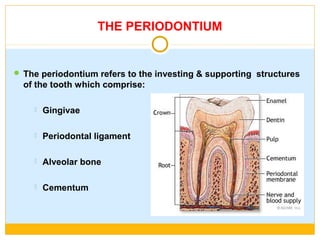
THE PERIODONTIUM
 The periodontium refers to the investing & supporting structures
of the tooth which comprise:
 Gingivae
 Periodontal ligament
 Alveolar bone
 Cementum
PATHOGENESIS OF PERIODONTAL DISEASE IN
PREGNANCY.
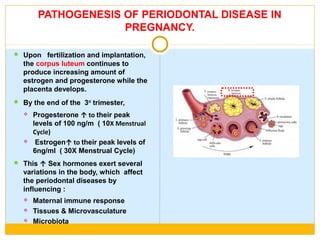
 Upon fertilization and implantation,
the corpus luteum continues to
produce increasing amount of
estrogen and progesterone while the
placenta develops.
 By the end of the 3rd
trimester,
 Progesterone ↑ to their peak
levels of 100 ng/m ( 10X Menstrual
Cycle)
 Estrogen↑ to their peak levels of
6ng/ml ( 30X Menstrual Cycle)
 This ↑ Sex hormones exert several
variations in the body, which affect
the periodontal diseases by
influencing :
 Maternal immune response
 Tissues & Microvasculature
 Microbiota
Effects on maternal immune responses
 For bacteria to colonize subgingival sites and ultimately infiltrate
the underlying connective tissue, many aspects of the host
response must be evaded.
 The maternal immune response is said to be naturally
suppressed in pregnancy. This may allow the fetus to survive as
an allograft ( a tissue or organ obtained from one member of a
species and grafted to a genetically dissimilar member of the
same species. Also called homograft )
 Studies have also shown:
 ↓ in neutrophil count, chemotaxis & phagocytosis.
 ↓ cell mediated immunity & phagocytosis.
 ↓T cell response with elevated Sex hormones, especially
progesterone.
Effects of ↑ Sex hormones levels on periodontal tissue &
microvasculature
 Estrogen regulates
 Cellular proliferation,
 Differentiation,
 Keratinisation
 Progesterone :
 Influences the permeability of microvasculature,
 Alters the rate and pattern of collagen production &
 ↑ metabolic breakdown of folate (necessary for tissue maintenance) .
 Receptors for estrogen & progesterone have been demonstrated
in the gingiva, this provides direct biochemical evidence that it is
a target organ for both sex hormones.
Effects on the Microbiota
 An alteration in the composition of subgingival plaque occurs during
pregnancy due to the change in subgingival microenvironment, due to :
 ↑ accumulation of active progesterone, whose metabolism is ↓ during pregnancy
 & the ability of Prevotella Intermedia to substitute an essential growth factor,
Vitamins K, with progesterone and estrogen.
 ↑ Sex hormone in the crevicular fluid provides a growth medium for
periodontal pathogens.
 The ↑ Sex hormone ↓ the degree of keratinization of the gingival epithelium
& alter the connective tissue ground substance together with ↑ epithelial
glycogen, are thought to result in ↓ effectiveness of the epithelial barrier in
pregnant women.
Prevotella intermedia is a Gram-negative, obligate anaerobic pathogenic bacterium
involved in periodontal infections, including gingivitis and periodontitis, and often
found in acute necrotizing ulcerative gingivitis . It is commonly isolated from
dentoalveolar abscesses, where obligate anaerobes predominate.P. intermedia use
steroids as growth factors, so their numbers are higher in pregnant women.
COMMON PERIODONTAL DISEASES ASSOCIATED WITH
PREGNANCY
Pregnancy Gingivitis
Hyperplasia :
 Generalized
 Localized (Pregnancy epulis) : Epulis (plural epulides) is any benign
tumor (i.e. lump) situated on the gingival or alveolar mucosa. The word
literally means "on the gingiva", and describes only the location of the
mass and has no further implications on the nature of the lesion.
Tooth mobility
Periodontitis
PREGNANCY GINGIVITIS
Epidemiological studies show the prevalence of
pregnancy gingivitis ranging from 35% to 100%.
Clinically, pregnancy gingivitis may range from mild to
severe gingival inflammation.
It may be characterised by
 Erythema,
 Edema,
 ↑ Bleeding tendency.
 ↑ Tissue edema may lead to increased probing depth.
PREGNANCY GINGIVITIS
Pregnancy does not cause gingivitis, but may
aggravate pre–existing disease.
The most marked changes are seen in gingival
vasculature.
Anterior site inflammation may be exacerbated by
increased mouth breathing, primarily in third trimester
due to pregnancy rhinitis.
The gingival changes usually resolve within a few
months of delivery if local irritants are eliminated .
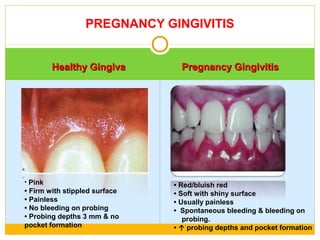
Healthy GingivaHealthy Gingiva Pregnancy GingivitisPregnancy Gingivitis
PREGNANCY GINGIVITIS
• Pink
• Firm with stippled surface
• Painless
• No bleeding on probing
• Probing depths 3 mm & no
pocket formation
• Red/bluish red
• Soft with shiny surface
• Usually painless
• Spontaneous bleeding & bleeding on
probing.
• ↑ probing depths and pocket formation
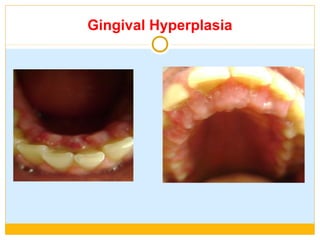
Gingival Hyperplasia
In some cases, after pregnancy, the gingiva will return
to normal height and contour with no further Tx
required.
In others, some enlargement may persist & surgical
gingivoplasty may still be indicated.
In severe cases, Closing the mouth & chewing can be
difficult without traumatising the hyperplastic tissue.
This leads to pain.
Tooth movement - the continously expanding gingiva
is present constant force
Gingival Hyperplasia
Pregnancy Epulis
 Pyogenic granuloma or pregnancy epulis occur in 0.2% to 9.6% of
pregnancies.
 The anterior region of the maxilla is most commonly affected & the tumor
appears most commonly in 2nd
& 3rd
month of gestation. They bleed easily;
and may become hyperplastic or nodular.
 Clinically and histologically, they are indistinguishable from the same
occurring in non pregnant females and men.
TOOTH MOBILITY
Increased tooth mobility has been detected in even in
periodontally healthy pregnant women.
The upper incisors are most mobile during the last
month of pregnancy.
Development of such mobility is possibly due to :
 Mineral shift
 Relaxin hormone
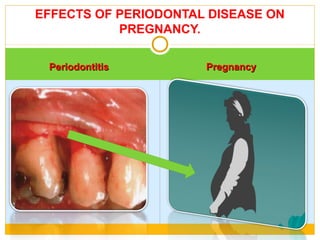
PeriodontitisPeriodontitis PregnancyPregnancy
EFFECTS OF PERIODONTAL DISEASE ON
PREGNANCY.
EFFECTS OF PERIODONTAL DISEASE ON PREGNANCY.
Periodontitis has an association with:
 Infective Endocarditis
 Diabetes.
 Cardiovascular Disease
 Pre-Term, Low Birth Weight Infants (PTLBW)
 Pulmonary Disease
 Others
EFFECTS OF PERIODONTAL DISEASE ON PREGNANCY.
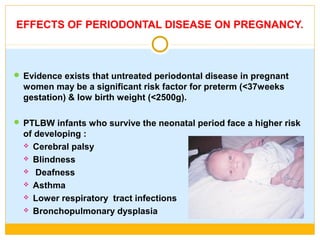
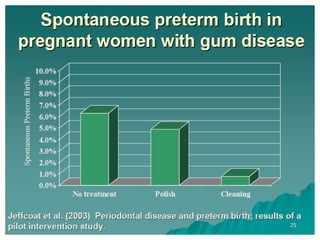
 Evidence exists that untreated periodontal disease in pregnant
women may be a significant risk factor for preterm (<37weeks
gestation) & low birth weight (<2500g).
 PTLBW infants who survive the neonatal period face a higher risk
of developing :
 Cerebral palsy
 Blindness
 Deafness
 Asthma
 Lower respiratory tract infections
 Bronchopulmonary dysplasia
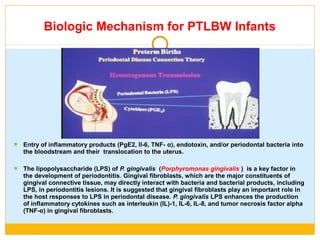
 Entry of inflammatory products (PgE2, Il-6, TNF- α), endotoxin, and/or periodontal bacteria into
the bloodstream and their translocation to the uterus.
 The lipopolysaccharide (LPS) of P. gingivalis (Porphyromonas gingivalis ) is a key factor in
the development of periodontitis. Gingival fibroblasts, which are the major constituents of
gingival connective tissue, may directly interact with bacteria and bacterial products, including
LPS, in periodontitis lesions. It is suggested that gingival fibroblasts play an important role in
the host responses to LPS in periodontal disease. P. gingivalis LPS enhances the production
of inflammatory cytokines such as interleukin (IL)-1, IL-6, IL-8, and tumor necrosis factor alpha
(TNF-α) in gingival fibroblasts.
Biologic Mechanism for PTLBW Infants
EFFECTS OF PERIODONTAL DISEASE ON
PREGNANCY.
 The current opinion is that the co–relation of periodontal disease to (PLBW)
infants occur as a result of infection, & is mediated indirectly mainly by the
translocation of :
 Bacterial products e.g. endotoxin & the action of maternally produced
inflammatory mediators
 Biologically active molecules e.g. PGE2 , TNF – α, IL- 6 which are normally involved
in normal parturition, are raised to artificially ↑ levels by the infection process,
which may foster premature labor .
 Progesterone stimulates the production of prostaglandins , PGE2 in particular,
which are potent mediators of the inflammatory response.
 There is a 55–fold increase in the proportion of P. Intermedia in pregnant women
compared with non–pregnant controls
TREATMENTS
Prevention:
Nutrition for Oral Health
 Avoid refined CHO & excessive Soft Diet.
 Raw fruits & vegetables.
 Dairy products.
Supplements
 Vitamin B
 Vitamin C
 Calcium
TREATMENTS
ORAL HYGIENE :
 ↓ THE BACTERIA LOAD IN THE MOUTH.
 Brushing & Flossing
 Antibacterial mouth rinse
 Xylitol gum mint
 KEEP ROUTINE DENTAL VISIT
TREATMENTS
GUIDELINES FOR TREATING THE PREGNANT PATIENT :
 Elective dental procedures can be delayed until after delivery,
however most common dental procedures can be safely
performed during pregnancy.
 Emergency dental treatment can and should be provided any time
during the pregnancy regardless of trimester.
 The best time to address active dental disease during pregnancy
is during the 2nd
trimester & early part of the 3rd
trimester.
COMPLICATIONS
 There is a strong tendency for dentists to postpone Rx until after
delivery because of the added risks involving:
 Radiographs
 Drug prescription &
 Recurrence
Complications may arise during dental procedures
such as :
 Syncope,
 Hemorrhage,
 Enhanced gag reflex,
 Supine hypotensive syndrome,
 Seizures &
 Gestational hyperglycemia.
BABY SAFELY DELIVERED
CONCLUSION
 Both estrogen and progesterone affect the oral cavity significantly.
Fortunately, healthy women experience minimal and transient side effects
from variation in hormone levels.
 Although a significant proportion of pregnant women suffers from
pregnancy gingivitis, this condition is both self limiting and transient.
 Gingival tissues return to their original healthy state postpartum when
estrogen and progesterone levels reach baseline values.
 However, women who are susceptible or have a pre–existing gingival
condition should seek treatment to prevent extension of the
inflammatory process into the deeper structures of the periodontium that
may cause bacteremia.
 Hence routine peridontal examination should be included as one of the
antenatal check up during pregnancy and any dysfunction should be
thoroughly investigated and treated for the sake of health of the mother
and baby.
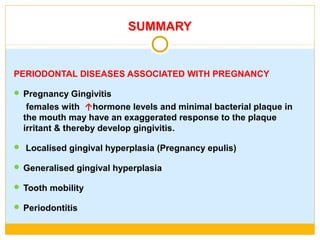
SUMMARY
PERIODONTAL DISEASES ASSOCIATED WITH PREGNANCY
 Pregnancy Gingivitis
females with ↑hormone levels and minimal bacterial plaque in
the mouth may have an exaggerated response to the plaque
irritant & thereby develop gingivitis.
 Localised gingival hyperplasia (Pregnancy epulis)
 Generalised gingival hyperplasia
 Tooth mobility
 Periodontitis
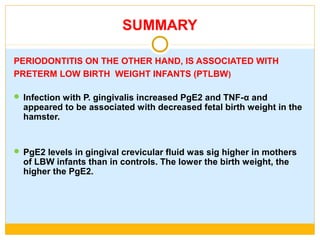
SUMMARY
PERIODONTITIS ON THE OTHER HAND, IS ASSOCIATED WITH
PRETERM LOW BIRTH WEIGHT INFANTS (PTLBW)
 Infection with P. gingivalis increased PgE2 and TNF-α and
appeared to be associated with decreased fetal birth weight in the
hamster.
 PgE2 levels in gingival crevicular fluid was sig higher in mothers
of LBW infants than in controls. The lower the birth weight, the
higher the PgE2.
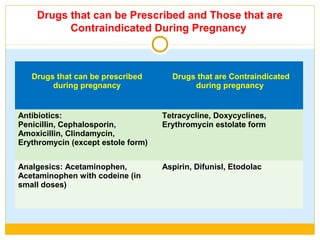
Drugs that can be Prescribed and Those that are
Contraindicated During Pregnancy
Drugs that can be prescribed
during pregnancy
Drugs that are Contraindicated
during pregnancy
Antibiotics:
Penicillin, Cephalosporin,
Amoxicillin, Clindamycin,
Erythromycin (except estole form)
Tetracycline, Doxycyclines,
Erythromycin estolate form
Analgesics: Acetaminophen,
Acetaminophen with codeine (in
small doses)
Aspirin, Difunisl, Etodolac
THANK YOUTHANK YOU

6.pregnancy the periodontium

  • 1.
    DR SUHAIL KISHAWI PREGNANCY& THE PERIODONTIUM
  • 2.
    OUTLINE  INTRODUCTION.  PREGNANCY& ITS FEATURES  THE PERIODONTIUM  PATHOGENESIS OF PERIODONTAL DISEASE IN PREGNANCY.  EFFECTS OF PERIODONTAL DISEASE ON PREGNANCY.  TREATMENTS  CONCLUSION  SUMMARY
  • 3.
    INTRODUCTION Females experience aseries of changes in their body which affect the periodontium. These changes could be physiological or non-physiological:  Physiological  Puberty  Menstrual cycle  Pregnancy  Menopause  Non-physiological  Oral contraceptives
  • 4.
    PREGNANCY & ITSFEATURES Pregnancy is a physiological condition of having a developing embryo/fetus in the body, after fertilization. Normal pregnancy term, from conception to birth is 37- 42 wks & can be divided into three trimesters: T1: 0-12 wks T2: 12-28 wks T3: 28-40 wks. Delivery at < 37wks is regarded as Preterm . Average birth weight is taken to be about 3.5kg. Birth weight < 2.5 kg is taken as a low birth weight (LBW).
  • 5.
  • 6.
    PREGNANCY FEATURES The numerousphysical and physiological changes that occur during pregnancy affect every major body system resulting in localized physical alterations in many parts of the body, including the oral cavity. These alterations include: Cardiovascular System ↑CO, ↑ HR, ↑BV ↓ BP due to ↓ P.R ↑ risk of hypotension due to ↓venous return ↑ Varicose veins, ↑hemorrhoid & ↑leg edema. Hematologic system ↓Hb & hematocrit count due to hemodilution. ↑ Leucocyte count but impaired function.
  • 7.
    PREGNANCY FEATURES Gastrointestinal System ↑Gastroesophagealreflux ↓G.I motility & constipation Respiratory System ↑O consumption₂ Endocrine System ↑ Estrogen ↑Progesterone hCG ( human chorionic gonadotrophin) Relaxin
  • 8.
    THE PERIODONTIUM  Theperiodontium refers to the investing & supporting structures of the tooth which comprise:  Gingivae  Periodontal ligament  Alveolar bone  Cementum
  • 9.
    PATHOGENESIS OF PERIODONTALDISEASE IN PREGNANCY.  Upon fertilization and implantation, the corpus luteum continues to produce increasing amount of estrogen and progesterone while the placenta develops.  By the end of the 3rd trimester,  Progesterone ↑ to their peak levels of 100 ng/m ( 10X Menstrual Cycle)  Estrogen↑ to their peak levels of 6ng/ml ( 30X Menstrual Cycle)  This ↑ Sex hormones exert several variations in the body, which affect the periodontal diseases by influencing :  Maternal immune response  Tissues & Microvasculature  Microbiota
  • 10.
    Effects on maternalimmune responses  For bacteria to colonize subgingival sites and ultimately infiltrate the underlying connective tissue, many aspects of the host response must be evaded.  The maternal immune response is said to be naturally suppressed in pregnancy. This may allow the fetus to survive as an allograft ( a tissue or organ obtained from one member of a species and grafted to a genetically dissimilar member of the same species. Also called homograft )  Studies have also shown:  ↓ in neutrophil count, chemotaxis & phagocytosis.  ↓ cell mediated immunity & phagocytosis.  ↓T cell response with elevated Sex hormones, especially progesterone.
  • 11.
    Effects of ↑Sex hormones levels on periodontal tissue & microvasculature  Estrogen regulates  Cellular proliferation,  Differentiation,  Keratinisation  Progesterone :  Influences the permeability of microvasculature,  Alters the rate and pattern of collagen production &  ↑ metabolic breakdown of folate (necessary for tissue maintenance) .  Receptors for estrogen & progesterone have been demonstrated in the gingiva, this provides direct biochemical evidence that it is a target organ for both sex hormones.
  • 12.
    Effects on theMicrobiota  An alteration in the composition of subgingival plaque occurs during pregnancy due to the change in subgingival microenvironment, due to :  ↑ accumulation of active progesterone, whose metabolism is ↓ during pregnancy  & the ability of Prevotella Intermedia to substitute an essential growth factor, Vitamins K, with progesterone and estrogen.  ↑ Sex hormone in the crevicular fluid provides a growth medium for periodontal pathogens.  The ↑ Sex hormone ↓ the degree of keratinization of the gingival epithelium & alter the connective tissue ground substance together with ↑ epithelial glycogen, are thought to result in ↓ effectiveness of the epithelial barrier in pregnant women. Prevotella intermedia is a Gram-negative, obligate anaerobic pathogenic bacterium involved in periodontal infections, including gingivitis and periodontitis, and often found in acute necrotizing ulcerative gingivitis . It is commonly isolated from dentoalveolar abscesses, where obligate anaerobes predominate.P. intermedia use steroids as growth factors, so their numbers are higher in pregnant women.
  • 13.
    COMMON PERIODONTAL DISEASESASSOCIATED WITH PREGNANCY Pregnancy Gingivitis Hyperplasia :  Generalized  Localized (Pregnancy epulis) : Epulis (plural epulides) is any benign tumor (i.e. lump) situated on the gingival or alveolar mucosa. The word literally means "on the gingiva", and describes only the location of the mass and has no further implications on the nature of the lesion. Tooth mobility Periodontitis
  • 14.
    PREGNANCY GINGIVITIS Epidemiological studiesshow the prevalence of pregnancy gingivitis ranging from 35% to 100%. Clinically, pregnancy gingivitis may range from mild to severe gingival inflammation. It may be characterised by  Erythema,  Edema,  ↑ Bleeding tendency.  ↑ Tissue edema may lead to increased probing depth.
  • 15.
    PREGNANCY GINGIVITIS Pregnancy doesnot cause gingivitis, but may aggravate pre–existing disease. The most marked changes are seen in gingival vasculature. Anterior site inflammation may be exacerbated by increased mouth breathing, primarily in third trimester due to pregnancy rhinitis. The gingival changes usually resolve within a few months of delivery if local irritants are eliminated .
  • 16.
    Healthy GingivaHealthy GingivaPregnancy GingivitisPregnancy Gingivitis PREGNANCY GINGIVITIS • Pink • Firm with stippled surface • Painless • No bleeding on probing • Probing depths 3 mm & no pocket formation • Red/bluish red • Soft with shiny surface • Usually painless • Spontaneous bleeding & bleeding on probing. • ↑ probing depths and pocket formation
  • 17.
    Gingival Hyperplasia In somecases, after pregnancy, the gingiva will return to normal height and contour with no further Tx required. In others, some enlargement may persist & surgical gingivoplasty may still be indicated. In severe cases, Closing the mouth & chewing can be difficult without traumatising the hyperplastic tissue. This leads to pain. Tooth movement - the continously expanding gingiva is present constant force
  • 18.
  • 19.
    Pregnancy Epulis  Pyogenicgranuloma or pregnancy epulis occur in 0.2% to 9.6% of pregnancies.  The anterior region of the maxilla is most commonly affected & the tumor appears most commonly in 2nd & 3rd month of gestation. They bleed easily; and may become hyperplastic or nodular.  Clinically and histologically, they are indistinguishable from the same occurring in non pregnant females and men.
  • 20.
    TOOTH MOBILITY Increased toothmobility has been detected in even in periodontally healthy pregnant women. The upper incisors are most mobile during the last month of pregnancy. Development of such mobility is possibly due to :  Mineral shift  Relaxin hormone
  • 21.
  • 22.
    EFFECTS OF PERIODONTALDISEASE ON PREGNANCY. Periodontitis has an association with:  Infective Endocarditis  Diabetes.  Cardiovascular Disease  Pre-Term, Low Birth Weight Infants (PTLBW)  Pulmonary Disease  Others
  • 23.
    EFFECTS OF PERIODONTALDISEASE ON PREGNANCY.  Evidence exists that untreated periodontal disease in pregnant women may be a significant risk factor for preterm (<37weeks gestation) & low birth weight (<2500g).  PTLBW infants who survive the neonatal period face a higher risk of developing :  Cerebral palsy  Blindness  Deafness  Asthma  Lower respiratory tract infections  Bronchopulmonary dysplasia
  • 24.
     Entry ofinflammatory products (PgE2, Il-6, TNF- α), endotoxin, and/or periodontal bacteria into the bloodstream and their translocation to the uterus.  The lipopolysaccharide (LPS) of P. gingivalis (Porphyromonas gingivalis ) is a key factor in the development of periodontitis. Gingival fibroblasts, which are the major constituents of gingival connective tissue, may directly interact with bacteria and bacterial products, including LPS, in periodontitis lesions. It is suggested that gingival fibroblasts play an important role in the host responses to LPS in periodontal disease. P. gingivalis LPS enhances the production of inflammatory cytokines such as interleukin (IL)-1, IL-6, IL-8, and tumor necrosis factor alpha (TNF-α) in gingival fibroblasts. Biologic Mechanism for PTLBW Infants
  • 25.
    EFFECTS OF PERIODONTALDISEASE ON PREGNANCY.  The current opinion is that the co–relation of periodontal disease to (PLBW) infants occur as a result of infection, & is mediated indirectly mainly by the translocation of :  Bacterial products e.g. endotoxin & the action of maternally produced inflammatory mediators  Biologically active molecules e.g. PGE2 , TNF – α, IL- 6 which are normally involved in normal parturition, are raised to artificially ↑ levels by the infection process, which may foster premature labor .  Progesterone stimulates the production of prostaglandins , PGE2 in particular, which are potent mediators of the inflammatory response.  There is a 55–fold increase in the proportion of P. Intermedia in pregnant women compared with non–pregnant controls
  • 27.
    TREATMENTS Prevention: Nutrition for OralHealth  Avoid refined CHO & excessive Soft Diet.  Raw fruits & vegetables.  Dairy products. Supplements  Vitamin B  Vitamin C  Calcium
  • 28.
    TREATMENTS ORAL HYGIENE : ↓ THE BACTERIA LOAD IN THE MOUTH.  Brushing & Flossing  Antibacterial mouth rinse  Xylitol gum mint  KEEP ROUTINE DENTAL VISIT
  • 29.
    TREATMENTS GUIDELINES FOR TREATINGTHE PREGNANT PATIENT :  Elective dental procedures can be delayed until after delivery, however most common dental procedures can be safely performed during pregnancy.  Emergency dental treatment can and should be provided any time during the pregnancy regardless of trimester.  The best time to address active dental disease during pregnancy is during the 2nd trimester & early part of the 3rd trimester.
  • 30.
    COMPLICATIONS  There isa strong tendency for dentists to postpone Rx until after delivery because of the added risks involving:  Radiographs  Drug prescription &  Recurrence Complications may arise during dental procedures such as :  Syncope,  Hemorrhage,  Enhanced gag reflex,  Supine hypotensive syndrome,  Seizures &  Gestational hyperglycemia.
  • 31.
  • 32.
    CONCLUSION  Both estrogenand progesterone affect the oral cavity significantly. Fortunately, healthy women experience minimal and transient side effects from variation in hormone levels.  Although a significant proportion of pregnant women suffers from pregnancy gingivitis, this condition is both self limiting and transient.  Gingival tissues return to their original healthy state postpartum when estrogen and progesterone levels reach baseline values.  However, women who are susceptible or have a pre–existing gingival condition should seek treatment to prevent extension of the inflammatory process into the deeper structures of the periodontium that may cause bacteremia.  Hence routine peridontal examination should be included as one of the antenatal check up during pregnancy and any dysfunction should be thoroughly investigated and treated for the sake of health of the mother and baby.
  • 33.
    SUMMARY PERIODONTAL DISEASES ASSOCIATEDWITH PREGNANCY  Pregnancy Gingivitis females with ↑hormone levels and minimal bacterial plaque in the mouth may have an exaggerated response to the plaque irritant & thereby develop gingivitis.  Localised gingival hyperplasia (Pregnancy epulis)  Generalised gingival hyperplasia  Tooth mobility  Periodontitis
  • 34.
    SUMMARY PERIODONTITIS ON THEOTHER HAND, IS ASSOCIATED WITH PRETERM LOW BIRTH WEIGHT INFANTS (PTLBW)  Infection with P. gingivalis increased PgE2 and TNF-α and appeared to be associated with decreased fetal birth weight in the hamster.  PgE2 levels in gingival crevicular fluid was sig higher in mothers of LBW infants than in controls. The lower the birth weight, the higher the PgE2.
  • 35.
    Drugs that canbe Prescribed and Those that are Contraindicated During Pregnancy Drugs that can be prescribed during pregnancy Drugs that are Contraindicated during pregnancy Antibiotics: Penicillin, Cephalosporin, Amoxicillin, Clindamycin, Erythromycin (except estole form) Tetracycline, Doxycyclines, Erythromycin estolate form Analgesics: Acetaminophen, Acetaminophen with codeine (in small doses) Aspirin, Difunisl, Etodolac
  • 36.