NETA
International Electrical Testing Association
Introduction Sample Published Standards
History
Benefits
Agenda
Topics Covered
Standard Development Process
Joint Cooperation with other SI
What is Neta?
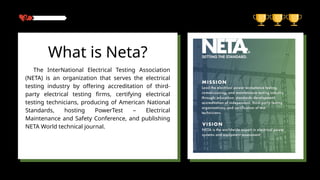
The InterNational Electrical Testing Association
(NETA) is an organization that serves the electrical
testing industry by offering accreditation of third-
party electrical testing firms, certifying electrical
testing technicians, producing of American National
Standards, hosting PowerTest – Electrical
Maintenance and Safety Conference, and publishing
NETA World technical journal.
What makes NETA so important?
NETA sets up the guidelines for testing technicians to follow. They set up
standards that can be followed when manufacturers literature cannot be
found or is available. NETA also sets up certifications for technicians to
acquire to prove that they are qualified to be performing quality work. They
are an independent standard that is not biased to take a customers side, or
a manufacturers side. They provide standards to assure that electrical
equipment functions properly and as intended per contract drawings.
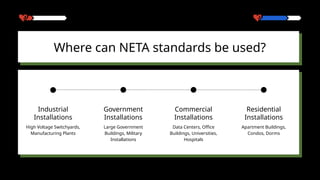
Where can NETA standards be used?
Industrial
Installations
High Voltage Switchyards,
Manufacturing Plants
Government
Installations
Large Government
Buildings, Military
Installations
Residential
Installations
Apartment Buildings,
Condos, Dorms
Commercial
Installations
Data Centers, Office
Buildings, Universities,
Hospitals
In the 1960s, the electrical industry was booming thanks to lower prices and
the huge increase in the number and reach of power lines, making electricity
more in demand than ever before. By 1972, it was widely recognized that this
rapid growth demanded some oversight to promote safety, system reliability,
and quality testing. Nine companies came together and channeled this need
into the creation of NETA, the National Electrical Testing Association. That
same year, NETA released its first standard, Acceptance Testing Specifications
for Electrical Power Equipment and Systems. NETA then turned its attention to
improving the work of electrical technicians. To that end, the NETA Electrical
Testing Technician Certification program was established in 1975. In
recognition that the association had reached beyond United States borders,
the name was changed to the InterNational Electrical Testing Association in
1983.
History
In its ever-increasing desire to keep ahead of the changing industry, the
NETA Accredited Company (NAC) program was instituted in 1991. Shortly
thereafter, a program was developed for individual professionals in the
electrical power industry to join NETA as alliance partners. NETA became
ANSI Accredited in 1996, and by 2000 had released the first ANSI Accredited
Standard, the ANSI/NETA Standard for Certification of Electrical Testing
Technicians. A version of the ANSI/NETA Standard for Maintenance Testing
Specifications was first published in 1975, with the most recent edition
released in 2015. In 2013, the latest version of NETA's very first publication, the
ANSI/NETA Standard for Acceptance Testing Specifications for Electrical Power
Equipment and Systems, was verified as an American National Standard.
History
Standard Development
Process
Go Back to Agenda Page
YES NO
1. Identify the need for a new standard
NETA identifies the need for a new standard based on
changes in technology, new industry developments, or
emerging issues related to electrical testing and
commissioning.
2. Formation of a technical committee
Once the need for a new standard is identified, a technical
committee is formed. The committee is composed of subject
matter experts and stakeholders in the industry, including
NETA members and other professionals.
3. Research and drafting
The technical committee conducts research, reviews existing
standards, and drafts the new standard. The draft standard
undergoes a peer review process to ensure that it is accurate,
complete, and meets industry needs.
4. Balloting and public review
Once the draft standard is complete, it is submitted to the
NETA Standards Review Council for approval. If approved, the
standard is released for public review and ballot by NETA
members, other industry stakeholders, and the public.
Feedback is collected and considered during the balloting
process.
5. Final approval and publication
Once the balloting and public review process is complete, the
standard is finalized and approved by the NETA Standards
Review Council. The standard is then published and made
available for use by the industry.
6. Maintenance and review
NETA standards are periodically reviewed and updated to
ensure that they remain current and relevant. The technical
committees responsible for each standard are responsible for
maintaining and updating the standard as needed.
Sample Published standards
1. ANSI/NETA ATS-2021:
Standard for Acceptance Testing Specifications for Electrical Power
Equipment and Systems: This standard provides guidelines and
specifications for the acceptance testing of electrical power equipment
and systems. It covers topics such as testing procedures, safety
requirements, and documentation.
Sample Published standards
2. ANSI/NETA MTS-2022:
Standard for Maintenance Testing Specifications for Electrical Power
Equipment and Systems: This standard provides guidelines and
specifications for the maintenance testing of electrical power
equipment and systems. It covers topics such as testing intervals,
safety requirements, and documentation.
Sample Published standards
3. ANSI/NETA ECS-2021:
Standard for Electrical Commissioning Specifications for Electrical
Power Equipment and Systems: This standard provides guidelines and
specifications for the commissioning of electrical power equipment
and systems. It covers topics such as planning, testing procedures,
safety requirements, and documentation.
Sample Published standards
4. ANSI/NETA ETT-2018:
Standard for Electrical Safety in the Workplace: This standard provides
guidelines for electrical safety in the workplace. It covers topics such as
hazard identification, protective equipment, training, and emergency
response.
Sample Published standards
5. ANSI/NETA PTS-2021:
Standard for Performing Arc-Flash Hazard Calculations: This standard
provides guidelines for performing arc-flash hazard calculations. It
covers topics such as data collection, calculations, and reporting.
Joint Cooperation or
Agreement with other SI
Providers
NETA has a formal
agreement with NICET
to recognize and honor
NICET certification for
certain NETA
certification programs.
National Institute for Certification
in Engineering Technologies
(NICET)
NETA collaborates with
IAEI to promote
electrical safety and
provide education and
training to industry
professionals.
InterNational Association of
Electrical Inspectors (IAEI)
NETA has partnered with
IEC to offer electrical
training and certification
programs for IEC
members.
International Electrical Contractors
(IEC)
NETA has collaborated with
IEEE on various standards
related to electrical testing,
including IEEE 3003.1 Standard
for Maintenance, Testing, and
Replacement of Vented Lead-
Acid Batteries for Stationary
Applications.
International Association of
Electrical and Electronics
Engineers (IEEE)
NETA has worked with
EGSA to develop
industry guidelines and
standards related to
generator testing and
maintenance.
Electrical Generating Systems
Association (EGSA)
NETA is a member of IEC, a global
organization that develops
international standards for
electrical technologies. NETA
participates in various technical
committees and working groups
within IEC, and contributes to the
development of international
standards related to electrical
testing and commissioning.
International Electrotechnical
Commission (IEC)
Benefits
• Industry Standards and Best Practices:
NETA develops and publishes standards and best practices related to
electrical testing, commissioning, and maintenance. These guidelines
help ensure that electrical systems are safe, reliable, and efficient, and
help prevent equipment failures and downtime.
Benefits
2. Certification Programs:
NETA offers certification programs for electrical testing technicians and
engineers. These programs help ensure that professionals in the
industry have the necessary skills and knowledge to perform their jobs
safely and effectively.
Benefits
3. Training and Education:
NETA provides training and education programs for its members and
the industry. These programs cover a wide range of topics, from
electrical safety to testing procedures to equipment maintenance, and
help ensure that industry professionals are up-to-date on the latest
developments and best practices.
Benefits
4. Networking and Community:
NETA provides a platform for industry professionals to connect and
share knowledge and resources. This network helps to foster
collaboration and innovation, and provides a supportive community for
professionals in the industry.
Benefits
5. Advocacy and Promotion:
NETA advocates for the industry and promotes the importance of
electrical testing and commissioning. This helps to raise awareness of
the critical role that these activities play in ensuring the safety and
reliability of electrical power systems.
Thank you!
Prepared by: Group 2
YES NO
Niel Ritchie Fajutnao
Lovely Joy Molo
Group 2
Florence Jay Fortu
Reino Falculan
Rey Joseph Panagsagan
Kimberly Rios
Kenjee Alec Chua
Prince Aduel Mariño
Jan Andrei Geroleo
Michael Tamayo

664100688-NETA.pptx.....................

  • 1.
  • 2.
    Introduction Sample PublishedStandards History Benefits Agenda Topics Covered Standard Development Process Joint Cooperation with other SI
  • 3.
    What is Neta? TheInterNational Electrical Testing Association (NETA) is an organization that serves the electrical testing industry by offering accreditation of third- party electrical testing firms, certifying electrical testing technicians, producing of American National Standards, hosting PowerTest – Electrical Maintenance and Safety Conference, and publishing NETA World technical journal.
  • 4.
    What makes NETAso important? NETA sets up the guidelines for testing technicians to follow. They set up standards that can be followed when manufacturers literature cannot be found or is available. NETA also sets up certifications for technicians to acquire to prove that they are qualified to be performing quality work. They are an independent standard that is not biased to take a customers side, or a manufacturers side. They provide standards to assure that electrical equipment functions properly and as intended per contract drawings.
  • 5.
    Where can NETAstandards be used? Industrial Installations High Voltage Switchyards, Manufacturing Plants Government Installations Large Government Buildings, Military Installations Residential Installations Apartment Buildings, Condos, Dorms Commercial Installations Data Centers, Office Buildings, Universities, Hospitals
  • 6.
    In the 1960s,the electrical industry was booming thanks to lower prices and the huge increase in the number and reach of power lines, making electricity more in demand than ever before. By 1972, it was widely recognized that this rapid growth demanded some oversight to promote safety, system reliability, and quality testing. Nine companies came together and channeled this need into the creation of NETA, the National Electrical Testing Association. That same year, NETA released its first standard, Acceptance Testing Specifications for Electrical Power Equipment and Systems. NETA then turned its attention to improving the work of electrical technicians. To that end, the NETA Electrical Testing Technician Certification program was established in 1975. In recognition that the association had reached beyond United States borders, the name was changed to the InterNational Electrical Testing Association in 1983. History
  • 7.
    In its ever-increasingdesire to keep ahead of the changing industry, the NETA Accredited Company (NAC) program was instituted in 1991. Shortly thereafter, a program was developed for individual professionals in the electrical power industry to join NETA as alliance partners. NETA became ANSI Accredited in 1996, and by 2000 had released the first ANSI Accredited Standard, the ANSI/NETA Standard for Certification of Electrical Testing Technicians. A version of the ANSI/NETA Standard for Maintenance Testing Specifications was first published in 1975, with the most recent edition released in 2015. In 2013, the latest version of NETA's very first publication, the ANSI/NETA Standard for Acceptance Testing Specifications for Electrical Power Equipment and Systems, was verified as an American National Standard. History
  • 8.
  • 9.
    1. Identify theneed for a new standard NETA identifies the need for a new standard based on changes in technology, new industry developments, or emerging issues related to electrical testing and commissioning.
  • 10.
    2. Formation ofa technical committee Once the need for a new standard is identified, a technical committee is formed. The committee is composed of subject matter experts and stakeholders in the industry, including NETA members and other professionals.
  • 11.
    3. Research anddrafting The technical committee conducts research, reviews existing standards, and drafts the new standard. The draft standard undergoes a peer review process to ensure that it is accurate, complete, and meets industry needs.
  • 12.
    4. Balloting andpublic review Once the draft standard is complete, it is submitted to the NETA Standards Review Council for approval. If approved, the standard is released for public review and ballot by NETA members, other industry stakeholders, and the public. Feedback is collected and considered during the balloting process.
  • 13.
    5. Final approvaland publication Once the balloting and public review process is complete, the standard is finalized and approved by the NETA Standards Review Council. The standard is then published and made available for use by the industry.
  • 14.
    6. Maintenance andreview NETA standards are periodically reviewed and updated to ensure that they remain current and relevant. The technical committees responsible for each standard are responsible for maintaining and updating the standard as needed.
  • 15.
    Sample Published standards 1.ANSI/NETA ATS-2021: Standard for Acceptance Testing Specifications for Electrical Power Equipment and Systems: This standard provides guidelines and specifications for the acceptance testing of electrical power equipment and systems. It covers topics such as testing procedures, safety requirements, and documentation.
  • 16.
    Sample Published standards 2.ANSI/NETA MTS-2022: Standard for Maintenance Testing Specifications for Electrical Power Equipment and Systems: This standard provides guidelines and specifications for the maintenance testing of electrical power equipment and systems. It covers topics such as testing intervals, safety requirements, and documentation.
  • 17.
    Sample Published standards 3.ANSI/NETA ECS-2021: Standard for Electrical Commissioning Specifications for Electrical Power Equipment and Systems: This standard provides guidelines and specifications for the commissioning of electrical power equipment and systems. It covers topics such as planning, testing procedures, safety requirements, and documentation.
  • 18.
    Sample Published standards 4.ANSI/NETA ETT-2018: Standard for Electrical Safety in the Workplace: This standard provides guidelines for electrical safety in the workplace. It covers topics such as hazard identification, protective equipment, training, and emergency response.
  • 19.
    Sample Published standards 5.ANSI/NETA PTS-2021: Standard for Performing Arc-Flash Hazard Calculations: This standard provides guidelines for performing arc-flash hazard calculations. It covers topics such as data collection, calculations, and reporting.
  • 20.
    Joint Cooperation or Agreementwith other SI Providers
  • 21.
    NETA has aformal agreement with NICET to recognize and honor NICET certification for certain NETA certification programs. National Institute for Certification in Engineering Technologies (NICET)
  • 22.
    NETA collaborates with IAEIto promote electrical safety and provide education and training to industry professionals. InterNational Association of Electrical Inspectors (IAEI)
  • 23.
    NETA has partneredwith IEC to offer electrical training and certification programs for IEC members. International Electrical Contractors (IEC)
  • 24.
    NETA has collaboratedwith IEEE on various standards related to electrical testing, including IEEE 3003.1 Standard for Maintenance, Testing, and Replacement of Vented Lead- Acid Batteries for Stationary Applications. International Association of Electrical and Electronics Engineers (IEEE)
  • 25.
    NETA has workedwith EGSA to develop industry guidelines and standards related to generator testing and maintenance. Electrical Generating Systems Association (EGSA)
  • 26.
    NETA is amember of IEC, a global organization that develops international standards for electrical technologies. NETA participates in various technical committees and working groups within IEC, and contributes to the development of international standards related to electrical testing and commissioning. International Electrotechnical Commission (IEC)
  • 27.
    Benefits • Industry Standardsand Best Practices: NETA develops and publishes standards and best practices related to electrical testing, commissioning, and maintenance. These guidelines help ensure that electrical systems are safe, reliable, and efficient, and help prevent equipment failures and downtime.
  • 28.
    Benefits 2. Certification Programs: NETAoffers certification programs for electrical testing technicians and engineers. These programs help ensure that professionals in the industry have the necessary skills and knowledge to perform their jobs safely and effectively.
  • 29.
    Benefits 3. Training andEducation: NETA provides training and education programs for its members and the industry. These programs cover a wide range of topics, from electrical safety to testing procedures to equipment maintenance, and help ensure that industry professionals are up-to-date on the latest developments and best practices.
  • 30.
    Benefits 4. Networking andCommunity: NETA provides a platform for industry professionals to connect and share knowledge and resources. This network helps to foster collaboration and innovation, and provides a supportive community for professionals in the industry.
  • 31.
    Benefits 5. Advocacy andPromotion: NETA advocates for the industry and promotes the importance of electrical testing and commissioning. This helps to raise awareness of the critical role that these activities play in ensuring the safety and reliability of electrical power systems.
  • 32.
  • 33.
    Niel Ritchie Fajutnao LovelyJoy Molo Group 2 Florence Jay Fortu Reino Falculan Rey Joseph Panagsagan Kimberly Rios Kenjee Alec Chua Prince Aduel Mariño Jan Andrei Geroleo Michael Tamayo