UNIT 6.4
MEMOIRS: EXPLORING PERSONAL
CHALLENGES
OBJECTIVE
•The student will be able Develop and
strengthen writing as needed by
planning, revising, editing and
applying appropriate sentence
structure and word order. Identify the
Parts of the Letter.
TODAY’S THEME:
I. CONJUNTIONS | DIRECT & INDIRECT
OBJECTS
•Conjunctions: A conjunction is a word
that "joins" ideas together. A conjunction
joins two parts of a sentence, two nouns
or two verbs together.
TYPES OF CONJUNCTIONS:
•COORDINATING CONJUNCTIONS:
•Use a coordinating conjunction when
you want to give equal emphasis to
two main clauses.
TYPES OF CONJUNCTIONS:
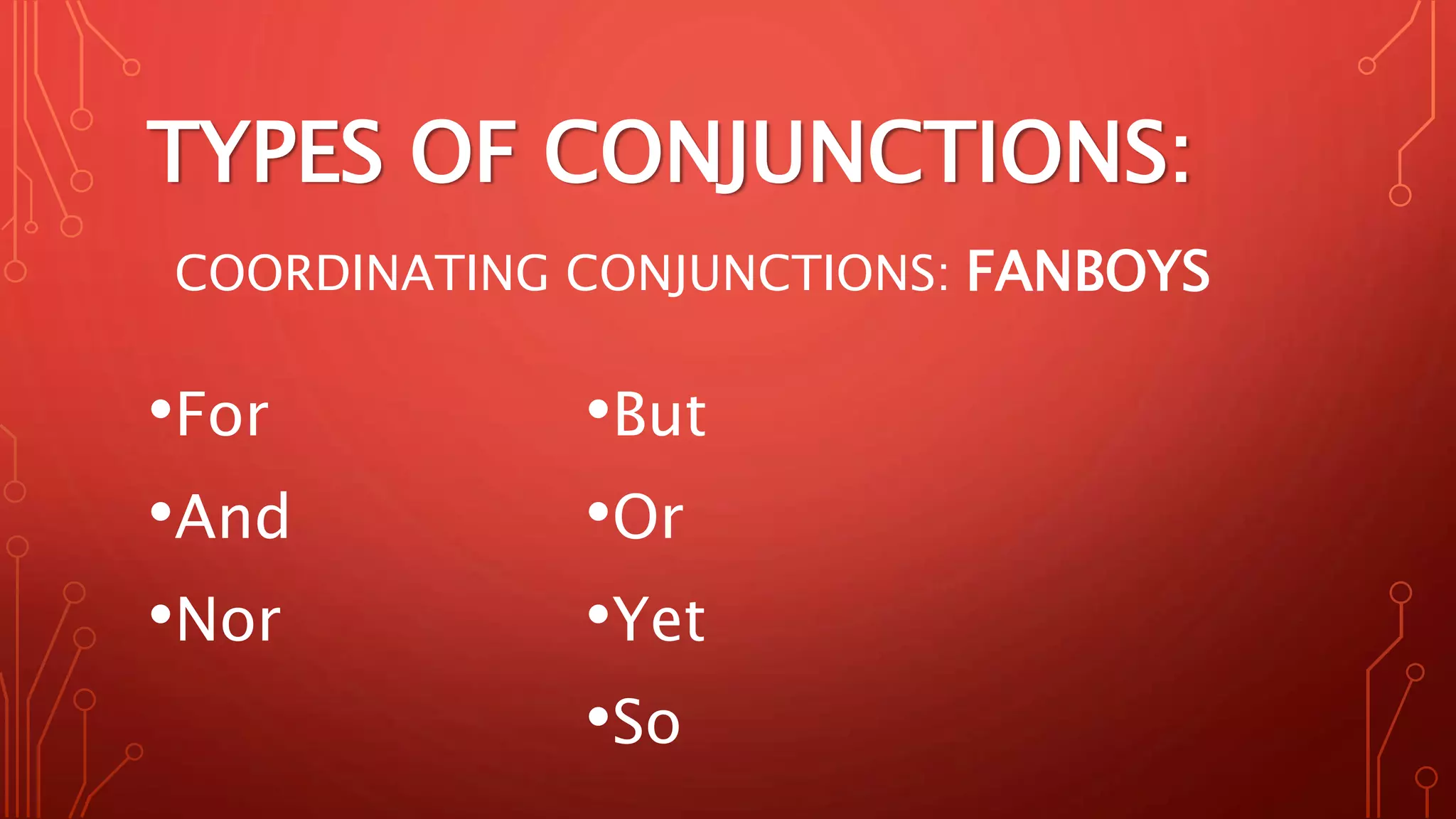
COORDINATING CONJUNCTIONS: FANBOYS
•For
•And
•Nor
•But
•Or
•Yet
•So
CORRELATIVE CONJUNCTIONS
•Correlative conjunctions are sort of like
tag-team conjunctions. They come in pairs,
and you have to use both of them in
different places in a sentence to make them
work. They get their name from the fact
that they work together (co-) and relate
one sentence element to another.
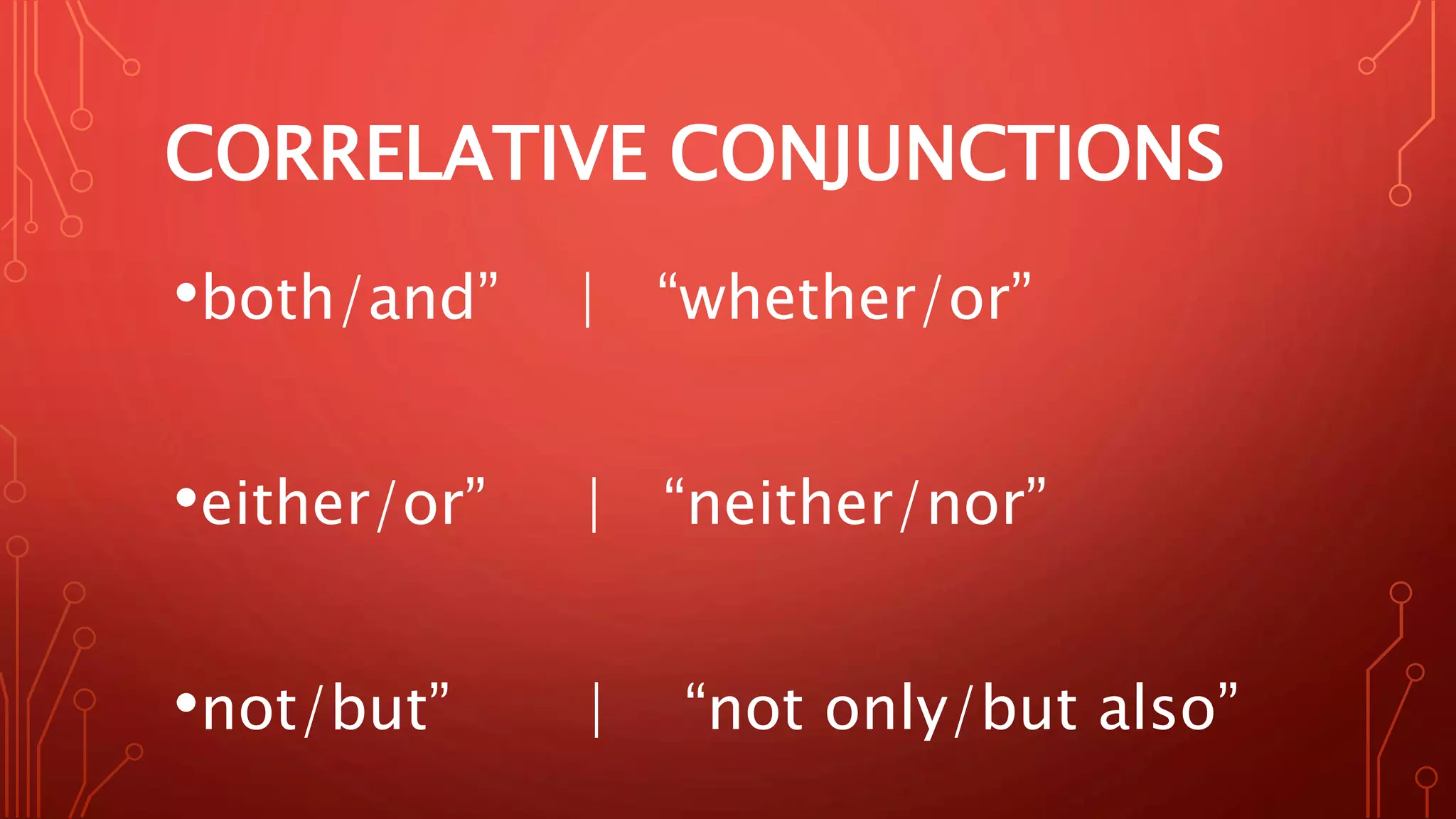
CORRELATIVE CONJUNCTIONS
•both/and” | “whether/or”
•either/or” | “neither/nor”
•not/but” | “not only/but also”
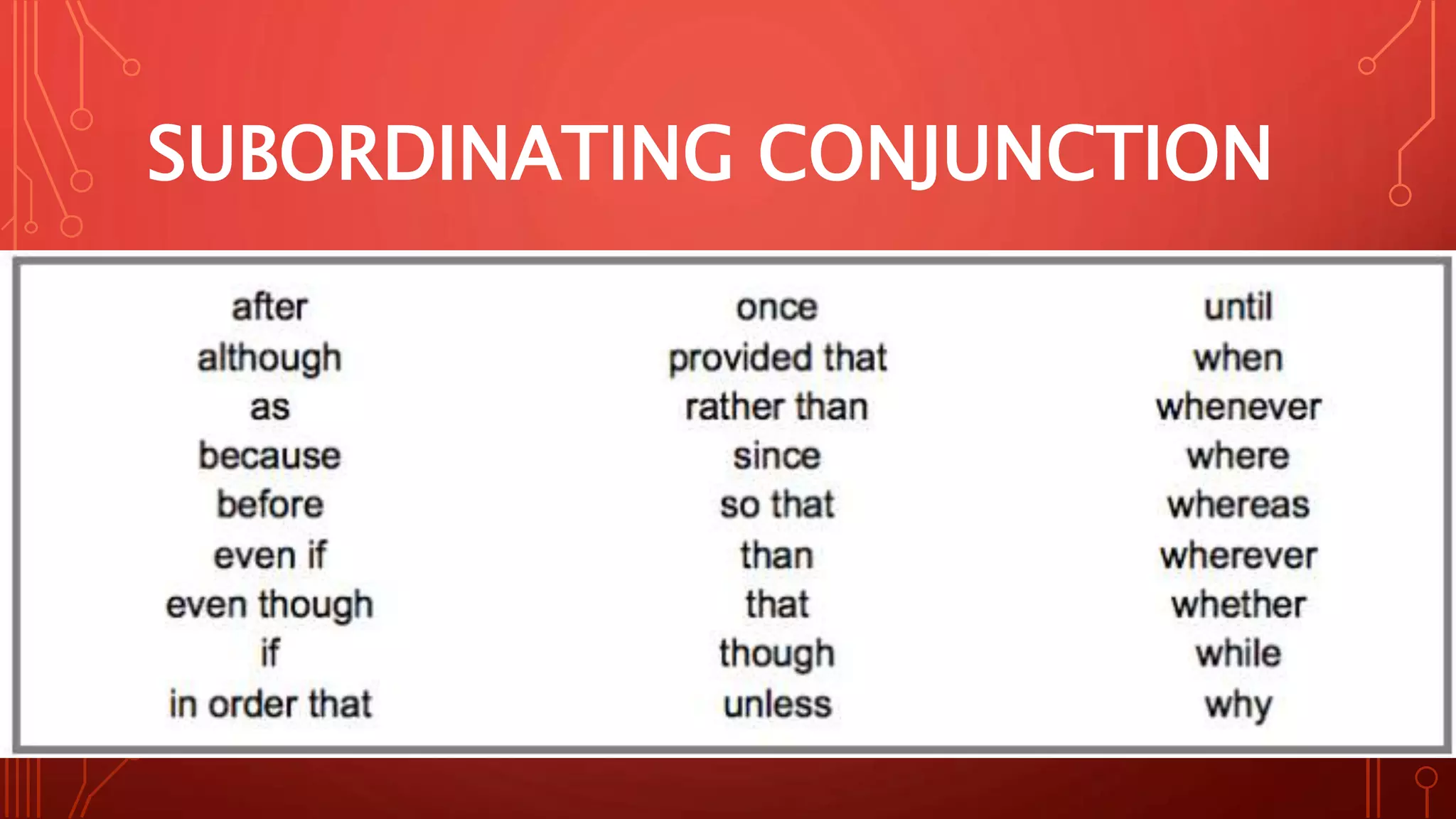
SUBORDINATING CONJUNCTION
•A subordinating conjunction is a word that
connects a main clause to a subordinate
clause. A main clause is an independent
clause that can stand alone by itself as a
sentence. In other words, a main clause does
not need any additional information to
operate as a sentence.
•For example, the sentence "The student failed
SUBORDINATING CONJUNCTION
•A subordinate clause is a dependent clause
that adds some extra information to the main
clause. These phrases cannot stand by
themselves, and their meaning is dependent
upon that of the independent clause. They
are not sentences!
•For example, "because she didn't study" is
not a complete idea worthy of being defined
SUBORDINATING CONJUNCTION
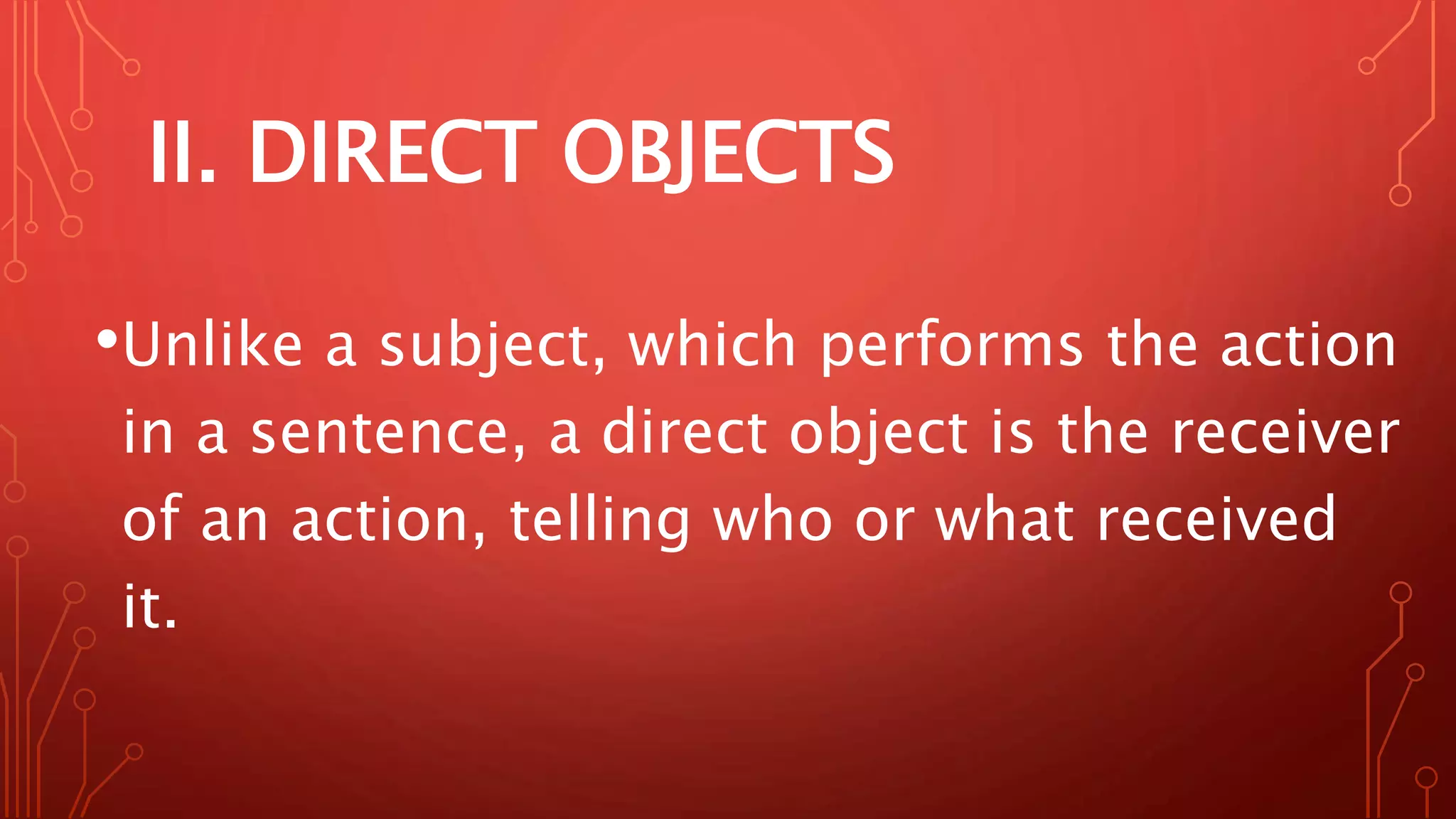
II. DIRECT OBJECTS
•Unlike a subject, which performs the action
in a sentence, a direct object is the receiver
of an action, telling who or what received
it.
II. DIRECT OBJECTS
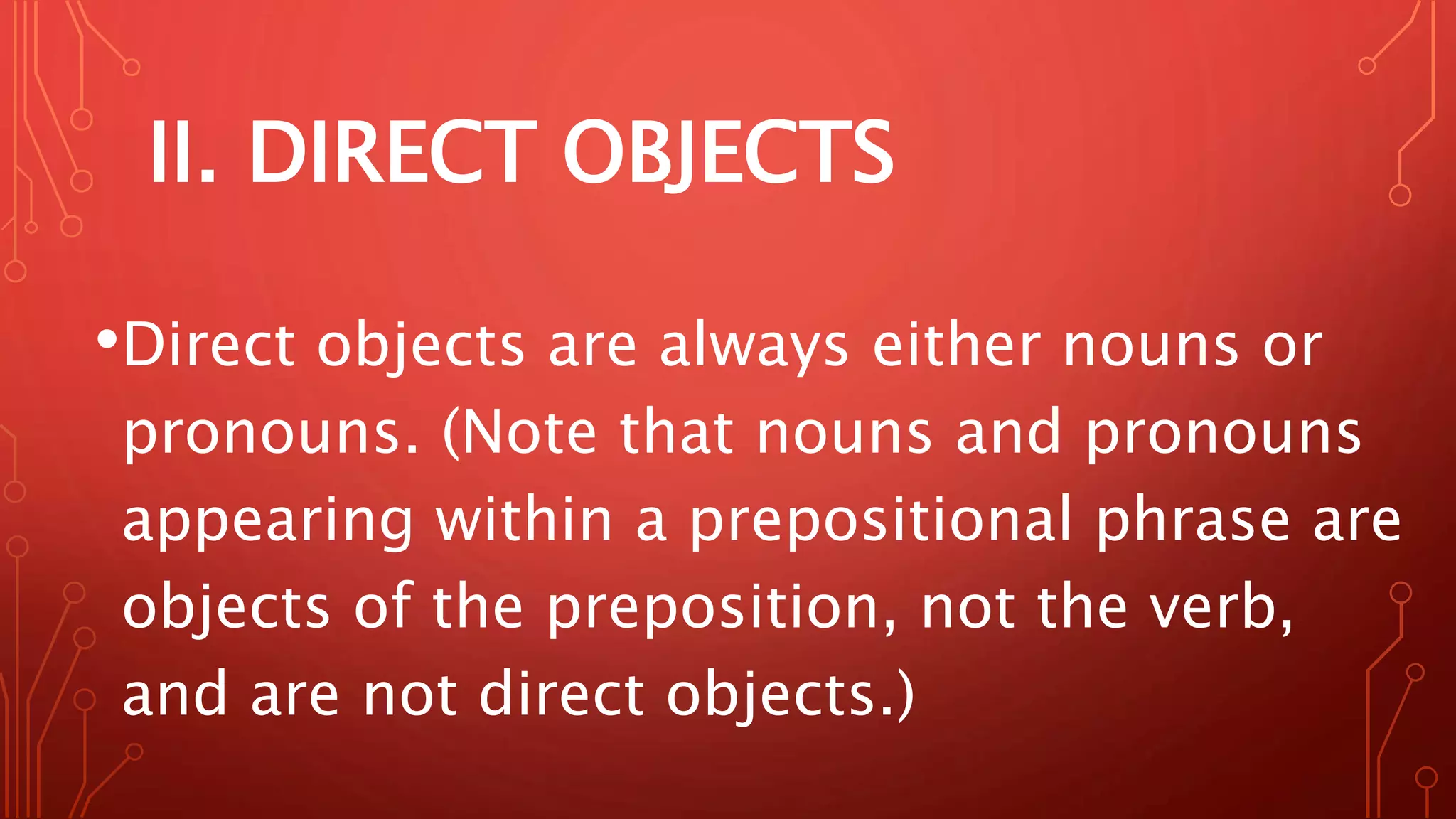
•Direct objects are always either nouns or
pronouns. (Note that nouns and pronouns
appearing within a prepositional phrase are
objects of the preposition, not the verb,
and are not direct objects.)
II. DIRECT OBJECTS
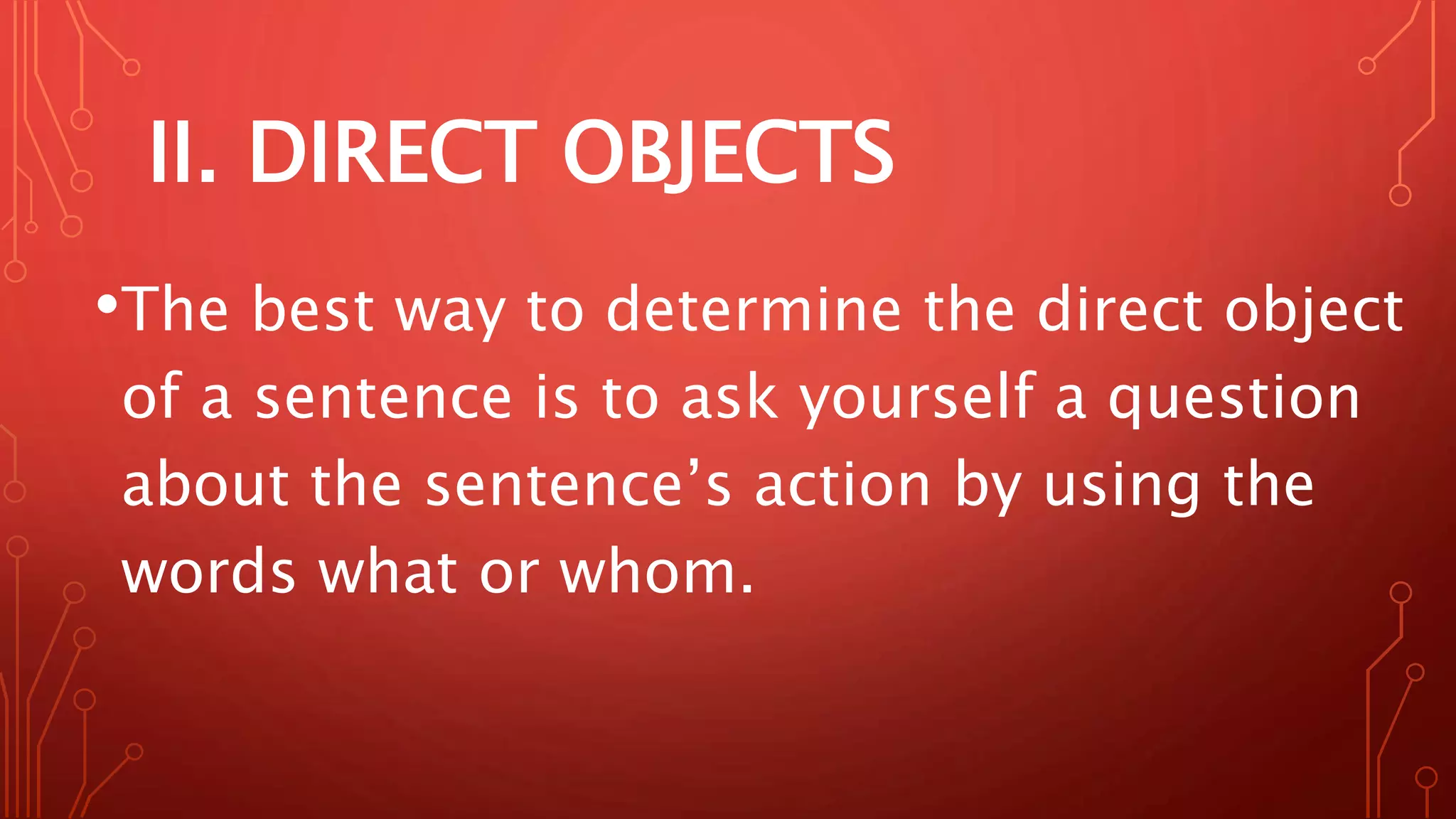
•The best way to determine the direct object
of a sentence is to ask yourself a question
about the sentence’s action by using the
words what or whom.
DIRECT OBJECT EXAMPLES:
Nouns as Direct Objects:
•Vanessa rode her bike. (Vanessa rode what? She
rode her bike. Bike is the direct object in the
sentence.)
•I returned the books to the library. (I returned
what? I returned books. Books is the direct object
DIRECT OBJECT EXAMPLES:
Nouns as Direct Objects:
•The pilot flew the plane across the Atlantic Ocean. (The
pilot flew what? The pilot flew the plane. Plane is the
direct object in the sentence.)
•Carmen rocked her baby to sleep. (Carmen rocked
whom? She rocked her baby. Baby is the direct object in
the sentence.)
DIRECT OBJECT EXAMPLES:
• Pronouns as Direct Objects:
•I took her with me to the store. (I took whom? I took
her. Her is the direct object in the sentence.)
•Shaun called us from camp. (Shaun called whom?
He called us. Us is the direct object in the
sentence.)
DIRECT OBJECT EXAMPLES:
• Compound Direct Objects:
•Dylan took his backpack and lunch out to the car. (Dylan
took what? He took his backpack and
lunch. Backpack and lunch are the direct objects in the
sentence.)
•The coach carried the bats and balls to the field. (The
coach carried what? The coach carried bats and
balls. Bats and balls are the direct objects in the sentence.)
6.4 presentation conjunctions do_id_reading_response

6.4 presentation conjunctions do_id_reading_response

  • 1.
    UNIT 6.4 MEMOIRS: EXPLORINGPERSONAL CHALLENGES
  • 2.
    OBJECTIVE •The student willbe able Develop and strengthen writing as needed by planning, revising, editing and applying appropriate sentence structure and word order. Identify the Parts of the Letter.
  • 3.
    TODAY’S THEME: I. CONJUNTIONS| DIRECT & INDIRECT OBJECTS •Conjunctions: A conjunction is a word that "joins" ideas together. A conjunction joins two parts of a sentence, two nouns or two verbs together.
  • 4.
    TYPES OF CONJUNCTIONS: •COORDINATINGCONJUNCTIONS: •Use a coordinating conjunction when you want to give equal emphasis to two main clauses.
  • 5.
    TYPES OF CONJUNCTIONS: COORDINATINGCONJUNCTIONS: FANBOYS •For •And •Nor •But •Or •Yet •So
  • 6.
    CORRELATIVE CONJUNCTIONS •Correlative conjunctionsare sort of like tag-team conjunctions. They come in pairs, and you have to use both of them in different places in a sentence to make them work. They get their name from the fact that they work together (co-) and relate one sentence element to another.
  • 7.
    CORRELATIVE CONJUNCTIONS •both/and” |“whether/or” •either/or” | “neither/nor” •not/but” | “not only/but also”
  • 8.
    SUBORDINATING CONJUNCTION •A subordinatingconjunction is a word that connects a main clause to a subordinate clause. A main clause is an independent clause that can stand alone by itself as a sentence. In other words, a main clause does not need any additional information to operate as a sentence. •For example, the sentence "The student failed
  • 9.
    SUBORDINATING CONJUNCTION •A subordinateclause is a dependent clause that adds some extra information to the main clause. These phrases cannot stand by themselves, and their meaning is dependent upon that of the independent clause. They are not sentences! •For example, "because she didn't study" is not a complete idea worthy of being defined
  • 10.
  • 11.
    II. DIRECT OBJECTS •Unlikea subject, which performs the action in a sentence, a direct object is the receiver of an action, telling who or what received it.
  • 12.
    II. DIRECT OBJECTS •Directobjects are always either nouns or pronouns. (Note that nouns and pronouns appearing within a prepositional phrase are objects of the preposition, not the verb, and are not direct objects.)
  • 13.
    II. DIRECT OBJECTS •Thebest way to determine the direct object of a sentence is to ask yourself a question about the sentence’s action by using the words what or whom.
  • 14.
    DIRECT OBJECT EXAMPLES: Nounsas Direct Objects: •Vanessa rode her bike. (Vanessa rode what? She rode her bike. Bike is the direct object in the sentence.) •I returned the books to the library. (I returned what? I returned books. Books is the direct object
  • 15.
    DIRECT OBJECT EXAMPLES: Nounsas Direct Objects: •The pilot flew the plane across the Atlantic Ocean. (The pilot flew what? The pilot flew the plane. Plane is the direct object in the sentence.) •Carmen rocked her baby to sleep. (Carmen rocked whom? She rocked her baby. Baby is the direct object in the sentence.)
  • 16.
    DIRECT OBJECT EXAMPLES: •Pronouns as Direct Objects: •I took her with me to the store. (I took whom? I took her. Her is the direct object in the sentence.) •Shaun called us from camp. (Shaun called whom? He called us. Us is the direct object in the sentence.)
  • 17.
    DIRECT OBJECT EXAMPLES: •Compound Direct Objects: •Dylan took his backpack and lunch out to the car. (Dylan took what? He took his backpack and lunch. Backpack and lunch are the direct objects in the sentence.) •The coach carried the bats and balls to the field. (The coach carried what? The coach carried bats and balls. Bats and balls are the direct objects in the sentence.)