Science and innovation for development:  where have the politics gone?   Andy Stirling SPRU – science and technology policy research presentation to ‘PolicyLab’ event  Royal Society, London 14 th  June, 2010
Innovation for Development   Linked challenges of poverty reduction, social justice and environmental   sustainability are the great moral and political imperatives of our age   Annual global spend on research and development exceeds $ 1 trillion  –  but driven by imperfect incentives: private profit, IP, rich consumers  –  military and security are the single largest area of expenditure   Key aim:  to better orient world innovation towards global imperatives  –  requires radical shift in current practice and politics of innovation   opening more deliberate choices of which  directions  to pursue   Crucial problem:  these debates presently marginalised or polarised  –  current policy lacks needed arenas, institutions, metrics, language   New Manifesto : tries to help catalyse vibrant new politics of innovation
The Missing Politics of Direction all technology is good… all innovation is good… “ For the objectives of the Lisbon Strategy …  pro-innovation  action [is] a priority.” - Council of Ministers “ [we need] more  `pro-innovation’  policies …” - Gordon Brown and determined solely by science…   “ [there is] an  anti-technology  culture  … a pro- technology culture must be created…”   -  Council for Science and Technology GM:  “… this government's approach is to make decisions … on the basis of  sound science     - Tony Blair  Chemicals: “ … sound science  will be the basis of the Commission's legislative proposal…” - European Commission
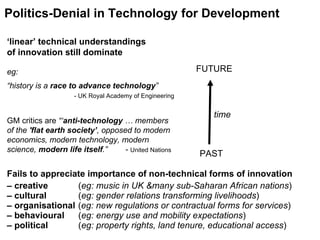
time Politics-Denial in Technology for Development PAST FUTURE ‘ linear’ technical understandings  of innovation still dominate eg: “history is a  race to advance technology ”   - UK Royal Academy of Engineering GM critics are  “‘ anti-technology  … members of the  'flat earth society’ , opposed to modern economics, modern technology, modern science,  modern life itself .”  -  United Nations  Fails to appreciate importance of non-technical forms of innovation –  creative     ( eg: music in UK &many sub-Saharan African nations ) –  cultural    ( eg: gender relations transforming livelihoods )  –  organisational   ( eg: new regulations or contractual forms for services ) –  behavioural   ( eg: energy use and mobility expectations ) –  political   ( eg: property rights, land tenure, educational access )
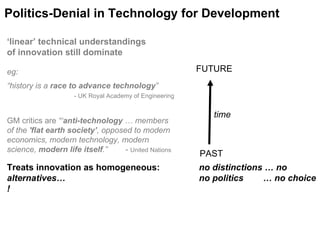
time PAST FUTURE Treats innovation as homogeneous:  no distinctions … no alternatives…  no politics  … no choice ! Politics-Denial in Technology for Development ‘ linear’ technical understandings  of innovation still dominate eg: “history is a  race to advance technology ”   - UK Royal Academy of Engineering GM critics are  “‘ anti-technology  … members of the  'flat earth society’ , opposed to modern economics, modern technology, modern science,  modern life itself .”  -  United Nations
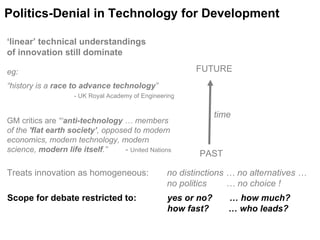
time PAST FUTURE Treats innovation as homogeneous:  no distinctions … no alternatives …  no politics  … no choice ! Scope for debate restricted to: yes or no?  … how much?  how fast?  … who leads? Politics-Denial in Technology for Development ‘ linear’ technical understandings  of innovation still dominate eg: “history is a  race to advance technology ”   - UK Royal Academy of Engineering GM critics are  “‘ anti-technology  … members of the  'flat earth society’ , opposed to modern economics, modern technology, modern science,  modern life itself .”  -  United Nations
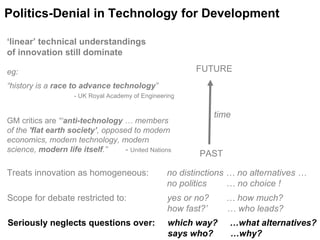
time PAST FUTURE Treats innovation as homogeneous:  no distinctions … no alternatives …  no politics  … no choice ! Scope for debate restricted to: yes or no?  … how much?  how fast?’  … who leads? Seriously neglects questions over:  which way?  …what alternatives?  says who?  …why?   Politics-Denial in Technology for Development ‘ linear’ technical understandings  of innovation still dominate eg: “history is a  race to advance technology ”   - UK Royal Academy of Engineering GM critics are  “‘ anti-technology  … members of the  'flat earth society’ , opposed to modern economics, modern technology, modern science,  modern life itself .”  -  United Nations
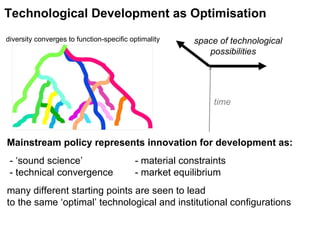
space of technological possibilities time Technological Development as Optimisation Mainstream policy represents innovation for development as:  - ‘sound science’ - material constraints  - technical convergence  - market equilibrium  many different starting points are seen to lead  to the same ‘optimal’ technological and institutional configurations diversity converges to function-specific optimality
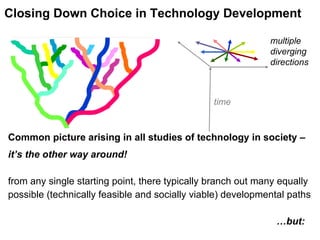
Closing Down Choice in Technology Development Common picture arising in all studies of technology in society – it’s the other way around! from any single starting point, there typically branch out many equally  possible (technically feasible and socially viable) developmental paths   … but: multiple diverging directions time
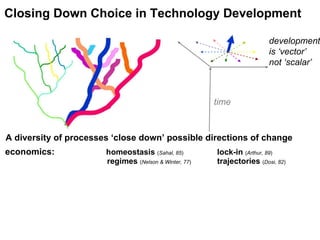
A diversity of processes ‘close down’ possible directions of change development  is ‘vector’  not ‘scalar’ economics:     homeostasis  ( Sahal, 85 ) lock-in  ( Arthur, 89 )      regimes  ( Nelson & Winter, 77 ) trajectories  ( Dosi, 82 ) time Closing Down Choice in Technology Development
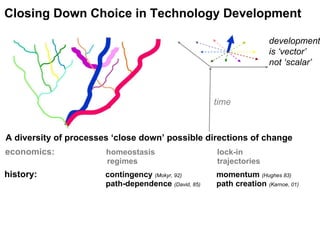
A diversity of processes ‘close down’ possible directions of change economics:     homeostasis  lock-in      regimes  trajectories  history:    contingency  (Mokyr, 92)  momentum  (Hughes 83)   path-dependence  (David, 85) path creation   (Karnoe, 01) time Closing Down Choice in Technology Development development  is ‘vector’  not ‘scalar’
A diversity of processes ‘close down’ possible directions of change economics:     homeostasis lock-in      regimes  trajectories history:    contingency   momentum    path-dependence  path creation philosophy/politics:   autonomy  (Winner, 77) closure  (Feenberg, 91)   entrapment  (Walker, 01) alignment  (Geels, 02) time Closing Down Choice in Technology Development development  is ‘vector’  not ‘scalar’
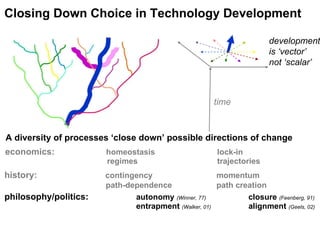
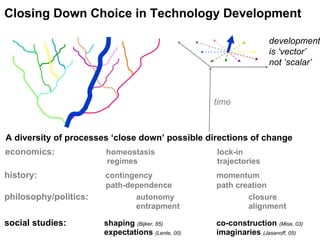
A diversity of processes ‘close down’ possible directions of change philosophy/politics:   autonomy  closure    entrapment  alignment social studies:   shaping  (Bijker, 85) co-construction  (Misa, 03)    expectations  (Lente, 00) imaginaries  (Jasanoff, 05) time Closing Down Choice in Technology Development development  is ‘vector’  not ‘scalar’ economics:     homeostasis lock-in      regimes  trajectories history:    contingency   momentum    path-dependence  path creation
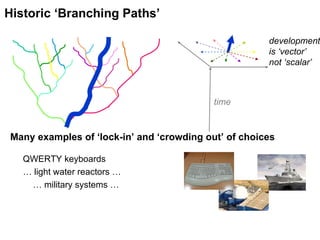
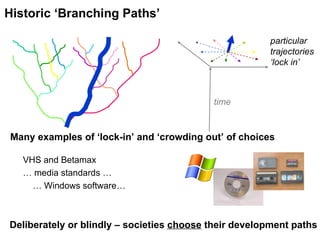
QWERTY keyboards …  light water reactors … …  military systems … Historic ‘Branching Paths’ Many examples of ‘lock-in’ and ‘crowding out’ of choices time development  is ‘vector’  not ‘scalar’
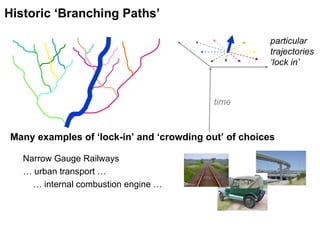
Historic ‘Branching Paths’ Narrow Gauge Railways …  urban transport … …  internal combustion engine … particular trajectories  ‘ lock in’ time Many examples of ‘lock-in’ and ‘crowding out’ of choices
Historic ‘Branching Paths’ VHS and Betamax …  media standards … …  Windows software…   Deliberately or blindly – societies  choose  their development paths particular trajectories  ‘ lock in’ time Many examples of ‘lock-in’ and ‘crowding out’ of choices
Alternative ‘Sustainable Energy Strategies’   Many possible pathways to ‘sustainable energy’:   …  which directions will we go?
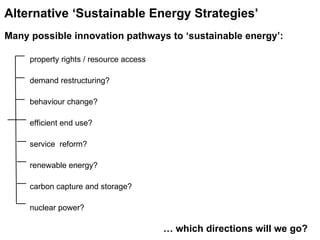
property rights / resource access demand restructuring? behaviour change? efficient end use? service  reform? renewable energy? carbon capture and storage? nuclear power?   …  which directions will we go?  Alternative ‘Sustainable Energy Strategies’   Many possible innovation pathways to ‘sustainable energy’:
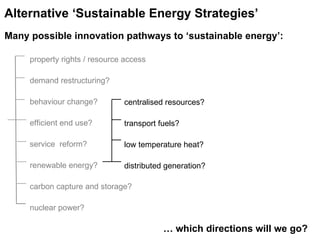
centralised resources? transport fuels? low temperature heat? distributed generation?   …  which directions will we go?  Alternative ‘Sustainable Energy Strategies’   Many possible innovation pathways to ‘sustainable energy’: property rights / resource access demand restructuring? behaviour change? efficient end use? service  reform? renewable energy? carbon capture and storage? nuclear power?
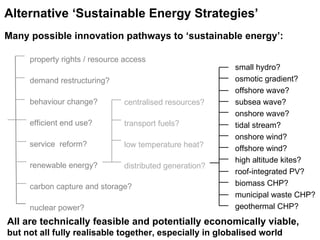
centralised resources? transport fuels? low temperature heat? distributed generation? small hydro? osmotic gradient? offshore wave? subsea wave? onshore wave? tidal stream? onshore wind? offshore wind? high altitude kites? roof-integrated PV? biomass CHP? municipal waste CHP? geothermal CHP? Alternative ‘Sustainable Energy Strategies’   Many possible innovation pathways to ‘sustainable energy’: All are technically feasible and potentially economically viable,  but not all fully realisable together, especially in globalised world  property rights / resource access demand restructuring? behaviour change? efficient end use? service  reform? renewable energy? carbon capture and storage? nuclear power?
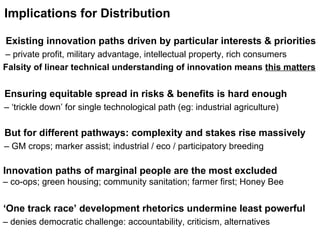
Implications for Distribution   Ensuring equitable spread in risks & benefits is hard enough  – ‘ trickle down’ for single technological path (eg: industrial agriculture)   But for different pathways: complexity and stakes rise massively  –  GM crops; marker assist; industrial / eco / participatory breeding   Innovation paths of marginal people are the most excluded    – co-ops; green housing; community sanitation; farmer first; Honey Bee   Existing innovation paths driven by particular interests & priorities   –  private profit, military advantage, intellectual property, rich consumers Falsity of linear technical understanding of innovation means  this matters  ‘ One track race’ development rhetorics undermine least powerful  –  denies democratic challenge: accountability, criticism, alternatives
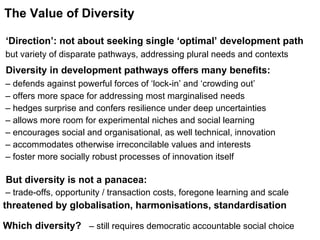
The Value of Diversity  ‘ Direction’: not about seeking single ‘optimal’ development path   but variety of disparate pathways, addressing plural needs and contexts   Diversity in development pathways offers many benefits:  –  defends against powerful forces of ‘lock-in’ and ‘crowding out’   –  offers more space for addressing most marginalised needs  –  hedges surprise and confers resilience under deep uncertainties  –  allows more room for experimental niches and social learning  –  encourages social and organisational, as well technical, innovation  –  accommodates otherwise irreconcilable values and interests  –  foster more socially robust processes of innovation itself   But diversity is not a panacea:  –  trade-offs, opportunity / transaction costs, foregone learning and scale threatened by globalisation, harmonisations, standardisation Which diversity?  – still requires democratic accountable social choice
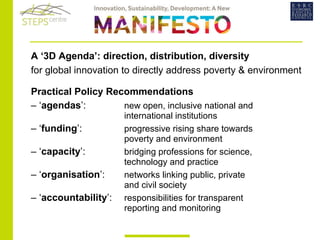
  A ‘3D Agenda’: direction, distribution, diversity   for global innovation to directly address poverty & environment   Practical Policy Recommendations  – ‘ agendas ’:  new open, inclusive national and  international institutions  – ‘ funding ’:  progressive rising share towards  poverty and environment  – ‘ capacity ’:  bridging professions for science,  technology and practice  – ‘ organisation ’:  networks linking public, private  and civil society  – ‘ accountability ’: responsibilities for transparent  reporting and monitoring

Andy Stirling - Royal Society Policy Lab

  • 1.
    Science and innovationfor development: where have the politics gone? Andy Stirling SPRU – science and technology policy research presentation to ‘PolicyLab’ event Royal Society, London 14 th June, 2010
  • 2.
    Innovation for Development Linked challenges of poverty reduction, social justice and environmental sustainability are the great moral and political imperatives of our age Annual global spend on research and development exceeds $ 1 trillion – but driven by imperfect incentives: private profit, IP, rich consumers – military and security are the single largest area of expenditure Key aim: to better orient world innovation towards global imperatives – requires radical shift in current practice and politics of innovation opening more deliberate choices of which directions to pursue Crucial problem: these debates presently marginalised or polarised – current policy lacks needed arenas, institutions, metrics, language New Manifesto : tries to help catalyse vibrant new politics of innovation
  • 3.
    The Missing Politicsof Direction all technology is good… all innovation is good… “ For the objectives of the Lisbon Strategy … pro-innovation action [is] a priority.” - Council of Ministers “ [we need] more `pro-innovation’ policies …” - Gordon Brown and determined solely by science… “ [there is] an anti-technology culture … a pro- technology culture must be created…” - Council for Science and Technology GM: “… this government's approach is to make decisions … on the basis of sound science - Tony Blair Chemicals: “ … sound science will be the basis of the Commission's legislative proposal…” - European Commission
  • 4.
    time Politics-Denial inTechnology for Development PAST FUTURE ‘ linear’ technical understandings of innovation still dominate eg: “history is a race to advance technology ” - UK Royal Academy of Engineering GM critics are “‘ anti-technology … members of the 'flat earth society’ , opposed to modern economics, modern technology, modern science, modern life itself .” - United Nations Fails to appreciate importance of non-technical forms of innovation – creative ( eg: music in UK &many sub-Saharan African nations ) – cultural ( eg: gender relations transforming livelihoods ) – organisational ( eg: new regulations or contractual forms for services ) – behavioural ( eg: energy use and mobility expectations ) – political ( eg: property rights, land tenure, educational access )
  • 5.
    time PAST FUTURETreats innovation as homogeneous: no distinctions … no alternatives… no politics … no choice ! Politics-Denial in Technology for Development ‘ linear’ technical understandings of innovation still dominate eg: “history is a race to advance technology ” - UK Royal Academy of Engineering GM critics are “‘ anti-technology … members of the 'flat earth society’ , opposed to modern economics, modern technology, modern science, modern life itself .” - United Nations
  • 6.
    time PAST FUTURETreats innovation as homogeneous: no distinctions … no alternatives … no politics … no choice ! Scope for debate restricted to: yes or no? … how much? how fast? … who leads? Politics-Denial in Technology for Development ‘ linear’ technical understandings of innovation still dominate eg: “history is a race to advance technology ” - UK Royal Academy of Engineering GM critics are “‘ anti-technology … members of the 'flat earth society’ , opposed to modern economics, modern technology, modern science, modern life itself .” - United Nations
  • 7.
    time PAST FUTURETreats innovation as homogeneous: no distinctions … no alternatives … no politics … no choice ! Scope for debate restricted to: yes or no? … how much? how fast?’ … who leads? Seriously neglects questions over: which way? …what alternatives? says who? …why? Politics-Denial in Technology for Development ‘ linear’ technical understandings of innovation still dominate eg: “history is a race to advance technology ” - UK Royal Academy of Engineering GM critics are “‘ anti-technology … members of the 'flat earth society’ , opposed to modern economics, modern technology, modern science, modern life itself .” - United Nations
  • 8.
    space of technologicalpossibilities time Technological Development as Optimisation Mainstream policy represents innovation for development as: - ‘sound science’ - material constraints - technical convergence - market equilibrium many different starting points are seen to lead to the same ‘optimal’ technological and institutional configurations diversity converges to function-specific optimality
  • 9.
    Closing Down Choicein Technology Development Common picture arising in all studies of technology in society – it’s the other way around! from any single starting point, there typically branch out many equally possible (technically feasible and socially viable) developmental paths … but: multiple diverging directions time
  • 10.
    A diversity ofprocesses ‘close down’ possible directions of change development is ‘vector’ not ‘scalar’ economics: homeostasis ( Sahal, 85 ) lock-in ( Arthur, 89 ) regimes ( Nelson & Winter, 77 ) trajectories ( Dosi, 82 ) time Closing Down Choice in Technology Development
  • 11.
    A diversity ofprocesses ‘close down’ possible directions of change economics: homeostasis lock-in regimes trajectories history: contingency (Mokyr, 92) momentum (Hughes 83) path-dependence (David, 85) path creation (Karnoe, 01) time Closing Down Choice in Technology Development development is ‘vector’ not ‘scalar’
  • 12.
    A diversity ofprocesses ‘close down’ possible directions of change economics: homeostasis lock-in regimes trajectories history: contingency momentum path-dependence path creation philosophy/politics: autonomy (Winner, 77) closure (Feenberg, 91) entrapment (Walker, 01) alignment (Geels, 02) time Closing Down Choice in Technology Development development is ‘vector’ not ‘scalar’
  • 13.
    A diversity ofprocesses ‘close down’ possible directions of change philosophy/politics: autonomy closure entrapment alignment social studies: shaping (Bijker, 85) co-construction (Misa, 03) expectations (Lente, 00) imaginaries (Jasanoff, 05) time Closing Down Choice in Technology Development development is ‘vector’ not ‘scalar’ economics: homeostasis lock-in regimes trajectories history: contingency momentum path-dependence path creation
  • 14.
    QWERTY keyboards … light water reactors … … military systems … Historic ‘Branching Paths’ Many examples of ‘lock-in’ and ‘crowding out’ of choices time development is ‘vector’ not ‘scalar’
  • 15.
    Historic ‘Branching Paths’Narrow Gauge Railways … urban transport … … internal combustion engine … particular trajectories ‘ lock in’ time Many examples of ‘lock-in’ and ‘crowding out’ of choices
  • 16.
    Historic ‘Branching Paths’VHS and Betamax … media standards … … Windows software… Deliberately or blindly – societies choose their development paths particular trajectories ‘ lock in’ time Many examples of ‘lock-in’ and ‘crowding out’ of choices
  • 17.
    Alternative ‘Sustainable EnergyStrategies’ Many possible pathways to ‘sustainable energy’: … which directions will we go?
  • 18.
    property rights /resource access demand restructuring? behaviour change? efficient end use? service reform? renewable energy? carbon capture and storage? nuclear power? … which directions will we go? Alternative ‘Sustainable Energy Strategies’ Many possible innovation pathways to ‘sustainable energy’:
  • 19.
    centralised resources? transportfuels? low temperature heat? distributed generation? … which directions will we go? Alternative ‘Sustainable Energy Strategies’ Many possible innovation pathways to ‘sustainable energy’: property rights / resource access demand restructuring? behaviour change? efficient end use? service reform? renewable energy? carbon capture and storage? nuclear power?
  • 20.
    centralised resources? transportfuels? low temperature heat? distributed generation? small hydro? osmotic gradient? offshore wave? subsea wave? onshore wave? tidal stream? onshore wind? offshore wind? high altitude kites? roof-integrated PV? biomass CHP? municipal waste CHP? geothermal CHP? Alternative ‘Sustainable Energy Strategies’ Many possible innovation pathways to ‘sustainable energy’: All are technically feasible and potentially economically viable, but not all fully realisable together, especially in globalised world property rights / resource access demand restructuring? behaviour change? efficient end use? service reform? renewable energy? carbon capture and storage? nuclear power?
  • 21.
    Implications for Distribution Ensuring equitable spread in risks & benefits is hard enough – ‘ trickle down’ for single technological path (eg: industrial agriculture) But for different pathways: complexity and stakes rise massively – GM crops; marker assist; industrial / eco / participatory breeding Innovation paths of marginal people are the most excluded – co-ops; green housing; community sanitation; farmer first; Honey Bee Existing innovation paths driven by particular interests & priorities – private profit, military advantage, intellectual property, rich consumers Falsity of linear technical understanding of innovation means this matters ‘ One track race’ development rhetorics undermine least powerful – denies democratic challenge: accountability, criticism, alternatives
  • 22.
    The Value ofDiversity ‘ Direction’: not about seeking single ‘optimal’ development path but variety of disparate pathways, addressing plural needs and contexts Diversity in development pathways offers many benefits: – defends against powerful forces of ‘lock-in’ and ‘crowding out’ – offers more space for addressing most marginalised needs – hedges surprise and confers resilience under deep uncertainties – allows more room for experimental niches and social learning – encourages social and organisational, as well technical, innovation – accommodates otherwise irreconcilable values and interests – foster more socially robust processes of innovation itself But diversity is not a panacea: – trade-offs, opportunity / transaction costs, foregone learning and scale threatened by globalisation, harmonisations, standardisation Which diversity? – still requires democratic accountable social choice
  • 23.
    A‘3D Agenda’: direction, distribution, diversity for global innovation to directly address poverty & environment Practical Policy Recommendations – ‘ agendas ’: new open, inclusive national and international institutions – ‘ funding ’: progressive rising share towards poverty and environment – ‘ capacity ’: bridging professions for science, technology and practice – ‘ organisation ’: networks linking public, private and civil society – ‘ accountability ’: responsibilities for transparent reporting and monitoring

Editor's Notes

  • #3 We live in a time of unprecedented advances in science and technology, and in global spending on R and D which now exceeds a trillion dollars. Yet for many people and places, poverty is deepening and the environment is in crisis. Thousands of children die daily from waterborne diseases, and more than a billion people go hungry. Global governance, economics and politics frequently work against the interests of poorer countries and people, worsening inequalities. Meeting these interlinked global challenges of poverty reduction, social justice and environmental sustainability is the great moral and political imperative of our age. Science, technology and innovation of many kinds have essential roles to play in this. But along with many others, the STEPS Centre believes that this imperative can only be fulfilled if there is a radical shift in how we think about and perform innovation – amounting to a new politics
  • #22 We live in a time of unprecedented advances in science and technology, and in global spending on R and D which now exceeds a trillion dollars. Yet for many people and places, poverty is deepening and the environment is in crisis. Thousands of children die daily from waterborne diseases, and more than a billion people go hungry. Global governance, economics and politics frequently work against the interests of poorer countries and people, worsening inequalities. Meeting these interlinked global challenges of poverty reduction, social justice and environmental sustainability is the great moral and political imperative of our age. Science, technology and innovation of many kinds have essential roles to play in this. But along with many others, the STEPS Centre believes that this imperative can only be fulfilled if there is a radical shift in how we think about and perform innovation – amounting to a new politics
  • #23 We live in a time of unprecedented advances in science and technology, and in global spending on R and D which now exceeds a trillion dollars. Yet for many people and places, poverty is deepening and the environment is in crisis. Thousands of children die daily from waterborne diseases, and more than a billion people go hungry. Global governance, economics and politics frequently work against the interests of poorer countries and people, worsening inequalities. Meeting these interlinked global challenges of poverty reduction, social justice and environmental sustainability is the great moral and political imperative of our age. Science, technology and innovation of many kinds have essential roles to play in this. But along with many others, the STEPS Centre believes that this imperative can only be fulfilled if there is a radical shift in how we think about and perform innovation – amounting to a new politics