Direction, Distribution, Diversity! pluralising progress    in innovation, sustainability and development Andy Stirling SPRU – science and technology policy research presentation to seminar at Department of Innovation Sciences Technical University Eindhoven, 15 th  April, 2010   www.anewmanifesto.org
The Missing Politics of Direction all technology is good… all innovation is good… “ For the objectives of the Lisbon Strategy …  pro-innovation  action [is] a priority.” - European Parliament “ [we need] more  `pro-innovation’  policies …” - EC President, José Manuel Barroso and determined solely by science…   “ [there is] an  anti-technology  culture  … a pro- technology culture must be created…”   -  Council for Science and Technology GM:  “… this government's approach is to make decisions … on the basis of  sound science     - Tony Blair  Chemicals: “ … sound science  will be the basis of the Commission's legislative proposal…” - EC RTD Commissioner, Philippe Busquin
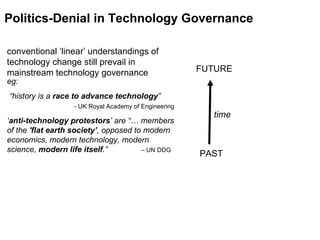
time Politics-Denial in Technology Governance PAST FUTURE conventional ‘linear’ understandings of technology change still prevail in mainstream technology governance eg:   “history is a  race to advance technology ”   - UK Royal Academy of Engineering ‘ anti-technology protestors ’ are “… members of the  'flat earth society’ , opposed to modern economics, modern technology, modern science,  modern life itself .”  – UN DDG
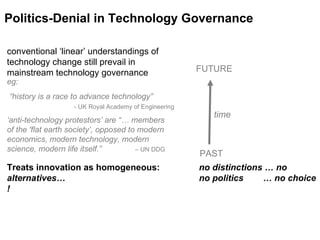
time Politics-Denial in Technology Governance PAST FUTURE conventional ‘linear’ understandings of technology change still prevail in mainstream technology governance eg:   “history is a race to advance technology”   - UK Royal Academy of Engineering ‘anti-technology protestors’ are “… members  of the 'flat earth society’, opposed to modern economics, modern technology, modern science, modern life itself.”  – UN DDG  Treats innovation as homogeneous:  no distinctions … no alternatives…  no politics  … no choice !
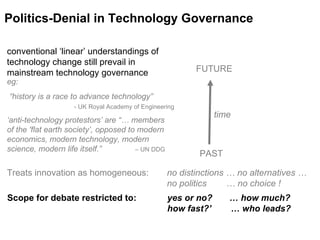
time Politics-Denial in Technology Governance PAST FUTURE conventional ‘linear’ understandings of technology change still prevail in mainstream technology governance eg:   “history is a race to advance technology”   - UK Royal Academy of Engineering ‘anti-technology protestors’ are “… members  of the 'flat earth society’, opposed to modern economics, modern technology, modern science, modern life itself.”  – UN DDG  Treats innovation as homogeneous:  no distinctions … no alternatives …  no politics  … no choice ! Scope for debate restricted to: yes or no?  … how much?  how fast?’  … who leads?
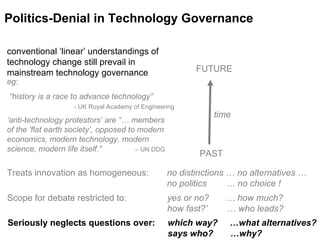
time Politics-Denial in Technology Governance PAST FUTURE conventional ‘linear’ understandings of technology change still prevail in mainstream technology governance eg:   “history is a race to advance technology”   - UK Royal Academy of Engineering ‘anti-technology protestors’ are “… members  of the 'flat earth society’, opposed to modern economics, modern technology, modern science, modern life itself.”  – UN DDG  Treats innovation as homogeneous:  no distinctions … no alternatives …  no politics  … no choice ! Scope for debate restricted to: yes or no?  … how much?  how fast?’  … who leads? Seriously neglects questions over:  which way?  …what alternatives?  says who?  …why?
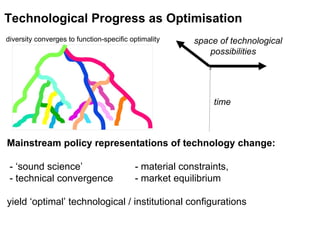
space of technological possibilities time Technological Progress as Optimisation Mainstream policy representations of technology change:    - ‘sound science’ - material constraints,  - technical convergence  - market equilibrium  yield ‘optimal’ technological / institutional configurations diversity converges to function-specific optimality
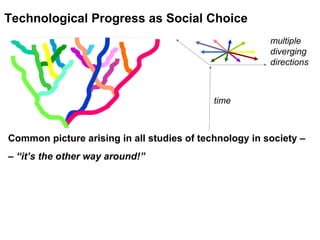
time Technological Progress as Social Choice Common picture arising in all studies of technology in society – – “ it’s the other way around!” multiple diverging directions
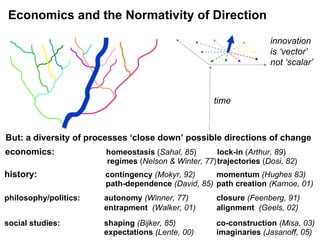
time But: a diversity of processes ‘close down’ possible directions of change innovation  is ‘vector’  not ‘scalar’ Economics and the Normativity of Direction economics:     homeostasis  ( Sahal, 85 ) lock-in  ( Arthur, 89 )      regimes  ( Nelson & Winter, 77 ) trajectories  ( Dosi, 82 ) history:    contingency  (Mokyr, 92)  momentum  (Hughes 83)   path-dependence  (David, 85) path creation   (Karnoe, 01) philosophy/politics:   autonomy  (Winner, 77) closure  (Feenberg, 91)   entrapment  (Walker, 01) alignment  (Geels, 02) social studies:   shaping  (Bijker, 85) co-construction  (Misa, 03)    expectations  (Lente, 00) imaginaries  (Jasanoff, 05)
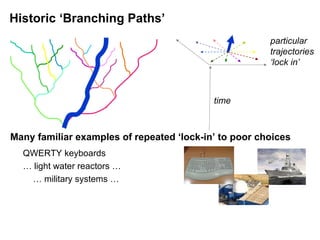
QWERTY keyboards …  light water reactors … …  military systems … Historic ‘Branching Paths’ Many familiar examples of repeated ‘lock-in’ to poor choices time particular trajectories  ‘ lock in’
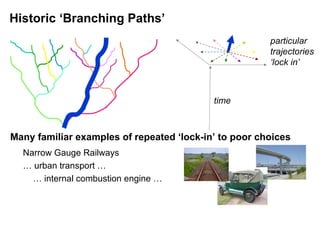
Historic ‘Branching Paths’ Many familiar examples of repeated ‘lock-in’ to poor choices Narrow Gauge Railways …  urban transport … …  internal combustion engine … time particular trajectories  ‘ lock in’
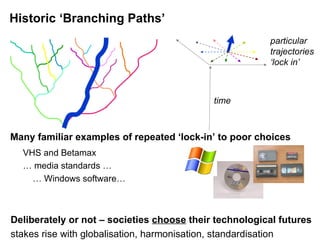
Historic ‘Branching Paths’ Many familiar examples of repeated ‘lock-in’ to poor choices VHS and Betamax …  media standards … …  Windows software… Deliberately or not – societies  choose  their technological futures stakes rise with globalisation, harmonisation, standardisation time particular trajectories  ‘ lock in’
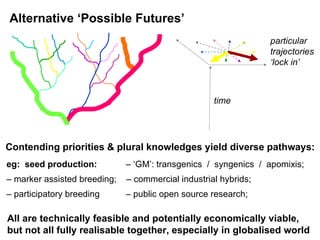
Contending priorities & plural knowledges yield diverse pathways: eg:  seed production:     – ‘GM’: transgenics  /  syngenics  /  apomixis;  –  marker assisted breeding;  –  commercial industrial hybrids;  –  participatory breeding    –  public open source research; time particular trajectories  ‘ lock in’ All are technically feasible and potentially economically viable,  but not all fully realisable together, especially in globalised world  Alternative ‘Possible Futures’
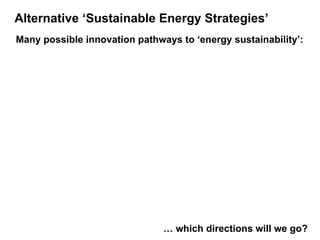
Alternative ‘Sustainable Energy Strategies’   Many possible innovation pathways to ‘energy sustainability’:   …  which directions will we go?
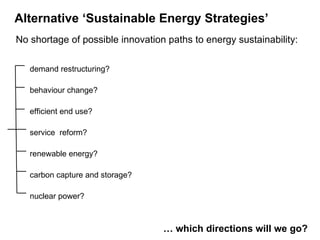
  No shortage of possible innovation paths to energy sustainability: demand restructuring? behaviour change? efficient end use? service  reform? renewable energy? carbon capture and storage? nuclear power? Alternative ‘Sustainable Energy Strategies’   …  which directions will we go?
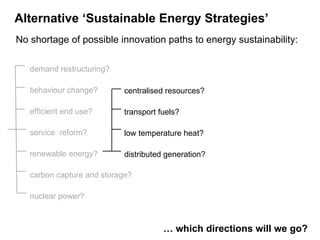
  No shortage of possible innovation paths to energy sustainability: demand restructuring? behaviour change? efficient end use? service  reform? renewable energy? carbon capture and storage? nuclear power? centralised resources? transport fuels? low temperature heat? distributed generation? Alternative ‘Sustainable Energy Strategies’   …  which directions will we go?
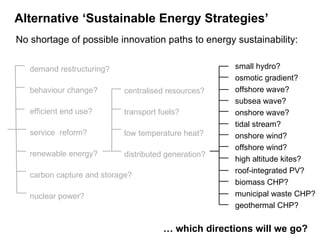
  No shortage of possible innovation paths to energy sustainability: demand restructuring? behaviour change? efficient end use? service  reform? renewable energy? carbon capture and storage? nuclear power? centralised resources? transport fuels? low temperature heat? distributed generation? small hydro? osmotic gradient? offshore wave? subsea wave? onshore wave? tidal stream? onshore wind? offshore wind? high altitude kites? roof-integrated PV? biomass CHP? municipal waste CHP? geothermal CHP? Alternative ‘Sustainable Energy Strategies’   …  which directions will we go?
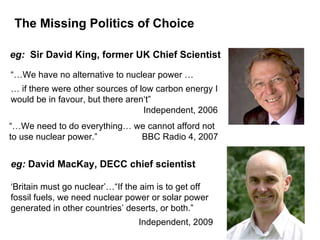
The Missing Politics of Choice “… We have no alternative to nuclear power …  …  if there were other sources of low carbon energy I would be in favour, but there aren‘t”     Independent, 2006 eg:  Sir David King, former UK Chief Scientist “… We need to do everything… we cannot afford not to use nuclear power.”     BBC Radio 4, 2007 eg:  David MacKay, DECC chief scientist ‘ Britain must go nuclear’…“If the aim is to get off fossil fuels, we need nuclear power or solar power generated in other countries’ deserts, or both.”  Independent, 2009
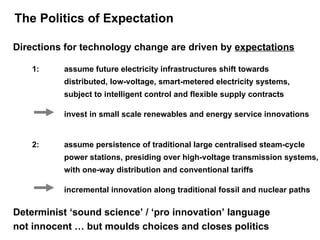
The Politics of Expectation 1:  assume future electricity infrastructures shift towards  distributed, low-voltage, smart-metered electricity systems,  subject to intelligent control and flexible supply contracts Directions for technology change are driven by  expectations invest in small scale renewables and energy service innovations 2:  assume persistence of traditional large centralised steam-cycle  power stations, presiding over high-voltage transmission systems,  with one-way distribution and conventional tariffs incremental innovation along traditional fossil and nuclear paths Determinist ‘sound science’ / ‘pro innovation’ language  not innocent … but moulds choices and closes politics
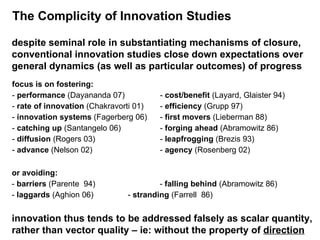
The Complicity of Innovation Studies despite seminal role in substantiating mechanisms of closure, conventional innovation studies close down expectations over general dynamics (as well as particular outcomes) of progress focus is on fostering: -  performance  (Dayananda 07)  -  cost/benefit  (Layard, Glaister 94)  -  rate of innovation  (Chakravorti 01) -  efficiency  (Grupp 97) -  innovation systems  (Fagerberg 06) -  first movers  (Lieberman 88) -  catching up  (Santangelo 06) -  forging ahead  (Abramowitz 86)   -  diffusion  (Rogers 03)  -  leapfrogging  (Brezis 93)  -  advance  (Nelson 02) -  agency  (Rosenberg 02) or avoiding: -  barriers  (Parente  94) -  falling behind  (Abramowitz 86) -  laggards  (Aghion 06)  -  stranding  (Farrell  86) innovation thus tends to be addressed falsely as scalar quantity,  rather than vector quality – ie: without the property of  direction
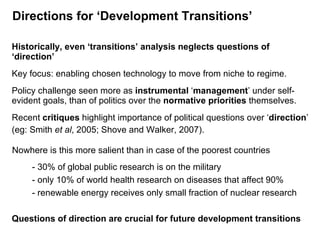
Directions for ‘Development Transitions’ Historically, even ‘transitions’ analysis neglects questions of ‘direction’ Key focus: enabling chosen technology to move from niche to regime. Policy challenge seen more as  instrumental  ‘ management ’ under self-evident goals, than of politics over the  normative priorities  themselves. Recent  critiques  highlight importance of political questions over ‘ direction ’ (eg: Smith  et al , 2005; Shove and Walker, 2007). Nowhere is this more salient than in case of the poorest countries - 30% of global public research is on the military - only 10% of world health research on diseases that affect 90% - renewable energy receives only small fraction of nuclear research Questions of direction are crucial for future development transitions
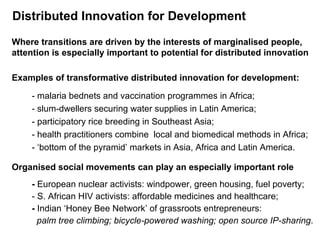
Distributed Innovation for Development Where transitions are driven by the interests of marginalised people, attention is especially important to potential for distributed innovation Examples of transformative distributed innovation for development: - malaria bednets and vaccination programmes in Africa; - slum-dwellers securing water supplies in Latin America; - participatory rice breeding  in Southeast Asia; - health practitioners combine  local and biomedical methods in Africa; - ‘bottom of the pyramid’ markets in Asia, Africa and Latin America. Organised social movements can play an especially important role -  European nuclear activists: windpower, green housing, fuel poverty; - S. African HIV activists: affordable medicines and healthcare;  -  Indian ‘Honey Bee Network’ of grassroots entrepreneurs:    palm tree climbing; bicycle-powered washing; open source IP-sharing .
Blind spot in social and political science of innovation   (Smith, 05)  political science:  ‘systems of production’, but not innovation  (Hollingsworth 97) social movements research: ideas, institutions, interests – not technology  (Smith, 05) social studies of technology: only general ‘pressure’  (Poel, 00; Jamison, 99)   multi-level model  acknowledges role …  (Schot, 03; Geels, 08)  … but pays insufficient attention to role of politics and power  (Smith et al, 05) But innovation studies neglects civil society… Restricted focus in innovation systems research - explicitly excluded in ‘triple helix’ (government, industry, academia)  (Etzkowitz 05) - sidelined as general factor in healthy economy  (Fukuyama 00)  - relevant only at lower levels of regional systems of innovation  (Cook 98) - implicated indirectly thro’ small business ‘partnerships’  in development  (Hall 01) on ‘democracy’: focus is on education system, not civil society  (Lundvall 09)
… tho’ civil society doesn’t neglect innovation!
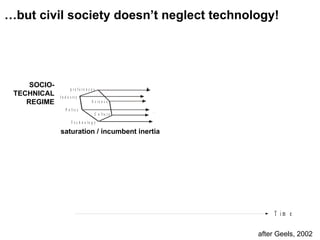
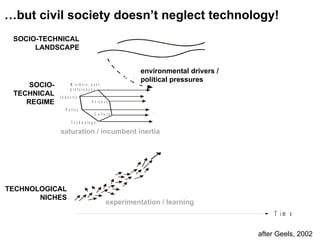
saturation / incumbent inertia SOCIO-TECHNICAL REGIME … but civil society doesn’t neglect technology! after Geels, 2002
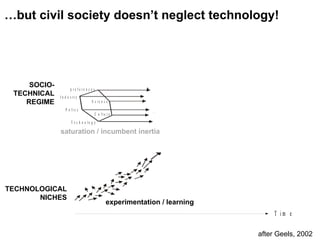
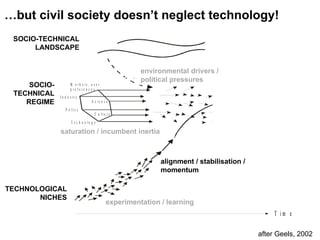
saturation / incumbent inertia experimentation / learning alignment / stabilisation / momentum TECHNOLOGICAL NICHES TECHNOLOGICAL NICHES SOCIO-TECHNICAL REGIME … but civil society doesn’t neglect technology! after Geels, 2002
saturation / incumbent inertia experimentation / learning alignment / stabilisation / momentum environmental drivers /  political pressures environmental drivers /  political pressures TECHNOLOGICAL NICHES TECHNOLOGICAL NICHES SOCIO-TECHNICAL REGIME SOCIO-TECHNICAL LANDSCAPE … but civil society doesn’t neglect technology! after Geels, 2002
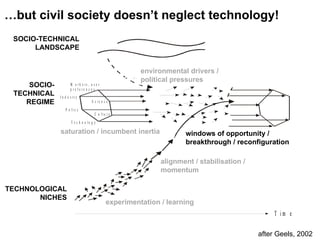
experimentation / learning alignment / stabilisation / momentum saturation / incumbent inertia windows of opportunity / breakthrough / reconfiguration environmental drivers /  political pressures environmental drivers /  political pressures TECHNOLOGICAL NICHES TECHNOLOGICAL NICHES SOCIO-TECHNICAL REGIME SOCIO-TECHNICAL LANDSCAPE … but civil society doesn’t neglect technology! after Geels, 2002
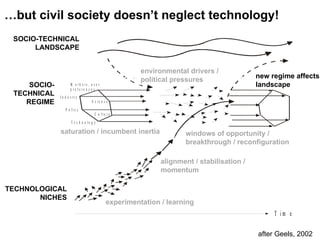
experimentation / learning alignment / stabilisation / momentum saturation / incumbent inertia windows of opportunity / breakthrough / reconfiguration environmental drivers /  political pressures environmental drivers /  political pressures TECHNOLOGICAL NICHES TECHNOLOGICAL NICHES SOCIO-TECHNICAL REGIME SOCIO-TECHNICAL LANDSCAPE new regime affects landscape … but civil society doesn’t neglect technology! after Geels, 2002
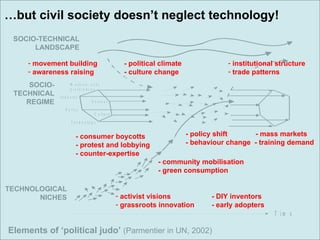
after Smith, 2006 eg: renewables / nuclear;  green / chlorine chemicals;  ecological / GM agriculture Elements of ‘political judo’  (Parmentier in UN, 2002) international trade regulation experimentation / learning alignment / stabilisation / momentum saturation / incumbent inertia windows of opportunity / breakthrough / reconfiguration environmental drivers /  political pressures environmental drivers /  political pressures TECHNOLOGICAL NICHES TECHNOLOGICAL NICHES SOCIO-TECHNICAL REGIME SOCIO-TECHNICAL LANDSCAPE activist visions - DIY inventors grassroots innovation - early adopters  - community mobilisation - green consumption - consumer boycotts  - protest and lobbying - counter-expertise - policy shift   - mass markets - behaviour change  - training demand movement building  - political climate awareness raising  - culture change institutional structure trade patterns … but civil society doesn’t neglect technology!
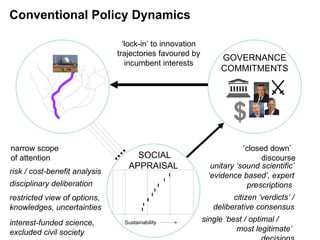
‘ lock-in’ to innovation trajectories favoured by incumbent interests multiple practices, and processes, for informing social agency (emergent and unstructured as well  as deliberately designed ) complex, dynamic, inter-coupled and mutually-reinforcing eco-socio-technical configurations narrow scope  of attention  Conventional Policy Dynamics SOCIAL APPRAISAL  GOVERNANCE COMMITMENTS ‘ closed down’  discourse POSSIBLE PATHWAYS unitary ‘sound scientific’ ‘evidence based’, expert prescriptions  citizen ‘verdicts’ / deliberative consensus single ‘best / optimal /  most legitimate’  decisions risk / cost-benefit analysis disciplinary deliberation restricted view of options, knowledges, uncertainties Sustainability $ IIIIII interest-funded science, excluded civil society
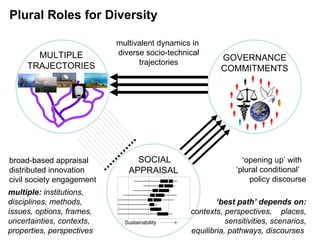
POSSIBLE PATHWAYS MULTIPLE TRAJECTORIES SOCIAL APPRAISAL  GOVERNANCE COMMITMENTS broad-based appraisal distributed innovation  civil society engagement ‘ opening up’ with  ‘plural conditional’  policy discourse multivalent dynamics in  diverse socio-technical trajectories ‘ best path’ depends on:  contexts,   perspectives,  places, sensitivities,   scenarios,  equilibria,   pathways, discourses  multiple:  institutions, disciplines, methods, issues, options, frames, uncertainties, contexts, properties, perspectives Plural Roles for Diversity Sustainability                 
  www.anewmanifesto.org Our  vision  is a world where science and technology work more directly for  social justice ,  poverty alleviation  and the  environment .  This requires innovation which is  transformative  –  reshaping  social and  power  relations to allow innovation in  new directions .  It means  challenging  the  dominance  of pathways driven simply by  private profit  and  military  interests.  It means innovation for  sustainability , paying attention to  ecological integrity  and  diverse  environmental and social  values .  It means that the  benefits  of innovation are widely and  equitably shared , and not captured by narrow, powerful interests.  It means encouraging  open  and  plural  forms of innovation  pathway  –  social  and technical; high tech and  low tech ; those which are currently hidden, as well as those which are more commonly recognised.  It means organising innovation in ways that are  networked ,  distributed  and  inclusive , involving diverse people and groups,  including  those who are  poor  and  marginalised .  It means going beyond  technical elites  in large international, state and commercial organisations to support and harness the energy, creativity and ingenuity of  users ,  workers ,  consumers ,  citizens ,  activists ,  farmers  and  small businesses .
 

Direction, Distribution, Diversity! pluralising progress in innovation, sustainability and development

  • 1.
    Direction, Distribution, Diversity!pluralising progress in innovation, sustainability and development Andy Stirling SPRU – science and technology policy research presentation to seminar at Department of Innovation Sciences Technical University Eindhoven, 15 th April, 2010 www.anewmanifesto.org
  • 2.
    The Missing Politicsof Direction all technology is good… all innovation is good… “ For the objectives of the Lisbon Strategy … pro-innovation action [is] a priority.” - European Parliament “ [we need] more `pro-innovation’ policies …” - EC President, José Manuel Barroso and determined solely by science… “ [there is] an anti-technology culture … a pro- technology culture must be created…” - Council for Science and Technology GM: “… this government's approach is to make decisions … on the basis of sound science - Tony Blair Chemicals: “ … sound science will be the basis of the Commission's legislative proposal…” - EC RTD Commissioner, Philippe Busquin
  • 3.
    time Politics-Denial inTechnology Governance PAST FUTURE conventional ‘linear’ understandings of technology change still prevail in mainstream technology governance eg: “history is a race to advance technology ” - UK Royal Academy of Engineering ‘ anti-technology protestors ’ are “… members of the 'flat earth society’ , opposed to modern economics, modern technology, modern science, modern life itself .” – UN DDG
  • 4.
    time Politics-Denial inTechnology Governance PAST FUTURE conventional ‘linear’ understandings of technology change still prevail in mainstream technology governance eg: “history is a race to advance technology” - UK Royal Academy of Engineering ‘anti-technology protestors’ are “… members of the 'flat earth society’, opposed to modern economics, modern technology, modern science, modern life itself.” – UN DDG Treats innovation as homogeneous: no distinctions … no alternatives… no politics … no choice !
  • 5.
    time Politics-Denial inTechnology Governance PAST FUTURE conventional ‘linear’ understandings of technology change still prevail in mainstream technology governance eg: “history is a race to advance technology” - UK Royal Academy of Engineering ‘anti-technology protestors’ are “… members of the 'flat earth society’, opposed to modern economics, modern technology, modern science, modern life itself.” – UN DDG Treats innovation as homogeneous: no distinctions … no alternatives … no politics … no choice ! Scope for debate restricted to: yes or no? … how much? how fast?’ … who leads?
  • 6.
    time Politics-Denial inTechnology Governance PAST FUTURE conventional ‘linear’ understandings of technology change still prevail in mainstream technology governance eg: “history is a race to advance technology” - UK Royal Academy of Engineering ‘anti-technology protestors’ are “… members of the 'flat earth society’, opposed to modern economics, modern technology, modern science, modern life itself.” – UN DDG Treats innovation as homogeneous: no distinctions … no alternatives … no politics … no choice ! Scope for debate restricted to: yes or no? … how much? how fast?’ … who leads? Seriously neglects questions over: which way? …what alternatives? says who? …why?
  • 7.
    space of technologicalpossibilities time Technological Progress as Optimisation Mainstream policy representations of technology change: - ‘sound science’ - material constraints, - technical convergence - market equilibrium yield ‘optimal’ technological / institutional configurations diversity converges to function-specific optimality
  • 8.
    time Technological Progressas Social Choice Common picture arising in all studies of technology in society – – “ it’s the other way around!” multiple diverging directions
  • 9.
    time But: adiversity of processes ‘close down’ possible directions of change innovation is ‘vector’ not ‘scalar’ Economics and the Normativity of Direction economics: homeostasis ( Sahal, 85 ) lock-in ( Arthur, 89 ) regimes ( Nelson & Winter, 77 ) trajectories ( Dosi, 82 ) history: contingency (Mokyr, 92) momentum (Hughes 83) path-dependence (David, 85) path creation (Karnoe, 01) philosophy/politics: autonomy (Winner, 77) closure (Feenberg, 91) entrapment (Walker, 01) alignment (Geels, 02) social studies: shaping (Bijker, 85) co-construction (Misa, 03) expectations (Lente, 00) imaginaries (Jasanoff, 05)
  • 10.
    QWERTY keyboards … light water reactors … … military systems … Historic ‘Branching Paths’ Many familiar examples of repeated ‘lock-in’ to poor choices time particular trajectories ‘ lock in’
  • 11.
    Historic ‘Branching Paths’Many familiar examples of repeated ‘lock-in’ to poor choices Narrow Gauge Railways … urban transport … … internal combustion engine … time particular trajectories ‘ lock in’
  • 12.
    Historic ‘Branching Paths’Many familiar examples of repeated ‘lock-in’ to poor choices VHS and Betamax … media standards … … Windows software… Deliberately or not – societies choose their technological futures stakes rise with globalisation, harmonisation, standardisation time particular trajectories ‘ lock in’
  • 13.
    Contending priorities &plural knowledges yield diverse pathways: eg: seed production: – ‘GM’: transgenics / syngenics / apomixis; – marker assisted breeding; – commercial industrial hybrids; – participatory breeding – public open source research; time particular trajectories ‘ lock in’ All are technically feasible and potentially economically viable, but not all fully realisable together, especially in globalised world Alternative ‘Possible Futures’
  • 14.
    Alternative ‘Sustainable EnergyStrategies’ Many possible innovation pathways to ‘energy sustainability’: … which directions will we go?
  • 15.
    Noshortage of possible innovation paths to energy sustainability: demand restructuring? behaviour change? efficient end use? service reform? renewable energy? carbon capture and storage? nuclear power? Alternative ‘Sustainable Energy Strategies’ … which directions will we go?
  • 16.
    Noshortage of possible innovation paths to energy sustainability: demand restructuring? behaviour change? efficient end use? service reform? renewable energy? carbon capture and storage? nuclear power? centralised resources? transport fuels? low temperature heat? distributed generation? Alternative ‘Sustainable Energy Strategies’ … which directions will we go?
  • 17.
    Noshortage of possible innovation paths to energy sustainability: demand restructuring? behaviour change? efficient end use? service reform? renewable energy? carbon capture and storage? nuclear power? centralised resources? transport fuels? low temperature heat? distributed generation? small hydro? osmotic gradient? offshore wave? subsea wave? onshore wave? tidal stream? onshore wind? offshore wind? high altitude kites? roof-integrated PV? biomass CHP? municipal waste CHP? geothermal CHP? Alternative ‘Sustainable Energy Strategies’ … which directions will we go?
  • 18.
    The Missing Politicsof Choice “… We have no alternative to nuclear power … … if there were other sources of low carbon energy I would be in favour, but there aren‘t” Independent, 2006 eg: Sir David King, former UK Chief Scientist “… We need to do everything… we cannot afford not to use nuclear power.” BBC Radio 4, 2007 eg: David MacKay, DECC chief scientist ‘ Britain must go nuclear’…“If the aim is to get off fossil fuels, we need nuclear power or solar power generated in other countries’ deserts, or both.” Independent, 2009
  • 19.
    The Politics ofExpectation 1: assume future electricity infrastructures shift towards distributed, low-voltage, smart-metered electricity systems, subject to intelligent control and flexible supply contracts Directions for technology change are driven by expectations invest in small scale renewables and energy service innovations 2: assume persistence of traditional large centralised steam-cycle power stations, presiding over high-voltage transmission systems, with one-way distribution and conventional tariffs incremental innovation along traditional fossil and nuclear paths Determinist ‘sound science’ / ‘pro innovation’ language not innocent … but moulds choices and closes politics
  • 20.
    The Complicity ofInnovation Studies despite seminal role in substantiating mechanisms of closure, conventional innovation studies close down expectations over general dynamics (as well as particular outcomes) of progress focus is on fostering: - performance (Dayananda 07) - cost/benefit (Layard, Glaister 94) - rate of innovation (Chakravorti 01) - efficiency (Grupp 97) - innovation systems (Fagerberg 06) - first movers (Lieberman 88) - catching up (Santangelo 06) - forging ahead (Abramowitz 86) - diffusion (Rogers 03) - leapfrogging (Brezis 93) - advance (Nelson 02) - agency (Rosenberg 02) or avoiding: - barriers (Parente 94) - falling behind (Abramowitz 86) - laggards (Aghion 06) - stranding (Farrell 86) innovation thus tends to be addressed falsely as scalar quantity, rather than vector quality – ie: without the property of direction
  • 21.
    Directions for ‘DevelopmentTransitions’ Historically, even ‘transitions’ analysis neglects questions of ‘direction’ Key focus: enabling chosen technology to move from niche to regime. Policy challenge seen more as instrumental ‘ management ’ under self-evident goals, than of politics over the normative priorities themselves. Recent critiques highlight importance of political questions over ‘ direction ’ (eg: Smith et al , 2005; Shove and Walker, 2007). Nowhere is this more salient than in case of the poorest countries - 30% of global public research is on the military - only 10% of world health research on diseases that affect 90% - renewable energy receives only small fraction of nuclear research Questions of direction are crucial for future development transitions
  • 22.
    Distributed Innovation forDevelopment Where transitions are driven by the interests of marginalised people, attention is especially important to potential for distributed innovation Examples of transformative distributed innovation for development: - malaria bednets and vaccination programmes in Africa; - slum-dwellers securing water supplies in Latin America; - participatory rice breeding in Southeast Asia; - health practitioners combine local and biomedical methods in Africa; - ‘bottom of the pyramid’ markets in Asia, Africa and Latin America. Organised social movements can play an especially important role - European nuclear activists: windpower, green housing, fuel poverty; - S. African HIV activists: affordable medicines and healthcare; - Indian ‘Honey Bee Network’ of grassroots entrepreneurs: palm tree climbing; bicycle-powered washing; open source IP-sharing .
  • 23.
    Blind spot insocial and political science of innovation (Smith, 05) political science: ‘systems of production’, but not innovation (Hollingsworth 97) social movements research: ideas, institutions, interests – not technology (Smith, 05) social studies of technology: only general ‘pressure’ (Poel, 00; Jamison, 99) multi-level model acknowledges role … (Schot, 03; Geels, 08) … but pays insufficient attention to role of politics and power (Smith et al, 05) But innovation studies neglects civil society… Restricted focus in innovation systems research - explicitly excluded in ‘triple helix’ (government, industry, academia) (Etzkowitz 05) - sidelined as general factor in healthy economy (Fukuyama 00) - relevant only at lower levels of regional systems of innovation (Cook 98) - implicated indirectly thro’ small business ‘partnerships’ in development (Hall 01) on ‘democracy’: focus is on education system, not civil society (Lundvall 09)
  • 24.
    … tho’ civilsociety doesn’t neglect innovation!
  • 25.
    saturation / incumbentinertia SOCIO-TECHNICAL REGIME … but civil society doesn’t neglect technology! after Geels, 2002
  • 26.
    saturation / incumbentinertia experimentation / learning alignment / stabilisation / momentum TECHNOLOGICAL NICHES TECHNOLOGICAL NICHES SOCIO-TECHNICAL REGIME … but civil society doesn’t neglect technology! after Geels, 2002
  • 27.
    saturation / incumbentinertia experimentation / learning alignment / stabilisation / momentum environmental drivers / political pressures environmental drivers / political pressures TECHNOLOGICAL NICHES TECHNOLOGICAL NICHES SOCIO-TECHNICAL REGIME SOCIO-TECHNICAL LANDSCAPE … but civil society doesn’t neglect technology! after Geels, 2002
  • 28.
    saturation / incumbentinertia experimentation / learning alignment / stabilisation / momentum environmental drivers / political pressures environmental drivers / political pressures TECHNOLOGICAL NICHES TECHNOLOGICAL NICHES SOCIO-TECHNICAL REGIME SOCIO-TECHNICAL LANDSCAPE … but civil society doesn’t neglect technology! after Geels, 2002
  • 29.
    experimentation / learningalignment / stabilisation / momentum saturation / incumbent inertia windows of opportunity / breakthrough / reconfiguration environmental drivers / political pressures environmental drivers / political pressures TECHNOLOGICAL NICHES TECHNOLOGICAL NICHES SOCIO-TECHNICAL REGIME SOCIO-TECHNICAL LANDSCAPE … but civil society doesn’t neglect technology! after Geels, 2002
  • 30.
    experimentation / learningalignment / stabilisation / momentum saturation / incumbent inertia windows of opportunity / breakthrough / reconfiguration environmental drivers / political pressures environmental drivers / political pressures TECHNOLOGICAL NICHES TECHNOLOGICAL NICHES SOCIO-TECHNICAL REGIME SOCIO-TECHNICAL LANDSCAPE new regime affects landscape … but civil society doesn’t neglect technology! after Geels, 2002
  • 31.
    after Smith, 2006eg: renewables / nuclear; green / chlorine chemicals; ecological / GM agriculture Elements of ‘political judo’ (Parmentier in UN, 2002) international trade regulation experimentation / learning alignment / stabilisation / momentum saturation / incumbent inertia windows of opportunity / breakthrough / reconfiguration environmental drivers / political pressures environmental drivers / political pressures TECHNOLOGICAL NICHES TECHNOLOGICAL NICHES SOCIO-TECHNICAL REGIME SOCIO-TECHNICAL LANDSCAPE activist visions - DIY inventors grassroots innovation - early adopters - community mobilisation - green consumption - consumer boycotts - protest and lobbying - counter-expertise - policy shift - mass markets - behaviour change - training demand movement building - political climate awareness raising - culture change institutional structure trade patterns … but civil society doesn’t neglect technology!
  • 32.
    ‘ lock-in’ toinnovation trajectories favoured by incumbent interests multiple practices, and processes, for informing social agency (emergent and unstructured as well as deliberately designed ) complex, dynamic, inter-coupled and mutually-reinforcing eco-socio-technical configurations narrow scope of attention Conventional Policy Dynamics SOCIAL APPRAISAL GOVERNANCE COMMITMENTS ‘ closed down’ discourse POSSIBLE PATHWAYS unitary ‘sound scientific’ ‘evidence based’, expert prescriptions citizen ‘verdicts’ / deliberative consensus single ‘best / optimal / most legitimate’ decisions risk / cost-benefit analysis disciplinary deliberation restricted view of options, knowledges, uncertainties Sustainability $ IIIIII interest-funded science, excluded civil society
  • 33.
    POSSIBLE PATHWAYS MULTIPLETRAJECTORIES SOCIAL APPRAISAL GOVERNANCE COMMITMENTS broad-based appraisal distributed innovation civil society engagement ‘ opening up’ with ‘plural conditional’ policy discourse multivalent dynamics in diverse socio-technical trajectories ‘ best path’ depends on: contexts, perspectives, places, sensitivities, scenarios, equilibria, pathways, discourses multiple: institutions, disciplines, methods, issues, options, frames, uncertainties, contexts, properties, perspectives Plural Roles for Diversity Sustainability                 
  • 34.
    www.anewmanifesto.orgOur vision is a world where science and technology work more directly for social justice , poverty alleviation and the environment . This requires innovation which is transformative – reshaping social and power relations to allow innovation in new directions . It means challenging the dominance of pathways driven simply by private profit and military interests. It means innovation for sustainability , paying attention to ecological integrity and diverse environmental and social values . It means that the benefits of innovation are widely and equitably shared , and not captured by narrow, powerful interests. It means encouraging open and plural forms of innovation pathway – social and technical; high tech and low tech ; those which are currently hidden, as well as those which are more commonly recognised. It means organising innovation in ways that are networked , distributed and inclusive , involving diverse people and groups, including those who are poor and marginalised . It means going beyond technical elites in large international, state and commercial organisations to support and harness the energy, creativity and ingenuity of users , workers , consumers , citizens , activists , farmers and small businesses .
  • 35.

Editor's Notes

  • #24 Johnson and Lundvall, 2000. Promoting innovation systems as a response to the globalising learning economy http://www.druid.dk/uploads/tx_picturedb/ds2000-106.pdf Cooke P, Uranga M G, Etxebarria G, 1998, "Regional systems of innovation: an evolutionary perspective" Environment and Planning A 30(9) 1563 – 1584 Henry Etzkowitza, José Manoel Carvalho de Mellob, Mariza Almeidac, Towards “meta-innovation” in Brazil: The evolution of the incubator and the emergence of a triple helix, Research Policy Volume 34, Issue 4, May 2005, Pages 411-424 http://www.sciencedirect.com/science?_ob=ArticleURL&_udi=B6V77-4FR8PHN-1&_user=128860&_rdoc=1&_fmt=&_orig=search&_sort=d&_docanchor=&view=c&_searchStrId=1033972868&_rerunOrigin=scholar.google&_acct=C000010638&_version=1&_urlVersion=0&_userid=128860&md5=9f4aa99c8023150dbde4bf839a35ec5c also: Loet Leydesdorff, Henry Etzkowitz , The Transformation Of University-industry-government Relations, Electronic Journal of Sociology (2001) http://sociology.org/content/vol005.004/th.html Henry Etzkowitza, José Manoel Carvalho de Mellob, Mariza Almeidac, Towards “meta-innovation” in Brazil: The evolution of the incubator and the emergence of a triple helix, Research Policy Volume 34, Issue 4, May 2005, Pages 411-424 http://www.sciencedirect.com/science?_ob=ArticleURL&_udi=B6V77-4FR8PHN-1&_user=128860&_rdoc=1&_fmt=&_orig=search&_sort=d&_docanchor=&view=c&_searchStrId=1033972868&_rerunOrigin=scholar.google&_acct=C000010638&_version=1&_urlVersion=0&_userid=128860&md5=9f4aa99c8023150dbde4bf839a35ec5c also: Loet Leydesdorff, Henry Etzkowitz , The Transformation Of University-industry-government Relations, Electronic Journal of Sociology (2001) http://sociology.org/content/vol005.004/th.html J. Rogers Hollingsworth, Robert Boyer (eds) Contemporary capitalism: the embeddedness of institutions, Cambridge, 1997 Johan Schot, The contested rise of a modernist technology politics. In Technology and modernity, eds. Th.J. Misa, P. Brey and A. Rip, 257–78. Cambridge: MIT Press.2003 Grin, J. 2006. Reflexive modernisation as a governance issue, or: designing and shaping re-structuration. In Reflexive governance for sustainable development, eds. J.-P. Voss, D. Bauknecht and R. Kemp, 57–81. Cheltenham: Edward Elgar.2006 Johan Schot∗ and FrankW. Geels, Strategic niche management and sustainable innovation journeys: theory, findings, research agenda, and policy, Technology Analysis & Strategic Management Vol. 20, No. 5, September 2008, 537–554 Lundvall and Lorenz, Innovation and Democracy in the Learning Economy: the new deal as response to the crisis, memorandum for No.10 policy seminar, October 2009
  • #25 Pressure on regime: destabilise it; force incumbents to invest in alternative solutions to the newly pressurised problems
  • #26 Pressure on regime: destabilise it; force incumbents to invest in alternative solutions to the newly pressurised problems
  • #27 Pressure on regime: destabilise it; force incumbents to invest in alternative solutions to the newly pressurised problems
  • #28 Pressure on regime: destabilise it; force incumbents to invest in alternative solutions to the newly pressurised problems
  • #29 Pressure on regime: destabilise it; force incumbents to invest in alternative solutions to the newly pressurised problems
  • #30 Pressure on regime: destabilise it; force incumbents to invest in alternative solutions to the newly pressurised problems
  • #31 Pressure on regime: destabilise it; force incumbents to invest in alternative solutions to the newly pressurised problems
  • #32 Pressure on regime: destabilise it; force incumbents to invest in alternative solutions to the newly pressurised problems