www.steps-centre.org/
www.sussex.ac.uk/spru/
www.multicriteria-mapping.org
www.sussex.ac.uk/spru/people/peoplelists/person/7513
Andy Stirling
SPRU & STEPS Centre
University of Sussex
Chair’s plenary lecture for Royal Geographical Society /
Institute for British Geographers conference on ‘Nexus Thinking’
Ondaatje Theatre, Imperial College, London
Tuesday 30th
August 2016
Meeting ‘Nexus’ Challenges:
from policy connections to political transformations
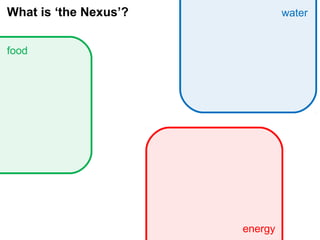
What is ‘the Nexus’?
food
water
energy
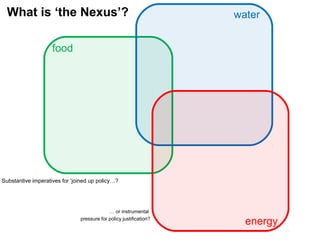
What is ‘the Nexus’?
food
water
energy
Substantive imperatives for ‘joined up policy…?
… or instrumental
pressure for policy justification?
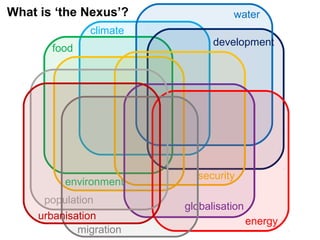
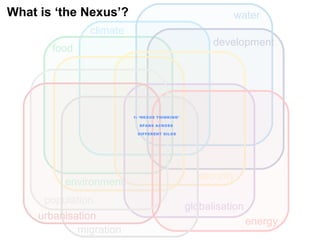
What is ‘the Nexus’?
climate
development
food
environment
security
globalisation
energy
population
migration
urbanisation
water
water
climate
development
food
environment
security
globalisation
energy
population
migration
urbanisation
1: ‘NEXUS THINKING’
SPANS ACROSS
DIFFERENT SILOS
What is ‘the Nexus’?
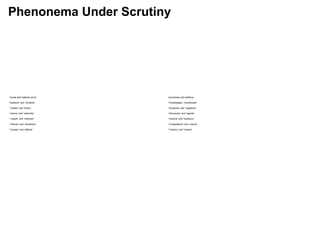
Phenonema Under Scrutiny
•social and material world
•“systems” and “contexts”
•“scales” and “levels”
•“actors” and “networks”
•“values” and “interests”
•“frames” and “narratives”
•“causes” and “effects”
•processes and relations
•“knowledges”,“incertitudes”
•“positives” and “negatives”
•“structures” and “agents”
•“actions” and “reactions”
•“imaginations” and “visions”
•“metrics” and ”indices”
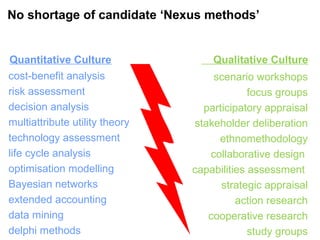
cost-benefit analysis
risk assessment
decision analysis
multiattribute utility theory
technology assessment
life cycle analysis
optimisation modelling
Bayesian networks
extended accounting
data mining
delphi methods
Quantitative Culture Qualitative Culture
No shortage of candidate ‘Nexus methods’
scenario workshops
focus groups
participatory appraisal
stakeholder deliberation
ethnomethodology
collaborative design
capabilities assessment
strategic appraisal
action research
cooperative research
study groups
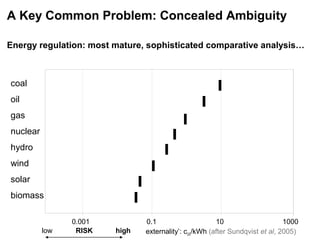
Energy regulation: most mature, sophisticated comparative analysis…
A Key Common Problem: Concealed Ambiguity
0.001 0.1 10 1000
externality’: cUS/kWh (after Sundqvist et al, 2005)low RISK high
coal
oil
gas
nuclear
hydro
wind
solar
biomass
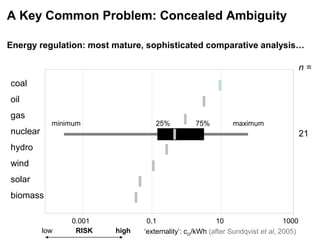
Energy regulation: most mature, sophisticated comparative analysis…
A Key Common Problem: Concealed Ambiguity
0.001 0.1 10 1000
coal
oil
gas
nuclear
hydro
21
wind
solar
biomass
n =
‘externality’: cUS/kWh (after Sundqvist et al, 2005)
minimum maximum25% 75%
low RISK high
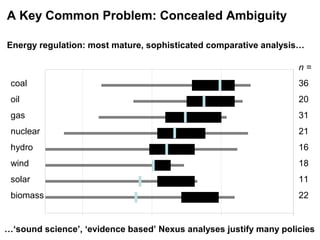
Energy regulation: most mature, sophisticated comparative analysis…
A Key Common Problem: Concealed Ambiguity
coal
oil
gas
nuclear
hydro
36
20
wind 18
solar 11
biomass 22
31
21
16
n =
…‘sound science’, ‘evidence based’ Nexus analyses justify many policies
Energy regulation: most mature, sophisticated comparative analysis…
A Key Common Problem: Concealed Ambiguity
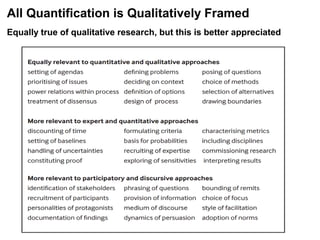
Equally true of qualitative research, but this is better appreciated
All Quantification is Qualitatively Framed
Equally true of qualitative research, but this is better appreciated
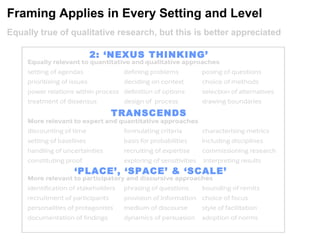
2: ‘NEXUS THINKING’
Framing Applies in Every Setting and Level
TRANSCENDS
‘PLACE’, ‘SPACE’ & ‘SCALE’
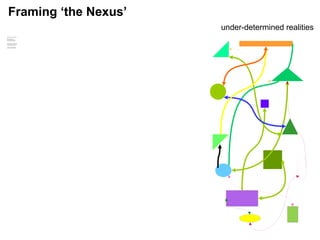
under-determined realities
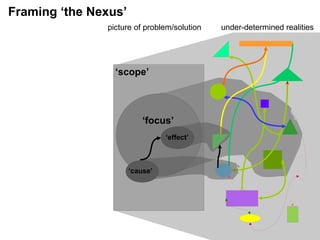
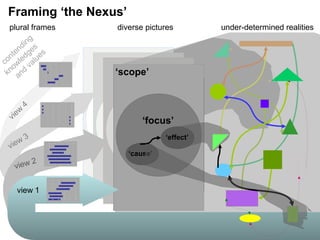
Framing ‘the Nexus’
Insights well known in geography:
-relational ontologies
-constructivist epistemologies
-nonrepresentational theories
…
But conventionally recognised only
in separated academic silos, often
mostlyconcerned with critique …
… and more preoccupied with
‘how to know?’ than ‘what to do?’
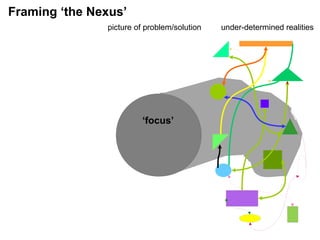
‘system’
‘focus’
under-determined realitiespicture of problem/solution
Framing ‘the Nexus’
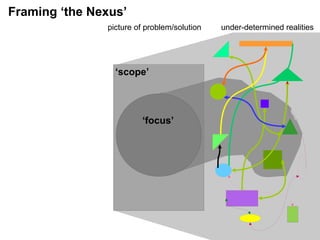
‘scope’
‘system’
‘focus’
under-determined realitiespicture of problem/solution
Framing ‘the Nexus’
‘scope’
‘system’
‘focus’
‘cause’
‘effect’
under-determined realitiespicture of problem/solution
Framing ‘the Nexus’
environment‘scope’
‘system’
‘focus’
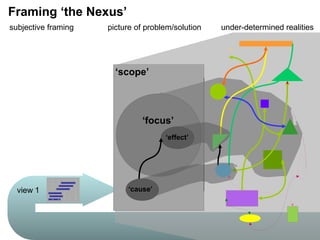
subjective framing
‘effect’
under-determined realities
‘cause’view 1
picture of problem/solution
Framing ‘the Nexus’
environment
‘system’
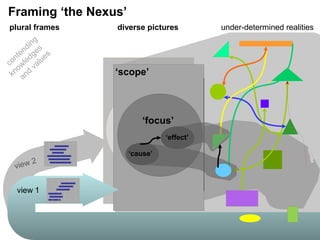
under-determined realitiesdiverse picturesplural frames
‘effect’
‘cause’
‘scope’
‘focus’
view 2
view 1
contending
knowledges
and
values
Framing ‘the Nexus’
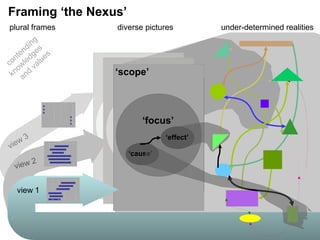
plural frames
‘system’
‘cause’
‘effect’
under-determined realitiesdiverse pictures
‘scope’
‘focus’
view 3
view 1
view 2
contending
knowledges
and
values
Framing ‘the Nexus’
view
4
plural frames
‘system’
‘cause’
‘effect’
under-determined realitiesdiverse pictures
‘scope’
‘focus’
contending
knowledges
and
values
view 1
view 2
view 3
Framing ‘the Nexus’
view
4
plural frames
‘system’
‘cause’
‘effect’
under-determined realitiesdiverse pictures
‘scope’
‘focus’
view 1
view 2
view 3
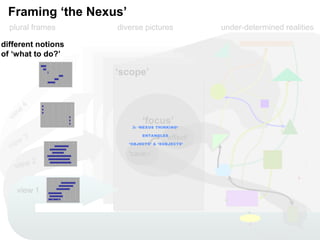
Framing ‘the Nexus’
different notions
of ‘what to do?’
3: ‘NEXUS THINKING’
ENTANGLES
‘OBJECTS’ & ‘SUBJECTS’
view
4
plural frames
‘system’
‘cause’
‘effect’
under-determined realitiesdiverse pictures
‘scope’
‘focus’
contending
knowledges
and
values
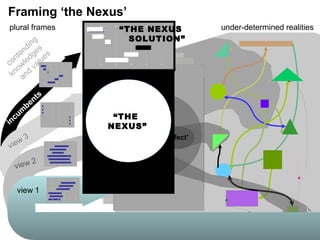
Framing ‘the Nexus’
incum
bents
view 2
view 3
view 1
“THE
NEXUS”
“THE NEXUS
SOLUTION”
incum
bents
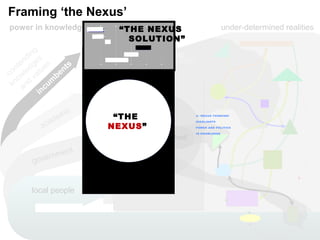
power in knowledge
‘system’
‘cause’
‘effect’
under-determined realities
academic
government
local people
diverse pictures
‘scope’
‘focus’
contending
knowledges
and
values
“THE
NEXUS”
Framing ‘the Nexus’
4: ‘NEXUS THINKING’
HIGHLIGHTS
POWER AND POLITICS
IN KNOWLEDGE
“THE
NEXUS”
“THE NEXUS
SOLUTION”
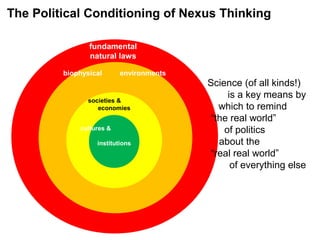
fundamental
natural laws
biophysical environments
societies &
economies
cultures &
institutions
Science (of all kinds!)
is a key means by
which to remind
“the real world”
of politics
about the
“real real world”
of everything else
The Political Conditioning of Nexus Thinking
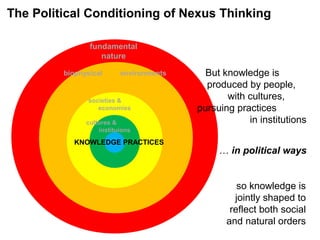
KNOWLEDGE PRACTICES
fundamental
nature
biophysical environments
societies &
economies
cultures &
instituions
But knowledge is
produced by people,
with cultures,
pursuing practices
in institutions
… in political ways
so knowledge is
jointly shaped to
reflect both social
and natural orders
The Political Conditioning of Nexus Thinking
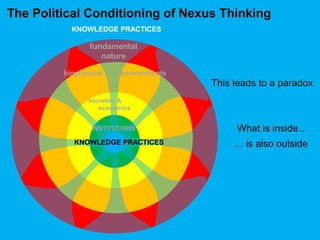
KNOWLEDGE PRACTICES
fundamental
nature
biophysical environments
societies &
economies
INSTITUTIONS
This leads to a paradox
What is inside…
… is also outside
The Political Conditioning of Nexus Thinking
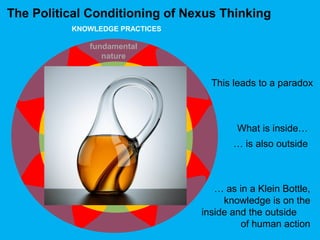
KNOWLEDGE PRACTICES
biophysical environments
societies &
economies
INSTITUTIONS
This leads to a paradox
What is inside…
… is also outside
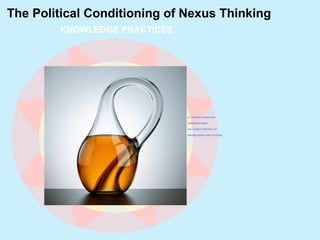
… as in a Klein Bottle,
knowledge is on the
inside and the outside
of human action
KNOWLEDGE PRACTICES
The Political Conditioning of Nexus Thinking
KNOWLEDGE PRACTICES
fundamental
nature
knowledge
practices
biophysical environments
INSTITUTIONS
KNOWLEDGE PRACTICES
The Political Conditioning of Nexus Thinking
5: ‘NEXUS THINKING’
UNDERSCORES
CO-CONSTITUTING OF
KNOWLEDGE AND ACTION
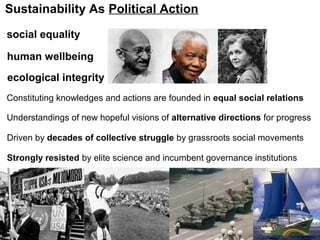
Constituting knowledges and actions are founded in equal social relations
Strongly resisted by elite science and incumbent governance institutions
Sustainability As Political Action
Driven by decades of collective struggle by grassroots social movements
Understandings of new hopeful visions of alternative directions for progress
social equality
human wellbeing
ecological integrity
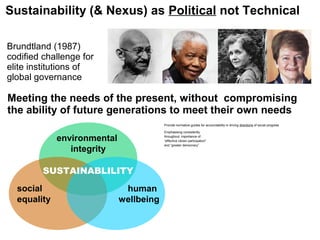
Sustainability (& Nexus) as Political not Technical
Meeting the needs of the present, without compromising
the ability of future generations to meet their own needs
Brundtland (1987)
codified challenge for
elite institutions of
global governance
Provide normative guides for accountability in driving directions of social progress
Emphasising consistently
throughout, importance of:
“effective citizen participation”
and “greater democracy”
environmental
integrity
social
equality
human
wellbeing
SUSTAINABLILITY
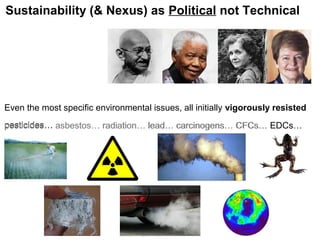
Even the most specific environmental issues, all initially vigorously resisted
pesticides…pesticides… asbestos…pesticides… asbestos… radiation…pesticides… asbestos… radiation… lead…pesticides… asbestos… radiation… lead… carcinogens…pesticides… asbestos… radiation… lead… carcinogens… CFCs…pesticides… asbestos… radiation… lead… carcinogens… CFCs… EDCs…
Sustainability (& Nexus) as Political not Technical
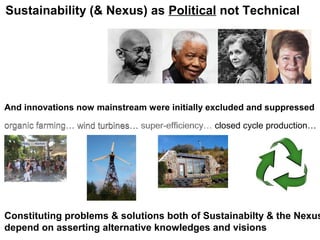
And innovations now mainstream were initially excluded and suppressed
organic farming…organic farming… wind turbines…organic farming… wind turbines… super-efficiency…organic farming… wind turbines… super-efficiency… closed cycle production…
Constituting problems & solutions both of Sustainabilty & the Nexus
depend on asserting alternative knowledges and visions
Sustainability (& Nexus) as Political not Technical
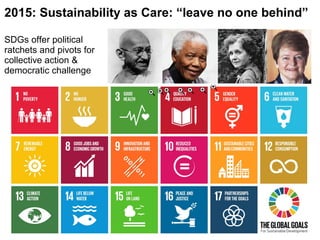
2015: Sustainability as Care: “leave no one behind”
SDGs offer political
ratchets and pivots for
collective action &
democratic challenge
2015: Sustainability as Care: “leave no one behind”
In this key normative tradition where it emerged, ‘nexus thinking’
can help illuminate, enable and render accountable, a complexity
and multiplicity of contexts, perspectives and possibilities
In this key normative tradition where it emerged, ‘nexus thinking’
can help illuminate, enable and render accountable, a complexity
and multiplicity of contexts, perspectives and possibilities
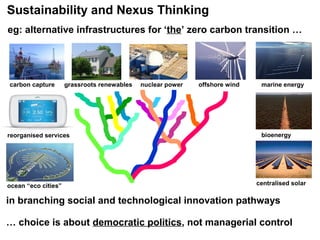
ocean “eco cities”
carbon capture
reorganised services
offshore windnuclear power marine energy
bioenergy
grassroots renewables
centralised solar
eg: alternative infrastructures for ‘the’ zero carbon transition …
in branching social and technological innovation pathways
… choice is about democratic politics, not managerial control
Sustainability and Nexus Thinking
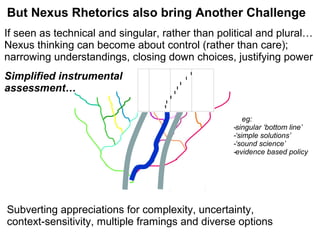
But Nexus Rhetorics also bring Another Challenge
If seen as technical and singular, rather than political and plural…
Nexus thinking can become about control (rather than care);
narrowing understandings, closing down choices, justifying power
Simplified instrumental
assessment…
eg:
-singular ‘bottom line’
-‘simple solutions’
-‘sound science’
-evidence based policy
Subverting appreciations for complexity, uncertainty,
context-sensitivity, multiple framings and diverse options
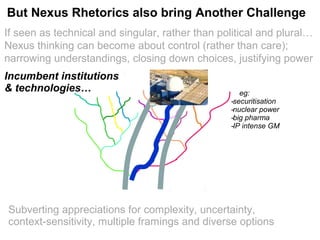
If seen as technical and singular, rather than political and plural…
Nexus thinking can become about control (rather than care);
narrowing understandings, closing down choices, justifying power
eg:
-securitisation
-nuclear power
-big pharma
-IP intense GM
Incumbent institutions
& technologies…
But Nexus Rhetorics also bring Another Challenge
Subverting appreciations for complexity, uncertainty,
context-sensitivity, multiple framings and diverse options
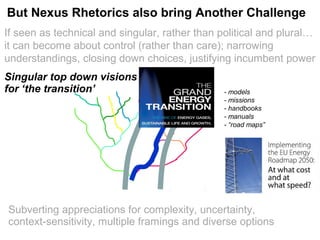
If seen as technical and singular, rather than political and plural…
it can become about control (rather than care); narrowing
understandings, closing down choices, justifying incumbent power
Politics reduced to risk: from ends: strategic choices between visions
to means: detailed regulation of modalities
Singular top down visions
for ‘the transition’ - models
- missions
- handbooks
- manuals
- “road maps”
But Nexus Rhetorics also bring Another Challenge
Subverting appreciations for complexity, uncertainty,
context-sensitivity, multiple framings and diverse options
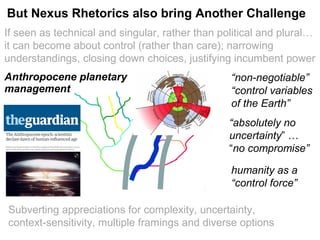
If seen as technical and singular, rather than political and plural…
it can become about control (rather than care); narrowing
understandings, closing down choices, justifying incumbent power
Politics reduced to risk: from ends: strategic choices between visions
to means: detailed regulation of modalities
Anthropocene planetary
management “control variables
of the Earth”
“non-negotiable”
“absolutely no
uncertainty” …
“no compromise”
humanity as a
“control force”
But Nexus Rhetorics also bring Another Challenge
Subverting appreciations for complexity, uncertainty,
context-sensitivity, multiple framings and diverse options
If seen as technical and singular, rather than political and plural…
it can become about control (rather than care); narrowing
understandings, closing down choices, justifying incumbent power
Politics reduced to risk: from ends: strategic choices between visions
to means: detailed regulation of modalities
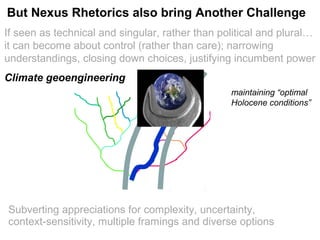
Climate geoengineering
maintaining “optimal
Holocene conditions”
But Nexus Rhetorics also bring Another Challenge
Subverting appreciations for complexity, uncertainty,
context-sensitivity, multiple framings and diverse options
From Rhetorics to Practice
Affirm key insights and qualities of ‘Nexus thinking’ discussed here…
1 ‘nexus thinking’ spans across different academic and policy silos
2 ‘nexus thinking’ is framed in ways that transcend place, space and scale
3 ‘nexus thinking’ means recognizing subjects are entangled in objects
4 ‘nexus thinking’ highlights politics and power in knowledge
5 ‘nexus thinking’ enacts co-constituting of knowledge and action
… ways of knowing are kinds of doing
INPUTS
(aspects taken into
account within
practice of research
or appraisal)
problems,
options,
pros / cons,
issues,
uncertainties,
perspectives
INPUTS
(things that are
taken into account)
Pro
blems, options, pros
/ cons, issues,
uncertainties,
perspectives
narrow
broad
closing down opening up
expert / analytic
participatory /
deliberative
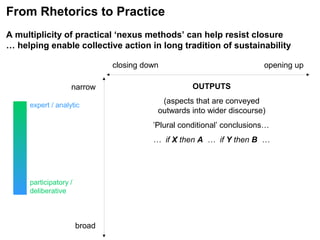
OUTPUTS
(aspects that are conveyed
outwards into wider discourse)
’Plural conditional’ conclusions…
… if X then A … if Y then B …
From Rhetorics to Practice
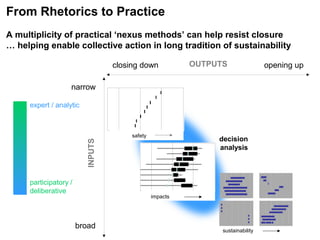
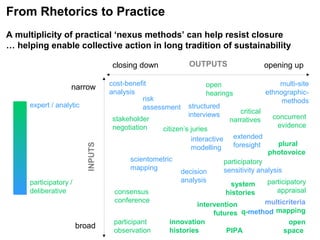
A multiplicity of practical ‘nexus methods’ can help resist closure
… helping enable collective action in long tradition of sustainability
narrow
broad
closing down opening up
expert / analytic
participatory /
deliberative
decision
analysis
INPUTS
OUTPUTS
sustainability
safety
impacts
From Rhetorics to Practice
A multiplicity of practical ‘nexus methods’ can help resist closure
… helping enable collective action in long tradition of sustainability
narrow
broad
closing down opening up
expert / analytic
participatory /
deliberative
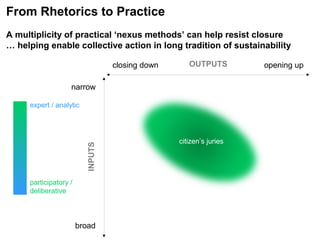
citizen’s juries
INPUTS
OUTPUTS
From Rhetorics to Practice
A multiplicity of practical ‘nexus methods’ can help resist closure
… helping enable collective action in long tradition of sustainability
narrow
broad
closing down opening up
expert / analytic
participatory /
deliberative
citizen’s juries
participatory
appraisal
q-method
scientometric
mapping
open
space
multicriteria
mapping
extended
foresight
citizen’s juries
decision
analysis
stakeholder
negotiation
participatory
sensitivity analysis
cost-benefit
analysis
risk
assessment
interactive
modelling
structured
interviews
participant
observation
multi-site
ethnographic-
methods
citizen’s juries
consensus
conference
open
hearings
concurrent
evidence
critical
narratives
intervention
futures
PIPA
plural
photovoice
system
histories
innovation
histories
INPUTS
OUTPUTS
From Rhetorics to Practice
A multiplicity of practical ‘nexus methods’ can help resist closure
… helping enable collective action in long tradition of sustainability
spot-the-
narrative
narrow
broad
closing down opening up
expert / analytic
participatory /
deliberative
citizen’s juries
decision
analysis
participatory
rural appraisal
stakeholder
negotiation
q-method
sensitivity
analysis
deliberative
mapping
scientometric
mapping
open
space
cost-benefit
analysis
risk
assessmen
t
interactive
modelling
structured
interviews
narrative-based
participant
observation
multi-site
ethnographic-
methods
citizen’s juries
consensus
conference
open
hearings
dissenting
opinions
multi-criteria
mapping
extended
foresight
stakeholder
negotiation
cost-benefit
analysis
risk
assessment
INPUTS
OUTPUTS
The Dance with Power
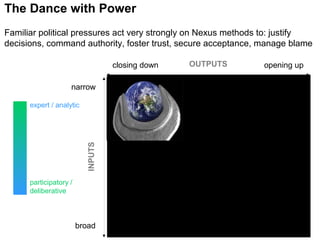
Familiar political pressures act very strongly on Nexus methods to: justify
decisions, command authority, foster trust, secure acceptance, manage blame
expert / analytic
participatory /
deliberative
narrow
broad
closing down opening up
participatory
appraisal
q-method open
space
multicriteria
mapping
participatory
sensitivity
analysis
intervention
futures PIPA
plural
photovoice
system
histories
innovation
histories
INPUTS
OUTPUTS
Nexus thinking: from connecting to transforming…
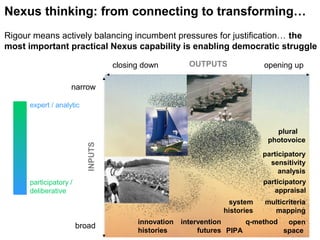
Rigour means actively balancing incumbent pressures for justification… the
most important practical Nexus capability is enabling democratic struggle

Andy Stirling - nexus methods (RGS 2016)

  • 1.
    www.steps-centre.org/ www.sussex.ac.uk/spru/ www.multicriteria-mapping.org www.sussex.ac.uk/spru/people/peoplelists/person/7513 Andy Stirling SPRU &STEPS Centre University of Sussex Chair’s plenary lecture for Royal Geographical Society / Institute for British Geographers conference on ‘Nexus Thinking’ Ondaatje Theatre, Imperial College, London Tuesday 30th August 2016 Meeting ‘Nexus’ Challenges: from policy connections to political transformations
  • 2.
    What is ‘theNexus’? food water energy
  • 3.
    What is ‘theNexus’? food water energy Substantive imperatives for ‘joined up policy…? … or instrumental pressure for policy justification?
  • 4.
    What is ‘theNexus’? climate development food environment security globalisation energy population migration urbanisation water
  • 5.
  • 6.
    Phenonema Under Scrutiny •socialand material world •“systems” and “contexts” •“scales” and “levels” •“actors” and “networks” •“values” and “interests” •“frames” and “narratives” •“causes” and “effects” •processes and relations •“knowledges”,“incertitudes” •“positives” and “negatives” •“structures” and “agents” •“actions” and “reactions” •“imaginations” and “visions” •“metrics” and ”indices”
  • 7.
    cost-benefit analysis risk assessment decisionanalysis multiattribute utility theory technology assessment life cycle analysis optimisation modelling Bayesian networks extended accounting data mining delphi methods Quantitative Culture Qualitative Culture No shortage of candidate ‘Nexus methods’ scenario workshops focus groups participatory appraisal stakeholder deliberation ethnomethodology collaborative design capabilities assessment strategic appraisal action research cooperative research study groups
  • 8.
    Energy regulation: mostmature, sophisticated comparative analysis… A Key Common Problem: Concealed Ambiguity
  • 9.
    0.001 0.1 101000 externality’: cUS/kWh (after Sundqvist et al, 2005)low RISK high coal oil gas nuclear hydro wind solar biomass Energy regulation: most mature, sophisticated comparative analysis… A Key Common Problem: Concealed Ambiguity
  • 10.
    0.001 0.1 101000 coal oil gas nuclear hydro 21 wind solar biomass n = ‘externality’: cUS/kWh (after Sundqvist et al, 2005) minimum maximum25% 75% low RISK high Energy regulation: most mature, sophisticated comparative analysis… A Key Common Problem: Concealed Ambiguity
  • 11.
    coal oil gas nuclear hydro 36 20 wind 18 solar 11 biomass22 31 21 16 n = …‘sound science’, ‘evidence based’ Nexus analyses justify many policies Energy regulation: most mature, sophisticated comparative analysis… A Key Common Problem: Concealed Ambiguity
  • 12.
    Equally true ofqualitative research, but this is better appreciated All Quantification is Qualitatively Framed
  • 13.
    Equally true ofqualitative research, but this is better appreciated 2: ‘NEXUS THINKING’ Framing Applies in Every Setting and Level TRANSCENDS ‘PLACE’, ‘SPACE’ & ‘SCALE’
  • 14.
    under-determined realities Framing ‘theNexus’ Insights well known in geography: -relational ontologies -constructivist epistemologies -nonrepresentational theories … But conventionally recognised only in separated academic silos, often mostlyconcerned with critique … … and more preoccupied with ‘how to know?’ than ‘what to do?’
  • 15.
    ‘system’ ‘focus’ under-determined realitiespicture ofproblem/solution Framing ‘the Nexus’
  • 16.
  • 17.
  • 18.
  • 19.
    environment ‘system’ under-determined realitiesdiverse picturespluralframes ‘effect’ ‘cause’ ‘scope’ ‘focus’ view 2 view 1 contending knowledges and values Framing ‘the Nexus’
  • 20.
    plural frames ‘system’ ‘cause’ ‘effect’ under-determined realitiesdiversepictures ‘scope’ ‘focus’ view 3 view 1 view 2 contending knowledges and values Framing ‘the Nexus’
  • 21.
    view 4 plural frames ‘system’ ‘cause’ ‘effect’ under-determined realitiesdiversepictures ‘scope’ ‘focus’ contending knowledges and values view 1 view 2 view 3 Framing ‘the Nexus’
  • 22.
    view 4 plural frames ‘system’ ‘cause’ ‘effect’ under-determined realitiesdiversepictures ‘scope’ ‘focus’ view 1 view 2 view 3 Framing ‘the Nexus’ different notions of ‘what to do?’ 3: ‘NEXUS THINKING’ ENTANGLES ‘OBJECTS’ & ‘SUBJECTS’
  • 23.
    view 4 plural frames ‘system’ ‘cause’ ‘effect’ under-determined realitiesdiversepictures ‘scope’ ‘focus’ contending knowledges and values Framing ‘the Nexus’ incum bents view 2 view 3 view 1 “THE NEXUS” “THE NEXUS SOLUTION”
  • 24.
    incum bents power in knowledge ‘system’ ‘cause’ ‘effect’ under-determinedrealities academic government local people diverse pictures ‘scope’ ‘focus’ contending knowledges and values “THE NEXUS” Framing ‘the Nexus’ 4: ‘NEXUS THINKING’ HIGHLIGHTS POWER AND POLITICS IN KNOWLEDGE “THE NEXUS” “THE NEXUS SOLUTION”
  • 25.
    fundamental natural laws biophysical environments societies& economies cultures & institutions Science (of all kinds!) is a key means by which to remind “the real world” of politics about the “real real world” of everything else The Political Conditioning of Nexus Thinking
  • 26.
    KNOWLEDGE PRACTICES fundamental nature biophysical environments societies& economies cultures & instituions But knowledge is produced by people, with cultures, pursuing practices in institutions … in political ways so knowledge is jointly shaped to reflect both social and natural orders The Political Conditioning of Nexus Thinking
  • 27.
    KNOWLEDGE PRACTICES fundamental nature biophysical environments societies& economies INSTITUTIONS This leads to a paradox What is inside… … is also outside The Political Conditioning of Nexus Thinking KNOWLEDGE PRACTICES
  • 28.
    biophysical environments societies & economies INSTITUTIONS Thisleads to a paradox What is inside… … is also outside … as in a Klein Bottle, knowledge is on the inside and the outside of human action KNOWLEDGE PRACTICES The Political Conditioning of Nexus Thinking KNOWLEDGE PRACTICES fundamental nature
  • 29.
    knowledge practices biophysical environments INSTITUTIONS KNOWLEDGE PRACTICES ThePolitical Conditioning of Nexus Thinking 5: ‘NEXUS THINKING’ UNDERSCORES CO-CONSTITUTING OF KNOWLEDGE AND ACTION
  • 30.
    Constituting knowledges andactions are founded in equal social relations Strongly resisted by elite science and incumbent governance institutions Sustainability As Political Action Driven by decades of collective struggle by grassroots social movements Understandings of new hopeful visions of alternative directions for progress social equality human wellbeing ecological integrity
  • 31.
    Sustainability (& Nexus)as Political not Technical Meeting the needs of the present, without compromising the ability of future generations to meet their own needs Brundtland (1987) codified challenge for elite institutions of global governance Provide normative guides for accountability in driving directions of social progress Emphasising consistently throughout, importance of: “effective citizen participation” and “greater democracy” environmental integrity social equality human wellbeing SUSTAINABLILITY
  • 32.
    Even the mostspecific environmental issues, all initially vigorously resisted pesticides…pesticides… asbestos…pesticides… asbestos… radiation…pesticides… asbestos… radiation… lead…pesticides… asbestos… radiation… lead… carcinogens…pesticides… asbestos… radiation… lead… carcinogens… CFCs…pesticides… asbestos… radiation… lead… carcinogens… CFCs… EDCs… Sustainability (& Nexus) as Political not Technical
  • 33.
    And innovations nowmainstream were initially excluded and suppressed organic farming…organic farming… wind turbines…organic farming… wind turbines… super-efficiency…organic farming… wind turbines… super-efficiency… closed cycle production… Constituting problems & solutions both of Sustainabilty & the Nexus depend on asserting alternative knowledges and visions Sustainability (& Nexus) as Political not Technical
  • 34.
    2015: Sustainability asCare: “leave no one behind” SDGs offer political ratchets and pivots for collective action & democratic challenge
  • 35.
    2015: Sustainability asCare: “leave no one behind” In this key normative tradition where it emerged, ‘nexus thinking’ can help illuminate, enable and render accountable, a complexity and multiplicity of contexts, perspectives and possibilities
  • 36.
    In this keynormative tradition where it emerged, ‘nexus thinking’ can help illuminate, enable and render accountable, a complexity and multiplicity of contexts, perspectives and possibilities ocean “eco cities” carbon capture reorganised services offshore windnuclear power marine energy bioenergy grassroots renewables centralised solar eg: alternative infrastructures for ‘the’ zero carbon transition … in branching social and technological innovation pathways … choice is about democratic politics, not managerial control Sustainability and Nexus Thinking
  • 37.
    But Nexus Rhetoricsalso bring Another Challenge If seen as technical and singular, rather than political and plural… Nexus thinking can become about control (rather than care); narrowing understandings, closing down choices, justifying power Simplified instrumental assessment… eg: -singular ‘bottom line’ -‘simple solutions’ -‘sound science’ -evidence based policy Subverting appreciations for complexity, uncertainty, context-sensitivity, multiple framings and diverse options
  • 38.
    If seen astechnical and singular, rather than political and plural… Nexus thinking can become about control (rather than care); narrowing understandings, closing down choices, justifying power eg: -securitisation -nuclear power -big pharma -IP intense GM Incumbent institutions & technologies… But Nexus Rhetorics also bring Another Challenge Subverting appreciations for complexity, uncertainty, context-sensitivity, multiple framings and diverse options
  • 39.
    If seen astechnical and singular, rather than political and plural… it can become about control (rather than care); narrowing understandings, closing down choices, justifying incumbent power Politics reduced to risk: from ends: strategic choices between visions to means: detailed regulation of modalities Singular top down visions for ‘the transition’ - models - missions - handbooks - manuals - “road maps” But Nexus Rhetorics also bring Another Challenge Subverting appreciations for complexity, uncertainty, context-sensitivity, multiple framings and diverse options
  • 40.
    If seen astechnical and singular, rather than political and plural… it can become about control (rather than care); narrowing understandings, closing down choices, justifying incumbent power Politics reduced to risk: from ends: strategic choices between visions to means: detailed regulation of modalities Anthropocene planetary management “control variables of the Earth” “non-negotiable” “absolutely no uncertainty” … “no compromise” humanity as a “control force” But Nexus Rhetorics also bring Another Challenge Subverting appreciations for complexity, uncertainty, context-sensitivity, multiple framings and diverse options
  • 41.
    If seen astechnical and singular, rather than political and plural… it can become about control (rather than care); narrowing understandings, closing down choices, justifying incumbent power Politics reduced to risk: from ends: strategic choices between visions to means: detailed regulation of modalities Climate geoengineering maintaining “optimal Holocene conditions” But Nexus Rhetorics also bring Another Challenge Subverting appreciations for complexity, uncertainty, context-sensitivity, multiple framings and diverse options
  • 42.
    From Rhetorics toPractice Affirm key insights and qualities of ‘Nexus thinking’ discussed here… 1 ‘nexus thinking’ spans across different academic and policy silos 2 ‘nexus thinking’ is framed in ways that transcend place, space and scale 3 ‘nexus thinking’ means recognizing subjects are entangled in objects 4 ‘nexus thinking’ highlights politics and power in knowledge 5 ‘nexus thinking’ enacts co-constituting of knowledge and action … ways of knowing are kinds of doing
  • 43.
    INPUTS (aspects taken into accountwithin practice of research or appraisal) problems, options, pros / cons, issues, uncertainties, perspectives INPUTS (things that are taken into account) Pro blems, options, pros / cons, issues, uncertainties, perspectives narrow broad closing down opening up expert / analytic participatory / deliberative OUTPUTS (aspects that are conveyed outwards into wider discourse) ’Plural conditional’ conclusions… … if X then A … if Y then B … From Rhetorics to Practice A multiplicity of practical ‘nexus methods’ can help resist closure … helping enable collective action in long tradition of sustainability
  • 44.
    narrow broad closing down openingup expert / analytic participatory / deliberative decision analysis INPUTS OUTPUTS sustainability safety impacts From Rhetorics to Practice A multiplicity of practical ‘nexus methods’ can help resist closure … helping enable collective action in long tradition of sustainability
  • 45.
    narrow broad closing down openingup expert / analytic participatory / deliberative citizen’s juries INPUTS OUTPUTS From Rhetorics to Practice A multiplicity of practical ‘nexus methods’ can help resist closure … helping enable collective action in long tradition of sustainability
  • 46.
    narrow broad closing down openingup expert / analytic participatory / deliberative citizen’s juries participatory appraisal q-method scientometric mapping open space multicriteria mapping extended foresight citizen’s juries decision analysis stakeholder negotiation participatory sensitivity analysis cost-benefit analysis risk assessment interactive modelling structured interviews participant observation multi-site ethnographic- methods citizen’s juries consensus conference open hearings concurrent evidence critical narratives intervention futures PIPA plural photovoice system histories innovation histories INPUTS OUTPUTS From Rhetorics to Practice A multiplicity of practical ‘nexus methods’ can help resist closure … helping enable collective action in long tradition of sustainability
  • 47.
    spot-the- narrative narrow broad closing down openingup expert / analytic participatory / deliberative citizen’s juries decision analysis participatory rural appraisal stakeholder negotiation q-method sensitivity analysis deliberative mapping scientometric mapping open space cost-benefit analysis risk assessmen t interactive modelling structured interviews narrative-based participant observation multi-site ethnographic- methods citizen’s juries consensus conference open hearings dissenting opinions multi-criteria mapping extended foresight stakeholder negotiation cost-benefit analysis risk assessment INPUTS OUTPUTS The Dance with Power Familiar political pressures act very strongly on Nexus methods to: justify decisions, command authority, foster trust, secure acceptance, manage blame
  • 48.
    expert / analytic participatory/ deliberative narrow broad closing down opening up participatory appraisal q-method open space multicriteria mapping participatory sensitivity analysis intervention futures PIPA plural photovoice system histories innovation histories INPUTS OUTPUTS Nexus thinking: from connecting to transforming… Rigour means actively balancing incumbent pressures for justification… the most important practical Nexus capability is enabling democratic struggle

Editor's Notes

  • #2 roland: analytic believe in method, intuitive believe in results Abstract The governance of science and technology is conditioned by some pervasive fallacies and fantasies. None are more extensive or deeply embedded, than those concerning the ability of human agency deliberately to control key features of interest in the world. Aspects and implications of the associated dilemmas arise both in the ways knowledge itself is understood, as well as the styles of intervention that society seeks to undertake. Common to both areas, are the neglected dynamics of power - encouraging exaggeration both of the quality of knowledge and the tractability of action. Focusing on the example of energy systems, this talk will quickly review some of the practical policy implications. It will argue for attention to a range of neglected 'broader based' methods for 'opening up' policy appraisal of energy systems. It will also conclude for greater attention to governance strategies that do not depend on claims and aspirations to control. Again, some practical implications will be discussed relating to resilience rather than stability in energy systems and transformation rather than deterministic transition. In all these respects, a concrete energy policy strategy that repeatedly comes to the fore is that of deliberate diversification.
  • #8 Here we will refer to other quantitative appraisal methods like risk analysis, decision analysis, environmental assessment, lifecycle assessment, wellbeing appraisal which is quite precise, where comparing the various options, you can get clear, objective distinctions. Here you see the ordering of choices in a single study through risk analysis which is scientific and evidence based, and which gives a clear picture of the best and worst case scenario
  • #43 Dynamic Sustainabilities’ and earlier STEPS work outlines case for: ‘broadening out the inputs of appraisal’ (options, issues, scenarios, uncertainties, methods, values, perspectives); ‘opening up the outputs of appraisal’ (moving from ‘unitary prescriptive’ to ‘plural and conditional’ representations of the issues to policy making and wider political debates. This is a novel and fundamental distinction, transcending conventional divides between expert and participatory, quantitative and qualitative, deliberative and analytic, natural and social scientific methods. There exists a wide diversity of different aspects and dimensions of appreciation – styles of method and stages and tasks in appraisal – in which this can be undertaken . A STEPS Methodology thus needs to address this complexity in a clear, practical, flexible, interdisciplinary way – sensitive to contrasting contexts and perspectives.
  • #44 Dynamic Sustainabilities’ and earlier STEPS work outlines case for: ‘broadening out the inputs of appraisal’ (options, issues, scenarios, uncertainties, methods, values, perspectives); ‘opening up the outputs of appraisal’ (moving from ‘unitary prescriptive’ to ‘plural and conditional’ representations of the issues to policy making and wider political debates. This is a novel and fundamental distinction, transcending conventional divides between expert and participatory, quantitative and qualitative, deliberative and analytic, natural and social scientific methods. There exists a wide diversity of different aspects and dimensions of appreciation – styles of method and stages and tasks in appraisal – in which this can be undertaken . A STEPS Methodology thus needs to address this complexity in a clear, practical, flexible, interdisciplinary way – sensitive to contrasting contexts and perspectives.
  • #45 As practised in the complex, diverse and dynamic realities of academic research and policy appraisal, each individual coinventionally-named method typically displays considerable latitude in the ways in which it is implemented in practise – spanning contrasting dimensions & degrees of ‘opening up’ and ‘closing down’. So it is difficult to generalise.
  • #46 As practised in the complex, diverse and dynamic realities of academic research and policy appraisal, each individual coinventionally-named method typically displays considerable latitude in the ways in which it is implemented in practise – spanning contrasting dimensions & degrees of ‘opening up’ and ‘closing down’. So it is difficult to generalise.