STEPS Centre ‘Pathways Methods’
helping appreciate alternative pathways
Andy Stirling
SPRU & STEPS Centre
University of Sussex
presentation to conference session on Nexus Methods
ESRC Methods Festival
University of Bath
5th
July 2016
www.steps-centre.org/
www.sussex.ac.uk/spru/
www.multicriteriamapping.com
www.sussex.ac.uk/spru/people/peoplelists/person/7513
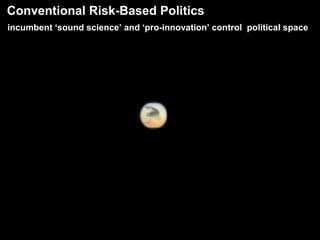
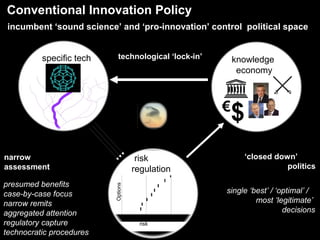
Conventional Risk-Based Politics
incumbent ‘sound science’ and ‘pro-innovation’ control political space
specific tech technological ‘lock-in’
risk
regulation
‘closed down’
politics
risk
Options
single ‘best’ / ‘optimal’ /
most ‘legitimate’
decisions
risk
presumed benefits
case-by-case focus
narrow remits
aggregated attention
regulatory capture
technocratic procedures
narrow
assessment
knowledge
economy
$
IIIIII
€
Conventional Innovation Policy
incumbent ‘sound science’ and ‘pro-innovation’ control political space
possible paths
multiple feasible
Innovation trajectories
choice
discourse
risk
options
perspective
ss
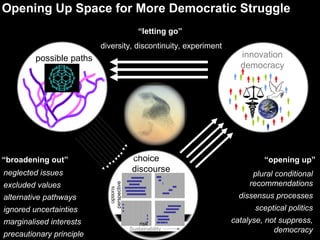
plural conditional
recommendations
dissensus processes
sceptical politics
catalyse, not suppress,
democracy
risk
neglected issues
excluded values
alternative pathways
ignored uncertainties
marginalised interests
precautionary principle
Sustainability
innovation
democracy


















“letting go”
diversity, discontinuity, experiment
risk
“broadening out” “opening up”


Opening Up Space for More Democratic Struggle
possible paths
multiple feasible
Innovation trajectories
choice
discourse
risk
options
perspective
ss
risk
Sustainability
innovation
democracy


















risk
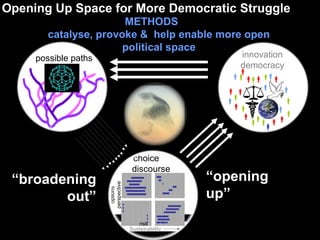
“broadening
out”
“opening
up”


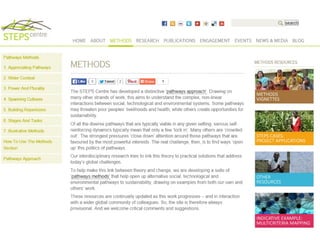
METHODS
catalyse, provoke & help enable more open
political space
Opening Up Space for More Democratic Struggle
Help Appreciate Alternative Pathways
Overall Aims
Help Appreciate Alternative Pathways
Overall Aims
Method alone can’t do whole job: also involves encompassing process
Help Appreciate Alternative Pathways
Method underpins both understanding and judgement; knowledge and action
Method alone can’t do whole job: also involves encompassing process
Overall Aims
Help Appreciate Alternative Pathways
Method underpins both understanding and judgement; knowledge and action
Critical focus on alternatives: reflecting and favouring marginal interests
Method alone can’t do whole job: also involves encompassing process
Overall Aims
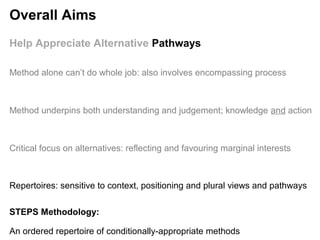
STEPS Methodology:
An ordered repertoire of conditionally-appropriate methods
Help Appreciate Alternative Pathways
Method underpins both understanding and judgement; knowledge and action
Critical focus on alternatives: reflecting and favouring marginal interests
Repertoires: sensitive to context, positioning and plural views and pathways
Method alone can’t do whole job: also involves encompassing process
Overall Aims
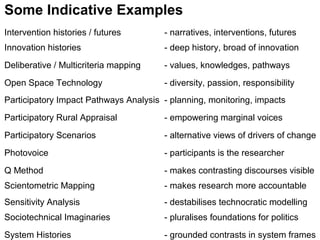
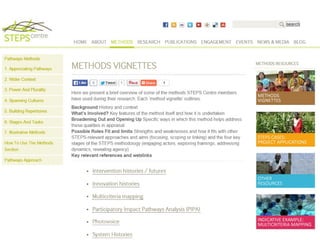
Intervention histories / futures - narratives, interventions, futures
Innovation histories - deep history, broad of innovation
Deliberative / Multicriteria mapping - values, knowledges, pathways
Open Space Technology - diversity, passion, responsibility
Participatory Impact Pathways Analysis - planning, monitoring, impacts
Participatory Rural Appraisal - empowering marginal voices
Participatory Scenarios - alternative views of drivers of change
Photovoice - participants is the researcher
Q Method - makes contrasting discourses visible
Scientometric Mapping - makes research more accountable
Sensitivity Analysis - destabilises technocratic modelling
Sociotechnical Imaginaries - pluralises foundations for politics
System Histories - grounded contrasts in system frames
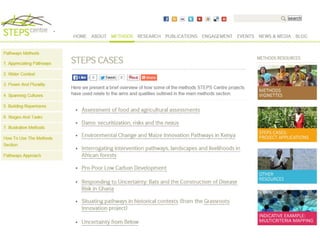
Some Indicative Examples
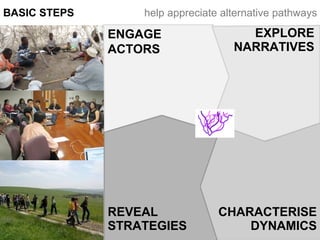
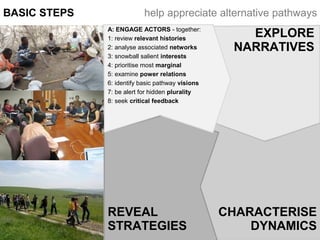
ENGAGE
ACTORS
help appreciate alternative pathwaysBASIC STEPS
EXPLORE
NARRATIVES
CHARACTERISE
DYNAMICS
REVEAL
STRATEGIES
ENGAGE
ACTORS
help appreciate alternative pathwaysBASIC STEPS
EXPLORE
NARRATIVES
CHARACTERISE
DYNAMICS
REVEAL
STRATEGIES
A: ENGAGE ACTORS - together:
1: review relevant histories
2: analyse associated networks
3: snowball salient interests
4: prioritise most marginal
5: examine power relations
6: identify basic pathway visions
7: be alert for hidden plurality
8: seek critical feedback
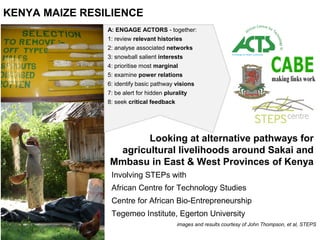
KENYA MAIZE RESILIENCE
Looking at alternative pathways for
agricultural livelihoods around Sakai and
Mmbasu in East & West Provinces of Kenya
Involving STEPs with
African Centre for Technology Studies
Centre for African Bio-Entrepreneurship
Tegemeo Institute, Egerton University
images and results courtesy of John Thompson, et al, STEPS
A: ENGAGE ACTORS - together:
1: review relevant histories
2: analyse associated networks
3: snowball salient interests
4: prioritise most marginal
5: examine power relations
6: identify basic pathway visions
7: be alert for hidden plurality
8: seek critical feedback
KENYA MAIZE RESILIENCE
A: ENGAGE ACTORS - together:
1: review relevant histories
2: analyse associated networks
3: snowball salient interests
4: prioritise most marginal
5: examine power relations
6: identify basic pathway visions
7: be alert for hidden plurality
8: seek critical feedback
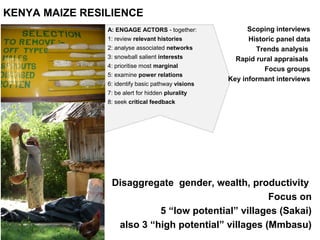
Scoping interviews
Historic panel data
Trends analysis
Rapid rural appraisals
Focus groups
Key informant interviews
Disaggregate gender, wealth, productivity
Focus on
5 “low potential” villages (Sakai)
also 3 “high potential” villages (Mmbasu)
B: EXPLORE NARRATIVES
1: review relevant histories
2: elicit notions of systems
3: explore related framings
4: address Sustainability values
5: scope possible pathways
6: review aspects of incertitude
7: differentiate perspectives
8: seek critical feedback
KENYA MAIZE RESILIENCE
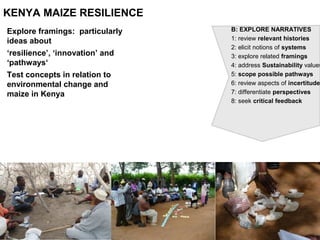
Explore framings: particularly
ideas about
‘resilience’, ‘innovation’ and
‘pathways‘
Test concepts in relation to
environmental change and
maize in Kenya
B: EXPLORE NARRATIVES
1: review relevant histories
2: elicit notions of systems
3: explore related framings
4: address Sustainability values
5: scope possible pathways
6: review aspects of incertitude
7: differentiate perspectives
8: seek critical feedback
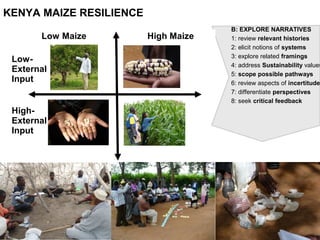
KENYA MAIZE RESILIENCE
Low Maize High Maize
Low-
External
Input
High-
External
Input
B: EXPLORE NARRATIVES
1: review relevant histories
2: elicit notions of systems
3: explore related framings
4: address Sustainability values
5: scope possible pathways
6: review aspects of incertitude
7: differentiate perspectives
8: seek critical feedback
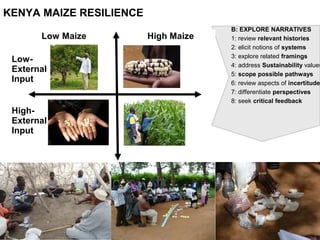
KENYA MAIZE RESILIENCE
Low Maize High Maize
Low-
External
Input
High-
External
Input
C CHARACTERISE DYNAMICS:
1: review relevant histories
2: explore challenges/opportunities
3: scrutinise likely shocks/stresses
4: look at actors’ strength/weakness
5: examine decision/branch points
6: identify winners/losers
7: attend to issues of power/politics
8: seek critical feedback
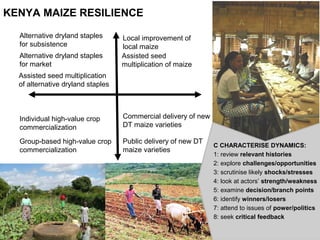
KENYA MAIZE RESILIENCE
Alternative dryland staples
for subsistence
Alternative dryland staples
for market
Local improvement of
local maize
Assisted seed
multiplication of maize
Assisted seed multiplication
of alternative dryland staples
Individual high-value crop
commercialization
Group-based high-value crop
commercialization
Commercial delivery of new
DT maize varieties
Public delivery of new DT
maize varieties
C CHARACTERISE DYNAMICS:
1: review relevant histories
2: explore challenges/opportunities
3: scrutinise likely shocks/stresses
4: look at actors’ strength/weakness
5: examine decision/branch points
6: identify winners/losers
7: attend to issues of power/politics
8: seek critical feedback
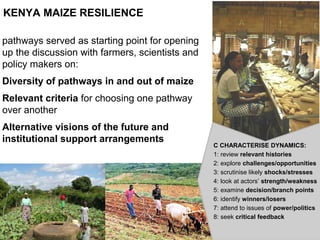
KENYA MAIZE RESILIENCE
pathways served as starting point for opening
up the discussion with farmers, scientists and
policy makers on:
Diversity of pathways in and out of maize
Relevant criteria for choosing one pathway
over another
Alternative visions of the future and
institutional support arrangements
REVEAL
STRATEGIES
D: REVEAL POLITICAL ACTIONS
1: review relevant histories
2: confirm key protagonists
3: explore forms of agency
4: define possible interventions
5: identify coping strategies
6: examine possible responses
7: establish accountabilities
8: seek critical feedback
KENYA MAIZE RESILIENCE
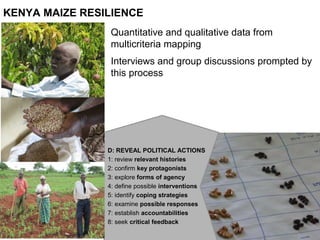
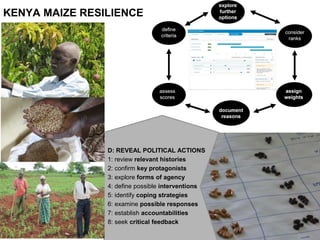
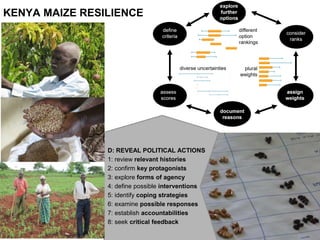
Quantitative and qualitative data from
multicriteria mapping
Interviews and group discussions prompted by
this process
REVEAL
STRATEGIES
D: REVEAL POLITICAL ACTIONS
1: review relevant histories
2: confirm key protagonists
3: explore forms of agency
4: define possible interventions
5: identify coping strategies
6: examine possible responses
7: establish accountabilities
8: seek critical feedback
KENYA MAIZE RESILIENCE
REVEAL
STRATEGIES
D: REVEAL POLITICAL ACTIONS
1: review relevant histories
2: confirm key protagonists
3: explore forms of agency
4: define possible interventions
5: identify coping strategies
6: examine possible responses
7: establish accountabilities
8: seek critical feedback
KENYA MAIZE RESILIENCE
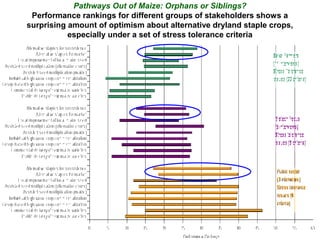
Pathways Out of Maize: Orphans or Siblings?
Performance rankings for different groups of stakeholders shows a
surprising amount of optimism about alternative dryland staple crops,
especially under a set of stress tolerance criteria
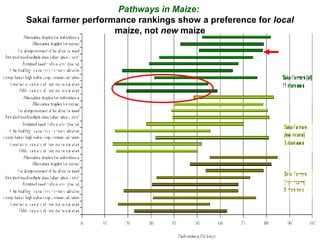
Pathways in Maize:
Sakai farmer performance rankings show a preference for local
maize, not new maize
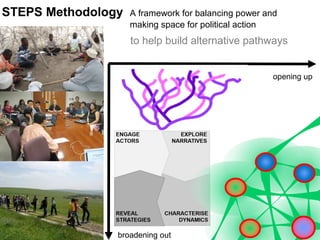
broadening out
opening up
STEPS Methodology A framework for balancing power and
making space for political action
to help build alternative pathways

Andy Stirling - STEPS Centre 'Pathways Methods'

  • 1.
    STEPS Centre ‘PathwaysMethods’ helping appreciate alternative pathways Andy Stirling SPRU & STEPS Centre University of Sussex presentation to conference session on Nexus Methods ESRC Methods Festival University of Bath 5th July 2016 www.steps-centre.org/ www.sussex.ac.uk/spru/ www.multicriteriamapping.com www.sussex.ac.uk/spru/people/peoplelists/person/7513
  • 2.
    Conventional Risk-Based Politics incumbent‘sound science’ and ‘pro-innovation’ control political space
  • 3.
    specific tech technological‘lock-in’ risk regulation ‘closed down’ politics risk Options single ‘best’ / ‘optimal’ / most ‘legitimate’ decisions risk presumed benefits case-by-case focus narrow remits aggregated attention regulatory capture technocratic procedures narrow assessment knowledge economy $ IIIIII € Conventional Innovation Policy incumbent ‘sound science’ and ‘pro-innovation’ control political space
  • 4.
    possible paths multiple feasible Innovationtrajectories choice discourse risk options perspective ss plural conditional recommendations dissensus processes sceptical politics catalyse, not suppress, democracy risk neglected issues excluded values alternative pathways ignored uncertainties marginalised interests precautionary principle Sustainability innovation democracy                   “letting go” diversity, discontinuity, experiment risk “broadening out” “opening up”   Opening Up Space for More Democratic Struggle
  • 5.
    possible paths multiple feasible Innovationtrajectories choice discourse risk options perspective ss risk Sustainability innovation democracy                   risk “broadening out” “opening up”   METHODS catalyse, provoke & help enable more open political space Opening Up Space for More Democratic Struggle
  • 6.
    Help Appreciate AlternativePathways Overall Aims
  • 7.
    Help Appreciate AlternativePathways Overall Aims Method alone can’t do whole job: also involves encompassing process
  • 8.
    Help Appreciate AlternativePathways Method underpins both understanding and judgement; knowledge and action Method alone can’t do whole job: also involves encompassing process Overall Aims
  • 9.
    Help Appreciate AlternativePathways Method underpins both understanding and judgement; knowledge and action Critical focus on alternatives: reflecting and favouring marginal interests Method alone can’t do whole job: also involves encompassing process Overall Aims
  • 10.
    STEPS Methodology: An orderedrepertoire of conditionally-appropriate methods Help Appreciate Alternative Pathways Method underpins both understanding and judgement; knowledge and action Critical focus on alternatives: reflecting and favouring marginal interests Repertoires: sensitive to context, positioning and plural views and pathways Method alone can’t do whole job: also involves encompassing process Overall Aims
  • 11.
    Intervention histories /futures - narratives, interventions, futures Innovation histories - deep history, broad of innovation Deliberative / Multicriteria mapping - values, knowledges, pathways Open Space Technology - diversity, passion, responsibility Participatory Impact Pathways Analysis - planning, monitoring, impacts Participatory Rural Appraisal - empowering marginal voices Participatory Scenarios - alternative views of drivers of change Photovoice - participants is the researcher Q Method - makes contrasting discourses visible Scientometric Mapping - makes research more accountable Sensitivity Analysis - destabilises technocratic modelling Sociotechnical Imaginaries - pluralises foundations for politics System Histories - grounded contrasts in system frames Some Indicative Examples
  • 15.
    ENGAGE ACTORS help appreciate alternativepathwaysBASIC STEPS EXPLORE NARRATIVES CHARACTERISE DYNAMICS REVEAL STRATEGIES
  • 16.
    ENGAGE ACTORS help appreciate alternativepathwaysBASIC STEPS EXPLORE NARRATIVES CHARACTERISE DYNAMICS REVEAL STRATEGIES A: ENGAGE ACTORS - together: 1: review relevant histories 2: analyse associated networks 3: snowball salient interests 4: prioritise most marginal 5: examine power relations 6: identify basic pathway visions 7: be alert for hidden plurality 8: seek critical feedback
  • 17.
    KENYA MAIZE RESILIENCE Lookingat alternative pathways for agricultural livelihoods around Sakai and Mmbasu in East & West Provinces of Kenya Involving STEPs with African Centre for Technology Studies Centre for African Bio-Entrepreneurship Tegemeo Institute, Egerton University images and results courtesy of John Thompson, et al, STEPS A: ENGAGE ACTORS - together: 1: review relevant histories 2: analyse associated networks 3: snowball salient interests 4: prioritise most marginal 5: examine power relations 6: identify basic pathway visions 7: be alert for hidden plurality 8: seek critical feedback
  • 18.
    KENYA MAIZE RESILIENCE A:ENGAGE ACTORS - together: 1: review relevant histories 2: analyse associated networks 3: snowball salient interests 4: prioritise most marginal 5: examine power relations 6: identify basic pathway visions 7: be alert for hidden plurality 8: seek critical feedback Scoping interviews Historic panel data Trends analysis Rapid rural appraisals Focus groups Key informant interviews Disaggregate gender, wealth, productivity Focus on 5 “low potential” villages (Sakai) also 3 “high potential” villages (Mmbasu)
  • 19.
    B: EXPLORE NARRATIVES 1:review relevant histories 2: elicit notions of systems 3: explore related framings 4: address Sustainability values 5: scope possible pathways 6: review aspects of incertitude 7: differentiate perspectives 8: seek critical feedback KENYA MAIZE RESILIENCE Explore framings: particularly ideas about ‘resilience’, ‘innovation’ and ‘pathways‘ Test concepts in relation to environmental change and maize in Kenya
  • 20.
    B: EXPLORE NARRATIVES 1:review relevant histories 2: elicit notions of systems 3: explore related framings 4: address Sustainability values 5: scope possible pathways 6: review aspects of incertitude 7: differentiate perspectives 8: seek critical feedback KENYA MAIZE RESILIENCE Low Maize High Maize Low- External Input High- External Input
  • 21.
    B: EXPLORE NARRATIVES 1:review relevant histories 2: elicit notions of systems 3: explore related framings 4: address Sustainability values 5: scope possible pathways 6: review aspects of incertitude 7: differentiate perspectives 8: seek critical feedback KENYA MAIZE RESILIENCE Low Maize High Maize Low- External Input High- External Input
  • 22.
    C CHARACTERISE DYNAMICS: 1:review relevant histories 2: explore challenges/opportunities 3: scrutinise likely shocks/stresses 4: look at actors’ strength/weakness 5: examine decision/branch points 6: identify winners/losers 7: attend to issues of power/politics 8: seek critical feedback KENYA MAIZE RESILIENCE Alternative dryland staples for subsistence Alternative dryland staples for market Local improvement of local maize Assisted seed multiplication of maize Assisted seed multiplication of alternative dryland staples Individual high-value crop commercialization Group-based high-value crop commercialization Commercial delivery of new DT maize varieties Public delivery of new DT maize varieties
  • 23.
    C CHARACTERISE DYNAMICS: 1:review relevant histories 2: explore challenges/opportunities 3: scrutinise likely shocks/stresses 4: look at actors’ strength/weakness 5: examine decision/branch points 6: identify winners/losers 7: attend to issues of power/politics 8: seek critical feedback KENYA MAIZE RESILIENCE pathways served as starting point for opening up the discussion with farmers, scientists and policy makers on: Diversity of pathways in and out of maize Relevant criteria for choosing one pathway over another Alternative visions of the future and institutional support arrangements
  • 24.
    REVEAL STRATEGIES D: REVEAL POLITICALACTIONS 1: review relevant histories 2: confirm key protagonists 3: explore forms of agency 4: define possible interventions 5: identify coping strategies 6: examine possible responses 7: establish accountabilities 8: seek critical feedback KENYA MAIZE RESILIENCE Quantitative and qualitative data from multicriteria mapping Interviews and group discussions prompted by this process
  • 25.
    REVEAL STRATEGIES D: REVEAL POLITICALACTIONS 1: review relevant histories 2: confirm key protagonists 3: explore forms of agency 4: define possible interventions 5: identify coping strategies 6: examine possible responses 7: establish accountabilities 8: seek critical feedback KENYA MAIZE RESILIENCE
  • 26.
    REVEAL STRATEGIES D: REVEAL POLITICALACTIONS 1: review relevant histories 2: confirm key protagonists 3: explore forms of agency 4: define possible interventions 5: identify coping strategies 6: examine possible responses 7: establish accountabilities 8: seek critical feedback KENYA MAIZE RESILIENCE
  • 27.
    Pathways Out ofMaize: Orphans or Siblings? Performance rankings for different groups of stakeholders shows a surprising amount of optimism about alternative dryland staple crops, especially under a set of stress tolerance criteria
  • 28.
    Pathways in Maize: Sakaifarmer performance rankings show a preference for local maize, not new maize
  • 29.
    broadening out opening up STEPSMethodology A framework for balancing power and making space for political action to help build alternative pathways

Editor's Notes

  • #2 roland: analytic believe in method, intuitive believe in results Abstract The governance of science and technology is conditioned by some pervasive fallacies and fantasies. None are more extensive or deeply embedded, than those concerning the ability of human agency deliberately to control key features of interest in the world. Aspects and implications of the associated dilemmas arise both in the ways knowledge itself is understood, as well as the styles of intervention that society seeks to undertake. Common to both areas, are the neglected dynamics of power - encouraging exaggeration both of the quality of knowledge and the tractability of action. Focusing on the example of energy systems, this talk will quickly review some of the practical policy implications. It will argue for attention to a range of neglected 'broader based' methods for 'opening up' policy appraisal of energy systems. It will also conclude for greater attention to governance strategies that do not depend on claims and aspirations to control. Again, some practical implications will be discussed relating to resilience rather than stability in energy systems and transformation rather than deterministic transition. In all these respects, a concrete energy policy strategy that repeatedly comes to the fore is that of deliberate diversification.
  • #16 The four distinct stages in this process are overlapping and mutually co-constituting. The logical sequence is therefore heuristic. The actual practice is more iterative and recursive. Each stage includes a number of discrete tasks. Tasks can be met in different ways. All are relevant in any context. But not all tasks are equally crucial in all contexts. So roles and styles of adopted methods may differ radically. Any ‘broadening out’ or ‘opening up’ of social appreciations of alternative pathways must in some way consider all these stages and tasks and thoroughly address a majority of tasks defined in each stage.
  • #17 The four distinct stages in this process are overlapping and mutually co-constituting. The logical sequence is therefore heuristic. The actual practice is more iterative and recursive. Each stage includes a number of discrete tasks. Tasks can be met in different ways. All are relevant in any context. But not all tasks are equally crucial in all contexts. So roles and styles of adopted methods may differ radically. Any ‘broadening out’ or ‘opening up’ of social appreciations of alternative pathways must in some way consider all these stages and tasks and thoroughly address a majority of tasks defined in each stage.
  • #18 The four distinct stages in this process are overlapping and mutually co-constituting. The logical sequence is therefore heuristic. The actual practice is more iterative and recursive. Each stage includes a number of discrete tasks. Tasks can be met in different ways. All are relevant in any context. But not all tasks are equally crucial in all contexts. So roles and styles of adopted methods may differ radically. Any ‘broadening out’ or ‘opening up’ of social appreciations of alternative pathways must in some way consider all these stages and tasks and thoroughly address a majority of tasks defined in each stage.
  • #19 The four distinct stages in this process are overlapping and mutually co-constituting. The logical sequence is therefore heuristic. The actual practice is more iterative and recursive. Each stage includes a number of discrete tasks. Tasks can be met in different ways. All are relevant in any context. But not all tasks are equally crucial in all contexts. So roles and styles of adopted methods may differ radically. Any ‘broadening out’ or ‘opening up’ of social appreciations of alternative pathways must in some way consider all these stages and tasks and thoroughly address a majority of tasks defined in each stage.
  • #20 The four distinct stages in this process are overlapping and mutually co-constituting. The logical sequence is therefore heuristic. The actual practice is more iterative and recursive. Each stage includes a number of discrete tasks. Tasks can be met in different ways. All are relevant in any context. But not all tasks are equally crucial in all contexts. So roles and styles of adopted methods may differ radically. Any ‘broadening out’ or ‘opening up’ of social appreciations of alternative pathways must in some way consider all these stages and tasks and thoroughly address a majority of tasks defined in each stage.
  • #21 The four distinct stages in this process are overlapping and mutually co-constituting. The logical sequence is therefore heuristic. The actual practice is more iterative and recursive. Each stage includes a number of discrete tasks. Tasks can be met in different ways. All are relevant in any context. But not all tasks are equally crucial in all contexts. So roles and styles of adopted methods may differ radically. Any ‘broadening out’ or ‘opening up’ of social appreciations of alternative pathways must in some way consider all these stages and tasks and thoroughly address a majority of tasks defined in each stage.
  • #22 The four distinct stages in this process are overlapping and mutually co-constituting. The logical sequence is therefore heuristic. The actual practice is more iterative and recursive. Each stage includes a number of discrete tasks. Tasks can be met in different ways. All are relevant in any context. But not all tasks are equally crucial in all contexts. So roles and styles of adopted methods may differ radically. Any ‘broadening out’ or ‘opening up’ of social appreciations of alternative pathways must in some way consider all these stages and tasks and thoroughly address a majority of tasks defined in each stage.