6 mysterious things in this
world
By Rohit From Grade 9
1. Mysterious Radio Signals
Since 2007, researchers have been receiving ultrastrong, ultrabright radio
signals lasting only a few milliseconds. These enigmatic flashes have been
called fast radio bursts (FRBs), and they appear to be coming from billions
of light-years away (they're not aliens, it's never aliens). Recently, scientists
managed to capture a repeating FRB, which flashed six times in a row, the
second such signal ever seen and one that could help them unravel this
mystery.
https://www.facebook.com/DMarketPlace/videos/2546849548884951/?t=0
2. Nuclear Pasta
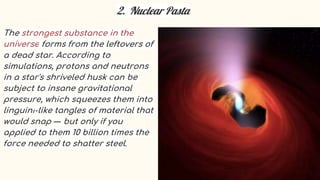
The strongest substance in the
universe forms from the leftovers of
a dead star. According to
simulations, protons and neutrons
in a star's shriveled husk can be
subject to insane gravitational
pressure, which squeezes them into
linguini-like tangles of material that
would snap — but only if you
applied to them 10 billion times the
force needed to shatter steel.
3. Haumea Has Rings
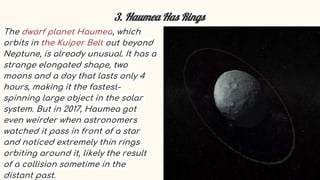
The dwarf planet Haumea, which
orbits in the Kuiper Belt out beyond
Neptune, is already unusual. It has a
strange elongated shape, two
moons and a day that lasts only 4
hours, making it the fastest-
spinning large object in the solar
system. But in 2017, Haumea got
even weirder when astronomers
watched it pass in front of a star
and noticed extremely thin rings
orbiting around it, likely the result
of a collision sometime in the
distant past.
4. A Moon with a Moon
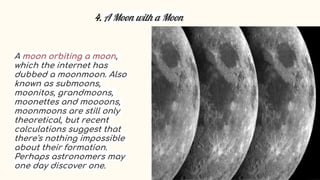
A moon orbiting a moon,
which the internet has
dubbed a moonmoon. Also
known as submoons,
moonitos, grandmoons,
moonettes and moooons,
moonmoons are still only
theoretical, but recent
calculations suggest that
there's nothing impossible
about their formation.
Perhaps astronomers may
one day discover one.
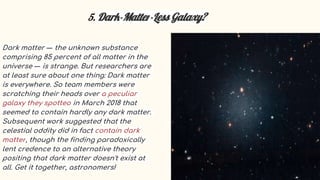
5. Dark-Matter-Less Galaxy?
Dark matter — the unknown substance
comprising 85 percent of all matter in the
universe — is strange. But researchers are
at least sure about one thing: Dark matter
is everywhere. So team members were
scratching their heads over a peculiar
galaxy they spotted in March 2018 that
seemed to contain hardly any dark matter.
Subsequent work suggested that the
celestial oddity did in fact contain dark
matter, though the finding paradoxically
lent credence to an alternative theory
positing that dark matter doesn't exist at
all. Get it together, astronomers!
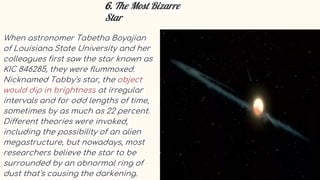
6. The Most Bizarre
Star
When astronomer Tabetha Boyajian
of Louisiana State University and her
colleagues first saw the star known as
KIC 846285, they were flummoxed.
Nicknamed Tabby's star, the object
would dip in brightness at irregular
intervals and for odd lengths of time,
sometimes by as much as 22 percent.
Different theories were invoked,
including the possibility of an alien
megastructure, but nowadays, most
researchers believe the star to be
surrounded by an abnormal ring of
dust that's causing the darkening.
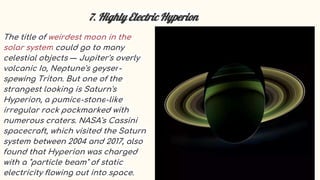
7. Highly Electric Hyperion
The title of weirdest moon in the
solar system could go to many
celestial objects — Jupiter's overly
volcanic Io, Neptune's geyser-
spewing Triton. But one of the
strangest looking is Saturn's
Hyperion, a pumice-stone-like
irregular rock pockmarked with
numerous craters. NASA's Cassini
spacecraft, which visited the Saturn
system between 2004 and 2017, also
found that Hyperion was charged
with a "particle beam" of static
electricity flowing out into space.
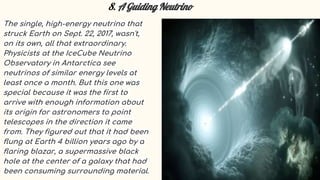
8. A Guiding Neutrino
The single, high-energy neutrino that
struck Earth on Sept. 22, 2017, wasn't,
on its own, all that extraordinary.
Physicists at the IceCube Neutrino
Observatory in Antarctica see
neutrinos of similar energy levels at
least once a month. But this one was
special because it was the first to
arrive with enough information about
its origin for astronomers to point
telescopes in the direction it came
from. They figured out that it had been
flung at Earth 4 billion years ago by a
flaring blazar, a supermassive black
hole at the center of a galaxy that had
been consuming surrounding material.
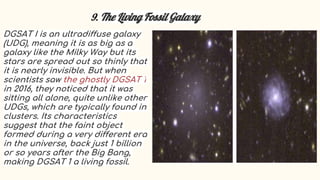
9. The Living Fossil Galaxy
DGSAT I is an ultradiffuse galaxy
(UDG), meaning it is as big as a
galaxy like the Milky Way but its
stars are spread out so thinly that
it is nearly invisible. But when
scientists saw the ghostly DGSAT 1
in 2016, they noticed that it was
sitting all alone, quite unlike other
UDGs, which are typically found in
clusters. Its characteristics
suggest that the faint object
formed during a very different era
in the universe, back just 1 billion
or so years after the Big Bang,
making DGSAT 1 a living fossil.
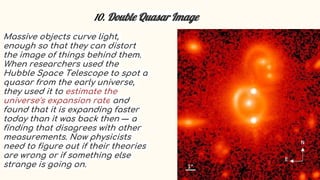
10. Double Quasar Image
Massive objects curve light,
enough so that they can distort
the image of things behind them.
When researchers used the
Hubble Space Telescope to spot a
quasar from the early universe,
they used it to estimate the
universe's expansion rate and
found that it is expanding faster
today than it was back then — a
finding that disagrees with other
measurements. Now physicists
need to figure out if their theories
are wrong or if something else
strange is going on.
11. Infrared Stream from
Space
Neutron stars are extremely dense objects formed after the death of a
regular star. Normally, they emit radio waves or higher-energy radiation
such as X-rays, but in September 2018, astronomers found a long stream
of infrared light coming from a neutron star 800 light-years away from
Earth — something never before observed. The researchers proposed that
a disk of dust surrounding the neutron star could be generating the
signal, but the ultimate explanation has yet to be found.
https://images.app.goo.gl/6CMmd5Evpg2GKguf7
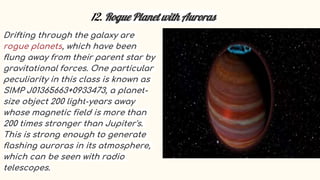
12. Rogue Planet with Auroras
Drifting through the galaxy are
rogue planets, which have been
flung away from their parent star by
gravitational forces. One particular
peculiarity in this class is known as
SIMP J01365663+0933473, a planet-
size object 200 light-years away
whose magnetic field is more than
200 times stronger than Jupiter's.
This is strong enough to generate
flashing auroras in its atmosphere,
which can be seen with radio
telescopes.
There are some videos in the below page
Check it out
This link is about the 10 Mysterious Things That Science Can't Explain :-
https://youtu.be/MScaB9XHMPo
This link is about the 12 Most Mysterious Places Scientists Still Can't Explain
:- https://youtu.be/nIFkpvx2vH4
This link is about the 7 Mysteries Science Hasn't Solved :- https://youtu.be/FXe5a-
CuiyQ
6 mysterious things in this world

6 mysterious things in this world

  • 1.
    6 mysterious thingsin this world By Rohit From Grade 9
  • 2.
    1. Mysterious RadioSignals Since 2007, researchers have been receiving ultrastrong, ultrabright radio signals lasting only a few milliseconds. These enigmatic flashes have been called fast radio bursts (FRBs), and they appear to be coming from billions of light-years away (they're not aliens, it's never aliens). Recently, scientists managed to capture a repeating FRB, which flashed six times in a row, the second such signal ever seen and one that could help them unravel this mystery. https://www.facebook.com/DMarketPlace/videos/2546849548884951/?t=0
  • 3.
    2. Nuclear Pasta Thestrongest substance in the universe forms from the leftovers of a dead star. According to simulations, protons and neutrons in a star's shriveled husk can be subject to insane gravitational pressure, which squeezes them into linguini-like tangles of material that would snap — but only if you applied to them 10 billion times the force needed to shatter steel.
  • 4.
    3. Haumea HasRings The dwarf planet Haumea, which orbits in the Kuiper Belt out beyond Neptune, is already unusual. It has a strange elongated shape, two moons and a day that lasts only 4 hours, making it the fastest- spinning large object in the solar system. But in 2017, Haumea got even weirder when astronomers watched it pass in front of a star and noticed extremely thin rings orbiting around it, likely the result of a collision sometime in the distant past.
  • 5.
    4. A Moonwith a Moon A moon orbiting a moon, which the internet has dubbed a moonmoon. Also known as submoons, moonitos, grandmoons, moonettes and moooons, moonmoons are still only theoretical, but recent calculations suggest that there's nothing impossible about their formation. Perhaps astronomers may one day discover one.
  • 6.
    5. Dark-Matter-Less Galaxy? Darkmatter — the unknown substance comprising 85 percent of all matter in the universe — is strange. But researchers are at least sure about one thing: Dark matter is everywhere. So team members were scratching their heads over a peculiar galaxy they spotted in March 2018 that seemed to contain hardly any dark matter. Subsequent work suggested that the celestial oddity did in fact contain dark matter, though the finding paradoxically lent credence to an alternative theory positing that dark matter doesn't exist at all. Get it together, astronomers!
  • 7.
    6. The MostBizarre Star When astronomer Tabetha Boyajian of Louisiana State University and her colleagues first saw the star known as KIC 846285, they were flummoxed. Nicknamed Tabby's star, the object would dip in brightness at irregular intervals and for odd lengths of time, sometimes by as much as 22 percent. Different theories were invoked, including the possibility of an alien megastructure, but nowadays, most researchers believe the star to be surrounded by an abnormal ring of dust that's causing the darkening.
  • 8.
    7. Highly ElectricHyperion The title of weirdest moon in the solar system could go to many celestial objects — Jupiter's overly volcanic Io, Neptune's geyser- spewing Triton. But one of the strangest looking is Saturn's Hyperion, a pumice-stone-like irregular rock pockmarked with numerous craters. NASA's Cassini spacecraft, which visited the Saturn system between 2004 and 2017, also found that Hyperion was charged with a "particle beam" of static electricity flowing out into space.
  • 9.
    8. A GuidingNeutrino The single, high-energy neutrino that struck Earth on Sept. 22, 2017, wasn't, on its own, all that extraordinary. Physicists at the IceCube Neutrino Observatory in Antarctica see neutrinos of similar energy levels at least once a month. But this one was special because it was the first to arrive with enough information about its origin for astronomers to point telescopes in the direction it came from. They figured out that it had been flung at Earth 4 billion years ago by a flaring blazar, a supermassive black hole at the center of a galaxy that had been consuming surrounding material.
  • 10.
    9. The LivingFossil Galaxy DGSAT I is an ultradiffuse galaxy (UDG), meaning it is as big as a galaxy like the Milky Way but its stars are spread out so thinly that it is nearly invisible. But when scientists saw the ghostly DGSAT 1 in 2016, they noticed that it was sitting all alone, quite unlike other UDGs, which are typically found in clusters. Its characteristics suggest that the faint object formed during a very different era in the universe, back just 1 billion or so years after the Big Bang, making DGSAT 1 a living fossil.
  • 11.
    10. Double QuasarImage Massive objects curve light, enough so that they can distort the image of things behind them. When researchers used the Hubble Space Telescope to spot a quasar from the early universe, they used it to estimate the universe's expansion rate and found that it is expanding faster today than it was back then — a finding that disagrees with other measurements. Now physicists need to figure out if their theories are wrong or if something else strange is going on.
  • 12.
    11. Infrared Streamfrom Space Neutron stars are extremely dense objects formed after the death of a regular star. Normally, they emit radio waves or higher-energy radiation such as X-rays, but in September 2018, astronomers found a long stream of infrared light coming from a neutron star 800 light-years away from Earth — something never before observed. The researchers proposed that a disk of dust surrounding the neutron star could be generating the signal, but the ultimate explanation has yet to be found. https://images.app.goo.gl/6CMmd5Evpg2GKguf7
  • 13.
    12. Rogue Planetwith Auroras Drifting through the galaxy are rogue planets, which have been flung away from their parent star by gravitational forces. One particular peculiarity in this class is known as SIMP J01365663+0933473, a planet- size object 200 light-years away whose magnetic field is more than 200 times stronger than Jupiter's. This is strong enough to generate flashing auroras in its atmosphere, which can be seen with radio telescopes.
  • 14.
    There are somevideos in the below page Check it out This link is about the 10 Mysterious Things That Science Can't Explain :- https://youtu.be/MScaB9XHMPo This link is about the 12 Most Mysterious Places Scientists Still Can't Explain :- https://youtu.be/nIFkpvx2vH4 This link is about the 7 Mysteries Science Hasn't Solved :- https://youtu.be/FXe5a- CuiyQ