Final Project
SCIENCEAstronomy is the oldest science, dating back thousands of years to when primitive people noticed objects in the sky overhead and watched the way the objects moved. In ancient Egypt, the first appearance of certain stars each year marked the onset of the seasonal flood, an important event for agriculture. Chosen by VotersEncarta Encyclopedia 20063/4/2010SCIENCE
SCIENCEAncient astronomy is not to be confused with astrology, the belief system which claims that human affairs are correlated with the positions of celestial objects. Although the two fields share a common origin and a part of their methods (namely, the use of ephemerides), they are distinct. From Wikipedia, the free encyclopedia3/4/2010SCIENCE
SCIENCEThe scientific study of matter in outer space, especially the positions, dimensions, distribution, motion, composition, energy, and evolution of celestial bodies and phenomena. A system of knowledge or beliefs about celestial phenomena: the various astronomies of ancient civilizations.3/4/2010SCIENCE
SCIENCEDuring the 20th century, the field of professional astronomy split into observational and theoretical branches. Observational astronomy is focused on acquiring data from observations of celestial objects, which is then analyzed using basic principles of physics. Theoretical astronomy is oriented towards the development of computer or analytical models to describe astronomical objects and phenomena. From Wikipedia, the free encyclopedia3/4/2010SCIENCE
SCIENCEIf the stars are not hot enough to cause ionization of the surrounding gas, the starlight is reflected by the dust and can be seen as the second type of nebula — a "reflection nebula." These nebulae look blue for the same reason our daytime sky appears blue — the light is being scattered throughout the nebula. http://www.astronomy.com/asy/default.aspx?c=a&id=22293/4/2010SCIENCE
SCIENCELooking for evidence of life on Mars or other planets? Finding cellulose microfibers would be the next best thing to a close encounter, according to new research from the University of North Carolina at Chapel Hill.The cover story for the April issue of the journal Astrobiology, the new research also pushes back the earliest direct evidence of biological material on Earth by about 200 million years.http://www.astronomy.com/asy/default.aspx?c=a&id=67713/4/2010SCIENCE
SCIENCEThe first bright nebula discovered was the Orion Nebula (M42) in 1612. The first reflection nebula discovered was M78, also in Orion, in 1780. http://www.astronomy.com/asy/default.aspx?c=a&id=67713/4/2010SCIENCE
SCIENCEAlthough a telescope may seem the logical choice, there's an alternative that in many respects works better. Binoculars are highly versatile instruments that can reveal craters on the Moon, moons orbiting Jupiter, Milky Way starfields, and even other galaxies. http://www.astronomy.com/asy/default.aspx?c=a&id=67713/4/2010SCIENCE
SCIENCEIn many ways, binoculars prove superior to a telescope for those starting out in astronomy. They have a wide field of view and provide right-side-up images, making objects easy to find. http://www.astronomy.com/asy/default.aspx?c=a&id=67713/4/2010SCIENCE
SCIENCEThey require no effort or expertise to set up — just sling them around your neck, step outside, and you're ready to go. That portability also makes binoculars ideal for those clear nights in the middle of the week when you don't have the time — or inclination — to get out a telescope. http://www.astronomy.com/asy/default.aspx?c=a&id=67713/4/2010SCIENCE
SCIENCEIf that still hasn't convinced you, maybe price will. Unless you have money to burn on image-stabilized models, binoculars offer a more affordable way to tour the heavens than a telescope. http://www.astronomy.com/asy/default.aspx?c=a&id=67713/4/2010SCIENCE
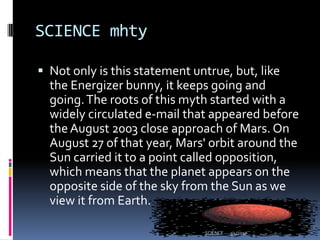
SCIENCE mhtyNot only is this statement untrue, but, like the Energizer bunny, it keeps going and going. The roots of this myth started with a widely circulated e-mail that appeared before the August 2003 close approach of Mars. On August 27 of that year, Mars' orbit around the Sun carried it to a point called opposition, which means that the planet appears on the opposite side of the sky from the Sun as we view it from Earth.3/4/2010SCIENCE
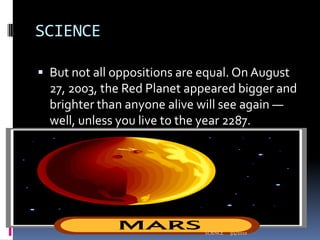
SCIENCEBut not all oppositions are equal. On August 27, 2003, the Red Planet appeared bigger and brighter than anyone alive will see again — well, unless you live to the year 2287.3/4/2010SCIENCE
SCIENCEA newly discovered star outside the Milky Way has yielded important clues about our galaxy's evolution. Located in the dwarf galaxy Sculptor some 280,000 light-years away, the star has a chemical make-up similar to the Milky Way's oldest stars3/4/2010SCIENCE
SCIENCESome recent studies had questioned the link between dwarf galaxies and the Milky Way, citing differences between the chemistry of their stars. But the differences may not be so big after all, according to new published research.3/4/2010SCIENCE
SCIENCEDwarf galaxies are small galaxies with just a few million stars at most. They often orbit larger galaxies such as the Milky Way, which consists of hundreds of billions of stars. In the "bottom-up model" of galaxy formation, proposed in 1978 by Carnegie astronomers Leonard Searle and Robert Zinn (now at Yale University), large galaxies attained their size over billions of years by swallowing up their smaller neighbors. 3/4/2010SCIENCE
SCIENCEIn addition to the star's total metal abundance, researchers also compared the abundance of iron to that of elements such as magnesium, calcium, and titanium. The ratios resembled those of old Milky Way stars, lending more support to the idea that these stars originally formed in dwarf galaxies.3/4/2010SCIENCE
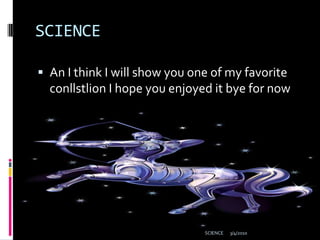
SCIENCEAn I think I will show you one of my favorite conllstlion I hope you enjoyed it bye for now3/4/2010SCIENCE
SCIENCENational Astronomy Day 2010, held Saturday, April 24, gives astronomy-lovers a chance to share their passion with the astronomy-curious. Clubs, planetaria, observatories, and museums will host public viewing events, telescope workshops, hands-on activities, and presentations to increase awareness about the profession and hobby.3/4/2010SCIENCE

Final Project

  • 1.
  • 2.
    SCIENCEAstronomy is theoldest science, dating back thousands of years to when primitive people noticed objects in the sky overhead and watched the way the objects moved. In ancient Egypt, the first appearance of certain stars each year marked the onset of the seasonal flood, an important event for agriculture. Chosen by VotersEncarta Encyclopedia 20063/4/2010SCIENCE
  • 3.
    SCIENCEAncient astronomy isnot to be confused with astrology, the belief system which claims that human affairs are correlated with the positions of celestial objects. Although the two fields share a common origin and a part of their methods (namely, the use of ephemerides), they are distinct. From Wikipedia, the free encyclopedia3/4/2010SCIENCE
  • 4.
    SCIENCEThe scientific studyof matter in outer space, especially the positions, dimensions, distribution, motion, composition, energy, and evolution of celestial bodies and phenomena. A system of knowledge or beliefs about celestial phenomena: the various astronomies of ancient civilizations.3/4/2010SCIENCE
  • 5.
    SCIENCEDuring the 20thcentury, the field of professional astronomy split into observational and theoretical branches. Observational astronomy is focused on acquiring data from observations of celestial objects, which is then analyzed using basic principles of physics. Theoretical astronomy is oriented towards the development of computer or analytical models to describe astronomical objects and phenomena. From Wikipedia, the free encyclopedia3/4/2010SCIENCE
  • 6.
    SCIENCEIf the starsare not hot enough to cause ionization of the surrounding gas, the starlight is reflected by the dust and can be seen as the second type of nebula — a "reflection nebula." These nebulae look blue for the same reason our daytime sky appears blue — the light is being scattered throughout the nebula. http://www.astronomy.com/asy/default.aspx?c=a&id=22293/4/2010SCIENCE
  • 7.
    SCIENCELooking for evidenceof life on Mars or other planets? Finding cellulose microfibers would be the next best thing to a close encounter, according to new research from the University of North Carolina at Chapel Hill.The cover story for the April issue of the journal Astrobiology, the new research also pushes back the earliest direct evidence of biological material on Earth by about 200 million years.http://www.astronomy.com/asy/default.aspx?c=a&id=67713/4/2010SCIENCE
  • 8.
    SCIENCEThe first brightnebula discovered was the Orion Nebula (M42) in 1612. The first reflection nebula discovered was M78, also in Orion, in 1780. http://www.astronomy.com/asy/default.aspx?c=a&id=67713/4/2010SCIENCE
  • 9.
    SCIENCEAlthough a telescopemay seem the logical choice, there's an alternative that in many respects works better. Binoculars are highly versatile instruments that can reveal craters on the Moon, moons orbiting Jupiter, Milky Way starfields, and even other galaxies. http://www.astronomy.com/asy/default.aspx?c=a&id=67713/4/2010SCIENCE
  • 10.
    SCIENCEIn many ways,binoculars prove superior to a telescope for those starting out in astronomy. They have a wide field of view and provide right-side-up images, making objects easy to find. http://www.astronomy.com/asy/default.aspx?c=a&id=67713/4/2010SCIENCE
  • 11.
    SCIENCEThey require noeffort or expertise to set up — just sling them around your neck, step outside, and you're ready to go. That portability also makes binoculars ideal for those clear nights in the middle of the week when you don't have the time — or inclination — to get out a telescope. http://www.astronomy.com/asy/default.aspx?c=a&id=67713/4/2010SCIENCE
  • 12.
    SCIENCEIf that stillhasn't convinced you, maybe price will. Unless you have money to burn on image-stabilized models, binoculars offer a more affordable way to tour the heavens than a telescope. http://www.astronomy.com/asy/default.aspx?c=a&id=67713/4/2010SCIENCE
  • 13.
    SCIENCE mhtyNot onlyis this statement untrue, but, like the Energizer bunny, it keeps going and going. The roots of this myth started with a widely circulated e-mail that appeared before the August 2003 close approach of Mars. On August 27 of that year, Mars' orbit around the Sun carried it to a point called opposition, which means that the planet appears on the opposite side of the sky from the Sun as we view it from Earth.3/4/2010SCIENCE
  • 14.
    SCIENCEBut not alloppositions are equal. On August 27, 2003, the Red Planet appeared bigger and brighter than anyone alive will see again — well, unless you live to the year 2287.3/4/2010SCIENCE
  • 15.
    SCIENCEA newly discoveredstar outside the Milky Way has yielded important clues about our galaxy's evolution. Located in the dwarf galaxy Sculptor some 280,000 light-years away, the star has a chemical make-up similar to the Milky Way's oldest stars3/4/2010SCIENCE
  • 16.
    SCIENCESome recent studieshad questioned the link between dwarf galaxies and the Milky Way, citing differences between the chemistry of their stars. But the differences may not be so big after all, according to new published research.3/4/2010SCIENCE
  • 17.
    SCIENCEDwarf galaxies aresmall galaxies with just a few million stars at most. They often orbit larger galaxies such as the Milky Way, which consists of hundreds of billions of stars. In the "bottom-up model" of galaxy formation, proposed in 1978 by Carnegie astronomers Leonard Searle and Robert Zinn (now at Yale University), large galaxies attained their size over billions of years by swallowing up their smaller neighbors. 3/4/2010SCIENCE
  • 18.
    SCIENCEIn addition tothe star's total metal abundance, researchers also compared the abundance of iron to that of elements such as magnesium, calcium, and titanium. The ratios resembled those of old Milky Way stars, lending more support to the idea that these stars originally formed in dwarf galaxies.3/4/2010SCIENCE
  • 19.
    SCIENCEAn I thinkI will show you one of my favorite conllstlion I hope you enjoyed it bye for now3/4/2010SCIENCE
  • 20.
    SCIENCENational Astronomy Day2010, held Saturday, April 24, gives astronomy-lovers a chance to share their passion with the astronomy-curious. Clubs, planetaria, observatories, and museums will host public viewing events, telescope workshops, hands-on activities, and presentations to increase awareness about the profession and hobby.3/4/2010SCIENCE