RECENT
DEVELOPMENTS
IN THE FIELD
OF
EXPLORATION
AND
TRAVEL
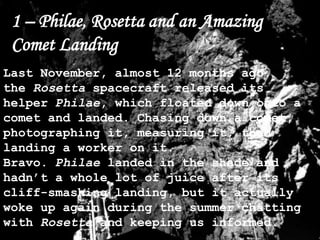
1 – Philae, Rosetta and an Amazing
Comet Landing
Last November, almost 12 months ago,
the Rosetta spacecraft released its
helper Philae, which floated down onto a
comet and landed. Chasing down a comet,
photographing it, measuring it, then
landing a worker on it.
Bravo. Philae landed in the shade and
hadn’t a whole lot of juice after its
cliff-smashing landing, but it actually
woke up again during the summer chatting
with Rosetta and keeping us informed.
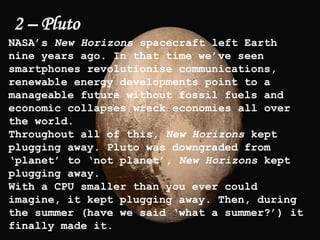
2 – Pluto
NASA’s New Horizons spacecraft left Earth
nine years ago. In that time we’ve seen
smartphones revolutionise communications,
renewable energy developments point to a
manageable future without fossil fuels and
economic collapses wreck economies all over
the world.
Throughout all of this, New Horizons kept
plugging away. Pluto was downgraded from
‘planet’ to ‘not planet’, New Horizons kept
plugging away.
With a CPU smaller than you ever could
imagine, it kept plugging away. Then, during
the summer (have we said ‘what a summer?’) it
finally made it.
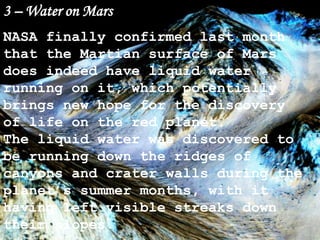
3 – Water on Mars
NASA finally confirmed last month
that the Martian surface of Mars
does indeed have liquid water
running on it, which potentially
brings new hope for the discovery
of life on the red planet.
The liquid water was discovered to
be running down the ridges of
canyons and crater walls during the
planet’s summer months, with it
having left visible streaks down
their slopes.
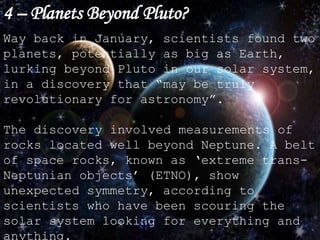
4 – Planets Beyond Pluto?
Way back in January, scientists found two
planets, potentially as big as Earth,
lurking beyond Pluto in our solar system,
in a discovery that “may be truly
revolutionary for astronomy”.
The discovery involved measurements of
rocks located well beyond Neptune. A belt
of space rocks, known as ‘extreme trans-
Neptunian objects’ (ETNO), show
unexpected symmetry, according to
scientists who have been scouring the
solar system looking for everything and
anything.
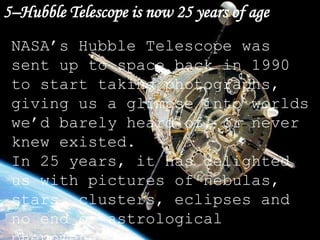
5–Hubble Telescope is now 25 years of age
NASA’s Hubble Telescope was
sent up to space back in 1990
to start taking photographs,
giving us a glimpse into worlds
we’d barely heard of, or never
knew existed.
In 25 years, it has delighted
us with pictures of nebulas,
stars, clusters, eclipses and
no end of astrological
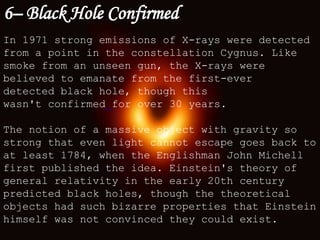
6– Black Hole Confirmed
In 1971 strong emissions of X-rays were detected
from a point in the constellation Cygnus. Like
smoke from an unseen gun, the X-rays were
believed to emanate from the first-ever
detected black hole, though this
wasn't confirmed for over 30 years.
The notion of a massive object with gravity so
strong that even light cannot escape goes back to
at least 1784, when the Englishman John Michell
first published the idea. Einstein's theory of
general relativity in the early 20th century
predicted black holes, though the theoretical
objects had such bizarre properties that Einstein
himself was not convinced they could exist.
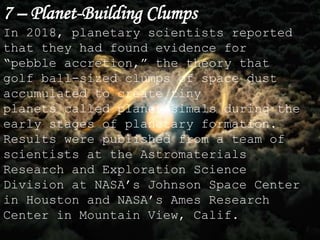
7 – Planet-Building Clumps
In 2018, planetary scientists reported
that they had found evidence for
“pebble accretion,” the theory that
golf ball-sized clumps of space dust
accumulated to create tiny
planets called planetesimals during the
early stages of planetary formation.
Results were published from a team of
scientists at the Astromaterials
Research and Exploration Science
Division at NASA’s Johnson Space Center
in Houston and NASA’s Ames Research
Center in Mountain View, Calif.
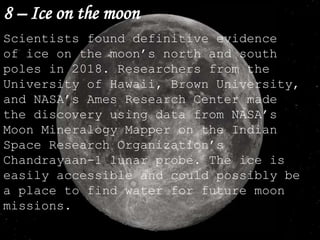
8 – Ice on the moon
Scientists found definitive evidence
of ice on the moon’s north and south
poles in 2018. Researchers from the
University of Hawaii, Brown University,
and NASA’s Ames Research Center made
the discovery using data from NASA’s
Moon Mineralogy Mapper on the Indian
Space Research Organization’s
Chandrayaan-1 lunar probe. The ice is
easily accessible and could possibly be
a place to find water for future moon
missions.
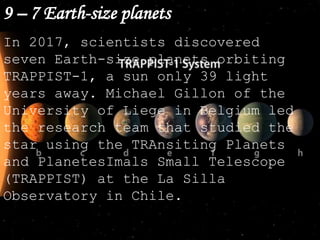
9 – 7 Earth-size planets
In 2017, scientists discovered
seven Earth-size planets orbiting
TRAPPIST-1, a sun only 39 light
years away. Michael Gillon of the
University of Liege in Belgium led
the research team that studied the
star using the TRAnsiting Planets
and PlanetesImals Small Telescope
(TRAPPIST) at the La Silla
Observatory in Chile.
MEMBERS:
FAJARDO, DAVID
IB-IB, JOHN LOUIE
CANGGAS, MICHKA
NATINGGA, KRISTINE

Recent developments in space exploration and travels

  • 1.
  • 2.
    1 – Philae,Rosetta and an Amazing Comet Landing Last November, almost 12 months ago, the Rosetta spacecraft released its helper Philae, which floated down onto a comet and landed. Chasing down a comet, photographing it, measuring it, then landing a worker on it. Bravo. Philae landed in the shade and hadn’t a whole lot of juice after its cliff-smashing landing, but it actually woke up again during the summer chatting with Rosetta and keeping us informed.
  • 3.
    2 – Pluto NASA’sNew Horizons spacecraft left Earth nine years ago. In that time we’ve seen smartphones revolutionise communications, renewable energy developments point to a manageable future without fossil fuels and economic collapses wreck economies all over the world. Throughout all of this, New Horizons kept plugging away. Pluto was downgraded from ‘planet’ to ‘not planet’, New Horizons kept plugging away. With a CPU smaller than you ever could imagine, it kept plugging away. Then, during the summer (have we said ‘what a summer?’) it finally made it.
  • 4.
    3 – Wateron Mars NASA finally confirmed last month that the Martian surface of Mars does indeed have liquid water running on it, which potentially brings new hope for the discovery of life on the red planet. The liquid water was discovered to be running down the ridges of canyons and crater walls during the planet’s summer months, with it having left visible streaks down their slopes.
  • 5.
    4 – PlanetsBeyond Pluto? Way back in January, scientists found two planets, potentially as big as Earth, lurking beyond Pluto in our solar system, in a discovery that “may be truly revolutionary for astronomy”. The discovery involved measurements of rocks located well beyond Neptune. A belt of space rocks, known as ‘extreme trans- Neptunian objects’ (ETNO), show unexpected symmetry, according to scientists who have been scouring the solar system looking for everything and anything.
  • 6.
    5–Hubble Telescope isnow 25 years of age NASA’s Hubble Telescope was sent up to space back in 1990 to start taking photographs, giving us a glimpse into worlds we’d barely heard of, or never knew existed. In 25 years, it has delighted us with pictures of nebulas, stars, clusters, eclipses and no end of astrological
  • 7.
    6– Black HoleConfirmed In 1971 strong emissions of X-rays were detected from a point in the constellation Cygnus. Like smoke from an unseen gun, the X-rays were believed to emanate from the first-ever detected black hole, though this wasn't confirmed for over 30 years. The notion of a massive object with gravity so strong that even light cannot escape goes back to at least 1784, when the Englishman John Michell first published the idea. Einstein's theory of general relativity in the early 20th century predicted black holes, though the theoretical objects had such bizarre properties that Einstein himself was not convinced they could exist.
  • 8.
    7 – Planet-BuildingClumps In 2018, planetary scientists reported that they had found evidence for “pebble accretion,” the theory that golf ball-sized clumps of space dust accumulated to create tiny planets called planetesimals during the early stages of planetary formation. Results were published from a team of scientists at the Astromaterials Research and Exploration Science Division at NASA’s Johnson Space Center in Houston and NASA’s Ames Research Center in Mountain View, Calif.
  • 9.
    8 – Iceon the moon Scientists found definitive evidence of ice on the moon’s north and south poles in 2018. Researchers from the University of Hawaii, Brown University, and NASA’s Ames Research Center made the discovery using data from NASA’s Moon Mineralogy Mapper on the Indian Space Research Organization’s Chandrayaan-1 lunar probe. The ice is easily accessible and could possibly be a place to find water for future moon missions.
  • 10.
    9 – 7Earth-size planets In 2017, scientists discovered seven Earth-size planets orbiting TRAPPIST-1, a sun only 39 light years away. Michael Gillon of the University of Liege in Belgium led the research team that studied the star using the TRAnsiting Planets and PlanetesImals Small Telescope (TRAPPIST) at the La Silla Observatory in Chile.
  • 11.
    MEMBERS: FAJARDO, DAVID IB-IB, JOHNLOUIE CANGGAS, MICHKA NATINGGA, KRISTINE