1© 2000, QualityToolBox.com, LLC, all rights reserved
A STRATEGY FOR
PERFORMANCE
EXCELLENCE
2© 2000, QualityToolBox.com, LLC, all rights reserved
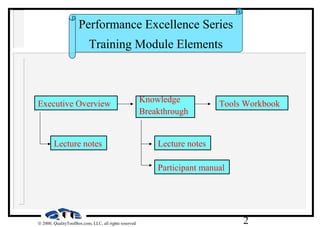
Executive Overview
Participant manual
Tools WorkbookKnowledge
Breakthrough
Lecture notes Lecture notes
Performance Excellence Series
Training Module Elements
3© 2000, QualityToolBox.com, LLC, all rights reserved
Session 1.0 Introduction…….……...……………………. 3
Session 2.0 Waste Management ……………………….. 14
Session 3.0 5S Implementation…………………………. 20
Element 3.1 Systematic Organization…………………... 31
Element 3.1.1 Red Tag System……………………………. 47
Element 3.2 Sorting Visual Placement………………….. 33
Element 3.2.1 Visual Sign System………………………….. 66
Element 3.2.2 Visual Color System………………………... 76
Element 3.3 Scrubbing Clean……………………………. 40
Element 3.4 Standardizing Control……………………... 45
Element 3.5 Self Discipline Control……………………... 48
4© 2000, QualityToolBox.com, LLC, all rights reserved
What is 5S ?
An essential step required for Waste Elimination
An integral step in Kaizen
A required element to achieve Lean-site
Manufacturing.
Systematic
Organization
“Seiri”
Orderliness
“Seiton”
Cleanliness
“Seiso”
Cleanup
“Seiketsu”
Cleanup
“Seiketsu”
Standardization/Perseverance
“Shitsuke”
5© 2000, QualityToolBox.com, LLC, all rights reserved
5S Performance Excellence Model
Systematic-Systematic
Organization
Scrubbing clean
Self-Discipline-
Control
Customer Expectations
Sorting Visual
Placement
Standardizing
Control
Improved Quality
Improved Safety
Reduced costs
Consistent Deliveries
Improved Product/ Service
Options
6© 2000, QualityToolBox.com, LLC, all rights reserved
The Five Elements of 5S
Systematic Systematic
Organization- Identifying what
items are required and which
are not.
Sorting Visual Placement-
Items should be easily
retrievable, easy to get, and
visual-easy to see.
Self-Discipline/Control-
Ensuring that Systematic
Organization, Visual
Placement & Cleanliness
are maintained.
Scrubbing Clean-Keep the area free from debris,
dirt, oil, items not needed.
Standardizing Control-
Maintain and continually
improve the previous
improvements.
7© 2000, QualityToolBox.com, LLC, all rights reserved
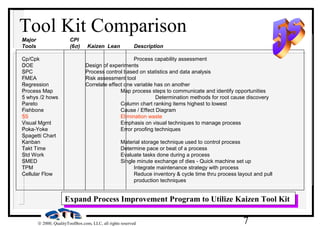
Major CPI
Tools (6σ) Kaizen Lean Description
Cp/Cpk Process capability assessment
DOE Design of experiments
SPC Process control based on statistics and data analysis
FMEA Risk assessment tool
Regression Correlate effect one variable has on another
Process Map Map process steps to communicate and identify opportunities
5 whys /2 hows Determination methods for root cause discovery
Pareto Column chart ranking items highest to lowest
Fishbone Cause / Effect Diagram
5S Elimination waste
Visual Mgmt Emphasis on visual techniques to manage process
Poka-Yoke Error proofing techniques
Spagetti Chart
Kanban Material storage technique used to control process
Takt Time Determine pace or beat of a process
Std Work Evaluate tasks done during a process
SMED Single minute exchange of dies - Quick machine set up
TPM Integrate maintenance strategy with process
Cellular Flow Reduce inventory & cycle time thru process layout and pull
production techniques
Expand Process Improvement Program to Utilize Kaizen Tool KitExpand Process Improvement Program to Utilize Kaizen Tool Kit
Tool Kit Comparison
8© 2000, QualityToolBox.com, LLC, all rights reserved
6 Sigma
• Disciplined Methodology
• Technical Approach
(Quantitative)
• Data Driven - Statistical
• Customer Focus
• Reduce Variation
• Focus on Large Impact
• Larger/Longer Projects
Kaizen
• Philosophical Approach
• Common Sense Approach
(Qualitative)
• Data Driven - Observation
• Operational Focus
• Waste Elimination 5S
• Incremental Change
• Smaller/Shorter Projects
Complimentary Tools Driving Continuous ImprovementComplimentary Tools Driving Continuous Improvement
Expanding the Strategy
Performance Excellence
9© 2000, QualityToolBox.com, LLC, all rights reserved
Comparative Analysis
Improvement Methodologies
• Similar in Structure
• Improvements measured against
established process
• Team oriented
• Similar improvement tools
• Measure effectiveness of improvements
• Maintain new performance level
• Standardize & Proceduralize
Results
• More Efficient Processes
Comparison
• Both are Effective Improvement
Mechanisms
• CPI/6s best applied to large complex
problems
• Kaizen/Lean best applied to achieve
incremental changes and eliminate wastes.
Measure
- Data Collection
- Determine Process Potential / Goals
Evaluate
- Root Cause / Vital Few
- Statistical Analysis
Improve & Verify
- Implement Improvement
- Validate Improvement
Standardize
- Standardize / Leverage
- SPC
- Update Procedures
Evaluate
- Baseline Process Performance
- Establish Target
Decide
-Compare solutions
- Choose
Act
-Communicate
- Implement improvement
- Control
Measure
- Validate improvement
- Standardize
- Update Procedures
Focus
- Reduce Process Variation
- Identify Critical Cause and Focus
Resources for Maximum Impact
Focus
- Eliminate Waste 5S
- Seek Incremental Process Changes
Kaizen/Lean6σ
Summary
- Technical Approach based on Statistical
Analysis
- Requires Significant Data Collection
- Best applied to Manufacturing Processes
- Typical Projects 1-3 Months
Summary
- Common Sense Approach based on
Observation
- Applicable to all types of processes
- Defined improvement strategy
- Typical Projects 1 week
10© 2000, QualityToolBox.com, LLC, all rights reserved
Why 5S
•To eliminate the wastes that result from
“uncontrolled” processes.
• To gain control on equipment, material & inventory
placement and position.
• Apply Control Techniques to Eliminate Erosion of
Improvements.
• Standardize Improvements for Maintenance of
Critical Process Parameters.
Look Familiar?
11© 2000, QualityToolBox.com, LLC, all rights reserved
Overproduction
Delays (waiting time)
Transportation
Process
Inventories
Motions
Defective products
Untapped Resources
Mis-used Resources
9
Wastes
The Nine types of wastes.
12© 2000, QualityToolBox.com, LLC, all rights reserved
Overproduction ______________________________
Delays (waiting time)__________________________
Transportation _______________________________
Process_____________________________________
Inventories__________________________________
Motions ____________________________________
Defective products ____________________________
Untapped Resources __________________________
Mis-used Resources ___________________________
9
Wastes
Give an example of each type of waste.
The Nine types of wastesThink Break
13© 2000, QualityToolBox.com, LLC, all rights reserved
5 S Element Waste/ Improvement Item Deliverable
Systematic
Organization
Elimination of finding.
Reduction of part selection errors.
Reduced Costs
Improved Quality
Increased Product Options
Sorting-Visual
Placement
Elimination of finding.
Elimination of nonconformances.
Elimination of motion.
Reduction of part selection errors.
Reduced Costs
Increased Safety
Improved Quality
Increased Product Options.
Scrubbing Clean Increased safety.
Preventive maintenance.
Increased equipment knowledge.
Increased Safety
Improved Quality
Standardization
Control
Increased equipment life.
Higher morale.
Clean environment.
Increased visibility of nonconformances.
Improved Quality
Consistent Delivery
Improved Safety
Elimination of Waste
14© 2000, QualityToolBox.com, LLC, all rights reserved
Systematic
Organization
Cleanliness
Visual Placement
Standardization
5 S
Implementation
Plan
Progressive
Enhancements
Step 1
Establish 5 S
Implementation Team
Step 2
Develop Specific
Implementation Plan
Step 3
Develop Communication
Plan
Step 4
Develop 5 S Training Plan
Step 5
Implement 5 S
Step 6
Verification of Effectiveness
15© 2000, QualityToolBox.com, LLC, all rights reserved
Removing “Red Tagged” stuff
What Stuff would you “Red Tag” in these pictures ?
Picture
A__________________________________________________________
Picture B
_________________________________________________________
Think Break
16© 2000, QualityToolBox.com, LLC, all rights reserved
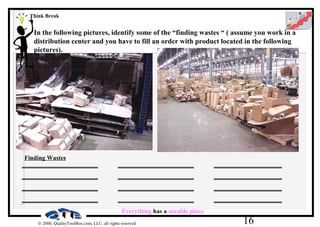
In the following pictures, identify some of the “finding wastes “ ( assume you work in a
distribution center and you have to fill an order with product located in the following
pictures).
___________________ ___________________ _________________
___________________ ___________________ _________________
___________________ ___________________ _________________
___________________ ___________________ _________________
Everything has a useable place
Think Break
Finding Wastes
17© 2000, QualityToolBox.com, LLC, all rights reserved
Some evidence of standardized work areas
•Clear, shiny aisle ways
•Color coded areas
•Slogans, banners
•No work-in-process ( WIP )
•One-Piece Flow
•Standardized Work Sheets
18© 2000, QualityToolBox.com, LLC, all rights reserved
Visual Color System Implementation
• Develop a map identifying the “access ways”(aisles, entrances, walkways etc.)
and the “action” areas.
• Perform any necessary realignment of walkways, isles, entrances.
• Assign an address to each of the major action areas.
• Mark off the Walkways, Aisles & entrances from the action areas Table 1.0
• Apply flow-direction arrows to aisles & walkways Table 1.0
• Perform any necessary realignment of action areas.
• Mark-off the inventory locations Table 1.0.
• Mark-off equipment/machine locations Table 1.0
• Mark-off storage locations( Cabinets,shelves,tables) Table 1.0
• Color-code the floors and respective action areas per Table 1.0.
19© 2000, QualityToolBox.com, LLC, all rights reserved
Cleanliness involves cleaning every aspect of
the Organization and the removal of dirt,
dust,oil, scraps on the floor, & garbage.
Key Deliverables
A clean Systematic Organization results in increased safety and
efficiency.
Increased
Safety
Increased
Efficiency
20© 2000, QualityToolBox.com, LLC, all rights reserved
Step 2: Allocation:
Assign resources to the specific tasks required to make 3S a habit.
5S “To Do” Plan
Date: Page of
5S Team Members Company/Division Name: Person Preparing This Sheet
Item
#
Date
Started
5S element 5S Task - Action Person
Responsible
Location/
Department
Percent
Complete
100 25
75 50
100 25
75 50
100 25
75 50
100 25
75 50
100 25
75 50
100 25
75 50
100 25
75 50
100 25
75 50
100 25
75 50
100 25
75 50
100 25
75 50
100 25
75 50
5S for the Workplace
Training and
Sourcebook
for
5S Worksheets
How to Use This Manual
The continuous improvement tools that are presented in Sections
1-10 of this manual are shown in order of use. These forms
MUST be completed in the order presented in this manual. Each
section contains a brief description of the tool, its purpose, when
to use it, who should use it, how to use it, and the expected
results.
Remember to focus on the elimination of waste.
Strive to maximize yields and obtain cost reductions
from existing machinery and equipment before
“buying solutions”. Improve current systems and
techniques before automation. Automating a system
or practices without first having an understanding of
the process will not solve underlying process
problems.
Perhaps the most important point to remember is that
we must understand a process before we make any
attempt in changing it. “No Tampering” is the first rule
of continuous improvement. We can not tamper with
a process without understanding it.
By using these tools, we will all share a common and
systematic approach for questioning, analyzing,
proposing solutions, experimenting, and finally,
implementing proven changes.
“The problems that exist in the world
today
cannot be solved by the same level of
thinking
that created them.”
Improvement
Identify waste
Measurement
5S
Template
Table of Contents
Section 1 Development of 5S “To Do” Plan: Establishment of the 5S team focused on
the development, training, and implementation of the company’s 5S program.
Deliverable includes action plan and associated tasks with the 5S
implementation. ………………………………………………………………………… 4
Section 2 Waste Identification Map: Identification of the 9 wastes associated with
production of products and services. A detailed map of each major work area is
developed describing the major types of wastes in each area. These wastes are
the improvement opportunities that exist prior to
5S………………………………...
The overall wastes is calculated for all the work areas and identified on the 9
Waste Radar Chart
7
Section 3 5S Action sheet: Establishing baseline key performance metrics in terms of
key deliverables, photographs, and current conditions of the “before” 5S
implementation phase. Deliverable includes the 5S action
sheet………………….
11
Red Tag Strategy: The utilization of “Red Tags” to visually identify items which
are not needed or used infrequently…………………………………………………..
14
Section 5 Visual Color Sheets: Utilization of colors to identify specific work actions,
inventory locations, access areas within the work environment. Initialization
begins with development of Visual Color
Sheets…………………………………….
17
Section 6 Visual Sign Sheets: Utilization of signs to identify machine, equipment, tooling,
inventory, safety, hazard and work center locations. Sample Sign
Sheets……….
20
Section 7 Standard Cleaning Work Sheet: A cleaning matrix identifying the work area
responsibilities, supplies, and schedules for cleaning. …………………………….. 23
Section 8 Cleaning “To Do List”: A action list identifying specific cleaning tasks for each
work area identified on the Standard Cleaning Work Sheet……………………….. 27
Section 9 5S Status Report: A report identifying implementation effectiveness of each 5S
steps applied. A variable metric ranging from 0-5 is established for each step
implemented…………………………………………………………………………….. 30
Section 10 Waste Identification Map: Identification of the 9 wastes associated with
production of products and services. A detailed map of each major work area is
developed describing the major types of wastes in each area. These wastes are
the improvement opportunities that exist prior to 5S……………………………
9 Wastes Radar Chart: After the completion of 5S, the results of the waste reduction
is recorded, charted and compared to the initial 9 Waste Radar Chart.
33
Section 2
Waste Identification Map
Manager or Team Leader (Section A) Area or Process Name (Section B) Person Preparing This Sheet (Section C)
Over production Delays

Transportation

Process

Inventory

Motion

Defective Product
Defective
Untapped
Resources 
Mis-used
Resources 
Waste Identification Map
9 Waste Radar Chart
% of Waste Before 5S
% of Waste After 5S
0
DefectiveP roduct
Transportation
Delays
Resources
M is-used
P rocess
10
Motion
Inventory
Untapped
Resources
90
70
20
30
40
50
60
80
100
Overproduction
Overproduction Delays Transportation Inventory Motion Processes Defective
Products
Untapped
Resources
Mis- Used
Resources
Before After Before After Before After Before After Before After Before After Before After Before After Before After
100
90
80
70
60
50
40
30
20
10
%ofWaste
0
The Nine
Wastes
PercentageofWaste
Waste Identification Map
Purpose Used to create a visual picture of a work area to assess waste in work place
organization, office/cell layout and crewing. Shows the type of each waste in
section/division of the organization. Also utilized to indicate equipment type,
size, and distances within each work area.
When To Use The Waste Identification Map should be used after the 5S “To Do” plan is
completed. A map should be developed for each department or focus area
of the 5S program. Do not attempt to develop a single Map for an entire
organization, it will become too busy to be effective.
Who Should Use It The Waste Identification Map can be used by anyone involved in continuous
process improvement.
Expected Benefits The Waste Identification Map will provide information about work waste in
each department, work sequence, equipment layout and distances. The
Waste Identification Map not only provides actual waste, but also provides a
visual layout of the interrelationship of the waste.
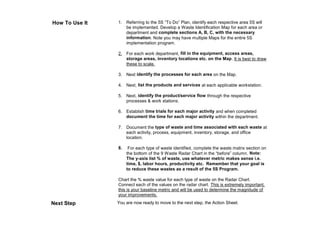
How To Use It 1. Referring to the 5S “To Do” Plan, identify each respective area 5S will
be implemented. Develop a Waste Identification Map for each area or
department and complete sections A, B, C, with the necessary
information. Note you may have multiple Maps for the entire 5S
implementation program.
2. For each work department, fill in the equipment, access areas,
storage areas, inventory locations etc. on the Map. It is best to draw
these to scale.
3. Next identify the processes for each area on the Map.
4. Next, list the products and services at each applicable workstation.
5. Next, identify the product/service flow through the respective
processes & work stations.
6. Establish time trials for each major activity and when completed
document the time for each major activity within the department.
7. Document the type of waste and time associated with each waste at
each activity, process, equipment, inventory, storage, and office
location.
8. For each type of waste identified, complete the waste matrix section on
the bottom of the 9 Waste Radar Chart in the “before” column. Note:
The y-axis list % of waste, use whatever metric makes sense i.e.
time, $, labor hours, productivity etc. Remember that your goal is
to reduce these wastes as a result of the 5S Program.
Chart the % waste value for each type of waste on the Radar Chart.
Connect each of the values on the radar chart. This is extremely important,
this is your baseline metric and will be used to determine the magnitude of
your improvements.
Next Step You are now ready to move to the next step, the Action Sheet.
5s smpl 1
5s smpl 1

5s smpl 1

  • 1.
    1© 2000, QualityToolBox.com,LLC, all rights reserved A STRATEGY FOR PERFORMANCE EXCELLENCE
  • 2.
    2© 2000, QualityToolBox.com,LLC, all rights reserved Executive Overview Participant manual Tools WorkbookKnowledge Breakthrough Lecture notes Lecture notes Performance Excellence Series Training Module Elements
  • 3.
    3© 2000, QualityToolBox.com,LLC, all rights reserved Session 1.0 Introduction…….……...……………………. 3 Session 2.0 Waste Management ……………………….. 14 Session 3.0 5S Implementation…………………………. 20 Element 3.1 Systematic Organization…………………... 31 Element 3.1.1 Red Tag System……………………………. 47 Element 3.2 Sorting Visual Placement………………….. 33 Element 3.2.1 Visual Sign System………………………….. 66 Element 3.2.2 Visual Color System………………………... 76 Element 3.3 Scrubbing Clean……………………………. 40 Element 3.4 Standardizing Control……………………... 45 Element 3.5 Self Discipline Control……………………... 48
  • 4.
    4© 2000, QualityToolBox.com,LLC, all rights reserved What is 5S ? An essential step required for Waste Elimination An integral step in Kaizen A required element to achieve Lean-site Manufacturing. Systematic Organization “Seiri” Orderliness “Seiton” Cleanliness “Seiso” Cleanup “Seiketsu” Cleanup “Seiketsu” Standardization/Perseverance “Shitsuke”
  • 5.
    5© 2000, QualityToolBox.com,LLC, all rights reserved 5S Performance Excellence Model Systematic-Systematic Organization Scrubbing clean Self-Discipline- Control Customer Expectations Sorting Visual Placement Standardizing Control Improved Quality Improved Safety Reduced costs Consistent Deliveries Improved Product/ Service Options
  • 6.
    6© 2000, QualityToolBox.com,LLC, all rights reserved The Five Elements of 5S Systematic Systematic Organization- Identifying what items are required and which are not. Sorting Visual Placement- Items should be easily retrievable, easy to get, and visual-easy to see. Self-Discipline/Control- Ensuring that Systematic Organization, Visual Placement & Cleanliness are maintained. Scrubbing Clean-Keep the area free from debris, dirt, oil, items not needed. Standardizing Control- Maintain and continually improve the previous improvements.
  • 7.
    7© 2000, QualityToolBox.com,LLC, all rights reserved Major CPI Tools (6σ) Kaizen Lean Description Cp/Cpk Process capability assessment DOE Design of experiments SPC Process control based on statistics and data analysis FMEA Risk assessment tool Regression Correlate effect one variable has on another Process Map Map process steps to communicate and identify opportunities 5 whys /2 hows Determination methods for root cause discovery Pareto Column chart ranking items highest to lowest Fishbone Cause / Effect Diagram 5S Elimination waste Visual Mgmt Emphasis on visual techniques to manage process Poka-Yoke Error proofing techniques Spagetti Chart Kanban Material storage technique used to control process Takt Time Determine pace or beat of a process Std Work Evaluate tasks done during a process SMED Single minute exchange of dies - Quick machine set up TPM Integrate maintenance strategy with process Cellular Flow Reduce inventory & cycle time thru process layout and pull production techniques Expand Process Improvement Program to Utilize Kaizen Tool KitExpand Process Improvement Program to Utilize Kaizen Tool Kit Tool Kit Comparison
  • 8.
    8© 2000, QualityToolBox.com,LLC, all rights reserved 6 Sigma • Disciplined Methodology • Technical Approach (Quantitative) • Data Driven - Statistical • Customer Focus • Reduce Variation • Focus on Large Impact • Larger/Longer Projects Kaizen • Philosophical Approach • Common Sense Approach (Qualitative) • Data Driven - Observation • Operational Focus • Waste Elimination 5S • Incremental Change • Smaller/Shorter Projects Complimentary Tools Driving Continuous ImprovementComplimentary Tools Driving Continuous Improvement Expanding the Strategy Performance Excellence
  • 9.
    9© 2000, QualityToolBox.com,LLC, all rights reserved Comparative Analysis Improvement Methodologies • Similar in Structure • Improvements measured against established process • Team oriented • Similar improvement tools • Measure effectiveness of improvements • Maintain new performance level • Standardize & Proceduralize Results • More Efficient Processes Comparison • Both are Effective Improvement Mechanisms • CPI/6s best applied to large complex problems • Kaizen/Lean best applied to achieve incremental changes and eliminate wastes. Measure - Data Collection - Determine Process Potential / Goals Evaluate - Root Cause / Vital Few - Statistical Analysis Improve & Verify - Implement Improvement - Validate Improvement Standardize - Standardize / Leverage - SPC - Update Procedures Evaluate - Baseline Process Performance - Establish Target Decide -Compare solutions - Choose Act -Communicate - Implement improvement - Control Measure - Validate improvement - Standardize - Update Procedures Focus - Reduce Process Variation - Identify Critical Cause and Focus Resources for Maximum Impact Focus - Eliminate Waste 5S - Seek Incremental Process Changes Kaizen/Lean6σ Summary - Technical Approach based on Statistical Analysis - Requires Significant Data Collection - Best applied to Manufacturing Processes - Typical Projects 1-3 Months Summary - Common Sense Approach based on Observation - Applicable to all types of processes - Defined improvement strategy - Typical Projects 1 week
  • 10.
    10© 2000, QualityToolBox.com,LLC, all rights reserved Why 5S •To eliminate the wastes that result from “uncontrolled” processes. • To gain control on equipment, material & inventory placement and position. • Apply Control Techniques to Eliminate Erosion of Improvements. • Standardize Improvements for Maintenance of Critical Process Parameters. Look Familiar?
  • 11.
    11© 2000, QualityToolBox.com,LLC, all rights reserved Overproduction Delays (waiting time) Transportation Process Inventories Motions Defective products Untapped Resources Mis-used Resources 9 Wastes The Nine types of wastes.
  • 12.
    12© 2000, QualityToolBox.com,LLC, all rights reserved Overproduction ______________________________ Delays (waiting time)__________________________ Transportation _______________________________ Process_____________________________________ Inventories__________________________________ Motions ____________________________________ Defective products ____________________________ Untapped Resources __________________________ Mis-used Resources ___________________________ 9 Wastes Give an example of each type of waste. The Nine types of wastesThink Break
  • 13.
    13© 2000, QualityToolBox.com,LLC, all rights reserved 5 S Element Waste/ Improvement Item Deliverable Systematic Organization Elimination of finding. Reduction of part selection errors. Reduced Costs Improved Quality Increased Product Options Sorting-Visual Placement Elimination of finding. Elimination of nonconformances. Elimination of motion. Reduction of part selection errors. Reduced Costs Increased Safety Improved Quality Increased Product Options. Scrubbing Clean Increased safety. Preventive maintenance. Increased equipment knowledge. Increased Safety Improved Quality Standardization Control Increased equipment life. Higher morale. Clean environment. Increased visibility of nonconformances. Improved Quality Consistent Delivery Improved Safety Elimination of Waste
  • 14.
    14© 2000, QualityToolBox.com,LLC, all rights reserved Systematic Organization Cleanliness Visual Placement Standardization 5 S Implementation Plan Progressive Enhancements Step 1 Establish 5 S Implementation Team Step 2 Develop Specific Implementation Plan Step 3 Develop Communication Plan Step 4 Develop 5 S Training Plan Step 5 Implement 5 S Step 6 Verification of Effectiveness
  • 15.
    15© 2000, QualityToolBox.com,LLC, all rights reserved Removing “Red Tagged” stuff What Stuff would you “Red Tag” in these pictures ? Picture A__________________________________________________________ Picture B _________________________________________________________ Think Break
  • 16.
    16© 2000, QualityToolBox.com,LLC, all rights reserved In the following pictures, identify some of the “finding wastes “ ( assume you work in a distribution center and you have to fill an order with product located in the following pictures). ___________________ ___________________ _________________ ___________________ ___________________ _________________ ___________________ ___________________ _________________ ___________________ ___________________ _________________ Everything has a useable place Think Break Finding Wastes
  • 17.
    17© 2000, QualityToolBox.com,LLC, all rights reserved Some evidence of standardized work areas •Clear, shiny aisle ways •Color coded areas •Slogans, banners •No work-in-process ( WIP ) •One-Piece Flow •Standardized Work Sheets
  • 18.
    18© 2000, QualityToolBox.com,LLC, all rights reserved Visual Color System Implementation • Develop a map identifying the “access ways”(aisles, entrances, walkways etc.) and the “action” areas. • Perform any necessary realignment of walkways, isles, entrances. • Assign an address to each of the major action areas. • Mark off the Walkways, Aisles & entrances from the action areas Table 1.0 • Apply flow-direction arrows to aisles & walkways Table 1.0 • Perform any necessary realignment of action areas. • Mark-off the inventory locations Table 1.0. • Mark-off equipment/machine locations Table 1.0 • Mark-off storage locations( Cabinets,shelves,tables) Table 1.0 • Color-code the floors and respective action areas per Table 1.0.
  • 19.
    19© 2000, QualityToolBox.com,LLC, all rights reserved Cleanliness involves cleaning every aspect of the Organization and the removal of dirt, dust,oil, scraps on the floor, & garbage. Key Deliverables A clean Systematic Organization results in increased safety and efficiency. Increased Safety Increased Efficiency
  • 20.
    20© 2000, QualityToolBox.com,LLC, all rights reserved Step 2: Allocation: Assign resources to the specific tasks required to make 3S a habit. 5S “To Do” Plan Date: Page of 5S Team Members Company/Division Name: Person Preparing This Sheet Item # Date Started 5S element 5S Task - Action Person Responsible Location/ Department Percent Complete 100 25 75 50 100 25 75 50 100 25 75 50 100 25 75 50 100 25 75 50 100 25 75 50 100 25 75 50 100 25 75 50 100 25 75 50 100 25 75 50 100 25 75 50 100 25 75 50
  • 21.
    5S for theWorkplace Training and Sourcebook for 5S Worksheets
  • 22.
    How to UseThis Manual The continuous improvement tools that are presented in Sections 1-10 of this manual are shown in order of use. These forms MUST be completed in the order presented in this manual. Each section contains a brief description of the tool, its purpose, when to use it, who should use it, how to use it, and the expected results. Remember to focus on the elimination of waste. Strive to maximize yields and obtain cost reductions from existing machinery and equipment before “buying solutions”. Improve current systems and techniques before automation. Automating a system or practices without first having an understanding of the process will not solve underlying process problems. Perhaps the most important point to remember is that we must understand a process before we make any attempt in changing it. “No Tampering” is the first rule of continuous improvement. We can not tamper with a process without understanding it. By using these tools, we will all share a common and systematic approach for questioning, analyzing, proposing solutions, experimenting, and finally, implementing proven changes. “The problems that exist in the world today cannot be solved by the same level of thinking that created them.” Improvement Identify waste Measurement 5S Template
  • 23.
    Table of Contents Section1 Development of 5S “To Do” Plan: Establishment of the 5S team focused on the development, training, and implementation of the company’s 5S program. Deliverable includes action plan and associated tasks with the 5S implementation. ………………………………………………………………………… 4 Section 2 Waste Identification Map: Identification of the 9 wastes associated with production of products and services. A detailed map of each major work area is developed describing the major types of wastes in each area. These wastes are the improvement opportunities that exist prior to 5S………………………………... The overall wastes is calculated for all the work areas and identified on the 9 Waste Radar Chart 7 Section 3 5S Action sheet: Establishing baseline key performance metrics in terms of key deliverables, photographs, and current conditions of the “before” 5S implementation phase. Deliverable includes the 5S action sheet…………………. 11 Red Tag Strategy: The utilization of “Red Tags” to visually identify items which are not needed or used infrequently………………………………………………….. 14 Section 5 Visual Color Sheets: Utilization of colors to identify specific work actions, inventory locations, access areas within the work environment. Initialization begins with development of Visual Color Sheets……………………………………. 17
  • 24.
    Section 6 VisualSign Sheets: Utilization of signs to identify machine, equipment, tooling, inventory, safety, hazard and work center locations. Sample Sign Sheets………. 20 Section 7 Standard Cleaning Work Sheet: A cleaning matrix identifying the work area responsibilities, supplies, and schedules for cleaning. …………………………….. 23 Section 8 Cleaning “To Do List”: A action list identifying specific cleaning tasks for each work area identified on the Standard Cleaning Work Sheet……………………….. 27 Section 9 5S Status Report: A report identifying implementation effectiveness of each 5S steps applied. A variable metric ranging from 0-5 is established for each step implemented…………………………………………………………………………….. 30 Section 10 Waste Identification Map: Identification of the 9 wastes associated with production of products and services. A detailed map of each major work area is developed describing the major types of wastes in each area. These wastes are the improvement opportunities that exist prior to 5S…………………………… 9 Wastes Radar Chart: After the completion of 5S, the results of the waste reduction is recorded, charted and compared to the initial 9 Waste Radar Chart. 33
  • 25.
  • 26.
    Manager or TeamLeader (Section A) Area or Process Name (Section B) Person Preparing This Sheet (Section C) Over production Delays  Transportation  Process  Inventory  Motion  Defective Product Defective Untapped Resources  Mis-used Resources  Waste Identification Map
  • 27.
    9 Waste RadarChart % of Waste Before 5S % of Waste After 5S 0 DefectiveP roduct Transportation Delays Resources M is-used P rocess 10 Motion Inventory Untapped Resources 90 70 20 30 40 50 60 80 100 Overproduction
  • 28.
    Overproduction Delays TransportationInventory Motion Processes Defective Products Untapped Resources Mis- Used Resources Before After Before After Before After Before After Before After Before After Before After Before After Before After 100 90 80 70 60 50 40 30 20 10 %ofWaste 0 The Nine Wastes PercentageofWaste
  • 29.
    Waste Identification Map PurposeUsed to create a visual picture of a work area to assess waste in work place organization, office/cell layout and crewing. Shows the type of each waste in section/division of the organization. Also utilized to indicate equipment type, size, and distances within each work area. When To Use The Waste Identification Map should be used after the 5S “To Do” plan is completed. A map should be developed for each department or focus area of the 5S program. Do not attempt to develop a single Map for an entire organization, it will become too busy to be effective. Who Should Use It The Waste Identification Map can be used by anyone involved in continuous process improvement. Expected Benefits The Waste Identification Map will provide information about work waste in each department, work sequence, equipment layout and distances. The Waste Identification Map not only provides actual waste, but also provides a visual layout of the interrelationship of the waste.
  • 30.
    How To UseIt 1. Referring to the 5S “To Do” Plan, identify each respective area 5S will be implemented. Develop a Waste Identification Map for each area or department and complete sections A, B, C, with the necessary information. Note you may have multiple Maps for the entire 5S implementation program. 2. For each work department, fill in the equipment, access areas, storage areas, inventory locations etc. on the Map. It is best to draw these to scale. 3. Next identify the processes for each area on the Map. 4. Next, list the products and services at each applicable workstation. 5. Next, identify the product/service flow through the respective processes & work stations. 6. Establish time trials for each major activity and when completed document the time for each major activity within the department. 7. Document the type of waste and time associated with each waste at each activity, process, equipment, inventory, storage, and office location. 8. For each type of waste identified, complete the waste matrix section on the bottom of the 9 Waste Radar Chart in the “before” column. Note: The y-axis list % of waste, use whatever metric makes sense i.e. time, $, labor hours, productivity etc. Remember that your goal is to reduce these wastes as a result of the 5S Program. Chart the % waste value for each type of waste on the Radar Chart. Connect each of the values on the radar chart. This is extremely important, this is your baseline metric and will be used to determine the magnitude of your improvements. Next Step You are now ready to move to the next step, the Action Sheet.

Editor's Notes

  • #2 5S is the foundation, the building blocks, for a “Kaizen” approach to incremental improvement. 5S focuses on the elimination of wastes( Muda) in the work environment: to include the office environment as well as the manufacturing environment. In simplest terms , it is the cleaning up of all the wastes so that the work environment produces “what” it wants, at the “time” it is needed in the “correct quantities”.
  • #5 5S was created in the Japanese manufacturing environment and literally stands for 5 Japanese words which begin with S: Seiri, Seiton, Seison, Seiketsu, Shitsuke When translated together mean a cleaning activity at a workplace. Aforementioned, 5S is an integral step towards Kaizen and Lean-site Manufacturing with the primary goal of being able to supply the customer ( internal,external) with the “right product” at the “right time” in the correct quantities.
  • #6 This model shows the inter-relationship of the 5S steps with the customer’s expectations of improved quality,improved safety, reduced nonconformance costs, improved product service options;thus, leading to a satisfied customer. Please note that the base of the pyramid is self-discipline-control. This step is key in maintaining the progress already achieved by the previous 4 S’s. Also please note, that the deliverables are closely related to the deliverables of a Kaizen process.
  • #7 Each of the translated 5S’s are defined here.
  • #8 This matrix is extremely important in understanding the relationship of Kaizen, Six Sigma, and Lean- site manufacturing. Notice that many of the continual improvement tools are common amongst the three programs. In essence it is important to note that Lean-site Manufacturing is really a deliverable of Kaizen ( when employed completely and correctly). It is also important here to recognize where 5S fits into the equation. 5S focuses on the elimination of wastes, so it is common and required for successful completion of Kaizen and Lean-site initiatives.
  • #9 A further breakdown of the continual improvement tools for Six Sigma and Kaizen, indicating the importance of waste elimination & 5S in Kaizen efforts.
  • #10 Another comparative analysis showing the major steps in each of a Six Sigma and a Kaizen Program and that the primary focus of 5S is process related i.e. not only to the processes of cleaning,organizing etc. associated wtih5S, but also the work processes of documentation,selling,purchasing,manufacturing,distribution and integration of these with5S processes.
  • #11 The primary focus of 5S is the elimination of wastes in the work environment that result from unorganized, unclean material, tools, machines, desks, inventories, aisles,walkways, storage locations. 5S provides a structured methodical approach towards this goal.
  • #12 The 7 types of wastes are identified. It is important that the group understand these 7 wastes. The primary focus of Kaizen and Lean-site Manufacturing are focused on the elimination of these wastes. 5S in turn focuses on the elimination of many of these wastes ( Delays, Transportation, Inventories, Motions, Defective products).
  • #13 Have each member work by themselves and identify an example of each type of the seven wastes. ( 10 minutes)
  • #14 This matrix identifies the first 4 steps in the 5S program and their related wastes and deliverables. This justifies the previous emphasis that 5S eliminates non-value added activities and creates opportunity to increase profits !
  • #15 Listed above is the implementation plan for a 5S program. Each step is explained on the upcoming slides.
  • #16 Have the group get in teams of three or more and identify the items in each picture that they would red tag. For each item they identified to be red tagged, have them identify why, and under what conditions they would red tag an item.
  • #17 Have the group form teams of two. Identify the wastes in each picture. Define why they are wastes. Give them about 15 minutes do this.
  • #18 A standardized work area is a result of applying the first 3 S’s. the result will be a clean, organized work area with evidence of visual color and sign strategies.
  • #20 Cleaning should involve everyone;including people in the office environment. Make it as fun as possible. Have competitions, awards, recognition programs. Make it simple, use cleaning tools you have available.( rags,mops,soap).
  • #21 The Resource Allocation Matrix identifies the required 5S task that needs to be completed in each 5S step job with the required frequency of action.