Mobility
5G
Contents
>Introduction to 5G
>5G use cases
>5G performance targets
>5G network architecture
>5G @Salford - industry
collaboration
>Summary
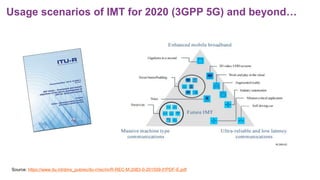
Usage scenarios of IMT for 2020 (3GPP 5G) and beyond…
Source: https://www.itu.int/dms_pubrec/itu-r/rec/m/R-REC-M.2083-0-201509-I!!PDF-E.pdf
5G use case families and related examples
Source: https://www.ngmn.org/uploads/media/NGMN_5G_White_Paper_V1_0.pdf
Selected parameters
ITU-R IMT-2020 Requirements
> The minimum requirements for eMBB peak data rate are
as follows:
– Downlink peak data rate is 20Gbps
– Uplink peak data rate is 10Gbps
> The minimum requirements for eMBB peak spectral
efficiencies are as follows:
– Downlink peak spectral efficiency is 30 bit/s/Hz
– Uplink peak spectral efficiency is 15 bit/s/Hz
> The target values for the user experienced data rate are
as follows in the Dense Urban – eMBB test environment:
– Downlink user experienced data rate is 100Mbps
– Uplink user experienced data rate is 50Mbps
> The minimum requirements for 1-way user plane latency
over the radio interface are:
– 4 ms for eMBB
– 1 ms for URLLC (3GPP target = 0.5ms)
> The minimum requirement for control plane latency is
20ms (Proponents are encouraged to consider lower
control plane latency, e.g. 10ms) 3GPP target = 10ms)
> The minimum requirement for mMTC connection density
is 1,000,000 devices per km2
> The minimum requirement for eMBB and URLLC mobility
interruption time is 0ms
Pioneer bands:
> 700 MHz band - to provide a coverage layer
> 2 x 30 MHz + 20 MHz centre gap - SDL - 2019
> 3.4 - 3.8 GHz band – to provide a large amount of contiguous
spectrum for high-data rate and low-latency services and a capacity
solution in congested areas
> 150 MHz in the 3.4 - 3.6 GHz band in 2018
> 116 MHz in 3.6 - 3.8 GHz band in 2019
> 26 GHz band - to provide “fibre-like” data rates and very low
latencies at short distance, as a capacity solution in very congested
hotspots
> 24.25 - 27.5 GHz - date tbd, likely auction post WRC2019
Note: Existing bands could be refarmed to 5G and more bands are likely in the future…
Radio
spectrum
3GPP 5G Network Architecture - reference point representation
UE RAN UPF DN
AMF SMF PCF
UDM
AF
AUSF
N1
N7
N6
N5
N4
N3
N2
N8
N9 - between UPFs
N14 - between AMFs
N10
N11
N12
N13
N15
NR air i/f
Note: Focus on mobile however Access Network (AN) could be fixed
NSSF
N22
3GPP 5G Network Architecture - service based architecture
Note: Focus on mobile however Access Network (AN) could be fixed
UE RAN UPF DN
AMF SMF
PCF UDM AF
N1
N6
N4
N3
N2
NR air i/f
NEF NRF
Nnef Nnrf Npcf Nudm Naf
Nausf Namf Nsmf
AUSF
NSSF
Nnssf
NG-CP
Functional decomposition of the RAN
U
E
RAN UPF DNN6N3NR air i/f
D
U
C
U
F1
Millimetre wave radio systems
Collaborative research between University of Salford, NEC, BT & EE Image source: University of Salford
Building a 5G test-bed at the University of Salford
Image source: University of Salford
> Positive press coverage during launch of test-bed and
collaborative research activity
> On-going research programme involving a PhD student and
academic staff along with industrial partners
> Presentation delivered at 5G World Congress in London during
2017, paper and poster at upcoming antennas and propagation
conference (EurAPP 2018)
> Other conferences and publications in planning
> Results to be shared with ETSI ISG on millimeter wave
transmission (mWT)
> Build on industry collaboration to further develop test-bed and
understand how to best utilise campus environment as live test
facility
> Engage wider student and staff community in live 5G
experimentation as a basis for new and innovative campus
services
Progress
and next
steps…
Except where otherwise noted, this work is licensed under CC-BY-NC-ND.
Andy Sutton
Visiting Professor
a.sutton@salford.ac.uk
I have been…
School of Computing, Science and Engineering
@960sutton
www.salford.ac.uk
Newton Building, University of Salford, Manchester M5 4WT
Back-up slides
> AUSF = Authentication Server Function
> UDM = Unified Data Management
> NSSF = Network Slice Selection Function
> NEF = Network Exposure Function
> NRF = Network Repository Function
> AMF = Core Access and Mobility Management Function
> SMF = Session Management Function
> PCF = Policy Control Function
> AF = Application Function
> UE = User Equipment
> RAN = Radio Access Network
> CU = Centralised Unit
> DU = Distributed Unit
> UPF = User Plane Function
> DN = Data Network, e.g. operator services, Internet or 3rd party services
Functional blocks within 5G network architecture
> N1: Reference point between the UE and the Access and Mobility Management function (AMF)
> N2: Reference point between the (R)AN and the Access and Mobility Management function
> N3: Reference point between the (R)AN and the User plane function (UPF)
> N4: Reference point between the Session Management function (SMF) and the User plane function (UPF)
> N5: Reference point between the Policy Function (PCF) and an Application Function (AF)
> N6: Reference point between the UP function (UPF) and a Data Network (DN)
> N7: Reference point between the Session Management function (SMF) and the Policy Control function (PCF)
> N7r: Reference point between the vPCF and the hPCF
> N8: Reference point between Unified Data Management and AMF
> N9: Reference point between two Core User plane functions (UPFs)
> N10: Reference point between UDM and SMF
> N11: Reference point between Access and Mobility Management function (AMF) and Session Management function (SMF)
> N12: Reference point between Access and Mobility Management function (AMF) and Authentication Server function (AUSF)
> N13: Reference point between UDM and Authentication Server function (AUSF)
> N14: Reference point between 2 Access and Mobility Management function (AMF)
> N15: Reference point between the PCF and the AMF in case of non-roaming scenario, V-PCF and AMF in case of roaming
scenario
> N16: Reference point between two SMFs, (in roaming case between V-SMF and the H-SMF)
> N22: Reference point between AMF and Network Slice Selection Function (NSSF)
5G interfaces (reference points)
Any questions? /
Thank you

5G

  • 1.
  • 2.
    Contents >Introduction to 5G >5Guse cases >5G performance targets >5G network architecture >5G @Salford - industry collaboration >Summary
  • 3.
    Usage scenarios ofIMT for 2020 (3GPP 5G) and beyond… Source: https://www.itu.int/dms_pubrec/itu-r/rec/m/R-REC-M.2083-0-201509-I!!PDF-E.pdf
  • 4.
    5G use casefamilies and related examples Source: https://www.ngmn.org/uploads/media/NGMN_5G_White_Paper_V1_0.pdf
  • 5.
    Selected parameters ITU-R IMT-2020Requirements > The minimum requirements for eMBB peak data rate are as follows: – Downlink peak data rate is 20Gbps – Uplink peak data rate is 10Gbps > The minimum requirements for eMBB peak spectral efficiencies are as follows: – Downlink peak spectral efficiency is 30 bit/s/Hz – Uplink peak spectral efficiency is 15 bit/s/Hz > The target values for the user experienced data rate are as follows in the Dense Urban – eMBB test environment: – Downlink user experienced data rate is 100Mbps – Uplink user experienced data rate is 50Mbps > The minimum requirements for 1-way user plane latency over the radio interface are: – 4 ms for eMBB – 1 ms for URLLC (3GPP target = 0.5ms) > The minimum requirement for control plane latency is 20ms (Proponents are encouraged to consider lower control plane latency, e.g. 10ms) 3GPP target = 10ms) > The minimum requirement for mMTC connection density is 1,000,000 devices per km2 > The minimum requirement for eMBB and URLLC mobility interruption time is 0ms
  • 6.
    Pioneer bands: > 700MHz band - to provide a coverage layer > 2 x 30 MHz + 20 MHz centre gap - SDL - 2019 > 3.4 - 3.8 GHz band – to provide a large amount of contiguous spectrum for high-data rate and low-latency services and a capacity solution in congested areas > 150 MHz in the 3.4 - 3.6 GHz band in 2018 > 116 MHz in 3.6 - 3.8 GHz band in 2019 > 26 GHz band - to provide “fibre-like” data rates and very low latencies at short distance, as a capacity solution in very congested hotspots > 24.25 - 27.5 GHz - date tbd, likely auction post WRC2019 Note: Existing bands could be refarmed to 5G and more bands are likely in the future… Radio spectrum
  • 7.
    3GPP 5G NetworkArchitecture - reference point representation UE RAN UPF DN AMF SMF PCF UDM AF AUSF N1 N7 N6 N5 N4 N3 N2 N8 N9 - between UPFs N14 - between AMFs N10 N11 N12 N13 N15 NR air i/f Note: Focus on mobile however Access Network (AN) could be fixed NSSF N22
  • 8.
    3GPP 5G NetworkArchitecture - service based architecture Note: Focus on mobile however Access Network (AN) could be fixed UE RAN UPF DN AMF SMF PCF UDM AF N1 N6 N4 N3 N2 NR air i/f NEF NRF Nnef Nnrf Npcf Nudm Naf Nausf Namf Nsmf AUSF NSSF Nnssf NG-CP
  • 9.
    Functional decomposition ofthe RAN U E RAN UPF DNN6N3NR air i/f D U C U F1
  • 10.
    Millimetre wave radiosystems Collaborative research between University of Salford, NEC, BT & EE Image source: University of Salford
  • 11.
    Building a 5Gtest-bed at the University of Salford Image source: University of Salford
  • 12.
    > Positive presscoverage during launch of test-bed and collaborative research activity > On-going research programme involving a PhD student and academic staff along with industrial partners > Presentation delivered at 5G World Congress in London during 2017, paper and poster at upcoming antennas and propagation conference (EurAPP 2018) > Other conferences and publications in planning > Results to be shared with ETSI ISG on millimeter wave transmission (mWT) > Build on industry collaboration to further develop test-bed and understand how to best utilise campus environment as live test facility > Engage wider student and staff community in live 5G experimentation as a basis for new and innovative campus services Progress and next steps…
  • 13.
    Except where otherwisenoted, this work is licensed under CC-BY-NC-ND. Andy Sutton Visiting Professor a.sutton@salford.ac.uk I have been… School of Computing, Science and Engineering @960sutton www.salford.ac.uk Newton Building, University of Salford, Manchester M5 4WT
  • 14.
  • 15.
    > AUSF =Authentication Server Function > UDM = Unified Data Management > NSSF = Network Slice Selection Function > NEF = Network Exposure Function > NRF = Network Repository Function > AMF = Core Access and Mobility Management Function > SMF = Session Management Function > PCF = Policy Control Function > AF = Application Function > UE = User Equipment > RAN = Radio Access Network > CU = Centralised Unit > DU = Distributed Unit > UPF = User Plane Function > DN = Data Network, e.g. operator services, Internet or 3rd party services Functional blocks within 5G network architecture
  • 16.
    > N1: Referencepoint between the UE and the Access and Mobility Management function (AMF) > N2: Reference point between the (R)AN and the Access and Mobility Management function > N3: Reference point between the (R)AN and the User plane function (UPF) > N4: Reference point between the Session Management function (SMF) and the User plane function (UPF) > N5: Reference point between the Policy Function (PCF) and an Application Function (AF) > N6: Reference point between the UP function (UPF) and a Data Network (DN) > N7: Reference point between the Session Management function (SMF) and the Policy Control function (PCF) > N7r: Reference point between the vPCF and the hPCF > N8: Reference point between Unified Data Management and AMF > N9: Reference point between two Core User plane functions (UPFs) > N10: Reference point between UDM and SMF > N11: Reference point between Access and Mobility Management function (AMF) and Session Management function (SMF) > N12: Reference point between Access and Mobility Management function (AMF) and Authentication Server function (AUSF) > N13: Reference point between UDM and Authentication Server function (AUSF) > N14: Reference point between 2 Access and Mobility Management function (AMF) > N15: Reference point between the PCF and the AMF in case of non-roaming scenario, V-PCF and AMF in case of roaming scenario > N16: Reference point between two SMFs, (in roaming case between V-SMF and the H-SMF) > N22: Reference point between AMF and Network Slice Selection Function (NSSF) 5G interfaces (reference points)
  • 17.