Science
                   Literacy
                   for
                   Librarians
Sarah Rosencrans
August 10, 2011
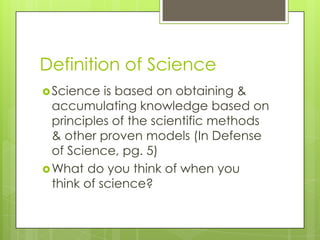
Definition of Science
 Science   is based on obtaining &
  accumulating knowledge based on
  principles of the scientific methods
  & other proven models (In Defense
  of Science, pg. 5)
 What do you think of when you
  think of science?
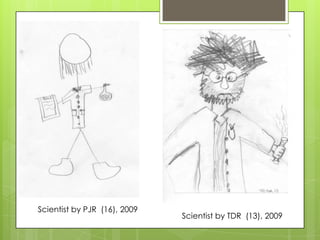
Scientist by PJR (16), 2009
                              Scientist by TDR (13), 2009
Definitions of science literacy
 “We  may define science literacy as an
  acquaintance with science, technology,
  & medicine, popularized to various
  degrees, on the part of the general public
  & special sectors of the public through
  information in the mass media &
  education in & out of schools.” (Shen,
  1975, pg. 45)
 Three types: Practical, Civic, Cultural
Definitions of science literacy
   “Science literacy is much less a measure of technical
    knowledge than of science awareness.”
   Attributes of science literacy
     Appreciation of the nature & aims of science & technology
     Knowledge of how science is funded, its conventional
      practices, & application of discoveries
     Basic understanding of interpreting numerical data
     General grounding in selected areas of science
     Appreciation of interrelationship between science,
      technology, & society
     Ability to update & acquire new scientific information in the
      future.


                                            (Sapp, 1992, pg. 25&26)
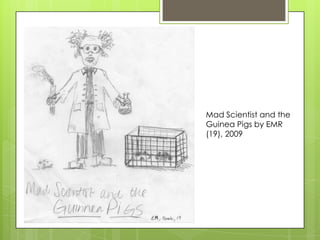
Mad Scientist and the
Guinea Pigs by EMR
(19), 2009
 American   students are falling
                behind in science & math
               Science is increasingly important
Why Science     to every day life
Literacy?      Science encompasses some of
                the major issues of the day
                 Public health
                 Climate change
                 Alternative energy
                 Jobs
Standards of science literacy
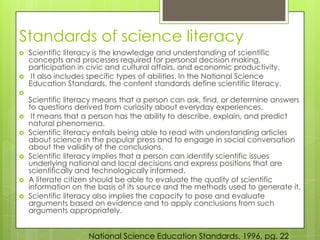
   Scientific literacy is the knowledge and understanding of scientific
    concepts and processes required for personal decision making,
    participation in civic and cultural affairs, and economic productivity.
    It also includes specific types of abilities. In the National Science
    Education Standards, the content standards define scientific literacy.

    Scientific literacy means that a person can ask, find, or determine answers
    to questions derived from curiosity about everyday experiences.
    It means that a person has the ability to describe, explain, and predict
    natural phenomena.
   Scientific literacy entails being able to read with understanding articles
    about science in the popular press and to engage in social conversation
    about the validity of the conclusions.
   Scientific literacy implies that a person can identify scientific issues
    underlying national and local decisions and express positions that are
    scientifically and technologically informed.
   A literate citizen should be able to evaluate the quality of scientific
    information on the basis of its source and the methods used to generate it.
   Scientific literacy also implies the capacity to pose and evaluate
    arguments based on evidence and to apply conclusions from such
    arguments appropriately.


                    National Science Education Standards. 1996, pg. 22
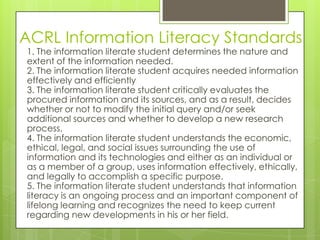
ACRL Information Literacy Standards
1. The information literate student determines the nature and
extent of the information needed.
2. The information literate student acquires needed information
effectively and efficiently
3. The information literate student critically evaluates the
procured information and its sources, and as a result, decides
whether or not to modify the initial query and/or seek
additional sources and whether to develop a new research
process.
4. The information literate student understands the economic,
ethical, legal, and social issues surrounding the use of
information and its technologies and either as an individual or
as a member of a group, uses information effectively, ethically,
and legally to accomplish a specific purpose.
5. The information literate student understands that information
literacy is an ongoing process and an important component of
lifelong learning and recognizes the need to keep current
regarding new developments in his or her field.
Science & Information Literacy
1. The information literate student determines the nature and
extent of the information needed. (ACRL)
   Scientific literacy means that a person can ask, find, or
    determine answers to questions derived from curiosity
    about everyday experiences.
   …person can identify scientific issues underlying national
    and local decisions…
   implies the capacity to pose[…]arguments based on
    evidence…
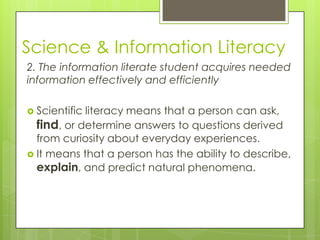
Science & Information Literacy
2. The information literate student acquires needed
information effectively and efficiently

 Scientificliteracy means that a person can ask,
  find, or determine answers to questions derived
  from curiosity about everyday experiences.
 It means that a person has the ability to describe,
  explain, and predict natural phenomena.
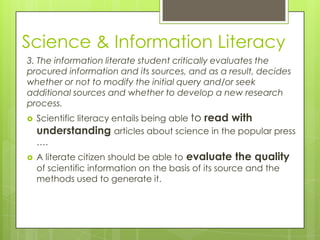
Science & Information Literacy
3. The information literate student critically evaluates the
procured information and its sources, and as a result, decides
whether or not to modify the initial query and/or seek
additional sources and whether to develop a new research
process.
   Scientific literacy entails being able to read with
    understanding articles about science in the popular press
    ….
   A literate citizen should be able to evaluate the quality
    of scientific information on the basis of its source and the
    methods used to generate it.
Science & Information Literacy
4. The information literate student understands the economic,
ethical, legal, and social issues surrounding the use of
information and its technologies and either as an individual or
as a member of a group, uses information effectively, ethically,
and legally to accomplish a specific purpose.

   Scientific literacy entails being able to read with
    understanding articles about science in the popular press
    and to engage in social conversation about the
    validity of the conclusions.
   Scientific literacy implies that a person can identify scientific
    issues underlying national and local decisions and express
    positions that are scientifically and
    technologically informed.
Science & Information Literacy
5. The information literate student understands that
information literacy is an ongoing process and an
important component of lifelong learning and
recognizes the need to keep current regarding new
developments in his or her field.
 Scientific literacy means that a person can ask,
  find, or determine answers to questions derived
  from curiosity about everyday experiences.
 Importance of staying on top of current issues
 This could include preparation for a future career
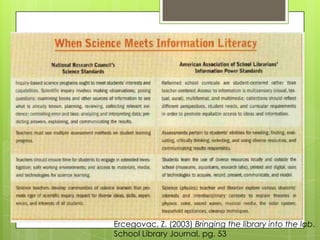
Ercegovac, Z. (2003) Bringing the library into the lab.
School Library Journal, pg. 53
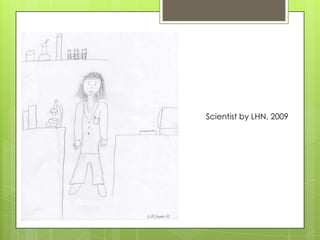
Scientist by LHN, 2009
Librarians & Science literacy
Science   literacy is a
 communication issue
“scientific information must be
 accessible & comprehensible
 in order to be useful” (Sapp,
 1992, pg. 26)
Librarians & science literacy
 Evaluating information sources
 Popularization conundrum
       Accessibility vs. accuracy?
 Literature
       Think Frankenstein
 Movies
   TV
       CSI & Discovery Channel
 Video Games
 Cartoons, Comics
Detecting Scientific Fraud
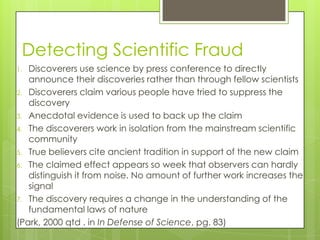
1. Discoverers use science by press conference to directly
   announce their discoveries rather than through fellow scientists
2. Discoverers claim various people have tried to suppress the
   discovery
3. Anecdotal evidence is used to back up the claim
4. The discoverers work in isolation from the mainstream scientific
   community
5. True believers cite ancient tradition in support of the new claim
6. The claimed effect appears so week that observers can hardly
   distinguish it from noise. No amount of further work increases the
   signal
7. The discovery requires a change in the understanding of the
   fundamental laws of nature
(Park, 2000 qtd . in In Defense of Science, pg. 83)
Librarians & Scientific Literacy
   Facilitating communication
     Creating a better understanding of the information
      seeking behavior of science-literate individuals
     Gauging characteristics of science literate
      individuals
     Evaluate & apply the appropriate information
      resources
        Evaluating popularizations of science for collection
         development & reference services
     Science literacy needed to develop collections and
      services to serve public education & science
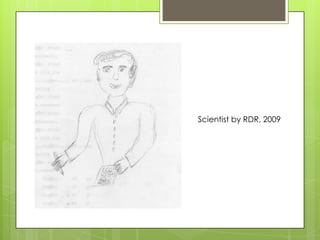
Scientist by RDR, 2009
Science Literacy for the
Information Age
 Science   stereotypes and library
  stereotypes must be overcome to
  promote scientific literacy
 Libraries have the resources to bridge the
  communication gap
 Scientists must teach the principles & facts
 Information is easier to access than ever,
  no excuse for being ignorant
Sources:

ACRL:
http://www.ala.org/ala/mgrps/divs/acrl/standards/infolitscitech.cfm

Ercegovac, Z. (2003) Bringing the library into the lab. School Library
Journal, pg. 53

National Science Education Standards (1996) Center for Science,
Mathematics, & Engineering Education.
http://www.nap.edu/openbook.php?record_id=4962

Sapp, Gregg. (1992) Science Literacy: A Discussion and an Information-
based Definition. College & Research Libraries, January, pp.21-30

Shen, Benjamin S.P. (1975) Science Literacy and the Public Understanding
of Science. Communication of Scientific Information, pp. 44-52)

Spellman, Frank R. & Price-Bayer, Joni. (2011) In Defense of Science: Why
Scientific Literacy Matters. Government Institutes.

573 science literacy

  • 1.
    Science Literacy for Librarians Sarah Rosencrans August 10, 2011
  • 2.
    Definition of Science Science is based on obtaining & accumulating knowledge based on principles of the scientific methods & other proven models (In Defense of Science, pg. 5)  What do you think of when you think of science?
  • 3.
    Scientist by PJR(16), 2009 Scientist by TDR (13), 2009
  • 4.
    Definitions of scienceliteracy  “We may define science literacy as an acquaintance with science, technology, & medicine, popularized to various degrees, on the part of the general public & special sectors of the public through information in the mass media & education in & out of schools.” (Shen, 1975, pg. 45)  Three types: Practical, Civic, Cultural
  • 5.
    Definitions of scienceliteracy  “Science literacy is much less a measure of technical knowledge than of science awareness.”  Attributes of science literacy  Appreciation of the nature & aims of science & technology  Knowledge of how science is funded, its conventional practices, & application of discoveries  Basic understanding of interpreting numerical data  General grounding in selected areas of science  Appreciation of interrelationship between science, technology, & society  Ability to update & acquire new scientific information in the future. (Sapp, 1992, pg. 25&26)
  • 6.
    Mad Scientist andthe Guinea Pigs by EMR (19), 2009
  • 7.
     American students are falling behind in science & math  Science is increasingly important Why Science to every day life Literacy?  Science encompasses some of the major issues of the day  Public health  Climate change  Alternative energy  Jobs
  • 8.
    Standards of scienceliteracy  Scientific literacy is the knowledge and understanding of scientific concepts and processes required for personal decision making, participation in civic and cultural affairs, and economic productivity.  It also includes specific types of abilities. In the National Science Education Standards, the content standards define scientific literacy.  Scientific literacy means that a person can ask, find, or determine answers to questions derived from curiosity about everyday experiences.  It means that a person has the ability to describe, explain, and predict natural phenomena.  Scientific literacy entails being able to read with understanding articles about science in the popular press and to engage in social conversation about the validity of the conclusions.  Scientific literacy implies that a person can identify scientific issues underlying national and local decisions and express positions that are scientifically and technologically informed.  A literate citizen should be able to evaluate the quality of scientific information on the basis of its source and the methods used to generate it.  Scientific literacy also implies the capacity to pose and evaluate arguments based on evidence and to apply conclusions from such arguments appropriately. National Science Education Standards. 1996, pg. 22
  • 9.
    ACRL Information LiteracyStandards 1. The information literate student determines the nature and extent of the information needed. 2. The information literate student acquires needed information effectively and efficiently 3. The information literate student critically evaluates the procured information and its sources, and as a result, decides whether or not to modify the initial query and/or seek additional sources and whether to develop a new research process. 4. The information literate student understands the economic, ethical, legal, and social issues surrounding the use of information and its technologies and either as an individual or as a member of a group, uses information effectively, ethically, and legally to accomplish a specific purpose. 5. The information literate student understands that information literacy is an ongoing process and an important component of lifelong learning and recognizes the need to keep current regarding new developments in his or her field.
  • 10.
    Science & InformationLiteracy 1. The information literate student determines the nature and extent of the information needed. (ACRL)  Scientific literacy means that a person can ask, find, or determine answers to questions derived from curiosity about everyday experiences.  …person can identify scientific issues underlying national and local decisions…  implies the capacity to pose[…]arguments based on evidence…
  • 11.
    Science & InformationLiteracy 2. The information literate student acquires needed information effectively and efficiently  Scientificliteracy means that a person can ask, find, or determine answers to questions derived from curiosity about everyday experiences.  It means that a person has the ability to describe, explain, and predict natural phenomena.
  • 12.
    Science & InformationLiteracy 3. The information literate student critically evaluates the procured information and its sources, and as a result, decides whether or not to modify the initial query and/or seek additional sources and whether to develop a new research process.  Scientific literacy entails being able to read with understanding articles about science in the popular press ….  A literate citizen should be able to evaluate the quality of scientific information on the basis of its source and the methods used to generate it.
  • 13.
    Science & InformationLiteracy 4. The information literate student understands the economic, ethical, legal, and social issues surrounding the use of information and its technologies and either as an individual or as a member of a group, uses information effectively, ethically, and legally to accomplish a specific purpose.  Scientific literacy entails being able to read with understanding articles about science in the popular press and to engage in social conversation about the validity of the conclusions.  Scientific literacy implies that a person can identify scientific issues underlying national and local decisions and express positions that are scientifically and technologically informed.
  • 14.
    Science & InformationLiteracy 5. The information literate student understands that information literacy is an ongoing process and an important component of lifelong learning and recognizes the need to keep current regarding new developments in his or her field.  Scientific literacy means that a person can ask, find, or determine answers to questions derived from curiosity about everyday experiences.  Importance of staying on top of current issues  This could include preparation for a future career
  • 15.
    Ercegovac, Z. (2003)Bringing the library into the lab. School Library Journal, pg. 53
  • 16.
  • 17.
    Librarians & Scienceliteracy Science literacy is a communication issue “scientific information must be accessible & comprehensible in order to be useful” (Sapp, 1992, pg. 26)
  • 18.
    Librarians & scienceliteracy  Evaluating information sources  Popularization conundrum  Accessibility vs. accuracy?  Literature  Think Frankenstein  Movies  TV  CSI & Discovery Channel  Video Games  Cartoons, Comics
  • 19.
    Detecting Scientific Fraud 1.Discoverers use science by press conference to directly announce their discoveries rather than through fellow scientists 2. Discoverers claim various people have tried to suppress the discovery 3. Anecdotal evidence is used to back up the claim 4. The discoverers work in isolation from the mainstream scientific community 5. True believers cite ancient tradition in support of the new claim 6. The claimed effect appears so week that observers can hardly distinguish it from noise. No amount of further work increases the signal 7. The discovery requires a change in the understanding of the fundamental laws of nature (Park, 2000 qtd . in In Defense of Science, pg. 83)
  • 20.
    Librarians & ScientificLiteracy  Facilitating communication  Creating a better understanding of the information seeking behavior of science-literate individuals  Gauging characteristics of science literate individuals  Evaluate & apply the appropriate information resources  Evaluating popularizations of science for collection development & reference services  Science literacy needed to develop collections and services to serve public education & science
  • 21.
  • 22.
    Science Literacy forthe Information Age  Science stereotypes and library stereotypes must be overcome to promote scientific literacy  Libraries have the resources to bridge the communication gap  Scientists must teach the principles & facts  Information is easier to access than ever, no excuse for being ignorant
  • 23.
    Sources: ACRL: http://www.ala.org/ala/mgrps/divs/acrl/standards/infolitscitech.cfm Ercegovac, Z. (2003)Bringing the library into the lab. School Library Journal, pg. 53 National Science Education Standards (1996) Center for Science, Mathematics, & Engineering Education. http://www.nap.edu/openbook.php?record_id=4962 Sapp, Gregg. (1992) Science Literacy: A Discussion and an Information- based Definition. College & Research Libraries, January, pp.21-30 Shen, Benjamin S.P. (1975) Science Literacy and the Public Understanding of Science. Communication of Scientific Information, pp. 44-52) Spellman, Frank R. & Price-Bayer, Joni. (2011) In Defense of Science: Why Scientific Literacy Matters. Government Institutes.