COMMAND WORDS
04/03/2016 All rights reserved – Sybille CZERNIAKOWSKI – iprp@sybille.cz 1
I D E NT I FY
O UT L I N E
D E S C R I B E
E X P L A I N
G IV E
04/03/2016 All rights reserved – Sybille CZERNIAKOWSKI – iprp@sybille.cz 2
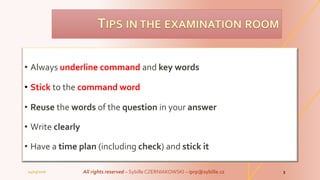
• Always underline command and key words
• Stick to the command word
• Reuse the words of the question in your answer
• Write clearly
• Have a time plan (including check) and stick it
04/03/2016 All rights reserved – Sybille CZERNIAKOWSKI – iprp@sybille.cz 3
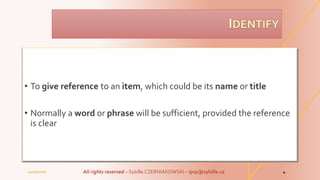
• To give reference to an item, which could be its name or title
• Normally a word or phrase will be sufficient, provided the reference
is clear
04/03/2016 All rights reserved – Sybille CZERNIAKOWSKI – iprp@sybille.cz 4
Inhalation
Ingestion
Absorption
Injection
Identify the main
routes of entry in
the body
(GC 2.7 – Chemical and biological health
hazards and risk control)
04/03/2016 All rights reserved – Sybille CZERNIAKOWSKI – iprp@sybille.cz 5
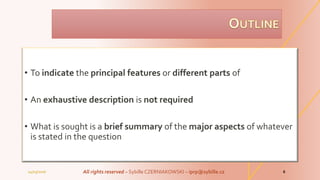
• To indicate the principal features or different parts of
• An exhaustive description is not required
• What is sought is a brief summary of the major aspects of whatever
is stated in the question
04/03/2016 All rights reserved – Sybille CZERNIAKOWSKI – iprp@sybille.cz 6
Fibres: threads or filaments
Dusts: solid airborne particles slightly heavier than air
Fumes: very small metallic or solid particles condensed
from the gaseous state
Liquid: free flowing fluid, substances at a temperature
between freezing and boiling points
Mists: small liquid droplets finely dispersed in a vapour
Vapours: substances closer to their boiling temperature
in a gaseous form
Gases: substances present at a temperature above their
boiling point
Outline the forms
of chemical agents
(GC 2.7 – Chemical and biological health
hazards and risk control)
04/03/2016 All rights reserved – Sybille CZERNIAKOWSKI – iprp@sybille.cz 7
• To give a detailed written account of the distinctive features of a
subject.
• The account should be factual, without any attempt to explain
• When describing a subject (or object) a test of sufficient detail would
be that another person would be able to visualise what you are
describing
04/03/2016 All rights reserved – Sybille CZERNIAKOWSKI – iprp@sybille.cz 8
The hearing system contains 3 parts:
• The outer ear (visible): an ear canal
conducts to the ear drum (tympanic
membrane)
• The middle ear (internal, fluid filled
chamber) which contains 3 ossicles (the
hammer, the anvil & the stirrup) in touch
with the oval window
• The inner ear or the cochlea (internal,
fluid filled chamber) with hair cells in
touch with the auditory nerve which
conducts to the brain.
Describe the
hearing system
(GC 2.8 – Physical and psychological health
hazards and risk control)
04/03/2016 All rights reserved – Sybille CZERNIAKOWSKI – iprp@sybille.cz 9
• To provide an understanding
• To make an idea or relationship clear
• This command word is testing the candidate’s ability to know or
understand why or how something happens
• Is often associated with the words how or why
04/03/2016 All rights reserved – Sybille CZERNIAKOWSKI – iprp@sybille.cz 10
• A fixed-guard (FG) is simple, always
in position and difficult to remove
contrary to the self-adjustable guard
(AG).
• Moreover, while a FG is almost
maintenance free, the AG requires
regular checks and maintenance.
• And, especially, a AG allows access
to small parts of the danger zone
while a FG provides total enclosure
of the hazard.
Explain why a fixed-
guard is a better
choice than a self-
adjustable guard
(GC 2.4 – Work equipment hazards and risk
control)
04/03/2016 All rights reserved – Sybille CZERNIAKOWSKI – iprp@sybille.cz 11
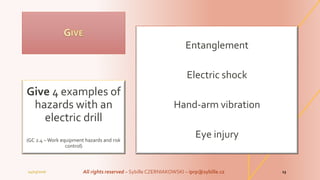
• To provide short, factual answers
• Normally a single word, phrase or sentence will be sufficient
04/03/2016 All rights reserved – Sybille CZERNIAKOWSKI – iprp@sybille.cz 12
Entanglement
Electric shock
Hand-arm vibration
Eye injury
Give 4 examples of
hazards with an
electric drill
(GC 2.4 – Work equipment hazards and risk
control)
04/03/2016 All rights reserved – Sybille CZERNIAKOWSKI – iprp@sybille.cz 13
Books
• Introduction to health and safety at
work for the NEBOSH National
General Certificate in Occupational
Health and Safety - 6th edition - Phil
HUGHES MBE and Ed FERRET -
ISBN: 978-0-415-72308-4
• Health and safety at work revision
guide for the NEBOSH National
General Certificate in Occupational
Health and Safety - 3rd edition - Ed
FERRET - ISBN: 978-1-138-91672-2
Others
• Guide to the NEBOSH National
General Certificate in Occupational
Health and Safety - version 2 -
November 2014 – NEBOSH
• Guidance on command words used in
learning outcomes and question papers
– Certificate qualifications – version 3 –
December 2015 - NEBOSH
• National General Certificate E-
learning Unit 2 (2014) - British Safety
Council
04/03/2016 All rights reserved – Sybille CZERNIAKOWSKI – iprp@sybille.cz 14

Nebosh command words

  • 1.
    COMMAND WORDS 04/03/2016 Allrights reserved – Sybille CZERNIAKOWSKI – iprp@sybille.cz 1
  • 2.
    I D ENT I FY O UT L I N E D E S C R I B E E X P L A I N G IV E 04/03/2016 All rights reserved – Sybille CZERNIAKOWSKI – iprp@sybille.cz 2
  • 3.
    • Always underlinecommand and key words • Stick to the command word • Reuse the words of the question in your answer • Write clearly • Have a time plan (including check) and stick it 04/03/2016 All rights reserved – Sybille CZERNIAKOWSKI – iprp@sybille.cz 3
  • 4.
    • To givereference to an item, which could be its name or title • Normally a word or phrase will be sufficient, provided the reference is clear 04/03/2016 All rights reserved – Sybille CZERNIAKOWSKI – iprp@sybille.cz 4
  • 5.
    Inhalation Ingestion Absorption Injection Identify the main routesof entry in the body (GC 2.7 – Chemical and biological health hazards and risk control) 04/03/2016 All rights reserved – Sybille CZERNIAKOWSKI – iprp@sybille.cz 5
  • 6.
    • To indicatethe principal features or different parts of • An exhaustive description is not required • What is sought is a brief summary of the major aspects of whatever is stated in the question 04/03/2016 All rights reserved – Sybille CZERNIAKOWSKI – iprp@sybille.cz 6
  • 7.
    Fibres: threads orfilaments Dusts: solid airborne particles slightly heavier than air Fumes: very small metallic or solid particles condensed from the gaseous state Liquid: free flowing fluid, substances at a temperature between freezing and boiling points Mists: small liquid droplets finely dispersed in a vapour Vapours: substances closer to their boiling temperature in a gaseous form Gases: substances present at a temperature above their boiling point Outline the forms of chemical agents (GC 2.7 – Chemical and biological health hazards and risk control) 04/03/2016 All rights reserved – Sybille CZERNIAKOWSKI – iprp@sybille.cz 7
  • 8.
    • To givea detailed written account of the distinctive features of a subject. • The account should be factual, without any attempt to explain • When describing a subject (or object) a test of sufficient detail would be that another person would be able to visualise what you are describing 04/03/2016 All rights reserved – Sybille CZERNIAKOWSKI – iprp@sybille.cz 8
  • 9.
    The hearing systemcontains 3 parts: • The outer ear (visible): an ear canal conducts to the ear drum (tympanic membrane) • The middle ear (internal, fluid filled chamber) which contains 3 ossicles (the hammer, the anvil & the stirrup) in touch with the oval window • The inner ear or the cochlea (internal, fluid filled chamber) with hair cells in touch with the auditory nerve which conducts to the brain. Describe the hearing system (GC 2.8 – Physical and psychological health hazards and risk control) 04/03/2016 All rights reserved – Sybille CZERNIAKOWSKI – iprp@sybille.cz 9
  • 10.
    • To providean understanding • To make an idea or relationship clear • This command word is testing the candidate’s ability to know or understand why or how something happens • Is often associated with the words how or why 04/03/2016 All rights reserved – Sybille CZERNIAKOWSKI – iprp@sybille.cz 10
  • 11.
    • A fixed-guard(FG) is simple, always in position and difficult to remove contrary to the self-adjustable guard (AG). • Moreover, while a FG is almost maintenance free, the AG requires regular checks and maintenance. • And, especially, a AG allows access to small parts of the danger zone while a FG provides total enclosure of the hazard. Explain why a fixed- guard is a better choice than a self- adjustable guard (GC 2.4 – Work equipment hazards and risk control) 04/03/2016 All rights reserved – Sybille CZERNIAKOWSKI – iprp@sybille.cz 11
  • 12.
    • To provideshort, factual answers • Normally a single word, phrase or sentence will be sufficient 04/03/2016 All rights reserved – Sybille CZERNIAKOWSKI – iprp@sybille.cz 12
  • 13.
    Entanglement Electric shock Hand-arm vibration Eyeinjury Give 4 examples of hazards with an electric drill (GC 2.4 – Work equipment hazards and risk control) 04/03/2016 All rights reserved – Sybille CZERNIAKOWSKI – iprp@sybille.cz 13
  • 14.
    Books • Introduction tohealth and safety at work for the NEBOSH National General Certificate in Occupational Health and Safety - 6th edition - Phil HUGHES MBE and Ed FERRET - ISBN: 978-0-415-72308-4 • Health and safety at work revision guide for the NEBOSH National General Certificate in Occupational Health and Safety - 3rd edition - Ed FERRET - ISBN: 978-1-138-91672-2 Others • Guide to the NEBOSH National General Certificate in Occupational Health and Safety - version 2 - November 2014 – NEBOSH • Guidance on command words used in learning outcomes and question papers – Certificate qualifications – version 3 – December 2015 - NEBOSH • National General Certificate E- learning Unit 2 (2014) - British Safety Council 04/03/2016 All rights reserved – Sybille CZERNIAKOWSKI – iprp@sybille.cz 14