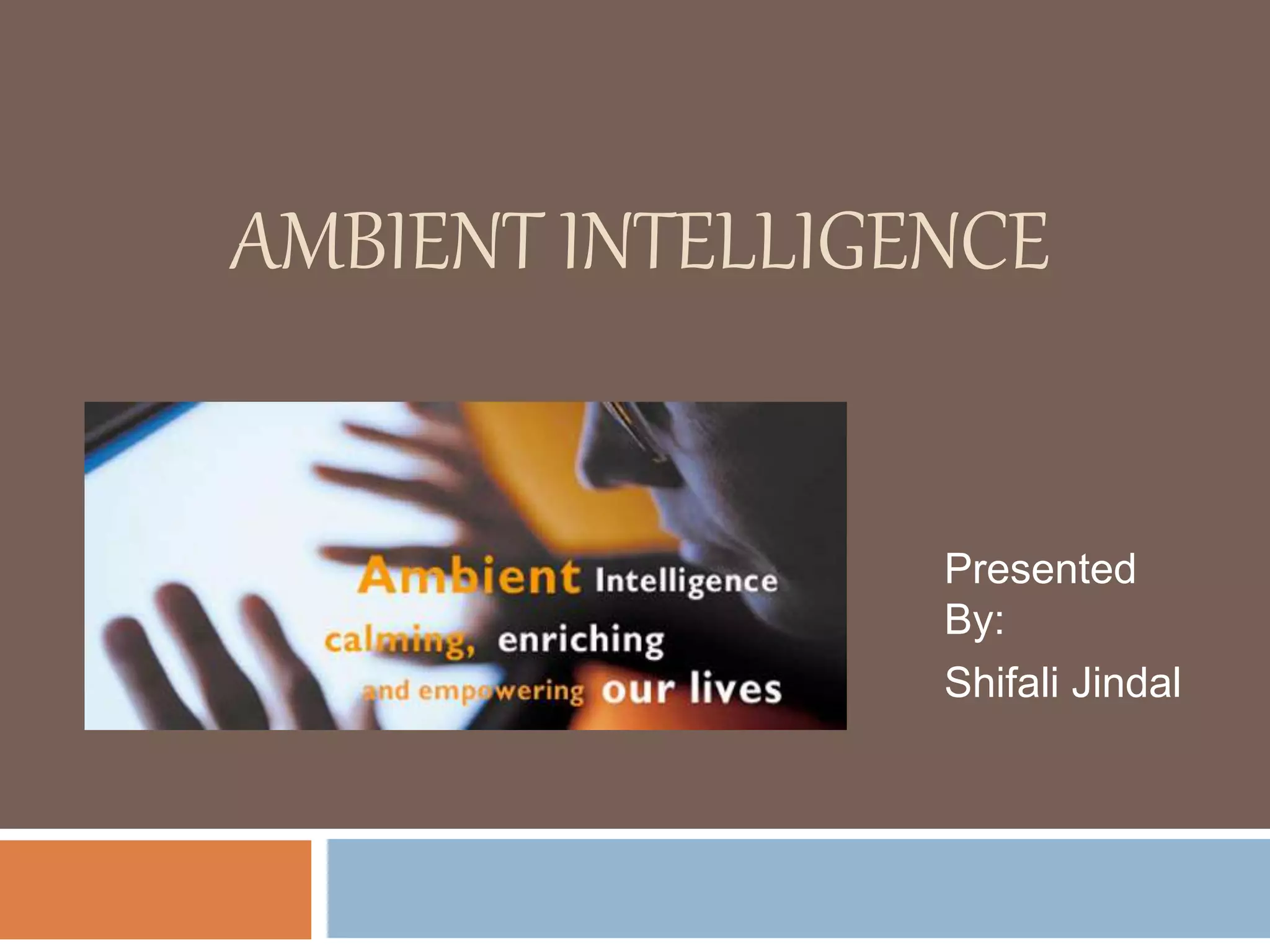
AMBIENT INTELLIGENCE
Presented
By:
Shifali Jindal
Contents
 Introduction
 History
 Key Characteristics
 Architecture
 Technologies
 Steps of Ambient Intelligence
 Applications
 Advantages
 Issues
 Research Work
 Future Scope
 Conclusion
 References
INTRODUCTION
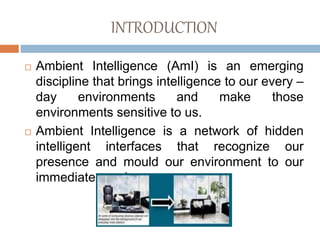
 Ambient Intelligence (AmI) is an emerging
discipline that brings intelligence to our every –
day environments and make those
environments sensitive to us.
 Ambient Intelligence is a network of hidden
intelligent interfaces that recognize our
presence and mould our environment to our
immediate needs.
HISTORY
 1998, ‘Philips’ sets out with a vision of 2020,
where a user friendly consumer electronic
industry would exist.
 1999, Oxygen Alliance
 2002, HomeLab
 European Commission used the vision in FP6.
 2004, First EUSAI was held, followed by many
conferences to date.
KEY CHARACTERISTICS
 Human Centric technologies that are:
Embedded
Context Aware
Personalized
Adaptive
Anticipatory
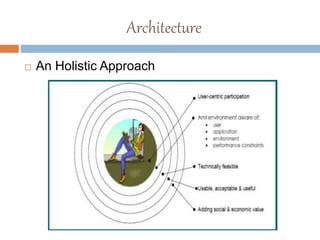
Architecture
 An Holistic Approach
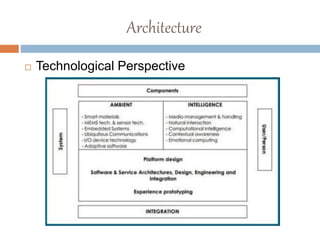
Architecture
 Technological Perspective
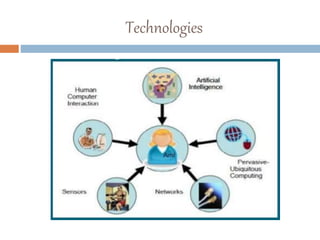
Technologies
 Ambient Intelligence builds on three recent key
technologies:
Ubiquitous Computing means integration of
microprocessors into everyday objects like
furniture, clothing, white goods, toys, even paint.
Ubiquitous Communication enables these
objects to communicate with each other and the
user by means of ad-hoc and wireless networking.
An Intelligent User Interface enables the
inhabitants of the AmI environment to control and
interact with the environment in a natural (voice,
gestures) and personalized way (preferences,
context).
Technologies
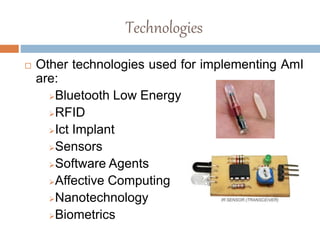
 Other technologies used for implementing AmI
are:
Bluetooth Low Energy
RFID
Ict Implant
Sensors
Software Agents
Affective Computing
Nanotechnology
Biometrics
Technologies
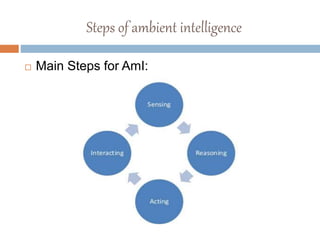
Steps of ambient intelligence
 Main Steps for AmI:
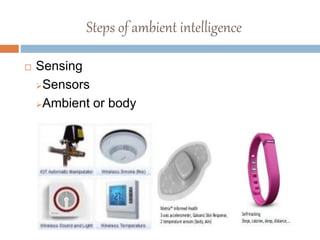
Steps of ambient intelligence
 Sensing
Sensors
Ambient or body
Steps of ambient intelligence
 Reasoning
Needed to provide responsiveness and
adaptability
Interpret and recognize context and activity
Context detection and context awareness
Mobility tracking
Activity recognition, activity prediction
Decision making
Steps of ambient intelligence
 Acting
 Home automation systems(lights, doors,
windows, temperature,…)
 User Interfaces or Wearable
devices(notification, information, alerting,…)
 Robots
Steps of ambient intelligence
 Interacting with Users
 Traditional user interfaces: web, mobiles
 Home fixtures
 Natural user interfaces:
 Speech, gesture, body motion tracking,
emotions, facial expressions, attention,…
 Interaction bypasses ICT
equipment(“disappearing computer”)
Applications
 Smart Homes:
Ambient Intelligence is allowing the home
itself to possess intelligence and make
decisions regarding its state and interactions
with its residents.
 Health – Related Applications:
Hospitals can increase the efficiency of their
services by monitoring patients’ health and
progress by performing automatic analysis of
activities in their rooms.
Applications
 Public Transportation sector:
Public transport can benefit from extra
technology including satellite services, GPS-
based spatial location, vehicle identification,
image processing and other technologies to
make transport more fluent and hence more
efficient and safe.
 Education Services:
Education-related institutions may use
technology to create smart classrooms where
the modes of learning are enhanced.
Applications
 Emergency services:
Safety-related services like fire brigades can
improve the reaction to a hazard by locating
the place more efficiently and also by
preparing the way to reach the place in
connection with street services.
Applications
 Production-oriented places:
Companies can use RFID sensors to tag
different products and track them along the
production and commercialization processes.
This allows identifying the product path from
production to consumer and helps improving
the process by providing valuable information
for the company on how to react to favorable
demand and unusual events like products that
become unsuitable for sale.
Advantages
 Reduced Human Efforts and machine
interactions.
 Increased Information, Connectivity and
Leisure
 Future Ready Ambience.
Issues
 Privacy and security.
 Interoperability.
 Reliability.
 Resource constraints.
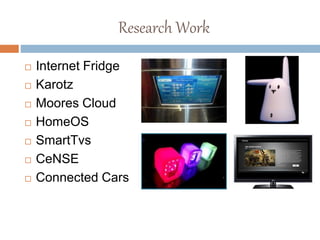
Research Work
 Internet Fridge
 Karotz
 Moores Cloud
 HomeOS
 SmartTvs
 CeNSE
 Connected Cars
Future Scope
 Many AmI applications relying upon wireless
sensors are at the mercy of the battery life for
the sensors.
 Challenge is to model multiple residents in an
environment.
 Challenge for AmI researches is to design self-
testing and self-repairing AmI software.
 Issues related to security and privacy for AmI
systems.
Conclusion
Ambient Intelligence is establishing fast as an
area where a confluence of topics can coverage
to help society through technology. There are
still many challenges ahead and improvements
are needed at all levels: infrastructure,
algorithms and human-computer interaction for
AmI systems to be widely accepted and more
important of all, be useful to society.
Reference
 www.jaise-journal.org
 www.dke.univie.ac.at/extern/bi.../ss2002/Ambi
ent-Intelligence.pdf
 www.irisa.fr/lande/lande/icse-
proceedings/icse/p43.pdf
Ambient Intelligence made by Shifali Jindal

Ambient Intelligence made by Shifali Jindal

  • 1.
  • 2.
    Contents  Introduction  History Key Characteristics  Architecture  Technologies  Steps of Ambient Intelligence  Applications  Advantages  Issues  Research Work  Future Scope  Conclusion  References
  • 3.
    INTRODUCTION  Ambient Intelligence(AmI) is an emerging discipline that brings intelligence to our every – day environments and make those environments sensitive to us.  Ambient Intelligence is a network of hidden intelligent interfaces that recognize our presence and mould our environment to our immediate needs.
  • 4.
    HISTORY  1998, ‘Philips’sets out with a vision of 2020, where a user friendly consumer electronic industry would exist.  1999, Oxygen Alliance  2002, HomeLab  European Commission used the vision in FP6.  2004, First EUSAI was held, followed by many conferences to date.
  • 5.
    KEY CHARACTERISTICS  HumanCentric technologies that are: Embedded Context Aware Personalized Adaptive Anticipatory
  • 6.
  • 7.
  • 8.
    Technologies  Ambient Intelligencebuilds on three recent key technologies: Ubiquitous Computing means integration of microprocessors into everyday objects like furniture, clothing, white goods, toys, even paint. Ubiquitous Communication enables these objects to communicate with each other and the user by means of ad-hoc and wireless networking. An Intelligent User Interface enables the inhabitants of the AmI environment to control and interact with the environment in a natural (voice, gestures) and personalized way (preferences, context).
  • 9.
    Technologies  Other technologiesused for implementing AmI are: Bluetooth Low Energy RFID Ict Implant Sensors Software Agents Affective Computing Nanotechnology Biometrics
  • 10.
  • 11.
    Steps of ambientintelligence  Main Steps for AmI:
  • 12.
    Steps of ambientintelligence  Sensing Sensors Ambient or body
  • 13.
    Steps of ambientintelligence  Reasoning Needed to provide responsiveness and adaptability Interpret and recognize context and activity Context detection and context awareness Mobility tracking Activity recognition, activity prediction Decision making
  • 14.
    Steps of ambientintelligence  Acting  Home automation systems(lights, doors, windows, temperature,…)  User Interfaces or Wearable devices(notification, information, alerting,…)  Robots
  • 15.
    Steps of ambientintelligence  Interacting with Users  Traditional user interfaces: web, mobiles  Home fixtures  Natural user interfaces:  Speech, gesture, body motion tracking, emotions, facial expressions, attention,…  Interaction bypasses ICT equipment(“disappearing computer”)
  • 16.
    Applications  Smart Homes: AmbientIntelligence is allowing the home itself to possess intelligence and make decisions regarding its state and interactions with its residents.  Health – Related Applications: Hospitals can increase the efficiency of their services by monitoring patients’ health and progress by performing automatic analysis of activities in their rooms.
  • 17.
    Applications  Public Transportationsector: Public transport can benefit from extra technology including satellite services, GPS- based spatial location, vehicle identification, image processing and other technologies to make transport more fluent and hence more efficient and safe.  Education Services: Education-related institutions may use technology to create smart classrooms where the modes of learning are enhanced.
  • 18.
    Applications  Emergency services: Safety-relatedservices like fire brigades can improve the reaction to a hazard by locating the place more efficiently and also by preparing the way to reach the place in connection with street services.
  • 19.
    Applications  Production-oriented places: Companiescan use RFID sensors to tag different products and track them along the production and commercialization processes. This allows identifying the product path from production to consumer and helps improving the process by providing valuable information for the company on how to react to favorable demand and unusual events like products that become unsuitable for sale.
  • 20.
    Advantages  Reduced HumanEfforts and machine interactions.  Increased Information, Connectivity and Leisure  Future Ready Ambience.
  • 21.
    Issues  Privacy andsecurity.  Interoperability.  Reliability.  Resource constraints.
  • 22.
    Research Work  InternetFridge  Karotz  Moores Cloud  HomeOS  SmartTvs  CeNSE  Connected Cars
  • 23.
    Future Scope  ManyAmI applications relying upon wireless sensors are at the mercy of the battery life for the sensors.  Challenge is to model multiple residents in an environment.  Challenge for AmI researches is to design self- testing and self-repairing AmI software.  Issues related to security and privacy for AmI systems.
  • 24.
    Conclusion Ambient Intelligence isestablishing fast as an area where a confluence of topics can coverage to help society through technology. There are still many challenges ahead and improvements are needed at all levels: infrastructure, algorithms and human-computer interaction for AmI systems to be widely accepted and more important of all, be useful to society.
  • 25.