Chapter 4
Emerg ing
Trends
Introduction
Technology is growing and evolving, impacting our lives in a way
no one could have imagined some decades ago.
Today you can listen to news or play your favourite music without
getting up from your place, by just giving spoken instructions.
Based on your preferences, are search history, your Online
shopping store recommends products for you and you are
surprised with their thoughtful matching choices, no? all this and
much more is possible because of modern age technologies.
Emerging Trends
Artificial Intelligence is comprised of two words Artificial and Intelligence,
where Artificial means "man-made," and intelligence means "thinking power",
hence AI means "a man-made thinking power.“
Artificial
Intelligence human
based skills
exists there ,wherea machine
can have such as learning,
reasoning, and solving
problems
According to the father of Artificial Intelligence, John McCarthy, it is
“The science and engineering of making intelligent machines
ARTIFICIAL INTELLIGENCE
Artificial intelligence (AI) refers to computer systems (including
both hardware and software) that are capable of doing things
that normally require human intelligence. For example,
recognizing images, videos, speech and decision making.
In artificial intelligence, computer systems try to partially mimic
the functioning of human brain, i.e., using inexact and
incomplete knowledge to make predictions.
One of the greatest advantages of AI systems is that they have
the capacity to enhance and improve their learning themselves
Modern AI Machines are designed and programmed to:
• Work with minimum human intervention.
• Create and update knowledge base, which keeps updating.
• Having heuristic abilities
(i.e, to learn from past mistakes, decisions and outcomes.)
Most famous example of AI today is social humanoid robot
Sophia, who has been awarded citizenship of Saudi Arabia.
Other common examples or AI today are:
1. Siri/Alexa – The personal assistance that have already become
the new normal for thousands of people around the globe.
2. Smart home devices like Google’s NEST.
3. Self-driving cars like those produced by Tesla.
4. Online games like Alien: Isolation.
It is predicted that in coming 5-10 years, AI will grow tremendously. AI base
machines would outperform humans in tasks such as translating languages,
driving trucks, etc
AI based technological trends:
1. Immersive experience with Extended Reality:
Extended Reality (XR) is an umbrella term that covers all of the various technologies
that enhance our senses and gives us immersive experience. It includes technologies
Virtual Reality (VR), Augmented Reality (AR) and Mixed Reality (MR) technologies. Let
us learn about these technologies.
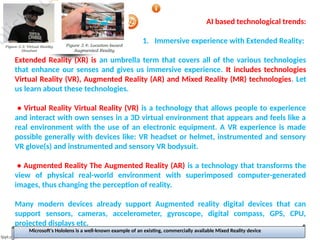
• Virtual Reality Virtual Reality (VR) is a technology that allows people to experience
and interact with own senses in a 3D virtual environment that appears and feels like a
real environment with the use of an electronic equipment. A VR experience is made
possible generally with devices like: VR headset or helmet, instrumented and sensory
VR glove(s) and instrumented and sensory VR bodysuit.
• Augmented Reality The Augmented Reality (AR) is a technology that transforms the
view of physical real-world environment with superimposed computer-generated
images, thus changing the perception of reality.
Many modern devices already support Augmented reality digital devices that can
support sensors, cameras, accelerometer, gyroscope, digital compass, GPS, CPU,
projected displays etc.
Microsoft's Hololens is a well-known example of an existing, commercially available Mixed Reality device
Applications of AI
AI has been dominant in various fields such as −
• Gaming
• Natural Language Processing
• Expert Systems
• Vision Systems
• Speech Recognition
• Handwriting Recognition
• Intelligent Robots
Artificial intelligence is a science and technology based on
disciplines such as Computer Science, Biology, Psychology,
Linguistics, Mathematics, and Engineering.
Emerging Trends
Machine Learning
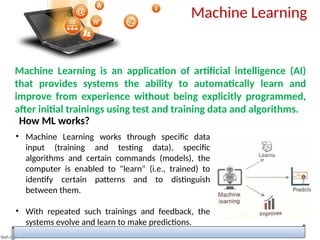
Machine Learning is an application of artificial intelligence (AI)
that provides systems the ability to automatically learn and
improve from experience without being explicitly programmed,
after initial trainings using test and training data and algorithms.
How ML works?
• Machine Learning works through specific data
input (training and testing data), specific
algorithms and certain commands (models), the
computer is enabled to "learn" (i.e., trained) to
identify certain patterns and to distinguish
between them.
• With repeated such trainings and feedback, the
systems evolve and learn to make predictions.
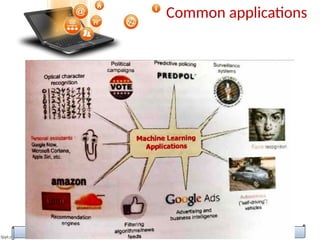
Common applications
Applications of Machine Learning
1.Image Recognition:
2. Speech Recognition
3. Traffic prediction:
4. Product recommendations:
5. Self-driving cars:
6. Email Spam and Malware Filtering:
7. Virtual Personal Assistant:
8. Online Fraud Detection:
9. Stock Market trading:
10. Medical Diagnosis:
11. Automatic Language Translation:
Emerging Trends
Internet of Things-IOT
The IOT concept was initially proposed by a member of the Radio Frequency
Identification (RFID) development community in 1999, and now it has become more
relevant to the practical world as the use of mobile devices, embedded
devices,communication, cloud computing and data analytics has increased.
Internet connects all people means “Internet of People”
IoT connects all things means “Internet of Things”
Interconnection of Things/Objects/Machines, e.g., sensors, mobilephones,
electronic devices, home appliances, any existing items and interact with each
other via Internet.
Internet of Things technology can include any sensor, electronic devices or software
which are connected to the internet and can be utilized remotely and can exchange
data. Here devices works themselves without human intervention for the welfare of
humans.
Emerging Trends
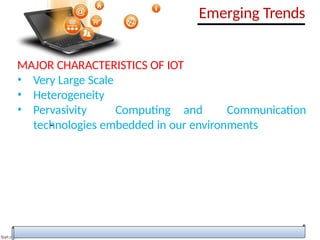
MAJOR CHARACTERISTICS OF IOT
• Very Large Scale
• Heterogeneity
• Pervasivity
-
Computing and Communication
technologies embedded in our environments
Emerging Trends
How Does the Internet of Things Work?
The Internet of Things is an aggregation of internet enabled sensors, smart
devices and software that can be manipulated by scripts, applications and
user interfaces across long distances.
Applications of IOT
• Smart house - Suppose we are not at home and doubts starts in our mind.
Did I turn the coffee maker off? Did I set the security alarm? etc. With a
smart home,we can quiet all of these worries with a quick glance at
smartphone/tablet. we can connect the devices and appliances in our
home so they can communicate with each other and with us and can work
with the commands given over smartphone remotely.
• Smart car - the driverless car (now a prototype) where taxis work based on
AI and take the passengers safely and accurately to the desired
destination.
Emerging Trends
Applications of IOT
• Elderly care- Patient surveillance can be life-saving; automatically detecting
when someone falls down or when they begin to experience a heart attack
so that emergency care can be sent immediately.
• Disaster warning- Sensors can collect critical information about the
environment, allowing for early detection of environmental disasters like
earthquakes, tsunamis, etc., thus saving lives.
• Delivery Drones – drones being used to deliver item with the help of smart
grid/geospatial data.
• A smart city is a framework, predominantly composed of Information and
Communication Technologies (ICT), to develop,
sustainable development practices to
address
deploy, and
promote
growing
urbanization
challenges. A big part of this ICT framework is essentially an intelligent
network of connected objects and machines that transmit data using
wireless technology and the cloud.
Emerging Trends
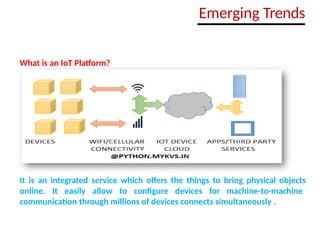
What is an IoT Platform?
It is an integrated service which offers the things to bring physical objects
online. It easily allow to configure devices for machine-to-machine
communication through millions of devices connects simultaneously .
Emerging Trends
What is an IoT Platform?
Sensors are useful and very important for the devices in order to
fetch the data. The data can be real-time, which includes the
current temperature, pressure or humidity.
List of Sensors most commonly used in the IoT devices,
• Temperature Sensor
• Pressure Sensor
• Proximity Sensor
• Accelerometer and Gyroscope Sensor
• IR Sensor
• Optical Sensor
• Gas Sensor
• Smoke Sensor
Emerging Trends
IoT Platform Types
• End-to-end IoT Platforms - provide the hardware, software, connectivity,
security, and device management tools to handle connection of millions of
concurrent device.
• Connectivity Management Platforms – It offer low power and low cost
connectivity management solutions through Wi-Fi and cellular technologies.
• IoT Cloud Platforms – It’s aim to get rid of the complexity of building our
own complex network
• Data Platform – It deals with data in some way with the tools we need to
route device data and manage / visualize data analytics.
Emerging Trends
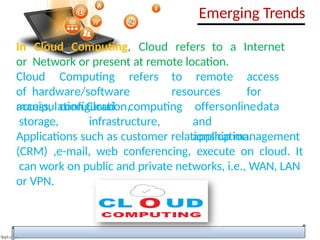
In Cloud Computing, Cloud refers to a Internet
or Network or present at remote location.
Cloud Computing refers to remote access
of hardware/software resources for
access, configuration,
manipulation.Cloud computing
storage, infrastructure,
offersonlinedata
and
application.
Applications such as customer relationship management
(CRM) ,e-mail, web conferencing, execute on cloud. It
can work on public and private networks, i.e., WAN, LAN
or VPN.
Emerging Trends
Uses of cloud computing
• Create new apps and services
• Store, back up and recover data
• Host websites and blogs
• Stream audio and video
• Deliver software on demand
• Analyze data for patterns and make
predictions
Cloud computing offers platform independency, because
software is not required to be installed locally on the
PC.Thus applications are being mobile and collaborative.
Emerging Trends
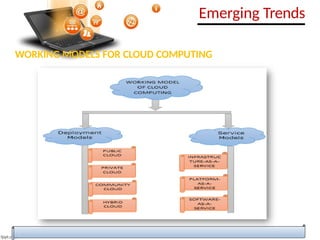
WORKING MODELS FOR CLOUD COMPUTING
Emerging Trends
WORKING MODELS FOR CLOUD COMPUTING
DEPLOYMENT MODEL
• PUBLIC CLOUD –
For general public.
• PRIVATE CLOUD –
For an organization only
• COMMUNITY CLOUD -
For group of organizations.
• HYBRID CLOUD –
Mixture of public and private cloud
Emerging Trends
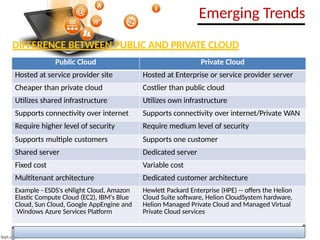
Public Cloud Private Cloud
Hosted at service provider site Hosted at Enterprise or service provider server
Cheaper than private cloud Costlier than public cloud
Utilizes shared infrastructure Utilizes own infrastructure
Supports connectivity over internet Supports connectivity over internet/Private WAN
Require higher level of security Require medium level of security
Supports multiple customers Supports one customer
Shared server Dedicated server
Fixed cost Variable cost
Multitenant architecture Dedicated customer architecture
Example - ESDS's eNlight Cloud, Amazon
Elastic Compute Cloud (EC2), IBM's Blue
Cloud, Sun Cloud, Google AppEngine and
Windows Azure Services Platform
Hewlett Packard Enterprise (HPE) -- offers the Helion
Cloud Suite software, Helion CloudSystem hardware,
Helion Managed Private Cloud and Managed Virtual
Private Cloud services
DIFFERENCE BETWEEN PUBLIC AND PRIVATE CLOUD
Emerging Trends
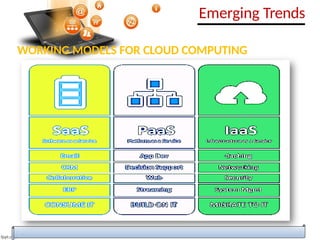
WORKING MODELS FOR CLOUD COMPUTING
Emerging Trends
Software as a Service (SaaS)
SaaS is a fully-developed software solution ready for
purchase and use over the internet on a subscription basis.
The SaaS provider manages the infrastructure, operating
systems, middleware, and data necessary to deliver the
program, ensuring that the software is available whenever
and wherever customers need it. Many SaaS applications
run directly through web browsers, eliminating the need for
downloads or installations. This greatly reduces software
management issues for internal IT teams.
Examples of SaaS: Microsoft Office 365, Salesforce, Cisco
WebEx, Google Apps.
Emerging Trends
Platform as a Service (PaaS)
PaaS is extremely helpful for any company that develops
software and web-based applications. Many of the tools needed
to develop for multiple platforms (computers, mobile devices,
browsers, etc) can be quite expensive. By using PaaS, customers
can access the development tools they need, when they need
them, without having to purchase them outright. Since the
platform is accessible over the internet, remote development
teams can all access the same assets to speed up product
development.
Examples of PaaS: AWS Elastic Beanstalk, Apache Stratos, Google
App Engine, Microsoft Azure
Emerging Trends
Infrastructure as a Service (IaaS)
it provides a completely virtualized computing
infrastructure that is provisioned and managed
over the internet. An IaaS provider manages the
physical end of the infrastructure (servers, data
storage space, etc) in a data center, but allows
customers to fully customize those virtualized
resources to suit their specific needs. Examples
of IaaS: Microsoft Azure, Amazon Web Services
(AWS), Cisco Metacloud, Google Compute
Engine (GCE)
Emerging Trends
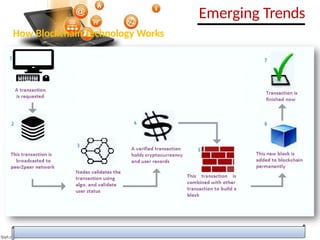
Blockchain Technology typically refers to the
transparent,
trustless, publicly accessible ledger that allows us to securely
transfer the ownership of units of value using public key
encryption and proof of work methods.
Thetechnology uses decentralized consensus to maintain
the network, means not centrally controlled by a bank,
corporation, or government. In fact, the larger the
network grows and becomes increasingly decentralized, the
more secure it becomes. The potential for blockchain technology
is not limited to bitcoin. As such, it has gained a lot of attention
in a variety of industries including: financial services,
charities and nonprofits, the arts, and e-
commerce.
Emerging Trends
How Blockchain Technology Works
Emerging Trends
Grid computing is a computer network in
which each computer's resources are
shared with every other computer in the
system. Processing power, memory and
data storage are all community resources
that authorized users can tap into and
work/use for specific tasks.
Emerging Trends

class 12 cbse board emerging trends12.pptx

  • 1.
  • 2.
    Introduction Technology is growingand evolving, impacting our lives in a way no one could have imagined some decades ago. Today you can listen to news or play your favourite music without getting up from your place, by just giving spoken instructions. Based on your preferences, are search history, your Online shopping store recommends products for you and you are surprised with their thoughtful matching choices, no? all this and much more is possible because of modern age technologies.
  • 3.
    Emerging Trends Artificial Intelligenceis comprised of two words Artificial and Intelligence, where Artificial means "man-made," and intelligence means "thinking power", hence AI means "a man-made thinking power.“ Artificial Intelligence human based skills exists there ,wherea machine can have such as learning, reasoning, and solving problems According to the father of Artificial Intelligence, John McCarthy, it is “The science and engineering of making intelligent machines
  • 4.
    ARTIFICIAL INTELLIGENCE Artificial intelligence(AI) refers to computer systems (including both hardware and software) that are capable of doing things that normally require human intelligence. For example, recognizing images, videos, speech and decision making. In artificial intelligence, computer systems try to partially mimic the functioning of human brain, i.e., using inexact and incomplete knowledge to make predictions. One of the greatest advantages of AI systems is that they have the capacity to enhance and improve their learning themselves
  • 5.
    Modern AI Machinesare designed and programmed to: • Work with minimum human intervention. • Create and update knowledge base, which keeps updating. • Having heuristic abilities (i.e, to learn from past mistakes, decisions and outcomes.) Most famous example of AI today is social humanoid robot Sophia, who has been awarded citizenship of Saudi Arabia.
  • 6.
    Other common examplesor AI today are: 1. Siri/Alexa – The personal assistance that have already become the new normal for thousands of people around the globe. 2. Smart home devices like Google’s NEST. 3. Self-driving cars like those produced by Tesla. 4. Online games like Alien: Isolation. It is predicted that in coming 5-10 years, AI will grow tremendously. AI base machines would outperform humans in tasks such as translating languages, driving trucks, etc
  • 7.
    AI based technologicaltrends: 1. Immersive experience with Extended Reality: Extended Reality (XR) is an umbrella term that covers all of the various technologies that enhance our senses and gives us immersive experience. It includes technologies Virtual Reality (VR), Augmented Reality (AR) and Mixed Reality (MR) technologies. Let us learn about these technologies. • Virtual Reality Virtual Reality (VR) is a technology that allows people to experience and interact with own senses in a 3D virtual environment that appears and feels like a real environment with the use of an electronic equipment. A VR experience is made possible generally with devices like: VR headset or helmet, instrumented and sensory VR glove(s) and instrumented and sensory VR bodysuit. • Augmented Reality The Augmented Reality (AR) is a technology that transforms the view of physical real-world environment with superimposed computer-generated images, thus changing the perception of reality. Many modern devices already support Augmented reality digital devices that can support sensors, cameras, accelerometer, gyroscope, digital compass, GPS, CPU, projected displays etc. Microsoft's Hololens is a well-known example of an existing, commercially available Mixed Reality device
  • 8.
    Applications of AI AIhas been dominant in various fields such as − • Gaming • Natural Language Processing • Expert Systems • Vision Systems • Speech Recognition • Handwriting Recognition • Intelligent Robots Artificial intelligence is a science and technology based on disciplines such as Computer Science, Biology, Psychology, Linguistics, Mathematics, and Engineering. Emerging Trends
  • 9.
    Machine Learning Machine Learningis an application of artificial intelligence (AI) that provides systems the ability to automatically learn and improve from experience without being explicitly programmed, after initial trainings using test and training data and algorithms. How ML works? • Machine Learning works through specific data input (training and testing data), specific algorithms and certain commands (models), the computer is enabled to "learn" (i.e., trained) to identify certain patterns and to distinguish between them. • With repeated such trainings and feedback, the systems evolve and learn to make predictions.
  • 10.
  • 11.
    Applications of MachineLearning 1.Image Recognition: 2. Speech Recognition 3. Traffic prediction: 4. Product recommendations: 5. Self-driving cars: 6. Email Spam and Malware Filtering: 7. Virtual Personal Assistant: 8. Online Fraud Detection: 9. Stock Market trading: 10. Medical Diagnosis: 11. Automatic Language Translation: Emerging Trends
  • 12.
    Internet of Things-IOT TheIOT concept was initially proposed by a member of the Radio Frequency Identification (RFID) development community in 1999, and now it has become more relevant to the practical world as the use of mobile devices, embedded devices,communication, cloud computing and data analytics has increased. Internet connects all people means “Internet of People” IoT connects all things means “Internet of Things” Interconnection of Things/Objects/Machines, e.g., sensors, mobilephones, electronic devices, home appliances, any existing items and interact with each other via Internet. Internet of Things technology can include any sensor, electronic devices or software which are connected to the internet and can be utilized remotely and can exchange data. Here devices works themselves without human intervention for the welfare of humans. Emerging Trends
  • 13.
    MAJOR CHARACTERISTICS OFIOT • Very Large Scale • Heterogeneity • Pervasivity - Computing and Communication technologies embedded in our environments Emerging Trends
  • 14.
    How Does theInternet of Things Work? The Internet of Things is an aggregation of internet enabled sensors, smart devices and software that can be manipulated by scripts, applications and user interfaces across long distances. Applications of IOT • Smart house - Suppose we are not at home and doubts starts in our mind. Did I turn the coffee maker off? Did I set the security alarm? etc. With a smart home,we can quiet all of these worries with a quick glance at smartphone/tablet. we can connect the devices and appliances in our home so they can communicate with each other and with us and can work with the commands given over smartphone remotely. • Smart car - the driverless car (now a prototype) where taxis work based on AI and take the passengers safely and accurately to the desired destination. Emerging Trends
  • 15.
    Applications of IOT •Elderly care- Patient surveillance can be life-saving; automatically detecting when someone falls down or when they begin to experience a heart attack so that emergency care can be sent immediately. • Disaster warning- Sensors can collect critical information about the environment, allowing for early detection of environmental disasters like earthquakes, tsunamis, etc., thus saving lives. • Delivery Drones – drones being used to deliver item with the help of smart grid/geospatial data. • A smart city is a framework, predominantly composed of Information and Communication Technologies (ICT), to develop, sustainable development practices to address deploy, and promote growing urbanization challenges. A big part of this ICT framework is essentially an intelligent network of connected objects and machines that transmit data using wireless technology and the cloud. Emerging Trends
  • 16.
    What is anIoT Platform? It is an integrated service which offers the things to bring physical objects online. It easily allow to configure devices for machine-to-machine communication through millions of devices connects simultaneously . Emerging Trends
  • 17.
    What is anIoT Platform? Sensors are useful and very important for the devices in order to fetch the data. The data can be real-time, which includes the current temperature, pressure or humidity. List of Sensors most commonly used in the IoT devices, • Temperature Sensor • Pressure Sensor • Proximity Sensor • Accelerometer and Gyroscope Sensor • IR Sensor • Optical Sensor • Gas Sensor • Smoke Sensor Emerging Trends
  • 18.
    IoT Platform Types •End-to-end IoT Platforms - provide the hardware, software, connectivity, security, and device management tools to handle connection of millions of concurrent device. • Connectivity Management Platforms – It offer low power and low cost connectivity management solutions through Wi-Fi and cellular technologies. • IoT Cloud Platforms – It’s aim to get rid of the complexity of building our own complex network • Data Platform – It deals with data in some way with the tools we need to route device data and manage / visualize data analytics. Emerging Trends
  • 19.
    In Cloud Computing,Cloud refers to a Internet or Network or present at remote location. Cloud Computing refers to remote access of hardware/software resources for access, configuration, manipulation.Cloud computing storage, infrastructure, offersonlinedata and application. Applications such as customer relationship management (CRM) ,e-mail, web conferencing, execute on cloud. It can work on public and private networks, i.e., WAN, LAN or VPN. Emerging Trends
  • 20.
    Uses of cloudcomputing • Create new apps and services • Store, back up and recover data • Host websites and blogs • Stream audio and video • Deliver software on demand • Analyze data for patterns and make predictions Cloud computing offers platform independency, because software is not required to be installed locally on the PC.Thus applications are being mobile and collaborative. Emerging Trends
  • 21.
    WORKING MODELS FORCLOUD COMPUTING Emerging Trends
  • 22.
    WORKING MODELS FORCLOUD COMPUTING DEPLOYMENT MODEL • PUBLIC CLOUD – For general public. • PRIVATE CLOUD – For an organization only • COMMUNITY CLOUD - For group of organizations. • HYBRID CLOUD – Mixture of public and private cloud Emerging Trends
  • 23.
    Public Cloud PrivateCloud Hosted at service provider site Hosted at Enterprise or service provider server Cheaper than private cloud Costlier than public cloud Utilizes shared infrastructure Utilizes own infrastructure Supports connectivity over internet Supports connectivity over internet/Private WAN Require higher level of security Require medium level of security Supports multiple customers Supports one customer Shared server Dedicated server Fixed cost Variable cost Multitenant architecture Dedicated customer architecture Example - ESDS's eNlight Cloud, Amazon Elastic Compute Cloud (EC2), IBM's Blue Cloud, Sun Cloud, Google AppEngine and Windows Azure Services Platform Hewlett Packard Enterprise (HPE) -- offers the Helion Cloud Suite software, Helion CloudSystem hardware, Helion Managed Private Cloud and Managed Virtual Private Cloud services DIFFERENCE BETWEEN PUBLIC AND PRIVATE CLOUD Emerging Trends
  • 24.
    WORKING MODELS FORCLOUD COMPUTING Emerging Trends
  • 25.
    Software as aService (SaaS) SaaS is a fully-developed software solution ready for purchase and use over the internet on a subscription basis. The SaaS provider manages the infrastructure, operating systems, middleware, and data necessary to deliver the program, ensuring that the software is available whenever and wherever customers need it. Many SaaS applications run directly through web browsers, eliminating the need for downloads or installations. This greatly reduces software management issues for internal IT teams. Examples of SaaS: Microsoft Office 365, Salesforce, Cisco WebEx, Google Apps. Emerging Trends
  • 26.
    Platform as aService (PaaS) PaaS is extremely helpful for any company that develops software and web-based applications. Many of the tools needed to develop for multiple platforms (computers, mobile devices, browsers, etc) can be quite expensive. By using PaaS, customers can access the development tools they need, when they need them, without having to purchase them outright. Since the platform is accessible over the internet, remote development teams can all access the same assets to speed up product development. Examples of PaaS: AWS Elastic Beanstalk, Apache Stratos, Google App Engine, Microsoft Azure Emerging Trends
  • 27.
    Infrastructure as aService (IaaS) it provides a completely virtualized computing infrastructure that is provisioned and managed over the internet. An IaaS provider manages the physical end of the infrastructure (servers, data storage space, etc) in a data center, but allows customers to fully customize those virtualized resources to suit their specific needs. Examples of IaaS: Microsoft Azure, Amazon Web Services (AWS), Cisco Metacloud, Google Compute Engine (GCE) Emerging Trends
  • 28.
    Blockchain Technology typicallyrefers to the transparent, trustless, publicly accessible ledger that allows us to securely transfer the ownership of units of value using public key encryption and proof of work methods. Thetechnology uses decentralized consensus to maintain the network, means not centrally controlled by a bank, corporation, or government. In fact, the larger the network grows and becomes increasingly decentralized, the more secure it becomes. The potential for blockchain technology is not limited to bitcoin. As such, it has gained a lot of attention in a variety of industries including: financial services, charities and nonprofits, the arts, and e- commerce. Emerging Trends
  • 29.
    How Blockchain TechnologyWorks Emerging Trends
  • 30.
    Grid computing isa computer network in which each computer's resources are shared with every other computer in the system. Processing power, memory and data storage are all community resources that authorized users can tap into and work/use for specific tasks. Emerging Trends