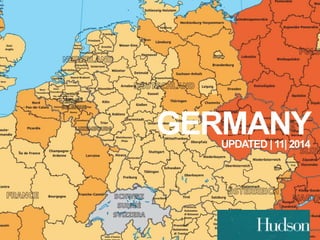
GERMANY 
UPDATED | 11| 2014
EU BUDGETS 
2014 | 2020
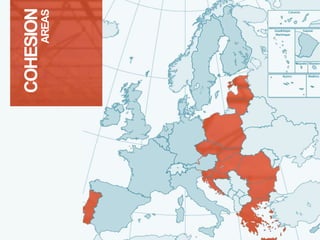
COHESION 
AREAS
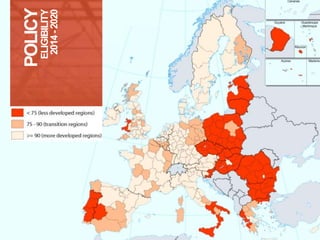
POLICY 
ELIGIBILITY 
2014 - 2020
ALL AMOUNTS x 1.000.000 
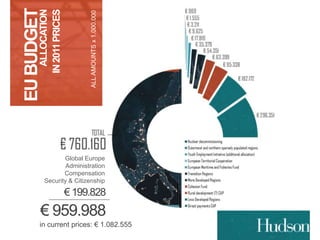
EU BUDGET 
ALLOCATION 
IN 2011 PRICES 
Global Europe 
Administration 
Compensation 
Security & Citizenship 
€ 199.828 
€ 959.988 
in current prices: € 1.082.555
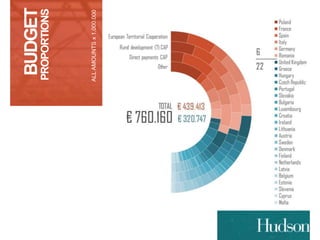
BUDGET 
PROPORTIONS 
ALL AMOUNTS x 1.000.000
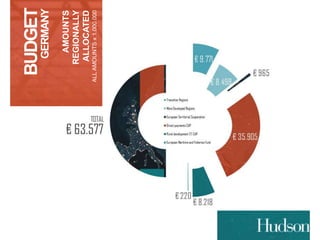
BUDGET 
GERMANY 
AMOUNTS 
REGIONALLY 
ALLOCATED 
ALL AMOUNTS x 1.000.000
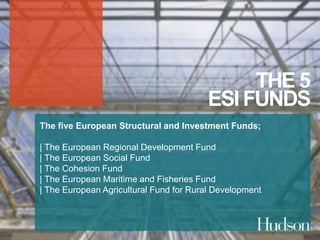
THE 5 
ESI FUNDS 
The five European Structural and Investment Funds; 
| The European Regional Development Fund 
| The European Social Fund 
| The Cohesion Fund 
| The European Maritime and Fisheries Fund 
| The European Agricultural Fund for Rural Development
PARTNERSHIP 
AGREEMENTS 
| EU Member States are required to draw up and implement 
strategic plans with investment priorities covering the five ESI 
Funds. 
| These Partnership Agreements (PAs) are negotiated between the 
European Commission and national authorities, following their 
consultation of various levels of governance, representatives from 
interest groups, civil society and local 
and regional representatives.
MAXIMUM 
AID PERCENTAGES 
Under the regional guidelines, areas which have a GDP per capital 
below 75% of the EU average are eligible in priority for regional 
investment aid, as the main purpose of regional aid is to foster the 
development of the less advantaged regions of Europe. 
| While for the period 2007-13, almost the entire territory of the German 
new Länder (following the reunification of Germany) fell within this 
category, none of the German regions qualify for this status for the 
2014-2020 period.
MAXIMUM 
AID PERCENTAGES 
| In order to ensure a smooth transition, these areas will continue to be 
eligible until 2020 and the maximum aid intensities applicable in these 
regions will be reduced by the end of 2017. 
| Under the guidelines, other regions can also be made eligible provided 
that they complywith certain criteria, in order to allow Member States to 
tackle their own regional disparities. 
| As these regions are less disadvantaged from a European perspective 
than areas with a GDP per capita below 75% of the EU average, both the 
geographical scope and the aid intensity are strictly limited.
MAXIMUM 
AID PERCENTAGES 
The regional map specifies what areas have been made eligible by 
Germany. 
| The maximum aid intensities for regional investment aid in the German 
assisted regions have slightly decreased as compared to the previous aid 
map (between 5 and 15 percentage points, depending on the region).
STATUS 
CURRENT 
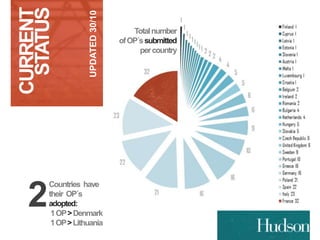
UPDATED 30/10 
Total number 
of OP´s submitted 
per country 
Countries have 
their OP´s 
adopted: 21 OP >Denmark 
1 OP >Lithuania
PLANNING 
| Partnership Agreement Adopted 22 – 05 – 2014 
| 15 Operational Programme’s and 1 Multi-Fund Programme 
submitted 
| Adoption of OP’s by European commission in Q4 2014 
| Exp.1st grant calls Q1 2015 for funding priorities related to OP’s 
OPs should be submitted by Member States within 3 months following the 
submission of the Partnership Agreement. 
The Commission makes observations within 3 months and adopts the OP 
no later than 6 months from the date of its submission.
FUNDING 
PRIORITIES 
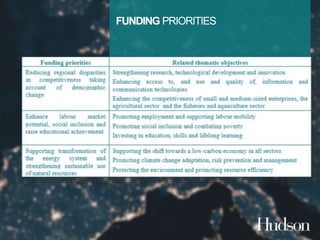
In order to improve regional competitiveness and break down 
regional disparities, measures are being taken under the ERDF that 
essentially focus on the following thematic objectives: 
| 1: ‘Strengthening research, technological development and innovation’ 
| 3: ‘Enhancing the competitiveness of SMEs’ 
| 3: ‘Supporting the shift towards a low-carbon economy in all sectors’
FUNDING 
PRIORITIES 
Around 83% of ERDF funding (not counting expenditure on 
technical assistance) will be used to support these three objectives. 
Of the remaining 17%+, a good third will be spend on each of Objectives 
6 ‘Preserving and protecting the environment and promoting resource 
efficiency’ and 
9 ‘Promoting social inclusion, combating poverty and any discrimination’. 
Under Objectives 6 and 9, together with Thematic Objective 5, attempts 
are above all made to promote the sustainable development of regions and 
cities.
FUNDING 
PRIORITIES 
To promote human resources and for the benefit of social cohesion, 
the funding awards from the ESF in the 2014-2020 funding period 
will focus on the following thematic objectives: 
| 8: ‘Promoting sustainable and quality employment and supporting labour 
mobility’ 
| 9: ‘Promoting social inclusion, combating poverty and any discrimination’ 
| 10: ‘Investing in education, training and vocational training for skills and 
lifelong learning’.
FUNDING 
PRIORITIES 
In order to achieve the common objectives, all ESF funding (excluding 
technical aid) is to be put towards these three thematic objectives. 
The analyses of the needs for action and funding turn out to some extent 
to be very varied between eastern and western Germany, but also between 
individual Länder in the eastern and western parts of the country. 
At the national level for Germany, the preliminary figures indicate that there 
is close to a one-third weighting: 
| 33.3% for objective 8 
| 33.1% for objective 9 
| 33.6% for objective 10.
FUNDING 
PRIORITIES 
For Germany as a whole, the ESF-supported Investitionen in die Köpfe 
[Investment in minds] will make visible contributions to smart, sustainable 
and inclusive growth and to adaptation to demographic change. 
In particular, results are to be expected from the mobilization of additional 
economic potential, with a key role to be played by hitherto unutilized 
economic potential among women. 
The development of human resources is supported on the supply side and 
the demand side in order to help secure the skills base and improve the 
situation of the disadvantaged.
FUNDING 
PRIORITIES 
Improving the sustainable management of natural resources and climate 
protection policy, plus economic and social development in rural areas, 
represent the core concerns of funding awards under the EAFRD. With this 
in mind, the following thematic objectives – among other objectives – are 
relevant: 
| 5: ‘Promoting climate change adaptation, risk prevention & management’ 
| 6: ‘Preserving & protecting the environment and promoting resource 
efficiency’ 
| 9: ‘Promoting social inclusion, combating poverty and any discrimination’.
FUNDING 
PRIORITIES 
When it comes to thematic concentration, around two thirds of the total 
expenditure allocated to the EAFRD (excluding technical assistance) jointly 
covers objectives 5, 6 and 9. 
A further 19% is allocated to thematic objective 3 in order to increase the 
competitiveness of SMEs.
FINANCIAL 
ALLOCATIONS 
On 1 January 2014 the new 2014-2020 funding period began. Over 
this funding period, funding amounting to EUR 19.2 billion from the 
ERDF and the ESF and EUR 8.3 billion from the EAFRD will be 
deployed in Germany to meet the European Union’s policy aims. 
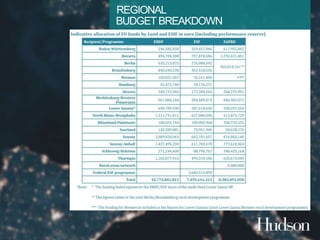
| Subsidies under the ERDF and the ESF vary region by region based on 
economic conditions. Higher levels of funding in Germany are by and large 
the preserve of the eastern Länder. 
| The EAFRD supports rural areas and the development of agriculture and 
forestry, while the EMFF supports the fisheries sector.
PROGRAMME 
ARCHITECTURE 
In Germany the implementation of the policies is by and large 
performed by the Länder as part of multiannual funding 
programmes. A total of 48 funding programmes are being put in 
place. 
| For the ERDF and the ESF, there are 15 operational programmes in the 
Länder and one multi-fund programme – a joint ERDF/ESF programme 
for Lower Saxony. There is also one national programme under the ESF. 
| For the EAFRD, there are 14 development programmes for rural areas. 
The EMFF consists of a single national programme.
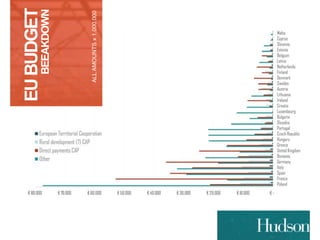
EU BUDGET 
BEEAKDOWN 
ALL AMOUNTS x 1.000.000
FUNDINGPRIORITIES
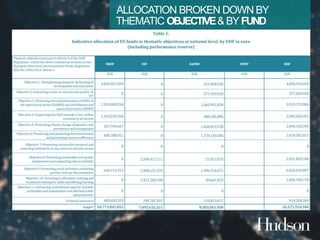
ALLOCATION BROKEN DOWN BY 
THEMATIC OBJECTIVE& BY FUND
REGIONAL 
BUDGET BREAKDOWN
EU Budget Germany 2014-2020 update November 2014

EU Budget Germany 2014-2020 update November 2014

  • 1.
  • 2.
  • 3.
  • 4.
  • 5.
    ALL AMOUNTS x1.000.000 EU BUDGET ALLOCATION IN 2011 PRICES Global Europe Administration Compensation Security & Citizenship € 199.828 € 959.988 in current prices: € 1.082.555
  • 6.
    BUDGET PROPORTIONS ALLAMOUNTS x 1.000.000
  • 7.
    BUDGET GERMANY AMOUNTS REGIONALLY ALLOCATED ALL AMOUNTS x 1.000.000
  • 8.
    THE 5 ESIFUNDS The five European Structural and Investment Funds; | The European Regional Development Fund | The European Social Fund | The Cohesion Fund | The European Maritime and Fisheries Fund | The European Agricultural Fund for Rural Development
  • 9.
    PARTNERSHIP AGREEMENTS |EU Member States are required to draw up and implement strategic plans with investment priorities covering the five ESI Funds. | These Partnership Agreements (PAs) are negotiated between the European Commission and national authorities, following their consultation of various levels of governance, representatives from interest groups, civil society and local and regional representatives.
  • 10.
    MAXIMUM AID PERCENTAGES Under the regional guidelines, areas which have a GDP per capital below 75% of the EU average are eligible in priority for regional investment aid, as the main purpose of regional aid is to foster the development of the less advantaged regions of Europe. | While for the period 2007-13, almost the entire territory of the German new Länder (following the reunification of Germany) fell within this category, none of the German regions qualify for this status for the 2014-2020 period.
  • 11.
    MAXIMUM AID PERCENTAGES | In order to ensure a smooth transition, these areas will continue to be eligible until 2020 and the maximum aid intensities applicable in these regions will be reduced by the end of 2017. | Under the guidelines, other regions can also be made eligible provided that they complywith certain criteria, in order to allow Member States to tackle their own regional disparities. | As these regions are less disadvantaged from a European perspective than areas with a GDP per capita below 75% of the EU average, both the geographical scope and the aid intensity are strictly limited.
  • 12.
    MAXIMUM AID PERCENTAGES The regional map specifies what areas have been made eligible by Germany. | The maximum aid intensities for regional investment aid in the German assisted regions have slightly decreased as compared to the previous aid map (between 5 and 15 percentage points, depending on the region).
  • 13.
    STATUS CURRENT UPDATED30/10 Total number of OP´s submitted per country Countries have their OP´s adopted: 21 OP >Denmark 1 OP >Lithuania
  • 14.
    PLANNING | PartnershipAgreement Adopted 22 – 05 – 2014 | 15 Operational Programme’s and 1 Multi-Fund Programme submitted | Adoption of OP’s by European commission in Q4 2014 | Exp.1st grant calls Q1 2015 for funding priorities related to OP’s OPs should be submitted by Member States within 3 months following the submission of the Partnership Agreement. The Commission makes observations within 3 months and adopts the OP no later than 6 months from the date of its submission.
  • 15.
    FUNDING PRIORITIES Inorder to improve regional competitiveness and break down regional disparities, measures are being taken under the ERDF that essentially focus on the following thematic objectives: | 1: ‘Strengthening research, technological development and innovation’ | 3: ‘Enhancing the competitiveness of SMEs’ | 3: ‘Supporting the shift towards a low-carbon economy in all sectors’
  • 16.
    FUNDING PRIORITIES Around83% of ERDF funding (not counting expenditure on technical assistance) will be used to support these three objectives. Of the remaining 17%+, a good third will be spend on each of Objectives 6 ‘Preserving and protecting the environment and promoting resource efficiency’ and 9 ‘Promoting social inclusion, combating poverty and any discrimination’. Under Objectives 6 and 9, together with Thematic Objective 5, attempts are above all made to promote the sustainable development of regions and cities.
  • 17.
    FUNDING PRIORITIES Topromote human resources and for the benefit of social cohesion, the funding awards from the ESF in the 2014-2020 funding period will focus on the following thematic objectives: | 8: ‘Promoting sustainable and quality employment and supporting labour mobility’ | 9: ‘Promoting social inclusion, combating poverty and any discrimination’ | 10: ‘Investing in education, training and vocational training for skills and lifelong learning’.
  • 18.
    FUNDING PRIORITIES Inorder to achieve the common objectives, all ESF funding (excluding technical aid) is to be put towards these three thematic objectives. The analyses of the needs for action and funding turn out to some extent to be very varied between eastern and western Germany, but also between individual Länder in the eastern and western parts of the country. At the national level for Germany, the preliminary figures indicate that there is close to a one-third weighting: | 33.3% for objective 8 | 33.1% for objective 9 | 33.6% for objective 10.
  • 19.
    FUNDING PRIORITIES ForGermany as a whole, the ESF-supported Investitionen in die Köpfe [Investment in minds] will make visible contributions to smart, sustainable and inclusive growth and to adaptation to demographic change. In particular, results are to be expected from the mobilization of additional economic potential, with a key role to be played by hitherto unutilized economic potential among women. The development of human resources is supported on the supply side and the demand side in order to help secure the skills base and improve the situation of the disadvantaged.
  • 20.
    FUNDING PRIORITIES Improvingthe sustainable management of natural resources and climate protection policy, plus economic and social development in rural areas, represent the core concerns of funding awards under the EAFRD. With this in mind, the following thematic objectives – among other objectives – are relevant: | 5: ‘Promoting climate change adaptation, risk prevention & management’ | 6: ‘Preserving & protecting the environment and promoting resource efficiency’ | 9: ‘Promoting social inclusion, combating poverty and any discrimination’.
  • 21.
    FUNDING PRIORITIES Whenit comes to thematic concentration, around two thirds of the total expenditure allocated to the EAFRD (excluding technical assistance) jointly covers objectives 5, 6 and 9. A further 19% is allocated to thematic objective 3 in order to increase the competitiveness of SMEs.
  • 22.
    FINANCIAL ALLOCATIONS On1 January 2014 the new 2014-2020 funding period began. Over this funding period, funding amounting to EUR 19.2 billion from the ERDF and the ESF and EUR 8.3 billion from the EAFRD will be deployed in Germany to meet the European Union’s policy aims. | Subsidies under the ERDF and the ESF vary region by region based on economic conditions. Higher levels of funding in Germany are by and large the preserve of the eastern Länder. | The EAFRD supports rural areas and the development of agriculture and forestry, while the EMFF supports the fisheries sector.
  • 23.
    PROGRAMME ARCHITECTURE InGermany the implementation of the policies is by and large performed by the Länder as part of multiannual funding programmes. A total of 48 funding programmes are being put in place. | For the ERDF and the ESF, there are 15 operational programmes in the Länder and one multi-fund programme – a joint ERDF/ESF programme for Lower Saxony. There is also one national programme under the ESF. | For the EAFRD, there are 14 development programmes for rural areas. The EMFF consists of a single national programme.
  • 24.
    EU BUDGET BEEAKDOWN ALL AMOUNTS x 1.000.000
  • 25.
  • 26.
    ALLOCATION BROKEN DOWNBY THEMATIC OBJECTIVE& BY FUND
  • 27.