
Data driven services: Enabling Privacy
and Personalisation for a Pervasive
Social Networking System
Howard Williams (Heriot-Watt Univ.)
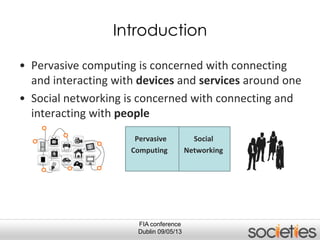
• Pervasive computing is concerned with connecting
and interacting with devices and services around one
• Social networking is concerned with connecting and
interacting with people
Pervasive Social
Computing Networking
FIA conference
Dublin 09/05/13
Introduction
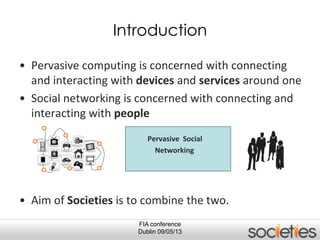
• Pervasive computing is concerned with connecting
and interacting with devices and services around one
• Social networking is concerned with connecting and
interacting with people
Pervasive Social
Networking
• Aim of Societies is to combine the two.
FIA conference
Dublin 09/05/13
Introduction
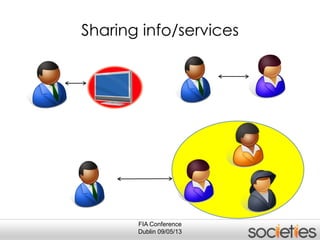
Sharing info/services
FIA Conference
Dublin 09/05/13
FIA conference
Dublin 09/05/13
Key Supporting Processes
Two key supporting processes for sharing info/services
• Needed to support Third Party Apps
• User Privacy
• Personalisation
• Both depend on Learning
• All three are data driven
FIA conference
Dublin 09/05/13
Privacy
• Need to control who has access what info
• Personal info (e.g. name, age, credit card)
• + Context info (e.g. location, other co-located users,
current task)
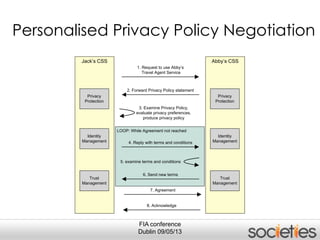
• Societies approach based on Personalised Privacy
Policy Negotiation
FIA conference
Dublin 09/05/13
Privacy
•Privacy policy negotiation enables users to choose the
personal data they wish to disclose to other users, to
third party apps or to communities.
•Approach adopted uses preferences to automate the
privacy policy negotiation process. This benefits the
user in several ways -
– The user is relieved of the burden of configuring the details of their
privacy policy manually
– It helps the user to be consistent with the data they disclose as the
same preference can be applied in more than one situation
•Trust used to ensure data owner and data requestor
adhere to terms of mutual data disclosure agreement
FIA conference
Dublin 09/05/13
LOOP: While Agreement not reached
Jack’s CSS
Identity
Management
Privacy
Protection
1. Request to use Abby’s
Travel Agent Service
2. Forward Privacy Policy statement
3. Examine Privacy Policy,
evaluate privacy preferences,
produce privacy policy
4. Reply with terms and conditions
5. examine terms and conditions
6. Send new terms
7. Agreement
8. Acknowledge
Trust
Management
Abby’s CSS
Identity
Management
Privacy
Protection
Trust
Management
Personalised Privacy Policy Negotiation
FIA conference
Dublin 09/05/13
Privacy
• System is able to control what data is revealed to
whom, based on user’s privacy preferences.
• User can also control the level of detail for any
individual data item, e.g. location (data obfuscation)
• Also used for multi-identity management and
selection.
FIA conference
Dublin 09/05/13
Personalisation
• The set of processes that adapt the behaviour of a
system to take account of the needs and preferences
of the individual user in the current context.
• This includes:
– Automatic triggering of services
– Service selection (device, app, ..)
– Initial parameters for service
– Changes to parameters when context changes
• Result will depend on user and current context
(location, time, day…)
FIA conference
Dublin 09/05/13
Personalisation
Societies uses several different mechanisms:
• Rule-based user preferences
• Neural network
• Bayesian network
• Context aware user intent (CAUI) models
• User intent based on Conditional Random Fields
(CRFs)
FIA conference
Dublin 09/05/13
Personalisation
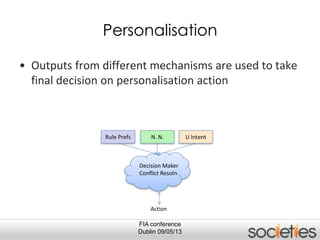
• Outputs from different mechanisms are used to take
final decision on personalisation action
U IntentN. N.Rule Prefs
Action
Decision Maker
Conflict Resoln
FIA conference
Dublin 09/05/13
Personalisation
Societies is extending the notion of personalisation to
include the needs and preferences of communities
as well as individuals. Thus we also have:
• Rule-based community preferences
• Context aware Community intent (CACI) models
FIA conference
Dublin 09/05/13
Learning
• Various forms of learning needed to build up profile
of user preferences, …
• Need to monitor user actions and context and build
up a cloudlet containing user history.
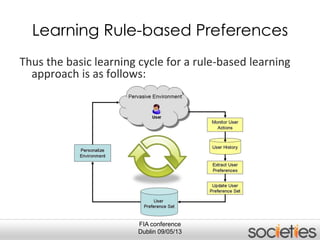
Thus the basic learning cycle for a rule-based learning
approach is as follows:
FIA conference
Dublin 09/05/13
Learning Rule-based Preferences
FIA conference
Dublin 09/05/13
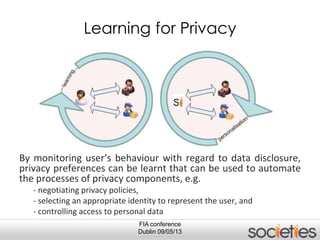
Learning for Privacy
By monitoring user’s behaviour with regard to data disclosure,
privacy preferences can be learnt that can be used to automate
the processes of privacy components, e.g.
- negotiating privacy policies,
- selecting an appropriate identity to represent the user, and
- controlling access to personal data
FIA conference
Dublin 09/05/13
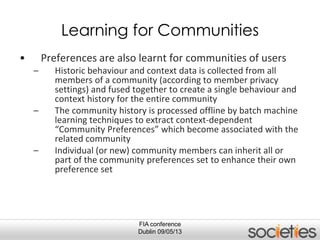
Learning for Communities
• Preferences are also learnt for communities of users
– Historic behaviour and context data is collected from all
members of a community (according to member privacy
settings) and fused together to create a single behaviour and
context history for the entire community
– The community history is processed offline by batch machine
learning techniques to extract context-dependent
“Community Preferences” which become associated with the
related community
– Individual (or new) community members can inherit all or
part of the community preferences set to enhance their own
preference set
FIA conference
Dublin 09/05/13
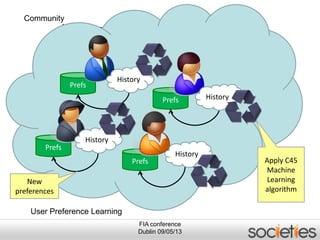
Learning for Communities
Community
Prefs
Prefs
Prefs
Prefs
Apply C45
Machine
Learning
algorithm
New
preferences
User Preference Learning
History
History
History
History
FIA conference
Dublin 09/05/13
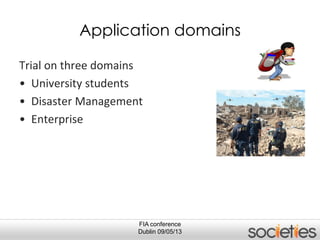
Application domains
Trial on three domains
• University students
• Disaster Management
• Enterprise
FIA conference
Dublin 09/05/13
Conclusion
• Personalisation and privacy are two data-driven
processes that are essential in a pervasive social
networking system. In turn they rely on learning –
another data-driven process.
• If an app wants to obtain info on the user, it must
use PPPN to obtain permission.
• If an app wants to use personalisation info
(preferences or intent) it must do this via the
personalisation APIs.
FIA conference
Dublin 09/05/13
Thank you!

FIA Dublin Presentations: Data driven services: Enabling Privacy and Personalisation for a Pervasive Social Networking System by Howard Williams

  • 1.
    Data driven services:Enabling Privacy and Personalisation for a Pervasive Social Networking System Howard Williams (Heriot-Watt Univ.)
  • 2.
    • Pervasive computingis concerned with connecting and interacting with devices and services around one • Social networking is concerned with connecting and interacting with people Pervasive Social Computing Networking FIA conference Dublin 09/05/13 Introduction
  • 3.
    • Pervasive computingis concerned with connecting and interacting with devices and services around one • Social networking is concerned with connecting and interacting with people Pervasive Social Networking • Aim of Societies is to combine the two. FIA conference Dublin 09/05/13 Introduction
  • 4.
  • 5.
    FIA conference Dublin 09/05/13 KeySupporting Processes Two key supporting processes for sharing info/services • Needed to support Third Party Apps • User Privacy • Personalisation • Both depend on Learning • All three are data driven
  • 6.
    FIA conference Dublin 09/05/13 Privacy •Need to control who has access what info • Personal info (e.g. name, age, credit card) • + Context info (e.g. location, other co-located users, current task) • Societies approach based on Personalised Privacy Policy Negotiation
  • 7.
    FIA conference Dublin 09/05/13 Privacy •Privacypolicy negotiation enables users to choose the personal data they wish to disclose to other users, to third party apps or to communities. •Approach adopted uses preferences to automate the privacy policy negotiation process. This benefits the user in several ways - – The user is relieved of the burden of configuring the details of their privacy policy manually – It helps the user to be consistent with the data they disclose as the same preference can be applied in more than one situation •Trust used to ensure data owner and data requestor adhere to terms of mutual data disclosure agreement
  • 8.
    FIA conference Dublin 09/05/13 LOOP:While Agreement not reached Jack’s CSS Identity Management Privacy Protection 1. Request to use Abby’s Travel Agent Service 2. Forward Privacy Policy statement 3. Examine Privacy Policy, evaluate privacy preferences, produce privacy policy 4. Reply with terms and conditions 5. examine terms and conditions 6. Send new terms 7. Agreement 8. Acknowledge Trust Management Abby’s CSS Identity Management Privacy Protection Trust Management Personalised Privacy Policy Negotiation
  • 9.
    FIA conference Dublin 09/05/13 Privacy •System is able to control what data is revealed to whom, based on user’s privacy preferences. • User can also control the level of detail for any individual data item, e.g. location (data obfuscation) • Also used for multi-identity management and selection.
  • 10.
    FIA conference Dublin 09/05/13 Personalisation •The set of processes that adapt the behaviour of a system to take account of the needs and preferences of the individual user in the current context. • This includes: – Automatic triggering of services – Service selection (device, app, ..) – Initial parameters for service – Changes to parameters when context changes • Result will depend on user and current context (location, time, day…)
  • 11.
    FIA conference Dublin 09/05/13 Personalisation Societiesuses several different mechanisms: • Rule-based user preferences • Neural network • Bayesian network • Context aware user intent (CAUI) models • User intent based on Conditional Random Fields (CRFs)
  • 12.
    FIA conference Dublin 09/05/13 Personalisation •Outputs from different mechanisms are used to take final decision on personalisation action U IntentN. N.Rule Prefs Action Decision Maker Conflict Resoln
  • 13.
    FIA conference Dublin 09/05/13 Personalisation Societiesis extending the notion of personalisation to include the needs and preferences of communities as well as individuals. Thus we also have: • Rule-based community preferences • Context aware Community intent (CACI) models
  • 14.
    FIA conference Dublin 09/05/13 Learning •Various forms of learning needed to build up profile of user preferences, … • Need to monitor user actions and context and build up a cloudlet containing user history.
  • 15.
    Thus the basiclearning cycle for a rule-based learning approach is as follows: FIA conference Dublin 09/05/13 Learning Rule-based Preferences
  • 16.
    FIA conference Dublin 09/05/13 Learningfor Privacy By monitoring user’s behaviour with regard to data disclosure, privacy preferences can be learnt that can be used to automate the processes of privacy components, e.g. - negotiating privacy policies, - selecting an appropriate identity to represent the user, and - controlling access to personal data
  • 17.
    FIA conference Dublin 09/05/13 Learningfor Communities • Preferences are also learnt for communities of users – Historic behaviour and context data is collected from all members of a community (according to member privacy settings) and fused together to create a single behaviour and context history for the entire community – The community history is processed offline by batch machine learning techniques to extract context-dependent “Community Preferences” which become associated with the related community – Individual (or new) community members can inherit all or part of the community preferences set to enhance their own preference set
  • 18.
    FIA conference Dublin 09/05/13 Learningfor Communities Community Prefs Prefs Prefs Prefs Apply C45 Machine Learning algorithm New preferences User Preference Learning History History History History
  • 19.
    FIA conference Dublin 09/05/13 Applicationdomains Trial on three domains • University students • Disaster Management • Enterprise
  • 20.
    FIA conference Dublin 09/05/13 Conclusion •Personalisation and privacy are two data-driven processes that are essential in a pervasive social networking system. In turn they rely on learning – another data-driven process. • If an app wants to obtain info on the user, it must use PPPN to obtain permission. • If an app wants to use personalisation info (preferences or intent) it must do this via the personalisation APIs.
  • 21.