I’m not you Modelling and conceptualizing personalization in information architecture Presented by / Bogo Vatovec Change Management / Knowledge Engineering / User Experience / Interaction Design / Process Engineering
Integration of personalization in a design of an interactive system. What will I be talking about?
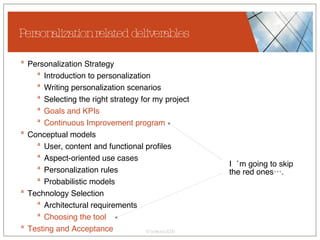
Personalization related deliverables Personalization Strategy  Introduction to personalization Writing personalization scenarios Selecting the right strategy for my project Goals and KPIs   Continuous Improvement program Conceptual models User, content and functional profiles Aspect-oriented use cases Personalization rules Probabilistic models Technology Selection Architectural requirements Choosing the tool Testing and Acceptance I‘m going to skip  the red ones….
Introduction to personalization
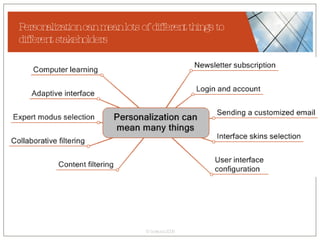
Personalization can mean lots of different things to different stakeholders
Some of these cases are trivial If you are happy enough that they apply to you, forget the rest of the presentation. For the others…
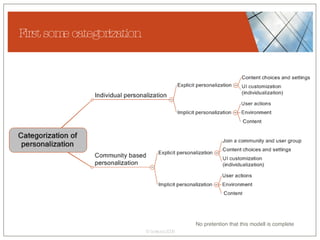
First some categorization No pretention that this modell is complete
Introduction – how personalization works Personalization works essentially using the following methods: Explicit settings: I want A, B and C. Similarity of profiles: If A is similar to B then do C. Sequence of actions: If 1) and 2) and 3), then do 4). Combination of: If A is similar to B and 1) and 2) then do 4)
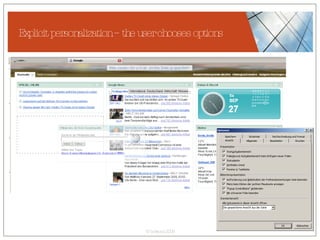
Explicit personalization – the user chooses options
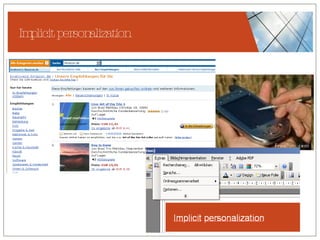
Implicit personalization
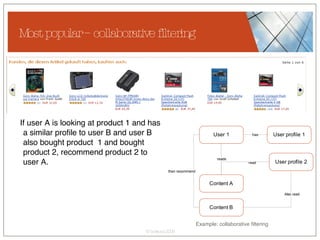
Most popular – collaborative filtering If user A is looking at product 1 and has a similar profile to user B and user B also bought product  1 and bought product 2, recommend product 2 to user A. Example: collaborative filtering
Conceptualizing personalization
Conceptualizing personalization  has one basic rule Describe behaviour without and with personalization separately.
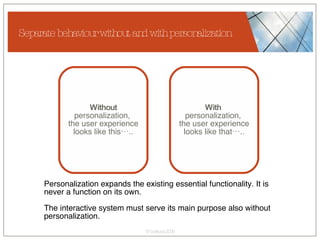
Separate behaviour without and with personalization Without  personalization,  the user experience looks like this….. With   personalization,  the user experience looks like that….. Personalization expands the existing essential functionality. It is never a function on its own.  The interactive system must serve its main purpose also without personalization.
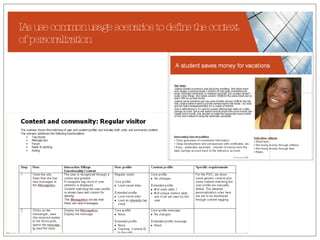
IAs use common usage scenarios to define the context of personalization
Align personalization with the business strategy and desired user experience Is it important to have user profiles? Which data about the users is important? What kind of a benefit does the interactive system provide for the user and the business through different personalization types? Clearly state the personalization strategy by: Describing the personalization type used Describing usage scenarios illustrating the experience State the benefits for the business and the user Make sure every stakeholder understands this Make sure to consider the following
Visualizing the big picture
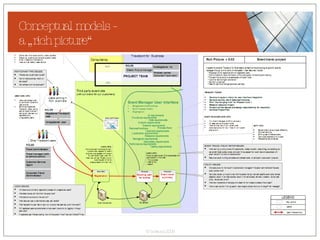
Conceptual models -  a „rich picture“
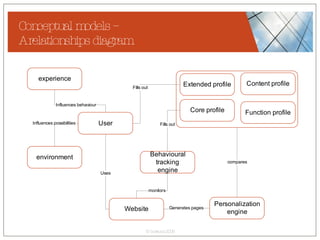
Conceptual models – A relationships diagram
Profiles, profiles, profiles
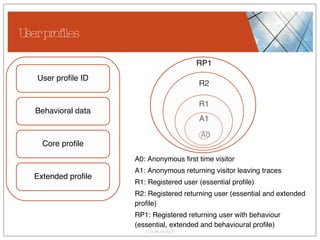
User profiles A0: Anonymous first time visitor A1: Anonymous returning visitor leaving traces R1: Registered user (essential profile) R2: Registered returning user (essential and extended profile) RP1: Registered returning user with behaviour (essential, extended and behavioural profile) User profile ID Behavioral data Core profile Extended profile A0 A1 R1 R2 RP1
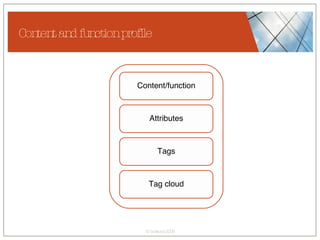
Content and function profile Content/function Attributes Tags Tag cloud
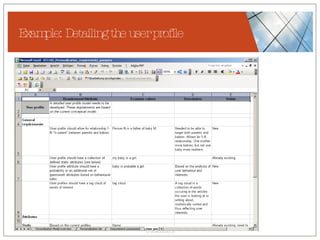
Example: Detailing the user profile
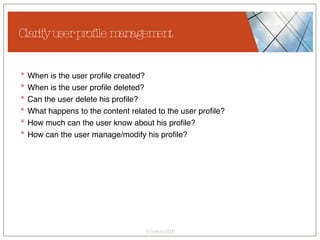
Clarify user profile management When is the user profile created? When is the user profile deleted? Can the user delete his profile? What happens to the content related to the user profile? How much can the user know about his profile? How can the user manage/modify his profile?
It‘s time for use cases and flowcharts
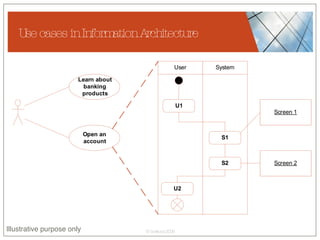
Use cases in Information Architecture  Illustrative purpose only
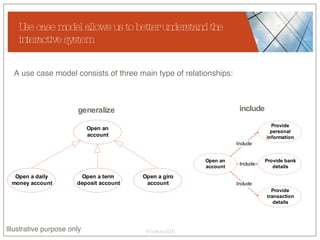
Use case model allows us to better understand the interactive system generalize include A use case model consists of three main type of relationships: Illustrative purpose only
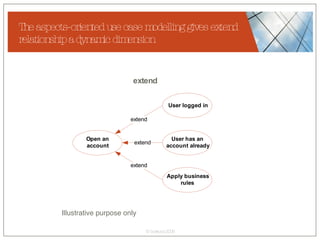
The aspects-oriented use case modelling gives extend relationship a dynamic dimension extend Illustrative purpose only
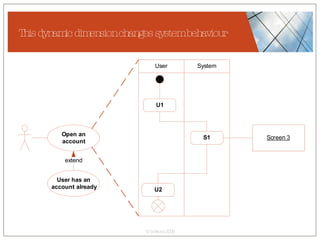
This dynamic dimension changes system behaviour
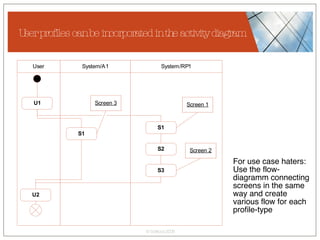
User profiles can be incorporated in the activity diagram For use case haters: Use the flow-diagramm connecting screens in the same way and create various flow for each profile-type
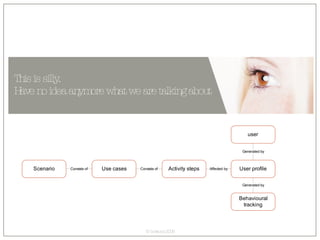
This is silly. Have no idea anymore what we are talking about
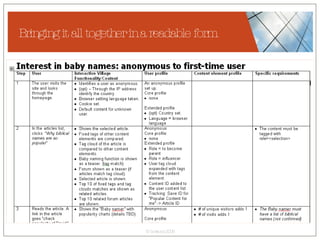
Bringing it all together in a readable form
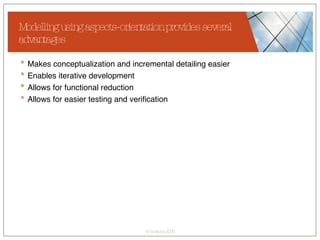
Modelling using aspects-orientation provides several advantages Makes conceptualization and incremental detailing easier Enables iterative development  Allows for functional reduction Allows for easier testing and verification
This was easy, wasn‘t it? Wait – were are at the personalization rules? Wait – were are the Bayesian models? Wait – were are adaptive interfaces?
Personalization rules specify conditions when personalization applies Some examples If user is looking at content A and content B has similar tags, show content B as related content. If user A is looking at product 1 and has a similar profile to user B and user B also bought product  1 and bought product 2, recommend product 2 to user A. If user A with profile A has click 1 then 2 then 3 and pauses for 2,5s here, show context sensitive help. In the conceptualizing process, we use a simple descriptive language like this. Notice example Number 2) – it has a sequence of conditions…. Will talk about this in a minute.
Let‘s move to technology a bit  and then explore the rest
Personalization strategy defines the use cases for technology Capture user behaviour on the website and store it in the user profile. Dynamically generate content recommendations based on user behaviour in real time (in one session) Dynamically generate content recommendations based on the stored user profile. Provide for statistical analysis of user behaviour based on user profiles to expand marketing knowledge. Provide the user the possibilities to customize the layout of the home pages.
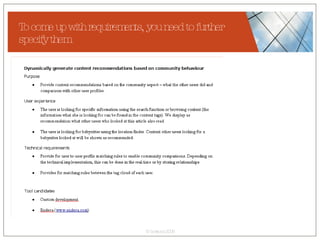
To come up with requirements, you need to further specify them
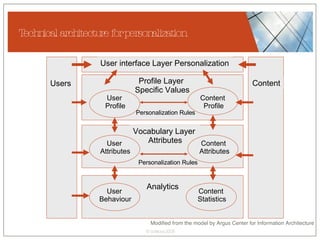
Technical architecture for personalization Users User interface Layer Personalization Profile Layer  Specific Values Vocabulary Layer  Attributes Content User  Profile Content  Profile Content  Attributes User  Attributes Personalization Rules Personalization Rules Modified from the model by Argus Center for Information Architecture Analytics User  Behaviour Content  Statistics
How can this model help us? How much does one system require explicit user profile setting?  How much implicit? How does it integrate with other systems to fill out the profiles? How does the system support vocabulary level personalization rules? How easy it is to automatically populate content values? What features does the personalization system include to manage controlled vocabularies?
Those of you who carefully listened notices that I missed an important compontent….. TIME
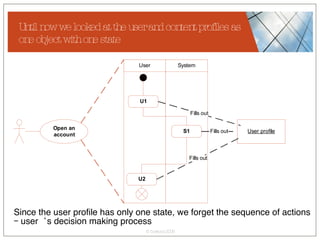
Until now we looked at the user and content profiles as one object with one state  Since the user profile has only one state, we forget the sequence of actions – user‘s decision making process
Here the fun begins: Adaptive user interfaces and even – yes – artificial intelligence Adaptive user interfaces  are interfaces which automatically acquire knowledge about the users, update this knowledge over time, and uses this knowledge to adapt to the users’ requirements. Artificial intelligence  is defined as as "the study and design of intelligent agents, where an intelligent agent is a system that perceives its environment and takes actions which maximize its chances of success.
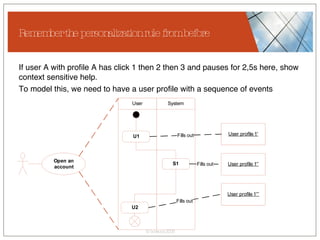
Remember the personalization rule from before If user A with profile A has click 1 then 2 then 3 and pauses for 2,5s here, show context sensitive help. To model this, we need to have a user profile with a sequence of events
How can we track all past user actions? Which data do we need to track? Can previous behaviour give us enough information for action? How can we provide qualitative personalization rules based on this data? Can previous behaviour provide us enough information to predict future user actions? A Wizard of Oz research methodology in reverse – can the experts predict user action? We talk about probability, game theory and statistics… Considering time brings a new dimension of complexity and challenges
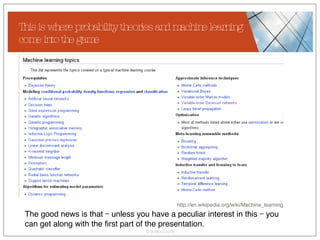
This is where probability theories and machine learning come into the game The good news is that – unless you have a peculiar interest in this – you can get along with the first part of the presentation.   http://en.wikipedia.org/wiki/Machine_learning
Summary – remember what we talked about… We looked at the following topics  Personalization types and categorization Personalization scenarios User, content and functional profiles Aspect-oriented use cases Personalization rules Probabilistic models Architectural requirements
Summary – the doggy bag What you should take with you Personalization was not invented by Amazon. Define what personalization is for you Explain this to every stakeholder Model personalization so that project members understand how it will work Use various models for various stakeholders Explore various modelling methods and start using them. They help in the communication and clarification of issues and open points.
Thank you! Bogo Vatovec bovacon Boxhagener Str. 111 / 10245 Berlin T +49 30 20078666 / F +49 30 20078661 / office@bovacon.com / www.bovacon.com © bovacon

Modelling Personalization

  • 1.
    I’m not youModelling and conceptualizing personalization in information architecture Presented by / Bogo Vatovec Change Management / Knowledge Engineering / User Experience / Interaction Design / Process Engineering
  • 2.
    Integration of personalizationin a design of an interactive system. What will I be talking about?
  • 3.
    Personalization related deliverablesPersonalization Strategy Introduction to personalization Writing personalization scenarios Selecting the right strategy for my project Goals and KPIs Continuous Improvement program Conceptual models User, content and functional profiles Aspect-oriented use cases Personalization rules Probabilistic models Technology Selection Architectural requirements Choosing the tool Testing and Acceptance I‘m going to skip the red ones….
  • 4.
  • 5.
    Personalization can meanlots of different things to different stakeholders
  • 6.
    Some of thesecases are trivial If you are happy enough that they apply to you, forget the rest of the presentation. For the others…
  • 7.
    First some categorizationNo pretention that this modell is complete
  • 8.
    Introduction – howpersonalization works Personalization works essentially using the following methods: Explicit settings: I want A, B and C. Similarity of profiles: If A is similar to B then do C. Sequence of actions: If 1) and 2) and 3), then do 4). Combination of: If A is similar to B and 1) and 2) then do 4)
  • 9.
    Explicit personalization –the user chooses options
  • 10.
  • 11.
    Most popular –collaborative filtering If user A is looking at product 1 and has a similar profile to user B and user B also bought product 1 and bought product 2, recommend product 2 to user A. Example: collaborative filtering
  • 12.
  • 13.
    Conceptualizing personalization has one basic rule Describe behaviour without and with personalization separately.
  • 14.
    Separate behaviour withoutand with personalization Without personalization, the user experience looks like this….. With personalization, the user experience looks like that….. Personalization expands the existing essential functionality. It is never a function on its own. The interactive system must serve its main purpose also without personalization.
  • 15.
    IAs use commonusage scenarios to define the context of personalization
  • 16.
    Align personalization withthe business strategy and desired user experience Is it important to have user profiles? Which data about the users is important? What kind of a benefit does the interactive system provide for the user and the business through different personalization types? Clearly state the personalization strategy by: Describing the personalization type used Describing usage scenarios illustrating the experience State the benefits for the business and the user Make sure every stakeholder understands this Make sure to consider the following
  • 17.
  • 18.
    Conceptual models - a „rich picture“
  • 19.
    Conceptual models –A relationships diagram
  • 20.
  • 21.
    User profiles A0:Anonymous first time visitor A1: Anonymous returning visitor leaving traces R1: Registered user (essential profile) R2: Registered returning user (essential and extended profile) RP1: Registered returning user with behaviour (essential, extended and behavioural profile) User profile ID Behavioral data Core profile Extended profile A0 A1 R1 R2 RP1
  • 22.
    Content and functionprofile Content/function Attributes Tags Tag cloud
  • 23.
  • 24.
    Clarify user profilemanagement When is the user profile created? When is the user profile deleted? Can the user delete his profile? What happens to the content related to the user profile? How much can the user know about his profile? How can the user manage/modify his profile?
  • 25.
    It‘s time foruse cases and flowcharts
  • 26.
    Use cases inInformation Architecture Illustrative purpose only
  • 27.
    Use case modelallows us to better understand the interactive system generalize include A use case model consists of three main type of relationships: Illustrative purpose only
  • 28.
    The aspects-oriented usecase modelling gives extend relationship a dynamic dimension extend Illustrative purpose only
  • 29.
    This dynamic dimensionchanges system behaviour
  • 30.
    User profiles canbe incorporated in the activity diagram For use case haters: Use the flow-diagramm connecting screens in the same way and create various flow for each profile-type
  • 31.
    This is silly.Have no idea anymore what we are talking about
  • 32.
    Bringing it alltogether in a readable form
  • 33.
    Modelling using aspects-orientationprovides several advantages Makes conceptualization and incremental detailing easier Enables iterative development Allows for functional reduction Allows for easier testing and verification
  • 34.
    This was easy,wasn‘t it? Wait – were are at the personalization rules? Wait – were are the Bayesian models? Wait – were are adaptive interfaces?
  • 35.
    Personalization rules specifyconditions when personalization applies Some examples If user is looking at content A and content B has similar tags, show content B as related content. If user A is looking at product 1 and has a similar profile to user B and user B also bought product 1 and bought product 2, recommend product 2 to user A. If user A with profile A has click 1 then 2 then 3 and pauses for 2,5s here, show context sensitive help. In the conceptualizing process, we use a simple descriptive language like this. Notice example Number 2) – it has a sequence of conditions…. Will talk about this in a minute.
  • 36.
    Let‘s move totechnology a bit and then explore the rest
  • 37.
    Personalization strategy definesthe use cases for technology Capture user behaviour on the website and store it in the user profile. Dynamically generate content recommendations based on user behaviour in real time (in one session) Dynamically generate content recommendations based on the stored user profile. Provide for statistical analysis of user behaviour based on user profiles to expand marketing knowledge. Provide the user the possibilities to customize the layout of the home pages.
  • 38.
    To come upwith requirements, you need to further specify them
  • 39.
    Technical architecture forpersonalization Users User interface Layer Personalization Profile Layer Specific Values Vocabulary Layer Attributes Content User Profile Content Profile Content Attributes User Attributes Personalization Rules Personalization Rules Modified from the model by Argus Center for Information Architecture Analytics User Behaviour Content Statistics
  • 40.
    How can thismodel help us? How much does one system require explicit user profile setting? How much implicit? How does it integrate with other systems to fill out the profiles? How does the system support vocabulary level personalization rules? How easy it is to automatically populate content values? What features does the personalization system include to manage controlled vocabularies?
  • 41.
    Those of youwho carefully listened notices that I missed an important compontent….. TIME
  • 42.
    Until now welooked at the user and content profiles as one object with one state Since the user profile has only one state, we forget the sequence of actions – user‘s decision making process
  • 43.
    Here the funbegins: Adaptive user interfaces and even – yes – artificial intelligence Adaptive user interfaces are interfaces which automatically acquire knowledge about the users, update this knowledge over time, and uses this knowledge to adapt to the users’ requirements. Artificial intelligence is defined as as "the study and design of intelligent agents, where an intelligent agent is a system that perceives its environment and takes actions which maximize its chances of success.
  • 44.
    Remember the personalizationrule from before If user A with profile A has click 1 then 2 then 3 and pauses for 2,5s here, show context sensitive help. To model this, we need to have a user profile with a sequence of events
  • 45.
    How can wetrack all past user actions? Which data do we need to track? Can previous behaviour give us enough information for action? How can we provide qualitative personalization rules based on this data? Can previous behaviour provide us enough information to predict future user actions? A Wizard of Oz research methodology in reverse – can the experts predict user action? We talk about probability, game theory and statistics… Considering time brings a new dimension of complexity and challenges
  • 46.
    This is whereprobability theories and machine learning come into the game The good news is that – unless you have a peculiar interest in this – you can get along with the first part of the presentation. http://en.wikipedia.org/wiki/Machine_learning
  • 47.
    Summary – rememberwhat we talked about… We looked at the following topics Personalization types and categorization Personalization scenarios User, content and functional profiles Aspect-oriented use cases Personalization rules Probabilistic models Architectural requirements
  • 48.
    Summary – thedoggy bag What you should take with you Personalization was not invented by Amazon. Define what personalization is for you Explain this to every stakeholder Model personalization so that project members understand how it will work Use various models for various stakeholders Explore various modelling methods and start using them. They help in the communication and clarification of issues and open points.
  • 49.
    Thank you! BogoVatovec bovacon Boxhagener Str. 111 / 10245 Berlin T +49 30 20078666 / F +49 30 20078661 / office@bovacon.com / www.bovacon.com © bovacon