Personalisation &
Measurement:
An Introduction
Farooq Ansari
Reading Room Manchester
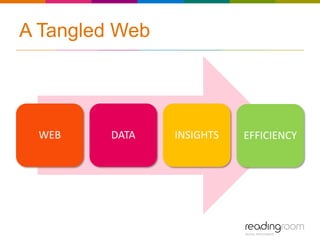
A Tangled Web


 WEB     DATA   INSIGHTS   EFFICIENCY
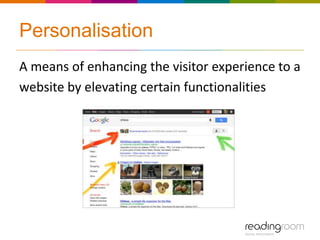
Personalisation
A means of enhancing the visitor experience to a
website by elevating certain functionalities
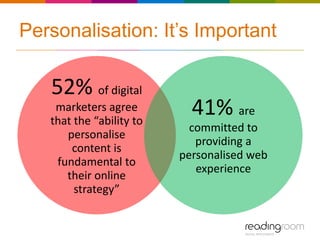
Personalisation: It’s Important

   52% of digital
    marketers agree
   that the “ability to
                            41% are
                            committed to
      personalise
                             providing a
       content is
                          personalised web
    fundamental to
                             experience
      their online
        strategy”
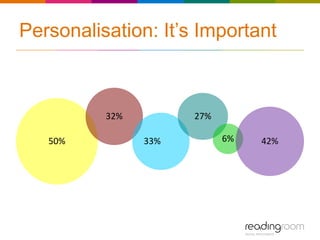
Personalisation: It’s Important


          32%         27%

   50%          33%         6%   42%
Personalisation: Factors
contributing to its rise
• Fall in the cost of
  deployment

• More crowded market

• More content
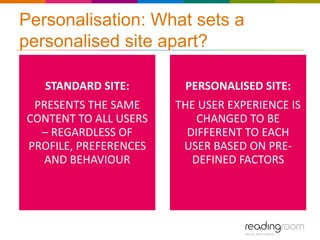
Personalisation: What sets a
personalised site apart?

   STANDARD SITE:       PERSONALISED SITE:
 PRESENTS THE SAME     THE USER EXPERIENCE IS
CONTENT TO ALL USERS       CHANGED TO BE
  – REGARDLESS OF        DIFFERENT TO EACH
PROFILE, PREFERENCES    USER BASED ON PRE-
  AND BEHAVIOUR           DEFINED FACTORS
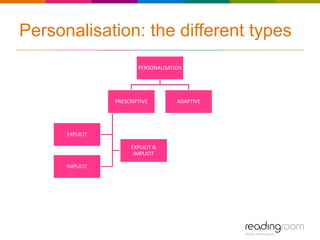
Personalisation: the different types
                         PERSONALISATION


                 PRESCRIPTIVE         ADAPTIVE


      EXPLICIT

                      EXPLICIT &
                       IMPLICIT

      IMPLICIT
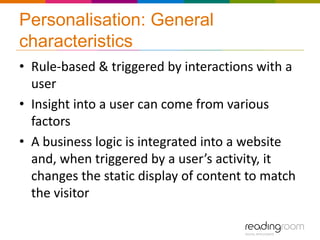
Personalisation: General
characteristics
• Rule-based & triggered by interactions with a
  user
• Insight into a user can come from various
  factors
• A business logic is integrated into a website
  and, when triggered by a user’s activity, it
  changes the static display of content to match
  the visitor
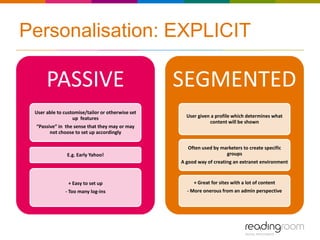
Personalisation: EXPLICIT

      PASSIVE                                     SEGMENTED
 User able to customise/tailor or otherwise set
                  up features                       User given a profile which determines what
                                                              content will be shown
 “Passive” in the sense that they may or may
       not choose to set up accordingly

                                                    Often used by marketers to create specific
               E.g. Early Yahoo!                                    groups
                                                  A good way of creating an extranet environment


                + Easy to set up                       + Great for sites with a lot of content
              - Too many log-ins                    - More onerous from an admin perspective
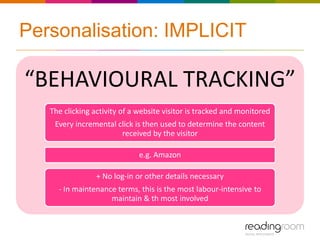
Personalisation: IMPLICIT

“BEHAVIOURAL TRACKING”
   The clicking activity of a website visitor is tracked and monitored
    Every incremental click is then used to determine the content
                       received by the visitor

                              e.g. Amazon

                 + No log-in or other details necessary
     - In maintenance terms, this is the most labour-intensive to
                    maintain & th most involved
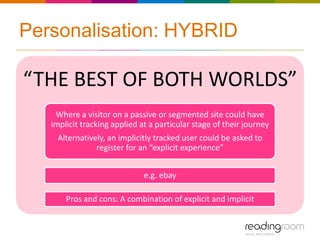
Personalisation: HYBRID

“THE BEST OF BOTH WORLDS”
    Where a visitor on a passive or segmented site could have
   implicit tracking applied at a particular stage of their journey
    Alternatively, an implicitly tracked user could be asked to
               register for an “explicit experience”


                              e.g. ebay

       Pros and cons: A combination of explicit and implicit
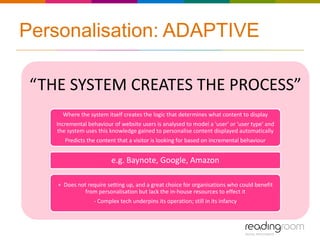
Personalisation: ADAPTIVE

 “THE SYSTEM CREATES THE PROCESS”
      Where the system itself creates the logic that determines what content to display
    Incremental behaviour of website users is analysed to model a 'user' or 'user type' and
    the system uses this knowledge gained to personalise content displayed automatically
       Predicts the content that a visitor is looking for based on incremental behaviour


                         e.g. Baynote, Google, Amazon

    + Does not require setting up, and a great choice for organisations who could benefit
             from personalisation but lack the in-house resources to effect it
                  - Complex tech underpins its operation; still in its infancy
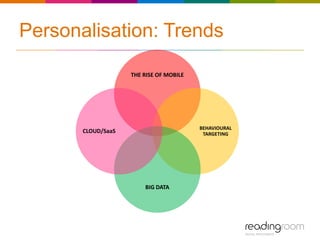
Personalisation: Trends

                    THE RISE OF MOBILE


                                         BEHAVIOURAL
       CLOUD/SaaS                         TARGETING


                        BIG DATA
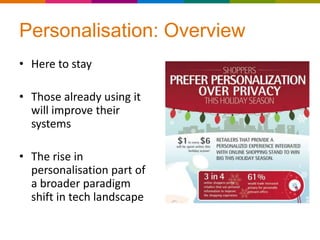
Personalisation: Overview
• Here to stay

• Those already using it
  will improve their
  systems

• The rise in
  personalisation part of
  a broader paradigm
  shift in tech landscape
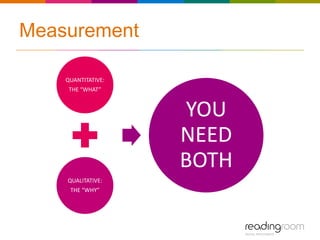
Measurement

    QUANTITATIVE:
     THE “WHAT”


                    YOU
                    NEED
                    BOTH
    QUALITATIVE:
     THE “WHY”
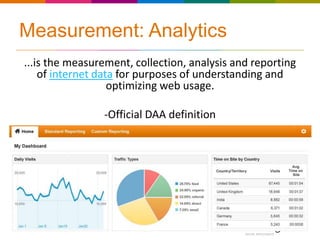
Measurement: Analytics
...is the measurement, collection, analysis and reporting
    of internet data for purposes of understanding and
                   optimizing web usage.

                -Official DAA definition
Measurement: Analytics:
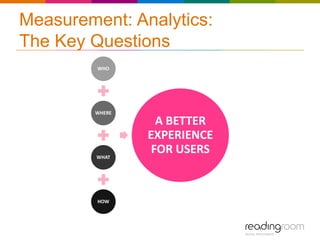
The Key Questions
         WHO


         WHERE
                   A BETTER
                 EXPERIENCE
         WHAT
                  FOR USERS


         HOW
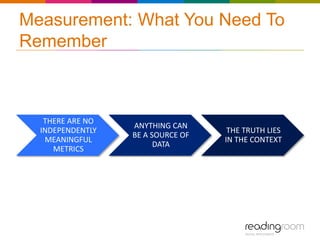
Measurement: What You Need To
Remember


   THERE ARE NO
                  ANYTHING CAN
  INDEPENDENTLY                     THE TRUTH LIES
                  BE A SOURCE OF
   MEANINGFUL                      IN THE CONTEXT
                        DATA
     METRICS
Measurement: The Need For
Context

    Metrics are only meaningful when
            interconnected...
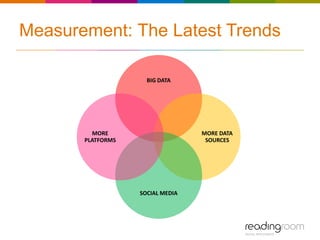
Measurement: The Latest Trends

                     BIG DATA


         MORE                     MORE DATA
       PLATFORMS                   SOURCES


                   SOCIAL MEDIA
Measurement: What We Can
Expect
•   Universal analytics
•   Attribution Modelling Tool
•   Cost Data Import
•   Customer Lifetime Value
•   Recency, Frequency and Monetary Value
•   Custom Dimensions/Metrics
•   Mobile
Measurement: The qualitative tools
The most important data point: how
customers/visitors interact with your web
presence

An ongoing process...
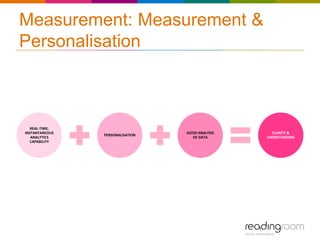
Measurement: Measurement &
Personalisation


        REAL-
                                         GOOD ANALYSIS OF     CLARITY &
TIME, INSTANTANEOUS    PERSONALISATION
                                              DATA          UNDRSTANDING
ANALYTICS CAPABILITY
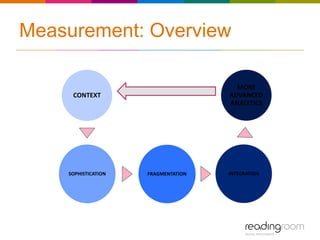
Measurement: Overview

                                       MORE
     CONTEXT                         ADVANCED
                                     ANALYTICS


    SOPHISTICATION   FRAGMENTATION   INTEGRATION
Conclusion
#1
There are increasingly sophisticated approaches
to both web personalisation and web
measurement
Conclusion
#2
This is necessary as we live in increasingly
complex times: more data, more devices, more
users, more content
Conclusion
#3
This complexity has an upside, as it will allow us
to derive greater value and understanding,
increasing ROI whilst delivering a far better user
proposition
Conclusion
#4
A “win-win” scenario for site owners and users –
it’s not just about a better site; it’s about a
better business

Personalisation & Measurement

  • 1.
  • 2.
    A Tangled Web WEB DATA INSIGHTS EFFICIENCY
  • 3.
    Personalisation A means ofenhancing the visitor experience to a website by elevating certain functionalities
  • 4.
    Personalisation: It’s Important 52% of digital marketers agree that the “ability to 41% are committed to personalise providing a content is personalised web fundamental to experience their online strategy”
  • 5.
    Personalisation: It’s Important 32% 27% 50% 33% 6% 42%
  • 6.
    Personalisation: Factors contributing toits rise • Fall in the cost of deployment • More crowded market • More content
  • 7.
    Personalisation: What setsa personalised site apart? STANDARD SITE: PERSONALISED SITE: PRESENTS THE SAME THE USER EXPERIENCE IS CONTENT TO ALL USERS CHANGED TO BE – REGARDLESS OF DIFFERENT TO EACH PROFILE, PREFERENCES USER BASED ON PRE- AND BEHAVIOUR DEFINED FACTORS
  • 8.
    Personalisation: the differenttypes PERSONALISATION PRESCRIPTIVE ADAPTIVE EXPLICIT EXPLICIT & IMPLICIT IMPLICIT
  • 9.
    Personalisation: General characteristics • Rule-based& triggered by interactions with a user • Insight into a user can come from various factors • A business logic is integrated into a website and, when triggered by a user’s activity, it changes the static display of content to match the visitor
  • 10.
    Personalisation: EXPLICIT PASSIVE SEGMENTED User able to customise/tailor or otherwise set up features User given a profile which determines what content will be shown “Passive” in the sense that they may or may not choose to set up accordingly Often used by marketers to create specific E.g. Early Yahoo! groups A good way of creating an extranet environment + Easy to set up + Great for sites with a lot of content - Too many log-ins - More onerous from an admin perspective
  • 11.
    Personalisation: IMPLICIT “BEHAVIOURAL TRACKING” The clicking activity of a website visitor is tracked and monitored Every incremental click is then used to determine the content received by the visitor e.g. Amazon + No log-in or other details necessary - In maintenance terms, this is the most labour-intensive to maintain & th most involved
  • 12.
    Personalisation: HYBRID “THE BESTOF BOTH WORLDS” Where a visitor on a passive or segmented site could have implicit tracking applied at a particular stage of their journey Alternatively, an implicitly tracked user could be asked to register for an “explicit experience” e.g. ebay Pros and cons: A combination of explicit and implicit
  • 13.
    Personalisation: ADAPTIVE “THESYSTEM CREATES THE PROCESS” Where the system itself creates the logic that determines what content to display Incremental behaviour of website users is analysed to model a 'user' or 'user type' and the system uses this knowledge gained to personalise content displayed automatically Predicts the content that a visitor is looking for based on incremental behaviour e.g. Baynote, Google, Amazon + Does not require setting up, and a great choice for organisations who could benefit from personalisation but lack the in-house resources to effect it - Complex tech underpins its operation; still in its infancy
  • 14.
    Personalisation: Trends THE RISE OF MOBILE BEHAVIOURAL CLOUD/SaaS TARGETING BIG DATA
  • 15.
    Personalisation: Overview • Hereto stay • Those already using it will improve their systems • The rise in personalisation part of a broader paradigm shift in tech landscape
  • 16.
    Measurement QUANTITATIVE: THE “WHAT” YOU NEED BOTH QUALITATIVE: THE “WHY”
  • 17.
    Measurement: Analytics ...is themeasurement, collection, analysis and reporting of internet data for purposes of understanding and optimizing web usage. -Official DAA definition
  • 18.
    Measurement: Analytics: The KeyQuestions WHO WHERE A BETTER EXPERIENCE WHAT FOR USERS HOW
  • 19.
    Measurement: What YouNeed To Remember THERE ARE NO ANYTHING CAN INDEPENDENTLY THE TRUTH LIES BE A SOURCE OF MEANINGFUL IN THE CONTEXT DATA METRICS
  • 20.
    Measurement: The NeedFor Context Metrics are only meaningful when interconnected...
  • 21.
    Measurement: The LatestTrends BIG DATA MORE MORE DATA PLATFORMS SOURCES SOCIAL MEDIA
  • 22.
    Measurement: What WeCan Expect • Universal analytics • Attribution Modelling Tool • Cost Data Import • Customer Lifetime Value • Recency, Frequency and Monetary Value • Custom Dimensions/Metrics • Mobile
  • 23.
    Measurement: The qualitativetools The most important data point: how customers/visitors interact with your web presence An ongoing process...
  • 24.
    Measurement: Measurement & Personalisation REAL- GOOD ANALYSIS OF CLARITY & TIME, INSTANTANEOUS PERSONALISATION DATA UNDRSTANDING ANALYTICS CAPABILITY
  • 25.
    Measurement: Overview MORE CONTEXT ADVANCED ANALYTICS SOPHISTICATION FRAGMENTATION INTEGRATION
  • 26.
    Conclusion #1 There are increasinglysophisticated approaches to both web personalisation and web measurement
  • 27.
    Conclusion #2 This is necessaryas we live in increasingly complex times: more data, more devices, more users, more content
  • 28.
    Conclusion #3 This complexity hasan upside, as it will allow us to derive greater value and understanding, increasing ROI whilst delivering a far better user proposition
  • 29.
    Conclusion #4 A “win-win” scenariofor site owners and users – it’s not just about a better site; it’s about a better business

Editor's Notes

  • #3 The web allows us to access/generates dataThis data IF USED CORRECTLY can provide insightsThese insights can help us to improve efficiency, process and deliver a better ROI
  • #4 Mid-1990’s: ATG/Broadvision early productsA means of enhancing the visitor experience to a website by elevating certain functionalitiesAmazon, eBay: early pioneers
  • #5 52% of digital marketers agree that “the ability to personalise content is fundamental to their online strategy”41% committed to providing personalised web experience
  • #6 What is the impact of personalisation on ROI & how is it measured?50% use “time spent on site” to measure increased engagementONLY 32% say their CMS enables personalisation YET 37% are targeting personalised content in real time33% say they use data effectively to maximise conversions27% test to see how different personalisation performsAND...6% use social graph data to personalise content42% say they can personalise using anonymous data
  • #7 Fall in the cost of deploymentMany mid-tier CMS solutions incorporated this functionality as a USP to set themselves apartMORE CONTENT, so companies need to work harder to point users to the RIGHT content
  • #8 A standard site presents the same content to all users, regardless of profile, preferences and behaviour.A personalised site is one where the experience is changed to be different to each user based on a number of pre-defined factorsPersonalised sites are PUSH- oriented, non-personalised sites are PULL- oriented
  • #11 (1) EXPLICIT: based on the user’s PROFILE, and can be PASSIVE (allowing users to make choices as to what they'd like to see) or SEGMENTED (allocating content choices based on a logic layer applied to that profile)Examples: Pros & cons
  • #12 (2) IMPLICIT/”BEHAVIOURAL TRACKING”: based upon a user’s clicking activity, the site dynamically offers content based upon that activityExamples: AmazonPros & cons
  • #13 (3) HYBRID: a solution that is designed to offer the best of both worldsExamples: eBayPros & cons
  • #14 (4) ADAPTIVE: where incremental website user behaviour monitored and personalisation takes place automatically Watch this space – tech developingAmazon? Google?
  • #15 The rise of mobileGrowth of behavioural targeting“Big Data”: larger data sets to improve personalisation, esp., in recommendations/promotionsBroader shift to cloud/SaaS tech: user behaviour even more critical to the underlying tech intelligence of these systems
  • #16 Here to stay and it will only increase in use and adoptionThose already using it will improve their systems, as evidenced by the increase in ROI that results from enhanced personalisation techniquesThe rise in personalisation part of a broader paradigm shift in tech landscape involving mobile-first, responsive & adaptive design, and cloud computing
  • #17 QUANTITATIVE measurement: tells you WHAT is happeningQUALITATIVE measurement: tells you WHY it is happeningBOTH are important
  • #18 Log files Taggingmore advanced analytics, ubiquity of Google Analytics bespoke CMS systems
  • #19 Who is using my site?Where are they coming from?What content are they consuming?How are they engaging with that content?What can we do to make their experience better?
  • #20 There are no independently meaningful metricsAnything can be a source of dataThe truth lies in the context...
  • #21 Traditionally, the top 4 metrics worth looking at are likely to be:Traffic sourcesTop contentBounce rateGoals/conversionsOnly meaningful when they are interconnected:In this example, always evaluate (i) traffic sources and (ii) top content in light of (iii) bounce rate and (iv) conversions
  • #22 Big Data to harness business intelligenceMore data sourcesMore platforms (particularly mobile: tablet, smartphone)Social media – also a source of contentionGoogle Analytics & “Universal” analytics
  • #23 Universal analytics: users can tailor it to their needs, integrate their own datasets and get a better view of the entire marketing funnelAttribution Modelling Tool: build models that give credit to all their digital channels, provide insight into the impact of various marketing programsCost Data Import: import users’ cost data from any digital sourceCustomer Lifetime ValueRecency, Frequency and Monetary ValueCustom Dimensions/Metrics: widen dimensions for bespoke measurementMobile
  • #24 The most important data point: how customers/visitors interact with your web presence:Usability testing“Follow Me Homes”A/B TestingSurveyingAn ongoing process...
  • #25 As personalisation becomes more ubiquitous and sophisticated, so there is an increasing need for a real-time, instantaneous customer analytics capabilityAs with the broader analytics scene, where personalisation is present it is vital to understand the data generated by analytics tools. Good analysis of data is imperative.
  • #26 Web measurement tools need to be understood contextually to derive the most benefitThese tools are increasing in sophistication to match both technological advances and also heightened business expectationsThe landscape for measurement is increasingly fragmented and diverseAll of these factors highlight a need for more integration, as increasingly disparate data sources & graphs, coupled with a fragmentation of platforms/devices used results in deeper challenges for measurementAs ever, the availability of more advanced analytics correlates with a need to have a more advanced & nuanced understanding of the analytics tools at our disposalPersonalisation amplifies all of the above factors, and creates a virtuous loop