INTRODUCTION
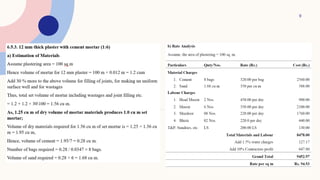
Analysis of ratesfor building works is the process of
separation of works into components/elements Viz.
Labour, materials, machinery, transport, overheads
and profit) of work and pricing them.
Rate Analysis 2
▪ To determinethe actual cost per unit of the items.
▪ To work out the economical use of materials and processes
in completing the particulars item.
▪ To calculate the cost of extra items which are not provided
in the contract bond, but are to be executed as per the
directions of the department.
▪ To revise the schedule of rates due to increase in the cost
of material and labour or due to change in technique.
5.
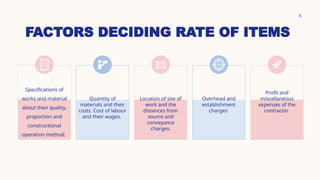
FACTORS DECIDING RATEOF ITEMS
5
Specifications of
works and material
about their quality,
proportion and
constructional
operation method.
Quantity of
materials and their
costs. Cost of labour
and their wages.
Location of site of
work and the
distances from
source and
conveyance
charges.
Overhead and
establishment
charges
Profit and
miscellaneous
expenses of the
contractor
6.
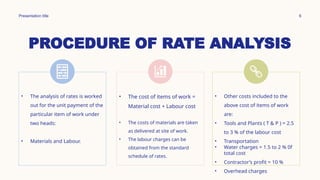
PROCEDURE OF RATEANALYSIS
Presentation title 6
• The analysis of rates is worked
out for the unit payment of the
particular item of work under
two heads:
• Materials and Labour.
• The cost of items of work =
Material cost + Labour cost
• The costs of materials are taken
as delivered at site of work.
• The labour charges can be
obtained from the standard
schedule of rates.
• Other costs included to the
above cost of items of work
are:
• Tools and Plants ( T & P ) = 2.5
to 3 % of the labour cost
• Transportation
• Water charges = 1.5 to 2 % 0f
total cost
• Contractor’s profit = 10 %
• Overhead charges
7.
OVERHEAD CHARGES
▪ Overheadcharges include general office expenses,
rents, taxes, supervision and other cost which are
indirect expenses on the job.
▪ Expenses for small tools such as planks, ladders, ropes
and other hand tools are also included in the over-
head charges.
▪ A provision of 2.5% to 5% is made in the rate analysis
as overhead charge.
▪ Overhead charges can be divided under two
categories: - General Overhead and, Job overhead.
8.
OVERHEAD CHARGES
8
GENERAL OVERHEAD:
Theseare the expanses made
throughout the year irrespective to
running works in hand.
These include:
• Establishment charge including rent
of office space and taxes
• Salaries to office staff
• Purchase of stationary, Printing,
postage etc.
• Electricity, telephone and water bills
• Travelling expanses
• Estimation and Professional
Practices
JOB OVERHEAD:
These are the expanses indirectly incurred
for the job or the project.
These include:
• Salaries of personnel engaged for the
work (Site engineers, Surveyors or site
office staff)
• Rent of temporary site office space,
electricity, telephone and water bills
• Handling of materials
• Repairs, carriage and depreciation of T
& P.
• Labour welfare, safety measures and
insurance etc.
ABSTRACT ESTIMATE
▪ Thisestimate is generally prepared in initial stages to
know the approximate cost of the project.
▪ By this estimate, the competent sanctioning authority can
decide the financial position and policy for the
administration section.
▪ In this estimate, the approximate cost of each important
item of work is displayed individually to know the
necessity and utility of each item of work.
▪ The items of work include the cost of lands, cost of roads,
electrification, water supply costs, cost of each building,
etc.
10
11.
ESCALATION
▪ “Changes inthe cost or price of specific goods or services
in a given economy over a period of time is defined as
“Cost Escalation”
▪ Escalation is computed as a percentage of the base
estimate and shown as a separate line item in budget
estimates.
▪ Various organizations publish cost index tables, calculated
based on periodical price movements, monthly, quarterly
and yearly.
Valuation is thetechnique of determination of fair
price of a property such as land, building, factory
or other structures. Valuation determines present
value of the property for sale or renting purpose.
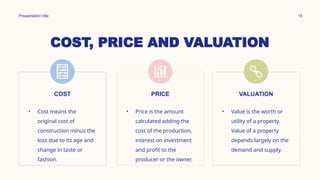
COST, PRICE ANDVALUATION
Presentation title 15
COST
• Cost means the
original cost of
construction minus the
loss due to its age and
change in taste or
fashion.
PRICE
• Price is the amount
calculated adding the
cost of the production,
interest on investment
and profit to the
producer or the owner.
VALUATION
• Value is the worth or
utility of a property.
Value of a property
depends largely on the
demand and supply.
16.
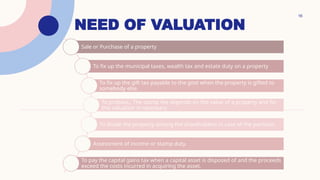
NEED OF VALUATION
16
Saleor Purchase of a property
To fix up the municipal taxes, wealth tax and estate duty on a property
To fix up the gift tax payable to the govt when the property is gifted to
somebody else.
To probate,; The stamp fee depends on the value of a property and for
this valuation is necessary.
To divide the property among the shareholders in case of the partition.
Assessment of income or stamp duty.
To pay the capital gains tax when a capital asset is disposed of and the proceeds
exceed the costs incurred in acquiring the asset.
17.
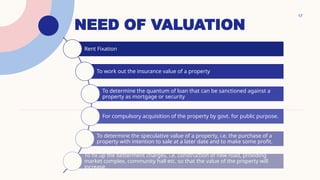
NEED OF VALUATION
17
RentFixation
To work out the insurance value of a property
To determine the quantum of loan that can be sanctioned against a
property as mortgage or security
For compulsory acquisition of the property by govt. for public purpose.
To determine the speculative value of a property, i.e. the purchase of a
property with intention to sale at a later date and to make some profit.
To fix up the betterment charges, i.e. construction of new road, providing
market complex, community hall etc. so that the value of the property will
increase.
#2 The rates of materials and labour vary from place to place and hence the rates of different items of works also vary from place to place. The rates of these works further help in determining cost of particular work and in turn cost of the project.
#4 Analysis of rates is required for:
Insertion in a tender (i.e.) as a lump sum, item rates
To check reasonability of rates inserted by tenderers
To assess various quantities of labour, materials, machinery, money and to effect economy by using alternatives and to optimize the resources
To assess the rates payable for deviations, extra items of work to the builder
To compare the costs with sanctioned amount and to take action for regularization of excess/ less cost
To workout the budget and cash flows at various stages of the work and arranging interim/ final payments
To detect irrational rates quoted by tenderers
To serve as basic data in case of disputes that may arise at a later stage
#6 Transportation cost (if conveyance more than 8 km is considered.)
To obtain labour cost the number and wages of different categories of labourers, skilled (Skilled 1st Class), semi-skilled (Skilled 2nd Class) and unskilled, required for each unit of work should be known and this number is multiplied by the respective wage per day. The labour charges can be obtained from the standard schedule of rates. 30% of the skilled labour provided in the data may be taken as 1st class, remaining 70% as 2nd class.
The length of time required to do a certain piece of the work may vary according to the skill and mental development of the workmen and working conditions to the particular
job.
a) Task
#10 Preliminary estimates are prepared with reference to the cost of similar type projects in a practical manner.
#11 Any cost estimate is a projection of cost at a particular point in time. Costs change from one point to another for labor, material, and equipment and by knowing the escalation or anticipated increase, owners may be able to provide for additional funds in their budget.
An estimator may use this historical database to project future cost growth.
#15 For example the cost to draw a painting may be 1,000/- rupees, but by adding profit for the painter the price may be fixed at 1,500/- rupees. Let us consider the painting is a very famous painting whose demand is more (like Monalisa by Leonardo da Vinci) then the value of the painting may be significantly high.
#16 To probate, i.e. to prove before a court that the written paper purporting to be the
will of a person who has died is indeed his lawful act the official copy of a will is to
be presented along with court stamp fees. The stamp fee depends on the value of a
property and for this valuation is necessary.
#17 To probate, i.e. to prove before a court that the written paper purporting to be the
will of a person who has died is indeed his lawful act the official copy of a will is to
be presented along with court stamp fees. The stamp fee depends on the value of a
property and for this valuation is necessary.