5 Keys to Safety Program
Engagement
5 Keys to Safety Program
Engagement
Need to create a Safety Program?
Need to invigorate your Safety
Program?
Spending too much on Workmen’s
Compensation claims?
Worried about employee safety
engagement?
Safety program tips that may
help!5 Simple Keys to Improve Your Safety Program and Engage
Employees
www.detroittool.com
Lebanon, Missouri
5 Keys to Safety Program
Engagement
Agenda
• Introduction – Why Safety?
• Engaged Team Members Creating a Safety Environment
• Five Keys
Weekly All-Team-Member Toolbox Talks
Monthly Engaged Safety Committee
Quarterly Physician Presentation
Daily Safety Cross Review
Random Catch People Doing Something Right
• Notes for Your Safety Program
• Regulatory Training
• Plant Wide Visuals
• Closing
• Questions
Plus a Free Downloadable Safety Cross!
5 Keys to Safety Program
Engagement
Engaged Team Members
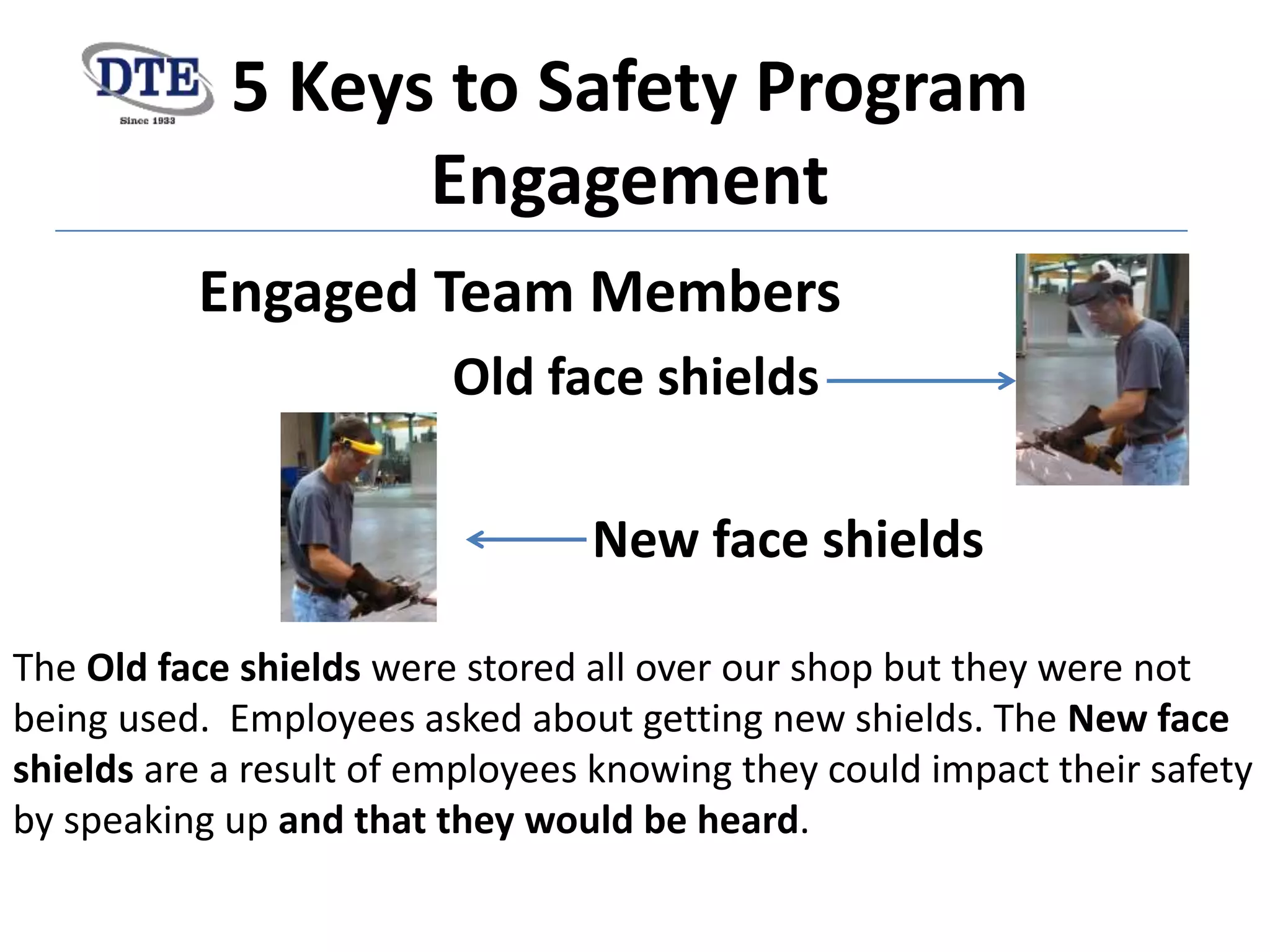
Old face shields
New face shields
The Old face shields were stored all over our shop but they were not
being used. Employees asked about getting new shields. The New face
shields are a result of employees knowing they could impact their safety
by speaking up and that they would be heard.
5 Keys to Safety Program
Engagement
DTE’s Toolbox Talks
–Learn to speak “Safety”
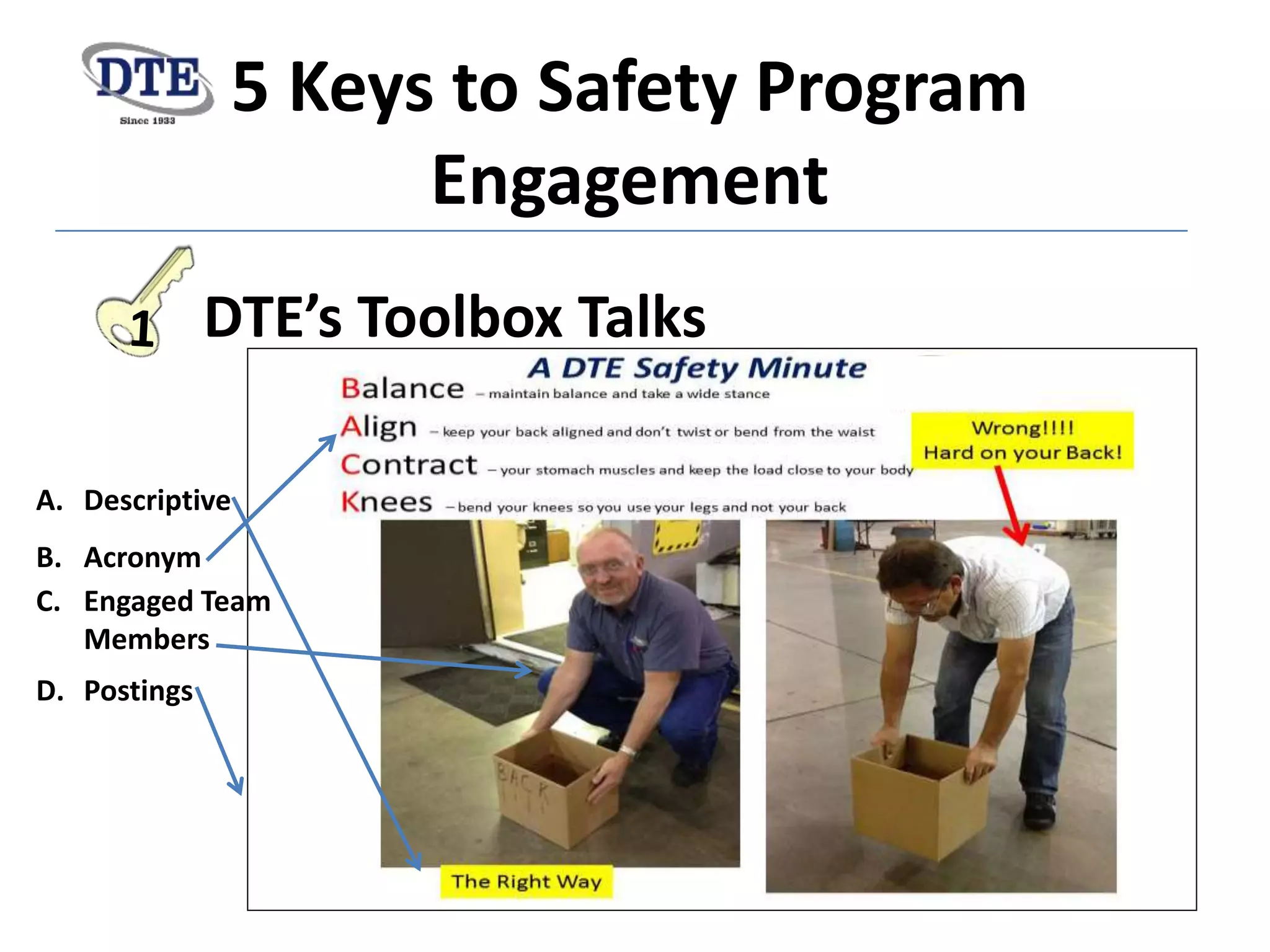
A. Make it descriptive
B. Acronyms are memorable
C. Engage others in your safety crusade
D. Continue engagement with postings
5 Keys to Safety Program
Engagement
A. Descriptive
B. Acronym
C. Engaged Team
Members
D. Postings
DTE’s Toolbox Talks
5 Keys to Safety Program
Engagement
DTE’s Toolbox Talks
–Keep it Simple, one subject
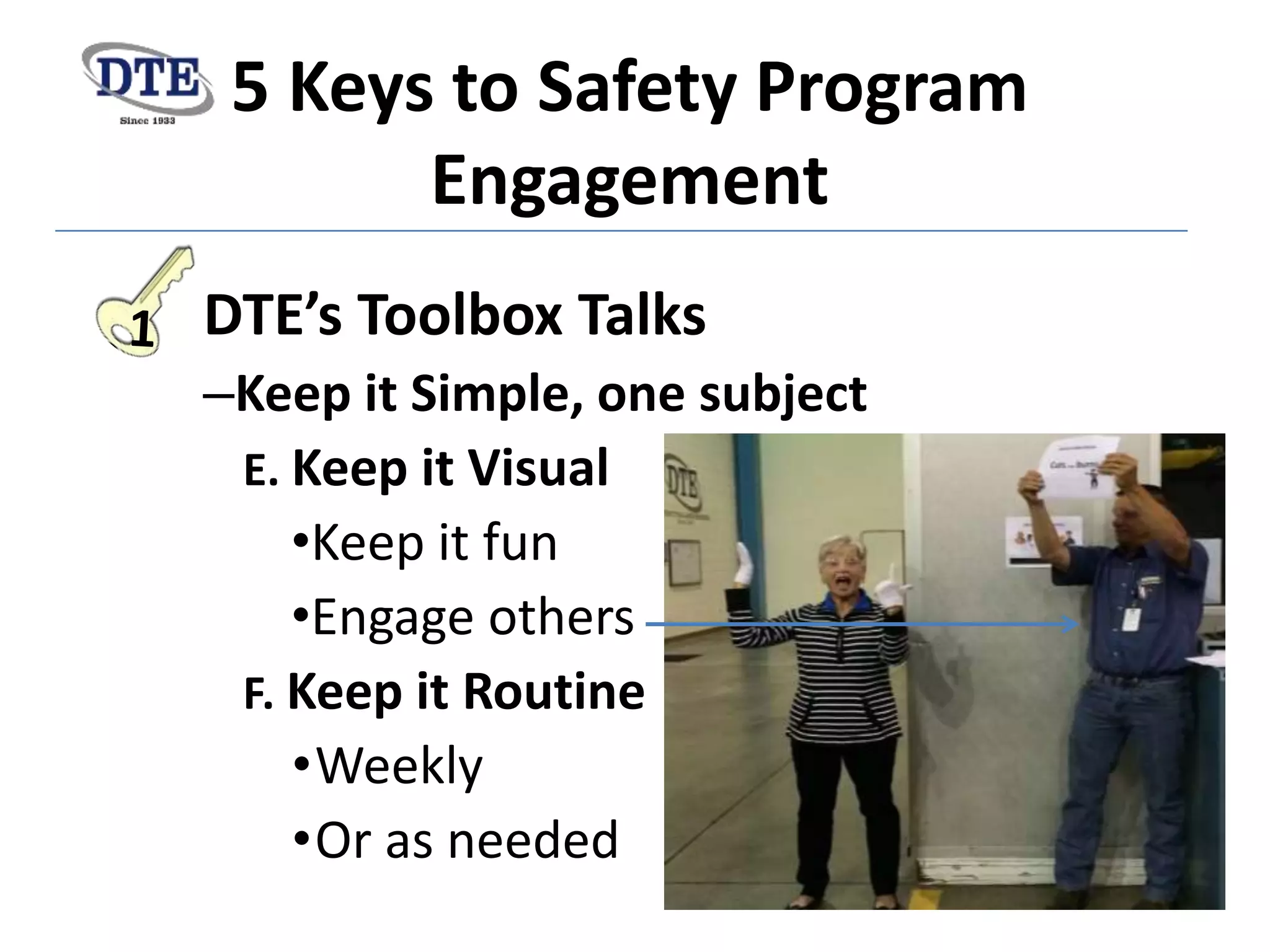
E. Keep it Visual
•Keep it fun
•Engage others
F. Keep it Routine
•Weekly
•Or as needed
5 Keys to Safety Program
Engagement
DTE’s Toolbox Talks
−Keep it Simple, one subject
G. Get help from others
• Workmen’s Comp provider
• Health Care professional
• YouTube video
• Employee - post seminar
5 Keys to Safety Program
Engagement
Safety Committee
‒Structure
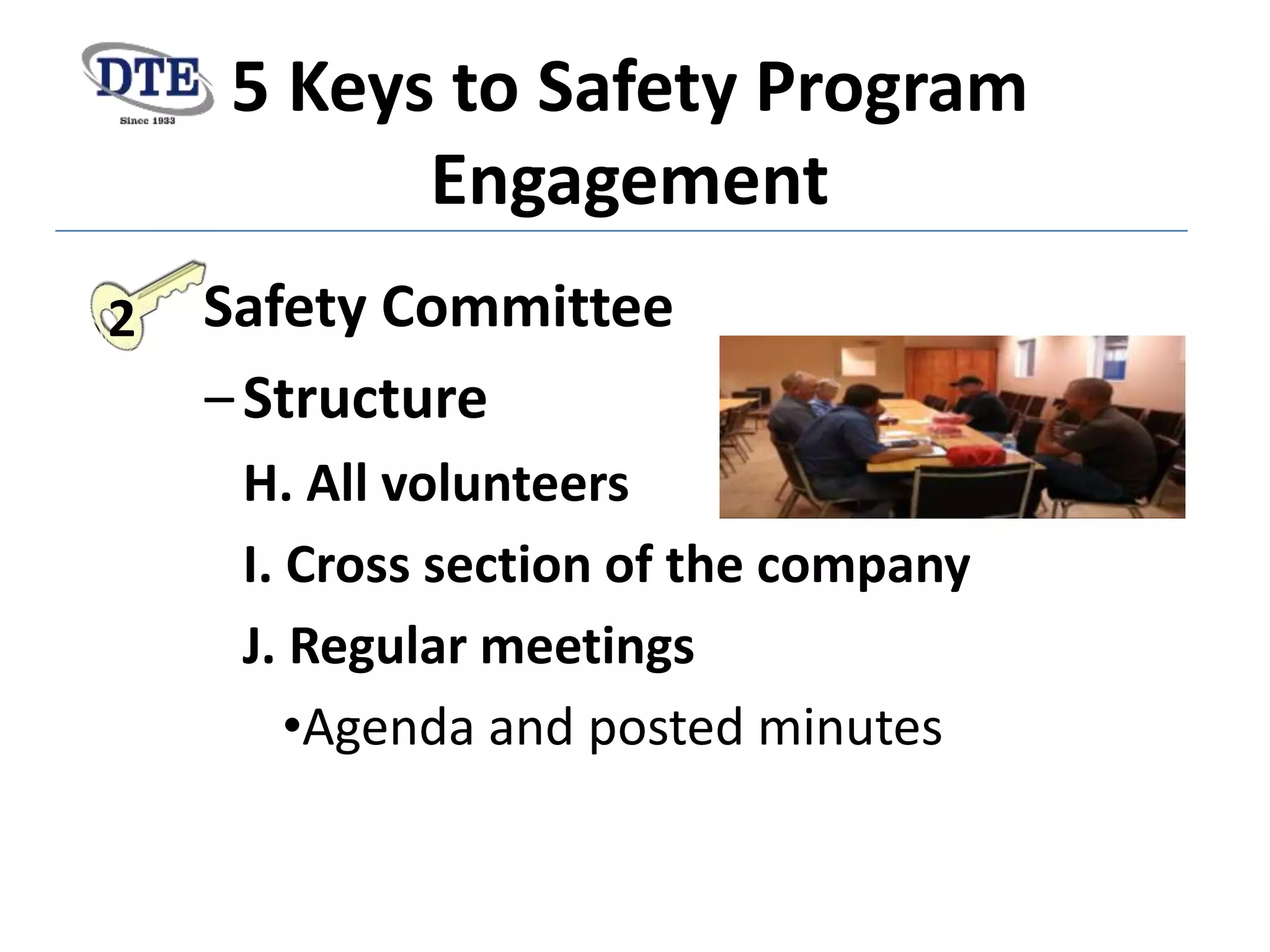
H. All volunteers
I. Cross section of the company
J. Regular meetings
•Agenda and posted minutes
2
5 Keys to Safety Program
Engagement
Safety Committee
‒ Duties
K. Determine the Monthly Safety Focus
•Keep focus relevant to time of year
»For Toolbox Talks and Quarterly Physician meetings
L. Suggest safety recognition events
‒ Engaged
M. First Responders
• Voluntarily elected
•Easy reference
2
5 Keys to Safety Program
Engagement
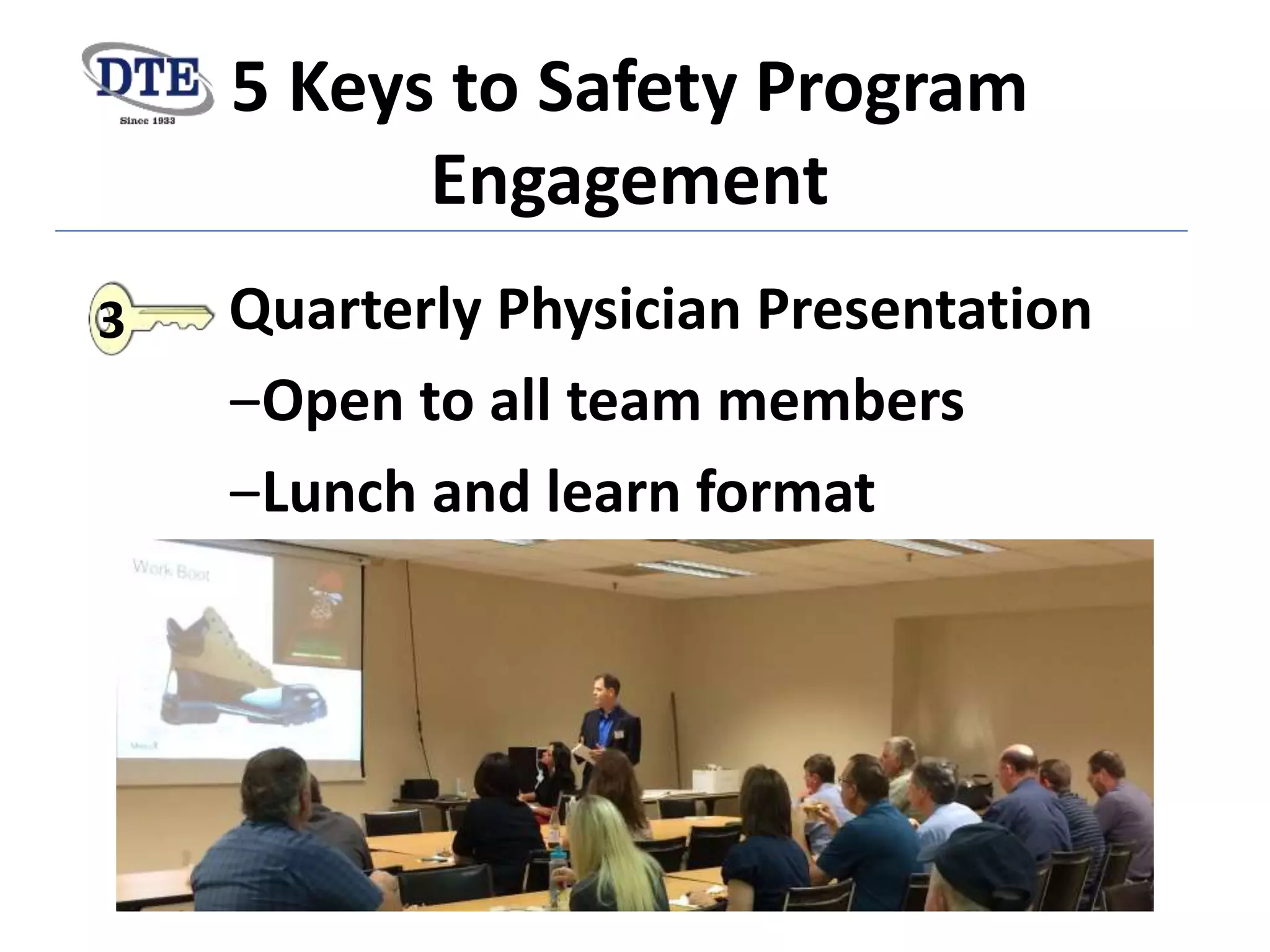
Quarterly Physician Presentation
‒Open to all team members
‒Lunch and learn format
3
5 Keys to Safety Program
Engagement
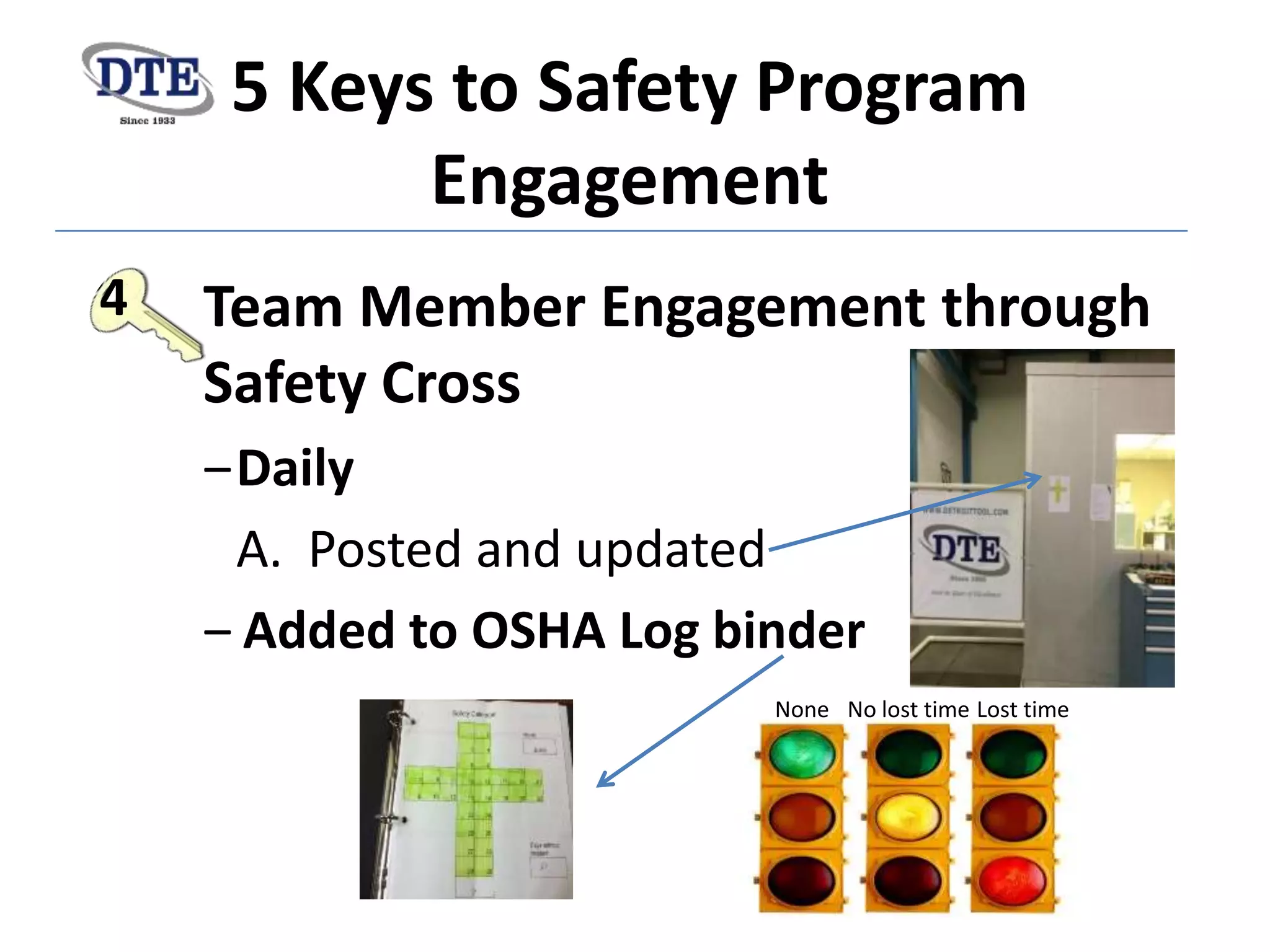
Team Member Engagement through
Safety Cross
‒Daily
A. Posted and updated
‒ Added to OSHA Log binder
4
None No lost time Lost time
5 Keys to Safety Program
Engagement
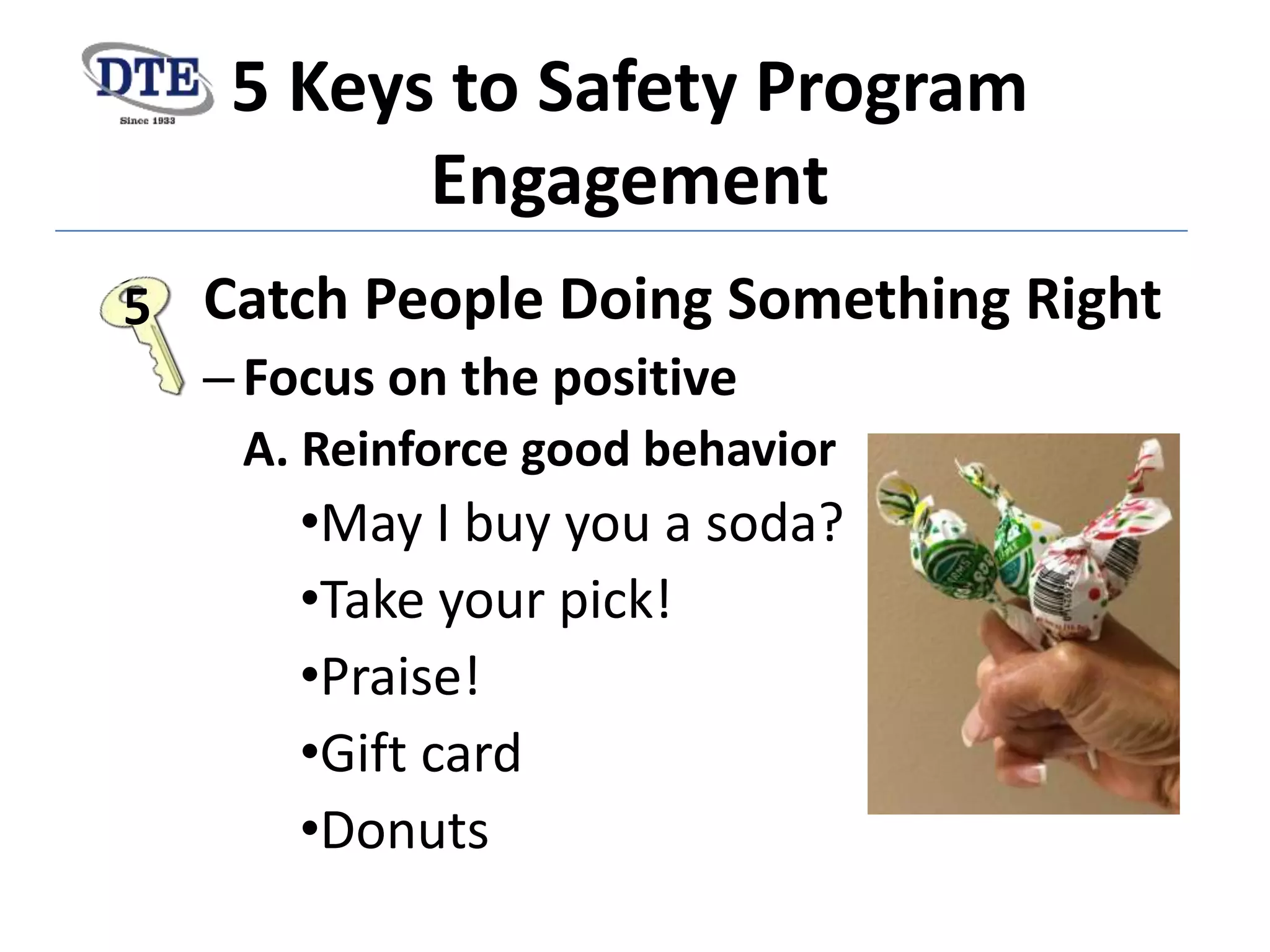
Catch People Doing Something Right
–Focus on the positive
A. Reinforce good behavior
•May I buy you a soda?
•Take your pick!
•Praise!
•Gift card
•Donuts
5
5 Keys to Safety Program
Engagement
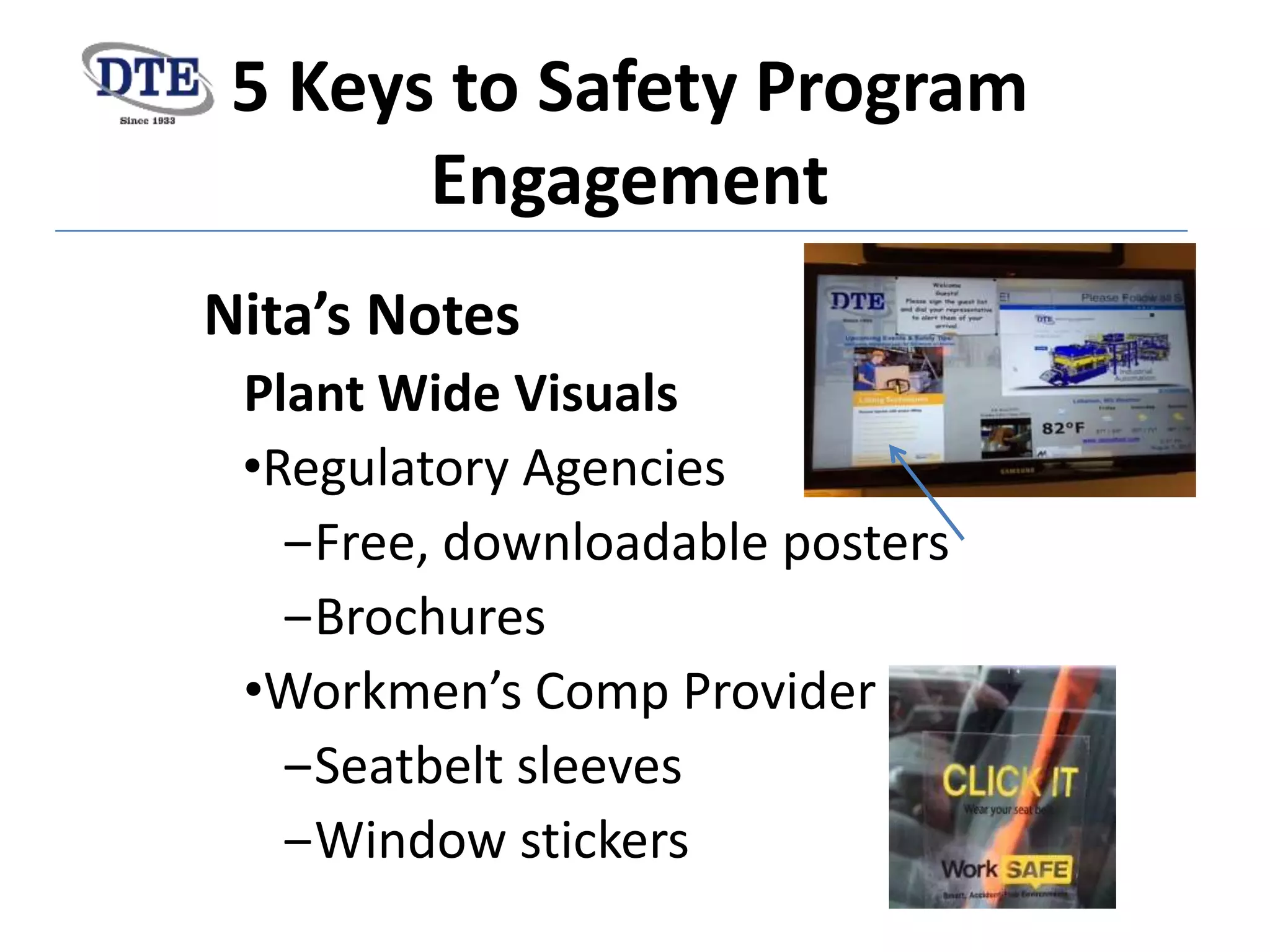
Plant Safety Handbook
•Written in plain language
Example: Blood Borne Pathogens
•Used in new employee orientation
•Used in our weekly Toolbox Talks
5 Keys to Safety Program
Engagement
Plant Wide Visuals
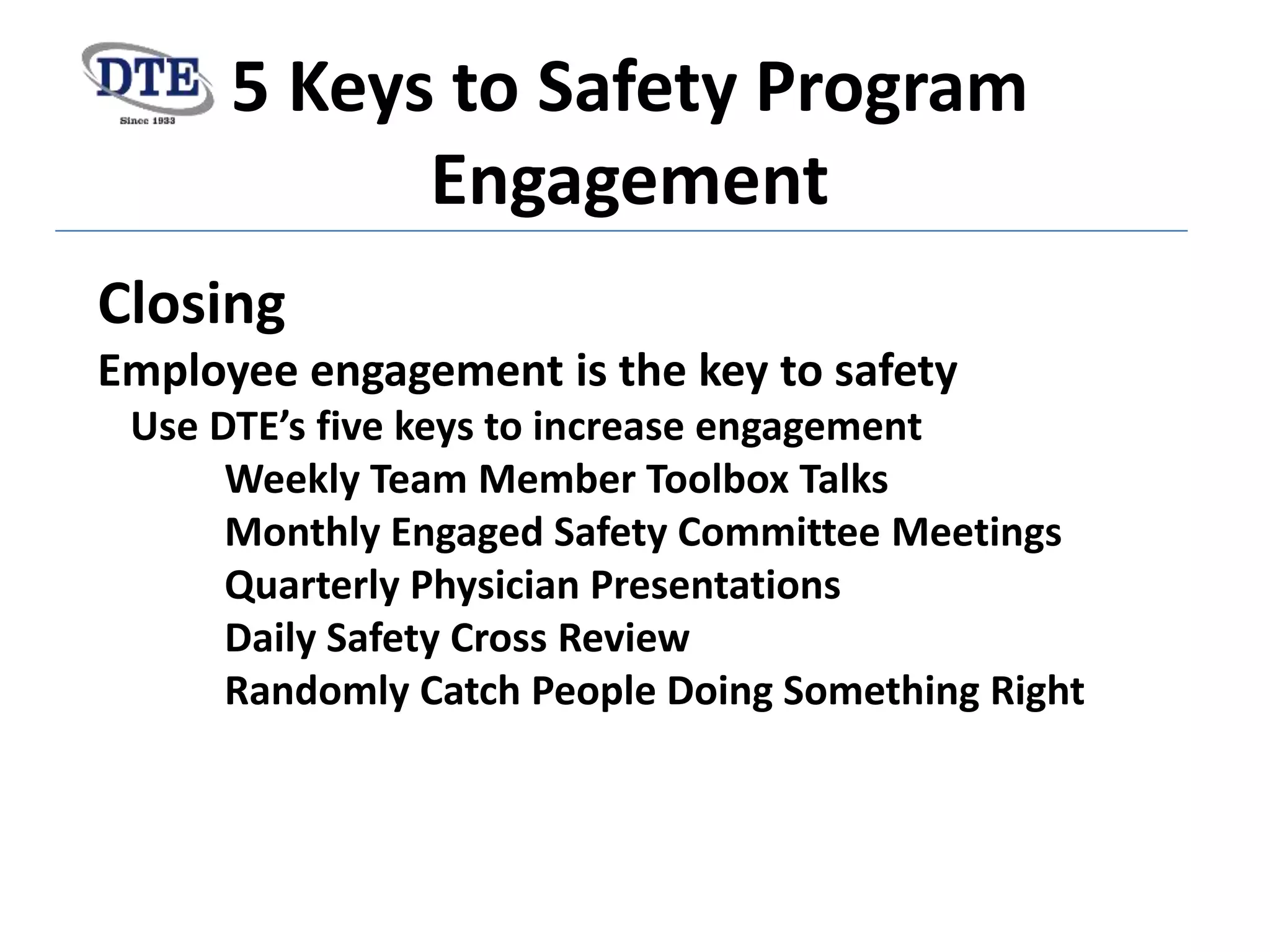
•Regulatory Agencies
‒Free, downloadable posters
‒Brochures
•Workmen’s Comp Provider
‒Seatbelt sleeves
‒Window stickers
5 Keys to Safety Program
Engagement
Closing
Employee engagement is the key to safety
Use DTE’s five keys to increase engagement
Weekly Team Member Toolbox Talks
Monthly Engaged Safety Committee Meetings
Quarterly Physician Presentations
Daily Safety Cross Review
Randomly Catch People Doing Something Right
5 Keys to Safety Program
Engagement
Don’t forget to download our Safety Cross
www.detroittool.com
Download the Safety Cross
View the Safety Webcast Now

5 keys to safety program engagement

  • 1.
    5 Keys toSafety Program Engagement 5 Keys to Safety Program Engagement Need to create a Safety Program? Need to invigorate your Safety Program? Spending too much on Workmen’s Compensation claims? Worried about employee safety engagement? Safety program tips that may help!5 Simple Keys to Improve Your Safety Program and Engage Employees www.detroittool.com Lebanon, Missouri
  • 2.
    5 Keys toSafety Program Engagement Agenda • Introduction – Why Safety? • Engaged Team Members Creating a Safety Environment • Five Keys Weekly All-Team-Member Toolbox Talks Monthly Engaged Safety Committee Quarterly Physician Presentation Daily Safety Cross Review Random Catch People Doing Something Right • Notes for Your Safety Program • Regulatory Training • Plant Wide Visuals • Closing • Questions Plus a Free Downloadable Safety Cross!
  • 3.
    5 Keys toSafety Program Engagement Engaged Team Members Old face shields New face shields The Old face shields were stored all over our shop but they were not being used. Employees asked about getting new shields. The New face shields are a result of employees knowing they could impact their safety by speaking up and that they would be heard.
  • 4.
    5 Keys toSafety Program Engagement DTE’s Toolbox Talks –Learn to speak “Safety” A. Make it descriptive B. Acronyms are memorable C. Engage others in your safety crusade D. Continue engagement with postings
  • 5.
    5 Keys toSafety Program Engagement A. Descriptive B. Acronym C. Engaged Team Members D. Postings DTE’s Toolbox Talks
  • 6.
    5 Keys toSafety Program Engagement DTE’s Toolbox Talks –Keep it Simple, one subject E. Keep it Visual •Keep it fun •Engage others F. Keep it Routine •Weekly •Or as needed
  • 7.
    5 Keys toSafety Program Engagement DTE’s Toolbox Talks −Keep it Simple, one subject G. Get help from others • Workmen’s Comp provider • Health Care professional • YouTube video • Employee - post seminar
  • 8.
    5 Keys toSafety Program Engagement Safety Committee ‒Structure H. All volunteers I. Cross section of the company J. Regular meetings •Agenda and posted minutes 2
  • 9.
    5 Keys toSafety Program Engagement Safety Committee ‒ Duties K. Determine the Monthly Safety Focus •Keep focus relevant to time of year »For Toolbox Talks and Quarterly Physician meetings L. Suggest safety recognition events ‒ Engaged M. First Responders • Voluntarily elected •Easy reference 2
  • 10.
    5 Keys toSafety Program Engagement Quarterly Physician Presentation ‒Open to all team members ‒Lunch and learn format 3
  • 11.
    5 Keys toSafety Program Engagement Team Member Engagement through Safety Cross ‒Daily A. Posted and updated ‒ Added to OSHA Log binder 4 None No lost time Lost time
  • 12.
    5 Keys toSafety Program Engagement Catch People Doing Something Right –Focus on the positive A. Reinforce good behavior •May I buy you a soda? •Take your pick! •Praise! •Gift card •Donuts 5
  • 13.
    5 Keys toSafety Program Engagement Plant Safety Handbook •Written in plain language Example: Blood Borne Pathogens •Used in new employee orientation •Used in our weekly Toolbox Talks
  • 14.
    5 Keys toSafety Program Engagement Plant Wide Visuals •Regulatory Agencies ‒Free, downloadable posters ‒Brochures •Workmen’s Comp Provider ‒Seatbelt sleeves ‒Window stickers
  • 15.
    5 Keys toSafety Program Engagement Closing Employee engagement is the key to safety Use DTE’s five keys to increase engagement Weekly Team Member Toolbox Talks Monthly Engaged Safety Committee Meetings Quarterly Physician Presentations Daily Safety Cross Review Randomly Catch People Doing Something Right
  • 16.
    5 Keys toSafety Program Engagement Don’t forget to download our Safety Cross www.detroittool.com Download the Safety Cross View the Safety Webcast Now

Editor's Notes

  • #3 Stage direction: Introduce the agenda, very informal, don’t just read.
  • #5 Our first key to safety are our weekly Team Safety Meetings called Toolbox Talks. Please notice that the keys are numbered and their position coordinates with the hands of a clock. (I know most of you already picked up on that.) When teaching anything, making your point easy to remember is important. Remember to make it visual—describe the point or better yet, utilize others to demonstrate the point. Use acronyms to help others recall certain points. Using other’s photos in posters, Webinars, or for your Toolbox Talk is very effective. And follow-up on your message with a posting to reinforce the important points. What we are trying to accomplish is a common language of safety, for instance, at DTE the blue buckets means something to us. We will touch more on the blue buckets later.
  • #6 Here is an example of a home made posting using photos of our employees demonstrating the right and wrong way to lift. Notice that we have A: Descriptive parts in the posting highlighted by the yellow. And then we have B: an acronym for taking care of your back (B-A-C-K). C: You can even get people to help with demonstrations during the Tool Box Talk, snap their photo while in progress, and populate the poster you already have in process. D: shows how a few minutes later you have a poster to hang all over your facility or email. We also post items such as this on Facebook, which we use as our safety newsletter. TIP: People respond to postings that feature someone they know.
  • #7 Each Wednesday at the beginning of the shift, a concise Toolbox Talk is given at DTE. Please note that the Toolbox Talk is in the shop, In the photo you see Nita engaged a helper, Tommy, with a visual poster and Nita is acting the parts out. Not as easy to see is that Nita is a mime complete with a powdered face (just add white gloves and a black and white striped shirt and viola!). The talk on this day was hand safety—we learned how to keep hands safe while she acted it out. The poster for hand safety was in American sign language for H-A-N-D. The visual posters were displayed after the Toolbox Talk. Believe me the whole shop floor talked about HAND safety for the rest of the day. The Safety Committee chooses the safety focus for the month and assists in the delivery of the Toolbox Talks. The Toolbox Talks are easy, inexpensive and effective: Choose your subject Create ways to make the subject “seen” or visual Know your material and keep notes handy Enjoy your talk and others will too Be consistent with your routine (each Wednesday at the start of the shift) And be concise—2-3 minutes maximum
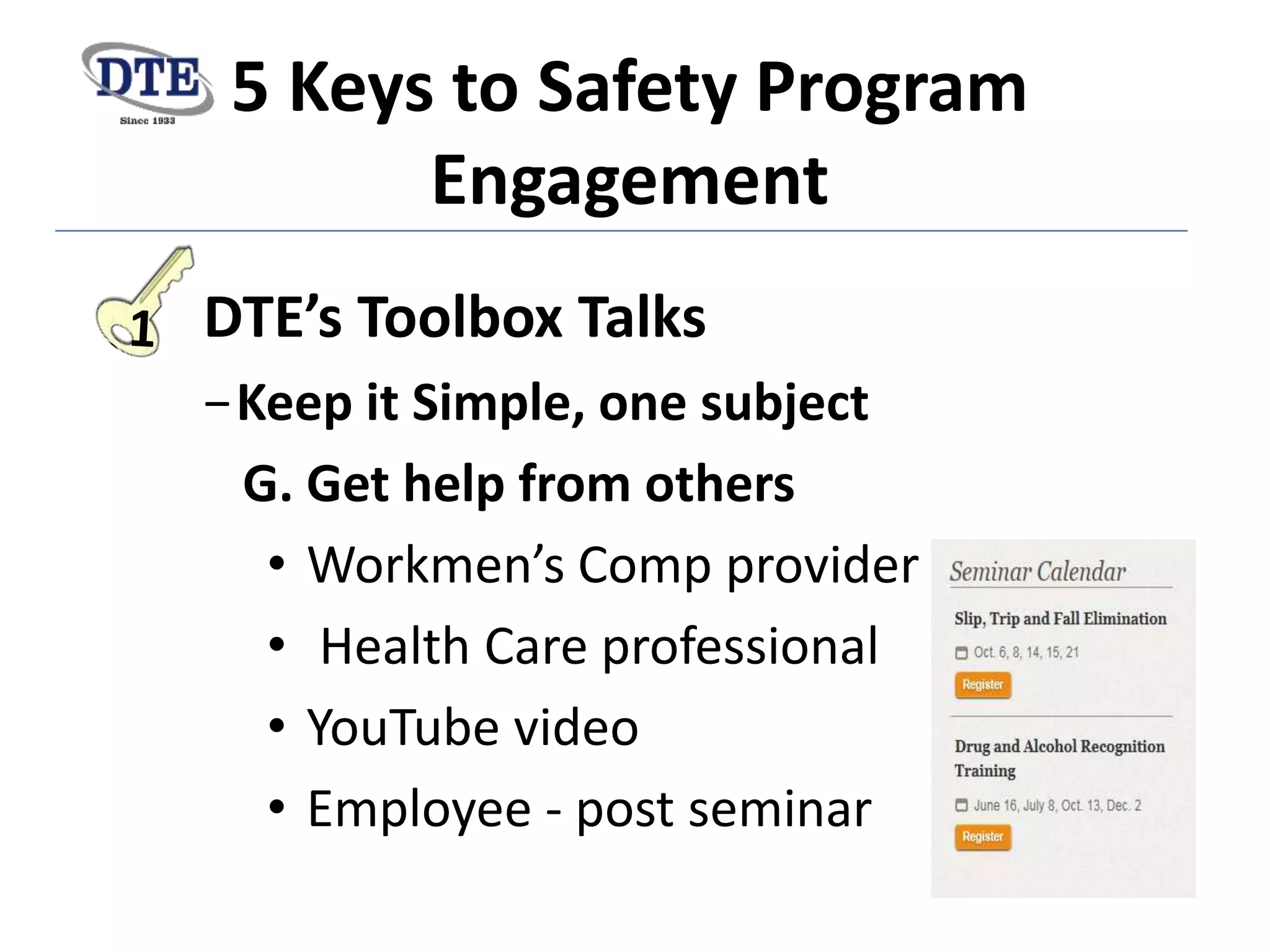
  • #8 Be creative with your Toolbox Talk—call your Workmen’s Comp provider and ask if a Loss Prevention Specialist will visit and deliver your talk once a year, each quarter, etc. Local Health Care professionals (example: Occupational Specialist Physician or Nurse) may come to your facility to give a short demonstration on lifting. Our Workmen’s Comp provider has links to posters, seminars, and YouTube videos that are helpful. Send an employee to a free safety seminar and ask them to lead a Toolbox Talk after they participate in the seminar.
  • #9 At DTE all members volunteer to be part of the Safety Committee and are from every department, both exempt and non-exempt. Safety Committee meetings are short (1/2 hour). At DTE we meet monthly and we keep on track with an agenda. The meetings generate the ideas for toolbox talks, areas of safety concern, review of first aid packs, and updates on DTE safety statistics. The agenda is used to generate the published meeting minutes. Many of the Safety Committee members participate in presenting the Toolbox Talks.
  • #10 The safety committee also decides on a monthly safety focus throughout the year. For example, October is National Fire Safety month—a time when DTE has fire drills, displays posters and sponsors Toolbox Talks on fire safety. Don’t forget June is National Safety Month—many items are published during National Safety Month and available for free. Keep your focus relevant to the time of year—avoid talking about slips during July—November, December or January may be a better time. The Safety Committee also suggests safety recognition events. For example, the Committee suggested purchasing high visibility orange t-shirts for all employees in recognition of DTE’s great safety record. Due to the Safety Committee’s efforts, all employees have enjoyed donuts for zero incident periods of time as well (since donuts are in the shape of a zero and we love them!). Our safety committee has also created DTE’s Healthy 100 Program. The Healthy 100 Program has sponsored quarterly programs that include smoking cessation, gym membership fee rebates, and specific health initiatives such as creating a walking track on the DTE campus, spring campus tree and flower planting celebrations, and walking or biking events.
  • #11 DTE has built a very good relationship with our local health care system. We are a small community of around 15,000 residents and we are very proud of our local state-of-the-art health care facilities and providers. Once a quarter, physicians visit our facility to present information relevant to safety and good employee health. The presentations are beneficial for both the employees and the health care providers as they often receive CEU’s for teaching our group. We have gained a great deal by developing good dialogue with our local health care providers. At DTE, all team members are invited and attend the meetings together, regardless of department, work area, etc.
  • #12 The DTE Safety Cross is a calendar in the shape of a cross (a common symbol for safety). The cross is colored daily using the same colors as a traffic light. Green is good—no incidents, all systems are go. Yellow indicates a no lost time incident—caution is necessary. Red is not good—a lost time incident has occurred. The calendar is simple and easy to maintain. At DTE we post it in a main shop traffic area, on the outside of an office area. The form is colored in every day and turned in to the safety manager at the end of the month. The days without incident are recorded and used as evidence with other data complied to create the yearly OSHA log. The information is current for the month and kept in a binder; handy for regulatory agency records.
  • #13 It’s the little things that make a difference—notice when people are doing things correctly and let them know! Try to keep small thank yous with you—our team likes lollipops with gum inside. When you catch them doing something right, offer to buy them a soda or a choice of candy. If you are unarmed, thank them! Shake their hand, tell them specifically what they were doing right and thank them again. This particular point cannot be understated. When you get the desired results, notice and say so. This point cannot be overemphasized. When you reinforce good safety messages with action—”I am watching and I notice”—people know that safety is being monitored in a positive way. While we can’t be everywhere and catch everything one may be pleasantly surprised that others will keep you informed.
  • #14 And now for Nita’s Notes. DTE has a formally written Health, Safety and Environmental Procedures book as I am sure many of you do. The most widely used safety document here is the Plant Safety Handbook, a condensed version written in plain language. For instance, our HSE book contains the statement in our Blood Borne Pathogens chapter: Detroit Tool will make available in strategic locations personal protective equipment that must be used by those who directly provide medical and first aid treatment to employees and who are exposed to body fluids. The Plant Safety Handbook states the same: Practice the following precautions (note: latex gloves, plastic, and bleach are located in blue buckets in the crib, supervisor’s offices and the HR office). Remember the earlier mention of the blue buckets in the manager’s offices? The Plant Safety Handbook follows the regulatory regulations concerning clean up of blood borne pathogens but states the process in plain language. And everyone at DTE understands the common language of the blue bucket. The photo on the left is from the Blood Borne Pathogens Toolbox Talk as well—a little red lipstick and you look like Dracula. Check out the Halloween makeup isle for teeth and your Blood Borne Pathogen talk given in October will be memorable!
  • #15 There are lots of good free visuals you can use in your safety program—many regulatory agencies have downloadable posters or brochures. Place posters where folks travel and change them often (we place them on the landing wall in the main stairway and on a monitor in our lobby) or place brochures in the break areas. We have a very good workmen’s comp provider that has given us high visibility seatbelt sleeves for our fleet and our forklifts, as well as seatbelt “Click It” stickers (as pictured in one of our vehicles).