NATIONAL INSTITUTE OF TECHNOLOGY
WARANGAL, HANUMAKONDA-506004,
TELANGANA STATE, INDIA
MINOR-1
SUBMITED BY – MANSI MISHRA
ROLL NO. – 22CEM7R13
SUBJECT – CONSTRUCTION TECHNIQUES (CE5101)
Under The Guidance Of:
Dr. Shashi Ram Mam
(Asst. professor, Dept. of civil engineering)
QUESTION -1: MANUFACTURING PROCESS OF CEMENT?
ANSWER -1:
 The cement is manufactured by integrating the calcareous component and argillaceous
component in ratio of 3:1.
 The calcareous component can be limestone, chalk, marine shells, marl whereas
argillaceous components can be shale, clay, blast furnace slag, slate.
 The calcareous component is used to derive the ingredient called lime whereas the
argillaceous component composed of silica, alumina, iron oxide and other impurities.
 Manufacturing of cement is done in following sequence of operation-:
a) Mixing of raw ingredients.
b) Burning
c) Grinding
 Manufacturing of cement can be done by any of the following methods -:
1) Wet process (Old method)
2) Dry process (New method)
1) Wet process :
 It is the old method of manufacturing which is now a days obsoleted.
 It is a costly method of manufacturing because it requires higher degree of fuel
consumption, power consumption.
 In this process the preheater is not used.
 The chief advantage of wet process are low cost of excavating and grinding raw
material (as dry process is used for hard raw material).
 Accurate control of composition and homogeneity of the slurry.
 Economical utilisation of fuel through elimination of separated drying operations.
 On the other hand it utilises longer kilns and more fuel for burning and are less
responsive to a variable clinker demand.
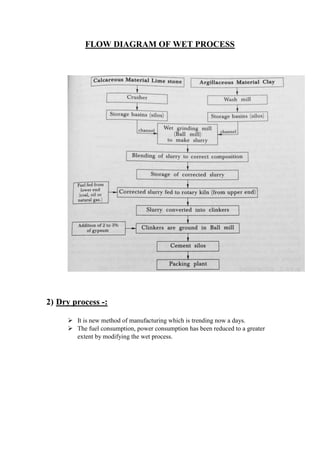
FLOW DIAGRAM OF WET PROCESS
2) Dry process -:
 It is new method of manufacturing which is trending now a days.
 The fuel consumption, power consumption has been reduced to a greater
extent by modifying the wet process.
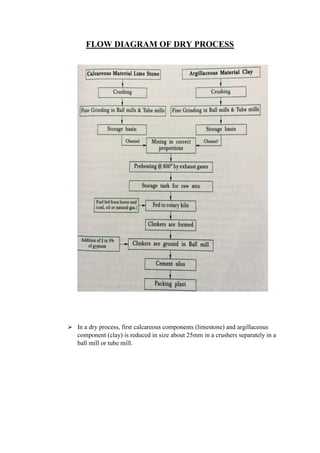
FLOW DIAGRAM OF DRY PROCESS
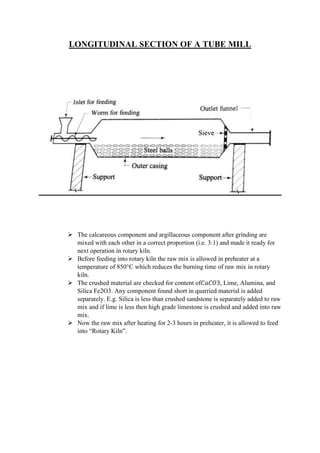
 In a dry process, first calcareous components (limestone) and argillaceous
component (clay) is reduced in size about 25mm in a crushers separately in a
ball mill or tube mill.
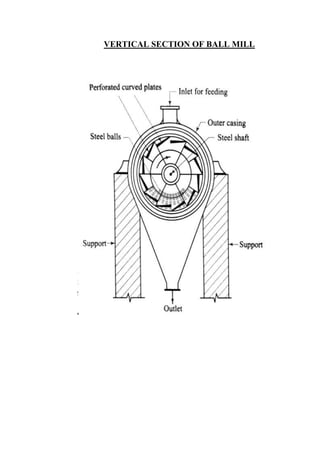
VERTICAL SECTION OF BALL MILL
LONGITUDINAL SECTION OF A TUBE MILL
 The calcareous component and argillaceous component after grinding are
mixed with each other in a correct proportion (i.e. 3:1) and made it ready for
next operation in rotary kiln.
 Before feeding into rotary kiln the raw mix is allowed in preheater at a
temperature of 850°C which reduces the burning time of raw mix in rotary
kiln.
 The crushed material are checked for content of𝐶𝑎𝐶𝑂3, Lime, Alumina, and
Silica Fe2O3. Any component found short in quarried material is added
separately. E.g. Silica is less than crushed sandstone is separately added to raw
mix and if lime is less then high grade limestone is crushed and added into raw
mix.
 Now the raw mix after heating for 2-3 hours in preheater, it is allowed to feed
into “Rotary Kiln”.
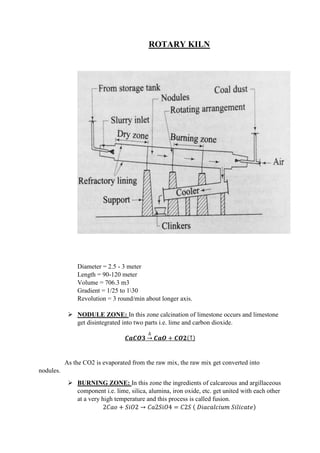
ROTARY KILN
Diameter = 2.5 - 3 meter
Length = 90-120 meter
Volume = 706.3 m3
Gradient = 1/25 to 130
Revolution = 3 round/min about longer axis.
 NODULE ZONE: In this zone calcination of limestone occurs and limestone
get disintegrated into two parts i.e. lime and carbon dioxide.
𝑪𝒂𝑪𝑶𝟑
∆
→ 𝑪𝒂𝑶 + 𝑪𝑶𝟐(↑)
As the CO2 is evaporated from the raw mix, the raw mix get converted into
nodules.
 BURNING ZONE: In this zone the ingredients of calcareous and argillaceous
component i.e. lime, silica, alumina, iron oxide, etc. get united with each other
at a very high temperature and this process is called fusion.
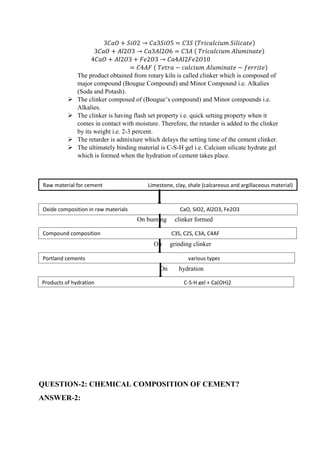
2𝐶𝑎𝑜 + 𝑆𝑖𝑂2 → 𝐶𝑎2𝑆𝑖𝑂4 = 𝐶2𝑆 ( 𝐷𝑖𝑎𝑐𝑎𝑙𝑐𝑖𝑢𝑚 𝑆𝑖𝑙𝑖𝑐𝑎𝑡𝑒)
3𝐶𝑎𝑂 + 𝑆𝑖𝑂2 → 𝐶𝑎3𝑆𝑖𝑂5 = 𝐶3𝑆 (𝑇𝑟𝑖𝑐𝑎𝑙𝑐𝑖𝑢𝑚 𝑆𝑖𝑙𝑖𝑐𝑎𝑡𝑒)
3𝐶𝑎𝑂 + 𝐴𝑙2𝑂3 → 𝐶𝑎3𝐴𝑙2𝑂6 = 𝐶3𝐴 ( 𝑇𝑟𝑖𝑐𝑎𝑙𝑐𝑖𝑢𝑚 𝐴𝑙𝑢𝑚𝑖𝑛𝑎𝑡𝑒)
4𝐶𝑎𝑂 + 𝐴𝑙2𝑂3 + 𝐹𝑒2𝑂3 → 𝐶𝑎4𝐴𝑙2𝐹𝑒2𝑂10
= 𝐶4𝐴𝐹 ( 𝑇𝑒𝑡𝑟𝑎 − 𝑐𝑎𝑙𝑐𝑖𝑢𝑚 𝐴𝑙𝑢𝑚𝑖𝑛𝑎𝑡𝑒 − 𝑓𝑒𝑟𝑟𝑖𝑡𝑒)
The product obtained from rotary kiln is called clinker which is composed of
major compound (Bougue Compound) and Minor Compound i.e. Alkalies
(Soda and Potash).
 The clinker composed of (Bougue’s compound) and Minor compounds i.e.
Alkalies.
 The clinker is having flash set property i.e. quick setting property when it
comes in contact with moisture. Therefore, the retarder is added to the clinker
by its weight i.e. 2-3 percent.
 The retarder is admixture which delays the setting time of the cement clinker.
 The ultimately binding material is C-S-H gel i.e. Calcium silicate hydrate gel
which is formed when the hydration of cement takes place.
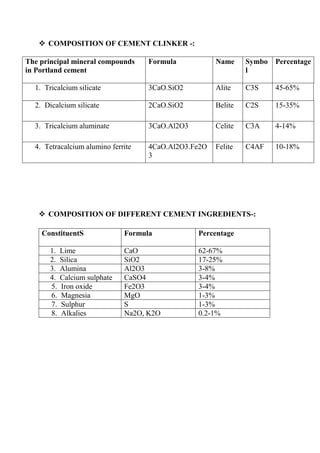
On burning clinker formed
On grinding clinker
On hydration
QUESTION-2: CHEMICAL COMPOSITION OF CEMENT?
ANSWER-2:
Raw material for cement Limestone, clay, shale (calcareous and argillaceous material)
Oxide composition in raw materials CaO, SiO2, Al2O3, Fe2O3
Compound composition C3S, C2S, C3A, C4AF
Portland cements various types
Products of hydration C-S-H gel + Ca(OH)2
 COMPOSITION OF CEMENT CLINKER -:
 COMPOSITION OF DIFFERENT CEMENT INGREDIENTS-:
The principal mineral compounds
in Portland cement
Formula Name Symbo
l
Percentage
1. Tricalcium silicate 3CaO.SiO2 Alite C3S 45-65%
2. Dicalcium silicate 2CaO.SiO2 Belite C2S 15-35%
3. Tricalcium aluminate 3CaO.Al2O3 Celite C3A 4-14%
4. Tetracalcium alumino ferrite 4CaO.Al2O3.Fe2O
3
Felite C4AF 10-18%
ConstituentS Formula Percentage
1. Lime CaO 62-67%
2. Silica SiO2 17-25%
3. Alumina Al2O3 3-8%
4. Calcium sulphate CaSO4 3-4%
5. Iron oxide Fe2O3 3-4%
6. Magnesia MgO 1-3%
7. Sulphur S 1-3%
8. Alkalies Na2O, K2O 0.2-1%
 Compostion of cement clinkers:
1. Tricalcium silicate-:
 It undergoes hydration within a week or two week after the addition of water in
cement, hence is responsible for development of early strength.
 If in any construction early strength is required proportion of C3S is increased as in :-
 Pavement construction
 Prefabricated structures
 Cold weather concreting
 Where formwork is to be reused for speedy construction
 It is observed to have best Cementous property amongst all the bouge’s
compounds.
 It also increases the resistance of cement against frost action (freezing and thawing).
 In real terms its effect on heat of hydration is more than C3A.
 Ca (OH) 2 released during hydration reduces the tendency of corrosion in
reinforcement.
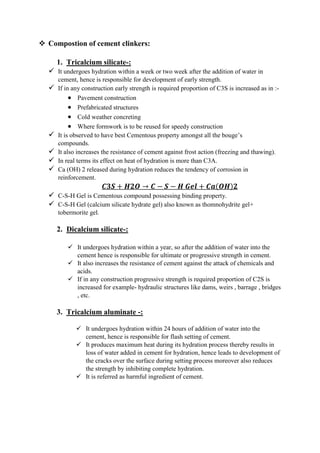
𝑪𝟑𝑺 + 𝑯𝟐𝑶 → 𝑪 − 𝑺 − 𝑯 𝑮𝒆𝒍 + 𝑪𝒂(𝑶𝑯)𝟐
 C-S-H Gel is Cementous compound possessing binding property.
 C-S-H Gel (calcium silicate hydrate gel) also known as thomnohydrite gel+
tobermorite gel.
2. Dicalcium silicate-:
 It undergoes hydration within a year, so after the addition of water into the
cement hence is responsible for ultimate or progressive strength in cement.
 It also increases the resistance of cement against the attack of chemicals and
acids.
 If in any construction progressive strength is required proportion of C2S is
increased for example- hydraulic structures like dams, weirs , barrage , bridges
, etc.
3. Tricalcium aluminate -:
 It undergoes hydration within 24 hours of addition of water into the
cement, hence is responsible for flash setting of cement.
 It produces maximum heat during its hydration process thereby results in
loss of water added in cement for hydration, hence leads to development of
the cracks over the surface during setting process moreover also reduces
the strength by inhibiting complete hydration.
 It is referred as harmful ingredient of cement.
4. Tetra calcium alumino ferrate-:
 It also undergoes hydration within 24 hours of addition of water into the
cement, hence is responsible for flash setting of cement.
 It is observed to have worst cementing property amongst all the bouges
compounds.
 It also reduces the resistance of cement against the attack of sulphur.
 It has no engineering use as it does not impart any property to the cement.
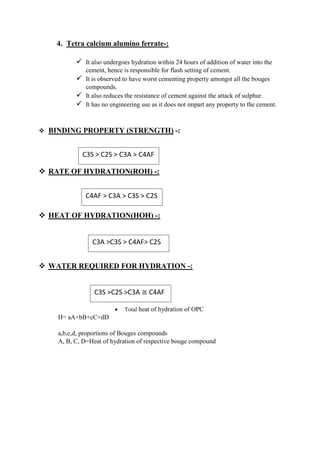
 BINDING PROPERTY (STRENGTH) -:
 RATE OF HYDRATION(ROH) -:
 HEAT OF HYDRATION(HOH) -:
 WATER REQUIRED FOR HYDRATION -:
 Total heat of hydration of OPC
H= aA+bB+cC+dD
a,b,c,d, proportions of Bouges compounds
A, B, C, D=Heat of hydration of respective bouge compound
C3S > C2S > C3A > C4AF
C4AF > C3A > C3S > C2S
C3A >C3S > C4AF> C2S
C3S >C2S >C3A ≅ C4AF
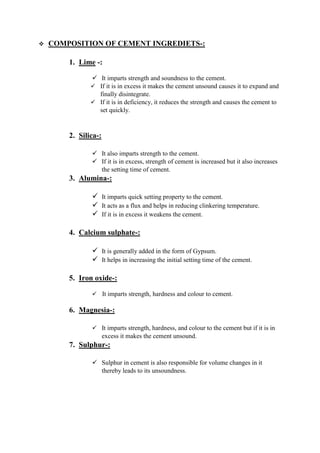
 COMPOSITION OF CEMENT INGREDIETS-:
1. Lime -:
 It imparts strength and soundness to the cement.
 If it is in excess it makes the cement unsound causes it to expand and
finally disintegrate.
 If it is in deficiency, it reduces the strength and causes the cement to
set quickly.
2. Silica-:
 It also imparts strength to the cement.
 If it is in excess, strength of cement is increased but it also increases
the setting time of cement.
3. Alumina-:
 It imparts quick setting property to the cement.
 It acts as a flux and helps in reducing clinkering temperature.
 If it is in excess it weakens the cement.
4. Calcium sulphate-:
 It is generally added in the form of Gypsum.
 It helps in increasing the initial setting time of the cement.
5. Iron oxide-:
 IIt imparts strength, hardness and colour to cement.
6. Magnesia-:
 It imparts strength, hardness, and colour to the cement but if it is in
excess it makes the cement unsound.
7. Sulphur-:
 Sulphur in cement is also responsible for volume changes in it
thereby leads to its unsoundness.
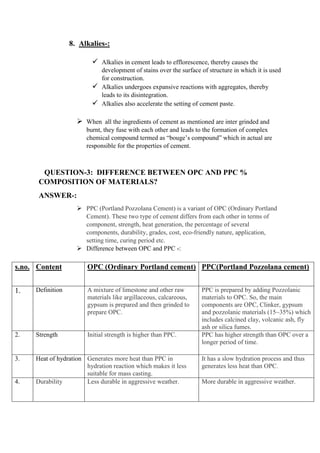
8. Alkalies-:
 Alkalies in cement leads to efflorescence, thereby causes the
development of stains over the surface of structure in which it is used
for construction.
 Alkalies undergoes expansive reactions with aggregates, thereby
leads to its disintegration.
 Alkalies also accelerate the setting of cement paste.
 When all the ingredients of cement as mentioned are inter grinded and
burnt, they fuse with each other and leads to the formation of complex
chemical compound termed as “bouge’s compound” which in actual are
responsible for the properties of cement.
QUESTION-3: DIFFERENCE BETWEEN OPC AND PPC %
COMPOSITION OF MATERIALS?
ANSWER-:
 PPC (Portland Pozzolana Cement) is a variant of OPC (Ordinary Portland
Cement). These two type of cement differs from each other in terms of
component, strength, heat generation, the percentage of several
components, durability, grades, cost, eco-friendly nature, application,
setting time, curing period etc.
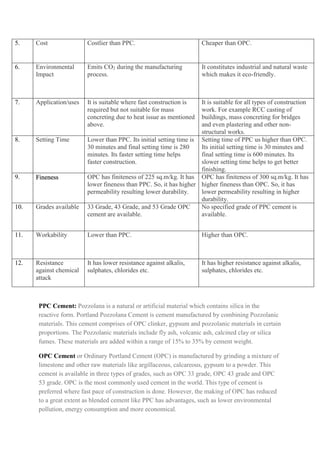
 Difference between OPC and PPC -:
s.no. Content OPC (Ordinary Portland cement) PPC(Portland Pozzolana cement)
1. Definition A mixture of limestone and other raw
materials like argillaceous, calcareous,
gypsum is prepared and then grinded to
prepare OPC.
PPC is prepared by adding Pozzolanic
materials to OPC. So, the main
components are OPC, Clinker, gypsum
and pozzolanic materials (15~35%) which
includes calcined clay, volcanic ash, fly
ash or silica fumes.
2. Strength Initial strength is higher than PPC. PPC has higher strength than OPC over a
longer period of time.
3. Heat of hydration Generates more heat than PPC in
hydration reaction which makes it less
suitable for mass casting.
It has a slow hydration process and thus
generates less heat than OPC.
4. Durability Less durable in aggressive weather. More durable in aggressive weather.
5. Cost Costlier than PPC. Cheaper than OPC.
6. Environmental
Impact
Emits CO2 during the manufacturing
process.
It constitutes industrial and natural waste
which makes it eco-friendly.
7. Application/uses It is suitable where fast construction is
required but not suitable for mass
concreting due to heat issue as mentioned
above.
It is suitable for all types of construction
work. For example RCC casting of
buildings, mass concreting for bridges
and even plastering and other non-
structural works.
8. Setting Time Lower than PPC. Its initial setting time is
30 minutes and final setting time is 280
minutes. Its faster setting time helps
faster construction.
Setting time of PPC us higher than OPC.
Its initial setting time is 30 minutes and
final setting time is 600 minutes. Its
slower setting time helps to get better
finishing.
9. Fineness OPC has finiteness of 225 sq.m/kg. It has
lower fineness than PPC. So, it has higher
permeability resulting lower durability.
OPC has finiteness of 300 sq.m/kg. It has
higher fineness than OPC. So, it has
lower permeability resulting in higher
durability.
10. Grades available 33 Grade, 43 Grade, and 53 Grade OPC
cement are available.
No specified grade of PPC cement is
available.
11. Workability Lower than PPC. Higher than OPC.
12. Resistance
against chemical
attack
It has lower resistance against alkalis,
sulphates, chlorides etc.
It has higher resistance against alkalis,
sulphates, chlorides etc.
PPC Cement: Pozzolana is a natural or artificial material which contains silica in the
reactive form. Portland Pozzolana Cement is cement manufactured by combining Pozzolanic
materials. This cement comprises of OPC clinker, gypsum and pozzolanic materials in certain
proportions. The Pozzolanic materials include fly ash, volcanic ash, calcined clay or silica
fumes. These materials are added within a range of 15% to 35% by cement weight.
OPC Cement or Ordinary Portland Cement (OPC) is manufactured by grinding a mixture of
limestone and other raw materials like argillaceous, calcareous, gypsum to a powder. This
cement is available in three types of grades, such as OPC 33 grade, OPC 43 grade and OPC
53 grade. OPC is the most commonly used cement in the world. This type of cement is
preferred where fast pace of construction is done. However, the making of OPC has reduced
to a great extent as blended cement like PPC has advantages, such as lower environmental
pollution, energy consumption and more economical.
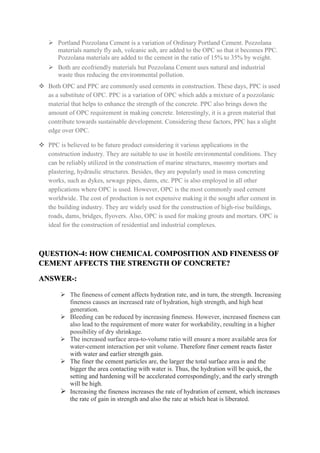
 Portland Pozzolana Cement is a variation of Ordinary Portland Cement. Pozzolana
materials namely fly ash, volcanic ash, are added to the OPC so that it becomes PPC.
Pozzolana materials are added to the cement in the ratio of 15% to 35% by weight.
 Both are ecofriendly materials but Pozzolana Cement uses natural and industrial
waste thus reducing the environmental pollution.
 Both OPC and PPC are commonly used cements in construction. These days, PPC is used
as a substitute of OPC. PPC is a variation of OPC which adds a mixture of a pozzolanic
material that helps to enhance the strength of the concrete. PPC also brings down the
amount of OPC requirement in making concrete. Interestingly, it is a green material that
contribute towards sustainable development. Considering these factors, PPC has a slight
edge over OPC.
 PPC is believed to be future product considering it various applications in the
construction industry. They are suitable to use in hostile environmental conditions. They
can be reliably utilized in the construction of marine structures, masonry mortars and
plastering, hydraulic structures. Besides, they are popularly used in mass concreting
works, such as dykes, sewage pipes, dams, etc. PPC is also employed in all other
applications where OPC is used. However, OPC is the most commonly used cement
worldwide. The cost of production is not expensive making it the sought after cement in
the building industry. They are widely used for the construction of high-rise buildings,
roads, dams, bridges, flyovers. Also, OPC is used for making grouts and mortars. OPC is
ideal for the construction of residential and industrial complexes.
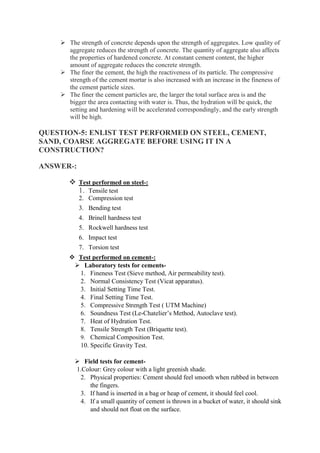
QUESTION-4: HOW CHEMICAL COMPOSITION AND FINENESS OF
CEMENT AFFECTS THE STRENGTH OF CONCRETE?
ANSWER-:
 The fineness of cement affects hydration rate, and in turn, the strength. Increasing
fineness causes an increased rate of hydration, high strength, and high heat
generation.
 Bleeding can be reduced by increasing fineness. However, increased fineness can
also lead to the requirement of more water for workability, resulting in a higher
possibility of dry shrinkage.
 The increased surface area-to-volume ratio will ensure a more available area for
water-cement interaction per unit volume. Therefore finer cement reacts faster
with water and earlier strength gain.
 The finer the cement particles are, the larger the total surface area is and the
bigger the area contacting with water is. Thus, the hydration will be quick, the
setting and hardening will be accelerated correspondingly, and the early strength
will be high.
 Increasing the fineness increases the rate of hydration of cement, which increases
the rate of gain in strength and also the rate at which heat is liberated.
 The strength of concrete depends upon the strength of aggregates. Low quality of
aggregate reduces the strength of concrete. The quantity of aggregate also affects
the properties of hardened concrete. At constant cement content, the higher
amount of aggregate reduces the concrete strength.
 The finer the cement, the high the reactiveness of its particle. The compressive
strength of the cement mortar is also increased with an increase in the fineness of
the cement particle sizes.
 The finer the cement particles are, the larger the total surface area is and the
bigger the area contacting with water is. Thus, the hydration will be quick, the
setting and hardening will be accelerated correspondingly, and the early strength
will be high.
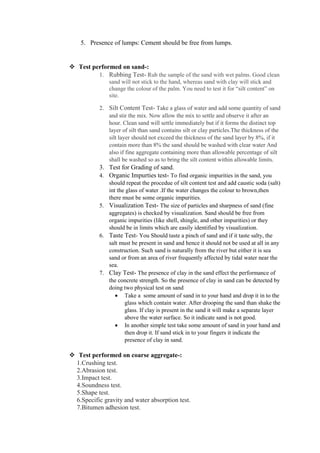
QUESTION-5: ENLIST TEST PERFORMED ON STEEL, CEMENT,
SAND, COARSE AGGREGATE BEFORE USING IT IN A
CONSTRUCTION?
ANSWER-:
 Test performed on steel-:
1. Tensile test
2. Compression test
3. Bending test
4. Brinell hardness test
5. Rockwell hardness test
6. Impact test
7. Torsion test
 Test performed on cement-:
 Laboratory tests for cements-
1. Fineness Test (Sieve method, Air permeability test).
2. Normal Consistency Test (Vicat apparatus).
3. Initial Setting Time Test.
4. Final Setting Time Test.
5. Compressive Strength Test ( UTM Machine)
6. Soundness Test (Le-Chatelier’s Method, Autoclave test).
7. Heat of Hydration Test.
8. Tensile Strength Test (Briquette test).
9. Chemical Composition Test.
10. Specific Gravity Test.
 Field tests for cement-
1.Colour: Grey colour with a light greenish shade.
2. Physical properties: Cement should feel smooth when rubbed in between
the fingers.
3. If hand is inserted in a bag or heap of cement, it should feel cool.
4. If a small quantity of cement is thrown in a bucket of water, it should sink
and should not float on the surface.
5. Presence of lumps: Cement should be free from lumps.
 Test performed on sand-:
1. Rubbing Test- Rub the sample of the sand with wet palms. Good clean
sand will not stick to the hand, whereas sand with clay will stick and
change the colour of the palm. You need to test it for “silt content” on
site.
2. Silt Content Test- Take a glass of water and add some quantity of sand
and stir the mix. Now allow the mix to settle and observe it after an
hour. Clean sand will settle immediately but if it forms the distinct top
layer of silt than sand contains silt or clay particles.The thickness of the
silt layer should not exceed the thickness of the sand layer by 8%, if it
contain more than 8% the sand should be washed with clear water And
also if fine aggregate containing more than allowable percentage of silt
shall be washed so as to bring the silt content within allowable limits.
3. Test for Grading of sand.
4. Organic Impurties test- To find organic impurities in the sand, you
should repeat the procedue of silt content test and add caustic soda (salt)
int the glass of water .If the water changes the colour to brown,then
there must be some organic impurities.
5. Visualization Test- The size of particles and sharpness of sand (fine
aggregates) is checked by visualization. Sand should be free from
organic impurities (like shell, shingle, and other impurities) or they
should be in limits which are easily identified by visualization.
6. Taste Test- You Should taste a pinch of sand and if it taste salty, the
salt must be present in sand and hence it should not be used at all in any
construction. Such sand is naturally from the river but either it is sea
sand or from an area of river frequently affected by tidal water near the
sea.
7. Clay Test- The presence of clay in the sand effect the performance of
the concrete strength. So the presence of clay in sand can be detected by
doing two physical test on sand
 Take a some amount of sand in to your hand and drop it in to the
glass which contain water. After drooping the sand than shake the
glass. If clay is present in the sand it will make a separate layer
above the water surface. So it indicate sand is not good.
 In another simple test take some amount of sand in your hand and
then drop it. If sand stick in to your fingers it indicate the
presence of clay in sand.
 Test performed on coarse aggregate-:
1.Crushing test.
2.Abrasion test.
3.Impact test.
4.Soundness test.
5.Shape test.
6.Specific gravity and water absorption test.
7.Bitumen adhesion test.
QUESTION-6: ENLIST 5 ADMIXTURES FOR ENHANCING
CONCRETE PROPERTIES?
ANSWER-:
 5 ADMIXTURES FOR ENHANCING CONCRETE
PROPERTIES-
1. Air entrainers [wood-derived acid salts (vinsol resins and wood
rosins) and synthetic resins].
2. Retarders [calcium sulphate or gypsum, Starch, cellulose products,
common sugar, salts of acids].
3. Accelerators [Triethenolamine, calcium formate, silica fume, calcium
chloride, finely divided silica gel etc.].
4. Plasticizers (water reducers) [phthalates, phosphates, carboxylic
acid esters, epoxidized fatty acid esters, polymeric polyesters,
modified polymers; liquid rubbers, and plastics, Nitrile Butadiene
Rubber (NBR), chlorinated PE, EVA, etc.; paraffinic, aromatic].
5. Superplasticizers (High range water reducers) [sulphonated
melamine formaldehyde (SMF), sulphonated naphthalene
formaldehyde (SNF), modified lignosulphonates (MLS) and
polycarboxylate derivatives].
QUESTION-7: SHORT NOTE ON READY MIXED CONCRETE?
ANSWER-:
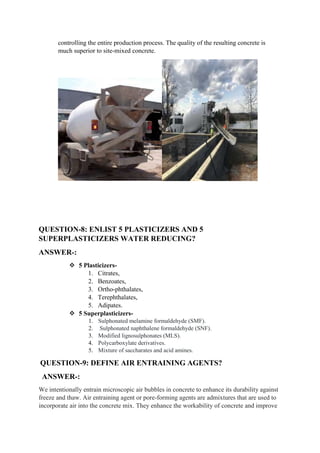
As the name indicates, Ready Mixed Concrete (RMC) is the concrete which is
delivered in the ready- to-use manner. RMC is defined by the American Concrete
Institute’s Committee 116R-90 as:
"Concrete that is manufactured for delivery to a purchaser in a plastic and unhardened
state".
The Indian Standard Specification IS 4926:2003 defines RMC as:
"Concrete mixed in a stationary mixer in a central batching and mixing plant or in a
truck-mixer and supplied in fresh condition to the purchaser either at the site or into
the purchaser's vehicles".
In India, concrete has traditionally been produced on site with the primitive
equipment’s and use of large labour force. Ready mixed concrete is an advanced
technology, involving a high degree of mechanization and automation. A typical
RMC plant consists of silos and bins for the storage of cement and aggregates
respectively, weigh batchers for proportioning different ingredients of concrete, high
efficiency mixer for thorough mixing of ingredients, and a computerized system
controlling the entire production process. The quality of the resulting concrete is
much superior to site-mixed concrete.
QUESTION-8: ENLIST 5 PLASTICIZERS AND 5
SUPERPLASTICIZERS WATER REDUCING?
ANSWER-:
 5 Plasticizers-
1. Citrates,
2. Benzoates,
3. Ortho-phthalates,
4. Terephthalates,
5. Adipates.
 5 Superplasticizers-
1. Sulphonated melamine formaldehyde (SMF).
2. Sulphonated naphthalene formaldehyde (SNF).
3. Modified lignosulphonates (MLS).
4. Polycarboxylate derivatives.
5. Mixture of saccharates and acid amines.
QUESTION-9: DEFINE AIR ENTRAINING AGENTS?
ANSWER-:
We intentionally entrain microscopic air bubbles in concrete to enhance its durability against
freeze and thaw. Air entraining agent or pore-forming agents are admixtures that are used to
incorporate air into the concrete mix. They enhance the workability of concrete and improve
resistance against salt scaling or freeze and thawing. In normal concrete, the air bubbles are
still there but they are just 1 to 3% by volume. So, to increase their percentage, an amount of
AEA is added in the concrete. The addition of such an admixture in the concrete is referred to
as air entrainment. So, if we’re working on a concrete project where it is exposed to free-thaw
cycle and you need to enhance resistance of concrete against deicer chemicals, you need to
use air entraining agent. Air entraining agents are added at an amount of 0.001 to 0.1 % by
weight of cement. However, this amount depends on the mix design, type of material, and
mixing condition. The most common of all air entraining agent is a surfactant. It is a surface
active substance and is a type of chemical that includes a detergent. So, when they are added,
air bubbles are produced during mixing or easy flowing concrete. These bubbles survive till
the concrete gets hardened. AEA decreases the surface tension of fresh concrete mixture and
thus it increases the workability of fresh concrete and reduces segregation and/or bleeding.
 Following are some of the common Air entraining agents:
1. surface-active substances – organic
2. substances that produce gas pores or bubbles
3. solid substances that are inorganic and are granulated in foam form from
polymers
4. Biodegradable polymers.
 Purpose of using air entraining agent-
There are two primary reasons of using air entraining agents in concrete:
1. To increase durability – Air entrainment enhances the resistance of concrete
against freeze and thaw moreover it avoids segregation.
2. To increase workability – air bubbles make concrete a good slump which is
good for workability.
QUESTION-10: WRITE SHORT NOTE ON CONCRETE PUMPING
MECHANISM AND REQUIREMENT?
a) HOW THIS IS PREPARED, MATERIALS INVOLVED, SIZE AND
DIMENSION OF AGGREGATE?
b) MIX PROPERTIES, PROPORTION, FLOWABILITY, SLUMP
VALVE?
ANSWER-:
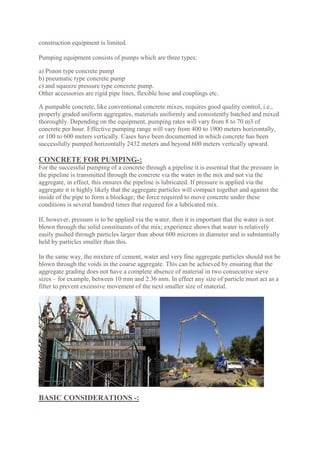
Pumped concrete may be defined as concrete that is conveyed by pressure through either
rigid pipe or flexible hose and discharged directly into the desired area. Pumping may be used
for most all concrete construction, but is especially useful where space or access for
construction equipment is limited.
Pumping equipment consists of pumps which are three types:
a) Piston type concrete pump
b) pneumatic type concrete pump
c) and squeeze pressure type concrete pump.
Other accessories are rigid pipe lines, flexible hose and couplings etc.
A pumpable concrete, like conventional concrete mixes, requires good quality control, i.e.,
properly graded uniform aggregates, materials uniformly and consistently batched and mixed
thoroughly. Depending on the equipment, pumping rates will vary from 8 to 70 m3 of
concrete per hour. Effective pumping range will vary from 400 to 1900 meters horizontally,
or 100 to 600 meters vertically. Cases have been documented in which concrete has been
successfully pumped horizontally 2432 meters and beyond 600 meters vertically upward.
CONCRETE FOR PUMPING-:
For the successful pumping of a concrete through a pipeline it is essential that the pressure in
the pipeline is transmitted through the concrete via the water in the mix and not via the
aggregate, in effect, this ensures the pipeline is lubricated. If pressure is applied via the
aggregate it is highly likely that the aggregate particles will compact together and against the
inside of the pipe to form a blockage; the force required to move concrete under these
conditions is several hundred times that required for a lubricated mix.
If, however, pressure is to be applied via the water, then it is important that the water is not
blown through the solid constituents of the mix; experience shows that water is relatively
easily pushed through particles larger than about 600 microns in diameter and is substantially
held by particles smaller than this.
In the same way, the mixture of cement, water and very fine aggregate particles should not be
blown through the voids in the coarse aggregate. This can be achieved by ensuring that the
aggregate grading does not have a complete absence of material in two consecutive sieve
sizes – for example, between 10 mm and 2.36 mm. In effect any size of particle must act as a
filter to prevent excessive movement of the next smaller size of material.
BASIC CONSIDERATIONS -:
(a) Cement content-:
Concrete without admixtures and of high cement content, over about 460 kg/m3
are liable to
prove difficult to pump, because of high friction between the concrete and the pipeline.
Cement contents below 270 to 320 kg/m3
depending upon the proportion of the aggregate
may also prove difficult to pump because of segregation within the pipe line.
(b) Workability-:
The workability of pumped concrete in general have a average slump of between 50 mm and
100 mm. A concrete of less than 50 mm slumps are impractical for pumping, and slump
above 125 mm should be avoided. In mixtures with high slump, the aggregate will segregate
from the mortar and paste and may cause blocking in the pump lines.
The mixing water requirements vary from different maximum sizes and type of aggregates.
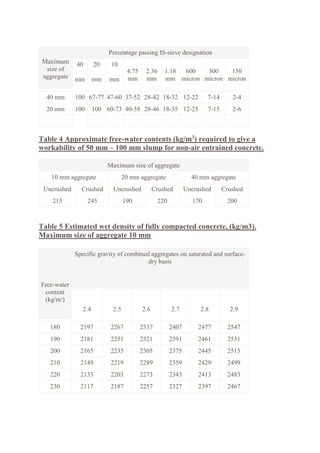
The approximate quantity of water for a slump of 50 mm and 100 mm is given in table 4. In
high strength concrete due to lower water-cement ratio and high cement concrete workability
is reduced with the given quantity of water per cu.m of concrete. In such case water reducing
admixtures are useful. In the addition of this type of admixtures at normal dosage levels to
obtain a higher workability for a given concrete mix, there is no necessity to make any
alteration to the mix design from that produced for the concrete of the initial lower slump.
There is generally no loss of cohesion or excess bleeding even when the hydroxycarboxylic
acid materials are used.
If this class of product is used to decrease the water cement ratio, again no change in mix
design will be required, although small alterations in plastic and hardened density will be
apparent and should be used in any yield calculations.
A loss of slump during pumping is normal and should be taken into consideration when
proportioning the concrete mixes. A slump loss of 25 mm per 300 meters of conduit length is
not unusual, the amount depending upon ambient temperature, length of line, pressure used to
move the concrete, moisture content of aggregate at the time of mixing, truck-haulage
distance, whether mix is kept agitated during haulage etc. The loss is greater for hose than for
pipe, and is sometimes as high as 20 mm per 30 meter.
(c) Aggregates-:
The maximum size of crushed aggregate is limited to one-third of the smallest inside
diameter of the hose or pipe based on simple geometry of cubical shape aggregates. For
uncrushed (rounded) aggregates, the maximum size should be limited to 40 percent of the
pipe or hose diameter.
The shape of the coarse aggregate, whether crushed or uncrushed has an influence on the mix
proportions, although both shapes can be pumped satisfactorily. The crushed pieces have a
larger surface area per unit volume as compared to uncrushed pieces and thus require
relatively more mortar to coat the surface. Coarse aggregate of a very bad particles shape
should be avoided.
Difficulties with pump mixed have often been experienced when too large a proportion of
coarse aggregate is used in an attempt to achieve economy by reducing the amount of cement
such mixes are also more difficult and costly to finish.
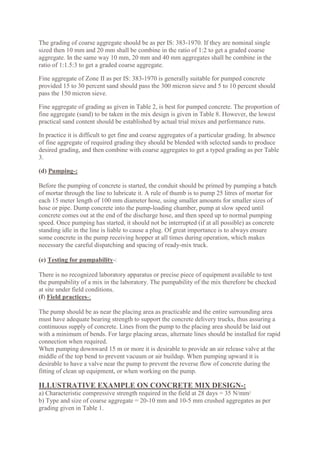
The grading of coarse aggregate should be as per IS: 383-1970. If they are nominal single
sized then 10 mm and 20 mm shall be combine in the ratio of 1:2 to get a graded coarse
aggregate. In the same way 10 mm, 20 mm and 40 mm aggregates shall be combine in the
ratio of 1:1.5:3 to get a graded coarse aggregate.
Fine aggregate of Zone II as per IS: 383-1970 is generally suitable for pumped concrete
provided 15 to 30 percent sand should pass the 300 micron sieve and 5 to 10 percent should
pass the 150 micron sieve.
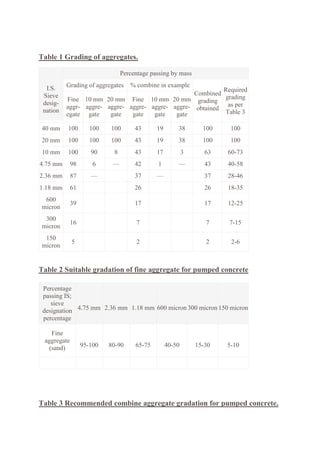
Fine aggregate of grading as given in Table 2, is best for pumped concrete. The proportion of
fine aggregate (sand) to be taken in the mix design is given in Table 8. However, the lowest
practical sand content should be established by actual trial mixes and performance runs.
In practice it is difficult to get fine and coarse aggregates of a particular grading. In absence
of fine aggregate of required grading they should be blended with selected sands to produce
desired grading, and then combine with coarse aggregates to get a typed grading as per Table
3.
(d) Pumping-:
Before the pumping of concrete is started, the conduit should be primed by pumping a batch
of mortar through the line to lubricate it. A rule of thumb is to pump 25 litres of mortar for
each 15 meter length of 100 mm diameter hose, using smaller amounts for smaller sizes of
hose or pipe. Dump concrete into the pump-loading chamber, pump at slow speed until
concrete comes out at the end of the discharge hose, and then speed up to normal pumping
speed. Once pumping has started, it should not be interrupted (if at all possible) as concrete
standing idle in the line is liable to cause a plug. Of great importance is to always ensure
some concrete in the pump receiving hopper at all times during operation, which makes
necessary the careful dispatching and spacing of ready-mix truck.
(e) Testing for pumpability-:
There is no recognized laboratory apparatus or precise piece of equipment available to test
the pumpability of a mix in the laboratory. The pumpability of the mix therefore be checked
at site under field conditions.
(f) Field practices-:
The pump should be as near the placing area as practicable and the entire surrounding area
must have adequate bearing strength to support the concrete delivery trucks, thus assuring a
continuous supply of concrete. Lines from the pump to the placing area should be laid out
with a minimum of bends. For large placing areas, alternate lines should be installed for rapid
connection when required.
When pumping downward 15 m or more it is desirable to provide an air release valve at the
middle of the top bend to prevent vacuum or air buildup. When pumping upward it is
desirable to have a valve near the pump to prevent the reverse flow of concrete during the
fitting of clean up equipment, or when working on the pump.
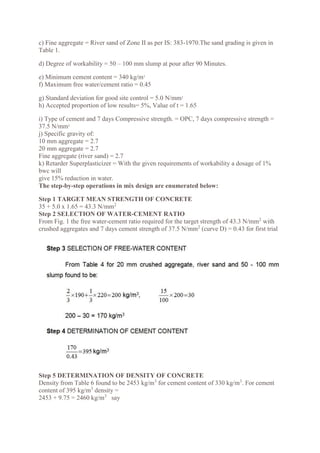
ILLUSTRATIVE EXAMPLE ON CONCRETE MIX DESIGN-:
a) Characteristic compressive strength required in the field at 28 days = 35 N/mm2
b) Type and size of coarse aggregate = 20-10 mm and 10-5 mm crushed aggregates as per
grading given in Table 1.
c) Fine aggregate = River sand of Zone II as per IS: 383-1970.The sand grading is given in
Table 1.
d) Degree of workability = 50 – 100 mm slump at pour after 90 Minutes.
e) Minimum cement content = 340 kg/m3
f) Maximum free water/cement ratio = 0.45
g) Standard deviation for good site control = 5.0 N/mm2
h) Accepted proportion of low results= 5%, Value of t = 1.65
i) Type of cement and 7 days Compressive strength. = OPC, 7 days compressive strength =
37.5 N/mm2
j) Specific gravity of:
10 mm aggregate = 2.7
20 mm aggregate = 2.7
Fine aggregate (river sand) = 2.7
k) Retarder Superplasticizer = With the given requirements of workability a dosage of 1%
bwc will
give 15% reduction in water.
The step-by-step operations in mix design are enumerated below:
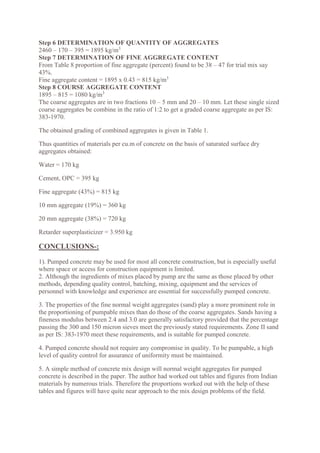
Step 1 TARGET MEAN STRENGTH OF CONCRETE
35 + 5.0 x 1.65 = 43.3 N/mm2
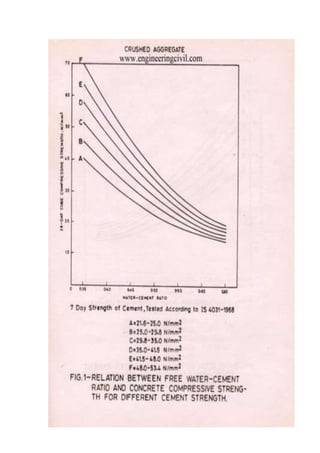
Step 2 SELECTION OF WATER-CEMENT RATIO
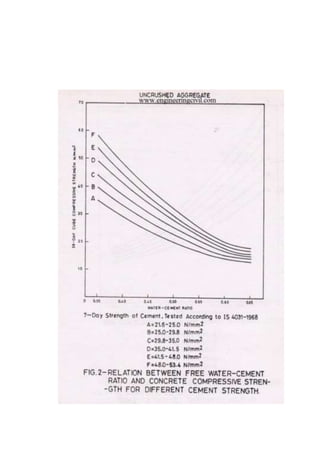
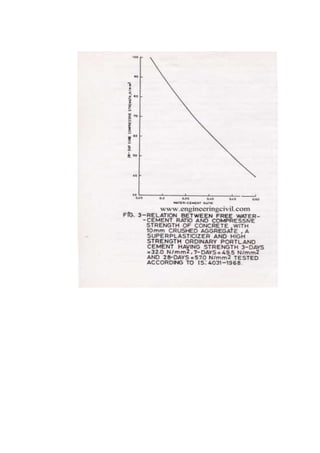
From Fig. 1 the free water-cement ratio required for the target strength of 43.3 N/mm2
with
crushed aggregates and 7 days cement strength of 37.5 N/mm2
(curve D) = 0.43 for first trial
Step 5 DETERMINATION OF DENSITY OF CONCRETE
Density from Table 6 found to be 2453 kg/m3
for cement content of 330 kg/m3
. For cement
content of 395 kg/m3
density =
2453 + 9.75 = 2460 kg/m3
say
Step 6 DETERMINATION OF QUANTITY OF AGGREGATES
2460 – 170 – 395 = 1895 kg/m3
Step 7 DETERMINATION OF FINE AGGREGATE CONTENT
From Table 8 proportion of fine aggregate (percent) found to be 38 – 47 for trial mix say
43%.
Fine aggregate content = 1895 x 0.43 = 815 kg/m3
Step 8 COURSE AGGREGATE CONTENT
1895 – 815 = 1080 kg/m3
The coarse aggregates are in two fractions 10 – 5 mm and 20 – 10 mm. Let these single sized
coarse aggregates be combine in the ratio of 1:2 to get a graded coarse aggregate as per IS:
383-1970.
The obtained grading of combined aggregates is given in Table 1.
Thus quantities of materials per cu.m of concrete on the basis of saturated surface dry
aggregates obtained:
Water = 170 kg
Cement, OPC = 395 kg
Fine aggregate (43%) = 815 kg
10 mm aggregate (19%) = 360 kg
20 mm aggregate (38%) = 720 kg
Retarder superplasticizer = 3.950 kg
CONCLUSIONS-:
1). Pumped concrete may be used for most all concrete construction, but is especially useful
where space or access for construction equipment is limited.
2. Although the ingredients of mixes placed by pump are the same as those placed by other
methods, depending quality control, batching, mixing, equipment and the services of
personnel with knowledge and experience are essential for successfully pumped concrete.
3. The properties of the fine normal weight aggregates (sand) play a more prominent role in
the proportioning of pumpable mixes than do those of the coarse aggregates. Sands having a
fineness modulus between 2.4 and 3.0 are generally satisfactory provided that the percentage
passing the 300 and 150 micron sieves meet the previously stated requirements. Zone II sand
as per IS: 383-1970 meet these requirements, and is suitable for pumped concrete.
4. Pumped concrete should not require any compromise in quality. To be pumpable, a high
level of quality control for assurance of uniformity must be maintained.
5. A simple method of concrete mix design will normal weight aggregates for pumped
concrete is described in the paper. The author had worked out tables and figures from Indian
materials by numerous trials. Therefore the proportions worked out with the help of these
tables and figures will have quite near approach to the mix design problems of the field.
Table 1 Grading of aggregates.
I.S.
Sieve
desig-
nation
Percentage passing by mass
Grading of aggregates % combine in example
Combined
grading
obtained
Required
grading
as per
Table 3
Fine
aggr-
egate
10 mm
aggre-
gate
20 mm
aggre-
gate
Fine
aggre-
gate
10 mm
aggre-
gate
20 mm
aggre-
gate
40 mm 100 100 100 43 19 38 100 100
20 mm 100 100 100 43 19 38 100 100
10 mm 100 90 8 43 17 3 63 60-73
4.75 mm 98 6 — 42 1 — 43 40-58
2.36 mm 87 — 37 — 37 28-46
1.18 mm 61 26 26 18-35
600
micron
39 17 17 12-25
300
micron
16 7 7 7-15
150
micron
5 2 2 2-6
Table 2 Suitable gradation of fine aggregate for pumped concrete
Percentage
passing IS;
sieve
designation
percentage
4.75 mm 2.36 mm 1.18 mm 600 micron 300 micron 150 micron
Fine
aggregate
(sand) 95-100 80-90 65-75 40-50 15-30 5-10
Table 3 Recommended combine aggregate gradation for pumped concrete.
Maximum
size of
aggregate
Percentage passing IS-sieve designation
40
mm
20
mm
10
mm
4.75
mm
2.36
mm
1.18
mm
600
micron
300
micron
150
micron
40 mm 100 67-77 47-60 37-52 28-42 18-32 12-22 7-14 2-4
20 mm 100 100 60-73 40-58 28-46 18-35 12-25 7-15 2-6
Table 4 Approximate free-water contents (kg/m3
) required to give a
workability of 50 mm – 100 mm slump for non-air entrained concrete.
Maximum size of aggregate
10 mm aggregate 20 mm aggregate 40 mm aggregate
Uncrushed Crushed Uncrushed Crushed Uncrushed Crushed
215 245 190 220 170 200
Table 5 Estimated wet density of fully compacted concrete, (kg/m3).
Maximum size of aggregate 10 mm
Free-water
content
(kg/m3
)
Specific gravity of combined aggregates on saturated and surface-
dry basis
2.4 2.5 2.6 2.7 2.8 2.9
180 2197 2267 2337 2407 2477 2547
190 2181 2251 2321 2391 2461 2531
200 2165 2235 2305 2375 2445 2515
210 2149 2219 2289 2359 2429 2499
220 2133 2203 2273 2343 2413 2483
230 2117 2187 2257 2327 2397 2467
The table is worked out for concrete having cement content of 330 kg/m3
. For each 20 kg
difference in cement content from 330 kg correct the weight per m3
3 kg in the same
direction.
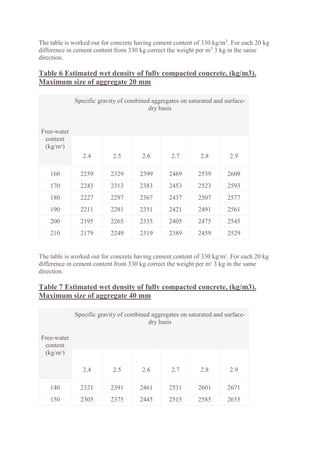
Table 6 Estimated wet density of fully compacted concrete, (kg/m3).
Maximum size of aggregate 20 mm
Free-water
content
(kg/m3
)
Specific gravity of combined aggregates on saturated and surface-
dry basis
2.4 2.5 2.6 2.7 2.8 2.9
160 2259 2329 2399 2469 2539 2609
170 2243 2313 2383 2453 2523 2593
180 2227 2297 2367 2437 2507 2577
190 2211 2281 2351 2421 2491 2561
200 2195 2265 2335 2405 2475 2545
210 2179 2249 2319 2389 2459 2529
The table is worked out for concrete having cement content of 330 kg/m3
. For each 20 kg
difference in cement content from 330 kg correct the weight per m3
3 kg in the same
direction.
Table 7 Estimated wet density of fully compacted concrete, (kg/m3).
Maximum size of aggregate 40 mm
Free-water
content
(kg/m3
)
Specific gravity of combined aggregates on saturated and surface-
dry basis
2.4 2.5 2.6 2.7 2.8 2.9
140 2321 2391 2461 2531 2601 2671
150 2305 2375 2445 2515 2585 2655
160 2289 2359 2429 2499 2569 2639
170 2273 2343 2413 2483 2553 2623
180 2257 2327 2397 2467 2537 2607
190 2241 2311 2381 2451 2521 2591
The table is worked out for concrete having cement content of 330 kg/m3
. For each 20 kg
difference in cement content from 330 kg correct the weight per m3
3 kg in the same
direction.
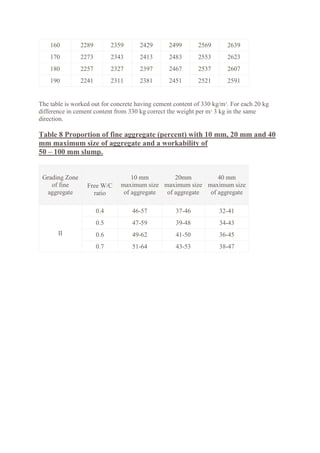
Table 8 Proportion of fine aggregate (percent) with 10 mm, 20 mm and 40
mm maximum size of aggregate and a workability of
50 – 100 mm slump.
Grading Zone
of fine
aggregate
Free W/C
ratio
10 mm
maximum size
of aggregate
20mm
maximum size
of aggregate
40 mm
maximum size
of aggregate
II
0.4 46-57 37-46 32-41
0.5 47-59 39-48 34-43
0.6 49-62 41-50 36-45
0.7 51-64 43-53 38-47

CONSTRUCTION TECHNIQUES.docx

  • 1.
    NATIONAL INSTITUTE OFTECHNOLOGY WARANGAL, HANUMAKONDA-506004, TELANGANA STATE, INDIA MINOR-1 SUBMITED BY – MANSI MISHRA ROLL NO. – 22CEM7R13 SUBJECT – CONSTRUCTION TECHNIQUES (CE5101) Under The Guidance Of: Dr. Shashi Ram Mam (Asst. professor, Dept. of civil engineering)
  • 2.
    QUESTION -1: MANUFACTURINGPROCESS OF CEMENT? ANSWER -1:  The cement is manufactured by integrating the calcareous component and argillaceous component in ratio of 3:1.  The calcareous component can be limestone, chalk, marine shells, marl whereas argillaceous components can be shale, clay, blast furnace slag, slate.  The calcareous component is used to derive the ingredient called lime whereas the argillaceous component composed of silica, alumina, iron oxide and other impurities.  Manufacturing of cement is done in following sequence of operation-: a) Mixing of raw ingredients. b) Burning c) Grinding  Manufacturing of cement can be done by any of the following methods -: 1) Wet process (Old method) 2) Dry process (New method) 1) Wet process :  It is the old method of manufacturing which is now a days obsoleted.  It is a costly method of manufacturing because it requires higher degree of fuel consumption, power consumption.  In this process the preheater is not used.  The chief advantage of wet process are low cost of excavating and grinding raw material (as dry process is used for hard raw material).  Accurate control of composition and homogeneity of the slurry.  Economical utilisation of fuel through elimination of separated drying operations.  On the other hand it utilises longer kilns and more fuel for burning and are less responsive to a variable clinker demand.
  • 3.
    FLOW DIAGRAM OFWET PROCESS 2) Dry process -:  It is new method of manufacturing which is trending now a days.  The fuel consumption, power consumption has been reduced to a greater extent by modifying the wet process.
  • 4.
    FLOW DIAGRAM OFDRY PROCESS  In a dry process, first calcareous components (limestone) and argillaceous component (clay) is reduced in size about 25mm in a crushers separately in a ball mill or tube mill.
  • 5.
  • 6.
    LONGITUDINAL SECTION OFA TUBE MILL  The calcareous component and argillaceous component after grinding are mixed with each other in a correct proportion (i.e. 3:1) and made it ready for next operation in rotary kiln.  Before feeding into rotary kiln the raw mix is allowed in preheater at a temperature of 850°C which reduces the burning time of raw mix in rotary kiln.  The crushed material are checked for content of𝐶𝑎𝐶𝑂3, Lime, Alumina, and Silica Fe2O3. Any component found short in quarried material is added separately. E.g. Silica is less than crushed sandstone is separately added to raw mix and if lime is less then high grade limestone is crushed and added into raw mix.  Now the raw mix after heating for 2-3 hours in preheater, it is allowed to feed into “Rotary Kiln”.
  • 7.
    ROTARY KILN Diameter =2.5 - 3 meter Length = 90-120 meter Volume = 706.3 m3 Gradient = 1/25 to 130 Revolution = 3 round/min about longer axis.  NODULE ZONE: In this zone calcination of limestone occurs and limestone get disintegrated into two parts i.e. lime and carbon dioxide. 𝑪𝒂𝑪𝑶𝟑 ∆ → 𝑪𝒂𝑶 + 𝑪𝑶𝟐(↑) As the CO2 is evaporated from the raw mix, the raw mix get converted into nodules.  BURNING ZONE: In this zone the ingredients of calcareous and argillaceous component i.e. lime, silica, alumina, iron oxide, etc. get united with each other at a very high temperature and this process is called fusion. 2𝐶𝑎𝑜 + 𝑆𝑖𝑂2 → 𝐶𝑎2𝑆𝑖𝑂4 = 𝐶2𝑆 ( 𝐷𝑖𝑎𝑐𝑎𝑙𝑐𝑖𝑢𝑚 𝑆𝑖𝑙𝑖𝑐𝑎𝑡𝑒)
  • 8.
    3𝐶𝑎𝑂 + 𝑆𝑖𝑂2→ 𝐶𝑎3𝑆𝑖𝑂5 = 𝐶3𝑆 (𝑇𝑟𝑖𝑐𝑎𝑙𝑐𝑖𝑢𝑚 𝑆𝑖𝑙𝑖𝑐𝑎𝑡𝑒) 3𝐶𝑎𝑂 + 𝐴𝑙2𝑂3 → 𝐶𝑎3𝐴𝑙2𝑂6 = 𝐶3𝐴 ( 𝑇𝑟𝑖𝑐𝑎𝑙𝑐𝑖𝑢𝑚 𝐴𝑙𝑢𝑚𝑖𝑛𝑎𝑡𝑒) 4𝐶𝑎𝑂 + 𝐴𝑙2𝑂3 + 𝐹𝑒2𝑂3 → 𝐶𝑎4𝐴𝑙2𝐹𝑒2𝑂10 = 𝐶4𝐴𝐹 ( 𝑇𝑒𝑡𝑟𝑎 − 𝑐𝑎𝑙𝑐𝑖𝑢𝑚 𝐴𝑙𝑢𝑚𝑖𝑛𝑎𝑡𝑒 − 𝑓𝑒𝑟𝑟𝑖𝑡𝑒) The product obtained from rotary kiln is called clinker which is composed of major compound (Bougue Compound) and Minor Compound i.e. Alkalies (Soda and Potash).  The clinker composed of (Bougue’s compound) and Minor compounds i.e. Alkalies.  The clinker is having flash set property i.e. quick setting property when it comes in contact with moisture. Therefore, the retarder is added to the clinker by its weight i.e. 2-3 percent.  The retarder is admixture which delays the setting time of the cement clinker.  The ultimately binding material is C-S-H gel i.e. Calcium silicate hydrate gel which is formed when the hydration of cement takes place. On burning clinker formed On grinding clinker On hydration QUESTION-2: CHEMICAL COMPOSITION OF CEMENT? ANSWER-2: Raw material for cement Limestone, clay, shale (calcareous and argillaceous material) Oxide composition in raw materials CaO, SiO2, Al2O3, Fe2O3 Compound composition C3S, C2S, C3A, C4AF Portland cements various types Products of hydration C-S-H gel + Ca(OH)2
  • 9.
     COMPOSITION OFCEMENT CLINKER -:  COMPOSITION OF DIFFERENT CEMENT INGREDIENTS-: The principal mineral compounds in Portland cement Formula Name Symbo l Percentage 1. Tricalcium silicate 3CaO.SiO2 Alite C3S 45-65% 2. Dicalcium silicate 2CaO.SiO2 Belite C2S 15-35% 3. Tricalcium aluminate 3CaO.Al2O3 Celite C3A 4-14% 4. Tetracalcium alumino ferrite 4CaO.Al2O3.Fe2O 3 Felite C4AF 10-18% ConstituentS Formula Percentage 1. Lime CaO 62-67% 2. Silica SiO2 17-25% 3. Alumina Al2O3 3-8% 4. Calcium sulphate CaSO4 3-4% 5. Iron oxide Fe2O3 3-4% 6. Magnesia MgO 1-3% 7. Sulphur S 1-3% 8. Alkalies Na2O, K2O 0.2-1%
  • 10.
     Compostion ofcement clinkers: 1. Tricalcium silicate-:  It undergoes hydration within a week or two week after the addition of water in cement, hence is responsible for development of early strength.  If in any construction early strength is required proportion of C3S is increased as in :-  Pavement construction  Prefabricated structures  Cold weather concreting  Where formwork is to be reused for speedy construction  It is observed to have best Cementous property amongst all the bouge’s compounds.  It also increases the resistance of cement against frost action (freezing and thawing).  In real terms its effect on heat of hydration is more than C3A.  Ca (OH) 2 released during hydration reduces the tendency of corrosion in reinforcement. 𝑪𝟑𝑺 + 𝑯𝟐𝑶 → 𝑪 − 𝑺 − 𝑯 𝑮𝒆𝒍 + 𝑪𝒂(𝑶𝑯)𝟐  C-S-H Gel is Cementous compound possessing binding property.  C-S-H Gel (calcium silicate hydrate gel) also known as thomnohydrite gel+ tobermorite gel. 2. Dicalcium silicate-:  It undergoes hydration within a year, so after the addition of water into the cement hence is responsible for ultimate or progressive strength in cement.  It also increases the resistance of cement against the attack of chemicals and acids.  If in any construction progressive strength is required proportion of C2S is increased for example- hydraulic structures like dams, weirs , barrage , bridges , etc. 3. Tricalcium aluminate -:  It undergoes hydration within 24 hours of addition of water into the cement, hence is responsible for flash setting of cement.  It produces maximum heat during its hydration process thereby results in loss of water added in cement for hydration, hence leads to development of the cracks over the surface during setting process moreover also reduces the strength by inhibiting complete hydration.  It is referred as harmful ingredient of cement.
  • 11.
    4. Tetra calciumalumino ferrate-:  It also undergoes hydration within 24 hours of addition of water into the cement, hence is responsible for flash setting of cement.  It is observed to have worst cementing property amongst all the bouges compounds.  It also reduces the resistance of cement against the attack of sulphur.  It has no engineering use as it does not impart any property to the cement.  BINDING PROPERTY (STRENGTH) -:  RATE OF HYDRATION(ROH) -:  HEAT OF HYDRATION(HOH) -:  WATER REQUIRED FOR HYDRATION -:  Total heat of hydration of OPC H= aA+bB+cC+dD a,b,c,d, proportions of Bouges compounds A, B, C, D=Heat of hydration of respective bouge compound C3S > C2S > C3A > C4AF C4AF > C3A > C3S > C2S C3A >C3S > C4AF> C2S C3S >C2S >C3A ≅ C4AF
  • 12.
     COMPOSITION OFCEMENT INGREDIETS-: 1. Lime -:  It imparts strength and soundness to the cement.  If it is in excess it makes the cement unsound causes it to expand and finally disintegrate.  If it is in deficiency, it reduces the strength and causes the cement to set quickly. 2. Silica-:  It also imparts strength to the cement.  If it is in excess, strength of cement is increased but it also increases the setting time of cement. 3. Alumina-:  It imparts quick setting property to the cement.  It acts as a flux and helps in reducing clinkering temperature.  If it is in excess it weakens the cement. 4. Calcium sulphate-:  It is generally added in the form of Gypsum.  It helps in increasing the initial setting time of the cement. 5. Iron oxide-:  IIt imparts strength, hardness and colour to cement. 6. Magnesia-:  It imparts strength, hardness, and colour to the cement but if it is in excess it makes the cement unsound. 7. Sulphur-:  Sulphur in cement is also responsible for volume changes in it thereby leads to its unsoundness.
  • 13.
    8. Alkalies-:  Alkaliesin cement leads to efflorescence, thereby causes the development of stains over the surface of structure in which it is used for construction.  Alkalies undergoes expansive reactions with aggregates, thereby leads to its disintegration.  Alkalies also accelerate the setting of cement paste.  When all the ingredients of cement as mentioned are inter grinded and burnt, they fuse with each other and leads to the formation of complex chemical compound termed as “bouge’s compound” which in actual are responsible for the properties of cement. QUESTION-3: DIFFERENCE BETWEEN OPC AND PPC % COMPOSITION OF MATERIALS? ANSWER-:  PPC (Portland Pozzolana Cement) is a variant of OPC (Ordinary Portland Cement). These two type of cement differs from each other in terms of component, strength, heat generation, the percentage of several components, durability, grades, cost, eco-friendly nature, application, setting time, curing period etc.  Difference between OPC and PPC -: s.no. Content OPC (Ordinary Portland cement) PPC(Portland Pozzolana cement) 1. Definition A mixture of limestone and other raw materials like argillaceous, calcareous, gypsum is prepared and then grinded to prepare OPC. PPC is prepared by adding Pozzolanic materials to OPC. So, the main components are OPC, Clinker, gypsum and pozzolanic materials (15~35%) which includes calcined clay, volcanic ash, fly ash or silica fumes. 2. Strength Initial strength is higher than PPC. PPC has higher strength than OPC over a longer period of time. 3. Heat of hydration Generates more heat than PPC in hydration reaction which makes it less suitable for mass casting. It has a slow hydration process and thus generates less heat than OPC. 4. Durability Less durable in aggressive weather. More durable in aggressive weather.
  • 14.
    5. Cost Costlierthan PPC. Cheaper than OPC. 6. Environmental Impact Emits CO2 during the manufacturing process. It constitutes industrial and natural waste which makes it eco-friendly. 7. Application/uses It is suitable where fast construction is required but not suitable for mass concreting due to heat issue as mentioned above. It is suitable for all types of construction work. For example RCC casting of buildings, mass concreting for bridges and even plastering and other non- structural works. 8. Setting Time Lower than PPC. Its initial setting time is 30 minutes and final setting time is 280 minutes. Its faster setting time helps faster construction. Setting time of PPC us higher than OPC. Its initial setting time is 30 minutes and final setting time is 600 minutes. Its slower setting time helps to get better finishing. 9. Fineness OPC has finiteness of 225 sq.m/kg. It has lower fineness than PPC. So, it has higher permeability resulting lower durability. OPC has finiteness of 300 sq.m/kg. It has higher fineness than OPC. So, it has lower permeability resulting in higher durability. 10. Grades available 33 Grade, 43 Grade, and 53 Grade OPC cement are available. No specified grade of PPC cement is available. 11. Workability Lower than PPC. Higher than OPC. 12. Resistance against chemical attack It has lower resistance against alkalis, sulphates, chlorides etc. It has higher resistance against alkalis, sulphates, chlorides etc. PPC Cement: Pozzolana is a natural or artificial material which contains silica in the reactive form. Portland Pozzolana Cement is cement manufactured by combining Pozzolanic materials. This cement comprises of OPC clinker, gypsum and pozzolanic materials in certain proportions. The Pozzolanic materials include fly ash, volcanic ash, calcined clay or silica fumes. These materials are added within a range of 15% to 35% by cement weight. OPC Cement or Ordinary Portland Cement (OPC) is manufactured by grinding a mixture of limestone and other raw materials like argillaceous, calcareous, gypsum to a powder. This cement is available in three types of grades, such as OPC 33 grade, OPC 43 grade and OPC 53 grade. OPC is the most commonly used cement in the world. This type of cement is preferred where fast pace of construction is done. However, the making of OPC has reduced to a great extent as blended cement like PPC has advantages, such as lower environmental pollution, energy consumption and more economical.
  • 15.
     Portland PozzolanaCement is a variation of Ordinary Portland Cement. Pozzolana materials namely fly ash, volcanic ash, are added to the OPC so that it becomes PPC. Pozzolana materials are added to the cement in the ratio of 15% to 35% by weight.  Both are ecofriendly materials but Pozzolana Cement uses natural and industrial waste thus reducing the environmental pollution.  Both OPC and PPC are commonly used cements in construction. These days, PPC is used as a substitute of OPC. PPC is a variation of OPC which adds a mixture of a pozzolanic material that helps to enhance the strength of the concrete. PPC also brings down the amount of OPC requirement in making concrete. Interestingly, it is a green material that contribute towards sustainable development. Considering these factors, PPC has a slight edge over OPC.  PPC is believed to be future product considering it various applications in the construction industry. They are suitable to use in hostile environmental conditions. They can be reliably utilized in the construction of marine structures, masonry mortars and plastering, hydraulic structures. Besides, they are popularly used in mass concreting works, such as dykes, sewage pipes, dams, etc. PPC is also employed in all other applications where OPC is used. However, OPC is the most commonly used cement worldwide. The cost of production is not expensive making it the sought after cement in the building industry. They are widely used for the construction of high-rise buildings, roads, dams, bridges, flyovers. Also, OPC is used for making grouts and mortars. OPC is ideal for the construction of residential and industrial complexes. QUESTION-4: HOW CHEMICAL COMPOSITION AND FINENESS OF CEMENT AFFECTS THE STRENGTH OF CONCRETE? ANSWER-:  The fineness of cement affects hydration rate, and in turn, the strength. Increasing fineness causes an increased rate of hydration, high strength, and high heat generation.  Bleeding can be reduced by increasing fineness. However, increased fineness can also lead to the requirement of more water for workability, resulting in a higher possibility of dry shrinkage.  The increased surface area-to-volume ratio will ensure a more available area for water-cement interaction per unit volume. Therefore finer cement reacts faster with water and earlier strength gain.  The finer the cement particles are, the larger the total surface area is and the bigger the area contacting with water is. Thus, the hydration will be quick, the setting and hardening will be accelerated correspondingly, and the early strength will be high.  Increasing the fineness increases the rate of hydration of cement, which increases the rate of gain in strength and also the rate at which heat is liberated.
  • 16.
     The strengthof concrete depends upon the strength of aggregates. Low quality of aggregate reduces the strength of concrete. The quantity of aggregate also affects the properties of hardened concrete. At constant cement content, the higher amount of aggregate reduces the concrete strength.  The finer the cement, the high the reactiveness of its particle. The compressive strength of the cement mortar is also increased with an increase in the fineness of the cement particle sizes.  The finer the cement particles are, the larger the total surface area is and the bigger the area contacting with water is. Thus, the hydration will be quick, the setting and hardening will be accelerated correspondingly, and the early strength will be high. QUESTION-5: ENLIST TEST PERFORMED ON STEEL, CEMENT, SAND, COARSE AGGREGATE BEFORE USING IT IN A CONSTRUCTION? ANSWER-:  Test performed on steel-: 1. Tensile test 2. Compression test 3. Bending test 4. Brinell hardness test 5. Rockwell hardness test 6. Impact test 7. Torsion test  Test performed on cement-:  Laboratory tests for cements- 1. Fineness Test (Sieve method, Air permeability test). 2. Normal Consistency Test (Vicat apparatus). 3. Initial Setting Time Test. 4. Final Setting Time Test. 5. Compressive Strength Test ( UTM Machine) 6. Soundness Test (Le-Chatelier’s Method, Autoclave test). 7. Heat of Hydration Test. 8. Tensile Strength Test (Briquette test). 9. Chemical Composition Test. 10. Specific Gravity Test.  Field tests for cement- 1.Colour: Grey colour with a light greenish shade. 2. Physical properties: Cement should feel smooth when rubbed in between the fingers. 3. If hand is inserted in a bag or heap of cement, it should feel cool. 4. If a small quantity of cement is thrown in a bucket of water, it should sink and should not float on the surface.
  • 17.
    5. Presence oflumps: Cement should be free from lumps.  Test performed on sand-: 1. Rubbing Test- Rub the sample of the sand with wet palms. Good clean sand will not stick to the hand, whereas sand with clay will stick and change the colour of the palm. You need to test it for “silt content” on site. 2. Silt Content Test- Take a glass of water and add some quantity of sand and stir the mix. Now allow the mix to settle and observe it after an hour. Clean sand will settle immediately but if it forms the distinct top layer of silt than sand contains silt or clay particles.The thickness of the silt layer should not exceed the thickness of the sand layer by 8%, if it contain more than 8% the sand should be washed with clear water And also if fine aggregate containing more than allowable percentage of silt shall be washed so as to bring the silt content within allowable limits. 3. Test for Grading of sand. 4. Organic Impurties test- To find organic impurities in the sand, you should repeat the procedue of silt content test and add caustic soda (salt) int the glass of water .If the water changes the colour to brown,then there must be some organic impurities. 5. Visualization Test- The size of particles and sharpness of sand (fine aggregates) is checked by visualization. Sand should be free from organic impurities (like shell, shingle, and other impurities) or they should be in limits which are easily identified by visualization. 6. Taste Test- You Should taste a pinch of sand and if it taste salty, the salt must be present in sand and hence it should not be used at all in any construction. Such sand is naturally from the river but either it is sea sand or from an area of river frequently affected by tidal water near the sea. 7. Clay Test- The presence of clay in the sand effect the performance of the concrete strength. So the presence of clay in sand can be detected by doing two physical test on sand  Take a some amount of sand in to your hand and drop it in to the glass which contain water. After drooping the sand than shake the glass. If clay is present in the sand it will make a separate layer above the water surface. So it indicate sand is not good.  In another simple test take some amount of sand in your hand and then drop it. If sand stick in to your fingers it indicate the presence of clay in sand.  Test performed on coarse aggregate-: 1.Crushing test. 2.Abrasion test. 3.Impact test. 4.Soundness test. 5.Shape test. 6.Specific gravity and water absorption test. 7.Bitumen adhesion test.
  • 18.
    QUESTION-6: ENLIST 5ADMIXTURES FOR ENHANCING CONCRETE PROPERTIES? ANSWER-:  5 ADMIXTURES FOR ENHANCING CONCRETE PROPERTIES- 1. Air entrainers [wood-derived acid salts (vinsol resins and wood rosins) and synthetic resins]. 2. Retarders [calcium sulphate or gypsum, Starch, cellulose products, common sugar, salts of acids]. 3. Accelerators [Triethenolamine, calcium formate, silica fume, calcium chloride, finely divided silica gel etc.]. 4. Plasticizers (water reducers) [phthalates, phosphates, carboxylic acid esters, epoxidized fatty acid esters, polymeric polyesters, modified polymers; liquid rubbers, and plastics, Nitrile Butadiene Rubber (NBR), chlorinated PE, EVA, etc.; paraffinic, aromatic]. 5. Superplasticizers (High range water reducers) [sulphonated melamine formaldehyde (SMF), sulphonated naphthalene formaldehyde (SNF), modified lignosulphonates (MLS) and polycarboxylate derivatives]. QUESTION-7: SHORT NOTE ON READY MIXED CONCRETE? ANSWER-: As the name indicates, Ready Mixed Concrete (RMC) is the concrete which is delivered in the ready- to-use manner. RMC is defined by the American Concrete Institute’s Committee 116R-90 as: "Concrete that is manufactured for delivery to a purchaser in a plastic and unhardened state". The Indian Standard Specification IS 4926:2003 defines RMC as: "Concrete mixed in a stationary mixer in a central batching and mixing plant or in a truck-mixer and supplied in fresh condition to the purchaser either at the site or into the purchaser's vehicles". In India, concrete has traditionally been produced on site with the primitive equipment’s and use of large labour force. Ready mixed concrete is an advanced technology, involving a high degree of mechanization and automation. A typical RMC plant consists of silos and bins for the storage of cement and aggregates respectively, weigh batchers for proportioning different ingredients of concrete, high efficiency mixer for thorough mixing of ingredients, and a computerized system
  • 19.
    controlling the entireproduction process. The quality of the resulting concrete is much superior to site-mixed concrete. QUESTION-8: ENLIST 5 PLASTICIZERS AND 5 SUPERPLASTICIZERS WATER REDUCING? ANSWER-:  5 Plasticizers- 1. Citrates, 2. Benzoates, 3. Ortho-phthalates, 4. Terephthalates, 5. Adipates.  5 Superplasticizers- 1. Sulphonated melamine formaldehyde (SMF). 2. Sulphonated naphthalene formaldehyde (SNF). 3. Modified lignosulphonates (MLS). 4. Polycarboxylate derivatives. 5. Mixture of saccharates and acid amines. QUESTION-9: DEFINE AIR ENTRAINING AGENTS? ANSWER-: We intentionally entrain microscopic air bubbles in concrete to enhance its durability against freeze and thaw. Air entraining agent or pore-forming agents are admixtures that are used to incorporate air into the concrete mix. They enhance the workability of concrete and improve
  • 20.
    resistance against saltscaling or freeze and thawing. In normal concrete, the air bubbles are still there but they are just 1 to 3% by volume. So, to increase their percentage, an amount of AEA is added in the concrete. The addition of such an admixture in the concrete is referred to as air entrainment. So, if we’re working on a concrete project where it is exposed to free-thaw cycle and you need to enhance resistance of concrete against deicer chemicals, you need to use air entraining agent. Air entraining agents are added at an amount of 0.001 to 0.1 % by weight of cement. However, this amount depends on the mix design, type of material, and mixing condition. The most common of all air entraining agent is a surfactant. It is a surface active substance and is a type of chemical that includes a detergent. So, when they are added, air bubbles are produced during mixing or easy flowing concrete. These bubbles survive till the concrete gets hardened. AEA decreases the surface tension of fresh concrete mixture and thus it increases the workability of fresh concrete and reduces segregation and/or bleeding.  Following are some of the common Air entraining agents: 1. surface-active substances – organic 2. substances that produce gas pores or bubbles 3. solid substances that are inorganic and are granulated in foam form from polymers 4. Biodegradable polymers.  Purpose of using air entraining agent- There are two primary reasons of using air entraining agents in concrete: 1. To increase durability – Air entrainment enhances the resistance of concrete against freeze and thaw moreover it avoids segregation. 2. To increase workability – air bubbles make concrete a good slump which is good for workability. QUESTION-10: WRITE SHORT NOTE ON CONCRETE PUMPING MECHANISM AND REQUIREMENT? a) HOW THIS IS PREPARED, MATERIALS INVOLVED, SIZE AND DIMENSION OF AGGREGATE? b) MIX PROPERTIES, PROPORTION, FLOWABILITY, SLUMP VALVE? ANSWER-: Pumped concrete may be defined as concrete that is conveyed by pressure through either rigid pipe or flexible hose and discharged directly into the desired area. Pumping may be used for most all concrete construction, but is especially useful where space or access for
  • 21.
    construction equipment islimited. Pumping equipment consists of pumps which are three types: a) Piston type concrete pump b) pneumatic type concrete pump c) and squeeze pressure type concrete pump. Other accessories are rigid pipe lines, flexible hose and couplings etc. A pumpable concrete, like conventional concrete mixes, requires good quality control, i.e., properly graded uniform aggregates, materials uniformly and consistently batched and mixed thoroughly. Depending on the equipment, pumping rates will vary from 8 to 70 m3 of concrete per hour. Effective pumping range will vary from 400 to 1900 meters horizontally, or 100 to 600 meters vertically. Cases have been documented in which concrete has been successfully pumped horizontally 2432 meters and beyond 600 meters vertically upward. CONCRETE FOR PUMPING-: For the successful pumping of a concrete through a pipeline it is essential that the pressure in the pipeline is transmitted through the concrete via the water in the mix and not via the aggregate, in effect, this ensures the pipeline is lubricated. If pressure is applied via the aggregate it is highly likely that the aggregate particles will compact together and against the inside of the pipe to form a blockage; the force required to move concrete under these conditions is several hundred times that required for a lubricated mix. If, however, pressure is to be applied via the water, then it is important that the water is not blown through the solid constituents of the mix; experience shows that water is relatively easily pushed through particles larger than about 600 microns in diameter and is substantially held by particles smaller than this. In the same way, the mixture of cement, water and very fine aggregate particles should not be blown through the voids in the coarse aggregate. This can be achieved by ensuring that the aggregate grading does not have a complete absence of material in two consecutive sieve sizes – for example, between 10 mm and 2.36 mm. In effect any size of particle must act as a filter to prevent excessive movement of the next smaller size of material. BASIC CONSIDERATIONS -:
  • 22.
    (a) Cement content-: Concretewithout admixtures and of high cement content, over about 460 kg/m3 are liable to prove difficult to pump, because of high friction between the concrete and the pipeline. Cement contents below 270 to 320 kg/m3 depending upon the proportion of the aggregate may also prove difficult to pump because of segregation within the pipe line. (b) Workability-: The workability of pumped concrete in general have a average slump of between 50 mm and 100 mm. A concrete of less than 50 mm slumps are impractical for pumping, and slump above 125 mm should be avoided. In mixtures with high slump, the aggregate will segregate from the mortar and paste and may cause blocking in the pump lines. The mixing water requirements vary from different maximum sizes and type of aggregates. The approximate quantity of water for a slump of 50 mm and 100 mm is given in table 4. In high strength concrete due to lower water-cement ratio and high cement concrete workability is reduced with the given quantity of water per cu.m of concrete. In such case water reducing admixtures are useful. In the addition of this type of admixtures at normal dosage levels to obtain a higher workability for a given concrete mix, there is no necessity to make any alteration to the mix design from that produced for the concrete of the initial lower slump. There is generally no loss of cohesion or excess bleeding even when the hydroxycarboxylic acid materials are used. If this class of product is used to decrease the water cement ratio, again no change in mix design will be required, although small alterations in plastic and hardened density will be apparent and should be used in any yield calculations. A loss of slump during pumping is normal and should be taken into consideration when proportioning the concrete mixes. A slump loss of 25 mm per 300 meters of conduit length is not unusual, the amount depending upon ambient temperature, length of line, pressure used to move the concrete, moisture content of aggregate at the time of mixing, truck-haulage distance, whether mix is kept agitated during haulage etc. The loss is greater for hose than for pipe, and is sometimes as high as 20 mm per 30 meter. (c) Aggregates-: The maximum size of crushed aggregate is limited to one-third of the smallest inside diameter of the hose or pipe based on simple geometry of cubical shape aggregates. For uncrushed (rounded) aggregates, the maximum size should be limited to 40 percent of the pipe or hose diameter. The shape of the coarse aggregate, whether crushed or uncrushed has an influence on the mix proportions, although both shapes can be pumped satisfactorily. The crushed pieces have a larger surface area per unit volume as compared to uncrushed pieces and thus require relatively more mortar to coat the surface. Coarse aggregate of a very bad particles shape should be avoided. Difficulties with pump mixed have often been experienced when too large a proportion of coarse aggregate is used in an attempt to achieve economy by reducing the amount of cement such mixes are also more difficult and costly to finish.
  • 23.
    The grading ofcoarse aggregate should be as per IS: 383-1970. If they are nominal single sized then 10 mm and 20 mm shall be combine in the ratio of 1:2 to get a graded coarse aggregate. In the same way 10 mm, 20 mm and 40 mm aggregates shall be combine in the ratio of 1:1.5:3 to get a graded coarse aggregate. Fine aggregate of Zone II as per IS: 383-1970 is generally suitable for pumped concrete provided 15 to 30 percent sand should pass the 300 micron sieve and 5 to 10 percent should pass the 150 micron sieve. Fine aggregate of grading as given in Table 2, is best for pumped concrete. The proportion of fine aggregate (sand) to be taken in the mix design is given in Table 8. However, the lowest practical sand content should be established by actual trial mixes and performance runs. In practice it is difficult to get fine and coarse aggregates of a particular grading. In absence of fine aggregate of required grading they should be blended with selected sands to produce desired grading, and then combine with coarse aggregates to get a typed grading as per Table 3. (d) Pumping-: Before the pumping of concrete is started, the conduit should be primed by pumping a batch of mortar through the line to lubricate it. A rule of thumb is to pump 25 litres of mortar for each 15 meter length of 100 mm diameter hose, using smaller amounts for smaller sizes of hose or pipe. Dump concrete into the pump-loading chamber, pump at slow speed until concrete comes out at the end of the discharge hose, and then speed up to normal pumping speed. Once pumping has started, it should not be interrupted (if at all possible) as concrete standing idle in the line is liable to cause a plug. Of great importance is to always ensure some concrete in the pump receiving hopper at all times during operation, which makes necessary the careful dispatching and spacing of ready-mix truck. (e) Testing for pumpability-: There is no recognized laboratory apparatus or precise piece of equipment available to test the pumpability of a mix in the laboratory. The pumpability of the mix therefore be checked at site under field conditions. (f) Field practices-: The pump should be as near the placing area as practicable and the entire surrounding area must have adequate bearing strength to support the concrete delivery trucks, thus assuring a continuous supply of concrete. Lines from the pump to the placing area should be laid out with a minimum of bends. For large placing areas, alternate lines should be installed for rapid connection when required. When pumping downward 15 m or more it is desirable to provide an air release valve at the middle of the top bend to prevent vacuum or air buildup. When pumping upward it is desirable to have a valve near the pump to prevent the reverse flow of concrete during the fitting of clean up equipment, or when working on the pump. ILLUSTRATIVE EXAMPLE ON CONCRETE MIX DESIGN-: a) Characteristic compressive strength required in the field at 28 days = 35 N/mm2 b) Type and size of coarse aggregate = 20-10 mm and 10-5 mm crushed aggregates as per grading given in Table 1.
  • 24.
    c) Fine aggregate= River sand of Zone II as per IS: 383-1970.The sand grading is given in Table 1. d) Degree of workability = 50 – 100 mm slump at pour after 90 Minutes. e) Minimum cement content = 340 kg/m3 f) Maximum free water/cement ratio = 0.45 g) Standard deviation for good site control = 5.0 N/mm2 h) Accepted proportion of low results= 5%, Value of t = 1.65 i) Type of cement and 7 days Compressive strength. = OPC, 7 days compressive strength = 37.5 N/mm2 j) Specific gravity of: 10 mm aggregate = 2.7 20 mm aggregate = 2.7 Fine aggregate (river sand) = 2.7 k) Retarder Superplasticizer = With the given requirements of workability a dosage of 1% bwc will give 15% reduction in water. The step-by-step operations in mix design are enumerated below: Step 1 TARGET MEAN STRENGTH OF CONCRETE 35 + 5.0 x 1.65 = 43.3 N/mm2 Step 2 SELECTION OF WATER-CEMENT RATIO From Fig. 1 the free water-cement ratio required for the target strength of 43.3 N/mm2 with crushed aggregates and 7 days cement strength of 37.5 N/mm2 (curve D) = 0.43 for first trial Step 5 DETERMINATION OF DENSITY OF CONCRETE Density from Table 6 found to be 2453 kg/m3 for cement content of 330 kg/m3 . For cement content of 395 kg/m3 density = 2453 + 9.75 = 2460 kg/m3 say
  • 25.
    Step 6 DETERMINATIONOF QUANTITY OF AGGREGATES 2460 – 170 – 395 = 1895 kg/m3 Step 7 DETERMINATION OF FINE AGGREGATE CONTENT From Table 8 proportion of fine aggregate (percent) found to be 38 – 47 for trial mix say 43%. Fine aggregate content = 1895 x 0.43 = 815 kg/m3 Step 8 COURSE AGGREGATE CONTENT 1895 – 815 = 1080 kg/m3 The coarse aggregates are in two fractions 10 – 5 mm and 20 – 10 mm. Let these single sized coarse aggregates be combine in the ratio of 1:2 to get a graded coarse aggregate as per IS: 383-1970. The obtained grading of combined aggregates is given in Table 1. Thus quantities of materials per cu.m of concrete on the basis of saturated surface dry aggregates obtained: Water = 170 kg Cement, OPC = 395 kg Fine aggregate (43%) = 815 kg 10 mm aggregate (19%) = 360 kg 20 mm aggregate (38%) = 720 kg Retarder superplasticizer = 3.950 kg CONCLUSIONS-: 1). Pumped concrete may be used for most all concrete construction, but is especially useful where space or access for construction equipment is limited. 2. Although the ingredients of mixes placed by pump are the same as those placed by other methods, depending quality control, batching, mixing, equipment and the services of personnel with knowledge and experience are essential for successfully pumped concrete. 3. The properties of the fine normal weight aggregates (sand) play a more prominent role in the proportioning of pumpable mixes than do those of the coarse aggregates. Sands having a fineness modulus between 2.4 and 3.0 are generally satisfactory provided that the percentage passing the 300 and 150 micron sieves meet the previously stated requirements. Zone II sand as per IS: 383-1970 meet these requirements, and is suitable for pumped concrete. 4. Pumped concrete should not require any compromise in quality. To be pumpable, a high level of quality control for assurance of uniformity must be maintained. 5. A simple method of concrete mix design will normal weight aggregates for pumped concrete is described in the paper. The author had worked out tables and figures from Indian materials by numerous trials. Therefore the proportions worked out with the help of these tables and figures will have quite near approach to the mix design problems of the field.
  • 30.
    Table 1 Gradingof aggregates. I.S. Sieve desig- nation Percentage passing by mass Grading of aggregates % combine in example Combined grading obtained Required grading as per Table 3 Fine aggr- egate 10 mm aggre- gate 20 mm aggre- gate Fine aggre- gate 10 mm aggre- gate 20 mm aggre- gate 40 mm 100 100 100 43 19 38 100 100 20 mm 100 100 100 43 19 38 100 100 10 mm 100 90 8 43 17 3 63 60-73 4.75 mm 98 6 — 42 1 — 43 40-58 2.36 mm 87 — 37 — 37 28-46 1.18 mm 61 26 26 18-35 600 micron 39 17 17 12-25 300 micron 16 7 7 7-15 150 micron 5 2 2 2-6 Table 2 Suitable gradation of fine aggregate for pumped concrete Percentage passing IS; sieve designation percentage 4.75 mm 2.36 mm 1.18 mm 600 micron 300 micron 150 micron Fine aggregate (sand) 95-100 80-90 65-75 40-50 15-30 5-10 Table 3 Recommended combine aggregate gradation for pumped concrete.
  • 31.
    Maximum size of aggregate Percentage passingIS-sieve designation 40 mm 20 mm 10 mm 4.75 mm 2.36 mm 1.18 mm 600 micron 300 micron 150 micron 40 mm 100 67-77 47-60 37-52 28-42 18-32 12-22 7-14 2-4 20 mm 100 100 60-73 40-58 28-46 18-35 12-25 7-15 2-6 Table 4 Approximate free-water contents (kg/m3 ) required to give a workability of 50 mm – 100 mm slump for non-air entrained concrete. Maximum size of aggregate 10 mm aggregate 20 mm aggregate 40 mm aggregate Uncrushed Crushed Uncrushed Crushed Uncrushed Crushed 215 245 190 220 170 200 Table 5 Estimated wet density of fully compacted concrete, (kg/m3). Maximum size of aggregate 10 mm Free-water content (kg/m3 ) Specific gravity of combined aggregates on saturated and surface- dry basis 2.4 2.5 2.6 2.7 2.8 2.9 180 2197 2267 2337 2407 2477 2547 190 2181 2251 2321 2391 2461 2531 200 2165 2235 2305 2375 2445 2515 210 2149 2219 2289 2359 2429 2499 220 2133 2203 2273 2343 2413 2483 230 2117 2187 2257 2327 2397 2467
  • 32.
    The table isworked out for concrete having cement content of 330 kg/m3 . For each 20 kg difference in cement content from 330 kg correct the weight per m3 3 kg in the same direction. Table 6 Estimated wet density of fully compacted concrete, (kg/m3). Maximum size of aggregate 20 mm Free-water content (kg/m3 ) Specific gravity of combined aggregates on saturated and surface- dry basis 2.4 2.5 2.6 2.7 2.8 2.9 160 2259 2329 2399 2469 2539 2609 170 2243 2313 2383 2453 2523 2593 180 2227 2297 2367 2437 2507 2577 190 2211 2281 2351 2421 2491 2561 200 2195 2265 2335 2405 2475 2545 210 2179 2249 2319 2389 2459 2529 The table is worked out for concrete having cement content of 330 kg/m3 . For each 20 kg difference in cement content from 330 kg correct the weight per m3 3 kg in the same direction. Table 7 Estimated wet density of fully compacted concrete, (kg/m3). Maximum size of aggregate 40 mm Free-water content (kg/m3 ) Specific gravity of combined aggregates on saturated and surface- dry basis 2.4 2.5 2.6 2.7 2.8 2.9 140 2321 2391 2461 2531 2601 2671 150 2305 2375 2445 2515 2585 2655
  • 33.
    160 2289 23592429 2499 2569 2639 170 2273 2343 2413 2483 2553 2623 180 2257 2327 2397 2467 2537 2607 190 2241 2311 2381 2451 2521 2591 The table is worked out for concrete having cement content of 330 kg/m3 . For each 20 kg difference in cement content from 330 kg correct the weight per m3 3 kg in the same direction. Table 8 Proportion of fine aggregate (percent) with 10 mm, 20 mm and 40 mm maximum size of aggregate and a workability of 50 – 100 mm slump. Grading Zone of fine aggregate Free W/C ratio 10 mm maximum size of aggregate 20mm maximum size of aggregate 40 mm maximum size of aggregate II 0.4 46-57 37-46 32-41 0.5 47-59 39-48 34-43 0.6 49-62 41-50 36-45 0.7 51-64 43-53 38-47