IN
SCIENCE INSTRUCTION
AND ITS IMPORTANCE
GLENDA M. MORALES
Teacher III
UTILIZATION OF THE 7E MODEL
Utilization of the 7E Model
• One theory to explain the nature Learning and teaching process
is constructivism.
Jean Piaget – covered learning theories, teaching methods and education reform.
Constructivism recognizes that students are at different levels of
understanding and elicit a variety of ideas.
The 7E is patterned to the 4E and 5E models of the
constructivist approach where learning is based on Inquiry-
based approach.
• The central aim of teaching science today is to promote
purposeful addition into the knowledge. To meet this goal, it is
pertinent to bridge the gap between common knowledge, past
information, and predictions. The ability to bridge the gaps
helps the learners to grasp the comprehension of new ideas and
then use it for explanation of situations they are supposed to
face.
• Objectives of the 7E Model
• A. established knowledge on the status of methodology based
instruction
• B. to connect and transfer information and visualized events by
implementing the 7e instructional model
• C. help students develop the skill of finding solutions to
problem (experiential learning).
•Rudiments are very important for effective
learning. 7E Model is applied step by step so
that it enables to realize rudiments and
misconceptions at the first step and teachers
can provide opportunities to take measures
according to situation.
• The 7E Learning Cycle is an expansion of the 5E
Learning cycle... This places a greater emphasis
on prior knowledge that can be used as a
foundation for the learning to come. Elaborate
and evaluate are expanded into elaborate evaluate
and extend.
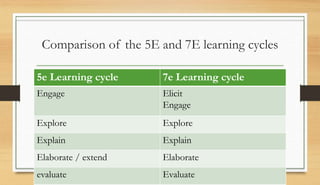
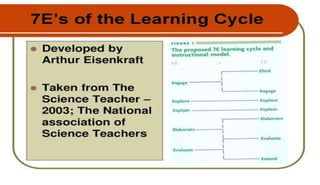
Comparison of the 5E and 7E learning cycles
5e Learning cycle 7e Learning cycle
Engage Elicit
Engage
Explore Explore
Explain Explain
Elaborate / extend Elaborate
evaluate Evaluate
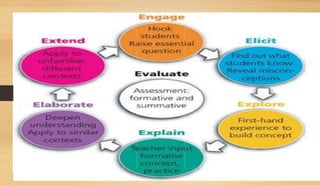
• 7E model consists of elicit, engage, explore, explain,
elaborate, evaluate and extend.
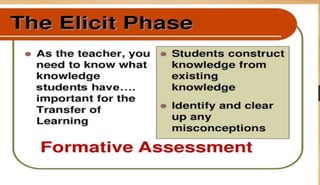
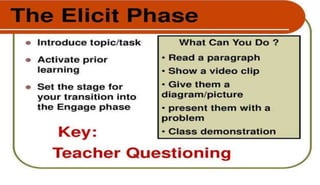
• Elicit – is the stage in which the prior knowledge of
the learner is elicited by questions and scenarios.
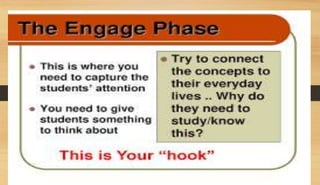
• Engage – is the stage in which events are associated with daily activities.
• Explore – is the stage in which students explores knowledge by showing
attitudes like scientists.
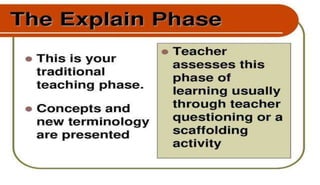
• Explain – is the process in which students try to make explanations about
their explorations.
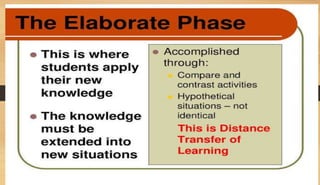
• In the elaborate stage – learners construct new knowledge.
• Evaluate stage, learners make comparisons and discuss their findings with
other learners in and outside their group.
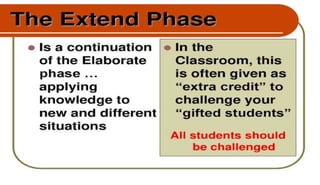
• Extend stage – is the one which students adapt their constructed knowledge
to another subject.
• These changes are not suggested to add
complexity, but rather to ensure instructions do
not omit crucial elements for learning from their
lessons while under the incorrect assumption they
are meeting the requirements of the learning
cycle.
Thank You!!!

UTILIZATION_OF_THE_7E_MODEL_IN_SCIENCE_I.pptx

  • 1.
    IN SCIENCE INSTRUCTION AND ITSIMPORTANCE GLENDA M. MORALES Teacher III UTILIZATION OF THE 7E MODEL
  • 2.
    Utilization of the7E Model • One theory to explain the nature Learning and teaching process is constructivism. Jean Piaget – covered learning theories, teaching methods and education reform. Constructivism recognizes that students are at different levels of understanding and elicit a variety of ideas. The 7E is patterned to the 4E and 5E models of the constructivist approach where learning is based on Inquiry- based approach.
  • 3.
    • The centralaim of teaching science today is to promote purposeful addition into the knowledge. To meet this goal, it is pertinent to bridge the gap between common knowledge, past information, and predictions. The ability to bridge the gaps helps the learners to grasp the comprehension of new ideas and then use it for explanation of situations they are supposed to face.
  • 4.
    • Objectives ofthe 7E Model • A. established knowledge on the status of methodology based instruction • B. to connect and transfer information and visualized events by implementing the 7e instructional model • C. help students develop the skill of finding solutions to problem (experiential learning).
  • 5.
    •Rudiments are veryimportant for effective learning. 7E Model is applied step by step so that it enables to realize rudiments and misconceptions at the first step and teachers can provide opportunities to take measures according to situation.
  • 6.
    • The 7ELearning Cycle is an expansion of the 5E Learning cycle... This places a greater emphasis on prior knowledge that can be used as a foundation for the learning to come. Elaborate and evaluate are expanded into elaborate evaluate and extend.
  • 7.
    Comparison of the5E and 7E learning cycles 5e Learning cycle 7e Learning cycle Engage Elicit Engage Explore Explore Explain Explain Elaborate / extend Elaborate evaluate Evaluate
  • 17.
    • 7E modelconsists of elicit, engage, explore, explain, elaborate, evaluate and extend. • Elicit – is the stage in which the prior knowledge of the learner is elicited by questions and scenarios.
  • 18.
    • Engage –is the stage in which events are associated with daily activities. • Explore – is the stage in which students explores knowledge by showing attitudes like scientists. • Explain – is the process in which students try to make explanations about their explorations.
  • 19.
    • In theelaborate stage – learners construct new knowledge. • Evaluate stage, learners make comparisons and discuss their findings with other learners in and outside their group. • Extend stage – is the one which students adapt their constructed knowledge to another subject.
  • 20.
    • These changesare not suggested to add complexity, but rather to ensure instructions do not omit crucial elements for learning from their lessons while under the incorrect assumption they are meeting the requirements of the learning cycle.
  • 21.