Journal of the Iranian Chemical Society
Nanocopper-mediated Direct Arylsulfonamidation of Aryl Halides with
Arylsulfonylazides
--Manuscript Draft--
Manuscript Number:
Full Title: Nanocopper-mediated Direct Arylsulfonamidation of Aryl Halides with
Arylsulfonylazides
Article Type: Original Paper
Corresponding Author: Issa Yavari
IRAN (ISLAMIC REPUBLIC OF)
Corresponding Author Secondary
Information:
Corresponding Author's Institution:
Corresponding Author's Secondary
Institution:
First Author: Issa Yavari
First Author Secondary Information:
Order of Authors: Issa Yavari
Yazdan Solgi
Majid Ghazanfarpour-Darjani
Salome Ahmadian
Order of Authors Secondary Information:
Abstract: An efficient protocol for direct arylsulfonamidation of aryl iodides and aryl bromides
using arylsulfonylazides catalyzed by copper nanoparticles is described.
Suggested Reviewers:
Powered by Editorial Manager® and Preprint Manager® from Aries Systems Corporation
1 | P a g e
Nanocopper-mediated Direct Arylsulfonamidation of Aryl
Halides with Arylsulfonylazides
I. Yavari*
and Y. Solgi, M. Ghazanfarpour-Darjani, S. Ahmadian
Department of Chemistry, Tarbiat Modares University, PO Box 14115-175, Tehran, Iran
An efficient protocol for direct arylsulfonamidation of aryl iodides and aryl bromides using
arylsulfonylazides catalyzed by copper nanoparticles is described.
Keywords: Arylsulfonyl azide, Aryliodide, Arylchloride, Cu NPs
*Corresponding author. E-mail: yavarisa@modares.ac.ir
INTRODUCTION
The copper-mediated C(aryl)-N bond formation is an important transformation in organic
synthesis and has been developed to include a wide range of substrates [1-3]. The foundation of
modern copper-mediated chemistry lies in the pioneering work of Ullmann and Goldberg [4].
Buchwald and co-workers extensively studied these reactions and developed an experimentally
simple and inexpensive catalytic system for these transformations [5-7].
N-Arylsulfonamide moiety is an important structural motif in many pharmaceutical
compounds [8]. Transition-metal-catalyzed N-arylation of sulfonamides offers a straightforward
method for the preparation of N-arylsulfonamides. Recently, the Cu-catalyzed coupling of aryl-
Manuscript
Click here to download Manuscript: Manuscript JICS.docx.docx Click here to view linked References
1
2
3
4
5
6
7
8
9
10
11
12
13
14
15
16
17
18
19
20
21
22
23
24
25
26
27
28
29
30
31
32
33
34
35
36
37
38
39
40
41
42
43
44
45
46
47
48
49
50
51
52
53
54
55
56
57
58
59
60
61
62
63
64
65
2 | P a g e
boronic acids, as well as, the Pd-catalyzed coupling of aryl bromides and aryl chlorides with
sulfonamides has been reported [9-13]. Most of the methods developed for synthesis of N-
arylsulfonamide derivatives are often troublesome and require strong bases, and expensive Pd
catalysts [14-17].
EXPERIMENTAL
All chemicals were obtained commercially and used without further purification. M.p.:
Electrothermal-9100 apparatus. IR Spectra: Shimadzu-IR-460 spectrometer; in cm−1
. 1
H- and
13
C-NMR Spectra: Bruker DRX-500 Avance instrumentat 500.1 and 125.7 MHz, resp.; δ in ppm,
J in Hz. MS: Finnigan-MAT-8430EI-MS mass spectrometer; at 70 eV; in m/z (rel. %). Elemental
analyses: Vario EL III CHNOS elemental analyzer. Scanning electron microscopy (SEM) images
were obtained using a Stereo Scan XL30 Philips.
General procedure
To a mixture of aryl halide 1 (1 mmol), sulfonylazide 2 (1.2 mmol), and CuI (0.1 mmol), ligand
(0.2 mmol) and K2CO3 (2 mmol) in DMF (4 mL) was added nano-Cu (53 nm), (0.5 mmol). The
mixture was stirred at 110 °C. After completion of the reaction [(24 h; TLC (AcOEt/hexane 1:5)
monitoring)], the mixture was diluted with CH2Cl2 (7 mL) and aqueous NH4Cl solution (5 mL),
stirred for 30 min and the layers separated. The aqueous layer was extracted with CH2Cl2 (5 mL
× 3) and the combined organic fractions dried (Na2SO4) and concentrated under reduced
pressure. Pure products were obtained by flash column chromatography [(silica gel (230–400
mesh; Merck), hexane/AcOEt 5:1)]. The copper nanoparticles were prepared according to
literature [19]. Compounds 3a [11], 3b [11], 3d [10], 3l [10], and 3n [9] are known.

1
2
3
4
5
6
7
8
9
10
11
12
13
14
15
16
17
18
19
20
21
22
23
24
25
26
27
28
29
30
31
32
33
34
35
36
37
38
39
40
41
42
43
44
45
46
47
48
49
50
51
52
53
54
55
56
57
58
59
60
61
62
63
64
65
3 | P a g e
4-Methyl-N-tosylbenzenamine (3c). Yield: 0.15 g (60%). Colorless solid. M.p. 99-
101°C. IR (KBr): 3280, 2921, 1510, 1329, 1160. 1
H-NMR: 2.21 (s, Me), 2.34 (s, Me), 7.03 (d, 3
J
= 8.4, 2CH), 7.07 (d, 3
J = 8.4, 2CH), 7.29 (d, 3
J = 8.2, 2CH), 7.63 (d, 3
J = 8.2, 2CH), 8.75 (s,
NH). 13
C-NMR: 20.6 (Me), 21.3 (Me), 122.1 (2 CH), 127.9 (2 CH), 130.2 (2 CH), 130.3 (2 CH),
134.9 (C), 136.2 (C), 142.0 (C), 144.2 (C). EI-MS: 261 (M+
, 6), 155 (6), 106 (100), 91 (24), 77
(23), 65 (12), 51 (4). Anal. calc. for C14H15NO2S (261.34): C, 64.34; H, 5.79; N, 5.36%. Found:
C, 64.6; H, 5.7; N, 5.5%.
4-Nitro-N-tosylbenzenamine (3e). Yield: 0.21 g (73%). Yellow solid. M.p. 197-199 °C.
IR (KBr):3326, 3081, 1510, 1333, 1150, 902, 671. 1
H-NMR: 2.36 (3H, s, Me), 7.37 (2 H, d, 3
J =
8.0 Hz, Ar), 7.45 (2 H, d, 3
J = 8.3 Hz, Ar), 8.0 (2 H, d, 3
J = 8.3 Hz, Ar), 9.79 (1 H, s, NH). 13
C
NMR (125.7 MHz, Acetone): δC = 20.5 (Me), 118.3 (2 CH), 125 (2 CH), 127.2 (2 CH), 129.9 (2
CH), 136.6 (C), 143.4 (C), 144.2 (C), 144.4 (C). EI-MS: 292 (M+
, 4), 155 (57), 91 (100), 77 (2),
65 (20), 51(2). Anal. calc. for C13H12N2O4S (292.31): C, 53.42; H, 4.14; N, 9.58%. Found: C,
53.6; H, 4.2; N, 9.5%.
4-Methoxy-N-tosylbenzenamine (3f). Yield: 0.16 g (58%). Colorless solid. M.p. 114-
116 °C. IR (KBr):3268, 2960, 1510, 1331, 1252, 1159, 910, 679. 1
H-NMR: 2.35 (3 H, s, Me),
3.71 (3 H, s, MeO), 6.79 (2 H, d, 3
J = 8.1 Hz, Ar), 7.07 (2 H, d, 3
J = 8.1 Hz, Ar), 7.29 (2 H, d, 3
J
= 8.2 Hz, Ar), 7.58 (2 H, d, 3
J = 8.2 Hz, Ar), 8.58 (s, NH). 13
C-NMR: 21.3 (Me), 55.6 (MeO),
115.0 (2 CH), 124.9 (2 CH), 128.0 (2 CH), 130.2 (2 CH), 129.3, 133.6 (C), 140.8 (C), 144.2 (C),
150.2 (C). EI-MS: 277 (M+
, 4), 155 (27), 123 (6), 91 (4), 77 (100), 65 (71), 51 (12). Anal. calc.
for C14H16NO3S (277.34): C, 60.63; H, 5.45; N, 5.05%. Found: C, 60.4; H, 5.5; N, 5.1%.
1
2
3
4
5
6
7
8
9
10
11
12
13
14
15
16
17
18
19
20
21
22
23
24
25
26
27
28
29
30
31
32
33
34
35
36
37
38
39
40
41
42
43
44
45
46
47
48
49
50
51
52
53
54
55
56
57
58
59
60
61
62
63
64
65
4 | P a g e
2-Nitro-N-tosylbenzenamine (3g). Yield: 0.18 g (63%). Yellow solid. M.p. 116-118 °C.
(KBr):3276, 3119, 1610, 1524, 1485, 1385, 1345, 1273. 1
H-NMR: 2.37 (3H, s, Me), 7.31 (1 H, t,
3
J = 7.8 Hz, Ar), 7.37 (2 H, d, 3
J = 8.2 Hz, Ar), 7.72 (1 H, t, 3
J = 7.8 Hz, Ar), 7.77 (1 H, d, 3
J =
8.1 Hz, Ar), 7.79 (2 H, d, 3
J = 8.2 Hz, Ar), 8.11 (1 H, d, 3
J = 8.1 Hz, Ar), 9.74 (s, NH). 13
C-
NMR: 21.4 (Me), 122.6 (CH), 125.3 (CH), 126.9 (2 CH), 128.2 (2 CH), 130.8 (CH), 134.1 (C),
136.5 (CH), 137.1 (C), 139.4 (C), 145.6 (C). EI-MS: 292 (M+
, 3), 155 (61), 91 (100), 77 (4), 65
(20), 52(6). Anal. calc. for C13H12N2O4S (292.31): C, 53.42; H, 4.14; N, 9.58%. Found: C, 53.6;
H, 4.2; N, 9.7%.
2-Nitro-1-phenylsulfonamidobenzene (3h). Yield: 0.17 g (64%). Yellow solid. M.p.
103-105 °C. IR (KBr): 3243, 3088, 1485, 1344, 1163, 915, 568. 1
H-NMR: 7.33 (1 H, t, 3
J = 7.2
Hz, Ar), 7.6 (2 H, t, 3
J = 7.8 Hz, Ar), 7.66-7.78 (3 H, m, Ar), 7.91 (2 H, d, 3
J = 7.8 Hz, Ar), 8.1 (1
H, d, 3
J = 7.7 Hz, Ar), 9.73 (s, NH). 13
C-NMR: 123 (CH), 125.6 (CH), 126.9 (2 CH), 128.1 (2
CH), 130.3 (CH), 133.8 (C), 134.6 (CH), 136.4 (CH), 139.5 (C), 145.4 (C). EI-MS: 278 (M+
, 4),
141 (55), 91 (100), 77 (23), 65 (14), 52(12). Anal. calc. for C12H10N2O4S (278.28): C, 51.79; H,
3.62; N, 10.07%. Found: C, 51.9; H, 3.7; N, 10.0%.
3-Triflouromethyl-N-tosylbenzenamine (3i). Yield: 0.18 g (59%). Colorless solid. M.p.
97-99 °C. IR (KBr): 3233, 2919, 1412, 1331, 1170, 933, 677. 1
H-NMR: 2.35 (3 H, s, Me), 7.33
(2 H, d, 3
J = 8.1 Hz, Ar) 7.38-7.55 (4 H, m, Ar), 7.72 (2 H, d, 3
J = 8.1 Hz, Ar) 9.33 (s, NH). 13
C-
NMR: 21.3 (Me), 117.2 (CH, q, 3
JCF = 3.7 Hz), 121.4 (CH, q, 3
JCF= 3.8 Hz), 124.4 (CH), 124.6
(CF3, q, 1
JCF = 270.2 Hz), 127.9 (2 CH), 130.5 (2 CH), 131.1 (CH), 131.7 (C, q, 2
J = 32.2 Hz),
137.5 (C), 139.8 (C), 144.9 (C). EI-MS: 315 (M+
, 3), 160 (5), 155 (52), 91 (100), 77 (2), 65 (20),
51 (2). Anal. calc. for C14H13F3NO2S (315.32): C, 53.17; H, 4.13; N, 4.44%. Found: C, 53.3; H,
4.2; N, 4.5%.
1
2
3
4
5
6
7
8
9
10
11
12
13
14
15
16
17
18
19
20
21
22
23
24
25
26
27
28
29
30
31
32
33
34
35
36
37
38
39
40
41
42
43
44
45
46
47
48
49
50
51
52
53
54
55
56
57
58
59
60
61
62
63
64
65
5 | P a g e
1-Phenylsulfonamido-3-trifluoromethylbenzene (3j). Yield: 0.18 g (60%). Colorless
solid. M.p. 68-70 °C, 0.18 g, yield: 60%. IR (KBr): 3263, 2926, 1415, 1329, 1165. 1
H-NMR:
7.39-7.84 (9 H, m, 2Ar), 9.38 (s, NH). 13
C-NMR: 118.1 (CH, q, 3
JCF = 3.8 Hz), 122.2 (CH, q, 3
JCF
= 3.8 Hz), 125.2 (CH), 124.6 (CF3, q, 1
JCF = 270.2 Hz), 128.4 (2 CH), 130.6 (2 CH), 131.1 (CH),
131.7 (CH), 132.3 (C, q, 2
JCF = 32.2 Hz), 134.5 (C), 140.21 (C), 141 (C). EI-MS: 301 (M+
, 4),
160 (9), 141 (48), 91 (100), 77 (4), 65 (23), 51 (2). Anal. calc. for C13H11F3NO2S (301.29): C,
51.65; H, 3.67; N, 4.63%. Found: C, 51.8; H, 3.6; N, 4.7%.
4-Cyano-N-tosylbenzenamine (3k). Yield: 0.16 g (61%). Colorless solid. M.p. 188-190
°C. IR (KBr): 3239, 2922, 2224, 1606, 1508, 1349, 1159. 1
H-NMR: 2.36 (3 H, s, Me), 7.36 (2 H,
d, 3
J = 8.1 Hz, Ar), 7.40 (2 H, d, 3
J = 8.3 Hz, Ar), 7.65 (2 H, d, 3
J = 8.3 Hz, Ar), 7.77 (2 H, d, 3
J =
8.1 Hz, Ar), 9.60 (s, NH). 13
C-NMR: 21.3 (Me), 107.5 (C), 119.1 (CN), 119.9 (2 CH), 127.9 (2
CH), 130.6 (2 CH), 134.3 (2 CH), 137.5 (C), 143.2 (C), 145.1 (C). EI-MS: 272 (M+
, 4), 155 (60),
156 (10), 117 (4), 91 (100), 77 (1), 65 (22), 51 (2). Anal. calc. for C14H12N2O2S (272.32): C,
61.75; H, 4.44; N, 10.29%. Found: C, 61.9; H, 4.5; N, 10.4%.
N-Tosyl-1-naphthylamine (3m). Yield: 0.17 g (58%). Colorless solid. M.p. 157-159 °C.
IR (KBr): 3264, 3064, 1414, 1342, 1311, 1157, 1090. 1
H-NMR: 2.33 (3 H, s, Me), 7.26 (2 H, d,
3
J = 8.2 Hz, Ar), 7.32-7.49 (4 H, m, Naph), 7.62 (2 H, d, 3
J = 7.7 Hz, Ar), 7.77 (1 H, d, 3
J = 8.2
Hz, Naph), 7.87 (1 H, d, 3
J = 7.7 Hz, Naph), 8.15 (1 H, d, 3
J = 8.2 Hz, Naph), 8.93 (s, NH). 13
C-
NMR: 21.6 (Me), 123.7 (CH), 123.8 (CH), 126.1 (C), 126.8 (CH), 126.9 (CH), 127.6 (CH),
128.0 (2 CH), 128.9 (CH), 130.2 (2 CH), ), 130.5 (C), 133.5 (C), 135.2 (C), 144.2 (C). EI-MS:
297 (M+
, 3), 155 (2), 142 (100), 115 (84), 91 (16), 77 (2), 65 (11), 51 (2). Anal. calc. for
C17H15NO2S (297.37): C, 68.66; H, 5.08; N, 4.71%. Found: C, 68.4; H, 5.1; N, 4.6%.
1
2
3
4
5
6
7
8
9
10
11
12
13
14
15
16
17
18
19
20
21
22
23
24
25
26
27
28
29
30
31
32
33
34
35
36
37
38
39
40
41
42
43
44
45
46
47
48
49
50
51
52
53
54
55
56
57
58
59
60
61
62
63
64
65
6 | P a g e
RESULTS AND DISCUSSION
Copper powder is reported [18] to have been effective catalyst for the decomposition of
arylsulfonylazides. We attempted to use this reaction conditions for coupling of the sulfonamide
produced by decomposition of sulfonylazides and aryl halides and design a novel an efficient
one-pot synthesis of N-arylsulfonamides. We initially selected iodobenzene (1a), (1 equiv) and
p-toluenesulfonylazide (2a), (1.2 equiv) as the model substrate for optimization of the reaction
conditions (Scheme 1). Then, the catalysis conditions, including copper source, ligand, base and
solvent were optimized. Our first test was performed in DMSO using a catalytic amount of CuI
(0.2 equiv), K2CO3 (2 equiv) as the base and 1,10-phenanthroline (0.2 equiv) as the ligand at
110°
C. Under these conditions, only small amounts (10%) of product (3a) were detected.
Under these reaction conditions, a set of catalysts such as CuCl, Cu2O and Cu(OAc)2
were screened, without success. We were pleased to discover that 0.5 equiv of copper powder
could afford the desired product in 24% yield. The same reaction in toluene afforded 3a in 18%
yield. Fair to good yields of 3a were obtained with DMF as the solvent. In this solvent a brief
study of several ligands, bases and copper sources were carried out. A significant improvement
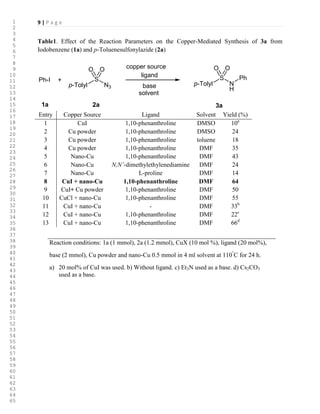
was achieved by using a combination of CuI, nano-Cu powder [19] (53 nm, Figure 1) and 1,10-
phenanthroline. The results are summarized in Table 1.
>Table 1<
Thus, the optimized reaction condition was started up by using 1equiv of iodobenzene,
1.2 equiv of p-toluenesulfonylazide, 10 mol-% CuI, 0.5 equiv. nano-Cu powder, 20 mol% 1,10-
phenanthroline and 2 equiv of K2CO3 in DMF at 110°
C (Scheme 2).
1
2
3
4
5
6
7
8
9
10
11
12
13
14
15
16
17
18
19
20
21
22
23
24
25
26
27
28
29
30
31
32
33
34
35
36
37
38
39
40
41
42
43
44
45
46
47
48
49
50
51
52
53
54
55
56
57
58
59
60
61
62
63
64
65
7 | P a g e
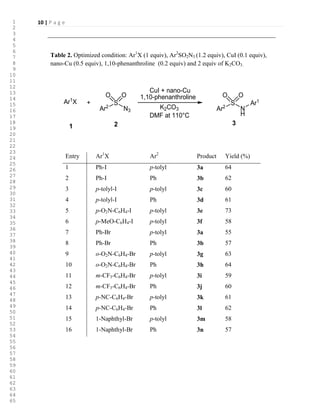
As shown in Table 2, using the optimized conditions described above, various N-
arylsulfonamides were synthesized from aryl iodides, aryl bromides and arylsulfonylazides. A
wide variety of functional groups, including nitro, cyano and trifluoromethyl, are tolerated by
these conditions. Arylsulfonylazides worked well as substrates, and the corresponding products
were obtained in good yield.
>Table 2<
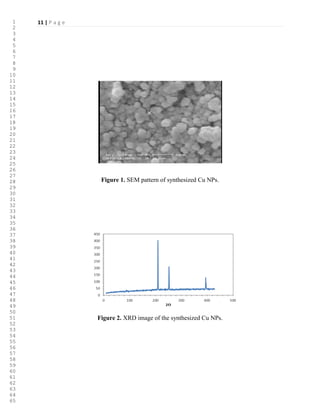
Copper nanoparticles used in this study, have been prepared according to literature [19].
Figure 1 shows XRD pattern of the Cu NPs. All of the diffraction peaks are in agreement with
the JCPDS file of Cu [19]. The morphology and grain size of the Cu NPs were investigated by
SEM (Figure 2). They have spherical morphology including a narrow distribution of sizes, from
32 nm to 68 nm.
>Figure 1<
>Figure 2<
CONCLUSIONS
In conclusion, we report an efficient synthetic procedure for the direct C-N bond formation
catalyzed by simple copper sources to form the corresponding N-arylsulfonamides by using aryl
halides and sulfonylazides. This method has advantages such as offering a simple and
inexpensive catalyst and simple workup.
REFERENCES
1
2
3
4
5
6
7
8
9
10
11
12
13
14
15
16
17
18
19
20
21
22
23
24
25
26
27
28
29
30
31
32
33
34
35
36
37
38
39
40
41
42
43
44
45
46
47
48
49
50
51
52
53
54
55
56
57
58
59
60
61
62
63
64
65
8 | P a g e
[1] G. Evano, N. Blanchard, M. Toumi, Chem. Rev. 108 (2008) 3054.
[2] F. Monnier, M. Taillefer, Angew. Chem. Int. Ed. 48 (2009) 2.
[3] S. V. Ley, A. W. Thomas, Angew. Chem. Int. Ed. 42 (2003) 5400.
[4] F. Ullmann, Ber. Dtsch. Chem. Ges. 36 (1903) 2382.
[5] A. Kiyomori, J. Marcoux, S. L. Buchwald, Tetrahedron Lett. 40 (1999) 2657.
[6] A. Shafir, S. L. Buchwald, J. Am. Chem. Soc. 128 (2006) 8742.
[7] E. R. Strieter, B. Bhayana, S. L. Buchwald, J. Am. Chem. Soc. 131 (2009) 78.
[8] A. Scozzafava, T. Owa, A. Mastrolorenzo, C. T. Supuran, Curr. Med. Chem. 10 (2003) 925.
[9] G. Burton, P. Cao, G. Li, R. Rivero, Org. Lett. 5 (2003) 4373
[10] P. Y. S. Lam, G. Vincent, C. G. Clark, S. Deudon, P. K. Jadhav, Tetrahedron Lett. 42
(2001) 3415.
[11] N. Liu, B. Tang, Y. Chen, L. He, Eur. J. Org. Chem. (2009) 2059.
[12] G. H. Imanzadeh, A. Zare, A. Khalafi-Nezhad, A. Hasaninejad, A. R. Moosavi-Zare,
A.
Parhami, J. Iran. Chem. Soc. 4 (2007) 467.
[13] A. R. Massah, M. Dabagh, S. Shahidi, H. Javaherian-Naghash, A. R. Momeni, H. Aliyan, J.
Iran. Chem. Soc. 6 (2009) 405.
[14] H. He, Y. J. Wu, Tetrahedron Lett. 44 (2003) 3385.
[15] D. Steinhuebel, M. Plaucki, D. Askin, U. Dolling, Tetrahedron Lett. 45 (2004) 3305.
[16] W. Deng, L. Liu, C. Zhang, M. Liu, Q. X. Guo, Tetrahedron Lett. 46 (2005) 7295.
[17] L. Alcaraz, C. Bennion, J. Morris, P. Meghani, S. M. Thom, Org. Lett. 6 (2004) 2705.
[18] H. Kwart, A. A. Kahn, J. Am. Chem. Soc. 89 (1967) 1950.
[19] S. Wu, D. J. Chen, Colloid. Interf. Sci. 273 (2004) 165.
1
2
3
4
5
6
7
8
9
10
11
12
13
14
15
16
17
18
19
20
21
22
23
24
25
26
27
28
29
30
31
32
33
34
35
36
37
38
39
40
41
42
43
44
45
46
47
48
49
50
51
52
53
54
55
56
57
58
59
60
61
62
63
64
65
9 | P a g e
Table1. Effect of the Reaction Parameters on the Copper-Mediated Synthesis of 3a from
Iodobenzene (1a) and p-Toluenesulfonylazide (2a)
p-Tolyl
S
N3
O O
+
p-Tolyl
S
N
H
O O
Ph
1a 2a
Ph-I
3a
copper source
ligand
base
solvent
Entry Copper Source Ligand Solvent Yield (%)
1 CuI 1,10-phenanthroline DMSO 10a
2 Cu powder 1,10-phenanthroline DMSO 24
3 Cu powder 1,10-phenanthroline toluene 18
4 Cu powder 1,10-phenanthroline DMF 35
5 Nano-Cu 1,10-phenanthroline DMF 43
6 Nano-Cu N,N’-dimethylethylenediamine DMF 24
7 Nano-Cu L-proline DMF 14
8 CuI + nano-Cu 1,10-phenanthroline DMF 64
9 CuI+ Cu powder 1,10-phenanthroline DMF 50
10 CuCl + nano-Cu 1,10-phenanthroline DMF 55
11 CuI + nano-Cu - DMF 33b
12 CuI + nano-Cu 1,10-phenanthroline DMF 22c
13 CuI + nano-Cu 1,10-phenanthroline DMF 66d
Reaction conditions: 1a (1 mmol), 2a (1.2 mmol), CuX (10 mol %), ligand (20 mol%),
base (2 mmol), Cu powder and nano-Cu 0.5 mmol in 4 ml solvent at 110°
C for 24 h.
a) 20 mol% of CuI was used. b) Without ligand. c) Et3N used as a base. d) Cs2CO3
used as a base.
1
2
3
4
5
6
7
8
9
10
11
12
13
14
15
16
17
18
19
20
21
22
23
24
25
26
27
28
29
30
31
32
33
34
35
36
37
38
39
40
41
42
43
44
45
46
47
48
49
50
51
52
53
54
55
56
57
58
59
60
61
62
63
64
65
10 | P a g e
Table 2. Optimized condition: Ar1
X (1 equiv), Ar2
SO2N3 (1.2 equiv), CuI (0.1 equiv),
nano-Cu (0.5 equiv), 1,10-phenanthroline (0.2 equiv) and 2 equiv of K2CO3.
Ar1X + S
Ar2
O O
N
H
Ar1S
Ar2
O O
N3
1,10-phenanthroline
CuI + nano-Cu
DMF at 110°C
K2CO3
1 2 3
Entry Ar1
X Ar2
Product Yield (%)
1 Ph-I p-tolyl 3a 64
2 Ph-I Ph 3b 62
3 p-tolyl-I p-tolyl 3c 60
4 p-tolyl-I Ph 3d 61
5 p-O2N-C6H4-I p-tolyl 3e 73
6 p-MeO-C6H4-I p-tolyl 3f 58
7 Ph-Br p-tolyl 3a 55
8 Ph-Br Ph 3b 57
9 o-O2N-C6H4-Br p-tolyl 3g 63
10 o-O2N-C6H4-Br Ph 3h 64
11 m-CF3-C6H4-Br p-tolyl 3i 59
12 m-CF3-C6H4-Br Ph 3j 60
13 p-NC-C6H4-Br p-tolyl 3k 61
14 p-NC-C6H4-Br Ph 3l 62
15 1-Naphthyl-Br p-tolyl 3m 58
16 1-Naphthyl-Br Ph 3n 57
1
2
3
4
5
6
7
8
9
10
11
12
13
14
15
16
17
18
19
20
21
22
23
24
25
26
27
28
29
30
31
32
33
34
35
36
37
38
39
40
41
42
43
44
45
46
47
48
49
50
51
52
53
54
55
56
57
58
59
60
61
62
63
64
65
11 | P a g e
Figure 1. SEM pattern of synthesized Cu NPs.
Figure 2. XRD image of the synthesized Cu NPs.
1
2
3
4
5
6
7
8
9
10
11
12
13
14
15
16
17
18
19
20
21
22
23
24
25
26
27
28
29
30
31
32
33
34
35
36
37
38
39
40
41
42
43
44
45
46
47
48
49
50
51
52
53
54
55
56
57
58
59
60
61
62
63
64
65
1 | P a g e
Professor Mojtaba Shamsipur,
Editor-in-Chief,
Department of Chemistry,
Razi University,
Kermanshah, Iran
(shamsipur@ics-ir.org)
April 18th, 2012
Dear Prof. Shaabani,
We should like the attached manuscript entitled:
Nanocopper-mediated Direct Arylsulfonamidation of Aryl Halides with
Arylsulfonylazides
By I. Yavari and Y. Solgi, M. Ghazanfarpour-Darjani, S. Ahmadian
to be considered for publication in J. Iran. Chem. Soc.
Sincerely yours
Issa Yavari
Professor of Org. Chem.
Dr. Issa Yavari
Chemistry Department,
Tarbiat Modares University,
P O Box 14115-175,
Tehran,
IRAN.
Fax: +98 21 82886544; E-mail: yavarisa@modares.ac.ir
Figure
1 | P a g e
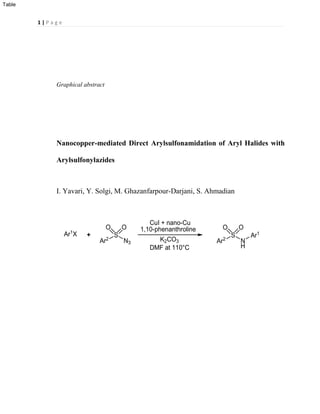
Graphical abstract
Nanocopper-mediated Direct Arylsulfonamidation of Aryl Halides with
Arylsulfonylazides
I. Yavari, Y. Solgi, M. Ghazanfarpour-Darjani, S. Ahmadian
Ar1X + S
Ar2
O O
N
H
Ar1S
Ar2
O O
N3
1,10-phenanthroline
CuI + nano-Cu
DMF at 110°C
K2CO3
Table

5

  • 1.
    Journal of theIranian Chemical Society Nanocopper-mediated Direct Arylsulfonamidation of Aryl Halides with Arylsulfonylazides --Manuscript Draft-- Manuscript Number: Full Title: Nanocopper-mediated Direct Arylsulfonamidation of Aryl Halides with Arylsulfonylazides Article Type: Original Paper Corresponding Author: Issa Yavari IRAN (ISLAMIC REPUBLIC OF) Corresponding Author Secondary Information: Corresponding Author's Institution: Corresponding Author's Secondary Institution: First Author: Issa Yavari First Author Secondary Information: Order of Authors: Issa Yavari Yazdan Solgi Majid Ghazanfarpour-Darjani Salome Ahmadian Order of Authors Secondary Information: Abstract: An efficient protocol for direct arylsulfonamidation of aryl iodides and aryl bromides using arylsulfonylazides catalyzed by copper nanoparticles is described. Suggested Reviewers: Powered by Editorial Manager® and Preprint Manager® from Aries Systems Corporation
  • 2.
    1 | Pa g e Nanocopper-mediated Direct Arylsulfonamidation of Aryl Halides with Arylsulfonylazides I. Yavari* and Y. Solgi, M. Ghazanfarpour-Darjani, S. Ahmadian Department of Chemistry, Tarbiat Modares University, PO Box 14115-175, Tehran, Iran An efficient protocol for direct arylsulfonamidation of aryl iodides and aryl bromides using arylsulfonylazides catalyzed by copper nanoparticles is described. Keywords: Arylsulfonyl azide, Aryliodide, Arylchloride, Cu NPs *Corresponding author. E-mail: yavarisa@modares.ac.ir INTRODUCTION The copper-mediated C(aryl)-N bond formation is an important transformation in organic synthesis and has been developed to include a wide range of substrates [1-3]. The foundation of modern copper-mediated chemistry lies in the pioneering work of Ullmann and Goldberg [4]. Buchwald and co-workers extensively studied these reactions and developed an experimentally simple and inexpensive catalytic system for these transformations [5-7]. N-Arylsulfonamide moiety is an important structural motif in many pharmaceutical compounds [8]. Transition-metal-catalyzed N-arylation of sulfonamides offers a straightforward method for the preparation of N-arylsulfonamides. Recently, the Cu-catalyzed coupling of aryl- Manuscript Click here to download Manuscript: Manuscript JICS.docx.docx Click here to view linked References 1 2 3 4 5 6 7 8 9 10 11 12 13 14 15 16 17 18 19 20 21 22 23 24 25 26 27 28 29 30 31 32 33 34 35 36 37 38 39 40 41 42 43 44 45 46 47 48 49 50 51 52 53 54 55 56 57 58 59 60 61 62 63 64 65
  • 3.
    2 | Pa g e boronic acids, as well as, the Pd-catalyzed coupling of aryl bromides and aryl chlorides with sulfonamides has been reported [9-13]. Most of the methods developed for synthesis of N- arylsulfonamide derivatives are often troublesome and require strong bases, and expensive Pd catalysts [14-17]. EXPERIMENTAL All chemicals were obtained commercially and used without further purification. M.p.: Electrothermal-9100 apparatus. IR Spectra: Shimadzu-IR-460 spectrometer; in cm−1 . 1 H- and 13 C-NMR Spectra: Bruker DRX-500 Avance instrumentat 500.1 and 125.7 MHz, resp.; δ in ppm, J in Hz. MS: Finnigan-MAT-8430EI-MS mass spectrometer; at 70 eV; in m/z (rel. %). Elemental analyses: Vario EL III CHNOS elemental analyzer. Scanning electron microscopy (SEM) images were obtained using a Stereo Scan XL30 Philips. General procedure To a mixture of aryl halide 1 (1 mmol), sulfonylazide 2 (1.2 mmol), and CuI (0.1 mmol), ligand (0.2 mmol) and K2CO3 (2 mmol) in DMF (4 mL) was added nano-Cu (53 nm), (0.5 mmol). The mixture was stirred at 110 °C. After completion of the reaction [(24 h; TLC (AcOEt/hexane 1:5) monitoring)], the mixture was diluted with CH2Cl2 (7 mL) and aqueous NH4Cl solution (5 mL), stirred for 30 min and the layers separated. The aqueous layer was extracted with CH2Cl2 (5 mL × 3) and the combined organic fractions dried (Na2SO4) and concentrated under reduced pressure. Pure products were obtained by flash column chromatography [(silica gel (230–400 mesh; Merck), hexane/AcOEt 5:1)]. The copper nanoparticles were prepared according to literature [19]. Compounds 3a [11], 3b [11], 3d [10], 3l [10], and 3n [9] are known.  1 2 3 4 5 6 7 8 9 10 11 12 13 14 15 16 17 18 19 20 21 22 23 24 25 26 27 28 29 30 31 32 33 34 35 36 37 38 39 40 41 42 43 44 45 46 47 48 49 50 51 52 53 54 55 56 57 58 59 60 61 62 63 64 65
  • 4.
    3 | Pa g e 4-Methyl-N-tosylbenzenamine (3c). Yield: 0.15 g (60%). Colorless solid. M.p. 99- 101°C. IR (KBr): 3280, 2921, 1510, 1329, 1160. 1 H-NMR: 2.21 (s, Me), 2.34 (s, Me), 7.03 (d, 3 J = 8.4, 2CH), 7.07 (d, 3 J = 8.4, 2CH), 7.29 (d, 3 J = 8.2, 2CH), 7.63 (d, 3 J = 8.2, 2CH), 8.75 (s, NH). 13 C-NMR: 20.6 (Me), 21.3 (Me), 122.1 (2 CH), 127.9 (2 CH), 130.2 (2 CH), 130.3 (2 CH), 134.9 (C), 136.2 (C), 142.0 (C), 144.2 (C). EI-MS: 261 (M+ , 6), 155 (6), 106 (100), 91 (24), 77 (23), 65 (12), 51 (4). Anal. calc. for C14H15NO2S (261.34): C, 64.34; H, 5.79; N, 5.36%. Found: C, 64.6; H, 5.7; N, 5.5%. 4-Nitro-N-tosylbenzenamine (3e). Yield: 0.21 g (73%). Yellow solid. M.p. 197-199 °C. IR (KBr):3326, 3081, 1510, 1333, 1150, 902, 671. 1 H-NMR: 2.36 (3H, s, Me), 7.37 (2 H, d, 3 J = 8.0 Hz, Ar), 7.45 (2 H, d, 3 J = 8.3 Hz, Ar), 8.0 (2 H, d, 3 J = 8.3 Hz, Ar), 9.79 (1 H, s, NH). 13 C NMR (125.7 MHz, Acetone): δC = 20.5 (Me), 118.3 (2 CH), 125 (2 CH), 127.2 (2 CH), 129.9 (2 CH), 136.6 (C), 143.4 (C), 144.2 (C), 144.4 (C). EI-MS: 292 (M+ , 4), 155 (57), 91 (100), 77 (2), 65 (20), 51(2). Anal. calc. for C13H12N2O4S (292.31): C, 53.42; H, 4.14; N, 9.58%. Found: C, 53.6; H, 4.2; N, 9.5%. 4-Methoxy-N-tosylbenzenamine (3f). Yield: 0.16 g (58%). Colorless solid. M.p. 114- 116 °C. IR (KBr):3268, 2960, 1510, 1331, 1252, 1159, 910, 679. 1 H-NMR: 2.35 (3 H, s, Me), 3.71 (3 H, s, MeO), 6.79 (2 H, d, 3 J = 8.1 Hz, Ar), 7.07 (2 H, d, 3 J = 8.1 Hz, Ar), 7.29 (2 H, d, 3 J = 8.2 Hz, Ar), 7.58 (2 H, d, 3 J = 8.2 Hz, Ar), 8.58 (s, NH). 13 C-NMR: 21.3 (Me), 55.6 (MeO), 115.0 (2 CH), 124.9 (2 CH), 128.0 (2 CH), 130.2 (2 CH), 129.3, 133.6 (C), 140.8 (C), 144.2 (C), 150.2 (C). EI-MS: 277 (M+ , 4), 155 (27), 123 (6), 91 (4), 77 (100), 65 (71), 51 (12). Anal. calc. for C14H16NO3S (277.34): C, 60.63; H, 5.45; N, 5.05%. Found: C, 60.4; H, 5.5; N, 5.1%. 1 2 3 4 5 6 7 8 9 10 11 12 13 14 15 16 17 18 19 20 21 22 23 24 25 26 27 28 29 30 31 32 33 34 35 36 37 38 39 40 41 42 43 44 45 46 47 48 49 50 51 52 53 54 55 56 57 58 59 60 61 62 63 64 65
  • 5.
    4 | Pa g e 2-Nitro-N-tosylbenzenamine (3g). Yield: 0.18 g (63%). Yellow solid. M.p. 116-118 °C. (KBr):3276, 3119, 1610, 1524, 1485, 1385, 1345, 1273. 1 H-NMR: 2.37 (3H, s, Me), 7.31 (1 H, t, 3 J = 7.8 Hz, Ar), 7.37 (2 H, d, 3 J = 8.2 Hz, Ar), 7.72 (1 H, t, 3 J = 7.8 Hz, Ar), 7.77 (1 H, d, 3 J = 8.1 Hz, Ar), 7.79 (2 H, d, 3 J = 8.2 Hz, Ar), 8.11 (1 H, d, 3 J = 8.1 Hz, Ar), 9.74 (s, NH). 13 C- NMR: 21.4 (Me), 122.6 (CH), 125.3 (CH), 126.9 (2 CH), 128.2 (2 CH), 130.8 (CH), 134.1 (C), 136.5 (CH), 137.1 (C), 139.4 (C), 145.6 (C). EI-MS: 292 (M+ , 3), 155 (61), 91 (100), 77 (4), 65 (20), 52(6). Anal. calc. for C13H12N2O4S (292.31): C, 53.42; H, 4.14; N, 9.58%. Found: C, 53.6; H, 4.2; N, 9.7%. 2-Nitro-1-phenylsulfonamidobenzene (3h). Yield: 0.17 g (64%). Yellow solid. M.p. 103-105 °C. IR (KBr): 3243, 3088, 1485, 1344, 1163, 915, 568. 1 H-NMR: 7.33 (1 H, t, 3 J = 7.2 Hz, Ar), 7.6 (2 H, t, 3 J = 7.8 Hz, Ar), 7.66-7.78 (3 H, m, Ar), 7.91 (2 H, d, 3 J = 7.8 Hz, Ar), 8.1 (1 H, d, 3 J = 7.7 Hz, Ar), 9.73 (s, NH). 13 C-NMR: 123 (CH), 125.6 (CH), 126.9 (2 CH), 128.1 (2 CH), 130.3 (CH), 133.8 (C), 134.6 (CH), 136.4 (CH), 139.5 (C), 145.4 (C). EI-MS: 278 (M+ , 4), 141 (55), 91 (100), 77 (23), 65 (14), 52(12). Anal. calc. for C12H10N2O4S (278.28): C, 51.79; H, 3.62; N, 10.07%. Found: C, 51.9; H, 3.7; N, 10.0%. 3-Triflouromethyl-N-tosylbenzenamine (3i). Yield: 0.18 g (59%). Colorless solid. M.p. 97-99 °C. IR (KBr): 3233, 2919, 1412, 1331, 1170, 933, 677. 1 H-NMR: 2.35 (3 H, s, Me), 7.33 (2 H, d, 3 J = 8.1 Hz, Ar) 7.38-7.55 (4 H, m, Ar), 7.72 (2 H, d, 3 J = 8.1 Hz, Ar) 9.33 (s, NH). 13 C- NMR: 21.3 (Me), 117.2 (CH, q, 3 JCF = 3.7 Hz), 121.4 (CH, q, 3 JCF= 3.8 Hz), 124.4 (CH), 124.6 (CF3, q, 1 JCF = 270.2 Hz), 127.9 (2 CH), 130.5 (2 CH), 131.1 (CH), 131.7 (C, q, 2 J = 32.2 Hz), 137.5 (C), 139.8 (C), 144.9 (C). EI-MS: 315 (M+ , 3), 160 (5), 155 (52), 91 (100), 77 (2), 65 (20), 51 (2). Anal. calc. for C14H13F3NO2S (315.32): C, 53.17; H, 4.13; N, 4.44%. Found: C, 53.3; H, 4.2; N, 4.5%. 1 2 3 4 5 6 7 8 9 10 11 12 13 14 15 16 17 18 19 20 21 22 23 24 25 26 27 28 29 30 31 32 33 34 35 36 37 38 39 40 41 42 43 44 45 46 47 48 49 50 51 52 53 54 55 56 57 58 59 60 61 62 63 64 65
  • 6.
    5 | Pa g e 1-Phenylsulfonamido-3-trifluoromethylbenzene (3j). Yield: 0.18 g (60%). Colorless solid. M.p. 68-70 °C, 0.18 g, yield: 60%. IR (KBr): 3263, 2926, 1415, 1329, 1165. 1 H-NMR: 7.39-7.84 (9 H, m, 2Ar), 9.38 (s, NH). 13 C-NMR: 118.1 (CH, q, 3 JCF = 3.8 Hz), 122.2 (CH, q, 3 JCF = 3.8 Hz), 125.2 (CH), 124.6 (CF3, q, 1 JCF = 270.2 Hz), 128.4 (2 CH), 130.6 (2 CH), 131.1 (CH), 131.7 (CH), 132.3 (C, q, 2 JCF = 32.2 Hz), 134.5 (C), 140.21 (C), 141 (C). EI-MS: 301 (M+ , 4), 160 (9), 141 (48), 91 (100), 77 (4), 65 (23), 51 (2). Anal. calc. for C13H11F3NO2S (301.29): C, 51.65; H, 3.67; N, 4.63%. Found: C, 51.8; H, 3.6; N, 4.7%. 4-Cyano-N-tosylbenzenamine (3k). Yield: 0.16 g (61%). Colorless solid. M.p. 188-190 °C. IR (KBr): 3239, 2922, 2224, 1606, 1508, 1349, 1159. 1 H-NMR: 2.36 (3 H, s, Me), 7.36 (2 H, d, 3 J = 8.1 Hz, Ar), 7.40 (2 H, d, 3 J = 8.3 Hz, Ar), 7.65 (2 H, d, 3 J = 8.3 Hz, Ar), 7.77 (2 H, d, 3 J = 8.1 Hz, Ar), 9.60 (s, NH). 13 C-NMR: 21.3 (Me), 107.5 (C), 119.1 (CN), 119.9 (2 CH), 127.9 (2 CH), 130.6 (2 CH), 134.3 (2 CH), 137.5 (C), 143.2 (C), 145.1 (C). EI-MS: 272 (M+ , 4), 155 (60), 156 (10), 117 (4), 91 (100), 77 (1), 65 (22), 51 (2). Anal. calc. for C14H12N2O2S (272.32): C, 61.75; H, 4.44; N, 10.29%. Found: C, 61.9; H, 4.5; N, 10.4%. N-Tosyl-1-naphthylamine (3m). Yield: 0.17 g (58%). Colorless solid. M.p. 157-159 °C. IR (KBr): 3264, 3064, 1414, 1342, 1311, 1157, 1090. 1 H-NMR: 2.33 (3 H, s, Me), 7.26 (2 H, d, 3 J = 8.2 Hz, Ar), 7.32-7.49 (4 H, m, Naph), 7.62 (2 H, d, 3 J = 7.7 Hz, Ar), 7.77 (1 H, d, 3 J = 8.2 Hz, Naph), 7.87 (1 H, d, 3 J = 7.7 Hz, Naph), 8.15 (1 H, d, 3 J = 8.2 Hz, Naph), 8.93 (s, NH). 13 C- NMR: 21.6 (Me), 123.7 (CH), 123.8 (CH), 126.1 (C), 126.8 (CH), 126.9 (CH), 127.6 (CH), 128.0 (2 CH), 128.9 (CH), 130.2 (2 CH), ), 130.5 (C), 133.5 (C), 135.2 (C), 144.2 (C). EI-MS: 297 (M+ , 3), 155 (2), 142 (100), 115 (84), 91 (16), 77 (2), 65 (11), 51 (2). Anal. calc. for C17H15NO2S (297.37): C, 68.66; H, 5.08; N, 4.71%. Found: C, 68.4; H, 5.1; N, 4.6%. 1 2 3 4 5 6 7 8 9 10 11 12 13 14 15 16 17 18 19 20 21 22 23 24 25 26 27 28 29 30 31 32 33 34 35 36 37 38 39 40 41 42 43 44 45 46 47 48 49 50 51 52 53 54 55 56 57 58 59 60 61 62 63 64 65
  • 7.
    6 | Pa g e RESULTS AND DISCUSSION Copper powder is reported [18] to have been effective catalyst for the decomposition of arylsulfonylazides. We attempted to use this reaction conditions for coupling of the sulfonamide produced by decomposition of sulfonylazides and aryl halides and design a novel an efficient one-pot synthesis of N-arylsulfonamides. We initially selected iodobenzene (1a), (1 equiv) and p-toluenesulfonylazide (2a), (1.2 equiv) as the model substrate for optimization of the reaction conditions (Scheme 1). Then, the catalysis conditions, including copper source, ligand, base and solvent were optimized. Our first test was performed in DMSO using a catalytic amount of CuI (0.2 equiv), K2CO3 (2 equiv) as the base and 1,10-phenanthroline (0.2 equiv) as the ligand at 110° C. Under these conditions, only small amounts (10%) of product (3a) were detected. Under these reaction conditions, a set of catalysts such as CuCl, Cu2O and Cu(OAc)2 were screened, without success. We were pleased to discover that 0.5 equiv of copper powder could afford the desired product in 24% yield. The same reaction in toluene afforded 3a in 18% yield. Fair to good yields of 3a were obtained with DMF as the solvent. In this solvent a brief study of several ligands, bases and copper sources were carried out. A significant improvement was achieved by using a combination of CuI, nano-Cu powder [19] (53 nm, Figure 1) and 1,10- phenanthroline. The results are summarized in Table 1. >Table 1< Thus, the optimized reaction condition was started up by using 1equiv of iodobenzene, 1.2 equiv of p-toluenesulfonylazide, 10 mol-% CuI, 0.5 equiv. nano-Cu powder, 20 mol% 1,10- phenanthroline and 2 equiv of K2CO3 in DMF at 110° C (Scheme 2). 1 2 3 4 5 6 7 8 9 10 11 12 13 14 15 16 17 18 19 20 21 22 23 24 25 26 27 28 29 30 31 32 33 34 35 36 37 38 39 40 41 42 43 44 45 46 47 48 49 50 51 52 53 54 55 56 57 58 59 60 61 62 63 64 65
  • 8.
    7 | Pa g e As shown in Table 2, using the optimized conditions described above, various N- arylsulfonamides were synthesized from aryl iodides, aryl bromides and arylsulfonylazides. A wide variety of functional groups, including nitro, cyano and trifluoromethyl, are tolerated by these conditions. Arylsulfonylazides worked well as substrates, and the corresponding products were obtained in good yield. >Table 2< Copper nanoparticles used in this study, have been prepared according to literature [19]. Figure 1 shows XRD pattern of the Cu NPs. All of the diffraction peaks are in agreement with the JCPDS file of Cu [19]. The morphology and grain size of the Cu NPs were investigated by SEM (Figure 2). They have spherical morphology including a narrow distribution of sizes, from 32 nm to 68 nm. >Figure 1< >Figure 2< CONCLUSIONS In conclusion, we report an efficient synthetic procedure for the direct C-N bond formation catalyzed by simple copper sources to form the corresponding N-arylsulfonamides by using aryl halides and sulfonylazides. This method has advantages such as offering a simple and inexpensive catalyst and simple workup. REFERENCES 1 2 3 4 5 6 7 8 9 10 11 12 13 14 15 16 17 18 19 20 21 22 23 24 25 26 27 28 29 30 31 32 33 34 35 36 37 38 39 40 41 42 43 44 45 46 47 48 49 50 51 52 53 54 55 56 57 58 59 60 61 62 63 64 65
  • 9.
    8 | Pa g e [1] G. Evano, N. Blanchard, M. Toumi, Chem. Rev. 108 (2008) 3054. [2] F. Monnier, M. Taillefer, Angew. Chem. Int. Ed. 48 (2009) 2. [3] S. V. Ley, A. W. Thomas, Angew. Chem. Int. Ed. 42 (2003) 5400. [4] F. Ullmann, Ber. Dtsch. Chem. Ges. 36 (1903) 2382. [5] A. Kiyomori, J. Marcoux, S. L. Buchwald, Tetrahedron Lett. 40 (1999) 2657. [6] A. Shafir, S. L. Buchwald, J. Am. Chem. Soc. 128 (2006) 8742. [7] E. R. Strieter, B. Bhayana, S. L. Buchwald, J. Am. Chem. Soc. 131 (2009) 78. [8] A. Scozzafava, T. Owa, A. Mastrolorenzo, C. T. Supuran, Curr. Med. Chem. 10 (2003) 925. [9] G. Burton, P. Cao, G. Li, R. Rivero, Org. Lett. 5 (2003) 4373 [10] P. Y. S. Lam, G. Vincent, C. G. Clark, S. Deudon, P. K. Jadhav, Tetrahedron Lett. 42 (2001) 3415. [11] N. Liu, B. Tang, Y. Chen, L. He, Eur. J. Org. Chem. (2009) 2059. [12] G. H. Imanzadeh, A. Zare, A. Khalafi-Nezhad, A. Hasaninejad, A. R. Moosavi-Zare, A. Parhami, J. Iran. Chem. Soc. 4 (2007) 467. [13] A. R. Massah, M. Dabagh, S. Shahidi, H. Javaherian-Naghash, A. R. Momeni, H. Aliyan, J. Iran. Chem. Soc. 6 (2009) 405. [14] H. He, Y. J. Wu, Tetrahedron Lett. 44 (2003) 3385. [15] D. Steinhuebel, M. Plaucki, D. Askin, U. Dolling, Tetrahedron Lett. 45 (2004) 3305. [16] W. Deng, L. Liu, C. Zhang, M. Liu, Q. X. Guo, Tetrahedron Lett. 46 (2005) 7295. [17] L. Alcaraz, C. Bennion, J. Morris, P. Meghani, S. M. Thom, Org. Lett. 6 (2004) 2705. [18] H. Kwart, A. A. Kahn, J. Am. Chem. Soc. 89 (1967) 1950. [19] S. Wu, D. J. Chen, Colloid. Interf. Sci. 273 (2004) 165. 1 2 3 4 5 6 7 8 9 10 11 12 13 14 15 16 17 18 19 20 21 22 23 24 25 26 27 28 29 30 31 32 33 34 35 36 37 38 39 40 41 42 43 44 45 46 47 48 49 50 51 52 53 54 55 56 57 58 59 60 61 62 63 64 65
  • 10.
    9 | Pa g e Table1. Effect of the Reaction Parameters on the Copper-Mediated Synthesis of 3a from Iodobenzene (1a) and p-Toluenesulfonylazide (2a) p-Tolyl S N3 O O + p-Tolyl S N H O O Ph 1a 2a Ph-I 3a copper source ligand base solvent Entry Copper Source Ligand Solvent Yield (%) 1 CuI 1,10-phenanthroline DMSO 10a 2 Cu powder 1,10-phenanthroline DMSO 24 3 Cu powder 1,10-phenanthroline toluene 18 4 Cu powder 1,10-phenanthroline DMF 35 5 Nano-Cu 1,10-phenanthroline DMF 43 6 Nano-Cu N,N’-dimethylethylenediamine DMF 24 7 Nano-Cu L-proline DMF 14 8 CuI + nano-Cu 1,10-phenanthroline DMF 64 9 CuI+ Cu powder 1,10-phenanthroline DMF 50 10 CuCl + nano-Cu 1,10-phenanthroline DMF 55 11 CuI + nano-Cu - DMF 33b 12 CuI + nano-Cu 1,10-phenanthroline DMF 22c 13 CuI + nano-Cu 1,10-phenanthroline DMF 66d Reaction conditions: 1a (1 mmol), 2a (1.2 mmol), CuX (10 mol %), ligand (20 mol%), base (2 mmol), Cu powder and nano-Cu 0.5 mmol in 4 ml solvent at 110° C for 24 h. a) 20 mol% of CuI was used. b) Without ligand. c) Et3N used as a base. d) Cs2CO3 used as a base. 1 2 3 4 5 6 7 8 9 10 11 12 13 14 15 16 17 18 19 20 21 22 23 24 25 26 27 28 29 30 31 32 33 34 35 36 37 38 39 40 41 42 43 44 45 46 47 48 49 50 51 52 53 54 55 56 57 58 59 60 61 62 63 64 65
  • 11.
    10 | Pa g e Table 2. Optimized condition: Ar1 X (1 equiv), Ar2 SO2N3 (1.2 equiv), CuI (0.1 equiv), nano-Cu (0.5 equiv), 1,10-phenanthroline (0.2 equiv) and 2 equiv of K2CO3. Ar1X + S Ar2 O O N H Ar1S Ar2 O O N3 1,10-phenanthroline CuI + nano-Cu DMF at 110°C K2CO3 1 2 3 Entry Ar1 X Ar2 Product Yield (%) 1 Ph-I p-tolyl 3a 64 2 Ph-I Ph 3b 62 3 p-tolyl-I p-tolyl 3c 60 4 p-tolyl-I Ph 3d 61 5 p-O2N-C6H4-I p-tolyl 3e 73 6 p-MeO-C6H4-I p-tolyl 3f 58 7 Ph-Br p-tolyl 3a 55 8 Ph-Br Ph 3b 57 9 o-O2N-C6H4-Br p-tolyl 3g 63 10 o-O2N-C6H4-Br Ph 3h 64 11 m-CF3-C6H4-Br p-tolyl 3i 59 12 m-CF3-C6H4-Br Ph 3j 60 13 p-NC-C6H4-Br p-tolyl 3k 61 14 p-NC-C6H4-Br Ph 3l 62 15 1-Naphthyl-Br p-tolyl 3m 58 16 1-Naphthyl-Br Ph 3n 57 1 2 3 4 5 6 7 8 9 10 11 12 13 14 15 16 17 18 19 20 21 22 23 24 25 26 27 28 29 30 31 32 33 34 35 36 37 38 39 40 41 42 43 44 45 46 47 48 49 50 51 52 53 54 55 56 57 58 59 60 61 62 63 64 65
  • 12.
    11 | Pa g e Figure 1. SEM pattern of synthesized Cu NPs. Figure 2. XRD image of the synthesized Cu NPs. 1 2 3 4 5 6 7 8 9 10 11 12 13 14 15 16 17 18 19 20 21 22 23 24 25 26 27 28 29 30 31 32 33 34 35 36 37 38 39 40 41 42 43 44 45 46 47 48 49 50 51 52 53 54 55 56 57 58 59 60 61 62 63 64 65
  • 13.
    1 | Pa g e Professor Mojtaba Shamsipur, Editor-in-Chief, Department of Chemistry, Razi University, Kermanshah, Iran (shamsipur@ics-ir.org) April 18th, 2012 Dear Prof. Shaabani, We should like the attached manuscript entitled: Nanocopper-mediated Direct Arylsulfonamidation of Aryl Halides with Arylsulfonylazides By I. Yavari and Y. Solgi, M. Ghazanfarpour-Darjani, S. Ahmadian to be considered for publication in J. Iran. Chem. Soc. Sincerely yours Issa Yavari Professor of Org. Chem. Dr. Issa Yavari Chemistry Department, Tarbiat Modares University, P O Box 14115-175, Tehran, IRAN. Fax: +98 21 82886544; E-mail: yavarisa@modares.ac.ir Figure
  • 14.
    1 | Pa g e Graphical abstract Nanocopper-mediated Direct Arylsulfonamidation of Aryl Halides with Arylsulfonylazides I. Yavari, Y. Solgi, M. Ghazanfarpour-Darjani, S. Ahmadian Ar1X + S Ar2 O O N H Ar1S Ar2 O O N3 1,10-phenanthroline CuI + nano-Cu DMF at 110°C K2CO3 Table