Name__________________________________________ Block_______Date___________________
T
TH
HE
E C
CE
EL
LL
L C
CY
YC
CL
LE
E
Matching: Match the term to the description. Write the letter on the space before each number.
A. Prophase B. Interphase C. Telophase D. Metaphase E. Anaphse F. Cytokinesis
____ 1. The sister chromatids are moving apart.
____ 2. The nucleolus begins to fade from view.
____ 3. A new nuclear membrane is forming around
the chromosomes.
____ 4. The cytoplasm of the cell is being divided.
____ 5. The chromosomes become invisible.
____ 6. The chromosomes are located at the equator
of the cell.
____ 7. The nuclear membrane begins to fade from
view.
____ 8. The division (cleavage) furrow appears.
____ 9. The chromosomes are moving towards the
poles of the cell.
____ 10. The spindle fibers begin to form.
____ 11. The spindle fibers are fully developed.
____ 12. Nucleus begins to form at opposite poles.
____ 14. The division of a cells cytoplasm.
____ 15. Chromosomes are replicated.
____ 16. The reverse of prophase.
____ 17. Period of growth and development that
precedes mitosis and follows
cytokinesis
Fill in the blank: Some will be used more than once.
A. Prophase D. Metaphase G. Chromatid J. Spindle fiber (x2)
B. Interphase (x2) E. Anaphase H. Cytokinesis (x2) K. Cell plate
C. Telophase F. Centromere I. Mitosis
______________18. Nuclear envelop and nucleoli
reappear and nucleus forms.
_______________19. During what phase of mitosis do
centromeres split and the
chromosomes move toward their
respective poles?
_______________20. What is the phase where chromatin
condenses to form chromosomes?
_______________21. What is the name of the structure
that connects the two chromatids?
_______________22. In a chromosome pair connected by
a centromere, what is each individual
chromosome called?
_____________23. What are the two parts of cell division?
_______________24. What structure forms in prophase
that helps the chromosomes move?
_______________25. Which phase of mitosis is the last
phase that chromatids are together?
_______________26. Which phase of the cell cycle is
characterized by a non-dividing cell?
_______________27. What structure is produced when
protein fibers radiate from centrioles?
______________ 28. What forms across the center of a
plant cell near the end of telophase?
______________29. The period of cell growth and
development between mitotic
divisions?
_______________30. When the two daughter cells split.
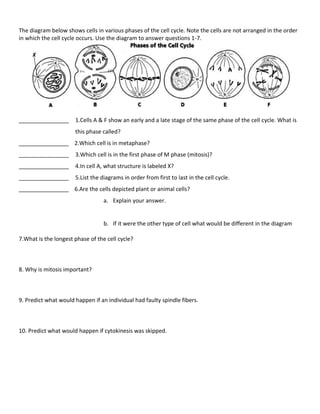
The diagram below shows cells in various phases of the cell cycle. Note the cells are not arranged in the order
in which the cell cycle occurs. Use the diagram to answer questions 1-7.
________________ 1.Cells A & F show an early and a late stage of the same phase of the cell cycle. What is
this phase called?
________________ 2.Which cell is in metaphase?
________________ 3.Which cell is in the first phase of M phase (mitosis)?
________________ 4.In cell A, what structure is labeled X?
________________ 5.List the diagrams in order from first to last in the cell cycle.
________________ 6.Are the cells depicted plant or animal cells?
a. Explain your answer.
b. If it were the other type of cell what would be different in the diagram
7.What is the longest phase of the cell cycle?
8. Why is mitosis important?
9. Predict what would happen if an individual had faulty spindle fibers.
10. Predict what would happen if cytokinesis was skipped.

4th quarter The Cell Cycle Worksheet.doc

  • 1.
    Name__________________________________________ Block_______Date___________________ T TH HE E C CE EL LL LC CY YC CL LE E Matching: Match the term to the description. Write the letter on the space before each number. A. Prophase B. Interphase C. Telophase D. Metaphase E. Anaphse F. Cytokinesis ____ 1. The sister chromatids are moving apart. ____ 2. The nucleolus begins to fade from view. ____ 3. A new nuclear membrane is forming around the chromosomes. ____ 4. The cytoplasm of the cell is being divided. ____ 5. The chromosomes become invisible. ____ 6. The chromosomes are located at the equator of the cell. ____ 7. The nuclear membrane begins to fade from view. ____ 8. The division (cleavage) furrow appears. ____ 9. The chromosomes are moving towards the poles of the cell. ____ 10. The spindle fibers begin to form. ____ 11. The spindle fibers are fully developed. ____ 12. Nucleus begins to form at opposite poles. ____ 14. The division of a cells cytoplasm. ____ 15. Chromosomes are replicated. ____ 16. The reverse of prophase. ____ 17. Period of growth and development that precedes mitosis and follows cytokinesis Fill in the blank: Some will be used more than once. A. Prophase D. Metaphase G. Chromatid J. Spindle fiber (x2) B. Interphase (x2) E. Anaphase H. Cytokinesis (x2) K. Cell plate C. Telophase F. Centromere I. Mitosis ______________18. Nuclear envelop and nucleoli reappear and nucleus forms. _______________19. During what phase of mitosis do centromeres split and the chromosomes move toward their respective poles? _______________20. What is the phase where chromatin condenses to form chromosomes? _______________21. What is the name of the structure that connects the two chromatids? _______________22. In a chromosome pair connected by a centromere, what is each individual chromosome called? _____________23. What are the two parts of cell division? _______________24. What structure forms in prophase that helps the chromosomes move? _______________25. Which phase of mitosis is the last phase that chromatids are together? _______________26. Which phase of the cell cycle is characterized by a non-dividing cell? _______________27. What structure is produced when protein fibers radiate from centrioles? ______________ 28. What forms across the center of a plant cell near the end of telophase? ______________29. The period of cell growth and development between mitotic divisions? _______________30. When the two daughter cells split.
  • 2.
    The diagram belowshows cells in various phases of the cell cycle. Note the cells are not arranged in the order in which the cell cycle occurs. Use the diagram to answer questions 1-7. ________________ 1.Cells A & F show an early and a late stage of the same phase of the cell cycle. What is this phase called? ________________ 2.Which cell is in metaphase? ________________ 3.Which cell is in the first phase of M phase (mitosis)? ________________ 4.In cell A, what structure is labeled X? ________________ 5.List the diagrams in order from first to last in the cell cycle. ________________ 6.Are the cells depicted plant or animal cells? a. Explain your answer. b. If it were the other type of cell what would be different in the diagram 7.What is the longest phase of the cell cycle? 8. Why is mitosis important? 9. Predict what would happen if an individual had faulty spindle fibers. 10. Predict what would happen if cytokinesis was skipped.