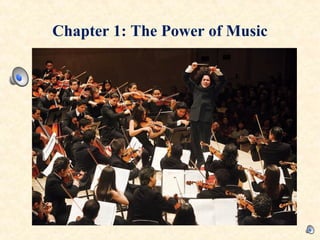
Chapter 1: The Power of Music
The Power of Music:
• What genres of music
do you enjoy?
• What role does music
play in your life?
• How do you listen to
music?
• Why is music so
universally appealing?
• How would YOU define
music?
What is Music?
• MUSIC: The rational organization of sounds
and silences passing through time
• Sound:
– Created by soundwaves – the vibrations that reflect
slight differences in air pressure
– Speed of the vibration determines whether pitches
are low or high
Music and Your Brain
• Our inner ear transforms soundwaves into electrical
signals that go to various parts of the brain that
analyze particular components of the sound: pitch,
color, loudness, duration and how music makes us
feel
Listening to Music
• 1870’s: Thomas Edison’s gramophone -Wax
cylinders
• 1940’s: Vinyl records
• 1960’s: Cassette tape; Eight track
• 1980’s: CD’s
• 1990’s - present: MP3 and M4A files,
streaming ie: Pandora
Capturing and Replaying Sound
Had to slip in this little
beauty. I had a radio just
like this as a kid!
Popular Music / Classical Music
Classical Music
1. “High art” or “learned”
music
2. Timeless qualities
3.Emphasizes
instrumental music
4.Precise notation
5.Acoustic instruments
6. Lengthy and varied in
mood
7. Abstract sound
Popular Music
1. Appeals to a large
population
2. Contemporary issues
of life
3.Emphasizes vocal
music
4.Electrically amplified
instruments
5. Short and conveys a
single mood
6.Emphasis on the beat
How does Classical Music Work?
Some concerts require a
large hall seating 2,000
to 3,000 listeners. The
NM Philharmonic plays
concerts at the zoo and
local parks, sometimes
for free! Smaller venues
holding 200 to 600
people are better for
music on a smaller scale.
Genre
• genre | ZHänr |nounˈ ə
• a category of artistic composition, as in music
or literature, characterized by similarities in
form, style, or subject matter.
• ORIGIN early 19th cent.: French, literally ‘a
kind’
Styles of Classical Music
• 476-1450: The Middle Ages
• 1450-1600: Renaissance
• 1600-1750: Baroque Era
• 1750-1820: Classical Era
• 1820-1900: Romantic Era
• 1880-1920: Impressionist Era
• 1900-1985: Modern Era
• 1945-present: Postmodern Era
Each musical era has its own
unique characteristics.
The Language of Music
• Music is a means of communication
• Music can convey any emotion
• Music has been a part of our lives since infancy
Photo here…
Where and How to Listen for this class
• Where to listen:
– Streaming Music from Mindtap and links
– Sites and applications like Spotify, Youtube and
iTunes
– Live music
– Make music yourself
• Four Steps To Becoming A Good Active Listener
1.Learn how music works
2.Improve your musical memory
3.Focus solely on the music
4.Practice listening actively
Attending a live classical concert
Attending a Live Classical Concert
• Perhaps the most important thing you will do
for this class
– Preparation before the concert:
• Develop familiarity with the music, listen on Youtube
first if possible
• Learn the history of the composer, pieces to be
performed
– Best sound usually is near the back of the hall –
also the cheapest tickets!
– The conductor’s gestures indicate important
musical events. Watch the conductor.
Concert Etiquette
• Don’t talk (or whisper) during the performance
• Applause
– When the conductor, concert master or soloist
walks onto the stage
– At the end of an entire composition or set
• Latecomers
– Never enter while a performance is in progress
– Wait to enter until an usher offers to seat you
or the ensemble prepares to play a new
composition
Concert Etiquette
–Electronic equipment
• Double check to make sure devices are off, this also
includes silencing watches that beep on the hour
• Do not check texts or play electronic games during
concerts; screens distract people sitting around and
many rows behind you in a darkened theatre
• Do not take pictures or videos of the performance;
camera flash temporarily blinds performers.
What to wear to a classical
concert?
Be neat, be comfortable
Albuquerque is not this fancy…
You may indeed choose to dress up, at
least somewhat…
Four Notes that Changed the World
• Listen to the opening of Beethoven's Fifth Symphony
• Listen for the ever-changing appearance of the
four-note motive
– Motive: a short, distinct musical figure
• Symphony: an instrumental genre for orchestra
• Movement: a large independent section of a major
instrumental work
https://www.youtube.com/watch?v=7jh-E5m01wY
Another Famous Beginning…
• Listen to "Also sprach Zarathustra" by Richard Strauss
• Listen for a gradual transition from the nothingness of
murky darkness, to shafts of light (trumpets), and finally
to the incandescent power of the full symphony
• Does this piece sound familiar to you?
• What does it make you think of?
Listen to the opening 2 minutes 20” of
this work
http://www.youtube.com/watch?v=6RdZ7rO_cr0
If you think Classical Music is
boring, try this…
• (click on link)
Leonard Bernstein "Mambo"
The Flash Mob Phenomenon…
http://www.youtube.com/watch?v=PJNp5UKRtbQ
Westbahnhoff – Train Station Vienna Austria
Carl Orff Carmina Burana

1listeningvoiceover

  • 1.
    Chapter 1: ThePower of Music
  • 2.
    The Power ofMusic: • What genres of music do you enjoy? • What role does music play in your life? • How do you listen to music? • Why is music so universally appealing? • How would YOU define music?
  • 3.
    What is Music? •MUSIC: The rational organization of sounds and silences passing through time • Sound: – Created by soundwaves – the vibrations that reflect slight differences in air pressure – Speed of the vibration determines whether pitches are low or high
  • 4.
    Music and YourBrain • Our inner ear transforms soundwaves into electrical signals that go to various parts of the brain that analyze particular components of the sound: pitch, color, loudness, duration and how music makes us feel
  • 5.
    Listening to Music •1870’s: Thomas Edison’s gramophone -Wax cylinders • 1940’s: Vinyl records • 1960’s: Cassette tape; Eight track • 1980’s: CD’s • 1990’s - present: MP3 and M4A files, streaming ie: Pandora
  • 6.
    Capturing and ReplayingSound Had to slip in this little beauty. I had a radio just like this as a kid!
  • 7.
    Popular Music /Classical Music
  • 8.
    Classical Music 1. “Highart” or “learned” music 2. Timeless qualities 3.Emphasizes instrumental music 4.Precise notation 5.Acoustic instruments 6. Lengthy and varied in mood 7. Abstract sound Popular Music 1. Appeals to a large population 2. Contemporary issues of life 3.Emphasizes vocal music 4.Electrically amplified instruments 5. Short and conveys a single mood 6.Emphasis on the beat
  • 9.
    How does ClassicalMusic Work? Some concerts require a large hall seating 2,000 to 3,000 listeners. The NM Philharmonic plays concerts at the zoo and local parks, sometimes for free! Smaller venues holding 200 to 600 people are better for music on a smaller scale.
  • 10.
    Genre • genre |ZHänr |nounˈ ə • a category of artistic composition, as in music or literature, characterized by similarities in form, style, or subject matter. • ORIGIN early 19th cent.: French, literally ‘a kind’
  • 11.
    Styles of ClassicalMusic • 476-1450: The Middle Ages • 1450-1600: Renaissance • 1600-1750: Baroque Era • 1750-1820: Classical Era • 1820-1900: Romantic Era • 1880-1920: Impressionist Era • 1900-1985: Modern Era • 1945-present: Postmodern Era Each musical era has its own unique characteristics.
  • 12.
    The Language ofMusic • Music is a means of communication • Music can convey any emotion • Music has been a part of our lives since infancy Photo here…
  • 13.
    Where and Howto Listen for this class • Where to listen: – Streaming Music from Mindtap and links – Sites and applications like Spotify, Youtube and iTunes – Live music – Make music yourself • Four Steps To Becoming A Good Active Listener 1.Learn how music works 2.Improve your musical memory 3.Focus solely on the music 4.Practice listening actively
  • 14.
    Attending a liveclassical concert
  • 15.
    Attending a LiveClassical Concert • Perhaps the most important thing you will do for this class – Preparation before the concert: • Develop familiarity with the music, listen on Youtube first if possible • Learn the history of the composer, pieces to be performed – Best sound usually is near the back of the hall – also the cheapest tickets! – The conductor’s gestures indicate important musical events. Watch the conductor.
  • 16.
    Concert Etiquette • Don’ttalk (or whisper) during the performance • Applause – When the conductor, concert master or soloist walks onto the stage – At the end of an entire composition or set • Latecomers – Never enter while a performance is in progress – Wait to enter until an usher offers to seat you or the ensemble prepares to play a new composition
  • 17.
    Concert Etiquette –Electronic equipment •Double check to make sure devices are off, this also includes silencing watches that beep on the hour • Do not check texts or play electronic games during concerts; screens distract people sitting around and many rows behind you in a darkened theatre • Do not take pictures or videos of the performance; camera flash temporarily blinds performers.
  • 18.
    What to wearto a classical concert? Be neat, be comfortable Albuquerque is not this fancy… You may indeed choose to dress up, at least somewhat…
  • 19.
    Four Notes thatChanged the World • Listen to the opening of Beethoven's Fifth Symphony • Listen for the ever-changing appearance of the four-note motive – Motive: a short, distinct musical figure • Symphony: an instrumental genre for orchestra • Movement: a large independent section of a major instrumental work https://www.youtube.com/watch?v=7jh-E5m01wY
  • 20.
    Another Famous Beginning… •Listen to "Also sprach Zarathustra" by Richard Strauss • Listen for a gradual transition from the nothingness of murky darkness, to shafts of light (trumpets), and finally to the incandescent power of the full symphony • Does this piece sound familiar to you? • What does it make you think of? Listen to the opening 2 minutes 20” of this work http://www.youtube.com/watch?v=6RdZ7rO_cr0
  • 21.
    If you thinkClassical Music is boring, try this… • (click on link) Leonard Bernstein "Mambo"
  • 22.
    The Flash MobPhenomenon… http://www.youtube.com/watch?v=PJNp5UKRtbQ Westbahnhoff – Train Station Vienna Austria Carl Orff Carmina Burana

Editor's Notes

  • #2 Gustavo Dudamel and the Simón Bolívar Youth Orchestra of Venezuela, at Carnegie Hall. 
  • #3 Jimi Hendrix
  • #5 Figure 1.1 The processing of music in our brain is a hugely complex activity involving many areas and associated links. The first recognition and sorting of sounds, both musical and linguistic, occurs largely in the primary auditory cortex in both the left and right temporal lobes.
  • #10 Figure 1.3 Some concerts require a large hall seating 2,000 to 3,000 listeners (such as the Schermerhorn Symphony Center, Nashville, Tennessee, shown in the chapter opener). For other performances, a smaller venue with 200 to 600 seats is more appropriate, as we see here at the chamber music hall of the Royal Conservatory of Music in Brussels, Belgium.
  • #20 Figure 1.5 Ludwig van Beethoven
  • #21 Figure 1.6 Strauss attempts to replicate in music the coming of a superhero, who ascends with the rising sun.