MUSIC OF THE MEDIEVAL
PERIOD
Composers, Characteristics, etc.
GREGORIAN CHANT
GREGORIAN CHANT
 Monophonic
 Free meter
 Modal
 Usually based in Latin Liturgy
 Use of Neume notation
TROUBADOR MUSIC
• CHARACTERISTICS
Monophonic
Sometimes with Improvised accompaniment
Chivalry and courtly love
Originatedin France
French Language
MUSIC OF THE RENAISSANCE PERIOD
1400-1600
• Rebirth, revival, rediscovery, looking back to the golden age of
Greece and Rome
• Music became popular for entertainment and activity for
amateurs and the educated.
• Sacred music started to decline but it was still of great
importance
• Secular music became more prominent
• “Golden Age” of A Capella choral music
Characteristics of Rennaisance
• Mostly polyphonic
• Imitation among the voices is common
• Use of word painting in texts and music
• Melodic lines move in a flowing manner
• Melodies are easier to perform because these move along a
scale with a few large leaps
Vocal Music of the Renaissance period
• MASS
• A form of sacred musical composition that sets texts of the Eucharistic
liturgy into music
Characteristics of the Mass
• Polyphonic
• May be sung a capella or with Orchestral Accompaniment
• Text may be syllabic (One note set to each syllable), neumatic
(a few notes to set one syllable), or melismatic (many notes to
one syllable)
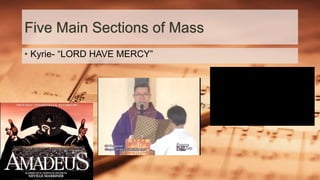
Five Main Sections of Mass
• Kyrie- “LORD HAVE MERCY”
Five Main Sections of Mass
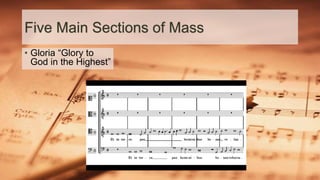
• Gloria “Glory to
God in the Highest”
Five Main Sections of Mass
• Credo “Apostle’s Creed” or “Nicean Creed”
Five Main Sections of Mass
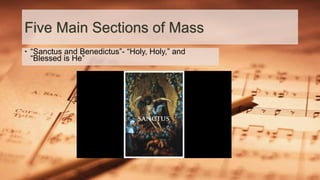
• “Sanctus and Benedictus”- “Holy, Holy,” and
“Blessed is He”
Five Main Sections of Mass
• Agnus Dei “Lamb of God”
Vocal Music of the Renaissance period
• MADRIGAL
• A Secular vocal polyphonic music composition which originated from
Italy.
• Written and expressed in a poetic text and sung during courtly social
gatherings
• Most important secular form during the Renaissance period
• CHARACTERISTICS
• Polyphonic
• Sung in a capella
• Through-composed
• 3-6 voices
FAMOUS COMPOSERS DURING THE TIME
• Giovanni Pierluigi da Palestrina, Rome, 1525, Feb. 2, 1594
-Greatest master o f roman Catholic Church-sacred music
-He has keen interest in satisfying the desires of church
-organist and choir master
• Thomas Morley, 1557-1602
-Singer in the local cathedral
-from boyhood, he became master of choristers (1583)
-he was believed to be a graduate in Bachelor of Music with Mr.
William Byrd, an Elizabethan composer.
MAPEH 9: Medieval Period

MAPEH 9: Medieval Period

  • 1.
    MUSIC OF THEMEDIEVAL PERIOD Composers, Characteristics, etc.
  • 2.
    GREGORIAN CHANT GREGORIAN CHANT Monophonic  Free meter  Modal  Usually based in Latin Liturgy  Use of Neume notation
  • 4.
    TROUBADOR MUSIC • CHARACTERISTICS Monophonic Sometimeswith Improvised accompaniment Chivalry and courtly love Originatedin France French Language
  • 5.
    MUSIC OF THERENAISSANCE PERIOD 1400-1600 • Rebirth, revival, rediscovery, looking back to the golden age of Greece and Rome • Music became popular for entertainment and activity for amateurs and the educated. • Sacred music started to decline but it was still of great importance • Secular music became more prominent • “Golden Age” of A Capella choral music
  • 6.
    Characteristics of Rennaisance •Mostly polyphonic • Imitation among the voices is common • Use of word painting in texts and music • Melodic lines move in a flowing manner • Melodies are easier to perform because these move along a scale with a few large leaps
  • 8.
    Vocal Music ofthe Renaissance period • MASS • A form of sacred musical composition that sets texts of the Eucharistic liturgy into music
  • 9.
    Characteristics of theMass • Polyphonic • May be sung a capella or with Orchestral Accompaniment • Text may be syllabic (One note set to each syllable), neumatic (a few notes to set one syllable), or melismatic (many notes to one syllable)
  • 10.
    Five Main Sectionsof Mass • Kyrie- “LORD HAVE MERCY”
  • 11.
    Five Main Sectionsof Mass • Gloria “Glory to God in the Highest”
  • 12.
    Five Main Sectionsof Mass • Credo “Apostle’s Creed” or “Nicean Creed”
  • 13.
    Five Main Sectionsof Mass • “Sanctus and Benedictus”- “Holy, Holy,” and “Blessed is He”
  • 14.
    Five Main Sectionsof Mass • Agnus Dei “Lamb of God”
  • 15.
    Vocal Music ofthe Renaissance period • MADRIGAL • A Secular vocal polyphonic music composition which originated from Italy. • Written and expressed in a poetic text and sung during courtly social gatherings • Most important secular form during the Renaissance period • CHARACTERISTICS • Polyphonic • Sung in a capella • Through-composed • 3-6 voices
  • 16.
    FAMOUS COMPOSERS DURINGTHE TIME • Giovanni Pierluigi da Palestrina, Rome, 1525, Feb. 2, 1594 -Greatest master o f roman Catholic Church-sacred music -He has keen interest in satisfying the desires of church -organist and choir master • Thomas Morley, 1557-1602 -Singer in the local cathedral -from boyhood, he became master of choristers (1583) -he was believed to be a graduate in Bachelor of Music with Mr. William Byrd, an Elizabethan composer.