Random Variables and
Probability Distribution
1. Concept of a Random Variable
2. Discrete Probability Distributions
3. Continuous Probability Distributions
Random Variables
Example 1:
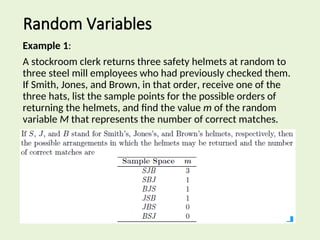
A stockroom clerk returns three safety helmets at random to
three steel mill employees who had previously checked them.
If Smith, Jones, and Brown, in that order, receive one of the
three hats, list the sample points for the possible orders of
returning the helmets, and find the value m of the random
variable M that represents the number of correct matches.
Random Variables (cont.)
Example 2:
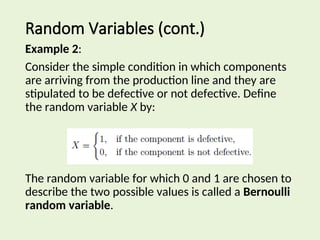
Consider the simple condition in which components
are arriving from the production line and they are
stipulated to be defective or not defective. Define
the random variable X by:
The random variable for which 0 and 1 are chosen to
describe the two possible values is called a Bernoulli
random variable.
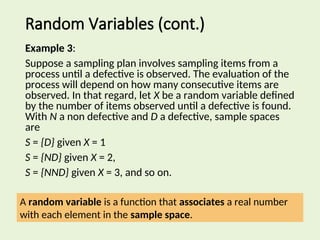
Example 3:
Suppose a sampling plan involves sampling items from a
process until a defective is observed. The evaluation of the
process will depend on how many consecutive items are
observed. In that regard, let X be a random variable defined
by the number of items observed until a defective is found.
With N a non defective and D a defective, sample spaces
are
S = {D} given X = 1
S = {ND} given X = 2,
S = {NND} given X = 3, and so on.
Random Variables (cont.)
A random variable is a function that associates a real number
with each element in the sample space.
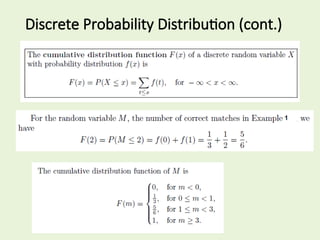
Discrete Probability Distribution
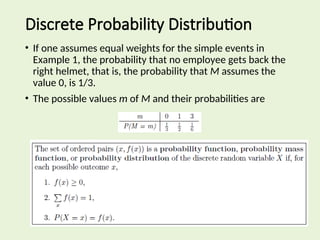
• If one assumes equal weights for the simple events in
Example 1, the probability that no employee gets back the
right helmet, that is, the probability that M assumes the
value 0, is 1/3.
• The possible values m of M and their probabilities are
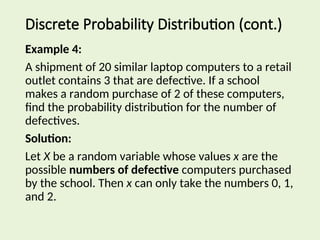
Example 4:
A shipment of 20 similar laptop computers to a retail
outlet contains 3 that are defective. If a school
makes a random purchase of 2 of these computers,
find the probability distribution for the number of
defectives.
Solution:
Let X be a random variable whose values x are the
possible numbers of defective computers purchased
by the school. Then x can only take the numbers 0, 1,
and 2.
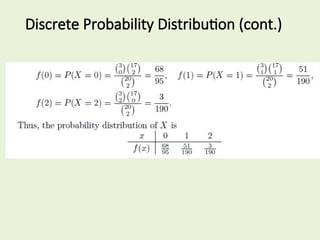
Discrete Probability Distribution (cont.)
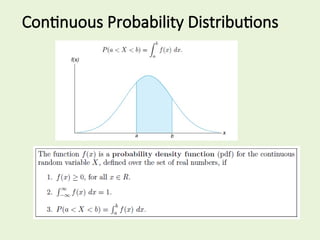
Continuous Probability Distributions
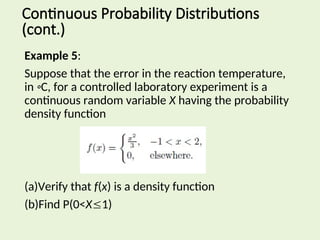
Example 5:
Suppose that the error in the reaction temperature,
in ◦C, for a controlled laboratory experiment is a
continuous random variable X having the probability
density function
(a)Verify that f(x) is a density function
(b)Find P(0<X1)
Continuous Probability Distributions
(cont.)
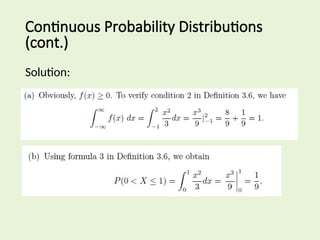
Solution:
Continuous Probability Distributions
(cont.)
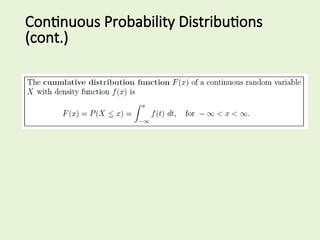
Continuous Probability Distributions
(cont.)

4_Random_variable_and_probability_distribution (2).ppt

  • 1.
    Random Variables and ProbabilityDistribution 1. Concept of a Random Variable 2. Discrete Probability Distributions 3. Continuous Probability Distributions
  • 2.
    Random Variables Example 1: Astockroom clerk returns three safety helmets at random to three steel mill employees who had previously checked them. If Smith, Jones, and Brown, in that order, receive one of the three hats, list the sample points for the possible orders of returning the helmets, and find the value m of the random variable M that represents the number of correct matches.
  • 3.
    Random Variables (cont.) Example2: Consider the simple condition in which components are arriving from the production line and they are stipulated to be defective or not defective. Define the random variable X by: The random variable for which 0 and 1 are chosen to describe the two possible values is called a Bernoulli random variable.
  • 4.
    Example 3: Suppose asampling plan involves sampling items from a process until a defective is observed. The evaluation of the process will depend on how many consecutive items are observed. In that regard, let X be a random variable defined by the number of items observed until a defective is found. With N a non defective and D a defective, sample spaces are S = {D} given X = 1 S = {ND} given X = 2, S = {NND} given X = 3, and so on. Random Variables (cont.) A random variable is a function that associates a real number with each element in the sample space.
  • 5.
    Discrete Probability Distribution •If one assumes equal weights for the simple events in Example 1, the probability that no employee gets back the right helmet, that is, the probability that M assumes the value 0, is 1/3. • The possible values m of M and their probabilities are
  • 6.
    Example 4: A shipmentof 20 similar laptop computers to a retail outlet contains 3 that are defective. If a school makes a random purchase of 2 of these computers, find the probability distribution for the number of defectives. Solution: Let X be a random variable whose values x are the possible numbers of defective computers purchased by the school. Then x can only take the numbers 0, 1, and 2. Discrete Probability Distribution (cont.)
  • 7.
  • 8.
  • 9.
  • 10.
    Example 5: Suppose thatthe error in the reaction temperature, in ◦C, for a controlled laboratory experiment is a continuous random variable X having the probability density function (a)Verify that f(x) is a density function (b)Find P(0<X1) Continuous Probability Distributions (cont.)
  • 11.
  • 12.