2011 International Transaction Journal of Engineering, Management, & Applied Sciences & Technologies.


                   International Transaction Journal of Engineering,
                   Management, & Applied Sciences & Technologies
                             http://www.TuEngr.com,               http://go.to/Research


A Study of Hole Drilling on Stainless Steel AISI 431 by EDM Using
Brass Tube Electrode
                      a                                   a*
Pichai Janmanee , and Apiwat Muttamara
a
    Department of Industrial Engineering Faculty of Engineering, Thammasat University, THAILAND

ARTICLEINFO                         ABSTRACT
Article history:                            When a depth hole is drilled by EDM, taper is occurred
Received 23 August 2011
Received in revised form            which is not desired in the process. This research was focused on
23 September 2011                   influence of EDM parameters on material removal rate (MRR),
Accepted 27 September 2011          electrode wear rate (EWR) and tapered hole of martensitic
Available online
27 September 2011                   stainless steel AISI 431. The considered factors consist of
Keywords:                           electrical current, on-time, duty factor, water pressure and servo
EDM, AISI 431,                      rate. The experimental results reveal that MRR increases when
Electrode,                          increasing of servo rate. The taper of hole increases with
Brass,                              increasing of electrical current and servo rate. However, it is
Taper                               reverse proportion to water pressure and duty factor.


                                       2011 International Transaction Journal of Engineering, Management, &
                                    Applied Sciences & Technologies.


1 Introduction 
       Nowadays, stainless steel AISI 431 is a popular material used in many industries such as
water pump, kitchenware, and fittings manufacturing industries(Jeong and Min, 2007).
Because of its durability to environment. However, as drilling a hole on stainless steel is
difficult due to its properties. Therefore, various meso or micro machining methods have been
introduced, such as machining, ultrasonic, electrochemical, laser, electrical discharge
machining. Especially an electrical discharge machining (EDM) is one of non-contact thermal
process, which has advantages such as high-precision machining of conductive materials and
*Corresponding author (A. Muttamara). Tel/Fax: +66-2-5643001 Ext.3189. E-mail addresses:
mapiwat@engr.tu.ac.th.      2011. International Transaction Journal of Engineering,
Management, & Applied Sciences & Technologies. Volume 2 No.4.            ISSN 2228-9860.
                                                                                                              471
eISSN 1906-9642. Online Available at http://TuEngr.com/V02/471-481.pdf
insulating materials regardless of material hardness, (Muttamara et al, 2009&2010). However,
the important type of defect from hole drilling during EDM process is hole taper and hole
accuracy (Ali et al.2009). Therefore, in order to improve hole quality, Sharma et al.(2002) and
Bilgi et al.(2007) investigated optimum values of the process parameters experimentally such
as voltage, feed rate, pulse on time, duty cycle, and the length of un–insulate tool.


                           Figure 1: Characteristic of taper on EDM


    In the EDM sparking hole drilling process, the viscous resistance in the narrow discharge
gap causes difficulty in the removal of debris and bubbles from the working area, abnormal
discharges are occurred and resulting in extensive electrode wear (Yu et al. 2009). Moreover,
the debris moved by pressure flow of dielectric fluid make taper on the workpiece. The hole
taper of workpiece from EDM process, which as shows in Figure 1, can be calculated by
equation (1).


                           tan                                                            (1)

       Where           D is hole entrances,
                       d is hole exits, and
                       L is hole length.

    This research focuses on influence of machining variables affecting material removal rate
(MRR), electrode wear rate (EWR), and taper on martensitic stainless steel AISI 431.


2 Experimental Procedure 
    The experiments were carried out on 35 mm of hole depth of martensitic stainless steel
AISI 431with ZNC-EDM model JM325DZ manufactured by Joemars company, as shown in
Figure2(a). The EDM was carried out on meso-scale machining with a brass tube electrode as

    472          Pichai Janmanee, and Apiwat Muttamara
outside diameter of 1 mm, inner hole diameter of 0.3 mm for flushing by dielectric fluid to
remove wear debris and heat ventilation size as shown in Figure 2(b). Principle of tube
electrode drilling is shown in Figure 2(c). The experiments were carried out in the de-ionised,
because of the advantage of material removal rate (Diver et al. 2004).                     The chemical
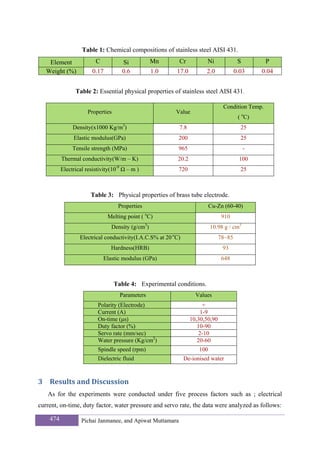
compositions and essential physical properties are shown in Table 1 and Table 2, respectively.
Table 3 shows the physical properties of an electrode.              The experiment conditions are
contained in Table 4.


       (a) EDM super drill model JM325DZ                     (b) Brass (Cu-Zn40) tube electrode


                                   (c) ZNC-EDM drilling process


                                  Figure 2: Experimental EDM .


*Corresponding author (A. Muttamara). Tel/Fax: +66-2-5643001 Ext.3189. E-mail addresses:
mapiwat@engr.tu.ac.th.      2011. International Transaction Journal of Engineering,
Management, & Applied Sciences & Technologies. Volume 2 No.4.            ISSN 2228-9860.
                                                                                                473
eISSN 1906-9642. Online Available at http://TuEngr.com/V02/471-481.pdf
Table 1: Chemical compositions of stainless steel AISI 431.
    Element              C            Si          Mn       Cr            Ni              S         P
   Weight (%)           0.17          0.6         1.0     17.0          2.0             0.03     0.04


                Table 2: Essential physical properties of stainless steel AISI 431.

                                                                                 Condition Temp.
                      Properties                          Value
                                                                                         ( oC)
               Density(x1000 Kg/m3)                        7.8                            25
               Elastic modulus(GPa)                        200                            25
               Tensile strength (MPa)                      965                               -
          Thermal conductivity(W/m – K)                    20.2                          100
          Electrical resistivity(10-9 Ω – m )              720                            25


                       Table 3: Physical properties of brass tube electrode.
                                    Properties                             Cu-Zn (60-40)
                               Melting point ( oC)                               910
                                Density (g/cm3)                            10.98 g / cm3
                  Electrical conductivity(I.A.C.S% at 20 oC)                    78~85
                                Hardness(HRB)                                    93
                             Elastic modulus (GPa)                               648


                                   Table 4: Experimental conditions.
                                     Parameters                     Values
                          Polarity (Electrode)                          +
                          Current (A)                                  1-9
                          On-time (μs)                            10,30,50,90
                          Duty factor (%)                            10-90
                          Servo rate (mm/sec)                         2-10
                          Water pressure (Kg/cm2)                    20-60
                          Spindle speed (rpm)                        100
                          Dielectric fluid                     De-ionised water


3 Results and Discussion 
   As for the experiments were conducted under five process factors such as ; electrical
current, on-time, duty factor, water pressure and servo rate, the data were analyzed as follows:

    474            Pichai Janmanee, and Apiwat Muttamara
3.1 Analysis of Water Pressure 
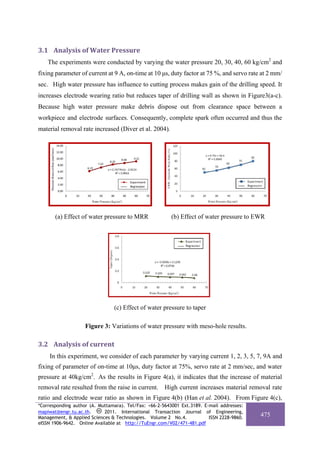
    The experiments were conducted by varying the water pressure 20, 30, 40, 60 kg/cm2 and
fixing parameter of current at 9 A, on-time at 10 μs, duty factor at 75 %, and servo rate at 2 mm/
sec. High water pressure has influence to cutting process makes gain of the drilling speed. It
increases electrode wearing ratio but reduces taper of drilling wall as shown in Figure3(a-c).
Because high water pressure make debris dispose out from clearance space between a
workpiece and electrode surfaces. Consequently, complete spark often occurred and thus the
material removal rate increased (Diver et al. 2004).


       (a) Effect of water pressure to MRR               (b) Effect of water pressure to EWR


                                (c) Effect of water pressure to taper

                    Figure 3: Variations of water pressure with meso-hole results.

3.2 Analysis of current 
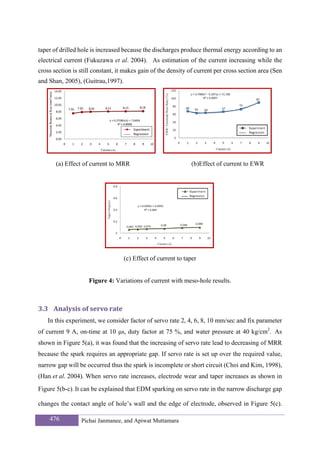
    In this experiment, we consider of each parameter by varying current 1, 2, 3, 5, 7, 9A and
fixing of parameter of on-time at 10μs, duty factor at 75%, servo rate at 2 mm/sec, and water
pressure at 40kg/cm2. As the results in Figure 4(a), it indicates that the increase of material
removal rate resulted from the raise in current. High current increases material removal rate
ratio and electrode wear ratio as shown in Figure 4(b) (Han et al. 2004). From Figure 4(c),
*Corresponding author (A. Muttamara). Tel/Fax: +66-2-5643001 Ext.3189. E-mail addresses:
mapiwat@engr.tu.ac.th.      2011. International Transaction Journal of Engineering,
Management, & Applied Sciences & Technologies. Volume 2 No.4.            ISSN 2228-9860.
                                                                                           475
eISSN 1906-9642. Online Available at http://TuEngr.com/V02/471-481.pdf
taper of drilled hole is increased because the discharges produce thermal energy according to an
electrical current (Fukuzawa et al. 2004). As estimation of the current increasing while the
cross section is still constant, it makes gain of the density of current per cross section area (Sen
and Shan, 2005), (Guitrau,1997).


       (a) Effect of current to MRR                           (b)Effect of current to EWR


                                   (c) Effect of current to taper


                    Figure 4: Variations of current with meso-hole results.


3.3 Analysis of servo rate 
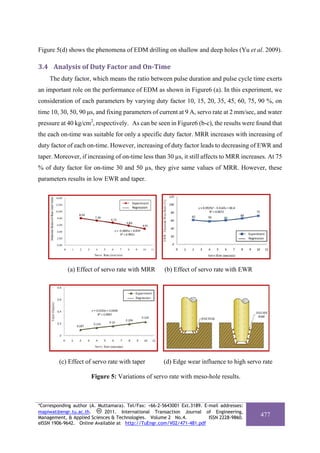
   In this experiment, we consider factor of servo rate 2, 4, 6, 8, 10 mm/sec and fix parameter
of current 9 A, on-time at 10 μs, duty factor at 75 %, and water pressure at 40 kg/cm2. As
shown in Figure 5(a), it was found that the increasing of servo rate lead to decreasing of MRR
because the spark requires an appropriate gap. If servo rate is set up over the required value,
narrow gap will be occurred thus the spark is incomplete or short circuit (Choi and Kim, 1998),
(Han et al. 2004). When servo rate increases, electrode wear and taper increases as shown in
Figure 5(b-c). It can be explained that EDM sparking on servo rate in the narrow discharge gap

changes the contact angle of hole’s wall and the edge of electrode, observed in Figure 5(c).

    476          Pichai Janmanee, and Apiwat Muttamara
Figure 5(d) shows the phenomena of EDM drilling on shallow and deep holes (Yu et al. 2009).

3.4 Analysis of Duty Factor and On­Time 
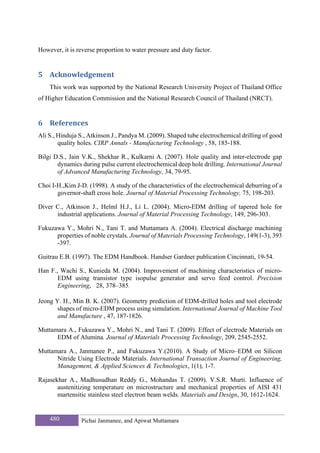
    The duty factor, which means the ratio between pulse duration and pulse cycle time exerts
an important role on the performance of EDM as shown in Figure6 (a). In this experiment, we
consideration of each parameters by varying duty factor 10, 15, 20, 35, 45, 60, 75, 90 %, on
time 10, 30, 50, 90 μs, and fixing parameters of current at 9 A, servo rate at 2 mm/sec, and water
pressure at 40 kg/cm2, respectively. As can be seen in Figure6 (b-c), the results were found that
the each on-time was suitable for only a specific duty factor. MRR increases with increasing of
duty factor of each on-time. However, increasing of duty factor leads to decreasing of EWR and
taper. Moreover, if increasing of on-time less than 30 µs, it still affects to MRR increases. At 75
% of duty factor for on-time 30 and 50 µs, they give same values of MRR. However, these
parameters results in low EWR and taper.


            (a) Effect of servo rate with MRR         (b) Effect of servo rate with EWR


         (c) Effect of servo rate with taper         (d) Edge wear influence to high servo rate

                      Figure 5: Variations of servo rate with meso-hole results.


*Corresponding author (A. Muttamara). Tel/Fax: +66-2-5643001 Ext.3189. E-mail addresses:
mapiwat@engr.tu.ac.th.      2011. International Transaction Journal of Engineering,
Management, & Applied Sciences & Technologies. Volume 2 No.4.            ISSN 2228-9860.
                                                                                           477
eISSN 1906-9642. Online Available at http://TuEngr.com/V02/471-481.pdf
(a) Relations of duty factor and cycle time          (b) Effect of duty factor to MRR


                          (c) Effect of duty factor to EWR


                          (d) Effect of duty factor to taper

               Figure 6: Variations of duty factor with meso-hole results.


478         Pichai Janmanee, and Apiwat Muttamara
Figure 7 shows impressions of the result from the experiment test with current at 9A,
on-time at 10μs, duty factor at 75%, servo rate at 2 mm/sec, and water pressure at 40 kg/cm2,
respectively. It shows the feature of taper could be achieved. Diameter at electrode entry was
between 1.08 mm and 0.97 mm as shown in Figure 7(a). Figure 7(b) shows result meso-hole
machined exit. Figure 8 shows an image of a section meso-hole machined using the same
condition.


                        (a) Hole entrance                         (b) Hole exit

                     Figure 7: Characteristic of meso-hole and electrode results.


                          Figure 8: SEM image of section meso-hole.


4 Conclusion 
    As the results of the material removal rate, electrode wear, taper in the drill hole meso-scale
by brass tube electrode, it can conclude that:
    1. The MRR is lower when increasing of servo rate.
    2. The taper of hole increases with increasing of electrical current and servo rate.

*Corresponding author (A. Muttamara). Tel/Fax: +66-2-5643001 Ext.3189. E-mail addresses:
mapiwat@engr.tu.ac.th.      2011. International Transaction Journal of Engineering,
Management, & Applied Sciences & Technologies. Volume 2 No.4.            ISSN 2228-9860.
                                                                                           479
eISSN 1906-9642. Online Available at http://TuEngr.com/V02/471-481.pdf
However, it is reverse proportion to water pressure and duty factor.


5 Acknowledgement 
    This work was supported by the National Research University Project of Thailand Office
of Higher Education Commission and the National Research Council of Thailand (NRCT).


6 References 
Ali S., Hinduja S., Atkinson J., Pandya M. (2009). Shaped tube electrochemical drilling of good
        quality holes. CIRP Annals - Manufacturing Technology , 58, 185-188.

Bilgi D.S., Jain V.K., Shekhar R., Kulkarni A. (2007). Hole quality and inter-electrode gap
       dynamics during pulse current electrochemical deep hole drilling. International Journal
       of Advanced Manufacturing Technology, 34, 79-95.

Choi I-H.,Kim J-D. (1998). A study of the characteristics of the electrochemical deburring of a
       governor-shaft cross hole. Journal of Material Processing Technology, 75, 198-203.

Diver C., Atkinson J., Helml H.J., Li L. (2004). Micro-EDM drilling of tapered hole for
      industrial applications. Journal of Material Processing Technology, 149, 296-303.

Fukuzawa Y., Mohri N., Tani T. and Muttamara A. (2004). Electrical discharge machining
      properties of noble crystals. Journal of Materials Processing Technology, 149(1-3), 393
      -397.

Guitrau E.B. (1997). The EDM Handbook. Handser Gardner publication Cincinnati, 19-54.

Han F., Wachi S., Kunieda M. (2004). Improvement of machining characteristics of micro-
       EDM using transistor type isopulse generator and servo feed control. Precision
       Engineering, 28, 378–385.

Jeong Y. H., Min B. K. (2007). Geometry prediction of EDM-drilled holes and tool electrode
       shapes of micro-EDM process using simulation. International Journal of Machine Tool
       and Manufacture , 47, 187-1826.

Muttamara A., Fukuzawa Y., Mohri N., and Tani T. (2009). Effect of electrode Materials on
      EDM of Alumina. Journal of Materials Processing Technology, 209, 2545-2552.

Muttamara A., Janmanee P., and Fukuzawa Y.(2010). A Study of Micro–EDM on Silicon
      Nitride Using Electrode Materials. International Transaction Journal of Engineering,
      Management, & Applied Sciences & Technologies, 1(1), 1-7.

Rajasekhar A., Madhusudhan Reddy G., Mohandas T. (2009). V.S.R. Murti. Influence of
       austenitizing temperature on microstructure and mechanical properties of AISI 431
       martensitic stainless steel electron beam welds. Materials and Design, 30, 1612-1624.


    480         Pichai Janmanee, and Apiwat Muttamara
Sen M., Shan H.S.(2005). A review of electrochemical macro- to micro-hole drilling processes.
       International Journal of Machine Tool and Manufacture,45, 137-152.

Sharma S., Jain V.K., Shekhar R. (2002). Electrochemical drilling of inconel super alloy with
      acidified NaCl electrolyte. International Journal of Advanced Manufacturing
      Technology, 19, 492-500.

Yu Z.Y., Zhang Y., Li J., Luan J., Zhao F., Guo D. (2009). High aspect ratio micro-hole drilling
      aided with ultrasonic vibration and planetary movement of electrode by micro-EDM.
      CIRP Annals - Manufacturing Technology, 58, 213-216.


              Pichai Janmanee is an Assistant Professor in the Department of Industrial Engineering at Rajamangala
              University of Technology Krungthep (RMUTK), Bangkok, Thailand. He received a BE in Industrial
              Engineering from Rajamangala University of Technology and ME in Production Engineering from King’s
              Mongkut University of Technology North Bangkok(KMUT’NB). His areas of research include machining
              and electrical discharge machining of hard materials.9


              Dr.Apiwat Muttamara is an Assistant Professor of Department of Industrial Engineering at Thammasat
              University. He received his B.Eng. from Kasetsart University and the D.Eng. in Materials Science from
              Nagaoka University of Technology, Japan. His areas of research include machining and electrical discharge
              machining of hard materials.


Peer Review: This article has been internationally peer-reviewed and accepted for publication
                according to the guidelines given at the journal’s website.


*Corresponding author (A. Muttamara). Tel/Fax: +66-2-5643001 Ext.3189. E-mail addresses:
mapiwat@engr.tu.ac.th.      2011. International Transaction Journal of Engineering,
Management, & Applied Sciences & Technologies. Volume 2 No.4.            ISSN 2228-9860.
                                                                                                           481
eISSN 1906-9642. Online Available at http://TuEngr.com/V02/471-481.pdf

A Study of Hole Drilling on Stainless Steel AISI 431 by EDM Using Brass Tube Electrode

  • 1.
    2011 International TransactionJournal of Engineering, Management, & Applied Sciences & Technologies. International Transaction Journal of Engineering, Management, & Applied Sciences & Technologies http://www.TuEngr.com, http://go.to/Research A Study of Hole Drilling on Stainless Steel AISI 431 by EDM Using Brass Tube Electrode a a* Pichai Janmanee , and Apiwat Muttamara a Department of Industrial Engineering Faculty of Engineering, Thammasat University, THAILAND ARTICLEINFO ABSTRACT Article history: When a depth hole is drilled by EDM, taper is occurred Received 23 August 2011 Received in revised form which is not desired in the process. This research was focused on 23 September 2011 influence of EDM parameters on material removal rate (MRR), Accepted 27 September 2011 electrode wear rate (EWR) and tapered hole of martensitic Available online 27 September 2011 stainless steel AISI 431. The considered factors consist of Keywords: electrical current, on-time, duty factor, water pressure and servo EDM, AISI 431, rate. The experimental results reveal that MRR increases when Electrode, increasing of servo rate. The taper of hole increases with Brass, increasing of electrical current and servo rate. However, it is Taper reverse proportion to water pressure and duty factor. 2011 International Transaction Journal of Engineering, Management, & Applied Sciences & Technologies. 1 Introduction  Nowadays, stainless steel AISI 431 is a popular material used in many industries such as water pump, kitchenware, and fittings manufacturing industries(Jeong and Min, 2007). Because of its durability to environment. However, as drilling a hole on stainless steel is difficult due to its properties. Therefore, various meso or micro machining methods have been introduced, such as machining, ultrasonic, electrochemical, laser, electrical discharge machining. Especially an electrical discharge machining (EDM) is one of non-contact thermal process, which has advantages such as high-precision machining of conductive materials and *Corresponding author (A. Muttamara). Tel/Fax: +66-2-5643001 Ext.3189. E-mail addresses: mapiwat@engr.tu.ac.th. 2011. International Transaction Journal of Engineering, Management, & Applied Sciences & Technologies. Volume 2 No.4. ISSN 2228-9860. 471 eISSN 1906-9642. Online Available at http://TuEngr.com/V02/471-481.pdf
  • 2.
    insulating materials regardlessof material hardness, (Muttamara et al, 2009&2010). However, the important type of defect from hole drilling during EDM process is hole taper and hole accuracy (Ali et al.2009). Therefore, in order to improve hole quality, Sharma et al.(2002) and Bilgi et al.(2007) investigated optimum values of the process parameters experimentally such as voltage, feed rate, pulse on time, duty cycle, and the length of un–insulate tool. Figure 1: Characteristic of taper on EDM In the EDM sparking hole drilling process, the viscous resistance in the narrow discharge gap causes difficulty in the removal of debris and bubbles from the working area, abnormal discharges are occurred and resulting in extensive electrode wear (Yu et al. 2009). Moreover, the debris moved by pressure flow of dielectric fluid make taper on the workpiece. The hole taper of workpiece from EDM process, which as shows in Figure 1, can be calculated by equation (1). tan (1) Where D is hole entrances, d is hole exits, and L is hole length. This research focuses on influence of machining variables affecting material removal rate (MRR), electrode wear rate (EWR), and taper on martensitic stainless steel AISI 431. 2 Experimental Procedure  The experiments were carried out on 35 mm of hole depth of martensitic stainless steel AISI 431with ZNC-EDM model JM325DZ manufactured by Joemars company, as shown in Figure2(a). The EDM was carried out on meso-scale machining with a brass tube electrode as 472 Pichai Janmanee, and Apiwat Muttamara
  • 3.
    outside diameter of1 mm, inner hole diameter of 0.3 mm for flushing by dielectric fluid to remove wear debris and heat ventilation size as shown in Figure 2(b). Principle of tube electrode drilling is shown in Figure 2(c). The experiments were carried out in the de-ionised, because of the advantage of material removal rate (Diver et al. 2004). The chemical compositions and essential physical properties are shown in Table 1 and Table 2, respectively. Table 3 shows the physical properties of an electrode. The experiment conditions are contained in Table 4. (a) EDM super drill model JM325DZ (b) Brass (Cu-Zn40) tube electrode (c) ZNC-EDM drilling process Figure 2: Experimental EDM . *Corresponding author (A. Muttamara). Tel/Fax: +66-2-5643001 Ext.3189. E-mail addresses: mapiwat@engr.tu.ac.th. 2011. International Transaction Journal of Engineering, Management, & Applied Sciences & Technologies. Volume 2 No.4. ISSN 2228-9860. 473 eISSN 1906-9642. Online Available at http://TuEngr.com/V02/471-481.pdf
  • 4.
    Table 1: Chemicalcompositions of stainless steel AISI 431. Element C Si Mn Cr Ni S P Weight (%) 0.17 0.6 1.0 17.0 2.0 0.03 0.04 Table 2: Essential physical properties of stainless steel AISI 431. Condition Temp. Properties Value ( oC) Density(x1000 Kg/m3) 7.8 25 Elastic modulus(GPa) 200 25 Tensile strength (MPa) 965 - Thermal conductivity(W/m – K) 20.2 100 Electrical resistivity(10-9 Ω – m ) 720 25 Table 3: Physical properties of brass tube electrode. Properties Cu-Zn (60-40) Melting point ( oC) 910 Density (g/cm3) 10.98 g / cm3 Electrical conductivity(I.A.C.S% at 20 oC) 78~85 Hardness(HRB) 93 Elastic modulus (GPa) 648 Table 4: Experimental conditions. Parameters Values Polarity (Electrode) + Current (A) 1-9 On-time (μs) 10,30,50,90 Duty factor (%) 10-90 Servo rate (mm/sec) 2-10 Water pressure (Kg/cm2) 20-60 Spindle speed (rpm) 100 Dielectric fluid De-ionised water 3 Results and Discussion  As for the experiments were conducted under five process factors such as ; electrical current, on-time, duty factor, water pressure and servo rate, the data were analyzed as follows: 474 Pichai Janmanee, and Apiwat Muttamara
  • 5.
    3.1 Analysis of Water Pressure  The experiments were conducted by varying the water pressure 20, 30, 40, 60 kg/cm2 and fixing parameter of current at 9 A, on-time at 10 μs, duty factor at 75 %, and servo rate at 2 mm/ sec. High water pressure has influence to cutting process makes gain of the drilling speed. It increases electrode wearing ratio but reduces taper of drilling wall as shown in Figure3(a-c). Because high water pressure make debris dispose out from clearance space between a workpiece and electrode surfaces. Consequently, complete spark often occurred and thus the material removal rate increased (Diver et al. 2004). (a) Effect of water pressure to MRR (b) Effect of water pressure to EWR (c) Effect of water pressure to taper Figure 3: Variations of water pressure with meso-hole results. 3.2 Analysis of current  In this experiment, we consider of each parameter by varying current 1, 2, 3, 5, 7, 9A and fixing of parameter of on-time at 10μs, duty factor at 75%, servo rate at 2 mm/sec, and water pressure at 40kg/cm2. As the results in Figure 4(a), it indicates that the increase of material removal rate resulted from the raise in current. High current increases material removal rate ratio and electrode wear ratio as shown in Figure 4(b) (Han et al. 2004). From Figure 4(c), *Corresponding author (A. Muttamara). Tel/Fax: +66-2-5643001 Ext.3189. E-mail addresses: mapiwat@engr.tu.ac.th. 2011. International Transaction Journal of Engineering, Management, & Applied Sciences & Technologies. Volume 2 No.4. ISSN 2228-9860. 475 eISSN 1906-9642. Online Available at http://TuEngr.com/V02/471-481.pdf
  • 6.
    taper of drilledhole is increased because the discharges produce thermal energy according to an electrical current (Fukuzawa et al. 2004). As estimation of the current increasing while the cross section is still constant, it makes gain of the density of current per cross section area (Sen and Shan, 2005), (Guitrau,1997). (a) Effect of current to MRR (b)Effect of current to EWR (c) Effect of current to taper Figure 4: Variations of current with meso-hole results. 3.3 Analysis of servo rate  In this experiment, we consider factor of servo rate 2, 4, 6, 8, 10 mm/sec and fix parameter of current 9 A, on-time at 10 μs, duty factor at 75 %, and water pressure at 40 kg/cm2. As shown in Figure 5(a), it was found that the increasing of servo rate lead to decreasing of MRR because the spark requires an appropriate gap. If servo rate is set up over the required value, narrow gap will be occurred thus the spark is incomplete or short circuit (Choi and Kim, 1998), (Han et al. 2004). When servo rate increases, electrode wear and taper increases as shown in Figure 5(b-c). It can be explained that EDM sparking on servo rate in the narrow discharge gap changes the contact angle of hole’s wall and the edge of electrode, observed in Figure 5(c). 476 Pichai Janmanee, and Apiwat Muttamara
  • 7.
    Figure 5(d) showsthe phenomena of EDM drilling on shallow and deep holes (Yu et al. 2009). 3.4 Analysis of Duty Factor and On­Time  The duty factor, which means the ratio between pulse duration and pulse cycle time exerts an important role on the performance of EDM as shown in Figure6 (a). In this experiment, we consideration of each parameters by varying duty factor 10, 15, 20, 35, 45, 60, 75, 90 %, on time 10, 30, 50, 90 μs, and fixing parameters of current at 9 A, servo rate at 2 mm/sec, and water pressure at 40 kg/cm2, respectively. As can be seen in Figure6 (b-c), the results were found that the each on-time was suitable for only a specific duty factor. MRR increases with increasing of duty factor of each on-time. However, increasing of duty factor leads to decreasing of EWR and taper. Moreover, if increasing of on-time less than 30 µs, it still affects to MRR increases. At 75 % of duty factor for on-time 30 and 50 µs, they give same values of MRR. However, these parameters results in low EWR and taper. (a) Effect of servo rate with MRR (b) Effect of servo rate with EWR (c) Effect of servo rate with taper (d) Edge wear influence to high servo rate Figure 5: Variations of servo rate with meso-hole results. *Corresponding author (A. Muttamara). Tel/Fax: +66-2-5643001 Ext.3189. E-mail addresses: mapiwat@engr.tu.ac.th. 2011. International Transaction Journal of Engineering, Management, & Applied Sciences & Technologies. Volume 2 No.4. ISSN 2228-9860. 477 eISSN 1906-9642. Online Available at http://TuEngr.com/V02/471-481.pdf
  • 8.
    (a) Relations ofduty factor and cycle time (b) Effect of duty factor to MRR (c) Effect of duty factor to EWR (d) Effect of duty factor to taper Figure 6: Variations of duty factor with meso-hole results. 478 Pichai Janmanee, and Apiwat Muttamara
  • 9.
    Figure 7 showsimpressions of the result from the experiment test with current at 9A, on-time at 10μs, duty factor at 75%, servo rate at 2 mm/sec, and water pressure at 40 kg/cm2, respectively. It shows the feature of taper could be achieved. Diameter at electrode entry was between 1.08 mm and 0.97 mm as shown in Figure 7(a). Figure 7(b) shows result meso-hole machined exit. Figure 8 shows an image of a section meso-hole machined using the same condition. (a) Hole entrance (b) Hole exit Figure 7: Characteristic of meso-hole and electrode results. Figure 8: SEM image of section meso-hole. 4 Conclusion  As the results of the material removal rate, electrode wear, taper in the drill hole meso-scale by brass tube electrode, it can conclude that: 1. The MRR is lower when increasing of servo rate. 2. The taper of hole increases with increasing of electrical current and servo rate. *Corresponding author (A. Muttamara). Tel/Fax: +66-2-5643001 Ext.3189. E-mail addresses: mapiwat@engr.tu.ac.th. 2011. International Transaction Journal of Engineering, Management, & Applied Sciences & Technologies. Volume 2 No.4. ISSN 2228-9860. 479 eISSN 1906-9642. Online Available at http://TuEngr.com/V02/471-481.pdf
  • 10.
    However, it isreverse proportion to water pressure and duty factor. 5 Acknowledgement  This work was supported by the National Research University Project of Thailand Office of Higher Education Commission and the National Research Council of Thailand (NRCT). 6 References  Ali S., Hinduja S., Atkinson J., Pandya M. (2009). Shaped tube electrochemical drilling of good quality holes. CIRP Annals - Manufacturing Technology , 58, 185-188. Bilgi D.S., Jain V.K., Shekhar R., Kulkarni A. (2007). Hole quality and inter-electrode gap dynamics during pulse current electrochemical deep hole drilling. International Journal of Advanced Manufacturing Technology, 34, 79-95. Choi I-H.,Kim J-D. (1998). A study of the characteristics of the electrochemical deburring of a governor-shaft cross hole. Journal of Material Processing Technology, 75, 198-203. Diver C., Atkinson J., Helml H.J., Li L. (2004). Micro-EDM drilling of tapered hole for industrial applications. Journal of Material Processing Technology, 149, 296-303. Fukuzawa Y., Mohri N., Tani T. and Muttamara A. (2004). Electrical discharge machining properties of noble crystals. Journal of Materials Processing Technology, 149(1-3), 393 -397. Guitrau E.B. (1997). The EDM Handbook. Handser Gardner publication Cincinnati, 19-54. Han F., Wachi S., Kunieda M. (2004). Improvement of machining characteristics of micro- EDM using transistor type isopulse generator and servo feed control. Precision Engineering, 28, 378–385. Jeong Y. H., Min B. K. (2007). Geometry prediction of EDM-drilled holes and tool electrode shapes of micro-EDM process using simulation. International Journal of Machine Tool and Manufacture , 47, 187-1826. Muttamara A., Fukuzawa Y., Mohri N., and Tani T. (2009). Effect of electrode Materials on EDM of Alumina. Journal of Materials Processing Technology, 209, 2545-2552. Muttamara A., Janmanee P., and Fukuzawa Y.(2010). A Study of Micro–EDM on Silicon Nitride Using Electrode Materials. International Transaction Journal of Engineering, Management, & Applied Sciences & Technologies, 1(1), 1-7. Rajasekhar A., Madhusudhan Reddy G., Mohandas T. (2009). V.S.R. Murti. Influence of austenitizing temperature on microstructure and mechanical properties of AISI 431 martensitic stainless steel electron beam welds. Materials and Design, 30, 1612-1624. 480 Pichai Janmanee, and Apiwat Muttamara
  • 11.
    Sen M., ShanH.S.(2005). A review of electrochemical macro- to micro-hole drilling processes. International Journal of Machine Tool and Manufacture,45, 137-152. Sharma S., Jain V.K., Shekhar R. (2002). Electrochemical drilling of inconel super alloy with acidified NaCl electrolyte. International Journal of Advanced Manufacturing Technology, 19, 492-500. Yu Z.Y., Zhang Y., Li J., Luan J., Zhao F., Guo D. (2009). High aspect ratio micro-hole drilling aided with ultrasonic vibration and planetary movement of electrode by micro-EDM. CIRP Annals - Manufacturing Technology, 58, 213-216. Pichai Janmanee is an Assistant Professor in the Department of Industrial Engineering at Rajamangala University of Technology Krungthep (RMUTK), Bangkok, Thailand. He received a BE in Industrial Engineering from Rajamangala University of Technology and ME in Production Engineering from King’s Mongkut University of Technology North Bangkok(KMUT’NB). His areas of research include machining and electrical discharge machining of hard materials.9 Dr.Apiwat Muttamara is an Assistant Professor of Department of Industrial Engineering at Thammasat University. He received his B.Eng. from Kasetsart University and the D.Eng. in Materials Science from Nagaoka University of Technology, Japan. His areas of research include machining and electrical discharge machining of hard materials. Peer Review: This article has been internationally peer-reviewed and accepted for publication according to the guidelines given at the journal’s website. *Corresponding author (A. Muttamara). Tel/Fax: +66-2-5643001 Ext.3189. E-mail addresses: mapiwat@engr.tu.ac.th. 2011. International Transaction Journal of Engineering, Management, & Applied Sciences & Technologies. Volume 2 No.4. ISSN 2228-9860. 481 eISSN 1906-9642. Online Available at http://TuEngr.com/V02/471-481.pdf