NEWTON’S RING
construction, working principle
& its applications
PRESENTED BY-
• AMRITA DAS(ME-127/18)
• SANGYUKTA DAS(ME-157/18)
• RUBIA SULTANA LASKAR(ME-158/18)
NEWTON’S RING :
It is phenomenon in which an
interference pattern is created by
reflection of light between two
surfaces – a spherical surface and
an adjacent touching flat surface.
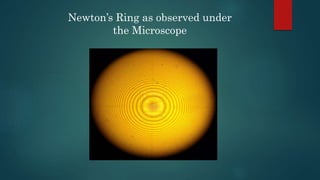
Newton’s Ring as observed under
the Microscope
CONSTRUCTION:
 A Monochromatic source of light S is kept
at the focus of lens L1.
 The parallel beam of light emerging from L1
falls on the glass plate G kept at 45.
 The glass plate reflects a part of the
incident light vertically downwards
normally on the thin air film enclosed by
the plano convex lens L and plane glass P.
 The reflected beam from the air film is
viewed in microscope. Alternate bright and
dark circular rings with dark spots as centre
is seen.
Experimental set-up:
Principle Of Newton’s Ring:
 The pattern is formed by alternating pattern of constructive and destructive interference
between the coherent light rays from two surfaces.
 The two pieces of glass make contact only at the centre at other points there is a slight air gap
between the two surfaces increasing the radial distance from the centre to the microscope.
 Light from monochromatic source shines through the top piece and reflects from both the
bottom surface of the top piece and the top surface of the optical flat.
 The reflected rays combine and superpose.
 These rings are concentric.
Applications :
 Using the method of Newton’s rings, the wavelength of a given
monochromatic source of light can be determined.
The radius of nth dark ring and (n+m)the dark ring are given by
rn
2 = nRλ and r2
n+m = (n+m) Rλ
rn+m
2 – rn
2 = mRλ
so, λ = [rn+m
2 – rn
2] / Mr
 Using Newton’s rings, the refractive index of a liquid can be
calculated. Let λa and λm represent the wavelength of light in air
and in medium (liquid). If rn is the radius of the nth dark ring in
the air and if rn is the radius of the nth dark ring in liquid, then
rn
2 = nRλa
r`n
2 = nRλm = nRλa/μ
so, μ = rn
2/ r`n
2
THANK YOU

440519050-Newton-s-ring.pptx

  • 1.
    NEWTON’S RING construction, workingprinciple & its applications PRESENTED BY- • AMRITA DAS(ME-127/18) • SANGYUKTA DAS(ME-157/18) • RUBIA SULTANA LASKAR(ME-158/18)
  • 2.
    NEWTON’S RING : Itis phenomenon in which an interference pattern is created by reflection of light between two surfaces – a spherical surface and an adjacent touching flat surface.
  • 3.
    Newton’s Ring asobserved under the Microscope
  • 4.
    CONSTRUCTION:  A Monochromaticsource of light S is kept at the focus of lens L1.  The parallel beam of light emerging from L1 falls on the glass plate G kept at 45.  The glass plate reflects a part of the incident light vertically downwards normally on the thin air film enclosed by the plano convex lens L and plane glass P.  The reflected beam from the air film is viewed in microscope. Alternate bright and dark circular rings with dark spots as centre is seen.
  • 5.
  • 6.
    Principle Of Newton’sRing:  The pattern is formed by alternating pattern of constructive and destructive interference between the coherent light rays from two surfaces.  The two pieces of glass make contact only at the centre at other points there is a slight air gap between the two surfaces increasing the radial distance from the centre to the microscope.  Light from monochromatic source shines through the top piece and reflects from both the bottom surface of the top piece and the top surface of the optical flat.  The reflected rays combine and superpose.  These rings are concentric.
  • 7.
    Applications :  Usingthe method of Newton’s rings, the wavelength of a given monochromatic source of light can be determined. The radius of nth dark ring and (n+m)the dark ring are given by rn 2 = nRλ and r2 n+m = (n+m) Rλ rn+m 2 – rn 2 = mRλ so, λ = [rn+m 2 – rn 2] / Mr  Using Newton’s rings, the refractive index of a liquid can be calculated. Let λa and λm represent the wavelength of light in air and in medium (liquid). If rn is the radius of the nth dark ring in the air and if rn is the radius of the nth dark ring in liquid, then rn 2 = nRλa r`n 2 = nRλm = nRλa/μ so, μ = rn 2/ r`n 2
  • 8.