The Role of SME Associations in Encouraging Research & Innovation Experiences from the Textile & Clothing Industry  Conference “ Research, Innovation and European SMEs” Dublin, 3 June 2004 Lutz Walter European Apparel & Textile Organisation
EU-25 Textile-Clothing  Industry Key Figures (200 2) Industry * >95% SME’s 15 Employee/Company 2,9% Investment/Turnover 366,3 Apparent consumption b€ 6,67 Investment  b€ 186.533 Companies* 65,2 Added Value  billion € 2.7 Employment  million persons 227,0 Turnover b€
The World of Textiles Disposal  / Recycling Fibre Thread Fabric Finished Fabric Clothing (Fashion &  Function) Home  Textiles Distribution  /   Retail  Textile Services Hotels Hospitals Public Services Private Consumption Commercial  Use Applications in Automotive Construction Agriculture Medical Sector ... High Street Comp.Outlet Mail Order Type n Technical Textiles Industry Service  Provider The Chemical  Fibre Industry The Textile Industry The Apparel  Industry Non-conventional  Textile  Processing Retail
Euratex Members Countries: EU-25 EFTA : CH-NW Medit. Rim :  Turkey, Morocco Textile Branches: Cotton, Wool, Man-made fibres, Silk & silk-type, Linen, Finishing, Knitting & knitwear, Carpets,  Embroidery, Ribbons, Braids, Sewing threads, Twines, Ropes, Nets, Furnishing textiles ...  Euratex
Major Current Concerns International Trade Research & Development, Innovation  Environment Intellectual Property Social Dialogue Euratex
EURATEX-R&D Mission To cooperate with all stakeholders in textile-related research in order to assure a maximum activity in joint European projects to the full benefit of the European textile & clothing industry. Euratex R&D
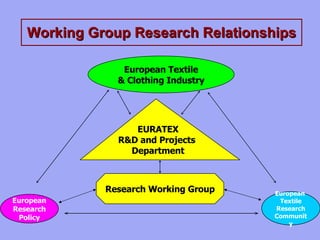
European  Textile Research Community Research Working Group EURATEX R&D and Projects  Department European Textile & Clothing Industry Working Group Research Relationships European Research Policy
Tasks of the Research Working Group Inform industry about EU Research Programmes Discuss European R&D policies and their relevance to the T/C sector, issue opinions and recommendations Liaise with EU research policy makers Develop long-term research priorities for the sector Coordinate European research activities Generate project ideas & facilitate partner search Present results of collaborative R&D projects Euratex R&D
First hand Experience from EU Projects involving SME’s Direct involvement of Euratex in selected projects of strategic importance to the industry as a whole. Main role: coordination and dissemination of results Main fields: research in applied information & environmental technologies, technology transfer, benchmarking , technology standards Programmes: NMP, IST, SME schemes (Collective Research, ETI) Euratex R&D
R&D/Innovation needs of SME’s   First-class research & best of breed technology Flexibly accessible local assistance through trusted partners Joint developments with suppliers/customers Incentives for R&D/innovation and favourable framework conditions Flexible quick-responding support programmes SME Needs
The ideal SME Programme Provides for full bottom-up initiatives without a thematic or political straightjacket Has open calls and pre-proposal checking facilities Has a programme budget that adapts to funding demands to ensure reasonable success rates Needs no more than 3 months from proposal submission to project start Allows maximum flexibility in the number and type of partners Has a light administration and simple transparent procedures Ensures quick reliable payments  Allows for flexible revision of scientific/technical objectives during the course of the project  Still provides for projects with a minimum duration serious research/innovation requires (min. 2 years) Industry Needs
The advantages of industry associations Knowledge of needs and problems of their member companies Unique position in terms of industry reach and networking power  Not tight up in day-to-day commercial operations, able to look at the bigger picture in economic, political and regulatory terms and think more long-term Multi-linguistic and international management skills Depend on a neutral and objective stance vis-à-vis their various members Industry Needs Role of Associations
Association’s limitations Big collective organisations are often distant from the problems of their (small) individual members Can be paralysed by conflicting interests within their membership Often lack scientific/technological expertise, project & IPR management skills Influence on research programmes, priority setting and project selection is often limited Role of Associations
Characteristics of a good SME-innovation supporting association A clearly defined sector, technology or market-oriented profile R&D/Innovation as strategic key objective of the association and corresponding staff profile Recognised R&D/Innovation reference for its members Trusted relationships to research community, policy makers and other relevant stakeholders Efficient direct two-way communication channels to members Strongly controlled and majority subscription-funded by industry members Role of Associations
How can policy support associations in their innovation role? Provide an innovation-friendly regulatory framework Involve associations in programme definition, priority setting and management of support schemes – build programmes that correspond to industrial reality Reduce complexity/bureaucracy and ensure more stability of innovation support programmes Support relevant knowledge and skill development of association staff Support communication between associations and their members Role of Associations

Lutz Walter

  • 1.
    The Role ofSME Associations in Encouraging Research & Innovation Experiences from the Textile & Clothing Industry Conference “ Research, Innovation and European SMEs” Dublin, 3 June 2004 Lutz Walter European Apparel & Textile Organisation
  • 2.
    EU-25 Textile-Clothing Industry Key Figures (200 2) Industry * >95% SME’s 15 Employee/Company 2,9% Investment/Turnover 366,3 Apparent consumption b€ 6,67 Investment b€ 186.533 Companies* 65,2 Added Value billion € 2.7 Employment million persons 227,0 Turnover b€
  • 3.
    The World ofTextiles Disposal / Recycling Fibre Thread Fabric Finished Fabric Clothing (Fashion & Function) Home Textiles Distribution / Retail Textile Services Hotels Hospitals Public Services Private Consumption Commercial Use Applications in Automotive Construction Agriculture Medical Sector ... High Street Comp.Outlet Mail Order Type n Technical Textiles Industry Service Provider The Chemical Fibre Industry The Textile Industry The Apparel Industry Non-conventional Textile Processing Retail
  • 4.
    Euratex Members Countries:EU-25 EFTA : CH-NW Medit. Rim : Turkey, Morocco Textile Branches: Cotton, Wool, Man-made fibres, Silk & silk-type, Linen, Finishing, Knitting & knitwear, Carpets, Embroidery, Ribbons, Braids, Sewing threads, Twines, Ropes, Nets, Furnishing textiles ... Euratex
  • 5.
    Major Current ConcernsInternational Trade Research & Development, Innovation Environment Intellectual Property Social Dialogue Euratex
  • 6.
    EURATEX-R&D Mission Tocooperate with all stakeholders in textile-related research in order to assure a maximum activity in joint European projects to the full benefit of the European textile & clothing industry. Euratex R&D
  • 7.
    European TextileResearch Community Research Working Group EURATEX R&D and Projects Department European Textile & Clothing Industry Working Group Research Relationships European Research Policy
  • 8.
    Tasks of theResearch Working Group Inform industry about EU Research Programmes Discuss European R&D policies and their relevance to the T/C sector, issue opinions and recommendations Liaise with EU research policy makers Develop long-term research priorities for the sector Coordinate European research activities Generate project ideas & facilitate partner search Present results of collaborative R&D projects Euratex R&D
  • 9.
    First hand Experiencefrom EU Projects involving SME’s Direct involvement of Euratex in selected projects of strategic importance to the industry as a whole. Main role: coordination and dissemination of results Main fields: research in applied information & environmental technologies, technology transfer, benchmarking , technology standards Programmes: NMP, IST, SME schemes (Collective Research, ETI) Euratex R&D
  • 10.
    R&D/Innovation needs ofSME’s First-class research & best of breed technology Flexibly accessible local assistance through trusted partners Joint developments with suppliers/customers Incentives for R&D/innovation and favourable framework conditions Flexible quick-responding support programmes SME Needs
  • 11.
    The ideal SMEProgramme Provides for full bottom-up initiatives without a thematic or political straightjacket Has open calls and pre-proposal checking facilities Has a programme budget that adapts to funding demands to ensure reasonable success rates Needs no more than 3 months from proposal submission to project start Allows maximum flexibility in the number and type of partners Has a light administration and simple transparent procedures Ensures quick reliable payments Allows for flexible revision of scientific/technical objectives during the course of the project Still provides for projects with a minimum duration serious research/innovation requires (min. 2 years) Industry Needs
  • 12.
    The advantages ofindustry associations Knowledge of needs and problems of their member companies Unique position in terms of industry reach and networking power Not tight up in day-to-day commercial operations, able to look at the bigger picture in economic, political and regulatory terms and think more long-term Multi-linguistic and international management skills Depend on a neutral and objective stance vis-à-vis their various members Industry Needs Role of Associations
  • 13.
    Association’s limitations Bigcollective organisations are often distant from the problems of their (small) individual members Can be paralysed by conflicting interests within their membership Often lack scientific/technological expertise, project & IPR management skills Influence on research programmes, priority setting and project selection is often limited Role of Associations
  • 14.
    Characteristics of agood SME-innovation supporting association A clearly defined sector, technology or market-oriented profile R&D/Innovation as strategic key objective of the association and corresponding staff profile Recognised R&D/Innovation reference for its members Trusted relationships to research community, policy makers and other relevant stakeholders Efficient direct two-way communication channels to members Strongly controlled and majority subscription-funded by industry members Role of Associations
  • 15.
    How can policysupport associations in their innovation role? Provide an innovation-friendly regulatory framework Involve associations in programme definition, priority setting and management of support schemes – build programmes that correspond to industrial reality Reduce complexity/bureaucracy and ensure more stability of innovation support programmes Support relevant knowledge and skill development of association staff Support communication between associations and their members Role of Associations