1
SCUTUM- SeCUring the EU GNSS adopTion in the dangeroUs Material transport 
EGNOS/Galileo for tracking and tracing the transport of dangerous goods by road 
2° call 7 FP – Transport/Aeronautics, E-GNSS services for professional applications 
Total cost ~ 2,24 M€; EC funding ~ 1,4 M€ 
~ 2 years, February 2010 - December 2011 
Project team: 
11 members, 4 EU countries 
Covering the value chain of EGNOS/Galileo applications 
Representatives from user community, Authorities, Standardization bodies 
Coordinated by Telespazio 
2
SCUTUM’s rationales: 
Need of exploiting EGNOS benefits in professional markets 
Searching for products/business models based on EGNOS 
Road as a priority market for EGNOS 
Transport of dangerous goods (regulated applications) possibly benefitting from EGNOS added 
value 
Heritages from previous public efforts/private investments (e.g. best practices, 
technologies/products) 
Convergence with the EU ITS Directive’ timing 
3
SCUTUM’s answers: 
Concrete use cases 
Conveying best practices based on GPS into E-GNSS 
Use of technology ready for EGNOS today and preparing for Galileo 
Easy retrofitting of existing (GPS-based) technology 
Proven solution into large-scale operation 
Involvement of key players (decision-makers, main users and relevant technology providers) 
Extending in Europe an Italian best practice 
Cross-border implementation in neighbouring countries (France and Austria) 
Standardization 
4
GPS + EGNOS OS + EDAS – added value for the users: 
GPS GPS + EGNOS 
Accurate position information 
Confidence/guarantee on the position for a better control 
Higher position accuracy for enhanced risk management, 
prevention/statistics 
Commercial benefits 
Increased safety 
5
SCUTUM’s implementation path: 
2009: 
eni and Italy’s Ministry of Transport validated EGNOS and considered 
EGNOS OS added value interesting for operational use 
2010: 
eni started a step-wise adoption of EGNOS OS and EDAS for monitoring the 
tankers transporting dangerous goods in Italy 
Existing GPS systems retrofitted to use EGNOS through Telespazio LCS (for the 
use of EDAS) 
2011: 
Implementation of EU large-scale operations 
Launching/supporting standardization 
6
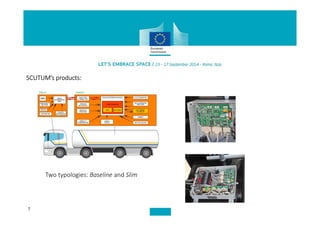
SCUTUM’s products: 
Two typologies: Baseline and Slim 
7
~ 300 operational 
tankers transporting 
hydrocarbon and 
chemical in Europe 
(in 2011) 
Today operational 
SCUTUM’s operations: 
8
SCUTUM’s standardization: 
CWA 16390: EU CEN technical specification/standard for the development of 
solutions/products/services based on EDAS 
(ftp://ftp.cen.eu/CEN/Sectors/List/ICT/CWAs/CWA16390.pdf) 
Endorsed by EU stakeholders from industries, institutions and research sector 
Enabling the development of products and applications based on the EDAS 
Compliant with the guidelines of the UNECE/OTIF WG on telematics for dangerous goods 
Applicable to ITS and mobility applications 
Validated by MEDDE, MIT, eni and ERF 
Today adopted in Italy and France 
9
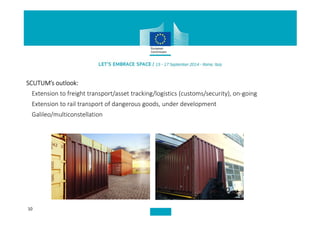
SCUTUM’s outlook: 
Extension to freight transport/asset tracking/logistics (customs/security), on-going 
Extension to rail transport of dangerous goods, under development 
Galileo/multiconstellation 
10
SCUTUM’s lessons learnt: 
Alignment with national priorities having a key role 
National entry points acting as facilitators (users, institutions, technology players) 
Standardization and certification, as needed 
EU coordination and harmonisation nurturing the implementation at large-scale 
EU policies & action plans creating the window of opportunity for EGNOS 
11
SCUTUM’s win-win factors: 
Commitment towards common interests 
Cooperation with main users and relevant technology providers, for: 
Guiding technology development and benefits validation 
User-driven solutions exploiting EGNOS added value 
Benefits validation/gradual introduction in sustainable business cases 
Flexibility of the technology solution 
Involvement of institutions to support the implementation of best practices 
12
Thank you ! 
Questions ? 
Contacts: 
www.scutumgnss.eu 
Antonella Di Fazio - antonella.difazio@telespazio.com 
13

SCUTUM - SeCUring the EU GNSS adopTion in the dangeroUs Material transport

  • 1.
  • 2.
    SCUTUM- SeCUring theEU GNSS adopTion in the dangeroUs Material transport EGNOS/Galileo for tracking and tracing the transport of dangerous goods by road 2° call 7 FP – Transport/Aeronautics, E-GNSS services for professional applications Total cost ~ 2,24 M€; EC funding ~ 1,4 M€ ~ 2 years, February 2010 - December 2011 Project team: 11 members, 4 EU countries Covering the value chain of EGNOS/Galileo applications Representatives from user community, Authorities, Standardization bodies Coordinated by Telespazio 2
  • 3.
    SCUTUM’s rationales: Needof exploiting EGNOS benefits in professional markets Searching for products/business models based on EGNOS Road as a priority market for EGNOS Transport of dangerous goods (regulated applications) possibly benefitting from EGNOS added value Heritages from previous public efforts/private investments (e.g. best practices, technologies/products) Convergence with the EU ITS Directive’ timing 3
  • 4.
    SCUTUM’s answers: Concreteuse cases Conveying best practices based on GPS into E-GNSS Use of technology ready for EGNOS today and preparing for Galileo Easy retrofitting of existing (GPS-based) technology Proven solution into large-scale operation Involvement of key players (decision-makers, main users and relevant technology providers) Extending in Europe an Italian best practice Cross-border implementation in neighbouring countries (France and Austria) Standardization 4
  • 5.
    GPS + EGNOSOS + EDAS – added value for the users: GPS GPS + EGNOS Accurate position information Confidence/guarantee on the position for a better control Higher position accuracy for enhanced risk management, prevention/statistics Commercial benefits Increased safety 5
  • 6.
    SCUTUM’s implementation path: 2009: eni and Italy’s Ministry of Transport validated EGNOS and considered EGNOS OS added value interesting for operational use 2010: eni started a step-wise adoption of EGNOS OS and EDAS for monitoring the tankers transporting dangerous goods in Italy Existing GPS systems retrofitted to use EGNOS through Telespazio LCS (for the use of EDAS) 2011: Implementation of EU large-scale operations Launching/supporting standardization 6
  • 7.
    SCUTUM’s products: Twotypologies: Baseline and Slim 7
  • 8.
    ~ 300 operational tankers transporting hydrocarbon and chemical in Europe (in 2011) Today operational SCUTUM’s operations: 8
  • 9.
    SCUTUM’s standardization: CWA16390: EU CEN technical specification/standard for the development of solutions/products/services based on EDAS (ftp://ftp.cen.eu/CEN/Sectors/List/ICT/CWAs/CWA16390.pdf) Endorsed by EU stakeholders from industries, institutions and research sector Enabling the development of products and applications based on the EDAS Compliant with the guidelines of the UNECE/OTIF WG on telematics for dangerous goods Applicable to ITS and mobility applications Validated by MEDDE, MIT, eni and ERF Today adopted in Italy and France 9
  • 10.
    SCUTUM’s outlook: Extensionto freight transport/asset tracking/logistics (customs/security), on-going Extension to rail transport of dangerous goods, under development Galileo/multiconstellation 10
  • 11.
    SCUTUM’s lessons learnt: Alignment with national priorities having a key role National entry points acting as facilitators (users, institutions, technology players) Standardization and certification, as needed EU coordination and harmonisation nurturing the implementation at large-scale EU policies & action plans creating the window of opportunity for EGNOS 11
  • 12.
    SCUTUM’s win-win factors: Commitment towards common interests Cooperation with main users and relevant technology providers, for: Guiding technology development and benefits validation User-driven solutions exploiting EGNOS added value Benefits validation/gradual introduction in sustainable business cases Flexibility of the technology solution Involvement of institutions to support the implementation of best practices 12
  • 13.
    Thank you ! Questions ? Contacts: www.scutumgnss.eu Antonella Di Fazio - antonella.difazio@telespazio.com 13