Protecting Rail Critical Infrastructure
Peter Guy
Operational Security & Continuity Planning Manager
Network Rail
Presentation Title: View > Header & Footer

Protecting Rail Critical National Infrastructure

Peter Guy
Operational Security & Continuity Planning Manager
Network Rail
Thursday 6th March 2014

7-Mar-14 / 2
Presentation Title: View > Header & Footer

Network Rail – who and what?
Network Rail owns and operates Britain’s railway infrastructure:
• Divided into nine Routes – Scotland, London North East, London North
West, Anglia, Kent, Sussex, Wessex, Western and Wales.
►There is a four-party relationship managing the rail sub-sector nationally.
This relationship is between:
• The Department for Transport (DfT),
• The Office of the Rail Regulator (ORR - the independent safety and
economic regulator for Britain’s railway),
• Network Rail, and
• The Train / Freight Operating Companies (30 in total).
►Not for profit Ltd company – public purse:
• Funding determined by ORR under five-year Control Period system:
- CP 5 starts on 1st April 2014.
►

7-Mar-14 / 3
Presentation Title: View > Header & Footer

Operational assets / processes / systems
Any facility whose business interruption (temporary or total loss) would impact
on the operation of the rail network. This includes:
• The new Regional Operations Centres.
• Signalling Control Centres.
• Route Control Centres.
• Electrical Control Rooms.
• Managed Stations.
• Locations where key functions / processes occur that allow the rail
network to operate, for example:
- Operational planning.
- Safety procedures.
- Financial Shared Services.
• Other vital infrastructure exists, for example, the Severn Tunnel, key
bridges and viaducts etc.
►Systems include IM, telecoms (e.g. signalling, power, communications).
►

7-Mar-14 / 4
Presentation Title: View > Header & Footer

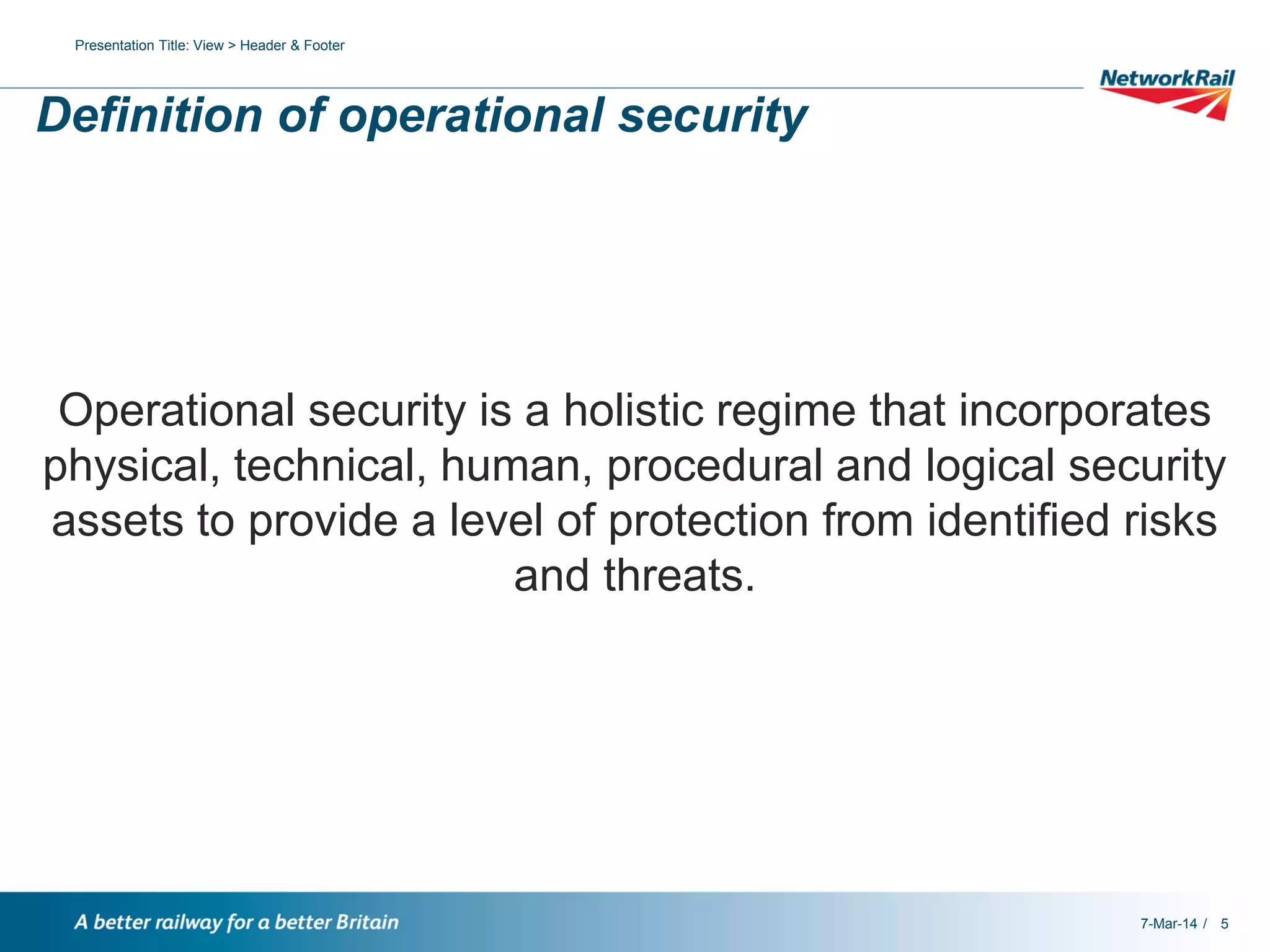
Definition of operational security

Operational security is a holistic regime that incorporates
physical, technical, human, procedural and logical security
assets to provide a level of protection from identified risks
and threats.

7-Mar-14 / 5
Presentation Title: View > Header & Footer

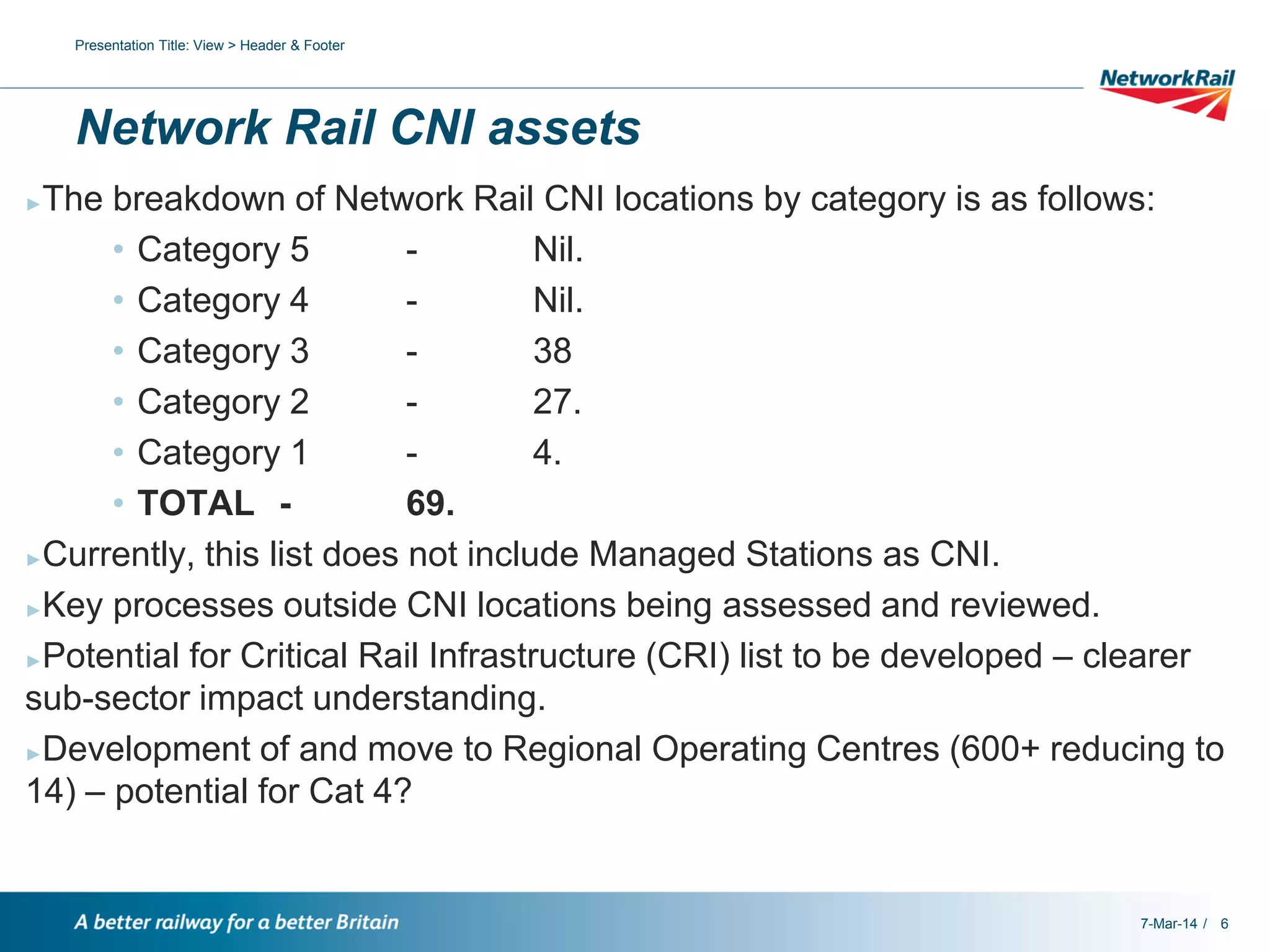
Network Rail CNI assets
The breakdown of Network Rail CNI locations by category is as follows:
• Category 5
Nil.
• Category 4
Nil.
• Category 3
38
• Category 2
27.
• Category 1
4.
• TOTAL 69.
►Currently, this list does not include Managed Stations as CNI.
►Key processes outside CNI locations being assessed and reviewed.
►Potential for Critical Rail Infrastructure (CRI) list to be developed – clearer
sub-sector impact understanding.
►Development of and move to Regional Operating Centres (600+ reducing to
14) – potential for Cat 4?
►

7-Mar-14 / 6
Presentation Title: View > Header & Footer

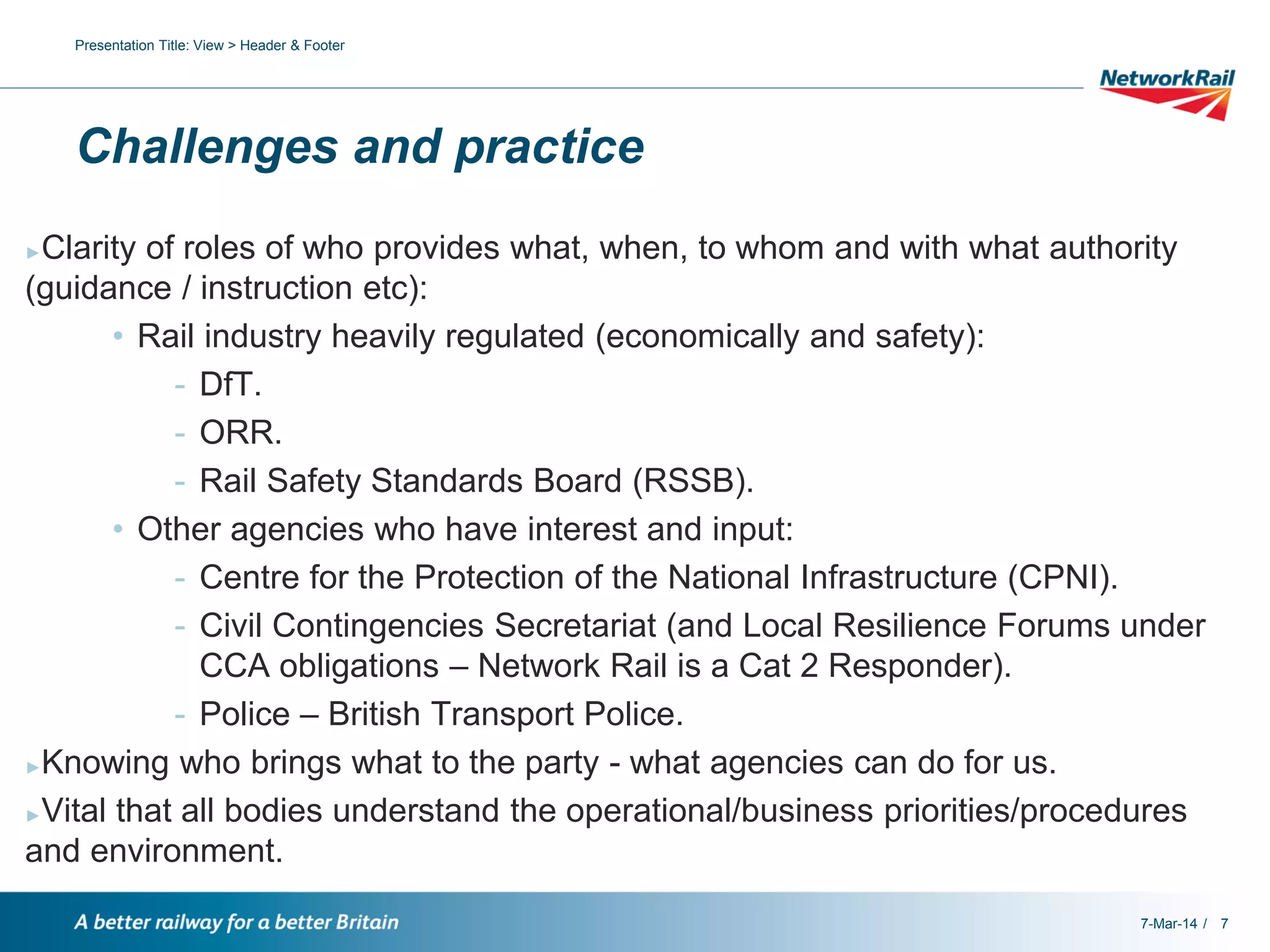
Challenges and practice
Clarity of roles of who provides what, when, to whom and with what authority
(guidance / instruction etc):
• Rail industry heavily regulated (economically and safety):
- DfT.
- ORR.
- Rail Safety Standards Board (RSSB).
• Other agencies who have interest and input:
- Centre for the Protection of the National Infrastructure (CPNI).
- Civil Contingencies Secretariat (and Local Resilience Forums under
CCA obligations – Network Rail is a Cat 2 Responder).
- Police – British Transport Police.
►Knowing who brings what to the party - what agencies can do for us.
►Vital that all bodies understand the operational/business priorities/procedures
and environment.
►

7-Mar-14 / 7
Presentation Title: View > Header & Footer

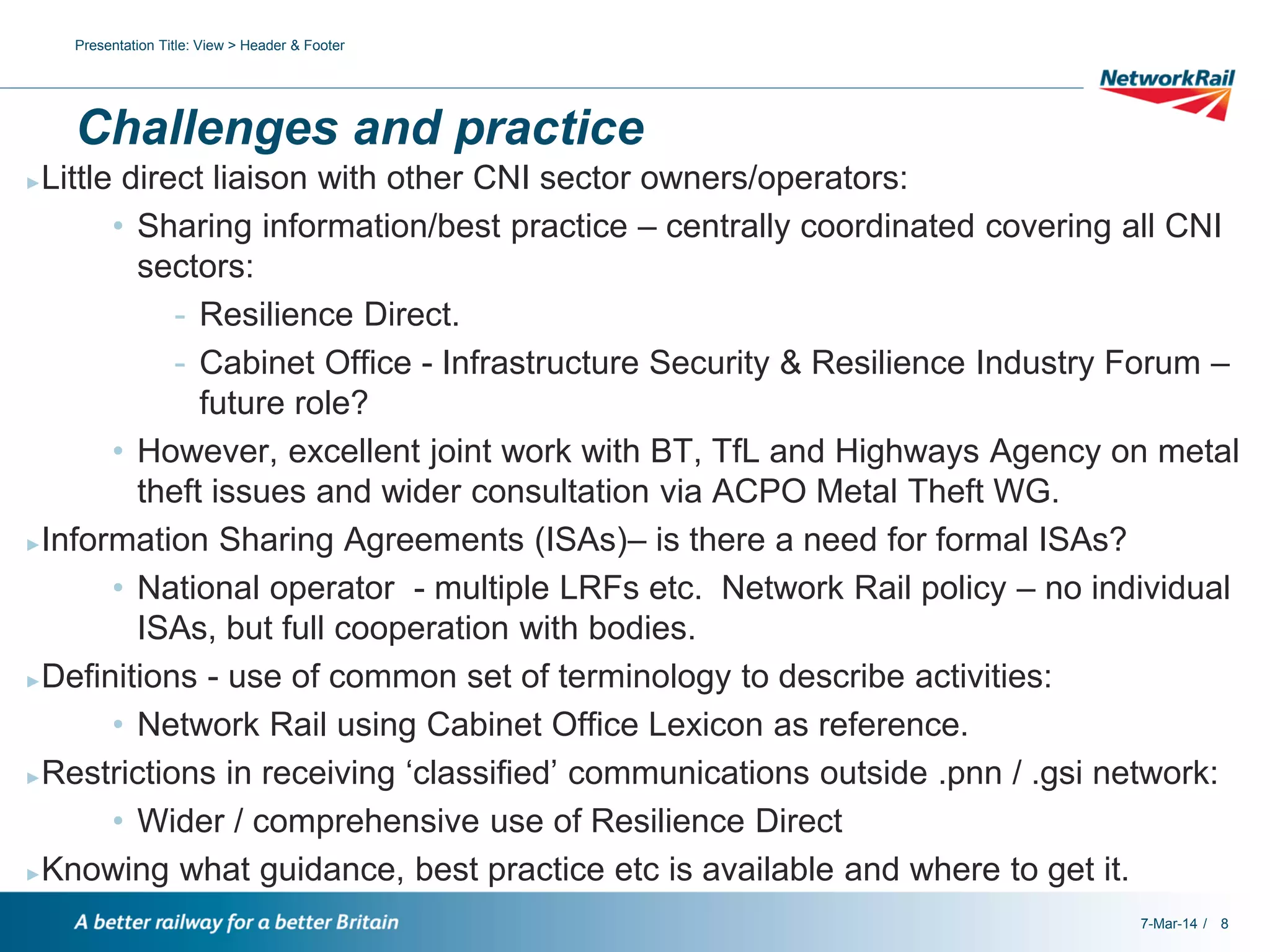
Challenges and practice
Little direct liaison with other CNI sector owners/operators:
• Sharing information/best practice – centrally coordinated covering all CNI
sectors:
- Resilience Direct.
- Cabinet Office - Infrastructure Security & Resilience Industry Forum –
future role?
• However, excellent joint work with BT, TfL and Highways Agency on metal
theft issues and wider consultation via ACPO Metal Theft WG.
►Information Sharing Agreements (ISAs)– is there a need for formal ISAs?
• National operator - multiple LRFs etc. Network Rail policy – no individual
ISAs, but full cooperation with bodies.
►Definitions - use of common set of terminology to describe activities:
• Network Rail using Cabinet Office Lexicon as reference.
►Restrictions in receiving ‘classified’ communications outside .pnn / .gsi network:
• Wider / comprehensive use of Resilience Direct
►Knowing what guidance, best practice etc is available and where to get it.
►

7-Mar-14 / 8
Presentation Title: View > Header & Footer

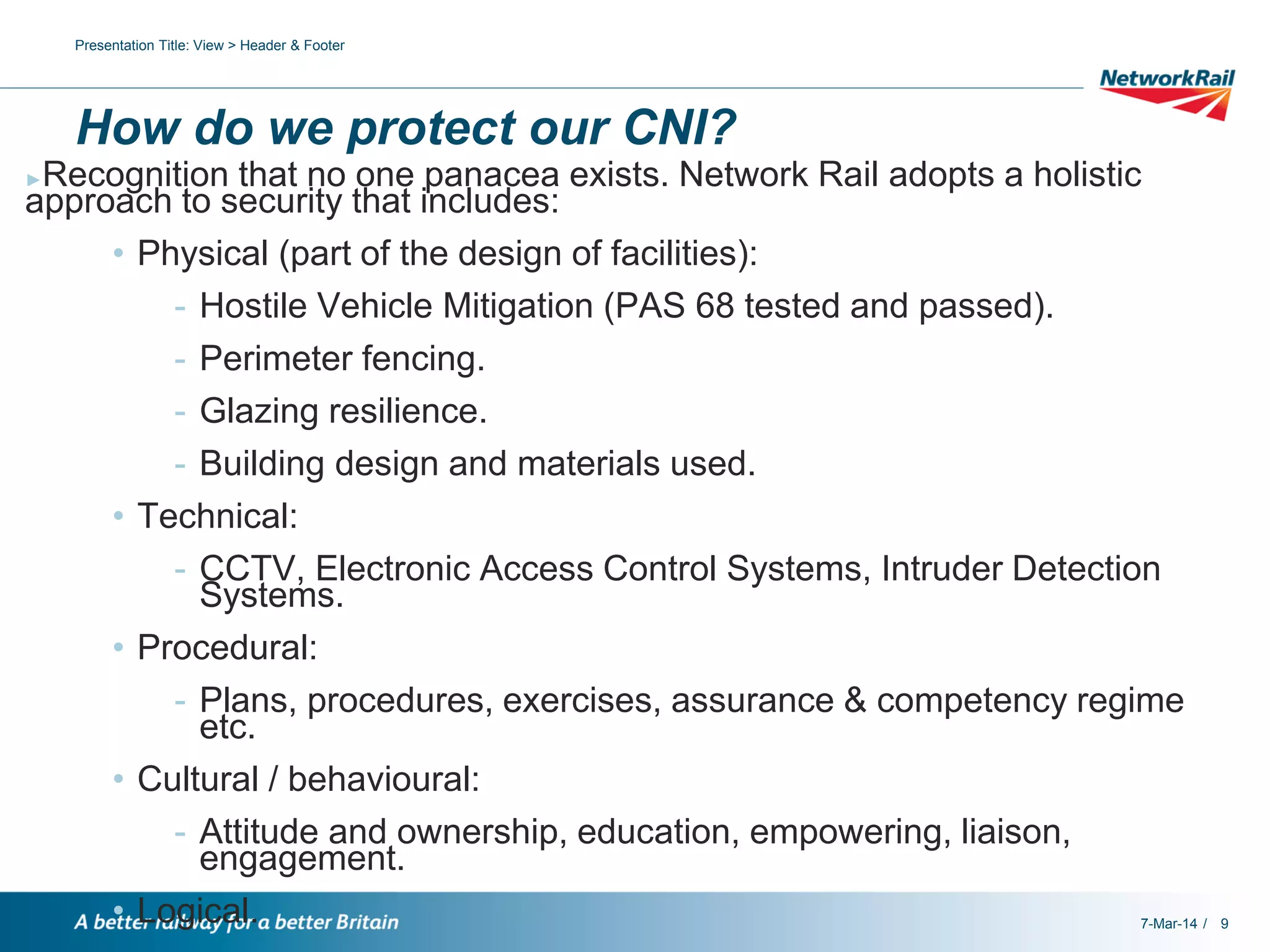
How do we protect our CNI?
Recognition that no one panacea exists. Network Rail adopts a holistic
approach to security that includes:
• Physical (part of the design of facilities):
- Hostile Vehicle Mitigation (PAS 68 tested and passed).
- Perimeter fencing.
- Glazing resilience.
- Building design and materials used.
• Technical:
- CCTV, Electronic Access Control Systems, Intruder Detection
Systems.
• Procedural:
- Plans, procedures, exercises, assurance & competency regime
etc.
• Cultural / behavioural:
- Attitude and ownership, education, empowering, liaison,
engagement.
• Logical.
7-Mar-14 /
►

9
Presentation Title: View > Header & Footer

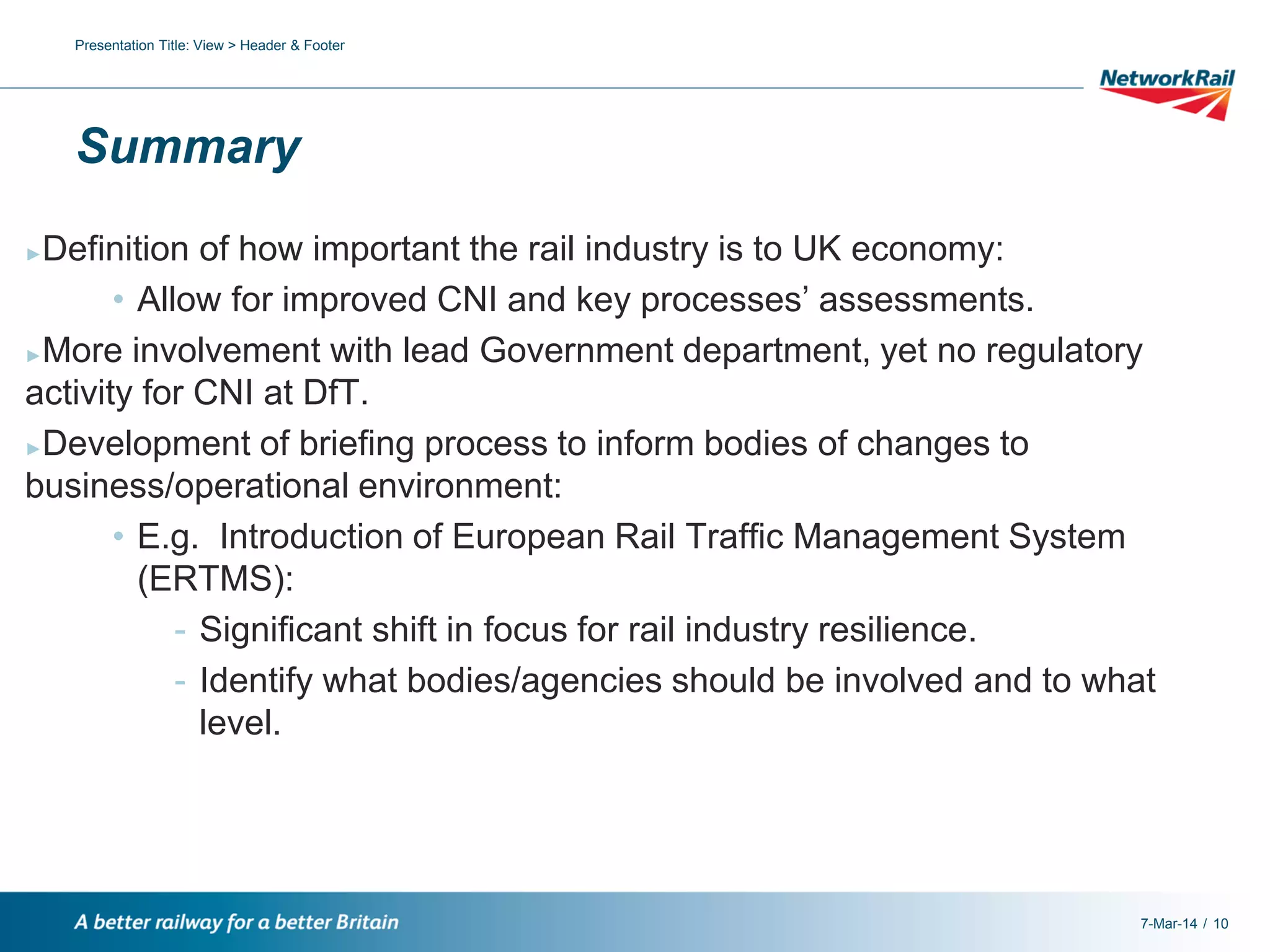
Summary
Definition of how important the rail industry is to UK economy:
• Allow for improved CNI and key processes’ assessments.
►More involvement with lead Government department, yet no regulatory
activity for CNI at DfT.
►Development of briefing process to inform bodies of changes to
business/operational environment:
• E.g. Introduction of European Rail Traffic Management System
(ERTMS):
- Significant shift in focus for rail industry resilience.
- Identify what bodies/agencies should be involved and to what
level.
►

7-Mar-14 / 10

Peter Guy, Operational Security & Continuity Planning Manager, Network Rail

  • 1.
    Protecting Rail CriticalInfrastructure Peter Guy Operational Security & Continuity Planning Manager Network Rail
  • 2.
    Presentation Title: View> Header & Footer Protecting Rail Critical National Infrastructure Peter Guy Operational Security & Continuity Planning Manager Network Rail Thursday 6th March 2014 7-Mar-14 / 2
  • 3.
    Presentation Title: View> Header & Footer Network Rail – who and what? Network Rail owns and operates Britain’s railway infrastructure: • Divided into nine Routes – Scotland, London North East, London North West, Anglia, Kent, Sussex, Wessex, Western and Wales. ►There is a four-party relationship managing the rail sub-sector nationally. This relationship is between: • The Department for Transport (DfT), • The Office of the Rail Regulator (ORR - the independent safety and economic regulator for Britain’s railway), • Network Rail, and • The Train / Freight Operating Companies (30 in total). ►Not for profit Ltd company – public purse: • Funding determined by ORR under five-year Control Period system: - CP 5 starts on 1st April 2014. ► 7-Mar-14 / 3
  • 4.
    Presentation Title: View> Header & Footer Operational assets / processes / systems Any facility whose business interruption (temporary or total loss) would impact on the operation of the rail network. This includes: • The new Regional Operations Centres. • Signalling Control Centres. • Route Control Centres. • Electrical Control Rooms. • Managed Stations. • Locations where key functions / processes occur that allow the rail network to operate, for example: - Operational planning. - Safety procedures. - Financial Shared Services. • Other vital infrastructure exists, for example, the Severn Tunnel, key bridges and viaducts etc. ►Systems include IM, telecoms (e.g. signalling, power, communications). ► 7-Mar-14 / 4
  • 5.
    Presentation Title: View> Header & Footer Definition of operational security Operational security is a holistic regime that incorporates physical, technical, human, procedural and logical security assets to provide a level of protection from identified risks and threats. 7-Mar-14 / 5
  • 6.
    Presentation Title: View> Header & Footer Network Rail CNI assets The breakdown of Network Rail CNI locations by category is as follows: • Category 5 Nil. • Category 4 Nil. • Category 3 38 • Category 2 27. • Category 1 4. • TOTAL 69. ►Currently, this list does not include Managed Stations as CNI. ►Key processes outside CNI locations being assessed and reviewed. ►Potential for Critical Rail Infrastructure (CRI) list to be developed – clearer sub-sector impact understanding. ►Development of and move to Regional Operating Centres (600+ reducing to 14) – potential for Cat 4? ► 7-Mar-14 / 6
  • 7.
    Presentation Title: View> Header & Footer Challenges and practice Clarity of roles of who provides what, when, to whom and with what authority (guidance / instruction etc): • Rail industry heavily regulated (economically and safety): - DfT. - ORR. - Rail Safety Standards Board (RSSB). • Other agencies who have interest and input: - Centre for the Protection of the National Infrastructure (CPNI). - Civil Contingencies Secretariat (and Local Resilience Forums under CCA obligations – Network Rail is a Cat 2 Responder). - Police – British Transport Police. ►Knowing who brings what to the party - what agencies can do for us. ►Vital that all bodies understand the operational/business priorities/procedures and environment. ► 7-Mar-14 / 7
  • 8.
    Presentation Title: View> Header & Footer Challenges and practice Little direct liaison with other CNI sector owners/operators: • Sharing information/best practice – centrally coordinated covering all CNI sectors: - Resilience Direct. - Cabinet Office - Infrastructure Security & Resilience Industry Forum – future role? • However, excellent joint work with BT, TfL and Highways Agency on metal theft issues and wider consultation via ACPO Metal Theft WG. ►Information Sharing Agreements (ISAs)– is there a need for formal ISAs? • National operator - multiple LRFs etc. Network Rail policy – no individual ISAs, but full cooperation with bodies. ►Definitions - use of common set of terminology to describe activities: • Network Rail using Cabinet Office Lexicon as reference. ►Restrictions in receiving ‘classified’ communications outside .pnn / .gsi network: • Wider / comprehensive use of Resilience Direct ►Knowing what guidance, best practice etc is available and where to get it. ► 7-Mar-14 / 8
  • 9.
    Presentation Title: View> Header & Footer How do we protect our CNI? Recognition that no one panacea exists. Network Rail adopts a holistic approach to security that includes: • Physical (part of the design of facilities): - Hostile Vehicle Mitigation (PAS 68 tested and passed). - Perimeter fencing. - Glazing resilience. - Building design and materials used. • Technical: - CCTV, Electronic Access Control Systems, Intruder Detection Systems. • Procedural: - Plans, procedures, exercises, assurance & competency regime etc. • Cultural / behavioural: - Attitude and ownership, education, empowering, liaison, engagement. • Logical. 7-Mar-14 / ► 9
  • 10.
    Presentation Title: View> Header & Footer Summary Definition of how important the rail industry is to UK economy: • Allow for improved CNI and key processes’ assessments. ►More involvement with lead Government department, yet no regulatory activity for CNI at DfT. ►Development of briefing process to inform bodies of changes to business/operational environment: • E.g. Introduction of European Rail Traffic Management System (ERTMS): - Significant shift in focus for rail industry resilience. - Identify what bodies/agencies should be involved and to what level. ► 7-Mar-14 / 10