Cal Poly Pomona Computer Science Department
Course Assessment Form (Expectations)
CS 420 Artificial Intelligence

INSTRUCTIONS

Please indicate which of the following learning outcomes you expect most students in your class
to meet. In the EVIDENCE column, list the specific instruments (e.g. Quiz 3, Homework 5, …)
that provide evidence that the outcome has been met.

                                                                        DO NOT
                                                               EXPECT   EXPECT   EVIDENCE   PO-LIST


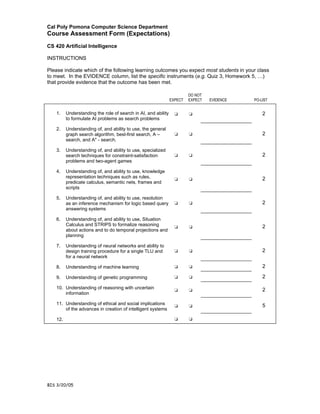
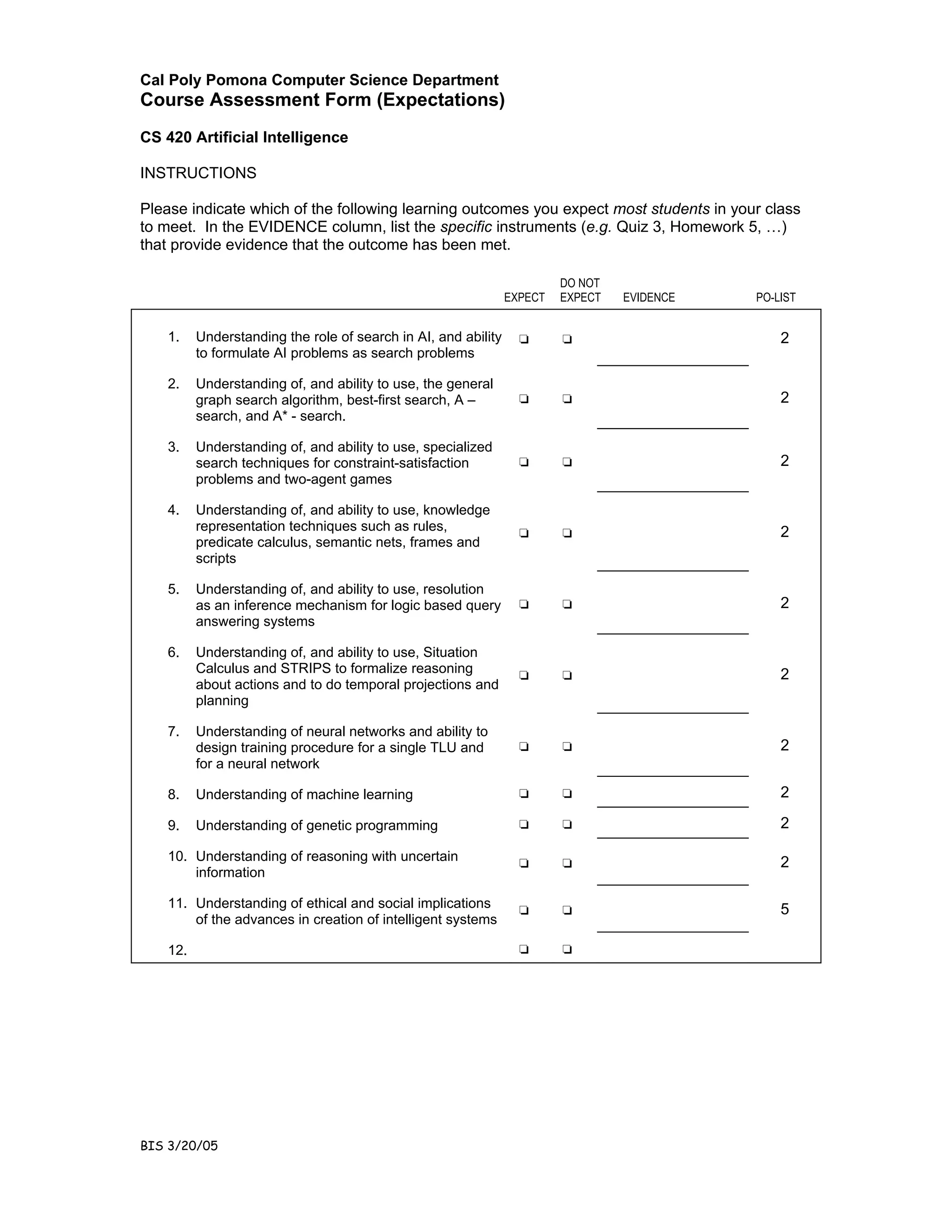
   1.    Understanding the role of search in AI, and ability     t      t                       2
         to formulate AI problems as search problems

   2.    Understanding of, and ability to use, the general
         graph search algorithm, best-first search, A –          t      t                       2
         search, and A* - search.

   3.    Understanding of, and ability to use, specialized
         search techniques for constraint-satisfaction           t      t                       2
         problems and two-agent games

   4.    Understanding of, and ability to use, knowledge
         representation techniques such as rules,                t      t                       2
         predicate calculus, semantic nets, frames and
         scripts

   5.    Understanding of, and ability to use, resolution
         as an inference mechanism for logic based query         t      t                       2
         answering systems

   6.    Understanding of, and ability to use, Situation
         Calculus and STRIPS to formalize reasoning              t      t                       2
         about actions and to do temporal projections and
         planning

   7.    Understanding of neural networks and ability to
         design training procedure for a single TLU and          t      t                       2
         for a neural network

   8.    Understanding of machine learning                       t      t                       2

   9.    Understanding of genetic programming                    t      t                       2

   10. Understanding of reasoning with uncertain                 t      t                       2
       information

   11. Understanding of ethical and social implications          t      t                       5
       of the advances in creation of intelligent systems

   12.                                                           t      t


BIS 3/20/05
Cal Poly Pomona Computer Science Department
Student Assessment Form (Fulfillment)
CS 420 Artificial Intelligence

INSTRUCTIONS

Please examine each student portfolio to assess the extent to which each of the following
learning outcomes appear to have been met by this student.

                                                                                            NOT
                                                                   MET                      MET

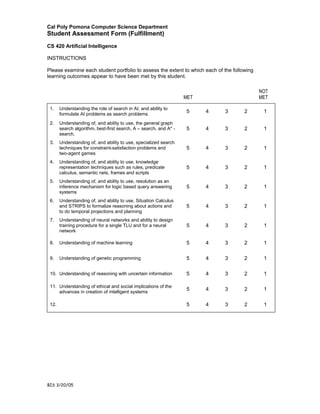
 1.    Understanding the role of search in AI, and ability to
       formulate AI problems as search problems
                                                                   5     4   3       2       1

 2.    Understanding of, and ability to use, the general graph
       search algorithm, best-first search, A – search, and A* -   5     4   3       2       1
       search.
 3.    Understanding of, and ability to use, specialized search
       techniques for constraint-satisfaction problems and         5     4   3       2       1
       two-agent games
 4.    Understanding of, and ability to use, knowledge
       representation techniques such as rules, predicate          5     4   3       2       1
       calculus, semantic nets, frames and scripts
 5.    Understanding of, and ability to use, resolution as an
       inference mechanism for logic based query answering         5     4   3       2       1
       systems
 6.    Understanding of, and ability to use, Situation Calculus
       and STRIPS to formalize reasoning about actions and         5     4   3       2       1
       to do temporal projections and planning
 7.    Understanding of neural networks and ability to design
       training procedure for a single TLU and for a neural        5     4   3       2       1
       network

 8.    Understanding of machine learning                           5     4   3       2       1

 9.    Understanding of genetic programming                        5     4   3       2       1

 10. Understanding of reasoning with uncertain information         5     4   3       2       1

 11. Understanding of ethical and social implications of the
     advances in creation of intelligent systems
                                                                   5     4   3       2       1

 12.                                                               5     4   3       2       1


BIS 3/20/05
Ethics & Social Issues in CS 420
by Halina Przymusinska & Barry Soroka
May 5, 2005

 RESOURCES
General Considerations. AI differs from other areas of CS with respect to ethical issues. Much
discussion of ethics and CS concerns the ethical use of existing artifacts. Today there are few AI
products to which this type of considerations is applicable. AI is still mostly an area of ongoing
research, and ethical questions involve: (1) What ethical questions would be caused by creation
of artifacts? and (2) What precautions should be taken so that artifacts do not harm society?
Thus, there is much science fiction about AI and ethics, but few actual case studies.
We don’t think that Sara Baase, A Gift of Fire, contains a relevant chapter.
http://www.aaai.org/AITopics/html/ethics.html
          This is the ethics website of the American Association for Artificial Intelligence. Many
          pointers to news articles.
http://www.chiark.greenend.org.uk/pipermail/ukcrypto/2000-January/007625.html
          This site describes a conference on Artificial Intelligence, Ethics and (Quasi)Human
          Rights. It enumerates many questions about AI and society. The conference itself
          probably presents many papers on this topic.
http://www.nickbostrom.com/ethics/ai.html
          A paper, Ethical Issues in Advanced Artificial Intelligence, by Nick Bostrom.
http://www.qub.ac.uk/phil/UCAS_Event/ethics.htm
          One professor’s website. Many pointers.
http://www.cs.wcupa.edu/~epstein/stoplay.html
          Pointer to stories and plays about ethical and social implications of AI, written by
          Professor Richard G Epstein.
http://www.dcs.ex.ac.uk/~hlgaylar/aisb.pdf
          What Can AI Do for Ethics? by Helen Seville & Debora G. Field. This paper discusses
          the possible uses of AI in ethical decision-making.
http://www.cs.bath.ac.uk/%7Ejjb/web/aiethics98.html
          Joanna Bryson & Phil Kime, Just Another Artifact: Ethics and the Empirical Experience of
          AI. What is the provenance of this paper?
 INSTRUCTOR EXPECTATIONS
Instructors are expected to spend about one hour discussing the social and ethical implications of
AI.
 STUDENT EXPECTIONS
Developments in AI research almost daily open new perspectives and thus involve moral and
ethical questions that have to be addressed in order to prevent human creativity from going awry.
To make students aware of such issues and to encourage them to give those issues some
thought we can give an assignment which has the following structure:
    1. Research different sources (journals, books, newspapers, web, etc.) for a topic that in
         your opinion qualifies under “Moral and Ethical Issues in AI” .
    2. Write a short summary of what you have found.
    3. If the topic you proposed is not accepted by instructor GOTO 1., otherwise write a paper
       which consists of two parts:
              •   Careful overview of the issues and author’s position taken on those issues.
              •   Your own position on the same issues and clear argument in defense of that
                  position.

 MATERIAL FOR ABET
Copies of three representative essays — Excellent, Satisfactory and Poor.


BIS 3/20/05

420.doc

  • 1.
    Cal Poly PomonaComputer Science Department Course Assessment Form (Expectations) CS 420 Artificial Intelligence INSTRUCTIONS Please indicate which of the following learning outcomes you expect most students in your class to meet. In the EVIDENCE column, list the specific instruments (e.g. Quiz 3, Homework 5, …) that provide evidence that the outcome has been met. DO NOT EXPECT EXPECT EVIDENCE PO-LIST 1. Understanding the role of search in AI, and ability t t 2 to formulate AI problems as search problems 2. Understanding of, and ability to use, the general graph search algorithm, best-first search, A – t t 2 search, and A* - search. 3. Understanding of, and ability to use, specialized search techniques for constraint-satisfaction t t 2 problems and two-agent games 4. Understanding of, and ability to use, knowledge representation techniques such as rules, t t 2 predicate calculus, semantic nets, frames and scripts 5. Understanding of, and ability to use, resolution as an inference mechanism for logic based query t t 2 answering systems 6. Understanding of, and ability to use, Situation Calculus and STRIPS to formalize reasoning t t 2 about actions and to do temporal projections and planning 7. Understanding of neural networks and ability to design training procedure for a single TLU and t t 2 for a neural network 8. Understanding of machine learning t t 2 9. Understanding of genetic programming t t 2 10. Understanding of reasoning with uncertain t t 2 information 11. Understanding of ethical and social implications t t 5 of the advances in creation of intelligent systems 12. t t BIS 3/20/05
  • 2.
    Cal Poly PomonaComputer Science Department Student Assessment Form (Fulfillment) CS 420 Artificial Intelligence INSTRUCTIONS Please examine each student portfolio to assess the extent to which each of the following learning outcomes appear to have been met by this student. NOT MET MET 1. Understanding the role of search in AI, and ability to formulate AI problems as search problems 5 4 3 2 1 2. Understanding of, and ability to use, the general graph search algorithm, best-first search, A – search, and A* - 5 4 3 2 1 search. 3. Understanding of, and ability to use, specialized search techniques for constraint-satisfaction problems and 5 4 3 2 1 two-agent games 4. Understanding of, and ability to use, knowledge representation techniques such as rules, predicate 5 4 3 2 1 calculus, semantic nets, frames and scripts 5. Understanding of, and ability to use, resolution as an inference mechanism for logic based query answering 5 4 3 2 1 systems 6. Understanding of, and ability to use, Situation Calculus and STRIPS to formalize reasoning about actions and 5 4 3 2 1 to do temporal projections and planning 7. Understanding of neural networks and ability to design training procedure for a single TLU and for a neural 5 4 3 2 1 network 8. Understanding of machine learning 5 4 3 2 1 9. Understanding of genetic programming 5 4 3 2 1 10. Understanding of reasoning with uncertain information 5 4 3 2 1 11. Understanding of ethical and social implications of the advances in creation of intelligent systems 5 4 3 2 1 12. 5 4 3 2 1 BIS 3/20/05
  • 3.
    Ethics & SocialIssues in CS 420 by Halina Przymusinska & Barry Soroka May 5, 2005 RESOURCES General Considerations. AI differs from other areas of CS with respect to ethical issues. Much discussion of ethics and CS concerns the ethical use of existing artifacts. Today there are few AI products to which this type of considerations is applicable. AI is still mostly an area of ongoing research, and ethical questions involve: (1) What ethical questions would be caused by creation of artifacts? and (2) What precautions should be taken so that artifacts do not harm society? Thus, there is much science fiction about AI and ethics, but few actual case studies. We don’t think that Sara Baase, A Gift of Fire, contains a relevant chapter. http://www.aaai.org/AITopics/html/ethics.html This is the ethics website of the American Association for Artificial Intelligence. Many pointers to news articles. http://www.chiark.greenend.org.uk/pipermail/ukcrypto/2000-January/007625.html This site describes a conference on Artificial Intelligence, Ethics and (Quasi)Human Rights. It enumerates many questions about AI and society. The conference itself probably presents many papers on this topic. http://www.nickbostrom.com/ethics/ai.html A paper, Ethical Issues in Advanced Artificial Intelligence, by Nick Bostrom. http://www.qub.ac.uk/phil/UCAS_Event/ethics.htm One professor’s website. Many pointers. http://www.cs.wcupa.edu/~epstein/stoplay.html Pointer to stories and plays about ethical and social implications of AI, written by Professor Richard G Epstein. http://www.dcs.ex.ac.uk/~hlgaylar/aisb.pdf What Can AI Do for Ethics? by Helen Seville & Debora G. Field. This paper discusses the possible uses of AI in ethical decision-making. http://www.cs.bath.ac.uk/%7Ejjb/web/aiethics98.html Joanna Bryson & Phil Kime, Just Another Artifact: Ethics and the Empirical Experience of AI. What is the provenance of this paper? INSTRUCTOR EXPECTATIONS Instructors are expected to spend about one hour discussing the social and ethical implications of AI. STUDENT EXPECTIONS Developments in AI research almost daily open new perspectives and thus involve moral and ethical questions that have to be addressed in order to prevent human creativity from going awry. To make students aware of such issues and to encourage them to give those issues some thought we can give an assignment which has the following structure: 1. Research different sources (journals, books, newspapers, web, etc.) for a topic that in your opinion qualifies under “Moral and Ethical Issues in AI” . 2. Write a short summary of what you have found. 3. If the topic you proposed is not accepted by instructor GOTO 1., otherwise write a paper which consists of two parts: • Careful overview of the issues and author’s position taken on those issues. • Your own position on the same issues and clear argument in defense of that position. MATERIAL FOR ABET Copies of three representative essays — Excellent, Satisfactory and Poor. BIS 3/20/05