Clinical Pharmacology (Phar521)
MSc Program
By: Dr. Tadesse B.
Course Credit: 3 Cr. Hrs (5 ECTS)
Course Contents
Contents for Both MSc Program
• Chapter 1: Introduction to
pharmacology
– General principles of pharmacology
• Pharmacokinetics
• Pharmacodynamics
• Chapter 2: Drugs for Pre-existing
medical conditions
– Drugs Used in Chronic
Conditions
• Antiasthmatics drugs
• Antidiabetic agents
• Antihypertensive agents
• Antiepileptic agents
• Antiparkinson‘s agents
– Drug Used in Mental Health
Problems
• Antianxiety drugs
• Antipsychotic drugs
• Antidepressant drugs
• Chapter 3: Analgesics and
Anesthetics
– Analgesics
– Local anesthetics
• Chapter 4: Drugs used in
disordered physiology
– Drugs for management of
coagulation disorders
(Anticoagulant Therapy)
Tadesse B. (Ph.D.) 2
Course Contents
Only for Maternity and Neonatal Health Program
• Chapter 5: Drugs in pregnancy
– Pharmacology of pregnancy
– Nutritional supplements: Iron
and folic acid
– Laxatives
– Antimicrobials
– Cough or cold remedies
– Drugs to reduce gastric acidity
– Drugs used for Pain relief,
headache, and fever
– Agents used for treatment of
Constipation, hemorrhoids,
and diarrhea
– Drugs used for management
of allergic reactions
– Drugs used to manage
Insomnia
– Drugs for the Management of
Rhesus incompatibility
• Group Assignment
– Drugs given to stop
premature labor
– Immunization during
pregnancy
– Contraceptives
– Other topics
Tadesse B. (Ph.D.) 3
Course Contents…
• Chapter 5: Adverse drug reactions and
interactions
– Introduction
– Adverse drug reactions
• Major groups of drugs involved in adverse drug
reactions
• Age-related adverse drug reactions
– Drug-Drug and Drug-Food Interactions
• Mechanisms of drug interactions
• Clinical significance of drug interactions to the
patient
• Steps in minimizing the effects of adverse drug
interactions
• Chapter 6: Antimicrobials
– Introduction
– Antibacterial Agents
– Antitubercular agents
– Antifungal agents
– Antiviral agents
– Antiprotozoal agents
– Interference with folate
• Chapter 7: Anti-inflammatory
drugs
– Introduction
– Non-steroidal anti-inflammatory
drugs
– Antirheumatoid drugs
• Group Assignment
– Patient concordance
– Legal & Professional
issues
– Other topics
Tadesse B. (Ph.D.) 4
For Adult Health Nursing & Pediatric & Child Health Nursing Program
Tentative Schedule
• Presentation:
– Saturday, April 29, 2023 (Morning)
• Mid-Exam:
– Wednesday, May 3, 2023 (Morning/Afternoon)
• Final Exam:
– Thursday, May 11, 2023 (Afternoon)
or
– Saturday, May 13, 2023 (Morning)
Tadesse B. (Ph.D.) 5
References
• Goodman and Gilman‘s: The Pharmacological Basis of
Therapeutics; 13th or latest ed.
• Katzung B.G.: Basic and Clinical Pharmacology: 13th or latest
edition.
• Rang H.P. and Dale M.M.: Pharmacology; 7th or latest edition.
• Charles R. Craig and Robert E. Stitzel: Modern Pharmacology
with Clinical Applications; 5th or latest editions
• Mycek M.J. and Harvey R.A. Lippincott‘s Illustrated Reviews:
Pharmacology; 6th or latest edition
6 Tadesse B. (Ph.D.)
Chapter 1
Pharmacodynamics and Pharmacokinetics
Contents of Chapter 1
• Pharmacodynamics and pharmacokinetics
– Pharmacokinetics Process
• Drug Absorption
• Drug Distribution
• Drug Biotransformation
• Excretion of Drugs
– Pharmacodynamics Process
• Site & Mechanisms of Drug Action
• Character of Receptors and Drugs
• Drug-Receptor interactions
• Dose-Response Relationship (ED50, LD50, Therapeutic Index,
Potency, Maximum Efficacy)
Tadesse B. (Ph.D.) 8
Specific Objectives
• At the end of the section, students will be able to:
– Explain the applications of pharmacokinetics to clinical practice.
– Identify the four primary processes of pharmacokinetics.
– Explain mechanisms by which drugs cross plasma membranes.
– Discuss factors affecting drug absorption.
– Discuss how drugs are distributed throughout the body.
– Describe how plasma proteins affect drug distribution.
– Explain the metabolism of drugs and its applications to pharmacotherapy.
– Identify major processes by which drugs are excreted.
– Explain how enterohepatic recirculation affects drug activity.
– Explain how a drug reaches and maintains its therapeutic range in the
plasma.
– Explain the applications of a drug plasma half-life (t1/2) to pharmacotherapy.
Tadesse B. (Ph.D.) 9
General Objective: The aim of this chapter is to introduce the
basic principles of pharmacology
Brainstorming?
• How can we define pharmacology?
• How can we define pharmacodynamics?
• How can we define pharmacokinetics?
Tadesse B. (Ph.D.) 10
Introduction: Definition of Terminologies
 Pharmacology can be defined as:
• The study of drugs and their action on living organisms.
• The study of substances that interact with living systems
through chemical processes (particularly by binding to regulatory
molecules) & alter (activate or inhibit) biologic function or
response
o These substances may be chemicals (drugs) that are
administered to a patient (humans) in order to achieve a
beneficial therapeutic effect
• It can also be defined as a branch of science concerned with the
effects of drugs on living organisms (pharmacodynamics) and
the effects of living organisms with drugs (pharmacokinetics).
• It expresses drug composition & properties, interactions,
toxicology, therapy, and medicinal uses such as application
and antipathogenic capabilities.
Tadesse B. (Ph.D.) 11
Introduction: Definition of Terminologies…
• Pharmacogenetics:
– It is the study of genetic influences on responses to drugs.
• Pharmacogenomics:
– It overlaps with pharmacogenetics, describing the use of genetic
information to guide the choice of drug therapy on an individual
basis.
– The underlying assumption is that differences between individuals in
their response to therapeutic drugs can be predicted from their
genetic make-up.
• Pharmacoepidemiology:
– It is the study of drug effects at the population level.
– It is concerned with the variability of drug effects between
individuals in a population and between populations.
• Pharmacoeconomics:
– It is the branch of health economics that aims to quantify in
economic terms the cost & benefit of drugs used therapeutically
Tadesse B. (Ph.D.) 12
Introduction: Definition of Terminologies…
• Toxicology:
– It is the branch of pharmacology that deals with the undesirable
effects of chemicals on living systems, from individual cells to
humans to complex ecosystems
• Xenobiotic: (xenos-―stranger‖)
– Any substance/chemical that is foreign to the human body (not
synthesized in the body)
• Receptor:
– The component of a cell or organism that interacts with a drug &
initiates the chain of biochemical events leading to the drug’s
observed effects.
• Prodrug:
– It is an ‗inactive’ form of a drug that requires metabolic
activation inside the body (bioactivation) in order to release the
‗active’ form of the drug.
– Once released in vivo, the active form of the drug will then exert
its pharmacological effect
Tadesse B. (Ph.D.) 13
Introduction: Definition of Terminologies…
• Medical pharmacology: the science of substances used to
prevent, diagnose, and treat disease.
• Molecular pharmacology: deals with drug molecules and
cell
• Cardiovascular pharmacology: deals with heart, the
vascular system
• Endocrine pharmacology: deals with hormones or
hormone derivatives
Tadesse B. (Ph.D.) 14
Introduction: Definition of Terminologies…
• Clinical pharmacology:
– Can be defined as the study of drugs in humans.
– Deals with the comparative clinical evaluations of new drug
for developing its therapeutic efficacy and safety
– Its objective is to optimize drug therapy and it is justified in so
far as it is put to practical use
• Clinical pharmacology provides the scientific basis for:
– The general aspects of rational, safe and effective drug therapy
– Drug therapy of individual diseases
– The safe introduction of new medicines.
• It also involves the complex interaction between the patient
and the drug
• It also provides the basis of good prescribing profile that
involves tailoring the drug and dosing regimen to the unique
patient.
– It is the principles behind the prescribing process
Tadesse B. (Ph.D.) 15
Introduction: Definition of Terminologies…
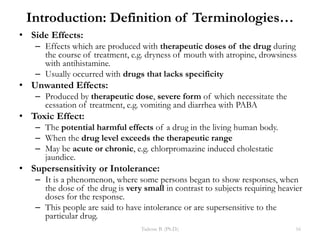
• Side Effects:
– Effects which are produced with therapeutic doses of the drug during
the course of treatment, e.g. dryness of mouth with atropine, drowsiness
with antihistamine.
– Usually occurred with drugs that lacks specificity
• Unwanted Effects:
– Produced by therapeutic dose, severe form of which necessitate the
cessation of treatment, e.g. vomiting and diarrhea with PABA
• Toxic Effect:
– The potential harmful effects of a drug in the living human body.
– When the drug level exceeds the therapeutic range
– May be acute or chronic, e.g. chlorpromazine induced cholestatic
jaundice.
• Supersensitivity or Intolerance:
– It is a phenomenon, where some persons began to show responses, when
the dose of the drug is very small in contrast to subjects requiring heavier
doses for the response.
– This people are said to have intolerance or are supersensitive to the
particular drug.
Tadesse B. (Ph.D.) 16
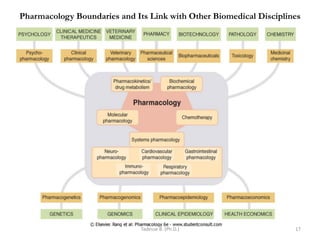
Pharmacology Boundaries and Its Link with Other Biomedical Disciplines
Tadesse B. (Ph.D.) 17
Introduction…
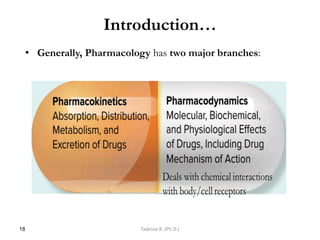
• Generally, Pharmacology has two major branches:
18 Tadesse B. (Ph.D.)
Introduction…
• Willingness to learn the principles of pharmacology,
and how to apply them in individual circumstances of
infinite variety is vital to success without harm: to
maximize benefit and minimize risk.
– All of these issues are the concern of clinical pharmacology
• Clinical pharmacology has been termed a bridging
discipline because it combines elements of classical
pharmacology with clinical medicine
Tadesse B. (Ph.D.) 19
Introduction…
• Knowledge of clinical pharmacology underpins decisions in
therapeutics, which is concerned with the
– Prevention, suppression or cure of disease
• Pharmacology is the same science whether it investigates animals
or humans.
• The concomitant dangers of drugs (fetal deformities, adverse
reactions, dependence) only add to the need for the systematic
and ethical application of science to drug development,
evaluation, and use
– i.e. clinical pharmacology
• Therapeutic success with drugs is becoming more and more
dependent on the user understanding of both
– Pharmacodynamics and pharmacokinetics
Tadesse B. (Ph.D.) 20
Introduction…
• Clinical pharmacology brings together clinical and scientific
practice to support critical & independent appraisal of data
pertaining to drugs and therapeutics, and the rational use of
medicines.
– It started in 1960‘s due the effect of thalidomide in the early
1960s
– It is needed to address more systematically issues of
• Efficacy, safety and rational use of medicines in
humans becomes crucial along with drug action,
receptors and laboratory experiments
Tadesse B. (Ph.D.) 21
Drug-Body Interactions
• The interactions between a drug administered
and the body are conveniently divided into
two classes:
–The Pharmacokinetic Processes &
–The Pharmacodynamic Processes
22 Tadesse B. (Ph.D.)
Drug-Body Interactions…
• Pharmacodynamics (PDs):
– Refers to the actions of the drug on the human body
(What the drug does to the body)
• Play the major role in deciding whether that class of drugs is
effective therapy for a particular disease or symptom
• Pharmacokinetics (PKs):
– Refers to the actions of the human body on the drug
(What the body does to the drug)
– It is the study of Absorption, Distribution, Metabolism
(Biotransformation) and Excretion (ADME) properties
of the drug with respect to time
• Great significance in the dose selection & administration of a
particular drug for a particular patient
23 Tadesse B. (Ph.D.)
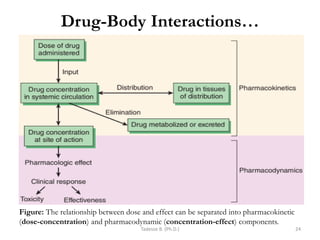
Drug-Body Interactions…
Tadesse B. (Ph.D.) 24
Figure: The relationship between dose and effect can be separated into pharmacokinetic
(dose-concentration) and pharmacodynamic (concentration-effect) components.
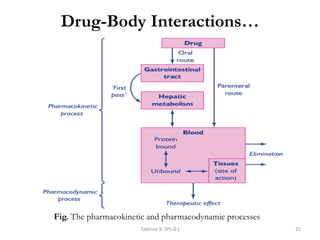
Drug-Body Interactions…
Tadesse B. (Ph.D.) 25
Fig. The pharmacokinetic and pharmacodynamic processes
Drug-Body Interactions…
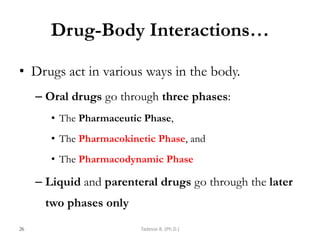
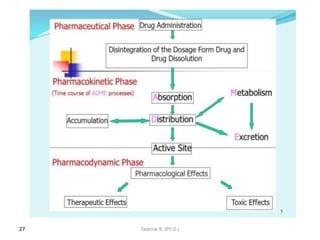
• Drugs act in various ways in the body.
– Oral drugs go through three phases:
• The Pharmaceutic Phase,
• The Pharmacokinetic Phase, and
• The Pharmacodynamic Phase
– Liquid and parenteral drugs go through the later
two phases only
26 Tadesse B. (Ph.D.)
27 Tadesse B. (Ph.D.)
Drug-Body Interactions…
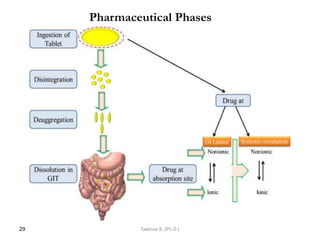
• The Pharmaceutic Phase of drug action is the dissolution of the
drug.
– Drugs must be in solution to be absorbed.
• Drugs that are liquid or drugs given by injection (parenteral drugs) do
not go through the pharmaceutic phase.
• A tablet or capsule (solid forms of a drug) goes through this phase as it
disintegrates into small particles and dissolves into the body fluids
within the gastrointestinal tract.
• Tablets that are enteric-coated do not disintegrate until reaching the
alkaline environment of the small intestine.
28 Tadesse B. (Ph.D.)
29
Pharmaceutical Phases
Tadesse B. (Ph.D.)
Pharmacokinetics Processes
Tadesse B. (Ph.D.) 30
Patient Case Scenario 1
• A 60 year lady complained of weakness, lethargy and easy
fatigability.
• Investigation showed that she had iron deficiency anaemia
(Hb 8g/dl).
• She was prescribed capsule, ferrous fumarate 300 mg BID.
She returned after one month with no improvement in
symptoms.
• Her Hb Level was unchanged.
• On enquiry she revealed that she felt epigastric distress after
taking the iron capsules, and had started taking antacid tablets
along with the capsules.
• What could be the possible reason for her failure to respond
to the oral iron medication?
Tadesse B. (Ph.D.) 31
Pharmacokinetics Processes
• The goal of drug therapeutics is to:
– Achieve a desired beneficial effect with minimal
adverse effects
• So that it Prevent, cure, or control various disease
states
• To achieve this goal, adequate drug doses must be delivered to
the target tissues so that therapeutic yet non-toxic levels
are obtained.
• Pharmacokinetics examines the movement of a drug over
time through the body.
32 Tadesse B. (Ph.D.)
Pharmacokinetics Processes…
• Applications of pharmacokinetics studies include:
o Bioavailability measurements
o Effects of physiological and pathological conditions on
drug disposition and absorption
o Dosage adjustment of drugs in disease states
o Correlation of responses with doses
o Evaluation of drug interactions
o To individualize the drug dosing regimen
Tadesse B. (Ph.D.) 33
Pharmacokinetics Processes…
• Pharmacological as well as toxicological actions of drugs
are primarily related to the plasma concentrations of drugs.
• Thus, the clinician must recognize that the:
– Speed of onset of drug action,
– Intensity of the drug's effect, and
– Duration of drug action
• Controlled by Four Fundamental Pathways of drug
movement and modification in the body
34 Tadesse B. (Ph.D.)
Pharmacokinetics Processes…
• The Four Fundamental Pathways include:
– Drug Absorption
– Drug Distribution
– Drug biotransformation (Metabolism)
– Drug Excretion
• These Pathways influences the clinician's decision
of the
– Route of administration for a specific drug,
– Amount and frequency of each dose, and
– Dosing intervals.
35 Tadesse B. (Ph.D.)
Tadesse B. (Ph.D.) 36
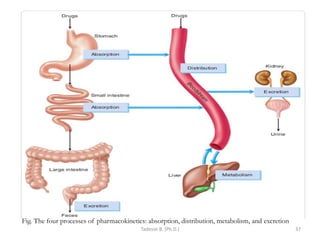
Fig. Drug Biodisposition
Tadesse B. (Ph.D.) 37
Fig. The four processes of pharmacokinetics: absorption, distribution, metabolism, and excretion
The four basic Pharmacokinetic processes
Tadesse B. (Ph.D.) 38
Dotted lines represent membranes that must be crossed as drugs move throughout the body
Factors that determine the intensity of drug responses
Tadesse B. (Ph.D.) 39
Pharmacokinetics Processes…
• The “standard” dose of a drug is based on trials in healthy volunteers
and patients with average ability to absorb, distribute, and eliminate
the drug
– This dose will not be suitable for every patient.
• Dosage adjustment in individual patients is important due to:
– Physiologic processes (e.g., body size, maturation of organ function in
infants) and
– Pathologic processes (e.g., heart failure, renal failure).
• These processes modify specific pharmacokinetic parameters.
• The two basic pharmacokinetic parameters are:
– Clearance: the measure of the ability of the body to eliminate the drug &
– Volume of distribution: the measure of the apparent space in the body
available to contain the drug
Tadesse B. (Ph.D.) 40
Pharmacokinetics Processes…
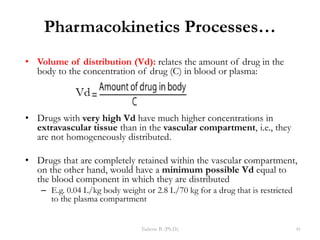
• Volume of distribution (Vd): relates the amount of drug in the
body to the concentration of drug (C) in blood or plasma:
• Drugs with very high Vd have much higher concentrations in
extravascular tissue than in the vascular compartment, i.e., they
are not homogeneously distributed.
• Drugs that are completely retained within the vascular compartment,
on the other hand, would have a minimum possible Vd equal to
the blood component in which they are distributed
– E.g. 0.04 L/kg body weight or 2.8 L/70 kg for a drug that is restricted
to the plasma compartment
Tadesse B. (Ph.D.) 41
Pharmacokinetics Processes…
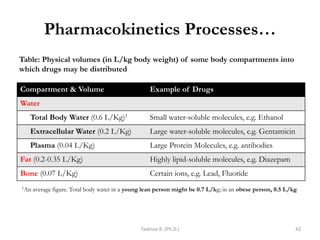
Tadesse B. (Ph.D.) 42
Compartment & Volume Example of Drugs
Water
Total Body Water (0.6 L/Kg)1 Small water-soluble molecules, e.g. Ethanol
Extracellular Water (0.2 L/Kg) Large water-soluble molecules, e.g. Gentamicin
Plasma (0.04 L/Kg) Large Protein Molecules, e.g. antibodies
Fat (0.2-0.35 L/Kg) Highly lipid-soluble molecules, e.g. Diazepam
Bone (0.07 L/Kg) Certain ions, e.g. Lead, Fluoride
1An average figure. Total body water in a young lean person might be 0.7 L/kg; in an obese person, 0.5 L/kg
Table: Physical volumes (in L/kg body weight) of some body compartments into
which drugs may be distributed
Pharmacokinetics Processes…
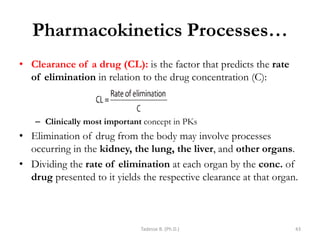
• Clearance of a drug (CL): is the factor that predicts the rate
of elimination in relation to the drug concentration (C):
– Clinically most important concept in PKs
• Elimination of drug from the body may involve processes
occurring in the kidney, the lung, the liver, and other organs.
• Dividing the rate of elimination at each organ by the conc. of
drug presented to it yields the respective clearance at that organ.
Tadesse B. (Ph.D.) 43
Pharmacokinetics Processes…
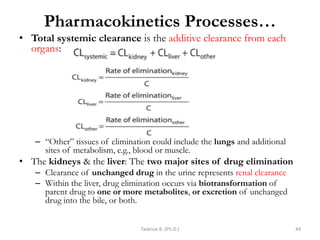
• Total systemic clearance is the additive clearance from each
organs:
– ―Other‖ tissues of elimination could include the lungs and additional
sites of metabolism, e.g., blood or muscle.
• The kidneys & the liver: The two major sites of drug elimination
– Clearance of unchanged drug in the urine represents renal clearance
– Within the liver, drug elimination occurs via biotransformation of
parent drug to one or more metabolites, or excretion of unchanged
drug into the bile, or both.
Tadesse B. (Ph.D.) 44
Pharmacokinetics Processes…
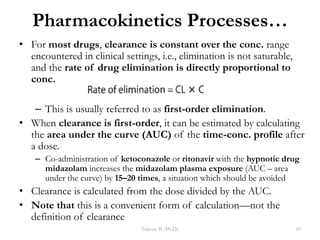
• For most drugs, clearance is constant over the conc. range
encountered in clinical settings, i.e., elimination is not saturable,
and the rate of drug elimination is directly proportional to
conc.
– This is usually referred to as first-order elimination.
• When clearance is first-order, it can be estimated by calculating
the area under the curve (AUC) of the time-conc. profile after
a dose.
– Co-administration of ketoconazole or ritonavir with the hypnotic drug
midazolam increases the midazolam plasma exposure (AUC – area
under the curve) by 15–20 times, a situation which should be avoided
• Clearance is calculated from the dose divided by the AUC.
• Note that this is a convenient form of calculation—not the
definition of clearance
Tadesse B. (Ph.D.) 45
Tadesse B. (Ph.D.) 46
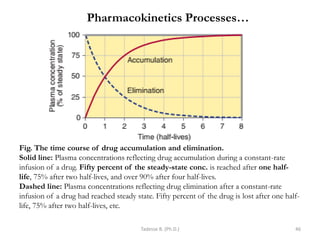
Fig. The time course of drug accumulation and elimination.
Solid line: Plasma concentrations reflecting drug accumulation during a constant-rate
infusion of a drug. Fifty percent of the steady-state conc. is reached after one half-
life, 75% after two half-lives, and over 90% after four half-lives.
Dashed line: Plasma concentrations reflecting drug elimination after a constant-rate
infusion of a drug had reached steady state. Fifty percent of the drug is lost after one half-
life, 75% after two half-lives, etc.
Pharmacokinetics Processes…
Tadesse B. (Ph.D.) 47
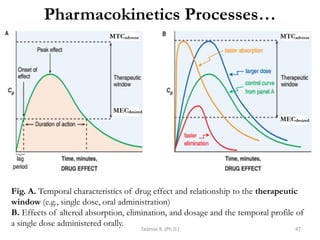
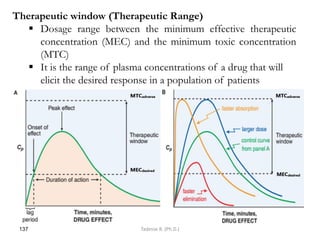
Fig. A. Temporal characteristics of drug effect and relationship to the therapeutic
window (e.g., single dose, oral administration)
B. Effects of altered absorption, elimination, and dosage and the temporal profile of
a single dose administered orally.
Pharmacokinetics Processes…
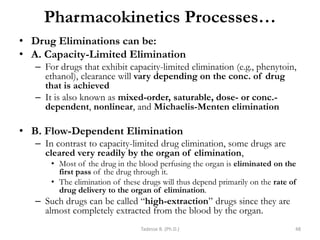
• Drug Eliminations can be:
• A. Capacity-Limited Elimination
– For drugs that exhibit capacity-limited elimination (e.g., phenytoin,
ethanol), clearance will vary depending on the conc. of drug
that is achieved
– It is also known as mixed-order, saturable, dose- or conc.-
dependent, nonlinear, and Michaelis-Menten elimination
• B. Flow-Dependent Elimination
– In contrast to capacity-limited drug elimination, some drugs are
cleared very readily by the organ of elimination,
• Most of the drug in the blood perfusing the organ is eliminated on the
first pass of the drug through it.
• The elimination of these drugs will thus depend primarily on the rate of
drug delivery to the organ of elimination.
– Such drugs can be called ―high-extraction‖ drugs since they are
almost completely extracted from the blood by the organ.
Tadesse B. (Ph.D.) 48
Pharmacokinetics Processes…
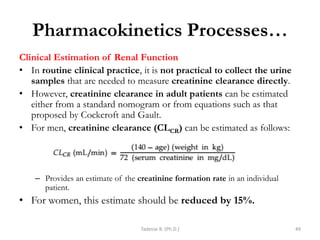
Clinical Estimation of Renal Function
• In routine clinical practice, it is not practical to collect the urine
samples that are needed to measure creatinine clearance directly.
• However, creatinine clearance in adult patients can be estimated
either from a standard nomogram or from equations such as that
proposed by Cockcroft and Gault.
• For men, creatinine clearance (CLCR) can be estimated as follows:
– Provides an estimate of the creatinine formation rate in an individual
patient.
• For women, this estimate should be reduced by 15%.
Tadesse B. (Ph.D.) 49
Pharmacokinetics Processes…
Tadesse B. (Ph.D.) 50
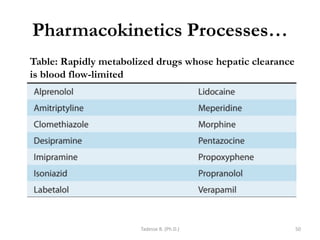
Table: Rapidly metabolized drugs whose hepatic clearance
is blood flow-limited
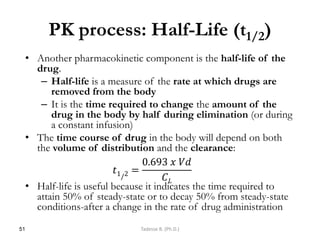
PK process: Half-Life (t1/2)
• Another pharmacokinetic component is the half-life of the
drug.
– Half-life is a measure of the rate at which drugs are
removed from the body
– It is the time required to change the amount of the
drug in the body by half during elimination (or during
a constant infusion)
• The time course of drug in the body will depend on both
the volume of distribution and the clearance:
• Half-life is useful because it indicates the time required to
attain 50% of steady-state or to decay 50% from steady-state
conditions-after a change in the rate of drug administration
51 Tadesse B. (Ph.D.)
𝑡1/2 =
0.693 𝑥 𝑉𝑑
𝐶𝐿
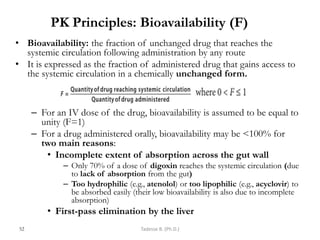
PK Principles: Bioavailability (F)
• Bioavailability: the fraction of unchanged drug that reaches the
systemic circulation following administration by any route
• It is expressed as the fraction of administered drug that gains access to
the systemic circulation in a chemically unchanged form.
– For an IV dose of the drug, bioavailability is assumed to be equal to
unity (F=1)
– For a drug administered orally, bioavailability may be <100% for
two main reasons:
• Incomplete extent of absorption across the gut wall
– Only 70% of a dose of digoxin reaches the systemic circulation (due
to lack of absorption from the gut)
– Too hydrophilic (e.g., atenolol) or too lipophilic (e.g., acyclovir) to
be absorbed easily (their low bioavailability is also due to incomplete
absorption)
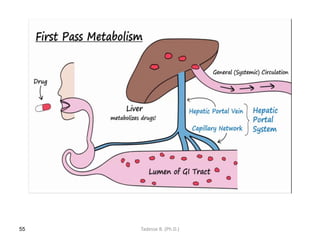
• First-pass elimination by the liver
52 Tadesse B. (Ph.D.)
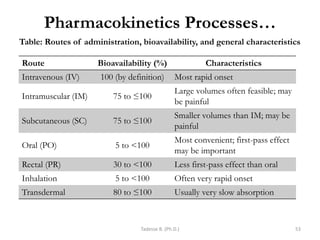
Pharmacokinetics Processes…
Table: Routes of administration, bioavailability, and general characteristics
Tadesse B. (Ph.D.) 53
Route Bioavailability (%) Characteristics
Intravenous (IV) 100 (by definition) Most rapid onset
Intramuscular (IM) 75 to ≤100
Large volumes often feasible; may
be painful
Subcutaneous (SC) 75 to ≤100
Smaller volumes than IM; may be
painful
Oral (PO) 5 to <100
Most convenient; first-pass effect
may be important
Rectal (PR) 30 to <100 Less first-pass effect than oral
Inhalation 5 to <100 Often very rapid onset
Transdermal 80 to ≤100 Usually very slow absorption
PK Principles: Bioavailability (F)…
• Factors that influence bioavailability:
– The extent of absorption may be reduced because of:
• First-pass hepatic metabolism (First-pass effect)
• Chemical instability
oUndergoes destruction at its site of administration
• Nature of the drug formulation
oA drug is incompletely released from its Drug
Formulation
• Physicochemical properties such as insolubility that
prevent complete absorption from its site of administration
54 Tadesse B. (Ph.D.)
55 Tadesse B. (Ph.D.)
PK Principles…
• Bioequivalence
– Two related drugs are bioequivalent if they show comparable
bioavailability and similar times to achieve peak blood conc.
– Two related drugs with a significant difference in
bioavailability are said to be bioinequivalent.
• Therapeutic equivalence
– Two similar drugs are therapeutically equivalent if they have
comparable efficacy and safety.
– Note: Clinical effectiveness often depends on both the
maximum serum drug concentrations and on the time
required (after administration) to reach peak conc.
• Therefore, two drugs that are bioequivalent may not be therapeutically
equivalent
56 Tadesse B. (Ph.D.)
i. PK Processes: Drug Absorption
• Absorption: the process by which unchanged drug
proceeds from the site of administration to the site of
measurement (blood/circulating body fluids) within the
body
• The rate of absorption determines how soon effects
will begin & depends on the route of administration
• The amount of absorption helps to determine how
intense effects will be
• Drugs can be absorbed from GIT (oral, buccal, sublingual
or rectally), mucous membranes, skin, lungs, muscle or
subcutaneous (SC) tissues
• In order for a drug to be absorbed, it must pass through
cell membranes
57 Tadesse B. (Ph.D.)
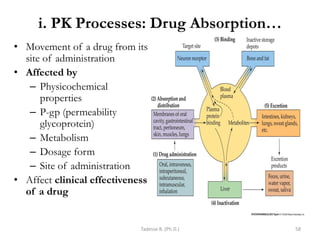
• Movement of a drug from its
site of administration
• Affected by
– Physicochemical
properties
– P-gp (permeability
glycoprotein)
– Metabolism
– Dosage form
– Site of administration
• Affect clinical effectiveness
of a drug
i. PK Processes: Drug Absorption…
Tadesse B. (Ph.D.) 58
PK Processes: Drug Absorption…
• The rate and efficiency of drug absorption depend on the
route of administration.
• The route of administration is determined primarily by the
– Properties of the drug (e.g., water or lipid solubility,
ionization, etc.) and
– Therapeutic objectives (e.g., the desirability of a rapid
onset of action or the need for long-term administration
or restriction to a local site).
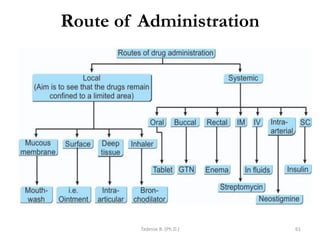
• There are two major routes of drug administration:
– Enteral (oral & Sublingual) and parenteral.
• The three major parenteral routes are intravascular
(intravenous or intra-arterial), intramuscular, and
subcutaneous.
59 Tadesse B. (Ph.D.)
PK Processes: Drug Absorption…
• For IV delivery, for example, drug absorption is complete;
that is, the total dose of drug reaches the systemic
circulation.
• Drug delivery by other routes may result in only partial
absorption and, thus, lower bioavailability.
• Enteric coating of a drug protects it from the acidic
environment; the coating may prevent gastric irritation,
and depending on the formulation, the release of the drug
may be prolonged, producing a sustained-release effect
60 Tadesse B. (Ph.D.)
Route of Administration
Tadesse B. (Ph.D.) 61
Patient Case Scenario 2
• A 4 year old child is brought to the hospital with the complaint
of fever, cough, difficulty in breathing and chest pain.
• On examination he is found to be dull, but irritable with fast
pulse (118/min), rapid breathing (RR 55/min) and in drawing
of lower chest during inspiration, wheezing, crepitations and
mild dehydration.
• Body temperature is 400C (1040F). The physician makes a
provisional diagnosis of acute pneumonia and orders relevant
haematological as well as bacteriological investigations. He
decides to introduce antibiotic therapy.
• a) In case he selects an antibiotic which can be given orally as
well as by IM or IV injection, which route of admin. will be
most appropriate in this case?
• b) Should the pediatrician administer the antibiotic straight away
or should he wait for the laboratory reports?
Tadesse B. (Ph.D.) 62
PK Processes: Drug Absorption…
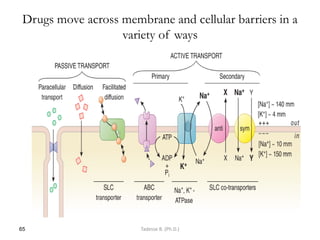
• Drugs can be absorbed by one or combination of the
following transport systems
• Transport Across Cell Membranes
– Every PK parameters involve the penetration of drug
across cell membrane
– Transport Mechanisms across cell membrane are:
• Passive transport
• Active transport
• Endocytosis and
• Exocytosis
63 Tadesse B. (Ph.D.)
PK Processes: Drug Absorption…
• Endocytosis and exocytosis:
– This type of drug delivery transports drugs of exceptionally
large size across the cell membrane.
• Endocytosis involves engulfment of a drug molecule by the cell
membrane & transport into the cell by pinching off the drug-filled
vesicle.
– E.g., Vitamin B12 is transported across the gut wall by
endocytosis.
• Exocytosis is the reverse of endocytosis and is used by cells to
secrete many substances by a similar vesicle formation process.
– E.g. Certain neurotransmitters (e.g., norepinephrine) are
stored in membrane-bound vesicles in the nerve terminal &
are released by exocytosis.
64 Tadesse B. (Ph.D.)
Drugs move across membrane and cellular barriers in a
variety of ways
65 Tadesse B. (Ph.D.)
PK Processes: Drug Absorption…
• Transport of drugs across cell membrane depend
on:
– Size, degree of ionization, shape, lipid solubility
• Since most drugs are weak acids or weak bases their
concentration of ionized & unionized state depend on:
– pH of media
– pKa of the drug
66 Tadesse B. (Ph.D.)
PK Processes: Drug Absorption…
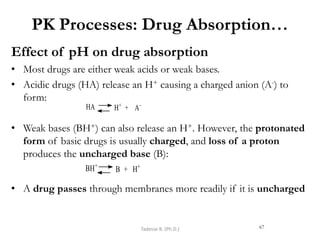
Effect of pH on drug absorption
• Most drugs are either weak acids or weak bases.
• Acidic drugs (HA) release an H+ causing a charged anion (A-) to
form:
• Weak bases (BH+) can also release an H+. However, the protonated
form of basic drugs is usually charged, and loss of a proton
produces the uncharged base (B):
• A drug passes through membranes more readily if it is uncharged
67
Tadesse B. (Ph.D.)
PK Processes: Drug Absorption…
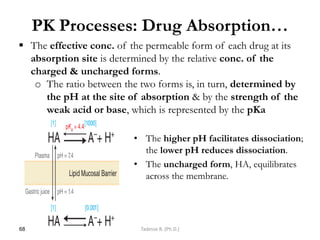
• The higher pH facilitates dissociation;
the lower pH reduces dissociation.
• The uncharged form, HA, equilibrates
across the membrane.
68 Tadesse B. (Ph.D.)
 The effective conc. of the permeable form of each drug at its
absorption site is determined by the relative conc. of the
charged & uncharged forms.
o The ratio between the two forms is, in turn, determined by
the pH at the site of absorption & by the strength of the
weak acid or base, which is represented by the pKa
PK Processes: Drug Absorption…
Sites of Absorption
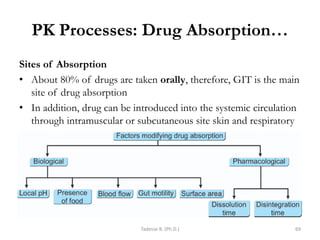
• About 80% of drugs are taken orally, therefore, GIT is the main
site of drug absorption
• In addition, drug can be introduced into the systemic circulation
through intramuscular or subcutaneous site skin and respiratory
tract
Tadesse B. (Ph.D.) 69
PK Processes: Drug Absorption…
• Factors Affecting Drug Absorption
 Route of administration*
 Dosage forms
• Particle size
• Disintegration rate and
dissolution rate
• Formulation: type & amount of
additives
– Diluents: Lactose, sucrose,
starch, calcium phosphate
 Physicochemical properties of the
drug
• Physical state
• Lipid or water solubility
• Ionization: Weak acid/bases,
organic
 Circulation at the site of
absorption
 Concentration of the drug
 Surface area of absorption site
 Blood flow to the absorption
site
 Total surface area available for
absorption
 Contact time at the absorption
surface
70
Tadesse B. (Ph.D.)
The rate at which a drug undergoes
absorption is influenced by the
physical and chemical properties of
the drug itself and by physiologic
and anatomic factors at the
absorption site.
Factors affecting drug absorption…
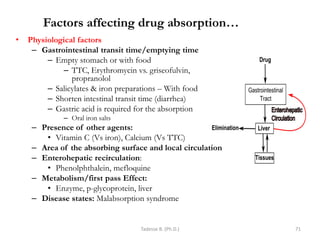
• Physiological factors
– Gastrointestinal transit time/emptying time
– Empty stomach or with food
– TTC, Erythromycin vs. griseofulvin,
propranolol
– Salicylates & iron preparations – With food
– Shorten intestinal transit time (diarrhea)
– Gastric acid is required for the absorption
– Oral iron salts
– Presence of other agents:
• Vitamin C (Vs iron), Calcium (Vs TTC)
– Area of the absorbing surface and local circulation
– Enterohepatic recirculation:
• Phenolphthalein, mefloquine
– Metabolism/first pass Effect:
• Enzyme, p-glycoprotein, liver
– Disease states: Malabsorption syndrome
Tadesse B. (Ph.D.) 71
Factors affecting drug absorption…
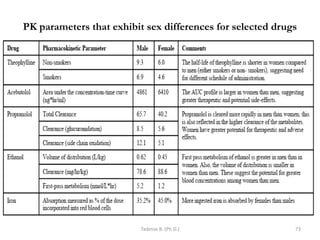
Sex Differences In Pharmacokinetics: Drug Absorption
• The factors influencing absorption are route-specific and may also be
sex-specific.
• Chemicals or drugs cross body surfaces such as the GIT, respiratory
tract, or skin (different in males and females) to enter the systemic
circulation.
• The absorption rate and extent of a drug are drug-specific.
– Examples of drugs that illustrate sex differences in drug absorption
include rifampicin and IM cephradine.
– Cephradine has a slower rate of IM absorption and lesser bioavailability
in females
• It has been hypothesized that women, by virtue of having greater
subcutaneous lipid content, receive different doses of transdermally
administered drugs.
• Women may also take in less of inhaled aerosol drugs such as
ribavirin and cyclosporine
Tadesse B. (Ph.D.) 72
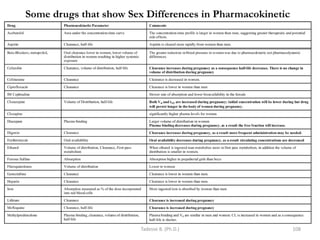
PK parameters that exhibit sex differences for selected drugs
Tadesse B. (Ph.D.) 73
Drug Approval During Pregnancy
Tadesse B. (Ph.D.) 74
• FDA developed a classification system related to the effects of drugs on unborn
child (fetus)
• Pregnancy categories are indicated for most drug:
• Category A: No risk to the fetus based on studies
– Medications in this class are considered safe to use
– E.g.: Vitamins, levothyroxine, saline nasal spray
• Category B: Little to no risk based on animal studies, but no controlled studies in
pregnant women
– Medications in this class are generally considered safe to use
– E.g. amoxicillin, cephalosporins, diphenhydramine, metformin, lispro or regular insulin,
ibuprofen, paracetamol, etc.
• Category C: Risk indicated on the fetus based on animal studies
– Drugs from this class can be given to pregnant women if the benefit to the mother
overweighs the risk to the fetus
– E.g. Diltiazem, spironolactone, Bactrim, fluoroquinolones, ethosuximide, gabapentin,
dextromethorphan, phenylephrine, glyburide (and most sulphonylureas),
thiazolidinedione's, glargine & detemir insulin, aspirin, morphine, tramadol,
• Category D: Risk to the fetus proved.
– E.g. Valproic acid, lorazepam, carbamazepine, morphine (if prolonged use)
• Category X: Risk proved; hence, avoid during pregnancy. It brings teratogenic effects
– E.g. Thalidomide, warfarin, ergotamine (sympatholytic)
ii) PK Processes: Drug Distribution
• Following absorption or systemic administration into the
bloodstream, a drug distributes into interstitial & intracellular
fluids
• Drug distribution is the process of reversible transfer of a drug
to & from the blood and various tissues of the body (E.g.: fat,
muscle, and brain tissue) and the relative proportions of drug in the
tissues.
• Drug is transported from the site of absorption to the site of action
• This process reflects a number of physiological factors & the
particular physicochemical properties of the individual drug
– Factors that affect the rate of delivery & potential amount of
drug distributed into tissues
• Cardiac output, regional blood flow, tissue volume, &
capillary permeability
75 Tadesse B. (Ph.D.)
PK processes: Drug Distribution …
• With exceptions such as the brain, diffusion of drug into the
interstitial fluid occurs rapidly because of the highly permeable
nature of the capillary endothelium
– Thus, tissue distribution is determined by:
• The partitioning of drug b/n blood & the particular
tissue
oLipid solubility & transmembrane pH gradients
are important determinants of such uptake for drugs
that are either weak acids or bases
• The more important determinant of blood-tissue partitioning:
– The relative binding of drug to plasma proteins (PPB) &
tissue macromolecules that limits the concentration of free
drug
Tadesse B. (Ph.D.) 76
I. Plasma Protein Binding (PPB)
– Drug in systemic circulation exist as bound & unbound form
– Many drugs circulate in the bloodstream bound to plasma
proteins.
• Albumin is a major carrier for acidic drugs;
• α1-acid glycoprotein binds basic drugs such as propranolol.
• Nonspecific binding to other plasma proteins generally occurs to a much
smaller extent.
– Albumin, α1-acid glycoprotein, etc. are the major binding
macromolecules.
– The binding is usually reversible & in dynamic equilibrium
D + P →[DP] → D + P
– As free drugs leave the systemic circulation, the bound drug
dissociate
77
PK processes: Drug Distribution…
Tadesse B. (Ph.D.)
• Plasma protein binding…
– The fraction of total drug in plasma that is bound is
determined by:
• The drug concentration
• The affinity of binding sites for the drug
• The number of binding sites
– The extent of this binding will influence the drug’s
distribution & rate of elimination because only the
unbound drug can:
• Diffuse through capillary beds & cell membrane (↓Vd)
• Produce therapeutic or toxic effect
• Be metabolized or excreted
78
PK processes: Drug Distribution…
Tadesse B. (Ph.D.)
PK processes: Drug Distribution…
 Plasma protein binding…
a) Albumin:
 Some factor affect the binding of drugs with albumin:
o Age
o Pregnancy
o Disease state: Hyperalbuminemia, Hypoalbuminemia,
Liver disease, etc.
b) α1–acid glycoprotein
 Serum plasma level increases in situation such as:
o Stress, injury, trauma, rheumatoid arthritis, surgery
79 Tadesse B. (Ph.D.)
PK processes: Drug Distribution…
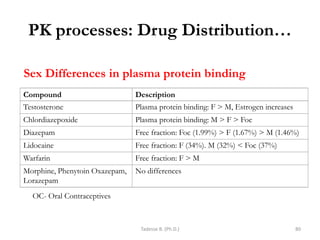
Compound Description
Testosterone Plasma protein binding: F > M, Estrogen increases
Chlordiazepoxide Plasma protein binding: M > F > Foc
Diazepam Free fraction: Foc (1.99%) > F (1.67%) > M (1.46%)
Lidocaine Free fraction: F (34%). M (32%) < Foc (37%)
Warfarin Free fraction: F > M
Morphine, Phenytoin Oxazepam,
Lorazepam
No differences
Tadesse B. (Ph.D.) 80
Sex Differences in plasma protein binding
OC- Oral Contraceptives
PK processes: Drug Distribution…
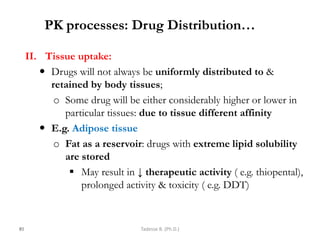
II. Tissue uptake:
 Drugs will not always be uniformly distributed to &
retained by body tissues;
o Some drug will be either considerably higher or lower in
particular tissues: due to tissue different affinity
 E.g. Adipose tissue
o Fat as a reservoir: drugs with extreme lipid solubility
are stored
 May result in ↓ therapeutic activity ( e.g. thiopental),
prolonged activity & toxicity ( e.g. DDT)
81 Tadesse B. (Ph.D.)
PK processes: Drug Distribution…
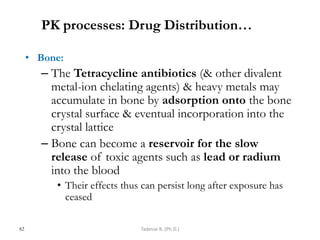
• Bone:
– The Tetracycline antibiotics (& other divalent
metal-ion chelating agents) & heavy metals may
accumulate in bone by adsorption onto the bone
crystal surface & eventual incorporation into the
crystal lattice
– Bone can become a reservoir for the slow
release of toxic agents such as lead or radium
into the blood
• Their effects thus can persist long after exposure has
ceased
82 Tadesse B. (Ph.D.)
PK processes: Drug Distribution…
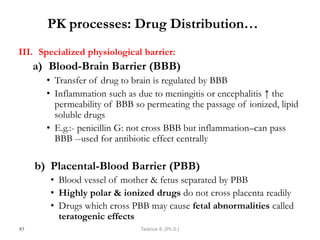
III. Specialized physiological barrier:
a) Blood-Brain Barrier (BBB)
• Transfer of drug to brain is regulated by BBB
• Inflammation such as due to meningitis or encephalitis ↑ the
permeability of BBB so permeating the passage of ionized, lipid
soluble drugs
• E.g.:- penicillin G: not cross BBB but inflammation–can pass
BBB --used for antibiotic effect centrally
b) Placental-Blood Barrier (PBB)
• Blood vessel of mother & fetus separated by PBB
• Highly polar & ionized drugs do not cross placenta readily
• Drugs which cross PBB may cause fetal abnormalities called
teratogenic effects
83 Tadesse B. (Ph.D.)
PK processes: Drug Distribution…
IV. Tissue perfusion:
– Different tissue have different rate & amount
of blood flow
• Highly perfused tissue:- heart, lung, brain, liver,
kidney
• Intermediate perfused tissue:- skeletal muscle
• Poorly perfused tissue:- skin, bone, nail, fat tissue
84 Tadesse B. (Ph.D.)
PK processes: Drug Distribution…
 Volume of distribution (Vd):
 It is the measure of the apparent space in the body available to
contain the drug
 Relates drug concentration in the plasma to total drug in the
body
 Gives rough estimation of overall distribution of a drug
in the body
 Vd = Amount of drug in body
Amount of drug in blood
 Having high Vd – high distribution
 Vd have inverse relationship with PPB
 ↑PPB ----- ↓VD (mainly found in plasma)
85
Tadesse B. (Ph.D.)
iii) PK processes: Drug Metabolism/Biotransformation
 What is Biotransformation?
 A chemical change (transformation) of drugs by
body enzyme
 Why Biotransformation?
 To facilitate excretion of drugs by changing to more
water soluble form
 Lipophilic → → hydrophilic
 NB: Elimination is the irreversible loss of drug
from the site of measurement
 Elimination occur by 2 process: excretion & metabolism
86 Tadesse B. (Ph.D.)
PK processes: Drug Metabolism/Biotransformation…
 Where Biotransformation?
 Metabolism of drug occur in all body parts
 Lung, GI, kidney, liver, blood….
 But mainly take place in liver ; because it contain large amount of
metabolizing enzyme
 How Biotransformation?
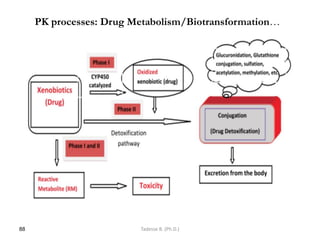
 Drug metabolism may be a Detoxification process or
Bioactivation process leading to varied consequences
 The detoxification reactions can be divided into two broad
categories in the liver
 Phase I reactions (functionalization) and
 Phase II reactions (conjugation)
 The reactions may occur (i) sequentially, (ii)
independently, or (iii) simultaneously
87 Tadesse B. (Ph.D.)
PK processes: Drug Metabolism/Biotransformation…
88 Tadesse B. (Ph.D.)
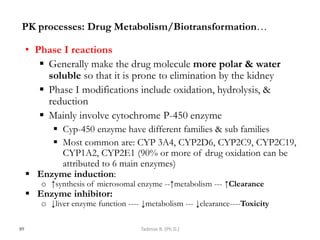
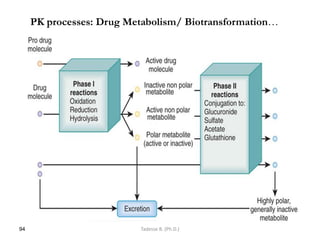
• Phase I reactions
 Generally make the drug molecule more polar & water
soluble so that it is prone to elimination by the kidney
 Phase I modifications include oxidation, hydrolysis, &
reduction
 Mainly involve cytochrome P-450 enzyme
 Cyp-450 enzyme have different families & sub families
 Most common are: CYP 3A4, CYP2D6, CYP2C9, CYP2C19,
CYP1A2, CYP2E1 (90% or more of drug oxidation can be
attributed to 6 main enzymes)
 Enzyme induction:
o ↑synthesis of microsomal enzyme --↑metabolism --- ↑Clearance
 Enzyme inhibitor:
o ↓liver enzyme function ---- ↓metabolism --- ↓clearance----Toxicity
89
PK processes: Drug Metabolism/Biotransformation…
Tadesse B. (Ph.D.)
PK processes: Drug
Metabolism/Biotransformation…
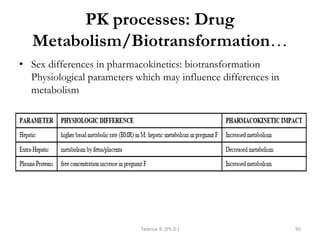
• Sex differences in pharmacokinetics: biotransformation
Physiological parameters which may influence differences in
metabolism
Tadesse B. (Ph.D.) 90
PK processes: Drug Metabolism/Biotransformation…
Tadesse B. (Ph.D.) 91
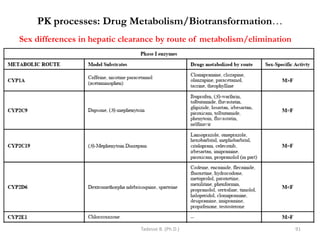
Sex differences in hepatic clearance by route of metabolism/elimination
PK processes: Drug Metabolism/ Biotransformation…
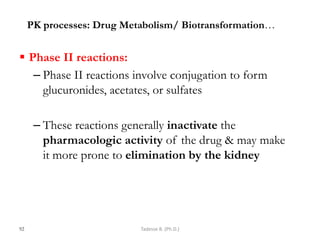
 Phase II reactions:
– Phase II reactions involve conjugation to form
glucuronides, acetates, or sulfates
– These reactions generally inactivate the
pharmacologic activity of the drug & may make
it more prone to elimination by the kidney
92 Tadesse B. (Ph.D.)
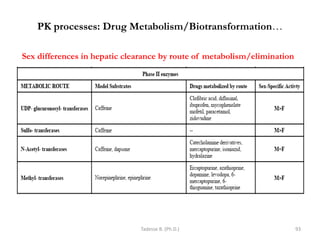
PK processes: Drug Metabolism/Biotransformation…
Tadesse B. (Ph.D.) 93
Sex differences in hepatic clearance by route of metabolism/elimination
PK processes: Drug Metabolism/ Biotransformation…
94 Tadesse B. (Ph.D.)
PK processes: Drug Metabolism/ Biotransformation…
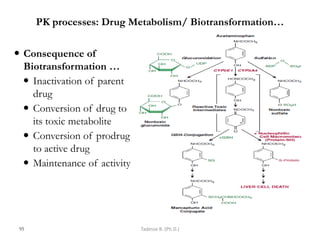
 Consequence of
Biotransformation …
 Inactivation of parent
drug
 Conversion of drug to
its toxic metabolite
 Conversion of prodrug
to active drug
 Maintenance of activity
95 Tadesse B. (Ph.D.)
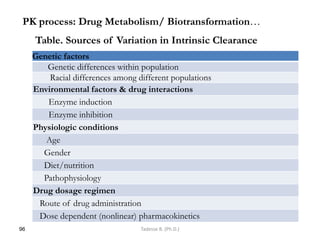
Table. Sources of Variation in Intrinsic Clearance
Genetic factors
Genetic differences within population
Racial differences among different populations
Environmental factors & drug interactions
Enzyme induction
Enzyme inhibition
Physiologic conditions
Age
Gender
Diet/nutrition
Pathophysiology
Drug dosage regimen
Route of drug administration
Dose dependent (nonlinear) pharmacokinetics
PK process: Drug Metabolism/ Biotransformation…
96 Tadesse B. (Ph.D.)
97
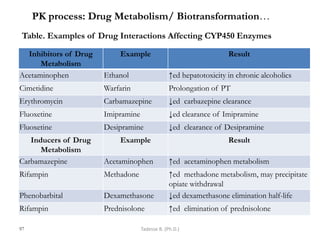
Table. Examples of Drug Interactions Affecting CYP450 Enzymes
Inhibitors of Drug
Metabolism
Example Result
Acetaminophen Ethanol ↑ed hepatotoxicity in chronic alcoholics
Cimetidine Warfarin Prolongation of PT
Erythromycin Carbamazepine ↓ed carbazepine clearance
Fluoxetine Imipramine ↓ed clearance of Imipramine
Fluoxetine Desipramine ↓ed clearance of Desipramine
Inducers of Drug
Metabolism
Example Result
Carbamazepine Acetaminophen ↑ed acetaminophen metabolism
Rifampin Methadone ↑ed methadone metabolism, may precipitate
opiate withdrawal
Phenobarbital Dexamethasone ↓ed dexamethasone elimination half-life
Rifampin Prednisolone ↑ed elimination of prednisolone
PK process: Drug Metabolism/ Biotransformation…
Tadesse B. (Ph.D.)
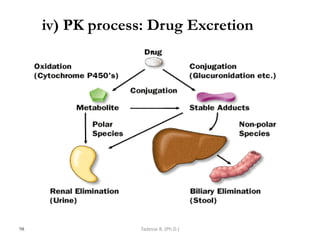
iv) PK process: Drug Excretion
98 Tadesse B. (Ph.D.)
iv) PK process: Drug Excretion …
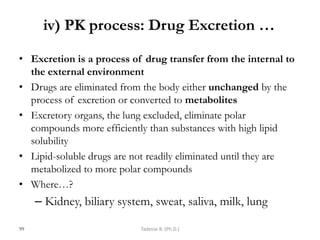
• Excretion is a process of drug transfer from the internal to
the external environment
• Drugs are eliminated from the body either unchanged by the
process of excretion or converted to metabolites
• Excretory organs, the lung excluded, eliminate polar
compounds more efficiently than substances with high lipid
solubility
• Lipid-soluble drugs are not readily eliminated until they are
metabolized to more polar compounds
• Where…?
– Kidney, biliary system, sweat, saliva, milk, lung
99 Tadesse B. (Ph.D.)
iv) PK process: Drug Excretion …
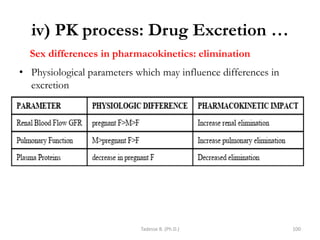
• Physiological parameters which may influence differences in
excretion
Tadesse B. (Ph.D.) 100
Sex differences in pharmacokinetics: elimination
iv) PK process: Drug Excretion …
Elimination:
• The major mode of drug elimination are:
– Biotransformation to inactive metabolites
– Excretion via kidney or via other modes including the bile duct, lungs, &
sweat
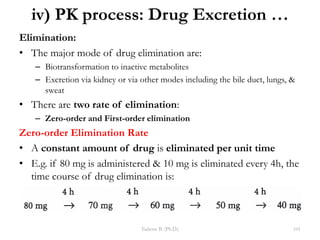
• There are two rate of elimination:
– Zero-order and First-order elimination
Zero-order Elimination Rate
• A constant amount of drug is eliminated per unit time
• E.g. if 80 mg is administered & 10 mg is eliminated every 4h, the
time course of drug elimination is:
Tadesse B. (Ph.D.) 101
iv) PK process: Drug Excretion …
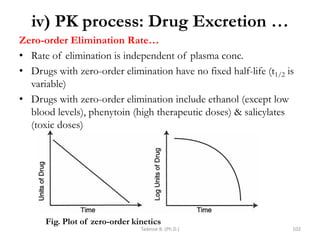
Zero-order Elimination Rate…
• Rate of elimination is independent of plasma conc.
• Drugs with zero-order elimination have no fixed half-life (t1/2 is
variable)
• Drugs with zero-order elimination include ethanol (except low
blood levels), phenytoin (high therapeutic doses) & salicylates
(toxic doses)
Tadesse B. (Ph.D.) 102
Fig. Plot of zero-order kinetics
iv) PK process: Drug Excretion …
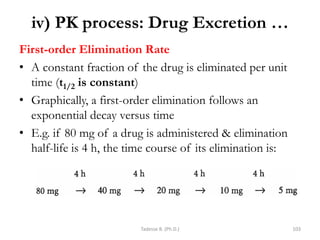
First-order Elimination Rate
• A constant fraction of the drug is eliminated per unit
time (t1/2 is constant)
• Graphically, a first-order elimination follows an
exponential decay versus time
• E.g. if 80 mg of a drug is administered & elimination
half-life is 4 h, the time course of its elimination is:
Tadesse B. (Ph.D.) 103
iv) PK process: Drug Excretion …
First-order Elimination Rate…
• Rate of elimination is directly proportional to plasma level (the
amount present)
– i.e. the higher the amount, the more rapid the elimination
• Most drugs follow first-order elimination rates
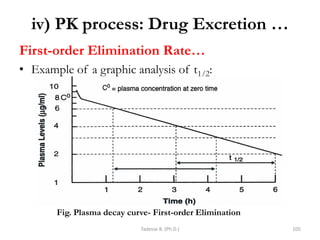
• t1/2 is inversely related to the elimination constant (k):
𝑡1/2 =
0.693
𝑘
Tadesse B. (Ph.D.)
104
Fig. Plot of first-order kinetics
iv) PK process: Drug Excretion …
First-order Elimination Rate…
• Example of a graphic analysis of t1/2:
Tadesse B. (Ph.D.) 105
Fig. Plasma decay curve- First-order Elimination
iv) PK process: Drug Excretion …
Example:
• (1) If we consider that at 0 hour the drug was 1000 mg in the body and it followed 1st
order kinetics and a constant fraction of 10% is filtered(and hence excreted) out by the
kidneys per hour. (A) Calculate the amount at the end of first hour.
• The amount of the drug in the body would be
– 1000 – (1000 × 10/100) = 1000 – 100 = 900 mg.
• (B) Calculate the amount at the end of 2nd, 3rd and 4th hour.
• The amount of drug still remaining in the body would be
– 900 – (900 × 10/100) = 900 – 90 = 810 mg
– 810 – ( 810 × 10/100) = 810 – 81 = 729 mg
– 729 – ( 729 × 10/100) = 729 – 72.9 = 656.1 mg and so forth.
• (2) If we followed of zero order kinetics, the quantity moving was a fixed amount. To
continue with the previous example, let the quantity of the drug in the body was 1000
mg and its excretion followed zero order kinetics and a fixed quantity, i.e. 10 mg is
passed out every hour then at the end of 1st , 2nd , 3rd , and 4th hour the body would
contain.
– 1000 – 10 = 990 mg
– 990 – 10 = 980 mg
– 980 – 10 = 970 mg
– 970 – 10 = 960 mg and so on.
• Unlike the first order kinetics, the amount excreted remains a fixed 10 mg/hr.
Tadesse B. (Ph.D.) 106
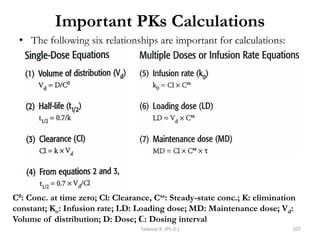
Important PKs Calculations
Tadesse B. (Ph.D.) 107
• The following six relationships are important for calculations:
C0: Conc. at time zero; Cl: Clearance, Css: Steady-state conc.; K: elimination
constant; Ko: Infusion rate; LD: Loading dose; MD: Maintenance dose; Vd:
Volume of distribution; D: Dose; Ꞇ: Dosing interval
Some drugs that show Sex Differences in Pharmacokinetic
Tadesse B. (Ph.D.) 108
Pharmacodynamics Processes
Tadesse B. (Ph.D.) 109
Contents
• Pharmacodynamics Processes
– Site & Mechanisms of Drug Action
– Character of Receptors and Drugs
– Drug-Receptor interactions
– Dose-Response Relationship (ED50, LD50,
Therapeutic Index, Potency, Maximum Efficacy)
110 Tadesse B. (Ph.D.)
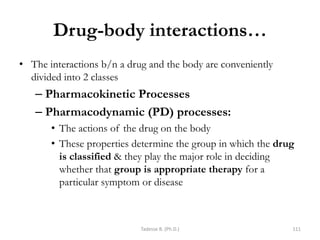
Drug-body interactions…
• The interactions b/n a drug and the body are conveniently
divided into 2 classes
– Pharmacokinetic Processes
– Pharmacodynamic (PD) processes:
• The actions of the drug on the body
• These properties determine the group in which the drug
is classified & they play the major role in deciding
whether that group is appropriate therapy for a
particular symptom or disease
Tadesse B. (Ph.D.) 111
PD: Introduction
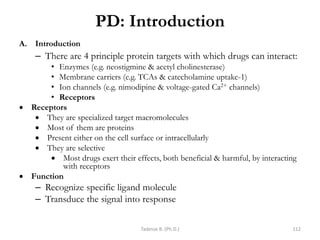
A. Introduction
– There are 4 principle protein targets with which drugs can interact:
• Enzymes (e.g. neostigmine & acetyl cholinesterase)
• Membrane carriers (e.g. TCAs & catecholamine uptake-1)
• Ion channels (e.g. nimodipine & voltage-gated Ca2+ channels)
• Receptors
 Receptors
 They are specialized target macromolecules
 Most of them are proteins
 Present either on the cell surface or intracellularly
 They are selective
 Most drugs exert their effects, both beneficial & harmful, by interacting
with receptors
 Function
– Recognize specific ligand molecule
– Transduce the signal into response
Tadesse B. (Ph.D.) 112
PD processes: Introduction…
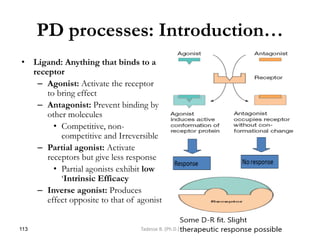
• Ligand: Anything that binds to a
receptor
– Agonist: Activate the receptor
to bring effect
– Antagonist: Prevent binding by
other molecules
• Competitive, non-
competitive and Irreversible
– Partial agonist: Activate
receptors but give less response
• Partial agonists exhibit low
‗Intrinsic Efficacy
– Inverse agonist: Produces
effect opposite to that of agonist
113 Tadesse B. (Ph.D.)
PD processes: Introduction…
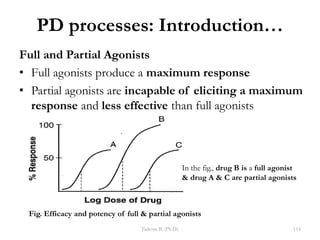
Full and Partial Agonists
• Full agonists produce a maximum response
• Partial agonists are incapable of eliciting a maximum
response and less effective than full agonists
Tadesse B. (Ph.D.) 114
Fig. Efficacy and potency of full & partial agonists
In the fig., drug B is a full agonist
& drug A & C are partial agonists
PD processes: Introduction…
Tadesse B. (Ph.D.) 115
Duality of Partial Agonists
• In figure displayed below, the lower curve represents effects of a partial
agonists when used alone-its ceiling effect = 50% maximal
• The upper curve shows the effect of ↑ing doses of the partial agonist on the
maximum response (100%) achieved in the presence of or by pretreatment
with a full agonist
• As the partial agonist displaces the full agonist from the receptor, the
response is reduced
– The partial agonist is acting as an antagonist
Fig. Duality of Partial
Agonists
PD processes: Introduction…
Pharmacologic Antagonism (Same Receptor)
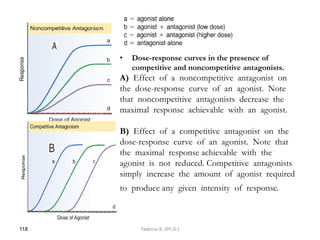
• Competitive antagonists:
– Cause a parallel shift to the right in D-R
curve for agonists
– Can be reversed by ↑ing the dose of the
agonist drug
– Appear to ↓ the potency of the agonist
• Non-competitive antagonists
– Cause a non-parallel shift to the right
– Can be only partially reversed by ↑ing the
dose of the agonist
– Appear to ↓ the efficacy of the agonist
• Physiologic antagonism (different
receptor)
– Two agonists with opposing action
antagonize each other
– Example: A vasoconstrictor with a
vasodilator
• Chemical antagonism
– Formation of a complex b/n
effector drug & another
compound
– Example: protamine binds to
heparin to reverse its action
• Potentiation
– Causes a parallel shift to the left
to the D-R curve
– Appears to ↑ the potency of the
agonist
Tadesse B. (Ph.D.) 116
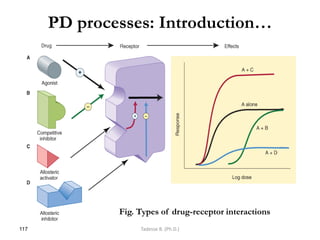
PD processes: Introduction…
117
Fig. Types of drug-receptor interactions
Tadesse B. (Ph.D.)
• Dose-response curves in the presence of
competitive and noncompetitive antagonists.
A) Effect of a noncompetitive antagonist on
the dose-response curve of an agonist. Note
that noncompetitive antagonists decrease the
maximal response achievable with an agonist.
B) Effect of a competitive antagonist on the
dose-response curve of an agonist. Note that
the maximal response achievable with the
agonist is not reduced. Competitive antagonists
simply increase the amount of agonist required
to produce any given intensity of response.
118 Tadesse B. (Ph.D.)
PD processes
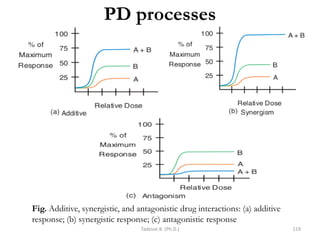
Tadesse B. (Ph.D.) 119
Fig. Additive, synergistic, and antagonistic drug interactions: (a) additive
response; (b) synergistic response; (c) antagonistic response
PD processes: Introduction…
• Cells may also have different types of receptors, each of
which is specific for a particular ligand
– On the heart, for example, there are β receptors
for NE, & muscarinic receptors for ACH
– These receptors dynamically interact to control
vital functions of the heart
• The magnitude of the response is proportional to the
number of drug–receptor complexes:
Drug + Receptor → Drug-Receptor complex → Biologic effect
120 Tadesse B. (Ph.D.)
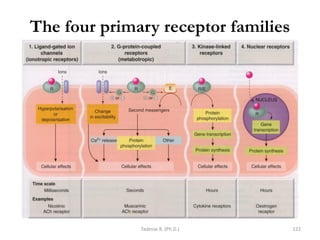
PD processes …
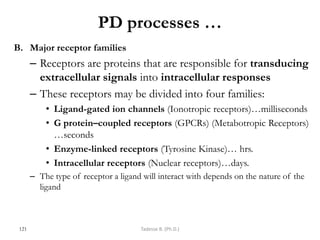
B. Major receptor families
– Receptors are proteins that are responsible for transducing
extracellular signals into intracellular responses
– These receptors may be divided into four families:
• Ligand-gated ion channels (Ionotropic receptors)…milliseconds
• G protein–coupled receptors (GPCRs) (Metabotropic Receptors)
…seconds
• Enzyme-linked receptors (Tyrosine Kinase)… hrs.
• Intracellular receptors (Nuclear receptors)…days.
– The type of receptor a ligand will interact with depends on the nature of the
ligand
121 Tadesse B. (Ph.D.)
The four primary receptor families
Tadesse B. (Ph.D.) 122
PD processes …
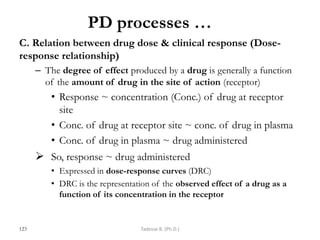
C. Relation between drug dose & clinical response (Dose-
response relationship)
– The degree of effect produced by a drug is generally a function
of the amount of drug in the site of action (receptor)
• Response ~ concentration (Conc.) of drug at receptor
site
• Conc. of drug at receptor site ~ conc. of drug in plasma
• Conc. of drug in plasma ~ drug administered
 So, response ~ drug administered
• Expressed in dose-response curves (DRC)
• DRC is the representation of the observed effect of a drug as a
function of its concentration in the receptor
123 Tadesse B. (Ph.D.)
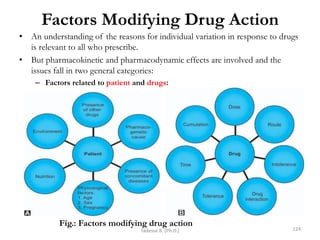
Factors Modifying Drug Action
• An understanding of the reasons for individual variation in response to drugs
is relevant to all who prescribe.
• But pharmacokinetic and pharmacodynamic effects are involved and the
issues fall in two general categories:
– Factors related to patient and drugs:
Fig.: Factors modifying drug action
Tadesse B. (Ph.D.) 124
PD processes: Relation between drug dose & clinical response
a) Dose & response in patients
It can be either Graded dose-response relations or Quantal dose-
response curves
1. Graded dose–response relations
• To choose among drugs and to determine appropriate doses
of a drug, the prescriber must know the relative pharmacologic
potency and maximal efficacy of the drugs in relation to the
desired therapeutic effect.
 Graded response: the response continuously ↑ as the
administered dose continuously ↑
 The response is a graded effect, meaning that the response is
continuous & gradual
 More common than quantal dose response, since it involves
single patient/animal
 Graph is done by giving different doses of a drug to single
individual & recording response
125 Tadesse B. (Ph.D.)
PD Process: Graded dose–response relations
• Two important properties of drugs can be determined by graded
dose-response curves
– Potency and Efficacy (intrinsic activity)
i. Potency:
– It is a measure of the amount of drug necessary to produce an
effect of a given magnitude
– It means how much drug concentration is required to obtain a
given response, usually the fifty percent of the maximal
response.
– It refers to the concentration (EC50) or dose (ED50) of a drug
required to produce 50% of that drug’s maximal effect.
• The lower the dose required to elicit given response, the more potent the drug is
– A drug with low ED50 is more potent than a drug with larger
ED50
126 Tadesse B. (Ph.D.)
PD Process: Graded dose–response relations
ii. Efficacy (intrinsic activity)
– It is the ability of a drug to illicit a physiologic response
when it interacts with a receptor
– The maximal response given by a drug.
– Efficacy is dependent on the number of drug–receptor
complexes formed & the efficiency of the coupling of
receptor activation to cellular responses
– The maximal response (Emax) or efficacy is more
important than drug potency
– A drug with greater efficacy is more therapeutically
beneficial than one that is more potent
– A drug may have high efficacy but low potency or vice
versa
127 Tadesse B. (Ph.D.)
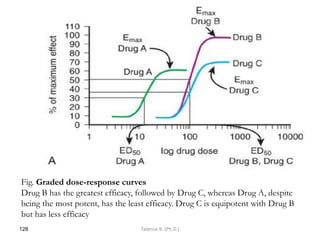
128
Fig. Graded dose-response curves
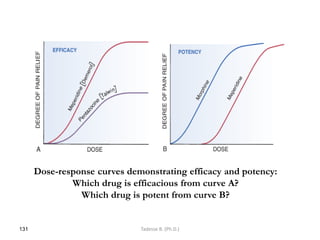
Drug B has the greatest efficacy, followed by Drug C, whereas Drug A, despite
being the most potent, has the least efficacy. Drug C is equipotent with Drug B
but has less efficacy
Tadesse B. (Ph.D.)
PD Process: Graded dose–response relations
• In selecting one of two drugs to administer to a patient, one must
make that selection based on the relative effectiveness rather
than the relative potency of the two drugs.
• However, pharmacologic potency is going to largely determine
the administered dose of the selected drug.
• In therapeutics, potency of a drug is usually stated in dosage
units with respect to a particular therapeutic end point
• Drug efficacy in a patient may be determined by:
– Mode of interactions of the drug with the receptor (as with
partial agonists)
– Characteristics of the receptor-effector system
– Therapeutic efficacy in a patient also depends on a host of
other factors
129 Tadesse B. (Ph.D.)
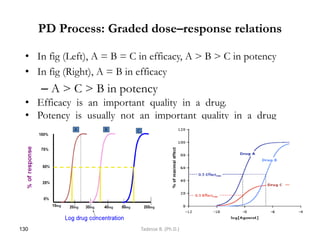
PD Process: Graded dose–response relations
• In fig (Left), A = B = C in efficacy, A > B > C in potency
• In fig (Right), A = B in efficacy
– A > C > B in potency
• Efficacy is an important quality in a drug.
• Potency is usually not an important quality in a drug
130 Tadesse B. (Ph.D.)
Dose-response curves demonstrating efficacy and potency:
Which drug is efficacious from curve A?
Which drug is potent from curve B?
131 Tadesse B. (Ph.D.)
PD processes: Relation between drug dose & clinical response…
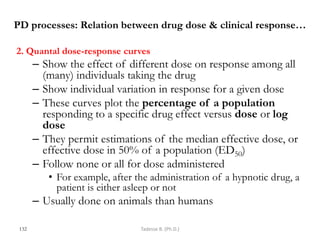
2. Quantal dose-response curves
– Show the effect of different dose on response among all
(many) individuals taking the drug
– Show individual variation in response for a given dose
– These curves plot the percentage of a population
responding to a specific drug effect versus dose or log
dose
– They permit estimations of the median effective dose, or
effective dose in 50% of a population (ED50)
– Follow none or all for dose administered
• For example, after the administration of a hypnotic drug, a
patient is either asleep or not
– Usually done on animals than humans
132 Tadesse B. (Ph.D.)
Quantal dose-response curves
133
Fig. Quantal dose-response curves
Tadesse B. (Ph.D.)
PD: Quantal dose-response curves
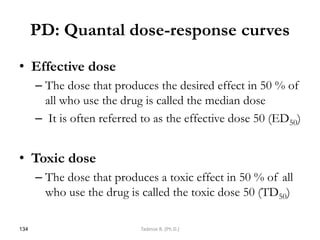
• Effective dose
– The dose that produces the desired effect in 50 % of
all who use the drug is called the median dose
– It is often referred to as the effective dose 50 (ED50)
• Toxic dose
– The dose that produces a toxic effect in 50 % of all
who use the drug is called the toxic dose 50 (TD50)
134 Tadesse B. (Ph.D.)
PD: Quantal dose-response curves
• Lethal dose or Toxic dose (LD50 or TD50)
– The dose that results in death in 50 percent of all who use the drug is
called the lethal dose 50 (LD50)
– This is an experimental term that can only be determined in animal
experiments and estimated in humans taking high doses in attempting
suicide
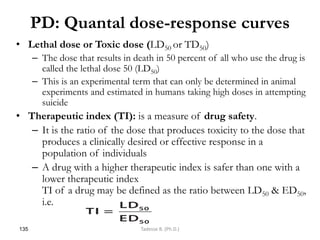
• Therapeutic index (TI): is a measure of drug safety.
– It is the ratio of the dose that produces toxicity to the dose that
produces a clinically desired or effective response in a
population of individuals
– A drug with a higher therapeutic index is safer than one with a
lower therapeutic index
TI of a drug may be defined as the ratio between LD50 & ED50,
i.e.
135 Tadesse B. (Ph.D.)
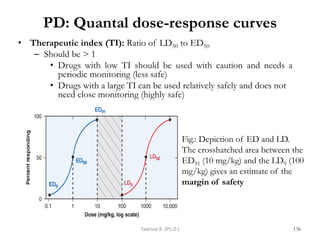
PD: Quantal dose-response curves
• Therapeutic index (TI): Ratio of LD50 to ED50
– Should be > 1
• Drugs with low TI should be used with caution and needs a
periodic monitoring (less safe)
• Drugs with a large TI can be used relatively safely and does not
need close monitoring (highly safe)
136
Fig.: Depiction of ED and LD.
The crosshatched area between the
ED91 (10 mg/kg) and the LD9 (100
mg/kg) gives an estimate of the
margin of safety
Tadesse B. (Ph.D.)
137
Therapeutic window (Therapeutic Range)
 Dosage range between the minimum effective therapeutic
concentration (MEC) and the minimum toxic concentration
(MTC)
 It is the range of plasma concentrations of a drug that will
elicit the desired response in a population of patients
Tadesse B. (Ph.D.)
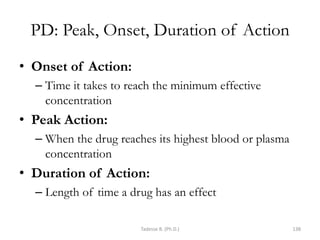
PD: Peak, Onset, Duration of Action
Tadesse B. (Ph.D.) 138
• Onset of Action:
– Time it takes to reach the minimum effective
concentration
• Peak Action:
– When the drug reaches its highest blood or plasma
concentration
• Duration of Action:
– Length of time a drug has an effect
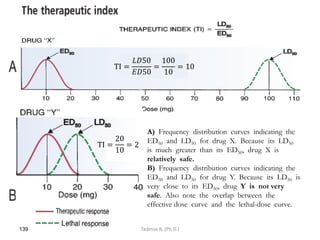
• A) Frequency distribution curves indicating the
ED50 and LD50 for drug X. Because its LD50
is much greater than its ED50, drug X is
relatively safe.
• B) Frequency distribution curves indicating the
ED50 and LD50 for drug Y. Because its LD50 is
very close to its ED50, drug Y is not very
safe. Also note the overlap between the
effective dose curve and the lethal-dose curve.
139 Tadesse B. (Ph.D.)
TI =
𝐿𝐷50
𝐸𝐷50
=
100
10
= 10
TI =
20
10
= 2
PD processes: Relation between drug dose & clinical response…
b) Variation in drug responsiveness
– There is a great deal of variability in the responsiveness
to a drug among individuals
• NB: Variation in drug responsiveness has also been
shown in a single individual at different times during
the course of Therapy by the same drug
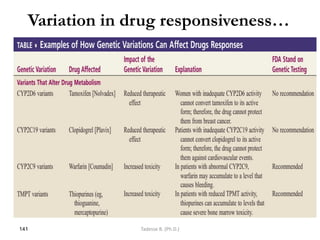
– Numerous factors affect drug responsiveness including
age, sex, body size, disease state, genetic factors, &
simultaneous administration of other drugs
140 Tadesse B. (Ph.D.)
Variation in drug responsiveness…
141 Tadesse B. (Ph.D.)
PD processes: Relation between drug dose & clinical response…
• 4 major mechanisms are known to contribute to variation in
drug responsiveness:
i. Alteration in drug concentration at the receptor site:
• Due to PK differences (in drug ADME) among patients,
which leads to variability in the clinical response
ii.Variation in concentration of an endogenous receptor
ligand:
– This particular management leads to a great deal of variability
in responses to drug antagonists & partial agonists
– E.g. the levels of endogenous catecholamines affect the
clinical response to the β-adrenoceptor antagonist propranolol
142 Tadesse B. (Ph.D.)
PD processes: Relation b/n drug dose & clinical response…
iii. Alterations in the number or function of receptors:
– An ↑ or ↓in the number of receptor sites or alterations
in the efficiency of the occupancy-response coupling can
cause variability in drug responsiveness
– Alteration in the number of receptor sites is sometimes
caused by other hormones
• E.g. thyroid hormones ↑ both the number of β-adrenoceptors
& cardiac sensitivity to catecholamines
iv. Changes in components of response distal to the receptor:
– Drug response in a patient depends not only on the
drug‘s ability to bind to the receptor, but also on:
• The functional integrity & efficiency of the biochemical
processes in the cell (occupancy-response coupling) &
• The physiologic regulation by interacting organ systems
143 Tadesse B. (Ph.D.)
PD processes: Relation b/n drug dose & clinical response…
• Changes in components of response distal to the receptor…
– Changes in these post-receptor events represent the
most important MZM that causes variation in
responsiveness to drug therapy
– Factors that influence these events include age &
general health of the patient &, most importantly, the
severity & pathophysiologic MZM of the disease
that is being treated
144 Tadesse B. (Ph.D.)
PD processes: Relation b/n drug dose & clinical response…
• Changes in components of response distal to the receptor…
– An unsatisfactory therapeutic response is sometimes attributed
to the physiologic compensatory MZMs that respond to &
oppose the effects of a drug (e.g., compensatory
vasoconstriction & fluid retention by the kidney can cause
tolerance to the antihypertensive effects of a vasodilator drug)
– In such cases, additional drugs may be required to treat the
patient
145 Tadesse B. (Ph.D.)
PD processes: Relation b/n drug dose & clinical response…
c) Clinical Selectivity: Beneficial (therapeutic) vs. Toxic
effects of drugs
– Clinical selectivity of a drug is determined by separating drug
effects into 2 categories:
• Beneficial/therapeutic effects Vs toxic effects
– 3 major mechanisms for mediating the beneficial & toxic
effects of drugs are known:
146 Tadesse B. (Ph.D.)
PD processes: Relation b/n drug dose & clinical response…
i. Therapeutic & toxic effects mediated by the same receptor-effector
management
– Much of the serious drug toxicity encountered clinically is
the result of a direct pharmacologic extension of the
therapeutic actions of the drug
– E.g., Hypotension caused by GTN therapy
– Hypoglycemia caused by insulin therapy
ii. Therapeutic & toxic effects mediated by identical receptors in different
tissues (or via different effector pathways)
– Many drugs exert both their therapeutic & toxic effects by
acting on a single receptor type in different tissues
– E.g., Digitalis glycosides, Methotrexate
iii. Therapeutic & toxic effects mediated by different types of receptors
147 Tadesse B. (Ph.D.)
Patient Case Scenario 1 Answer
• Gastric acid is required for the absorption of
oral iron salts.
• Concurrent ingestion of antacid tablets could
have interfered with iron absorption.
• Hence, the anaemia failed to improve
Tadesse B. (Ph.D.) 148
Patient Case Scenario 2: Answer
• a) Since the child is seriously ill, a fast and more predictable
action of the antibiotic is needed; a parenteral route of
administration is right.
• Moreover, oral dosing may be difficult in this case as the
child is dull and irritable.
• Entering a vein for IV injection is relatively difficult in
children, particularly in the presence of dehydration.
• Therefore, the antibiotic may be injected IM; however, if
IV line is set up for rehydration, the antibiotic may be
administered through the IV line.
• b) In this case the provisionally selected antibiotic may be
amoxicillin, which should be started as early as possible,
because the child is seriously ill. Waiting for the lab reports to
confirm the diagnosis/ select the definitive antibiotic may
compromise the prognosis.
Tadesse B. (Ph.D.) 149
Thank You
Tadesse B. (Ph.D.) 150

Chapter 1- MSC PKs & PDs -Ok11.pdf

  • 1.
    Clinical Pharmacology (Phar521) MScProgram By: Dr. Tadesse B. Course Credit: 3 Cr. Hrs (5 ECTS)
  • 2.
    Course Contents Contents forBoth MSc Program • Chapter 1: Introduction to pharmacology – General principles of pharmacology • Pharmacokinetics • Pharmacodynamics • Chapter 2: Drugs for Pre-existing medical conditions – Drugs Used in Chronic Conditions • Antiasthmatics drugs • Antidiabetic agents • Antihypertensive agents • Antiepileptic agents • Antiparkinson‘s agents – Drug Used in Mental Health Problems • Antianxiety drugs • Antipsychotic drugs • Antidepressant drugs • Chapter 3: Analgesics and Anesthetics – Analgesics – Local anesthetics • Chapter 4: Drugs used in disordered physiology – Drugs for management of coagulation disorders (Anticoagulant Therapy) Tadesse B. (Ph.D.) 2
  • 3.
    Course Contents Only forMaternity and Neonatal Health Program • Chapter 5: Drugs in pregnancy – Pharmacology of pregnancy – Nutritional supplements: Iron and folic acid – Laxatives – Antimicrobials – Cough or cold remedies – Drugs to reduce gastric acidity – Drugs used for Pain relief, headache, and fever – Agents used for treatment of Constipation, hemorrhoids, and diarrhea – Drugs used for management of allergic reactions – Drugs used to manage Insomnia – Drugs for the Management of Rhesus incompatibility • Group Assignment – Drugs given to stop premature labor – Immunization during pregnancy – Contraceptives – Other topics Tadesse B. (Ph.D.) 3
  • 4.
    Course Contents… • Chapter5: Adverse drug reactions and interactions – Introduction – Adverse drug reactions • Major groups of drugs involved in adverse drug reactions • Age-related adverse drug reactions – Drug-Drug and Drug-Food Interactions • Mechanisms of drug interactions • Clinical significance of drug interactions to the patient • Steps in minimizing the effects of adverse drug interactions • Chapter 6: Antimicrobials – Introduction – Antibacterial Agents – Antitubercular agents – Antifungal agents – Antiviral agents – Antiprotozoal agents – Interference with folate • Chapter 7: Anti-inflammatory drugs – Introduction – Non-steroidal anti-inflammatory drugs – Antirheumatoid drugs • Group Assignment – Patient concordance – Legal & Professional issues – Other topics Tadesse B. (Ph.D.) 4 For Adult Health Nursing & Pediatric & Child Health Nursing Program
  • 5.
    Tentative Schedule • Presentation: –Saturday, April 29, 2023 (Morning) • Mid-Exam: – Wednesday, May 3, 2023 (Morning/Afternoon) • Final Exam: – Thursday, May 11, 2023 (Afternoon) or – Saturday, May 13, 2023 (Morning) Tadesse B. (Ph.D.) 5
  • 6.
    References • Goodman andGilman‘s: The Pharmacological Basis of Therapeutics; 13th or latest ed. • Katzung B.G.: Basic and Clinical Pharmacology: 13th or latest edition. • Rang H.P. and Dale M.M.: Pharmacology; 7th or latest edition. • Charles R. Craig and Robert E. Stitzel: Modern Pharmacology with Clinical Applications; 5th or latest editions • Mycek M.J. and Harvey R.A. Lippincott‘s Illustrated Reviews: Pharmacology; 6th or latest edition 6 Tadesse B. (Ph.D.)
  • 7.
  • 8.
    Contents of Chapter1 • Pharmacodynamics and pharmacokinetics – Pharmacokinetics Process • Drug Absorption • Drug Distribution • Drug Biotransformation • Excretion of Drugs – Pharmacodynamics Process • Site & Mechanisms of Drug Action • Character of Receptors and Drugs • Drug-Receptor interactions • Dose-Response Relationship (ED50, LD50, Therapeutic Index, Potency, Maximum Efficacy) Tadesse B. (Ph.D.) 8
  • 9.
    Specific Objectives • Atthe end of the section, students will be able to: – Explain the applications of pharmacokinetics to clinical practice. – Identify the four primary processes of pharmacokinetics. – Explain mechanisms by which drugs cross plasma membranes. – Discuss factors affecting drug absorption. – Discuss how drugs are distributed throughout the body. – Describe how plasma proteins affect drug distribution. – Explain the metabolism of drugs and its applications to pharmacotherapy. – Identify major processes by which drugs are excreted. – Explain how enterohepatic recirculation affects drug activity. – Explain how a drug reaches and maintains its therapeutic range in the plasma. – Explain the applications of a drug plasma half-life (t1/2) to pharmacotherapy. Tadesse B. (Ph.D.) 9 General Objective: The aim of this chapter is to introduce the basic principles of pharmacology
  • 10.
    Brainstorming? • How canwe define pharmacology? • How can we define pharmacodynamics? • How can we define pharmacokinetics? Tadesse B. (Ph.D.) 10
  • 11.
    Introduction: Definition ofTerminologies  Pharmacology can be defined as: • The study of drugs and their action on living organisms. • The study of substances that interact with living systems through chemical processes (particularly by binding to regulatory molecules) & alter (activate or inhibit) biologic function or response o These substances may be chemicals (drugs) that are administered to a patient (humans) in order to achieve a beneficial therapeutic effect • It can also be defined as a branch of science concerned with the effects of drugs on living organisms (pharmacodynamics) and the effects of living organisms with drugs (pharmacokinetics). • It expresses drug composition & properties, interactions, toxicology, therapy, and medicinal uses such as application and antipathogenic capabilities. Tadesse B. (Ph.D.) 11
  • 12.
    Introduction: Definition ofTerminologies… • Pharmacogenetics: – It is the study of genetic influences on responses to drugs. • Pharmacogenomics: – It overlaps with pharmacogenetics, describing the use of genetic information to guide the choice of drug therapy on an individual basis. – The underlying assumption is that differences between individuals in their response to therapeutic drugs can be predicted from their genetic make-up. • Pharmacoepidemiology: – It is the study of drug effects at the population level. – It is concerned with the variability of drug effects between individuals in a population and between populations. • Pharmacoeconomics: – It is the branch of health economics that aims to quantify in economic terms the cost & benefit of drugs used therapeutically Tadesse B. (Ph.D.) 12
  • 13.
    Introduction: Definition ofTerminologies… • Toxicology: – It is the branch of pharmacology that deals with the undesirable effects of chemicals on living systems, from individual cells to humans to complex ecosystems • Xenobiotic: (xenos-―stranger‖) – Any substance/chemical that is foreign to the human body (not synthesized in the body) • Receptor: – The component of a cell or organism that interacts with a drug & initiates the chain of biochemical events leading to the drug’s observed effects. • Prodrug: – It is an ‗inactive’ form of a drug that requires metabolic activation inside the body (bioactivation) in order to release the ‗active’ form of the drug. – Once released in vivo, the active form of the drug will then exert its pharmacological effect Tadesse B. (Ph.D.) 13
  • 14.
    Introduction: Definition ofTerminologies… • Medical pharmacology: the science of substances used to prevent, diagnose, and treat disease. • Molecular pharmacology: deals with drug molecules and cell • Cardiovascular pharmacology: deals with heart, the vascular system • Endocrine pharmacology: deals with hormones or hormone derivatives Tadesse B. (Ph.D.) 14
  • 15.
    Introduction: Definition ofTerminologies… • Clinical pharmacology: – Can be defined as the study of drugs in humans. – Deals with the comparative clinical evaluations of new drug for developing its therapeutic efficacy and safety – Its objective is to optimize drug therapy and it is justified in so far as it is put to practical use • Clinical pharmacology provides the scientific basis for: – The general aspects of rational, safe and effective drug therapy – Drug therapy of individual diseases – The safe introduction of new medicines. • It also involves the complex interaction between the patient and the drug • It also provides the basis of good prescribing profile that involves tailoring the drug and dosing regimen to the unique patient. – It is the principles behind the prescribing process Tadesse B. (Ph.D.) 15
  • 16.
    Introduction: Definition ofTerminologies… • Side Effects: – Effects which are produced with therapeutic doses of the drug during the course of treatment, e.g. dryness of mouth with atropine, drowsiness with antihistamine. – Usually occurred with drugs that lacks specificity • Unwanted Effects: – Produced by therapeutic dose, severe form of which necessitate the cessation of treatment, e.g. vomiting and diarrhea with PABA • Toxic Effect: – The potential harmful effects of a drug in the living human body. – When the drug level exceeds the therapeutic range – May be acute or chronic, e.g. chlorpromazine induced cholestatic jaundice. • Supersensitivity or Intolerance: – It is a phenomenon, where some persons began to show responses, when the dose of the drug is very small in contrast to subjects requiring heavier doses for the response. – This people are said to have intolerance or are supersensitive to the particular drug. Tadesse B. (Ph.D.) 16
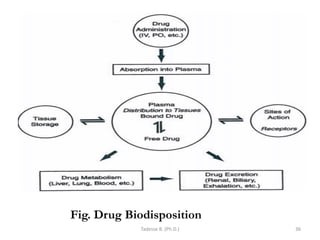
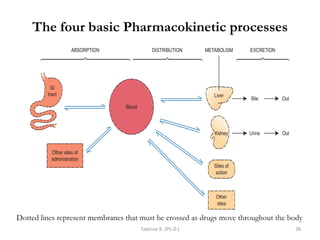
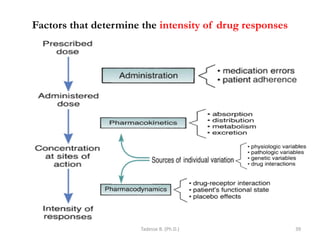
  • 17.
    Pharmacology Boundaries andIts Link with Other Biomedical Disciplines Tadesse B. (Ph.D.) 17
  • 18.
    Introduction… • Generally, Pharmacologyhas two major branches: 18 Tadesse B. (Ph.D.)
  • 19.
    Introduction… • Willingness tolearn the principles of pharmacology, and how to apply them in individual circumstances of infinite variety is vital to success without harm: to maximize benefit and minimize risk. – All of these issues are the concern of clinical pharmacology • Clinical pharmacology has been termed a bridging discipline because it combines elements of classical pharmacology with clinical medicine Tadesse B. (Ph.D.) 19
  • 20.
    Introduction… • Knowledge ofclinical pharmacology underpins decisions in therapeutics, which is concerned with the – Prevention, suppression or cure of disease • Pharmacology is the same science whether it investigates animals or humans. • The concomitant dangers of drugs (fetal deformities, adverse reactions, dependence) only add to the need for the systematic and ethical application of science to drug development, evaluation, and use – i.e. clinical pharmacology • Therapeutic success with drugs is becoming more and more dependent on the user understanding of both – Pharmacodynamics and pharmacokinetics Tadesse B. (Ph.D.) 20
  • 21.
    Introduction… • Clinical pharmacologybrings together clinical and scientific practice to support critical & independent appraisal of data pertaining to drugs and therapeutics, and the rational use of medicines. – It started in 1960‘s due the effect of thalidomide in the early 1960s – It is needed to address more systematically issues of • Efficacy, safety and rational use of medicines in humans becomes crucial along with drug action, receptors and laboratory experiments Tadesse B. (Ph.D.) 21
  • 22.
    Drug-Body Interactions • Theinteractions between a drug administered and the body are conveniently divided into two classes: –The Pharmacokinetic Processes & –The Pharmacodynamic Processes 22 Tadesse B. (Ph.D.)
  • 23.
    Drug-Body Interactions… • Pharmacodynamics(PDs): – Refers to the actions of the drug on the human body (What the drug does to the body) • Play the major role in deciding whether that class of drugs is effective therapy for a particular disease or symptom • Pharmacokinetics (PKs): – Refers to the actions of the human body on the drug (What the body does to the drug) – It is the study of Absorption, Distribution, Metabolism (Biotransformation) and Excretion (ADME) properties of the drug with respect to time • Great significance in the dose selection & administration of a particular drug for a particular patient 23 Tadesse B. (Ph.D.)
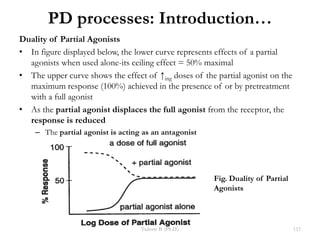
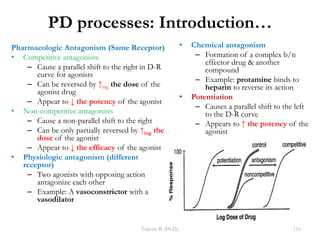
  • 24.
    Drug-Body Interactions… Tadesse B.(Ph.D.) 24 Figure: The relationship between dose and effect can be separated into pharmacokinetic (dose-concentration) and pharmacodynamic (concentration-effect) components.
  • 25.
    Drug-Body Interactions… Tadesse B.(Ph.D.) 25 Fig. The pharmacokinetic and pharmacodynamic processes
  • 26.
    Drug-Body Interactions… • Drugsact in various ways in the body. – Oral drugs go through three phases: • The Pharmaceutic Phase, • The Pharmacokinetic Phase, and • The Pharmacodynamic Phase – Liquid and parenteral drugs go through the later two phases only 26 Tadesse B. (Ph.D.)
  • 27.
  • 28.
    Drug-Body Interactions… • ThePharmaceutic Phase of drug action is the dissolution of the drug. – Drugs must be in solution to be absorbed. • Drugs that are liquid or drugs given by injection (parenteral drugs) do not go through the pharmaceutic phase. • A tablet or capsule (solid forms of a drug) goes through this phase as it disintegrates into small particles and dissolves into the body fluids within the gastrointestinal tract. • Tablets that are enteric-coated do not disintegrate until reaching the alkaline environment of the small intestine. 28 Tadesse B. (Ph.D.)
  • 29.
  • 30.
  • 31.
    Patient Case Scenario1 • A 60 year lady complained of weakness, lethargy and easy fatigability. • Investigation showed that she had iron deficiency anaemia (Hb 8g/dl). • She was prescribed capsule, ferrous fumarate 300 mg BID. She returned after one month with no improvement in symptoms. • Her Hb Level was unchanged. • On enquiry she revealed that she felt epigastric distress after taking the iron capsules, and had started taking antacid tablets along with the capsules. • What could be the possible reason for her failure to respond to the oral iron medication? Tadesse B. (Ph.D.) 31
  • 32.
    Pharmacokinetics Processes • Thegoal of drug therapeutics is to: – Achieve a desired beneficial effect with minimal adverse effects • So that it Prevent, cure, or control various disease states • To achieve this goal, adequate drug doses must be delivered to the target tissues so that therapeutic yet non-toxic levels are obtained. • Pharmacokinetics examines the movement of a drug over time through the body. 32 Tadesse B. (Ph.D.)
  • 33.
    Pharmacokinetics Processes… • Applicationsof pharmacokinetics studies include: o Bioavailability measurements o Effects of physiological and pathological conditions on drug disposition and absorption o Dosage adjustment of drugs in disease states o Correlation of responses with doses o Evaluation of drug interactions o To individualize the drug dosing regimen Tadesse B. (Ph.D.) 33
  • 34.
    Pharmacokinetics Processes… • Pharmacologicalas well as toxicological actions of drugs are primarily related to the plasma concentrations of drugs. • Thus, the clinician must recognize that the: – Speed of onset of drug action, – Intensity of the drug's effect, and – Duration of drug action • Controlled by Four Fundamental Pathways of drug movement and modification in the body 34 Tadesse B. (Ph.D.)
  • 35.
    Pharmacokinetics Processes… • TheFour Fundamental Pathways include: – Drug Absorption – Drug Distribution – Drug biotransformation (Metabolism) – Drug Excretion • These Pathways influences the clinician's decision of the – Route of administration for a specific drug, – Amount and frequency of each dose, and – Dosing intervals. 35 Tadesse B. (Ph.D.)
  • 36.
    Tadesse B. (Ph.D.)36 Fig. Drug Biodisposition
  • 37.
    Tadesse B. (Ph.D.)37 Fig. The four processes of pharmacokinetics: absorption, distribution, metabolism, and excretion
  • 38.
    The four basicPharmacokinetic processes Tadesse B. (Ph.D.) 38 Dotted lines represent membranes that must be crossed as drugs move throughout the body
  • 39.
    Factors that determinethe intensity of drug responses Tadesse B. (Ph.D.) 39
  • 40.
    Pharmacokinetics Processes… • The“standard” dose of a drug is based on trials in healthy volunteers and patients with average ability to absorb, distribute, and eliminate the drug – This dose will not be suitable for every patient. • Dosage adjustment in individual patients is important due to: – Physiologic processes (e.g., body size, maturation of organ function in infants) and – Pathologic processes (e.g., heart failure, renal failure). • These processes modify specific pharmacokinetic parameters. • The two basic pharmacokinetic parameters are: – Clearance: the measure of the ability of the body to eliminate the drug & – Volume of distribution: the measure of the apparent space in the body available to contain the drug Tadesse B. (Ph.D.) 40
  • 41.
    Pharmacokinetics Processes… • Volumeof distribution (Vd): relates the amount of drug in the body to the concentration of drug (C) in blood or plasma: • Drugs with very high Vd have much higher concentrations in extravascular tissue than in the vascular compartment, i.e., they are not homogeneously distributed. • Drugs that are completely retained within the vascular compartment, on the other hand, would have a minimum possible Vd equal to the blood component in which they are distributed – E.g. 0.04 L/kg body weight or 2.8 L/70 kg for a drug that is restricted to the plasma compartment Tadesse B. (Ph.D.) 41
  • 42.
    Pharmacokinetics Processes… Tadesse B.(Ph.D.) 42 Compartment & Volume Example of Drugs Water Total Body Water (0.6 L/Kg)1 Small water-soluble molecules, e.g. Ethanol Extracellular Water (0.2 L/Kg) Large water-soluble molecules, e.g. Gentamicin Plasma (0.04 L/Kg) Large Protein Molecules, e.g. antibodies Fat (0.2-0.35 L/Kg) Highly lipid-soluble molecules, e.g. Diazepam Bone (0.07 L/Kg) Certain ions, e.g. Lead, Fluoride 1An average figure. Total body water in a young lean person might be 0.7 L/kg; in an obese person, 0.5 L/kg Table: Physical volumes (in L/kg body weight) of some body compartments into which drugs may be distributed
  • 43.
    Pharmacokinetics Processes… • Clearanceof a drug (CL): is the factor that predicts the rate of elimination in relation to the drug concentration (C): – Clinically most important concept in PKs • Elimination of drug from the body may involve processes occurring in the kidney, the lung, the liver, and other organs. • Dividing the rate of elimination at each organ by the conc. of drug presented to it yields the respective clearance at that organ. Tadesse B. (Ph.D.) 43
  • 44.
    Pharmacokinetics Processes… • Totalsystemic clearance is the additive clearance from each organs: – ―Other‖ tissues of elimination could include the lungs and additional sites of metabolism, e.g., blood or muscle. • The kidneys & the liver: The two major sites of drug elimination – Clearance of unchanged drug in the urine represents renal clearance – Within the liver, drug elimination occurs via biotransformation of parent drug to one or more metabolites, or excretion of unchanged drug into the bile, or both. Tadesse B. (Ph.D.) 44
  • 45.
    Pharmacokinetics Processes… • Formost drugs, clearance is constant over the conc. range encountered in clinical settings, i.e., elimination is not saturable, and the rate of drug elimination is directly proportional to conc. – This is usually referred to as first-order elimination. • When clearance is first-order, it can be estimated by calculating the area under the curve (AUC) of the time-conc. profile after a dose. – Co-administration of ketoconazole or ritonavir with the hypnotic drug midazolam increases the midazolam plasma exposure (AUC – area under the curve) by 15–20 times, a situation which should be avoided • Clearance is calculated from the dose divided by the AUC. • Note that this is a convenient form of calculation—not the definition of clearance Tadesse B. (Ph.D.) 45
  • 46.
    Tadesse B. (Ph.D.)46 Fig. The time course of drug accumulation and elimination. Solid line: Plasma concentrations reflecting drug accumulation during a constant-rate infusion of a drug. Fifty percent of the steady-state conc. is reached after one half- life, 75% after two half-lives, and over 90% after four half-lives. Dashed line: Plasma concentrations reflecting drug elimination after a constant-rate infusion of a drug had reached steady state. Fifty percent of the drug is lost after one half- life, 75% after two half-lives, etc. Pharmacokinetics Processes…
  • 47.
    Pharmacokinetics Processes… Tadesse B.(Ph.D.) 47 Fig. A. Temporal characteristics of drug effect and relationship to the therapeutic window (e.g., single dose, oral administration) B. Effects of altered absorption, elimination, and dosage and the temporal profile of a single dose administered orally.
  • 48.
    Pharmacokinetics Processes… • DrugEliminations can be: • A. Capacity-Limited Elimination – For drugs that exhibit capacity-limited elimination (e.g., phenytoin, ethanol), clearance will vary depending on the conc. of drug that is achieved – It is also known as mixed-order, saturable, dose- or conc.- dependent, nonlinear, and Michaelis-Menten elimination • B. Flow-Dependent Elimination – In contrast to capacity-limited drug elimination, some drugs are cleared very readily by the organ of elimination, • Most of the drug in the blood perfusing the organ is eliminated on the first pass of the drug through it. • The elimination of these drugs will thus depend primarily on the rate of drug delivery to the organ of elimination. – Such drugs can be called ―high-extraction‖ drugs since they are almost completely extracted from the blood by the organ. Tadesse B. (Ph.D.) 48
  • 49.
    Pharmacokinetics Processes… Clinical Estimationof Renal Function • In routine clinical practice, it is not practical to collect the urine samples that are needed to measure creatinine clearance directly. • However, creatinine clearance in adult patients can be estimated either from a standard nomogram or from equations such as that proposed by Cockcroft and Gault. • For men, creatinine clearance (CLCR) can be estimated as follows: – Provides an estimate of the creatinine formation rate in an individual patient. • For women, this estimate should be reduced by 15%. Tadesse B. (Ph.D.) 49
  • 50.
    Pharmacokinetics Processes… Tadesse B.(Ph.D.) 50 Table: Rapidly metabolized drugs whose hepatic clearance is blood flow-limited
  • 51.
    PK process: Half-Life(t1/2) • Another pharmacokinetic component is the half-life of the drug. – Half-life is a measure of the rate at which drugs are removed from the body – It is the time required to change the amount of the drug in the body by half during elimination (or during a constant infusion) • The time course of drug in the body will depend on both the volume of distribution and the clearance: • Half-life is useful because it indicates the time required to attain 50% of steady-state or to decay 50% from steady-state conditions-after a change in the rate of drug administration 51 Tadesse B. (Ph.D.) 𝑡1/2 = 0.693 𝑥 𝑉𝑑 𝐶𝐿
  • 52.
    PK Principles: Bioavailability(F) • Bioavailability: the fraction of unchanged drug that reaches the systemic circulation following administration by any route • It is expressed as the fraction of administered drug that gains access to the systemic circulation in a chemically unchanged form. – For an IV dose of the drug, bioavailability is assumed to be equal to unity (F=1) – For a drug administered orally, bioavailability may be <100% for two main reasons: • Incomplete extent of absorption across the gut wall – Only 70% of a dose of digoxin reaches the systemic circulation (due to lack of absorption from the gut) – Too hydrophilic (e.g., atenolol) or too lipophilic (e.g., acyclovir) to be absorbed easily (their low bioavailability is also due to incomplete absorption) • First-pass elimination by the liver 52 Tadesse B. (Ph.D.)
  • 53.
    Pharmacokinetics Processes… Table: Routesof administration, bioavailability, and general characteristics Tadesse B. (Ph.D.) 53 Route Bioavailability (%) Characteristics Intravenous (IV) 100 (by definition) Most rapid onset Intramuscular (IM) 75 to ≤100 Large volumes often feasible; may be painful Subcutaneous (SC) 75 to ≤100 Smaller volumes than IM; may be painful Oral (PO) 5 to <100 Most convenient; first-pass effect may be important Rectal (PR) 30 to <100 Less first-pass effect than oral Inhalation 5 to <100 Often very rapid onset Transdermal 80 to ≤100 Usually very slow absorption
  • 54.
    PK Principles: Bioavailability(F)… • Factors that influence bioavailability: – The extent of absorption may be reduced because of: • First-pass hepatic metabolism (First-pass effect) • Chemical instability oUndergoes destruction at its site of administration • Nature of the drug formulation oA drug is incompletely released from its Drug Formulation • Physicochemical properties such as insolubility that prevent complete absorption from its site of administration 54 Tadesse B. (Ph.D.)
  • 55.
  • 56.
    PK Principles… • Bioequivalence –Two related drugs are bioequivalent if they show comparable bioavailability and similar times to achieve peak blood conc. – Two related drugs with a significant difference in bioavailability are said to be bioinequivalent. • Therapeutic equivalence – Two similar drugs are therapeutically equivalent if they have comparable efficacy and safety. – Note: Clinical effectiveness often depends on both the maximum serum drug concentrations and on the time required (after administration) to reach peak conc. • Therefore, two drugs that are bioequivalent may not be therapeutically equivalent 56 Tadesse B. (Ph.D.)
  • 57.
    i. PK Processes:Drug Absorption • Absorption: the process by which unchanged drug proceeds from the site of administration to the site of measurement (blood/circulating body fluids) within the body • The rate of absorption determines how soon effects will begin & depends on the route of administration • The amount of absorption helps to determine how intense effects will be • Drugs can be absorbed from GIT (oral, buccal, sublingual or rectally), mucous membranes, skin, lungs, muscle or subcutaneous (SC) tissues • In order for a drug to be absorbed, it must pass through cell membranes 57 Tadesse B. (Ph.D.)
  • 58.
    • Movement ofa drug from its site of administration • Affected by – Physicochemical properties – P-gp (permeability glycoprotein) – Metabolism – Dosage form – Site of administration • Affect clinical effectiveness of a drug i. PK Processes: Drug Absorption… Tadesse B. (Ph.D.) 58
  • 59.
    PK Processes: DrugAbsorption… • The rate and efficiency of drug absorption depend on the route of administration. • The route of administration is determined primarily by the – Properties of the drug (e.g., water or lipid solubility, ionization, etc.) and – Therapeutic objectives (e.g., the desirability of a rapid onset of action or the need for long-term administration or restriction to a local site). • There are two major routes of drug administration: – Enteral (oral & Sublingual) and parenteral. • The three major parenteral routes are intravascular (intravenous or intra-arterial), intramuscular, and subcutaneous. 59 Tadesse B. (Ph.D.)
  • 60.
    PK Processes: DrugAbsorption… • For IV delivery, for example, drug absorption is complete; that is, the total dose of drug reaches the systemic circulation. • Drug delivery by other routes may result in only partial absorption and, thus, lower bioavailability. • Enteric coating of a drug protects it from the acidic environment; the coating may prevent gastric irritation, and depending on the formulation, the release of the drug may be prolonged, producing a sustained-release effect 60 Tadesse B. (Ph.D.)
  • 61.
  • 62.
    Patient Case Scenario2 • A 4 year old child is brought to the hospital with the complaint of fever, cough, difficulty in breathing and chest pain. • On examination he is found to be dull, but irritable with fast pulse (118/min), rapid breathing (RR 55/min) and in drawing of lower chest during inspiration, wheezing, crepitations and mild dehydration. • Body temperature is 400C (1040F). The physician makes a provisional diagnosis of acute pneumonia and orders relevant haematological as well as bacteriological investigations. He decides to introduce antibiotic therapy. • a) In case he selects an antibiotic which can be given orally as well as by IM or IV injection, which route of admin. will be most appropriate in this case? • b) Should the pediatrician administer the antibiotic straight away or should he wait for the laboratory reports? Tadesse B. (Ph.D.) 62
  • 63.
    PK Processes: DrugAbsorption… • Drugs can be absorbed by one or combination of the following transport systems • Transport Across Cell Membranes – Every PK parameters involve the penetration of drug across cell membrane – Transport Mechanisms across cell membrane are: • Passive transport • Active transport • Endocytosis and • Exocytosis 63 Tadesse B. (Ph.D.)
  • 64.
    PK Processes: DrugAbsorption… • Endocytosis and exocytosis: – This type of drug delivery transports drugs of exceptionally large size across the cell membrane. • Endocytosis involves engulfment of a drug molecule by the cell membrane & transport into the cell by pinching off the drug-filled vesicle. – E.g., Vitamin B12 is transported across the gut wall by endocytosis. • Exocytosis is the reverse of endocytosis and is used by cells to secrete many substances by a similar vesicle formation process. – E.g. Certain neurotransmitters (e.g., norepinephrine) are stored in membrane-bound vesicles in the nerve terminal & are released by exocytosis. 64 Tadesse B. (Ph.D.)
  • 65.
    Drugs move acrossmembrane and cellular barriers in a variety of ways 65 Tadesse B. (Ph.D.)
  • 66.
    PK Processes: DrugAbsorption… • Transport of drugs across cell membrane depend on: – Size, degree of ionization, shape, lipid solubility • Since most drugs are weak acids or weak bases their concentration of ionized & unionized state depend on: – pH of media – pKa of the drug 66 Tadesse B. (Ph.D.)
  • 67.
    PK Processes: DrugAbsorption… Effect of pH on drug absorption • Most drugs are either weak acids or weak bases. • Acidic drugs (HA) release an H+ causing a charged anion (A-) to form: • Weak bases (BH+) can also release an H+. However, the protonated form of basic drugs is usually charged, and loss of a proton produces the uncharged base (B): • A drug passes through membranes more readily if it is uncharged 67 Tadesse B. (Ph.D.)
  • 68.
    PK Processes: DrugAbsorption… • The higher pH facilitates dissociation; the lower pH reduces dissociation. • The uncharged form, HA, equilibrates across the membrane. 68 Tadesse B. (Ph.D.)  The effective conc. of the permeable form of each drug at its absorption site is determined by the relative conc. of the charged & uncharged forms. o The ratio between the two forms is, in turn, determined by the pH at the site of absorption & by the strength of the weak acid or base, which is represented by the pKa
  • 69.
    PK Processes: DrugAbsorption… Sites of Absorption • About 80% of drugs are taken orally, therefore, GIT is the main site of drug absorption • In addition, drug can be introduced into the systemic circulation through intramuscular or subcutaneous site skin and respiratory tract Tadesse B. (Ph.D.) 69
  • 70.
    PK Processes: DrugAbsorption… • Factors Affecting Drug Absorption  Route of administration*  Dosage forms • Particle size • Disintegration rate and dissolution rate • Formulation: type & amount of additives – Diluents: Lactose, sucrose, starch, calcium phosphate  Physicochemical properties of the drug • Physical state • Lipid or water solubility • Ionization: Weak acid/bases, organic  Circulation at the site of absorption  Concentration of the drug  Surface area of absorption site  Blood flow to the absorption site  Total surface area available for absorption  Contact time at the absorption surface 70 Tadesse B. (Ph.D.) The rate at which a drug undergoes absorption is influenced by the physical and chemical properties of the drug itself and by physiologic and anatomic factors at the absorption site.
  • 71.
    Factors affecting drugabsorption… • Physiological factors – Gastrointestinal transit time/emptying time – Empty stomach or with food – TTC, Erythromycin vs. griseofulvin, propranolol – Salicylates & iron preparations – With food – Shorten intestinal transit time (diarrhea) – Gastric acid is required for the absorption – Oral iron salts – Presence of other agents: • Vitamin C (Vs iron), Calcium (Vs TTC) – Area of the absorbing surface and local circulation – Enterohepatic recirculation: • Phenolphthalein, mefloquine – Metabolism/first pass Effect: • Enzyme, p-glycoprotein, liver – Disease states: Malabsorption syndrome Tadesse B. (Ph.D.) 71
  • 72.
    Factors affecting drugabsorption… Sex Differences In Pharmacokinetics: Drug Absorption • The factors influencing absorption are route-specific and may also be sex-specific. • Chemicals or drugs cross body surfaces such as the GIT, respiratory tract, or skin (different in males and females) to enter the systemic circulation. • The absorption rate and extent of a drug are drug-specific. – Examples of drugs that illustrate sex differences in drug absorption include rifampicin and IM cephradine. – Cephradine has a slower rate of IM absorption and lesser bioavailability in females • It has been hypothesized that women, by virtue of having greater subcutaneous lipid content, receive different doses of transdermally administered drugs. • Women may also take in less of inhaled aerosol drugs such as ribavirin and cyclosporine Tadesse B. (Ph.D.) 72
  • 73.
    PK parameters thatexhibit sex differences for selected drugs Tadesse B. (Ph.D.) 73
  • 74.
    Drug Approval DuringPregnancy Tadesse B. (Ph.D.) 74 • FDA developed a classification system related to the effects of drugs on unborn child (fetus) • Pregnancy categories are indicated for most drug: • Category A: No risk to the fetus based on studies – Medications in this class are considered safe to use – E.g.: Vitamins, levothyroxine, saline nasal spray • Category B: Little to no risk based on animal studies, but no controlled studies in pregnant women – Medications in this class are generally considered safe to use – E.g. amoxicillin, cephalosporins, diphenhydramine, metformin, lispro or regular insulin, ibuprofen, paracetamol, etc. • Category C: Risk indicated on the fetus based on animal studies – Drugs from this class can be given to pregnant women if the benefit to the mother overweighs the risk to the fetus – E.g. Diltiazem, spironolactone, Bactrim, fluoroquinolones, ethosuximide, gabapentin, dextromethorphan, phenylephrine, glyburide (and most sulphonylureas), thiazolidinedione's, glargine & detemir insulin, aspirin, morphine, tramadol, • Category D: Risk to the fetus proved. – E.g. Valproic acid, lorazepam, carbamazepine, morphine (if prolonged use) • Category X: Risk proved; hence, avoid during pregnancy. It brings teratogenic effects – E.g. Thalidomide, warfarin, ergotamine (sympatholytic)
  • 75.
    ii) PK Processes:Drug Distribution • Following absorption or systemic administration into the bloodstream, a drug distributes into interstitial & intracellular fluids • Drug distribution is the process of reversible transfer of a drug to & from the blood and various tissues of the body (E.g.: fat, muscle, and brain tissue) and the relative proportions of drug in the tissues. • Drug is transported from the site of absorption to the site of action • This process reflects a number of physiological factors & the particular physicochemical properties of the individual drug – Factors that affect the rate of delivery & potential amount of drug distributed into tissues • Cardiac output, regional blood flow, tissue volume, & capillary permeability 75 Tadesse B. (Ph.D.)
  • 76.
    PK processes: DrugDistribution … • With exceptions such as the brain, diffusion of drug into the interstitial fluid occurs rapidly because of the highly permeable nature of the capillary endothelium – Thus, tissue distribution is determined by: • The partitioning of drug b/n blood & the particular tissue oLipid solubility & transmembrane pH gradients are important determinants of such uptake for drugs that are either weak acids or bases • The more important determinant of blood-tissue partitioning: – The relative binding of drug to plasma proteins (PPB) & tissue macromolecules that limits the concentration of free drug Tadesse B. (Ph.D.) 76
  • 77.
    I. Plasma ProteinBinding (PPB) – Drug in systemic circulation exist as bound & unbound form – Many drugs circulate in the bloodstream bound to plasma proteins. • Albumin is a major carrier for acidic drugs; • α1-acid glycoprotein binds basic drugs such as propranolol. • Nonspecific binding to other plasma proteins generally occurs to a much smaller extent. – Albumin, α1-acid glycoprotein, etc. are the major binding macromolecules. – The binding is usually reversible & in dynamic equilibrium D + P →[DP] → D + P – As free drugs leave the systemic circulation, the bound drug dissociate 77 PK processes: Drug Distribution… Tadesse B. (Ph.D.)
  • 78.
    • Plasma proteinbinding… – The fraction of total drug in plasma that is bound is determined by: • The drug concentration • The affinity of binding sites for the drug • The number of binding sites – The extent of this binding will influence the drug’s distribution & rate of elimination because only the unbound drug can: • Diffuse through capillary beds & cell membrane (↓Vd) • Produce therapeutic or toxic effect • Be metabolized or excreted 78 PK processes: Drug Distribution… Tadesse B. (Ph.D.)
  • 79.
    PK processes: DrugDistribution…  Plasma protein binding… a) Albumin:  Some factor affect the binding of drugs with albumin: o Age o Pregnancy o Disease state: Hyperalbuminemia, Hypoalbuminemia, Liver disease, etc. b) α1–acid glycoprotein  Serum plasma level increases in situation such as: o Stress, injury, trauma, rheumatoid arthritis, surgery 79 Tadesse B. (Ph.D.)
  • 80.
    PK processes: DrugDistribution… Compound Description Testosterone Plasma protein binding: F > M, Estrogen increases Chlordiazepoxide Plasma protein binding: M > F > Foc Diazepam Free fraction: Foc (1.99%) > F (1.67%) > M (1.46%) Lidocaine Free fraction: F (34%). M (32%) < Foc (37%) Warfarin Free fraction: F > M Morphine, Phenytoin Oxazepam, Lorazepam No differences Tadesse B. (Ph.D.) 80 Sex Differences in plasma protein binding OC- Oral Contraceptives
  • 81.
    PK processes: DrugDistribution… II. Tissue uptake:  Drugs will not always be uniformly distributed to & retained by body tissues; o Some drug will be either considerably higher or lower in particular tissues: due to tissue different affinity  E.g. Adipose tissue o Fat as a reservoir: drugs with extreme lipid solubility are stored  May result in ↓ therapeutic activity ( e.g. thiopental), prolonged activity & toxicity ( e.g. DDT) 81 Tadesse B. (Ph.D.)
  • 82.
    PK processes: DrugDistribution… • Bone: – The Tetracycline antibiotics (& other divalent metal-ion chelating agents) & heavy metals may accumulate in bone by adsorption onto the bone crystal surface & eventual incorporation into the crystal lattice – Bone can become a reservoir for the slow release of toxic agents such as lead or radium into the blood • Their effects thus can persist long after exposure has ceased 82 Tadesse B. (Ph.D.)
  • 83.
    PK processes: DrugDistribution… III. Specialized physiological barrier: a) Blood-Brain Barrier (BBB) • Transfer of drug to brain is regulated by BBB • Inflammation such as due to meningitis or encephalitis ↑ the permeability of BBB so permeating the passage of ionized, lipid soluble drugs • E.g.:- penicillin G: not cross BBB but inflammation–can pass BBB --used for antibiotic effect centrally b) Placental-Blood Barrier (PBB) • Blood vessel of mother & fetus separated by PBB • Highly polar & ionized drugs do not cross placenta readily • Drugs which cross PBB may cause fetal abnormalities called teratogenic effects 83 Tadesse B. (Ph.D.)
  • 84.
    PK processes: DrugDistribution… IV. Tissue perfusion: – Different tissue have different rate & amount of blood flow • Highly perfused tissue:- heart, lung, brain, liver, kidney • Intermediate perfused tissue:- skeletal muscle • Poorly perfused tissue:- skin, bone, nail, fat tissue 84 Tadesse B. (Ph.D.)
  • 85.
    PK processes: DrugDistribution…  Volume of distribution (Vd):  It is the measure of the apparent space in the body available to contain the drug  Relates drug concentration in the plasma to total drug in the body  Gives rough estimation of overall distribution of a drug in the body  Vd = Amount of drug in body Amount of drug in blood  Having high Vd – high distribution  Vd have inverse relationship with PPB  ↑PPB ----- ↓VD (mainly found in plasma) 85 Tadesse B. (Ph.D.)
  • 86.
    iii) PK processes:Drug Metabolism/Biotransformation  What is Biotransformation?  A chemical change (transformation) of drugs by body enzyme  Why Biotransformation?  To facilitate excretion of drugs by changing to more water soluble form  Lipophilic → → hydrophilic  NB: Elimination is the irreversible loss of drug from the site of measurement  Elimination occur by 2 process: excretion & metabolism 86 Tadesse B. (Ph.D.)
  • 87.
    PK processes: DrugMetabolism/Biotransformation…  Where Biotransformation?  Metabolism of drug occur in all body parts  Lung, GI, kidney, liver, blood….  But mainly take place in liver ; because it contain large amount of metabolizing enzyme  How Biotransformation?  Drug metabolism may be a Detoxification process or Bioactivation process leading to varied consequences  The detoxification reactions can be divided into two broad categories in the liver  Phase I reactions (functionalization) and  Phase II reactions (conjugation)  The reactions may occur (i) sequentially, (ii) independently, or (iii) simultaneously 87 Tadesse B. (Ph.D.)
  • 88.
    PK processes: DrugMetabolism/Biotransformation… 88 Tadesse B. (Ph.D.)
  • 89.
    • Phase Ireactions  Generally make the drug molecule more polar & water soluble so that it is prone to elimination by the kidney  Phase I modifications include oxidation, hydrolysis, & reduction  Mainly involve cytochrome P-450 enzyme  Cyp-450 enzyme have different families & sub families  Most common are: CYP 3A4, CYP2D6, CYP2C9, CYP2C19, CYP1A2, CYP2E1 (90% or more of drug oxidation can be attributed to 6 main enzymes)  Enzyme induction: o ↑synthesis of microsomal enzyme --↑metabolism --- ↑Clearance  Enzyme inhibitor: o ↓liver enzyme function ---- ↓metabolism --- ↓clearance----Toxicity 89 PK processes: Drug Metabolism/Biotransformation… Tadesse B. (Ph.D.)
  • 90.
    PK processes: Drug Metabolism/Biotransformation… •Sex differences in pharmacokinetics: biotransformation Physiological parameters which may influence differences in metabolism Tadesse B. (Ph.D.) 90
  • 91.
    PK processes: DrugMetabolism/Biotransformation… Tadesse B. (Ph.D.) 91 Sex differences in hepatic clearance by route of metabolism/elimination
  • 92.
    PK processes: DrugMetabolism/ Biotransformation…  Phase II reactions: – Phase II reactions involve conjugation to form glucuronides, acetates, or sulfates – These reactions generally inactivate the pharmacologic activity of the drug & may make it more prone to elimination by the kidney 92 Tadesse B. (Ph.D.)
  • 93.
    PK processes: DrugMetabolism/Biotransformation… Tadesse B. (Ph.D.) 93 Sex differences in hepatic clearance by route of metabolism/elimination
  • 94.
    PK processes: DrugMetabolism/ Biotransformation… 94 Tadesse B. (Ph.D.)
  • 95.
    PK processes: DrugMetabolism/ Biotransformation…  Consequence of Biotransformation …  Inactivation of parent drug  Conversion of drug to its toxic metabolite  Conversion of prodrug to active drug  Maintenance of activity 95 Tadesse B. (Ph.D.)
  • 96.
    Table. Sources ofVariation in Intrinsic Clearance Genetic factors Genetic differences within population Racial differences among different populations Environmental factors & drug interactions Enzyme induction Enzyme inhibition Physiologic conditions Age Gender Diet/nutrition Pathophysiology Drug dosage regimen Route of drug administration Dose dependent (nonlinear) pharmacokinetics PK process: Drug Metabolism/ Biotransformation… 96 Tadesse B. (Ph.D.)
  • 97.
    97 Table. Examples ofDrug Interactions Affecting CYP450 Enzymes Inhibitors of Drug Metabolism Example Result Acetaminophen Ethanol ↑ed hepatotoxicity in chronic alcoholics Cimetidine Warfarin Prolongation of PT Erythromycin Carbamazepine ↓ed carbazepine clearance Fluoxetine Imipramine ↓ed clearance of Imipramine Fluoxetine Desipramine ↓ed clearance of Desipramine Inducers of Drug Metabolism Example Result Carbamazepine Acetaminophen ↑ed acetaminophen metabolism Rifampin Methadone ↑ed methadone metabolism, may precipitate opiate withdrawal Phenobarbital Dexamethasone ↓ed dexamethasone elimination half-life Rifampin Prednisolone ↑ed elimination of prednisolone PK process: Drug Metabolism/ Biotransformation… Tadesse B. (Ph.D.)
  • 98.
    iv) PK process:Drug Excretion 98 Tadesse B. (Ph.D.)
  • 99.
    iv) PK process:Drug Excretion … • Excretion is a process of drug transfer from the internal to the external environment • Drugs are eliminated from the body either unchanged by the process of excretion or converted to metabolites • Excretory organs, the lung excluded, eliminate polar compounds more efficiently than substances with high lipid solubility • Lipid-soluble drugs are not readily eliminated until they are metabolized to more polar compounds • Where…? – Kidney, biliary system, sweat, saliva, milk, lung 99 Tadesse B. (Ph.D.)
  • 100.
    iv) PK process:Drug Excretion … • Physiological parameters which may influence differences in excretion Tadesse B. (Ph.D.) 100 Sex differences in pharmacokinetics: elimination
  • 101.
    iv) PK process:Drug Excretion … Elimination: • The major mode of drug elimination are: – Biotransformation to inactive metabolites – Excretion via kidney or via other modes including the bile duct, lungs, & sweat • There are two rate of elimination: – Zero-order and First-order elimination Zero-order Elimination Rate • A constant amount of drug is eliminated per unit time • E.g. if 80 mg is administered & 10 mg is eliminated every 4h, the time course of drug elimination is: Tadesse B. (Ph.D.) 101
  • 102.
    iv) PK process:Drug Excretion … Zero-order Elimination Rate… • Rate of elimination is independent of plasma conc. • Drugs with zero-order elimination have no fixed half-life (t1/2 is variable) • Drugs with zero-order elimination include ethanol (except low blood levels), phenytoin (high therapeutic doses) & salicylates (toxic doses) Tadesse B. (Ph.D.) 102 Fig. Plot of zero-order kinetics
  • 103.
    iv) PK process:Drug Excretion … First-order Elimination Rate • A constant fraction of the drug is eliminated per unit time (t1/2 is constant) • Graphically, a first-order elimination follows an exponential decay versus time • E.g. if 80 mg of a drug is administered & elimination half-life is 4 h, the time course of its elimination is: Tadesse B. (Ph.D.) 103
  • 104.
    iv) PK process:Drug Excretion … First-order Elimination Rate… • Rate of elimination is directly proportional to plasma level (the amount present) – i.e. the higher the amount, the more rapid the elimination • Most drugs follow first-order elimination rates • t1/2 is inversely related to the elimination constant (k): 𝑡1/2 = 0.693 𝑘 Tadesse B. (Ph.D.) 104 Fig. Plot of first-order kinetics
  • 105.
    iv) PK process:Drug Excretion … First-order Elimination Rate… • Example of a graphic analysis of t1/2: Tadesse B. (Ph.D.) 105 Fig. Plasma decay curve- First-order Elimination
  • 106.
    iv) PK process:Drug Excretion … Example: • (1) If we consider that at 0 hour the drug was 1000 mg in the body and it followed 1st order kinetics and a constant fraction of 10% is filtered(and hence excreted) out by the kidneys per hour. (A) Calculate the amount at the end of first hour. • The amount of the drug in the body would be – 1000 – (1000 × 10/100) = 1000 – 100 = 900 mg. • (B) Calculate the amount at the end of 2nd, 3rd and 4th hour. • The amount of drug still remaining in the body would be – 900 – (900 × 10/100) = 900 – 90 = 810 mg – 810 – ( 810 × 10/100) = 810 – 81 = 729 mg – 729 – ( 729 × 10/100) = 729 – 72.9 = 656.1 mg and so forth. • (2) If we followed of zero order kinetics, the quantity moving was a fixed amount. To continue with the previous example, let the quantity of the drug in the body was 1000 mg and its excretion followed zero order kinetics and a fixed quantity, i.e. 10 mg is passed out every hour then at the end of 1st , 2nd , 3rd , and 4th hour the body would contain. – 1000 – 10 = 990 mg – 990 – 10 = 980 mg – 980 – 10 = 970 mg – 970 – 10 = 960 mg and so on. • Unlike the first order kinetics, the amount excreted remains a fixed 10 mg/hr. Tadesse B. (Ph.D.) 106
  • 107.
    Important PKs Calculations TadesseB. (Ph.D.) 107 • The following six relationships are important for calculations: C0: Conc. at time zero; Cl: Clearance, Css: Steady-state conc.; K: elimination constant; Ko: Infusion rate; LD: Loading dose; MD: Maintenance dose; Vd: Volume of distribution; D: Dose; Ꞇ: Dosing interval
  • 108.
    Some drugs thatshow Sex Differences in Pharmacokinetic Tadesse B. (Ph.D.) 108
  • 109.
  • 110.
    Contents • Pharmacodynamics Processes –Site & Mechanisms of Drug Action – Character of Receptors and Drugs – Drug-Receptor interactions – Dose-Response Relationship (ED50, LD50, Therapeutic Index, Potency, Maximum Efficacy) 110 Tadesse B. (Ph.D.)
  • 111.
    Drug-body interactions… • Theinteractions b/n a drug and the body are conveniently divided into 2 classes – Pharmacokinetic Processes – Pharmacodynamic (PD) processes: • The actions of the drug on the body • These properties determine the group in which the drug is classified & they play the major role in deciding whether that group is appropriate therapy for a particular symptom or disease Tadesse B. (Ph.D.) 111
  • 112.
    PD: Introduction A. Introduction –There are 4 principle protein targets with which drugs can interact: • Enzymes (e.g. neostigmine & acetyl cholinesterase) • Membrane carriers (e.g. TCAs & catecholamine uptake-1) • Ion channels (e.g. nimodipine & voltage-gated Ca2+ channels) • Receptors  Receptors  They are specialized target macromolecules  Most of them are proteins  Present either on the cell surface or intracellularly  They are selective  Most drugs exert their effects, both beneficial & harmful, by interacting with receptors  Function – Recognize specific ligand molecule – Transduce the signal into response Tadesse B. (Ph.D.) 112
  • 113.
    PD processes: Introduction… •Ligand: Anything that binds to a receptor – Agonist: Activate the receptor to bring effect – Antagonist: Prevent binding by other molecules • Competitive, non- competitive and Irreversible – Partial agonist: Activate receptors but give less response • Partial agonists exhibit low ‗Intrinsic Efficacy – Inverse agonist: Produces effect opposite to that of agonist 113 Tadesse B. (Ph.D.)
  • 114.
    PD processes: Introduction… Fulland Partial Agonists • Full agonists produce a maximum response • Partial agonists are incapable of eliciting a maximum response and less effective than full agonists Tadesse B. (Ph.D.) 114 Fig. Efficacy and potency of full & partial agonists In the fig., drug B is a full agonist & drug A & C are partial agonists
  • 115.
    PD processes: Introduction… TadesseB. (Ph.D.) 115 Duality of Partial Agonists • In figure displayed below, the lower curve represents effects of a partial agonists when used alone-its ceiling effect = 50% maximal • The upper curve shows the effect of ↑ing doses of the partial agonist on the maximum response (100%) achieved in the presence of or by pretreatment with a full agonist • As the partial agonist displaces the full agonist from the receptor, the response is reduced – The partial agonist is acting as an antagonist Fig. Duality of Partial Agonists
  • 116.
    PD processes: Introduction… PharmacologicAntagonism (Same Receptor) • Competitive antagonists: – Cause a parallel shift to the right in D-R curve for agonists – Can be reversed by ↑ing the dose of the agonist drug – Appear to ↓ the potency of the agonist • Non-competitive antagonists – Cause a non-parallel shift to the right – Can be only partially reversed by ↑ing the dose of the agonist – Appear to ↓ the efficacy of the agonist • Physiologic antagonism (different receptor) – Two agonists with opposing action antagonize each other – Example: A vasoconstrictor with a vasodilator • Chemical antagonism – Formation of a complex b/n effector drug & another compound – Example: protamine binds to heparin to reverse its action • Potentiation – Causes a parallel shift to the left to the D-R curve – Appears to ↑ the potency of the agonist Tadesse B. (Ph.D.) 116
  • 117.
    PD processes: Introduction… 117 Fig.Types of drug-receptor interactions Tadesse B. (Ph.D.)
  • 118.
    • Dose-response curvesin the presence of competitive and noncompetitive antagonists. A) Effect of a noncompetitive antagonist on the dose-response curve of an agonist. Note that noncompetitive antagonists decrease the maximal response achievable with an agonist. B) Effect of a competitive antagonist on the dose-response curve of an agonist. Note that the maximal response achievable with the agonist is not reduced. Competitive antagonists simply increase the amount of agonist required to produce any given intensity of response. 118 Tadesse B. (Ph.D.)
  • 119.
    PD processes Tadesse B.(Ph.D.) 119 Fig. Additive, synergistic, and antagonistic drug interactions: (a) additive response; (b) synergistic response; (c) antagonistic response
  • 120.
    PD processes: Introduction… •Cells may also have different types of receptors, each of which is specific for a particular ligand – On the heart, for example, there are β receptors for NE, & muscarinic receptors for ACH – These receptors dynamically interact to control vital functions of the heart • The magnitude of the response is proportional to the number of drug–receptor complexes: Drug + Receptor → Drug-Receptor complex → Biologic effect 120 Tadesse B. (Ph.D.)
  • 121.
    PD processes … B.Major receptor families – Receptors are proteins that are responsible for transducing extracellular signals into intracellular responses – These receptors may be divided into four families: • Ligand-gated ion channels (Ionotropic receptors)…milliseconds • G protein–coupled receptors (GPCRs) (Metabotropic Receptors) …seconds • Enzyme-linked receptors (Tyrosine Kinase)… hrs. • Intracellular receptors (Nuclear receptors)…days. – The type of receptor a ligand will interact with depends on the nature of the ligand 121 Tadesse B. (Ph.D.)
  • 122.
    The four primaryreceptor families Tadesse B. (Ph.D.) 122
  • 123.
    PD processes … C.Relation between drug dose & clinical response (Dose- response relationship) – The degree of effect produced by a drug is generally a function of the amount of drug in the site of action (receptor) • Response ~ concentration (Conc.) of drug at receptor site • Conc. of drug at receptor site ~ conc. of drug in plasma • Conc. of drug in plasma ~ drug administered  So, response ~ drug administered • Expressed in dose-response curves (DRC) • DRC is the representation of the observed effect of a drug as a function of its concentration in the receptor 123 Tadesse B. (Ph.D.)
  • 124.
    Factors Modifying DrugAction • An understanding of the reasons for individual variation in response to drugs is relevant to all who prescribe. • But pharmacokinetic and pharmacodynamic effects are involved and the issues fall in two general categories: – Factors related to patient and drugs: Fig.: Factors modifying drug action Tadesse B. (Ph.D.) 124
  • 125.
    PD processes: Relationbetween drug dose & clinical response a) Dose & response in patients It can be either Graded dose-response relations or Quantal dose- response curves 1. Graded dose–response relations • To choose among drugs and to determine appropriate doses of a drug, the prescriber must know the relative pharmacologic potency and maximal efficacy of the drugs in relation to the desired therapeutic effect.  Graded response: the response continuously ↑ as the administered dose continuously ↑  The response is a graded effect, meaning that the response is continuous & gradual  More common than quantal dose response, since it involves single patient/animal  Graph is done by giving different doses of a drug to single individual & recording response 125 Tadesse B. (Ph.D.)
  • 126.
    PD Process: Gradeddose–response relations • Two important properties of drugs can be determined by graded dose-response curves – Potency and Efficacy (intrinsic activity) i. Potency: – It is a measure of the amount of drug necessary to produce an effect of a given magnitude – It means how much drug concentration is required to obtain a given response, usually the fifty percent of the maximal response. – It refers to the concentration (EC50) or dose (ED50) of a drug required to produce 50% of that drug’s maximal effect. • The lower the dose required to elicit given response, the more potent the drug is – A drug with low ED50 is more potent than a drug with larger ED50 126 Tadesse B. (Ph.D.)
  • 127.
    PD Process: Gradeddose–response relations ii. Efficacy (intrinsic activity) – It is the ability of a drug to illicit a physiologic response when it interacts with a receptor – The maximal response given by a drug. – Efficacy is dependent on the number of drug–receptor complexes formed & the efficiency of the coupling of receptor activation to cellular responses – The maximal response (Emax) or efficacy is more important than drug potency – A drug with greater efficacy is more therapeutically beneficial than one that is more potent – A drug may have high efficacy but low potency or vice versa 127 Tadesse B. (Ph.D.)
  • 128.
    128 Fig. Graded dose-responsecurves Drug B has the greatest efficacy, followed by Drug C, whereas Drug A, despite being the most potent, has the least efficacy. Drug C is equipotent with Drug B but has less efficacy Tadesse B. (Ph.D.)
  • 129.
    PD Process: Gradeddose–response relations • In selecting one of two drugs to administer to a patient, one must make that selection based on the relative effectiveness rather than the relative potency of the two drugs. • However, pharmacologic potency is going to largely determine the administered dose of the selected drug. • In therapeutics, potency of a drug is usually stated in dosage units with respect to a particular therapeutic end point • Drug efficacy in a patient may be determined by: – Mode of interactions of the drug with the receptor (as with partial agonists) – Characteristics of the receptor-effector system – Therapeutic efficacy in a patient also depends on a host of other factors 129 Tadesse B. (Ph.D.)
  • 130.
    PD Process: Gradeddose–response relations • In fig (Left), A = B = C in efficacy, A > B > C in potency • In fig (Right), A = B in efficacy – A > C > B in potency • Efficacy is an important quality in a drug. • Potency is usually not an important quality in a drug 130 Tadesse B. (Ph.D.)
  • 131.
    Dose-response curves demonstratingefficacy and potency: Which drug is efficacious from curve A? Which drug is potent from curve B? 131 Tadesse B. (Ph.D.)
  • 132.
    PD processes: Relationbetween drug dose & clinical response… 2. Quantal dose-response curves – Show the effect of different dose on response among all (many) individuals taking the drug – Show individual variation in response for a given dose – These curves plot the percentage of a population responding to a specific drug effect versus dose or log dose – They permit estimations of the median effective dose, or effective dose in 50% of a population (ED50) – Follow none or all for dose administered • For example, after the administration of a hypnotic drug, a patient is either asleep or not – Usually done on animals than humans 132 Tadesse B. (Ph.D.)
  • 133.
    Quantal dose-response curves 133 Fig.Quantal dose-response curves Tadesse B. (Ph.D.)
  • 134.
    PD: Quantal dose-responsecurves • Effective dose – The dose that produces the desired effect in 50 % of all who use the drug is called the median dose – It is often referred to as the effective dose 50 (ED50) • Toxic dose – The dose that produces a toxic effect in 50 % of all who use the drug is called the toxic dose 50 (TD50) 134 Tadesse B. (Ph.D.)
  • 135.
    PD: Quantal dose-responsecurves • Lethal dose or Toxic dose (LD50 or TD50) – The dose that results in death in 50 percent of all who use the drug is called the lethal dose 50 (LD50) – This is an experimental term that can only be determined in animal experiments and estimated in humans taking high doses in attempting suicide • Therapeutic index (TI): is a measure of drug safety. – It is the ratio of the dose that produces toxicity to the dose that produces a clinically desired or effective response in a population of individuals – A drug with a higher therapeutic index is safer than one with a lower therapeutic index TI of a drug may be defined as the ratio between LD50 & ED50, i.e. 135 Tadesse B. (Ph.D.)
  • 136.
    PD: Quantal dose-responsecurves • Therapeutic index (TI): Ratio of LD50 to ED50 – Should be > 1 • Drugs with low TI should be used with caution and needs a periodic monitoring (less safe) • Drugs with a large TI can be used relatively safely and does not need close monitoring (highly safe) 136 Fig.: Depiction of ED and LD. The crosshatched area between the ED91 (10 mg/kg) and the LD9 (100 mg/kg) gives an estimate of the margin of safety Tadesse B. (Ph.D.)
  • 137.
    137 Therapeutic window (TherapeuticRange)  Dosage range between the minimum effective therapeutic concentration (MEC) and the minimum toxic concentration (MTC)  It is the range of plasma concentrations of a drug that will elicit the desired response in a population of patients Tadesse B. (Ph.D.)
  • 138.
    PD: Peak, Onset,Duration of Action Tadesse B. (Ph.D.) 138 • Onset of Action: – Time it takes to reach the minimum effective concentration • Peak Action: – When the drug reaches its highest blood or plasma concentration • Duration of Action: – Length of time a drug has an effect
  • 139.
    • A) Frequencydistribution curves indicating the ED50 and LD50 for drug X. Because its LD50 is much greater than its ED50, drug X is relatively safe. • B) Frequency distribution curves indicating the ED50 and LD50 for drug Y. Because its LD50 is very close to its ED50, drug Y is not very safe. Also note the overlap between the effective dose curve and the lethal-dose curve. 139 Tadesse B. (Ph.D.) TI = 𝐿𝐷50 𝐸𝐷50 = 100 10 = 10 TI = 20 10 = 2
  • 140.
    PD processes: Relationbetween drug dose & clinical response… b) Variation in drug responsiveness – There is a great deal of variability in the responsiveness to a drug among individuals • NB: Variation in drug responsiveness has also been shown in a single individual at different times during the course of Therapy by the same drug – Numerous factors affect drug responsiveness including age, sex, body size, disease state, genetic factors, & simultaneous administration of other drugs 140 Tadesse B. (Ph.D.)
  • 141.
    Variation in drugresponsiveness… 141 Tadesse B. (Ph.D.)
  • 142.
    PD processes: Relationbetween drug dose & clinical response… • 4 major mechanisms are known to contribute to variation in drug responsiveness: i. Alteration in drug concentration at the receptor site: • Due to PK differences (in drug ADME) among patients, which leads to variability in the clinical response ii.Variation in concentration of an endogenous receptor ligand: – This particular management leads to a great deal of variability in responses to drug antagonists & partial agonists – E.g. the levels of endogenous catecholamines affect the clinical response to the β-adrenoceptor antagonist propranolol 142 Tadesse B. (Ph.D.)
  • 143.
    PD processes: Relationb/n drug dose & clinical response… iii. Alterations in the number or function of receptors: – An ↑ or ↓in the number of receptor sites or alterations in the efficiency of the occupancy-response coupling can cause variability in drug responsiveness – Alteration in the number of receptor sites is sometimes caused by other hormones • E.g. thyroid hormones ↑ both the number of β-adrenoceptors & cardiac sensitivity to catecholamines iv. Changes in components of response distal to the receptor: – Drug response in a patient depends not only on the drug‘s ability to bind to the receptor, but also on: • The functional integrity & efficiency of the biochemical processes in the cell (occupancy-response coupling) & • The physiologic regulation by interacting organ systems 143 Tadesse B. (Ph.D.)
  • 144.
    PD processes: Relationb/n drug dose & clinical response… • Changes in components of response distal to the receptor… – Changes in these post-receptor events represent the most important MZM that causes variation in responsiveness to drug therapy – Factors that influence these events include age & general health of the patient &, most importantly, the severity & pathophysiologic MZM of the disease that is being treated 144 Tadesse B. (Ph.D.)
  • 145.
    PD processes: Relationb/n drug dose & clinical response… • Changes in components of response distal to the receptor… – An unsatisfactory therapeutic response is sometimes attributed to the physiologic compensatory MZMs that respond to & oppose the effects of a drug (e.g., compensatory vasoconstriction & fluid retention by the kidney can cause tolerance to the antihypertensive effects of a vasodilator drug) – In such cases, additional drugs may be required to treat the patient 145 Tadesse B. (Ph.D.)
  • 146.
    PD processes: Relationb/n drug dose & clinical response… c) Clinical Selectivity: Beneficial (therapeutic) vs. Toxic effects of drugs – Clinical selectivity of a drug is determined by separating drug effects into 2 categories: • Beneficial/therapeutic effects Vs toxic effects – 3 major mechanisms for mediating the beneficial & toxic effects of drugs are known: 146 Tadesse B. (Ph.D.)
  • 147.
    PD processes: Relationb/n drug dose & clinical response… i. Therapeutic & toxic effects mediated by the same receptor-effector management – Much of the serious drug toxicity encountered clinically is the result of a direct pharmacologic extension of the therapeutic actions of the drug – E.g., Hypotension caused by GTN therapy – Hypoglycemia caused by insulin therapy ii. Therapeutic & toxic effects mediated by identical receptors in different tissues (or via different effector pathways) – Many drugs exert both their therapeutic & toxic effects by acting on a single receptor type in different tissues – E.g., Digitalis glycosides, Methotrexate iii. Therapeutic & toxic effects mediated by different types of receptors 147 Tadesse B. (Ph.D.)
  • 148.
    Patient Case Scenario1 Answer • Gastric acid is required for the absorption of oral iron salts. • Concurrent ingestion of antacid tablets could have interfered with iron absorption. • Hence, the anaemia failed to improve Tadesse B. (Ph.D.) 148
  • 149.
    Patient Case Scenario2: Answer • a) Since the child is seriously ill, a fast and more predictable action of the antibiotic is needed; a parenteral route of administration is right. • Moreover, oral dosing may be difficult in this case as the child is dull and irritable. • Entering a vein for IV injection is relatively difficult in children, particularly in the presence of dehydration. • Therefore, the antibiotic may be injected IM; however, if IV line is set up for rehydration, the antibiotic may be administered through the IV line. • b) In this case the provisionally selected antibiotic may be amoxicillin, which should be started as early as possible, because the child is seriously ill. Waiting for the lab reports to confirm the diagnosis/ select the definitive antibiotic may compromise the prognosis. Tadesse B. (Ph.D.) 149
  • 150.