TL-I Objective 2 Phase 2 Draft Workplan – Nov. 20, 2009

       “Improving Cowpea Productivity for Marginal
                  Environments in SSA”


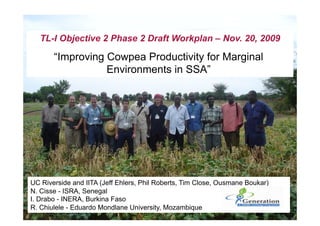
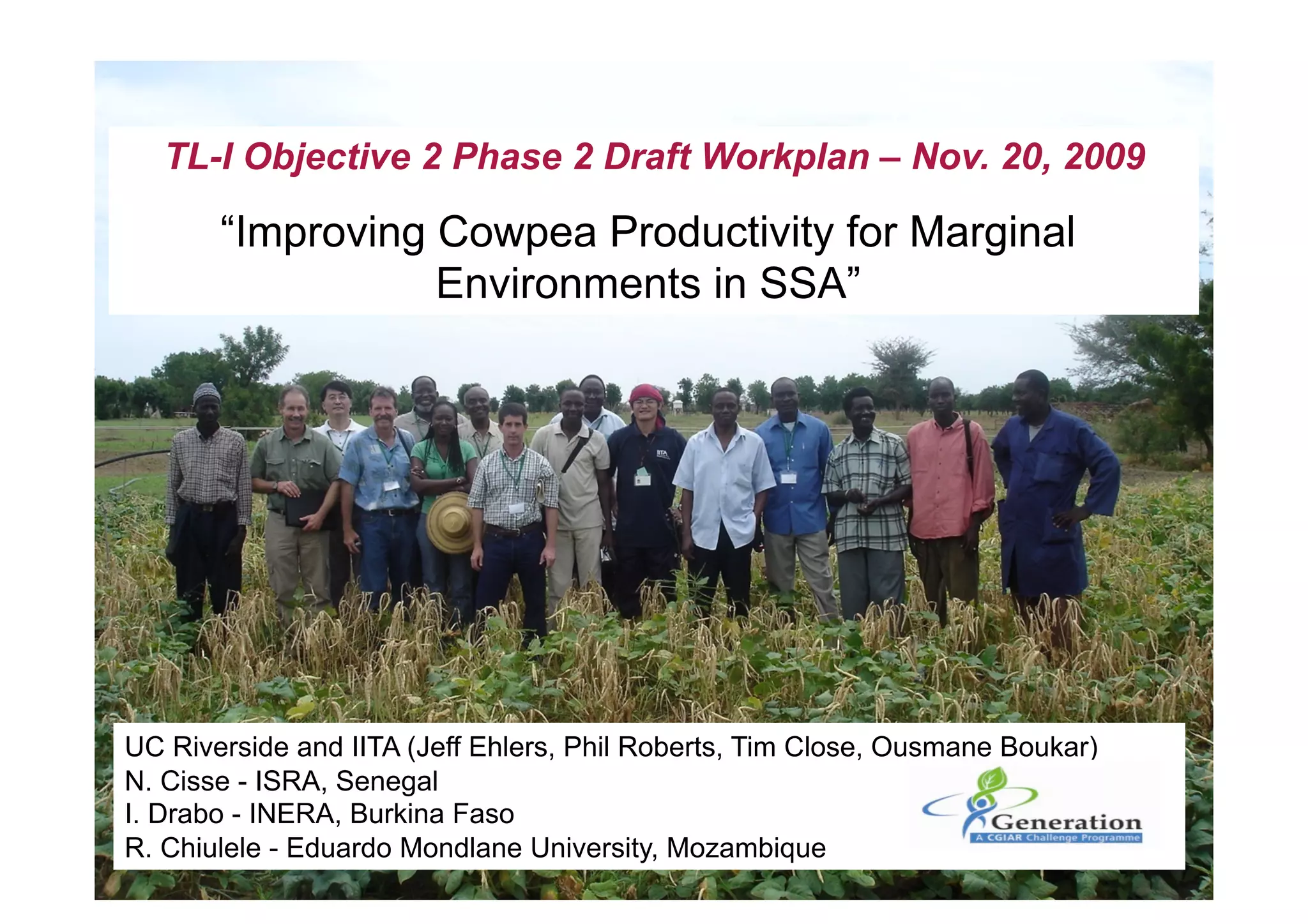
UC Riverside and IITA (Jeff Ehlers, Phil Roberts, Tim Close, Ousmane Boukar)
N. Cisse - ISRA, Senegal
I. Drabo - INERA, Burkina Faso
R. Chiulele - Eduardo Mondlane University, Mozambique
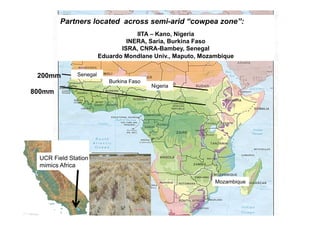
Partners located across semi-arid “cowpea zone”:
                                    IITA – Kano, Nigeria
                                 INERA, Saria, Burkina Faso
                               ISRA, CNRA-Bambey, Senegal
                        Eduardo Mondlane Univ., Maputo, Mozambique


 200mm        Senegal
                           Burkina Faso
                                          Nigeria
800mm


 UCR Field Station
 mimics Africa

                                                            Mozambique
Rationale
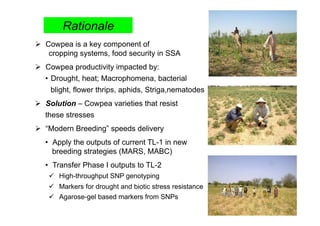
  Cowpea is a key component of
    cropping systems, food security in SSA
  Cowpea productivity impacted by:
   • Drought, heat; Macrophomena, bacterial
     blight, flower thrips, aphids, Striga,nematodes
  Solution – Cowpea varieties that resist
   these stresses
  “Modern Breeding” speeds delivery
   •  Apply the outputs of current TL-1 in new
      breeding strategies (MARS, MABC)
   •  Transfer Phase I outputs to TL-2
      High-throughput SNP genotyping
      Markers for drought and biotic stress resistance
      Agarose-gel based markers from SNPs
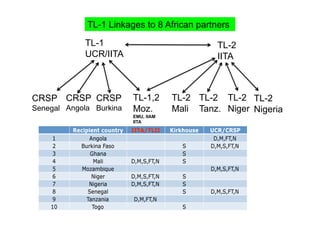
TL-1 Linkages to 8 African partners
             TL-1                             TL-2
             UCR/IITA                         IITA


CRSP CRSP CRSP           TL-1,2      TL-2 TL-2 TL-2 TL-2
Senegal Angola Burkina   Moz.        Mali Tanz. Niger Nigeria
                         EMU, IIAM
                         IITA
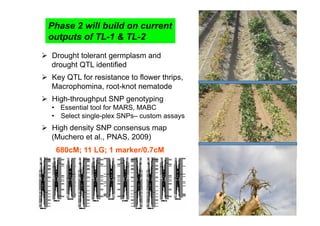
Phase 2 will build on current
  outputs of TL-1 & TL-2

  Drought tolerant germplasm and
   drought QTL identified
  Key QTL for resistance to flower thrips,
   Macrophomina, root-knot nematode
  High-throughput SNP genotyping
   •  Essential tool for MARS, MABC
   •  Select single-plex SNPs– custom assays
  High density SNP consensus map
   (Muchero et al., PNAS, 2009)
    680cM; 11 LG; 1 marker/0.7cM


                                               5 
Activity
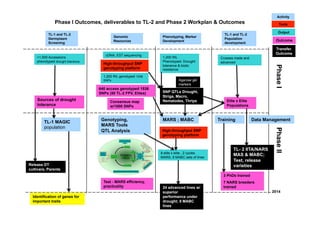
               Phase I Outcomes, deliverables to TL-2 and Phase 2 Workplan & Outcomes                                        Tools

                                                                                                                            Output
           TL-1 and TL-2                                                                        TL-1 and TL-2
                                            Genomic              Phenotyping, Marker
           Germplasm                                                                            Population
                                            Resources            Development                                              Outcome
           Screening                                                                            development
                                                                                                                          Transfer.
                                      cDNA, EST sequencing                                                                Outcome
    >1,500 Accessions                                            1,200 RIL                    Crosses made and
    phenotyped drought tolerance                                 Phenotyped- Drought          advanced
                                     High-throughput SNP
                                                                 tolerance & biotic


                                                                                                                          Phase I
                                     genotyping platform         resistance

                                     1,200 RIL genotyped 1536
                                     SNPs                                 Agarose gel
                                                                          markers
                                   640 access genotyped 1536
                                   SNPs (50 TL-2 FPV, Elites)    SNP QTLs Drought,
                                                                 Striga, Macro,
    Sources of drought                   Consensus map           Nematodes, Thrips               Elite x Elite
    tolerance                            w/1000 SNPs                                             Populations


                                    Genotyping,                  MARS ; MABC                 Training            Data Management
        TL-1 MAGIC
                                    MARS Tools
        population


                                                                                                                          Phase II
                                    QTL Analysis                High-throughput SNP
                                                                genotyping platform


                                                                                                     TL- 2 IITA/NARS
                                                                8 elite x elite , 2 cycles
                                                                                                     MAS & MABC;
                                                                MARS; 8 MABC sets of lines
                                                                                                     Test, release
Release DT                                                                                           varieties
cultivars, Parents
                                                                                               3 PhDs trained
                                     Test - MARS efficiency,                                   7 NARS breeders
                                     practicality                24 advanced lines w/          trained
                                                                 superior                                               2014
  Identification of genes for                                    performance under
  important traits                                               drought; 8 MABC
                                                                 lines                       then
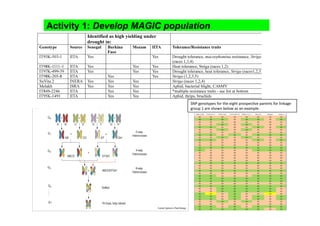
Activity 1: Develop MAGIC population


                               SNP genotypes for the eight prospec3ve parents for linkage 
                               group 1 are shown below as an example.
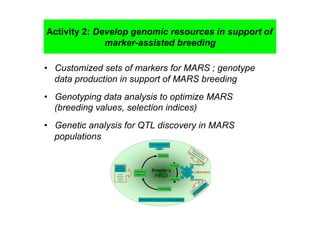
Activity 2: Develop genomic resources in support of
              marker-assisted breeding

•  Customized sets of markers for MARS ; genotype
   data production in support of MARS breeding
•  Genotyping data analysis to optimize MARS
   (breeding values, selection indices)
•  Genetic analysis for QTL discovery in MARS
   populations
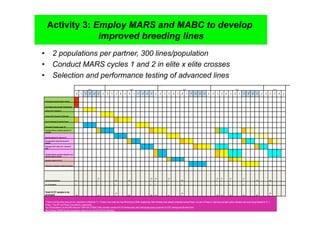
Activity 3: Employ MARS and MABC to develop
               improved breeding lines
•  2 populations per partner, 300 lines/population
•  Conduct MARS cycles 1 and 2 in elite x elite crosses
•  Selection and performance testing of advanced lines
                                                                   2010                                                       2011                                                                         2012                                                                   2013                                                2014
                                                 May


                                                                                                                          May


                                                                                                                                                                                                       May


                                                                                                                                                                                                                                                                                May
                                                                   Aug

                                                                          Sep


                                                                                      Nov

                                                                                            Dec


                                                                                                                                                 Aug

                                                                                                                                                       Sep


                                                                                                                                                                   Nov

                                                                                                                                                                         Dec


                                                                                                                                                                                                                          Aug

                                                                                                                                                                                                                                Sep


                                                                                                                                                                                                                                            Nov

                                                                                                                                                                                                                                                  Dec


                                                                                                                                                                                                                                                                                                  Aug

                                                                                                                                                                                                                                                                                                        Sep


                                                                                                                                                                                                                                                                                                                    Nov

                                                                                                                                                                                                                                                                                                                          Dec
                                                                                                        Feb

                                                                                                              Mar


                                                                                                                                                                                     Feb

                                                                                                                                                                                           Mar


                                                                                                                                                                                                                                                              Feb

                                                                                                                                                                                                                                                                    Mar


                                                                                                                                                                                                                                                                                                                                      Feb

                                                                                                                                                                                                                                                                                                                                             Mar
                                                       Jun


                                                                                                  Jan


                                                                                                                                     Jun


                                                                                                                                                                               Jan


                                                                                                                                                                                                              Jun


                                                                                                                                                                                                                                                        Jan


                                                                                                                                                                                                                                                                                      Jun


                                                                                                                                                                                                                                                                                                                                Jan
                                                                                Oct


                                                                                                                    Apr


                                                                                                                                                             Oct


                                                                                                                                                                                                 Apr


                                                                                                                                                                                                                                      Oct


                                                                                                                                                                                                                                                                          Apr


                                                                                                                                                                                                                                                                                                              Oct


                                                                                                                                                                                                                                                                                                                                                   Apr
                                                             Jul


                                                                                                                                           Jul


                                                                                                                                                                                                                    Jul


                                                                                                                                                                                                                                                                                            Jul
Phenotyping of parents (Phase 1 Output)


Sow Parents, Cross, Harvest F1(greenhouse)

Sowing of 6 F1; Harvest F2


Sowing of 6 F2; Harvest 6 F3 (300 each)


Sow F3; Genotype F3; Harvest F4 seed


Phenotype F4 Families; select 10%

Genotype 5/family, recombine selected 4 F5
(Crosses)


Sow Recombined (F1), Harvest 4 F2

Genotype 400 F2, select 100; harvest F3
selected

Phenotype 100 F3, Select 10% -, Harvest F4
seed


Genotype 5/family, recombine selected F4, also
advance selects to F5-tests

Genotype, advance F5 to F6


Performance evaluation to determine progress


                                                                                10x                                                                          30x   10x               10x                                                                10x   10x         10x               10x
Genotyping Needs/popln                           92                             5                       300               300                                5     5                 2                 400                                              5     5           5                 5                 100               300

No. of Populations                               2                              2                       6                 2                                  6     2                 2                 6                                                6     2           6                 6                 6                 6


Total=10,727 samples to be                                                                              180                                                                                            240                                                                                                                      180
genotyped                                        184                            100                     0                 600                                900   100               40                0                                                300   100         300               300               600               0


**Yellow and Blue filled areas are for populations initiated for TL-1 Phase 2 and under the Top-Off funding in 2009, respectively; Red indicates work already completed during Phase 1 as part of Phase 2; Light blue and light yellow indicates new cycle being initiated for TL-1
Phase 1 ‘Top-Off’ and Phase 2 populations, respectively.
Top-Off populations (SuVita2/Mouride and IT93K-503-1/IT84S-2246) currently consist of 92 F4 families each, with phenotyping being conducted at UCR, Senegal and Burkina Faso.
The 6 Phase 2 MARS founder populations (Table 2) will consist of 300 F3:4 families.
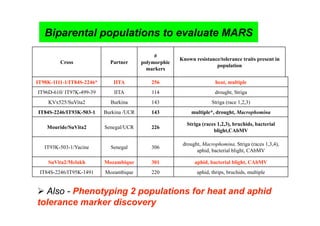
Biparental populations to evaluate MARS

                                               #
                                                        Known resistance/tolerance traits present in
         Cross               Partner      polymorphic
                                                                       population
                                            markers

IT98K-1111-1/IT84S-2246*      IITA           256                        heat, multiple
IT96D-610/ IT97K-499-39        IITA           114                       drought, Striga
    KVx525/SuVita2           Burkina         143                      Striga (race 1,2,3)
IT84S-2246/IT93K-503-1     Burkina /UCR      143             multiple*, drought, Macrophomina

                                                           Striga (races 1,2,3), bruchids, bacterial
    Mouride/SuVita2        Senegal/UCR       226
                                                                       blight,CAbMV

                                                         drought, Macrophomina, Striga (races 1,3,4),
   IT93K-503-1/Yacine        Senegal         306
                                                               aphid, bacterial blight, CAbMV

    SuVita2/Melakh         Mozambique        301              aphid, bacterial blight, CAbMV
 IT84S-2246/IT95K-1491     Mozambique        220               aphid, thrips, bruchids, multiple


 Also - Phenotyping 2 populations for heat and aphid
tolerance marker discovery
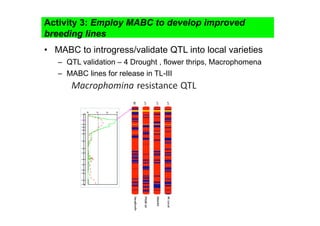
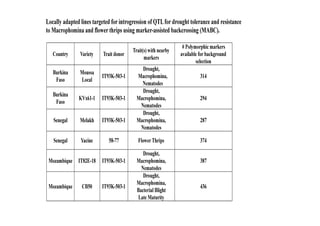
Activity 3: Employ MABC to develop improved
breeding lines
•  MABC to introgress/validate QTL into local varieties
   –  QTL validation – 4 Drought , flower thrips, Macrophomena
   –  MABC lines for release in TL-III
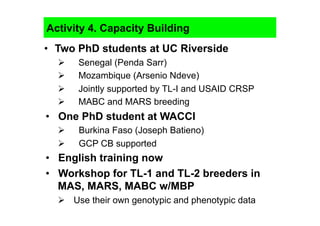
Activity 4. Capacity Building
•  Two PhD students at UC Riverside
      Senegal (Penda Sarr)
      Mozambique (Arsenio Ndeve)
      Jointly supported by TL-I and USAID CRSP
      MABC and MARS breeding
•  One PhD student at WACCI
      Burkina Faso (Joseph Batieno)
      GCP CB supported
•  English training now
•  Workshop for TL-1 and TL-2 breeders in
   MAS, MARS, MABC w/MBP
    Use their own genotypic and phenotypic data
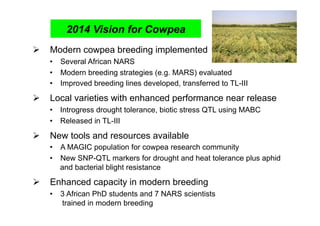
2014 Vision for Cowpea
  Modern cowpea breeding implemented
   •  Several African NARS
   •  Modern breeding strategies (e.g. MARS) evaluated
   •  Improved breeding lines developed, transferred to TL-III

  Local varieties with enhanced performance near release
   •  Introgress drought tolerance, biotic stress QTL using MABC
   •  Released in TL-III

  New tools and resources available
   •  A MAGIC population for cowpea research community
   •  New SNP-QTL markers for drought and heat tolerance plus aphid
      and bacterial blight resistance

  Enhanced capacity in modern breeding
   •  3 African PhD students and 7 NARS scientists
      trained in modern breeding
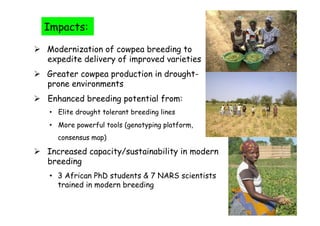
Impacts:

  Modernization of cowpea breeding to
   expedite delivery of improved varieties
  Greater cowpea production in drought-
   prone environments
  Enhanced breeding potential from:
   •  Elite drought tolerant breeding lines
   •  More powerful tools (genotyping platform,
      consensus map)

  Increased capacity/sustainability in modern
   breeding
   •  3 African PhD students & 7 NARS scientists
      trained in modern breeding
Thank You
Phase II Outputs for MBP:

  MAGIC population available for gene discovery

  Genotypic and phenotypic data from 2 cycles of MARS

  300 additional RIL genotyped, even better map

Outputs for TL-III

  Validated markers for Drought Tolerance, Macrophomena,
   Bacterial Blight, Flower Thrips & Striga resistance

  More SNP markers for drought from elite x elite analysis

  New markers for heat tolerance, aphid resistance

  1,000 SNPs validated for use in flexible genotyping platforms

  8 ‘improved local’ candidate varieties from MABC

  24 advanced breeding lines from MARS

40 Jeff Ehlers Tli Objective2 Phase Ii Work Plan

  • 1.
    TL-I Objective 2Phase 2 Draft Workplan – Nov. 20, 2009 “Improving Cowpea Productivity for Marginal Environments in SSA” UC Riverside and IITA (Jeff Ehlers, Phil Roberts, Tim Close, Ousmane Boukar) N. Cisse - ISRA, Senegal I. Drabo - INERA, Burkina Faso R. Chiulele - Eduardo Mondlane University, Mozambique
  • 2.
    Partners located acrosssemi-arid “cowpea zone”: IITA – Kano, Nigeria INERA, Saria, Burkina Faso ISRA, CNRA-Bambey, Senegal Eduardo Mondlane Univ., Maputo, Mozambique 200mm Senegal Burkina Faso Nigeria 800mm UCR Field Station mimics Africa Mozambique
  • 3.
    Rationale   Cowpea isa key component of cropping systems, food security in SSA   Cowpea productivity impacted by: • Drought, heat; Macrophomena, bacterial blight, flower thrips, aphids, Striga,nematodes   Solution – Cowpea varieties that resist these stresses   “Modern Breeding” speeds delivery •  Apply the outputs of current TL-1 in new breeding strategies (MARS, MABC) •  Transfer Phase I outputs to TL-2   High-throughput SNP genotyping   Markers for drought and biotic stress resistance   Agarose-gel based markers from SNPs
  • 4.
    TL-1 Linkages to8 African partners TL-1 TL-2 UCR/IITA IITA CRSP CRSP CRSP TL-1,2 TL-2 TL-2 TL-2 TL-2 Senegal Angola Burkina Moz. Mali Tanz. Niger Nigeria EMU, IIAM IITA
  • 5.
    Phase 2 willbuild on current outputs of TL-1 & TL-2   Drought tolerant germplasm and drought QTL identified   Key QTL for resistance to flower thrips, Macrophomina, root-knot nematode   High-throughput SNP genotyping •  Essential tool for MARS, MABC •  Select single-plex SNPs– custom assays   High density SNP consensus map (Muchero et al., PNAS, 2009) 680cM; 11 LG; 1 marker/0.7cM 5 
  • 6.
    Activity Phase I Outcomes, deliverables to TL-2 and Phase 2 Workplan & Outcomes Tools Output TL-1 and TL-2 TL-1 and TL-2 Genomic Phenotyping, Marker Germplasm Population Resources Development Outcome Screening development Transfer. cDNA, EST sequencing Outcome >1,500 Accessions 1,200 RIL Crosses made and phenotyped drought tolerance Phenotyped- Drought advanced High-throughput SNP tolerance & biotic Phase I genotyping platform resistance 1,200 RIL genotyped 1536 SNPs Agarose gel markers 640 access genotyped 1536 SNPs (50 TL-2 FPV, Elites) SNP QTLs Drought, Striga, Macro, Sources of drought Consensus map Nematodes, Thrips Elite x Elite tolerance w/1000 SNPs Populations Genotyping, MARS ; MABC Training Data Management TL-1 MAGIC MARS Tools population Phase II QTL Analysis High-throughput SNP genotyping platform TL- 2 IITA/NARS 8 elite x elite , 2 cycles MAS & MABC; MARS; 8 MABC sets of lines Test, release Release DT varieties cultivars, Parents 3 PhDs trained Test - MARS efficiency, 7 NARS breeders practicality 24 advanced lines w/ trained superior 2014 Identification of genes for performance under important traits drought; 8 MABC lines then
  • 7.
    Activity 1: DevelopMAGIC population SNP genotypes for the eight prospec3ve parents for linkage  group 1 are shown below as an example.
  • 8.
    Activity 2: Developgenomic resources in support of marker-assisted breeding •  Customized sets of markers for MARS ; genotype data production in support of MARS breeding •  Genotyping data analysis to optimize MARS (breeding values, selection indices) •  Genetic analysis for QTL discovery in MARS populations
  • 9.
    Activity 3: EmployMARS and MABC to develop improved breeding lines •  2 populations per partner, 300 lines/population •  Conduct MARS cycles 1 and 2 in elite x elite crosses •  Selection and performance testing of advanced lines 2010 2011 2012 2013 2014 May May May May Aug Sep Nov Dec Aug Sep Nov Dec Aug Sep Nov Dec Aug Sep Nov Dec Feb Mar Feb Mar Feb Mar Feb Mar Jun Jan Jun Jan Jun Jan Jun Jan Oct Apr Oct Apr Oct Apr Oct Apr Jul Jul Jul Jul Phenotyping of parents (Phase 1 Output) Sow Parents, Cross, Harvest F1(greenhouse) Sowing of 6 F1; Harvest F2 Sowing of 6 F2; Harvest 6 F3 (300 each) Sow F3; Genotype F3; Harvest F4 seed Phenotype F4 Families; select 10% Genotype 5/family, recombine selected 4 F5 (Crosses) Sow Recombined (F1), Harvest 4 F2 Genotype 400 F2, select 100; harvest F3 selected Phenotype 100 F3, Select 10% -, Harvest F4 seed Genotype 5/family, recombine selected F4, also advance selects to F5-tests Genotype, advance F5 to F6 Performance evaluation to determine progress 10x 30x 10x 10x 10x 10x 10x 10x Genotyping Needs/popln 92 5 300 300 5 5 2 400 5 5 5 5 100 300 No. of Populations 2 2 6 2 6 2 2 6 6 2 6 6 6 6 Total=10,727 samples to be 180 240 180 genotyped 184 100 0 600 900 100 40 0 300 100 300 300 600 0 **Yellow and Blue filled areas are for populations initiated for TL-1 Phase 2 and under the Top-Off funding in 2009, respectively; Red indicates work already completed during Phase 1 as part of Phase 2; Light blue and light yellow indicates new cycle being initiated for TL-1 Phase 1 ‘Top-Off’ and Phase 2 populations, respectively. Top-Off populations (SuVita2/Mouride and IT93K-503-1/IT84S-2246) currently consist of 92 F4 families each, with phenotyping being conducted at UCR, Senegal and Burkina Faso. The 6 Phase 2 MARS founder populations (Table 2) will consist of 300 F3:4 families.
  • 10.
    Biparental populations toevaluate MARS # Known resistance/tolerance traits present in Cross Partner polymorphic population markers IT98K-1111-1/IT84S-2246* IITA 256 heat, multiple IT96D-610/ IT97K-499-39 IITA 114 drought, Striga KVx525/SuVita2 Burkina 143 Striga (race 1,2,3) IT84S-2246/IT93K-503-1 Burkina /UCR 143 multiple*, drought, Macrophomina Striga (races 1,2,3), bruchids, bacterial Mouride/SuVita2 Senegal/UCR 226 blight,CAbMV drought, Macrophomina, Striga (races 1,3,4), IT93K-503-1/Yacine Senegal 306 aphid, bacterial blight, CAbMV SuVita2/Melakh Mozambique 301 aphid, bacterial blight, CAbMV IT84S-2246/IT95K-1491 Mozambique 220 aphid, thrips, bruchids, multiple  Also - Phenotyping 2 populations for heat and aphid tolerance marker discovery
  • 11.
    Activity 3: EmployMABC to develop improved breeding lines •  MABC to introgress/validate QTL into local varieties –  QTL validation – 4 Drought , flower thrips, Macrophomena –  MABC lines for release in TL-III
  • 13.
    Activity 4. CapacityBuilding •  Two PhD students at UC Riverside   Senegal (Penda Sarr)   Mozambique (Arsenio Ndeve)   Jointly supported by TL-I and USAID CRSP   MABC and MARS breeding •  One PhD student at WACCI   Burkina Faso (Joseph Batieno)   GCP CB supported •  English training now •  Workshop for TL-1 and TL-2 breeders in MAS, MARS, MABC w/MBP   Use their own genotypic and phenotypic data
  • 14.
    2014 Vision forCowpea   Modern cowpea breeding implemented •  Several African NARS •  Modern breeding strategies (e.g. MARS) evaluated •  Improved breeding lines developed, transferred to TL-III   Local varieties with enhanced performance near release •  Introgress drought tolerance, biotic stress QTL using MABC •  Released in TL-III   New tools and resources available •  A MAGIC population for cowpea research community •  New SNP-QTL markers for drought and heat tolerance plus aphid and bacterial blight resistance   Enhanced capacity in modern breeding •  3 African PhD students and 7 NARS scientists trained in modern breeding
  • 15.
    Impacts:   Modernization ofcowpea breeding to expedite delivery of improved varieties   Greater cowpea production in drought- prone environments   Enhanced breeding potential from: •  Elite drought tolerant breeding lines •  More powerful tools (genotyping platform, consensus map)   Increased capacity/sustainability in modern breeding •  3 African PhD students & 7 NARS scientists trained in modern breeding
  • 16.
  • 17.
    Phase II Outputsfor MBP:   MAGIC population available for gene discovery   Genotypic and phenotypic data from 2 cycles of MARS   300 additional RIL genotyped, even better map Outputs for TL-III   Validated markers for Drought Tolerance, Macrophomena, Bacterial Blight, Flower Thrips & Striga resistance   More SNP markers for drought from elite x elite analysis   New markers for heat tolerance, aphid resistance   1,000 SNPs validated for use in flexible genotyping platforms   8 ‘improved local’ candidate varieties from MABC   24 advanced breeding lines from MARS