Example

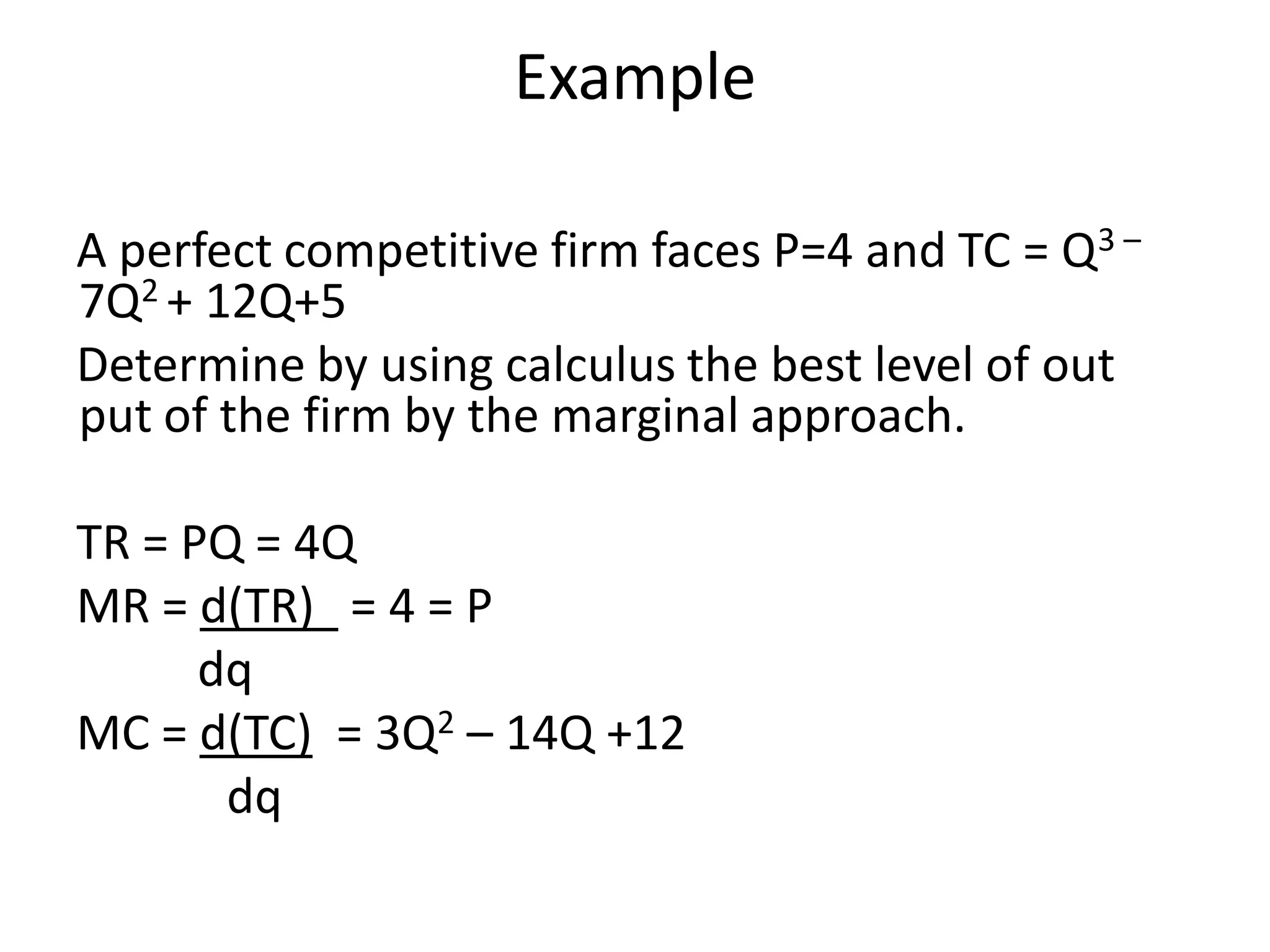
A perfect competitive firm faces P=4 and TC = Q3 –
7Q2 + 12Q+5
Determine by using calculus the best level of out
put of the firm by the marginal approach.

TR = PQ = 4Q
MR = d(TR) = 4 = P
      dq
MC = d(TC) = 3Q2 – 14Q +12
       dq
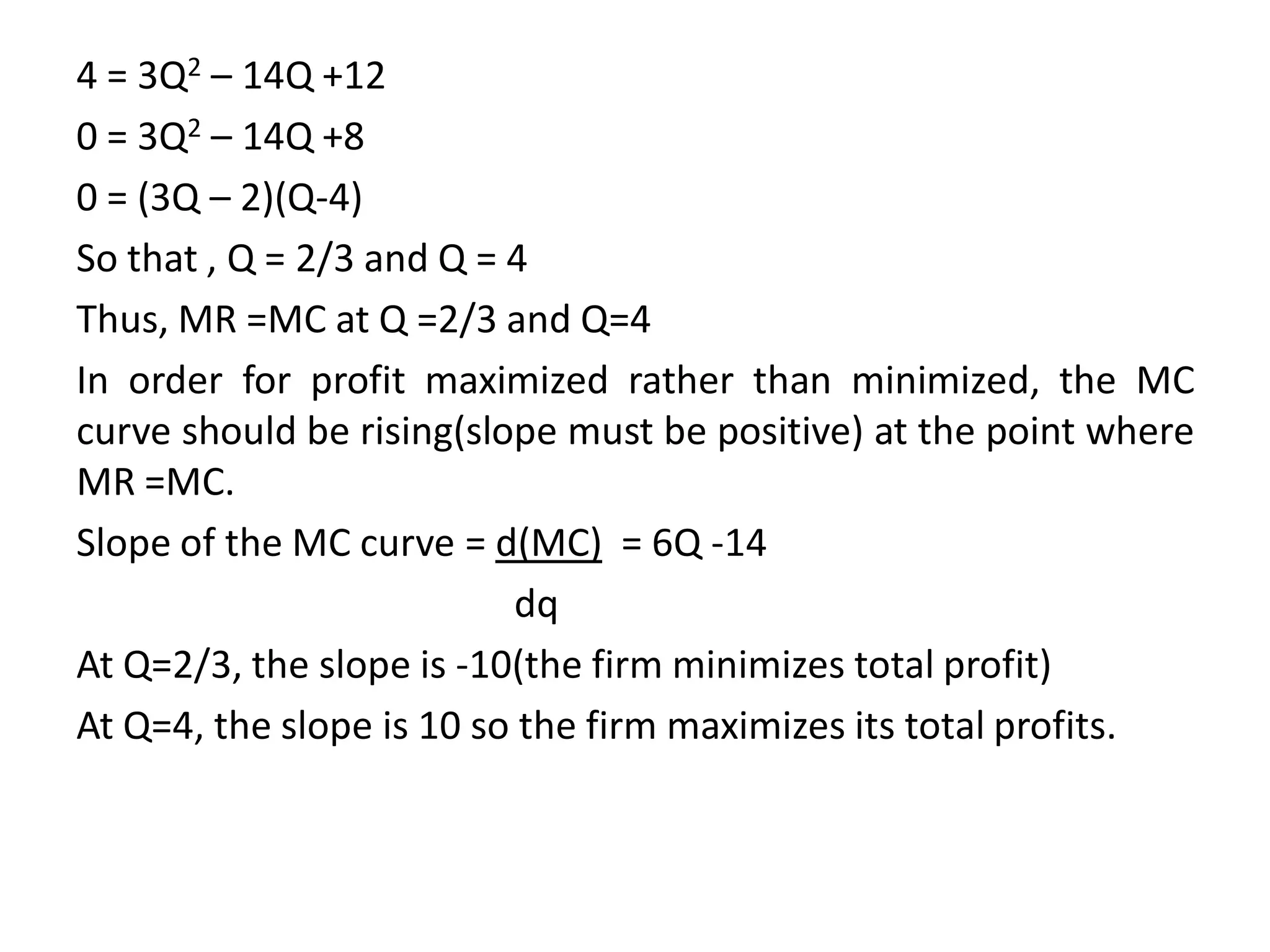
4 = 3Q2 – 14Q +12
0 = 3Q2 – 14Q +8
0 = (3Q – 2)(Q-4)
So that , Q = 2/3 and Q = 4
Thus, MR =MC at Q =2/3 and Q=4
In order for profit maximized rather than minimized, the MC
curve should be rising(slope must be positive) at the point where
MR =MC.
Slope of the MC curve = d(MC) = 6Q -14
                           dq
At Q=2/3, the slope is -10(the firm minimizes total profit)
At Q=4, the slope is 10 so the firm maximizes its total profits.
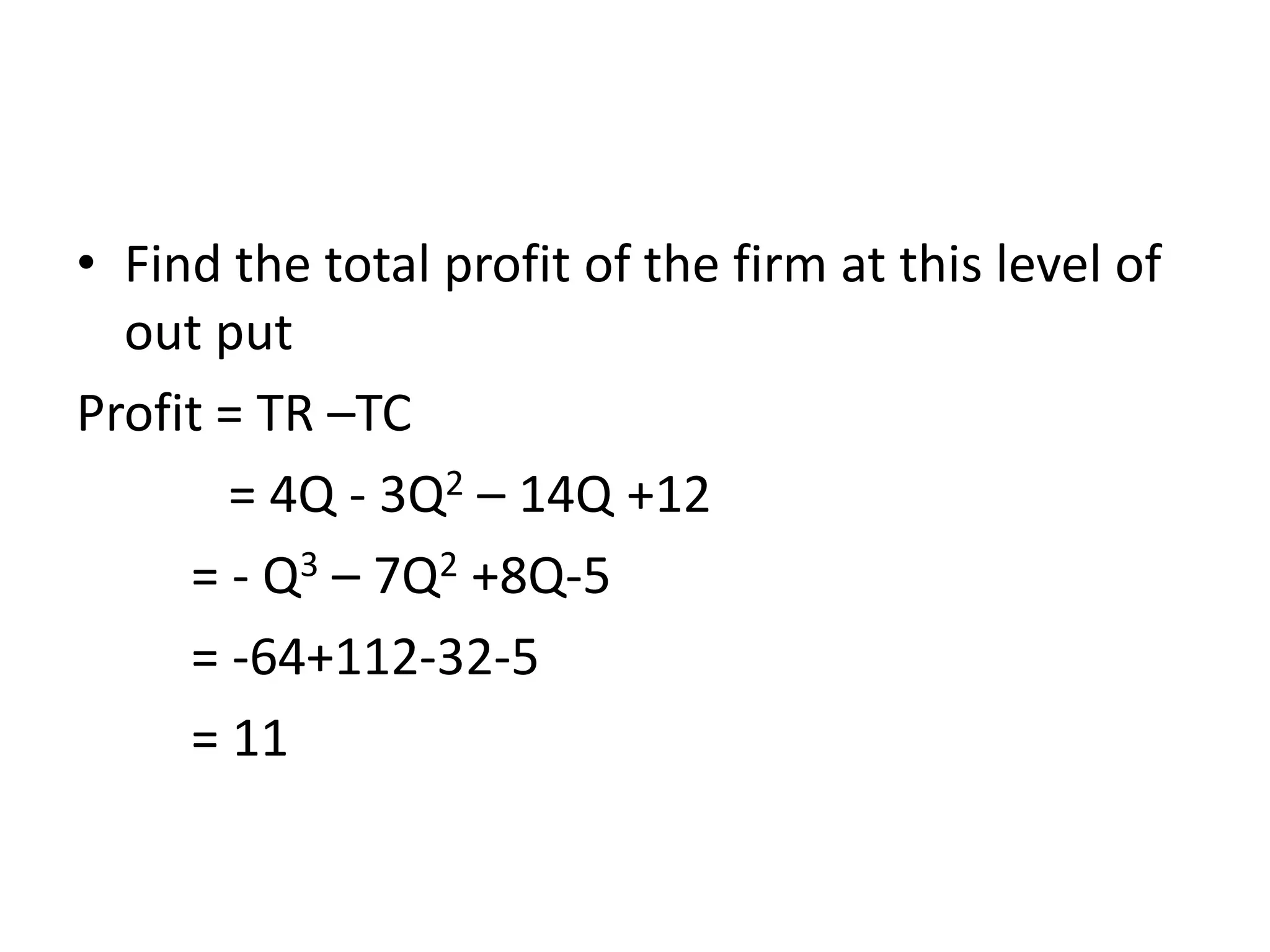
• Find the total profit of the firm at this level of
  out put
Profit = TR –TC
       = 4Q - 3Q2 – 14Q +12
     = - Q3 – 7Q2 +8Q-5
     = -64+112-32-5
     = 11

Example (2)

  • 1.
    Example A perfect competitivefirm faces P=4 and TC = Q3 – 7Q2 + 12Q+5 Determine by using calculus the best level of out put of the firm by the marginal approach. TR = PQ = 4Q MR = d(TR) = 4 = P dq MC = d(TC) = 3Q2 – 14Q +12 dq
  • 2.
    4 = 3Q2– 14Q +12 0 = 3Q2 – 14Q +8 0 = (3Q – 2)(Q-4) So that , Q = 2/3 and Q = 4 Thus, MR =MC at Q =2/3 and Q=4 In order for profit maximized rather than minimized, the MC curve should be rising(slope must be positive) at the point where MR =MC. Slope of the MC curve = d(MC) = 6Q -14 dq At Q=2/3, the slope is -10(the firm minimizes total profit) At Q=4, the slope is 10 so the firm maximizes its total profits.
  • 3.
    • Find thetotal profit of the firm at this level of out put Profit = TR –TC = 4Q - 3Q2 – 14Q +12 = - Q3 – 7Q2 +8Q-5 = -64+112-32-5 = 11